light TOYOTA AURIS HYBRID 2012 Repair Manual
[x] Cancel search | Manufacturer: TOYOTA, Model Year: 2012, Model line: AURIS HYBRID, Model: TOYOTA AURIS HYBRID 2012Pages: 524, PDF Size: 26.34 MB
Page 216 of 524
216 2-3. Operating the lights and wipers
UK_AURIS_HV_EE
NOTICE
When the windshield is dry
Do not use the wipers, as they may damage the windshield.
When the washer fluid tank is empty
Do not operate the switch continually as the washer fluid pump may over-
heat.
When a nozzle becomes blocked
In this case, contact any authorized Toyota dealer or repairer, or another
duly qualified and equipped professional immediately.
Do not try to clear it with a pin or other object. The nozzle will be damaged.
Page 217 of 524
217
2-3. Operating the lights and wipers
2
When driving
UK_AURIS_HV_EE
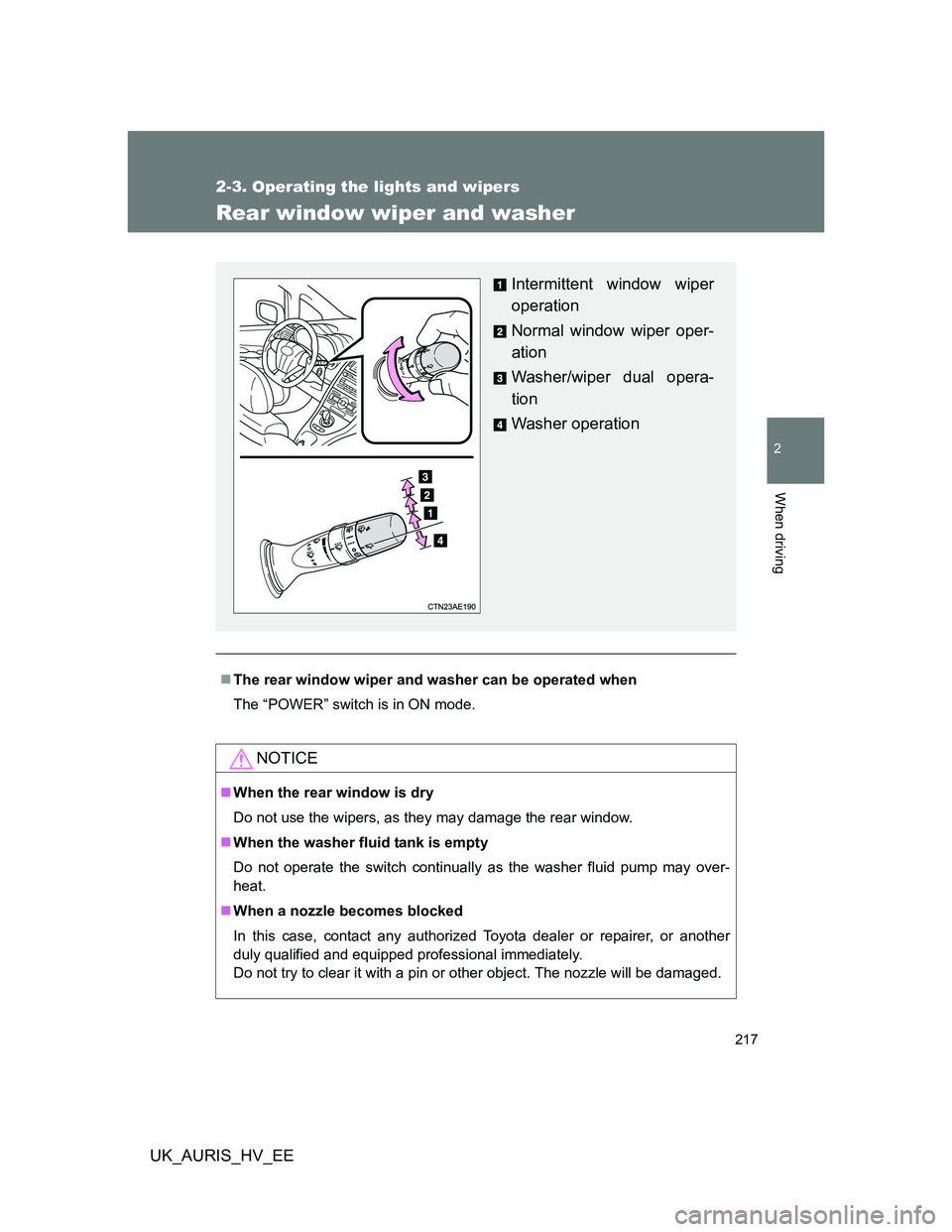
Rear window wiper and washer
The rear window wiper and washer can be operated when
The “POWER” switch is in ON mode.
NOTICE
When the rear window is dry
Do not use the wipers, as they may damage the rear window.
When the washer fluid tank is empty
Do not operate the switch continually as the washer fluid pump may over-
heat.
When a nozzle becomes blocked
In this case, contact any authorized Toyota dealer or repairer, or another
duly qualified and equipped professional immediately.
Do not try to clear it with a pin or other object. The nozzle will be damaged.
Intermittent window wiper
operation
Normal window wiper oper-
ation
Washer/wiper dual opera-
tion
Washer operation
Page 218 of 524
218
2-3. Operating the lights and wipers
UK_AURIS_HV_EE
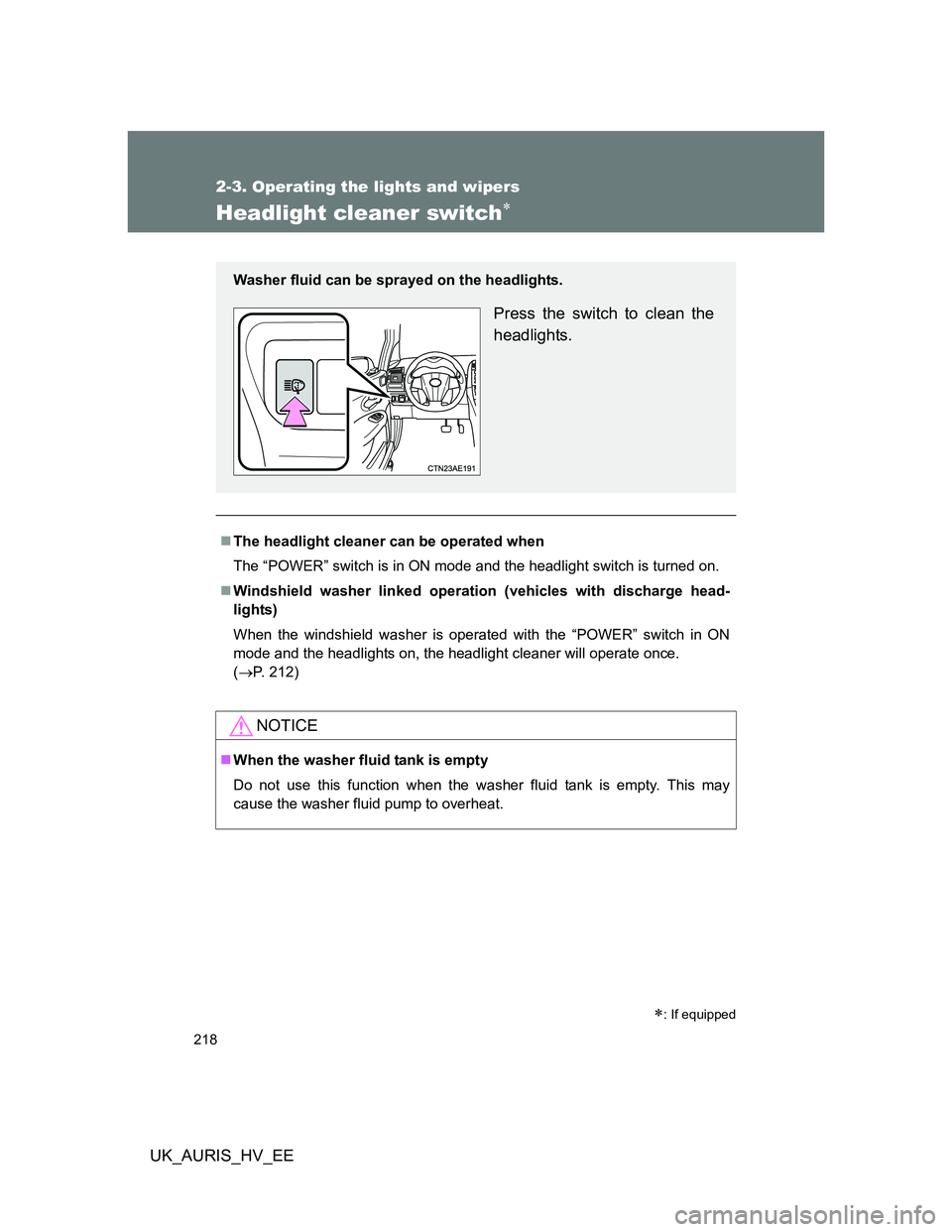
Headlight cleaner switch
The headlight cleaner can be operated when
The “POWER” switch is in ON mode and the headlight switch is turned on.
Windshield washer linked operation (vehicles with discharge head-
lights)
When the windshield washer is operated with the “POWER” switch in ON
mode and the headlights on, the headlight cleaner will operate once.
(P. 212)
NOTICE
When the washer fluid tank is empty
Do not use this function when the washer fluid tank is empty. This may
cause the washer fluid pump to overheat.
: If equipped
Washer fluid can be sprayed on the headlights.
Press the switch to clean the
headlights.
Page 220 of 524
220 2-4. Using other driving systems
UK_AURIS_HV_EE
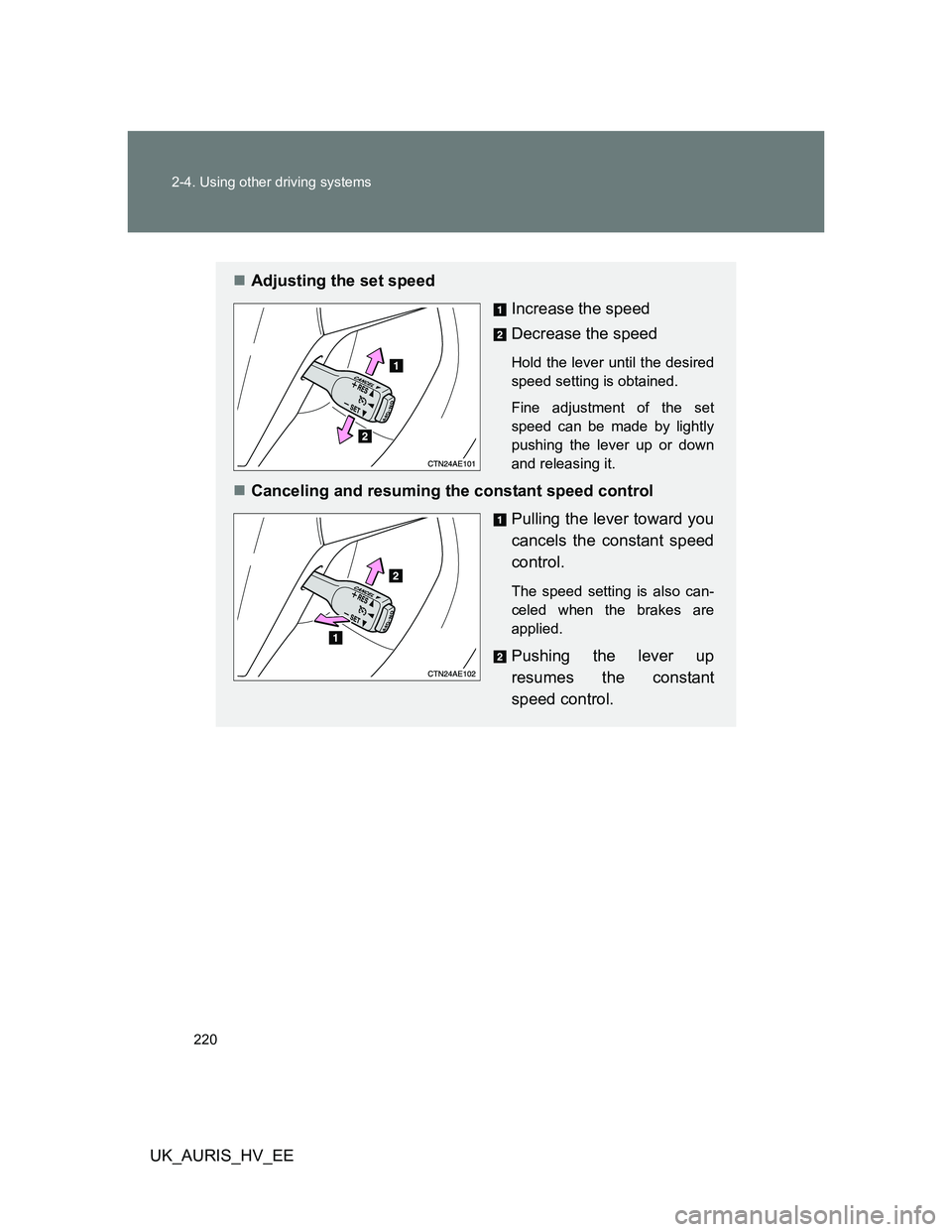
Adjusting the set speed
Increase the speed
Decrease the speed
Hold the lever until the desired
speed setting is obtained.
Fine adjustment of the set
speed can be made by lightly
pushing the lever up or down
and releasing it.
Canceling and resuming the constant speed control
Pulling the lever toward you
cancels the constant speed
control.
The speed setting is also can-
celed when the brakes are
applied.
Pushing the lever up
resumes the constant
speed control.
Page 221 of 524
221 2-4. Using other driving systems
2
When driving
UK_AURIS_HV_EE
Cruise control can be set when
The shift position is in D.
Vehicle speed is above approximately 40 km/h (25 mph).
Accelerating
The vehicle can be accelerated normally. After acceleration, the set speed
resumes.
Automatic cruise control cancellation
Cruise control will stop maintaining the vehicle speed in any of the following
situations.
Actual vehicle speed falls more than approximately 16 km/h (10 mph)
below the preset vehicle speed.
At this time, the memorized set speed is not retained.
Actual vehicle speed is below approximately 40 km/h (25 mph).
VSC is activated.
If the cruise control indicator light flashes
Press the “ON-OFF” button once to deactivate the system, and then press
the button again to reactivate the system.
If the cruise control speed cannot be set or if the cruise control cancels
immediately after being activated, there may be a malfunction in the cruise
control system. Contact any authorized Toyota dealer or repairer, or another
duly qualified and equipped professional, and have the vehicle inspected by
your Toyota dealer.
Page 223 of 524
223
2-4. Using other driving systems
2
When driving
UK_AURIS_HV_EE
Toyota parking assist-sensor
: If equipped
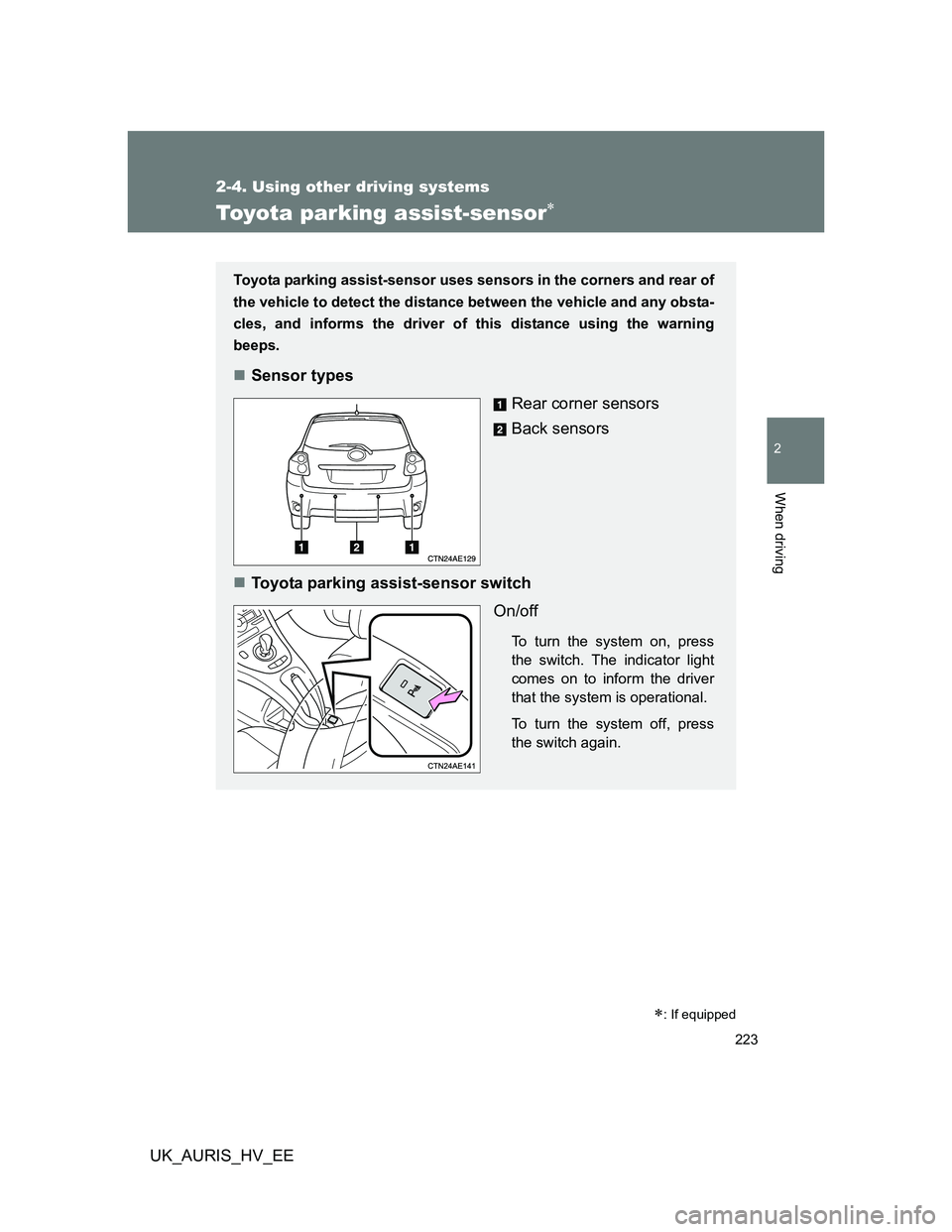
Toyota parking assist-sensor uses sensors in the corners and rear of
the vehicle to detect the distance between the vehicle and any obsta-
cles, and informs the driver of this distance using the warning
beeps.
Sensor types
Rear corner sensors
Back sensors
Toyota parking assist-sensor switch
On/off
To turn the system on, press
the switch. The indicator light
comes on to inform the driver
that the system is operational.
To turn the system off, press
the switch again.
Page 226 of 524
226 2-4. Using other driving systems
UK_AURIS_HV_EE
Sensor detection information
Certain vehicle conditions and the surrounding environment may affect
the ability of the sensor to correctly detect obstacles. Particular instances
where this may occur are listed below.
• There is dirt, snow or ice on the sensor. (Wiping the sensor will resolve
this problem.)
• The sensor is frozen. (Thawing the sensor will resolve this problem.)
• The sensor is covered in any way.
• In harsh sunlight or intense cold weather.
• When driving bumpy, sloped or gravel roads, or over grass.
• If there is something producing ultrasonic waves nearby, such as
another vehicle’s horn, motorcycle engine noise, air braking sound
from heavy-duty vehicles, or another vehicle using the park assist sys-
tem.
• In heavy rain, or if water is splashed on the sensors.
• The vehicle is leaning considerably to one side.
• If a commercial fender pole or radio antenna is installed.
• If moving towards a high curb or a curb corner.
• If towing eyelet is installed on your vehicle.
• The bumper or sensor receives a strong impact.
• A non-genuine Toyota suspension (lowered suspension etc.) is
installed.
In addition to the examples above, there are instances in which, because of
their shapes, signs and other objects may be judged by the sensors to be
closer than they are.
The shape of the obstacle may prevent the sensor from detecting it. Pay
particular attention to the following obstacles.
• Thin objects such as wire, fencing or rope.
• Objects that absorb sound waves, such as cotton or snow.
• Objects with sharp corners.
• Low objects.
• Objects where the upper section projects out over the lower section.
Page 229 of 524
229 2-4. Using other driving systems
2
When driving
UK_AURIS_HV_EE
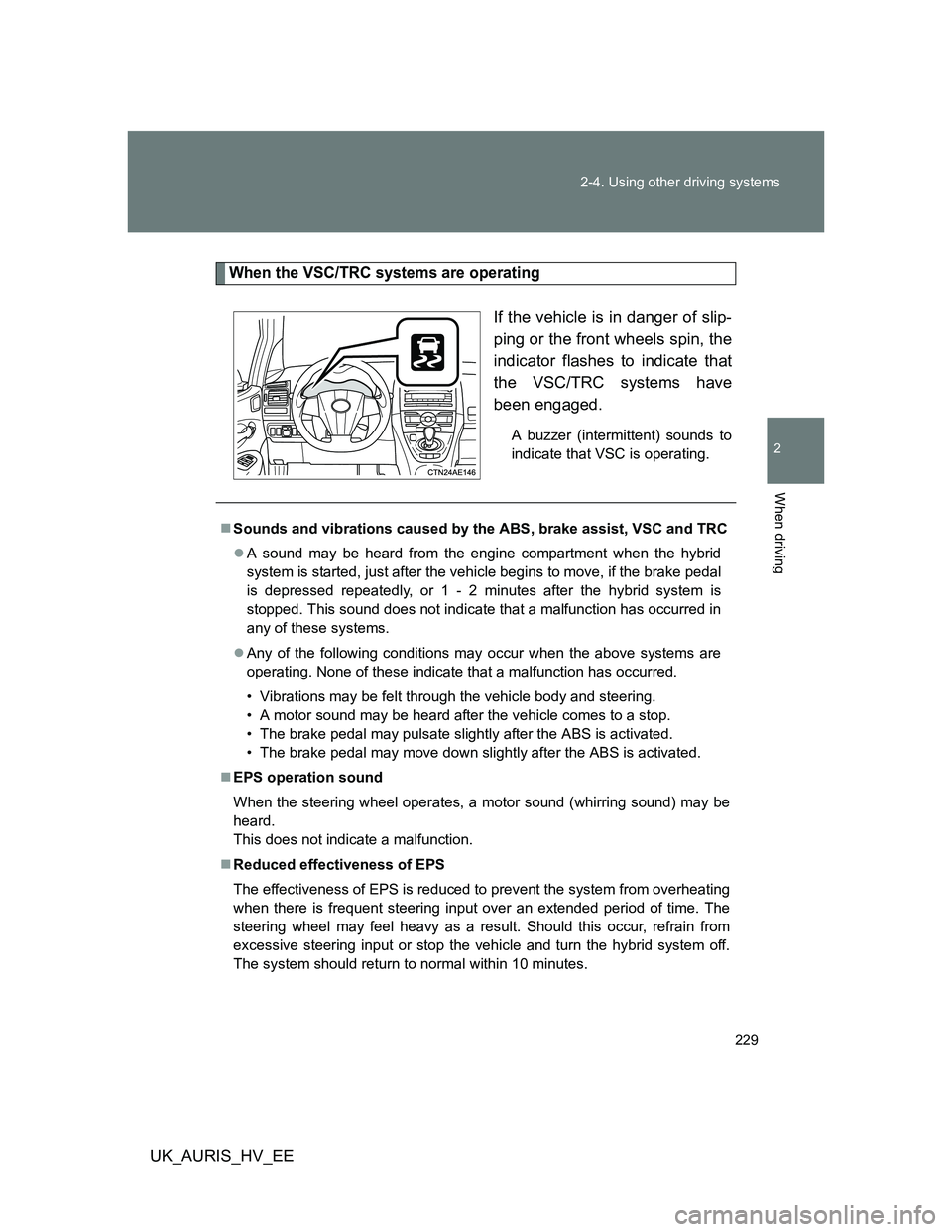
When the VSC/TRC systems are operating
If the vehicle is in danger of slip-
ping or the front wheels spin, the
indicator flashes to indicate that
the VSC/TRC systems have
been engaged.
A buzzer (intermittent) sounds to
indicate that VSC is operating.
Sounds and vibrations caused by the ABS, brake assist, VSC and TRC
A sound may be heard from the engine compartment when the hybrid
system is started, just after the vehicle begins to move, if the brake pedal
is depressed repeatedly, or 1 - 2 minutes after the hybrid system is
stopped. This sound does not indicate that a malfunction has occurred in
any of these systems.
Any of the following conditions may occur when the above systems are
operating. None of these indicate that a malfunction has occurred.
• Vibrations may be felt through the vehicle body and steering.
• A motor sound may be heard after the vehicle comes to a stop.
• The brake pedal may pulsate slightly after the ABS is activated.
• The brake pedal may move down slightly after the ABS is activated.
EPS operation sound
When the steering wheel operates, a motor sound (whirring sound) may be
heard.
This does not indicate a malfunction.
Reduced effectiveness of EPS
The effectiveness of EPS is reduced to prevent the system from overheating
when there is frequent steering input over an extended period of time. The
steering wheel may feel heavy as a result. Should this occur, refrain from
excessive steering input or stop the vehicle and turn the hybrid system off.
The system should return to normal within 10 minutes.
Page 230 of 524
230 2-4. Using other driving systems
UK_AURIS_HV_EE
CAUTION
The ABS does not operate effectively when
The limit of tire gripping have been exceeded.
The vehicle hydroplanes while driving at high speed on the wet or slick
road.
Stopping distance when the ABS is operating may exceed that of nor-
mal conditions
The ABS is not designed to shorten the vehicle's stopping distance. Always
maintain a safe distance from the vehicle in front of you in the following situ-
ations.
When driving on dirt, gravel or snow-covered roads
When driving with tire chains
When driving over bumps in the road
When driving over roads with potholes or roads with uneven pavement
TRC may not operate effectively when
Directional control and power may not be achievable while driving on slip-
pery road surfaces, even if the TRC is operating.
Do not drive the vehicle in conditions where stability and power may be lost.
When the VSC is activated
The slip indicator light flashes and a warning buzzer sounds. Always drive
carefully. Reckless driving may cause an accident. Exercise particular care
when the indicator light flashes and a buzzer sounds.
Page 232 of 524
232
2-4. Using other driving systems
UK_AURIS_HV_EE
Hill-start assist control
Hill-start assist control operating conditions
The system operates in the following situations:
• The shift position is other than P.
• The parking brake is not applied.
• The accelerator pedal is not depressed.
Hill-start assist control
While hill-start assist control is operating, the brakes remain automati-
cally applied after the driver releases the brake pedal. The stop lights and
the high mounted stoplight turn on.
Hill-start assist control operates for about 2 seconds after the brake pedal
is released.
If the slip indicator does not flash and the buzzer does not sound when
the brake pedal is further depressed, slightly reduce the pressure on the
brake pedal (do not allow the vehicle to roll backward) and then firmly
depress it again. If the system still does not operate, check that the oper-
ating conditions explained above have been met.
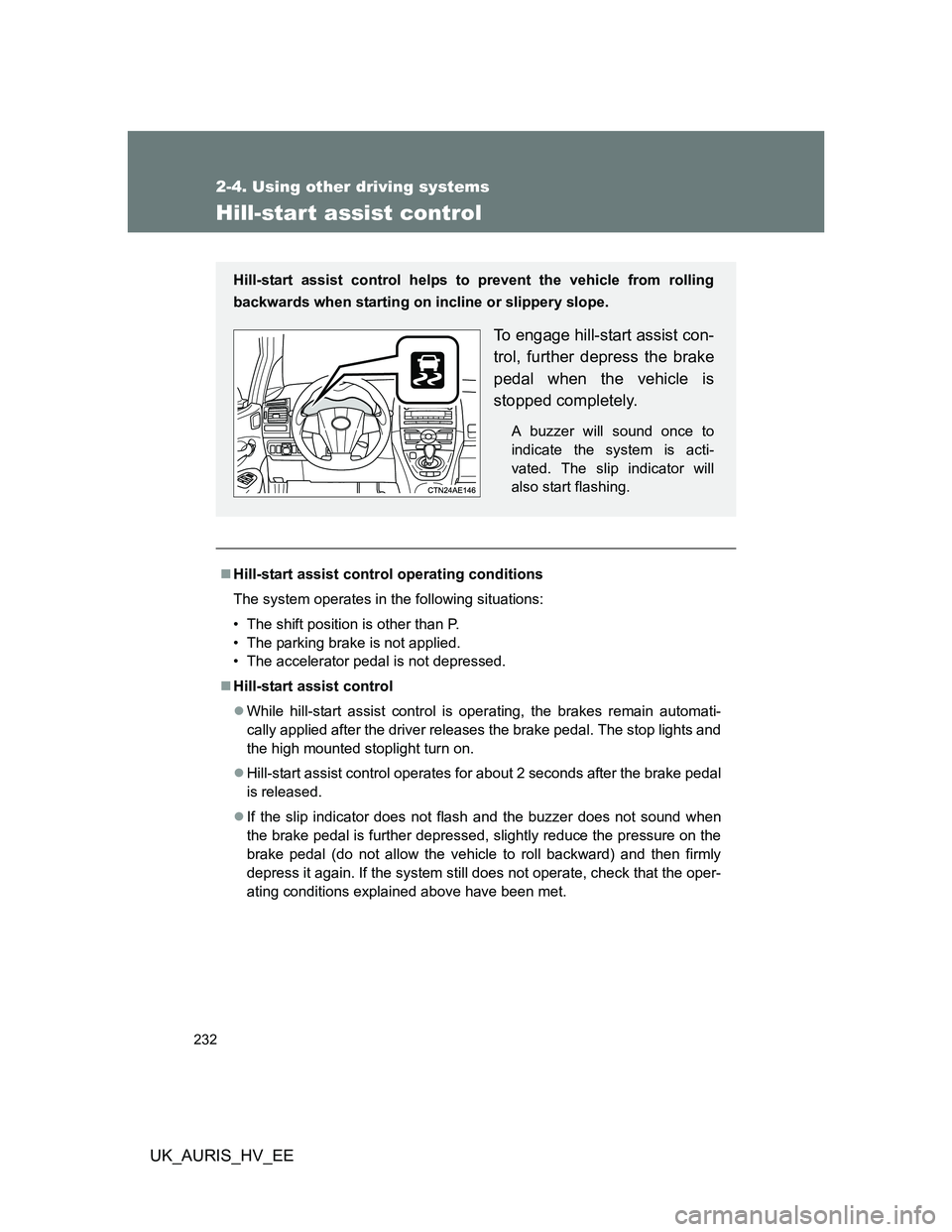
Hill-start assist control helps to prevent the vehicle from rolling
backwards when starting on incline or slippery slope.
To engage hill-start assist con-
trol, further depress the brake
pedal when the vehicle is
stopped completely.
A buzzer will sound once to
indicate the system is acti-
vated. The slip indicator will
also start flashing.