light TOYOTA AURIS HYBRID 2012 Owner's Guide
[x] Cancel search | Manufacturer: TOYOTA, Model Year: 2012, Model line: AURIS HYBRID, Model: TOYOTA AURIS HYBRID 2012Pages: 524, PDF Size: 26.34 MB
Page 119 of 524
119 1-7. Theft deterrent system
1
Before driving
UK_AURIS_HV_EE
Unstable items, such as dangling accessories or clothes hanging on the
coat hooks, are in the vehicle.
The windows or moon roof (if equipped) are open.
The vehicle is inside an automatic or high-pressure car wash.
The vehicle experiences impacts, such as hail, lightning strikes, or other
kinds of repeated impacts or vibrations.
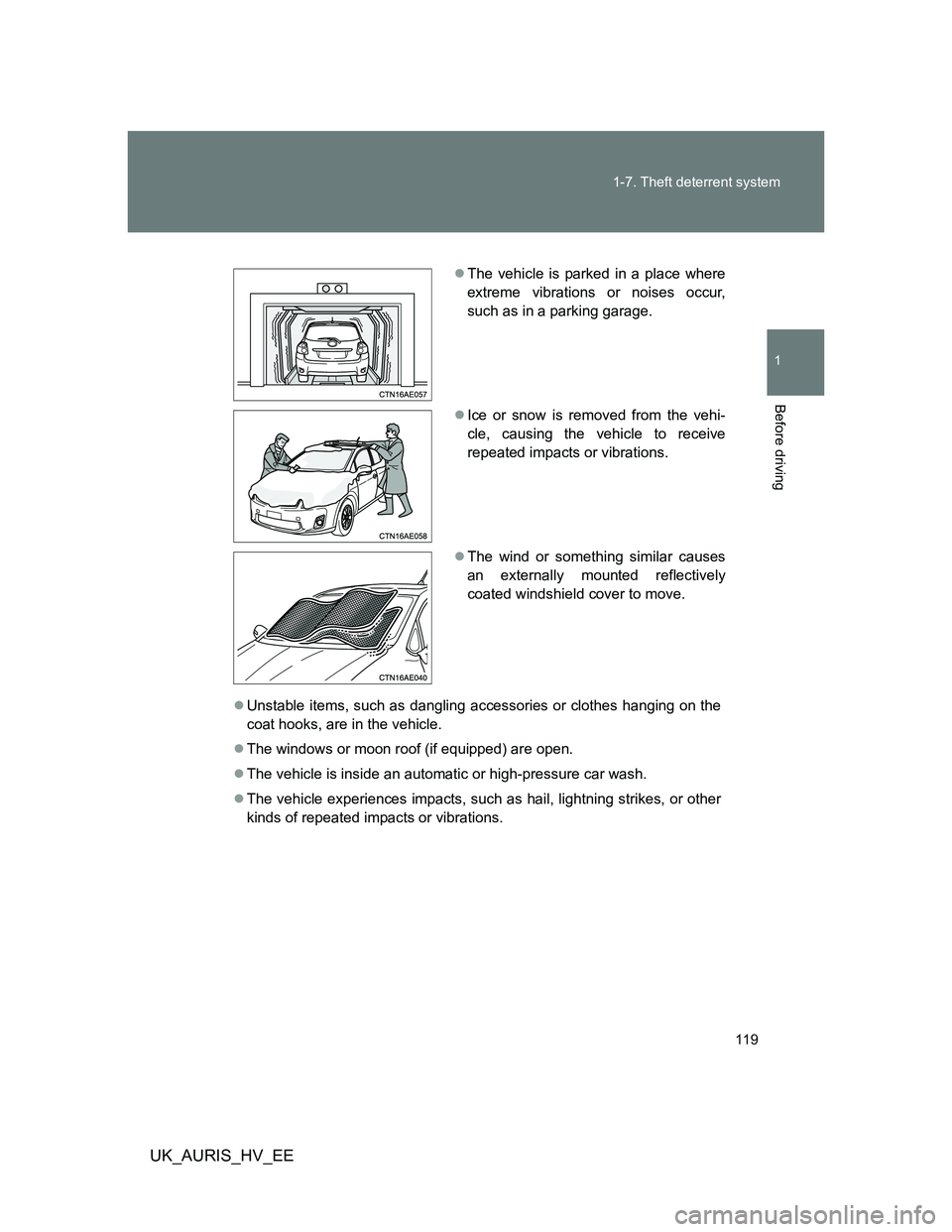
The vehicle is parked in a place where
extreme vibrations or noises occur,
such as in a parking garage.
Ice or snow is removed from the vehi-
cle, causing the vehicle to receive
repeated impacts or vibrations.
The wind or something similar causes
an externally mounted reflectively
coated windshield cover to move.
Page 130 of 524
130 1-8. Safety information
UK_AURIS_HV_EE
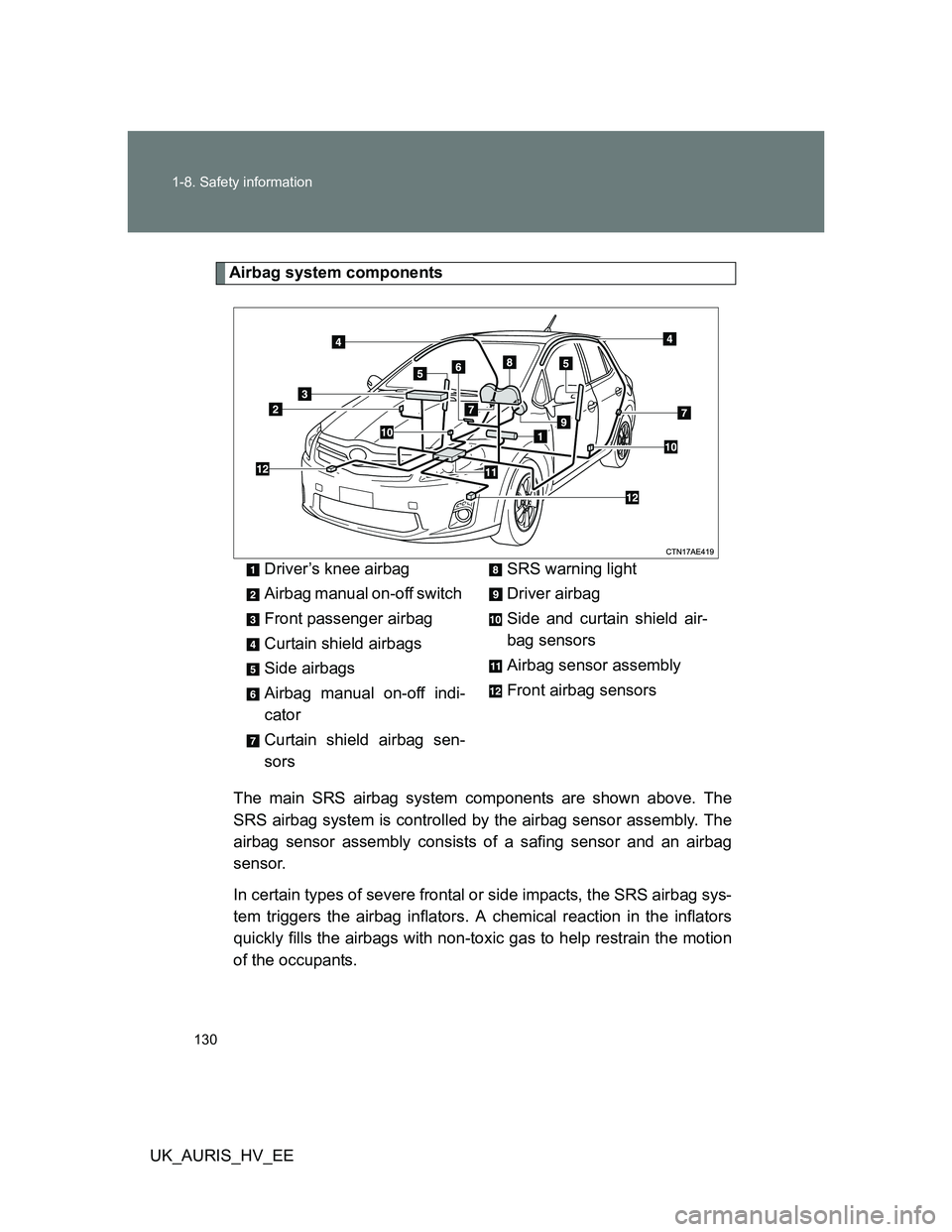
Airbag system components
The main SRS airbag system components are shown above. The
SRS airbag system is controlled by the airbag sensor assembly. The
airbag sensor assembly consists of a safing sensor and an airbag
sensor.
In certain types of severe frontal or side impacts, the SRS airbag sys-
tem triggers the airbag inflators. A chemical reaction in the inflators
quickly fills the airbags with non-toxic gas to help restrain the motion
of the occupants. Driver’s knee airbag
Airbag manual on-off switch
Front passenger airbag
Curtain shield airbags
Side airbags
Airbag manual on-off indi-
cator
Curtain shield airbag sen-
sorsSRS warning light
Driver airbag
Side and curtain shield air-
bag sensors
Airbag sensor assembly
Front airbag sensors
Page 131 of 524
131 1-8. Safety information
1
Before driving
UK_AURIS_HV_EE
If the SRS airbags deploy (inflate)
Bruising and slight abrasions may result from contact with a deploying
(inflating) SRS airbag.
A loud noise and white powder will be emitted.
Parts of the airbag module (steering wheel hub, airbag cover and inflator)
as well as the front seats, and parts of the front and rear pillars and roof
side rail, may be hot for several minutes. The airbag itself may also be
hot.
The windshield may crack.
SRS airbag deployment conditions (front airbags)
The SRS front airbags will deploy in the event of an impact that exceeds
the set threshold level (the level of force corresponding to an approxi-
mately 20 - 30 km/h [12 - 18 mph] frontal collision with a fixed wall that
does not move or deform).
However, this threshold velocity will be considerably higher if the vehicle
strikes an object, such as a parked vehicle or sign pole, which can move or
deform on impact, or if the vehicle is involved in an underride collision (e.g.
a collision in which the front of the vehicle “underrides”, or goes under, the
bed of a truck, etc.).
It is possible that in some collisions where the forward deceleration of the
vehicle is very close to the designed threshold level, the SRS front air-
bags and the seat belt pretensioners may not activate together.
SRS airbag deployment conditions (side airbags and curtain shield air-
bags)
The SRS side airbags and curtain shield airbags will deploy in the event of
an impact that exceeds the set threshold level (the level of force correspond-
ing to the impact force produced by an approximately 1500 kg [3300 lb.]
vehicle colliding with the vehicle cabin from a direction perpendicular to the
vehicle orientation at an approximate speed of 20 - 30 km/h [12 - 18 mph]).
Page 135 of 524
135 1-8. Safety information
1
Before driving
UK_AURIS_HV_EE
CAUTION
SRS airbag precautions
Observe the following precautions regarding the airbags.
Failure to do so may cause death or serious injury.
The driver and all passengers in the vehicle must wear their seat belts
properly.
The SRS airbags are supplemental devices to be used with the seat belts.
The SRS driver airbag deploys with considerable force, and can cause
death or serious injury especially if the driver is very close to the airbag.
Since the risk zone for the driver’s airbag is the first 50 - 75 mm (2 - 3 in.) of
inflation, placing yourself 250 mm (10 in.) from your driver airbag provides
you with a clear margin of safety. This distance is measured from the center
of the steering wheel to your breastbone. If you sit less than 250 mm (10 in.)
away now, you can change your driving position in several ways:
• Move your seat to the rear as far as you can while still reaching the
pedals comfortably.
• Slightly recline the back of the seat.
Although vehicle designs vary, many drivers can achieve the 250 mm
(10 in.) distance, even with the driver seat all the way forward, simply
by reclining the back of the seat somewhat. If reclining the back of your
seat makes it hard to see the road, raise yourself by using a firm, non-
slippery cushion, or raise the seat if your vehicle has that feature.
• If your steering wheel is adjustable, tilt it downward. This points the air-
bag toward your chest instead of your head and neck.
The seat should be adjusted as recommended above, while still maintaining
control of the foot pedals, steering wheel, and your view of the instrument
panel controls.
Page 163 of 524
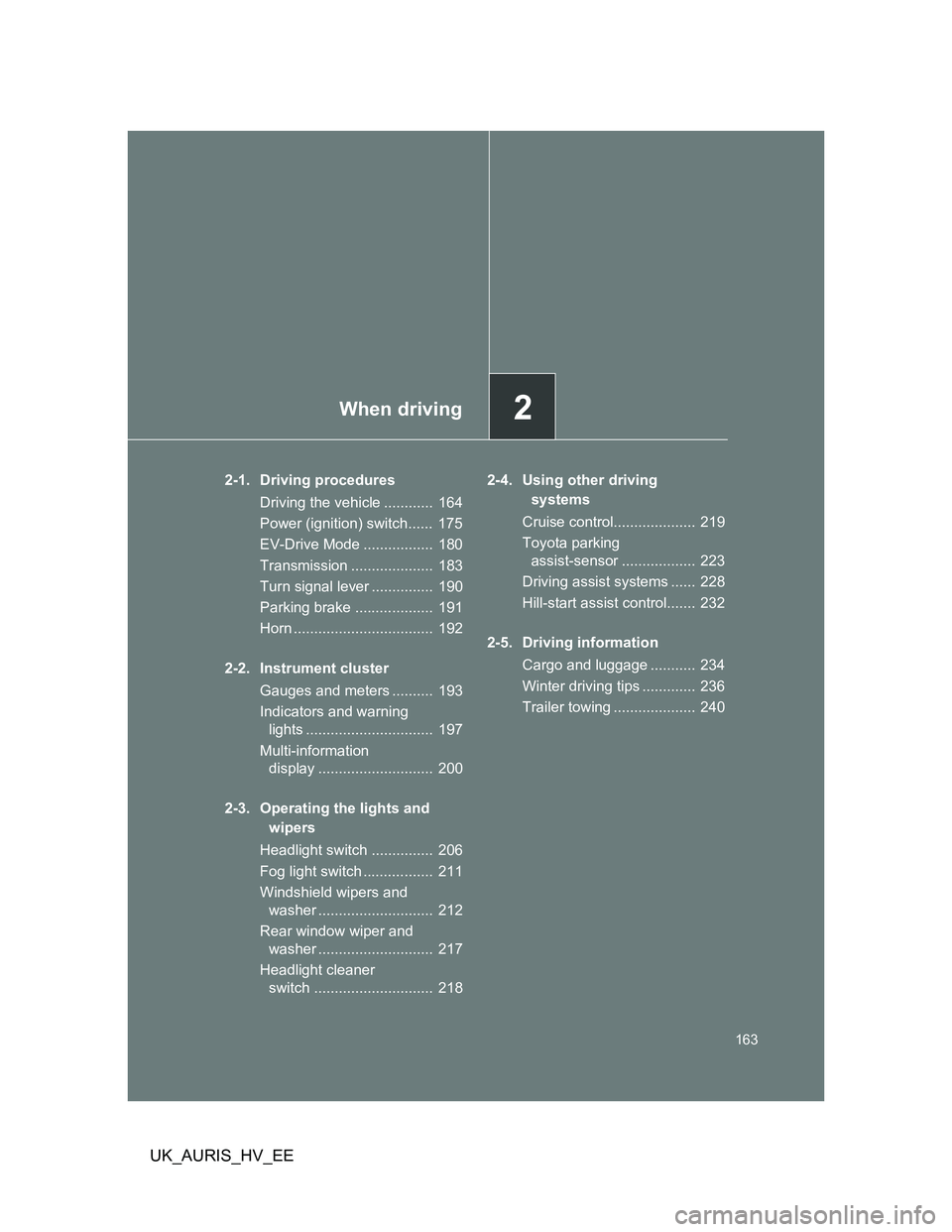
2When driving
163
UK_AURIS_HV_EE
2-1. Driving procedures
Driving the vehicle ............ 164
Power (ignition) switch...... 175
EV-Drive Mode ................. 180
Transmission .................... 183
Turn signal lever ............... 190
Parking brake ................... 191
Horn .................................. 192
2-2. Instrument cluster
Gauges and meters .......... 193
Indicators and warning
lights ............................... 197
Multi-information
display ............................ 200
2-3. Operating the lights and
wipers
Headlight switch ............... 206
Fog light switch ................. 211
Windshield wipers and
washer ............................ 212
Rear window wiper and
washer ............................ 217
Headlight cleaner
switch ............................. 2182-4. Using other driving
systems
Cruise control.................... 219
Toyota parking
assist-sensor .................. 223
Driving assist systems ...... 228
Hill-start assist control....... 232
2-5. Driving information
Cargo and luggage ........... 234
Winter driving tips ............. 236
Trailer towing .................... 240
Page 166 of 524
166 2-1. Driving procedures
UK_AURIS_HV_EE
Operating your vehicle in a foreign country
Comply with the relevant vehicle registration laws and confirm the availability
of the correct fuel. (P. 494)
For efficient use
Select the D position when driving.
In the N position, the gasoline engine operates but electricity cannot be
generated.
The hybrid battery (traction battery) will be discharged requiring unnec-
essary engine power to recharge.
Drive your vehicle smoothly.
Avoid abrupt acceleration and deceleration. Gradual acceleration and
deceleration will make more effective use of the traction motor without
having to use gasoline engine power.
Avoid repeated acceleration.
Repeated acceleration consumes hybrid battery (traction battery) power,
resulting in poor acceleration. Battery power can be restored by driving
with the accelerator pedal slightly released.
Push the P position switch when parking.
In the N position, the hybrid battery (traction battery) does not recharge.
Leaving the N position selected for an extended period of the time may
discharge the hybrid battery. The vehicle cannot run if the hybrid battery
is discharged.
Page 167 of 524
167 2-1. Driving procedures
2
When driving
UK_AURIS_HV_EE
Eco-friendly driving
Eco-friendly driving can be achieved by driving with Hybrid System Indicator.
(P. 195)
Brake actuator
The brake actuator uses brake fluid pressurized by the pump to power-assist
the brakes. If the brake actuator fails during driving, the brake system warn-
ing light comes on and the buzzer sounds intermittently. In this case, the
brakes may not work properly. If they do not work well, depress the brake
pedal firmly. If the brake system warning light comes on, immediately stop
your vehicle and contact any authorized Toyota dealer or repairer, or another
duly qualified and equipped professional.
In the following conditions, you may hear a sound in the engine compart-
ment. This is not a malfunction.
The driver’s door is opened with the hybrid system turned off.
The brake pedal is depressed with the hybrid system turned off.
After the hybrid system is turned on.
The brake pedal is depressed repeatedly with the hybrid system turned
on.
After the hybrid system is turned off.
The brake pedal may be hard to depress or the brake pedal stroke may be
short before turning the hybrid system on. This is not a malfunction.
When braking the vehicle
When applying brakes, you may hear a sound coming from the motor gener-
ator.
However, this does not indicate any trouble.
Page 168 of 524
168 2-1. Driving procedures
UK_AURIS_HV_EE
CAUTION
When starting the vehicle
Always keep your foot on the brake pedal while stopped with the hybrid sys-
tem operating. This prevents the vehicle from creeping.
When driving the vehicle
Do not drive if you are unfamiliar with the location of the brake and accel-
erator pedals to avoid depressing the wrong pedal.
• Accidentally depressing the accelerator pedal instead of the brake
pedal will result in sudden acceleration that may lead to an accident
that could result in death or serious injury.
• When backing up, you may twist your body around, leading to a diffi-
culty in operating the pedals. Make sure to operate the pedals properly.
• Make sure to keep a correct driving posture even when moving the
vehicle only slightly, allowing you to depress the brake and accelerator
pedals properly.
• Depress the brake pedal using your right foot. Depressing the brake
pedal using your left foot may delay response in an emergency, result-
ing in an accident.
The driver should pay attention to pedestrians when the vehicle is pow-
ered only by the electric motor (traction motor). Because there is no hybrid
system sounds, the pedestrians may misjudge the vehicle’s movement.
Do not drive the vehicle over or stop the vehicle near flammable materials.
The exhaust system and exhaust gases can be extremely hot. This may
cause a fire if there is any flammable material nearby.
Do not let the vehicle roll backwards while a forward driving position is
selected, or roll forward while R is selected.
Doing so may cause the hybrid system not to operate or lead to poor
brake and steering performance, resulting in an accident or damage to the
vehicle.
Page 170 of 524
170 2-1. Driving procedures
UK_AURIS_HV_EE
CAUTION
Do not adjust the display, the position of the steering wheel, the seat, or
the inside or outside rear view mirrors while driving.
Doing so may result in a loss of vehicle control that can cause accidents
that may result in death or serious injury.
Always check that all passengers' arms, heads or other parts of their bod-
ies are not outside the vehicle, as this may result in death or serious injury.
When driving on slippery road surfaces
Sudden braking, acceleration and steering may cause tire slippage and
reduce your ability to control the vehicle, resulting in an accident.
Abrupt changes from shift position D to B and rapid changes in the engine
speed could cause the vehicle to skid, resulting in an accident.
After driving through a puddle, lightly depress the brake pedal to make
sure that the brakes are functioning properly. Wet brake pads may prevent
the brakes from functioning properly. If the brakes on only one side are wet
and not functioning properly, steering control may be affected, resulting in
an accident.
When changing the shift position
Be careful not to change the shift position with the accelerator pedal
depressed.
This may lead to unexpected rapid acceleration of the vehicle that may
cause an accident and result in death or serious injury.
After the shift lever is operated, make sure to check the current shift position
using the shift position indicator. (P. 193)
When the vehicle is stopped
Do not race the hybrid system.
If the vehicle is in any shift position other than P or N, the vehicle may
accelerate suddenly and unexpectedly, and may cause an accident.
Do not leave the vehicle with the hybrid system on for a long time.
If such a situation cannot be avoided, park the vehicle in an open space
and check that exhaust fumes do not enter the vehicle interior.
Always keep a foot on the brake pedal while the hybrid system is operating
to prevent an accident caused by the vehicle moving.
Page 171 of 524
171 2-1. Driving procedures
2
When driving
UK_AURIS_HV_EE
CAUTION
When the vehicle is parked
Do not leave glasses, cigarette lighters, spray cans, or soft drink cans in
the vehicle when it is in the sun.
Doing so may result in the following.
• Gas may leak from a cigarette lighter or spray can, and may lead to a
fire.
• The temperature inside the vehicle may cause the plastic lenses and
plastic material of eye glasses to deform or crack.
• Soft drink cans may fracture, causing the contents to spray over the
interior of the vehicle, and may also cause a short circuit in the vehi-
cle's electrical components.
Always apply the parking brake, push the P position switch, turn the hybrid
system off and lock the vehicle.
Do not leave the vehicle unattended while the hybrid system is operating.
Do not touch the exhaust pipe while the hybrid system is operating or
immediately after turning the hybrid system off.
Doing so may cause burns.
Do not leave the hybrid system operating in an area with snow build-up, or
where it is snowing. If snowbanks build up around the vehicle while the
hybrid system is operating, exhaust gases may collect and enter the vehi-
cle. This may lead to death or a serious health hazard.
When parking the vehicle
Be sure to firmly apply the parking brake and push the P position switch.
Failure to do so may cause the vehicle to move or the vehicle may acceler-
ate suddenly, resulting in an accident if the accelerator pedal is accidentally
depressed.