led TOYOTA AURIS HYBRID 2017 Owners Manual
[x] Cancel search | Manufacturer: TOYOTA, Model Year: 2017, Model line: AURIS HYBRID, Model: TOYOTA AURIS HYBRID 2017Pages: 664, PDF Size: 27.42 MB
Page 4 of 664

TABLE OF CONTENTS4
AURIS Touring Sports_EE (12L13E)5-1. Basic Operations
Audio system types............342
Steering wheel audio
switches ...........................343
AUX port/USB port.............344
5-2. Using the audio system
Optimal use of the audio
system .............................345
5-3. Using the radio
Radio operation .................347
5-4. Playing audio CDs and
MP3/WMA discs
CD player operation ...........350
5-5. Using an external
device
Listening to an iPod ...........358
Listening to a USB
memory device ................366
Using the AUX port ............3735-6. Using Bluetooth
®
devices
Bluetooth
® audio/phone .... 374
Using the steering
wheel switches ................ 379
Registering a
Bluetooth
® device ........... 380
5-7. “SET UP” menu
Using the “SET UP” menu
(“Bluetooth” menu) .......... 381
Using the “SET UP” menu
(“Phone” menu) ............... 386
5-8. Bluetooth
® Audio
Operating a Bluetooth®
enabled portable
player .............................. 391
5-9. Bluetooth
® Phone
Making a phone call .......... 394
Receiving a phone call ...... 396
Speaking on the phone ..... 397
5-10. Bluetooth
®
Bluetooth®......................... 399
5Audio system
AURIS Touring Sports_OM_Europe_OM12L13E.book 4 ページ 2016年6月27日 月曜日 午後5時21分
Page 8 of 664
8
AURIS Touring Sports_EE (12L13E)Please note that this manual applies to all models and explains all equipment,
including options. Therefore, you may find some explanations for equipment
not installed on your vehicle.
All specifications provided in this manual are current at the time of printing.
However, because of the Toyota policy of continual product improvement, we
reserve the right to make changes at any time without notice.
Depending on specifications, the vehicle shown in the illustrations may differ
from your vehicle in terms of equipment.
Both genuine Toyota and a wide variety of other spare parts and accessories
for Toyota vehicles are currently available on the market. Should it be deter-
mined that any of the genuine Toyota parts or accessories supplied with the
vehicle need to be replaced, Toyota recommends that genuine Toyota parts
or accessories, be used to replace them. Other parts or accessories of
matching quality can also be used. Toyota cannot accept any liability or guar-
antee spare parts and accessories which are not genuine Toyota products,
nor for replacement or installation involving such parts. In addition, damage
or performance problems resulting from the use of non-genuine Toyota spare
parts or accessories may not be covered under warranty.
For your information
Main Owner’s Manual
Accessories, spare parts and modification of your Toyota
AURIS Touring Sports_OM_Europe_OM12L13E.book 8 ページ 2016年6月27日 月曜日 午後5時21分
Page 43 of 664

431-1. For safe use
1
For safety and security
AURIS Touring Sports_EE (12L13E)
The main SRS airbag system components are shown above. The
SRS airbag system is controlled by the airbag sensor assembly. As
the airbags deploy, a chemical reaction in the inflators quickly fills the
airbags with non-toxic gas to help restrain the motion of the occu-
pants.
SRS airbag system components
Side impact sensors (rear)
SRS warning light
Curtain shield airbags
Driver airbag
Front side airbags
Side impact sensors (front)
Seat belt pretensioners and
force limitersDriver’s knee airbag
Front impact sensors
Airbag sensor assembly
Airbag manual on-off switch
Front passenger airbag
“PASSENGER AIR BAG” indi-
cator1
2
3
4
5
6
7
8
9
10
11
12
13
AURIS Touring Sports_OM_Europe_OM12L13E.book 43 ページ 2016年6月27日 月曜日 午後5時21分
Page 44 of 664

441-1. For safe use
AURIS Touring Sports_EE (12L13E)
WARNING
■SRS airbag precautions
Observe the following precautions regarding the SRS airbags.
Failure to do so may cause death or serious injury.
●The driver and all passengers in the vehicle must wear their seat belts
properly.
The SRS airbags are supplemental devices to be used with the seat belts.
●The SRS driver airbag deploys with considerable force, and can cause
death or serious injury especially if the driver is very close to the airbag.
Since the risk zone for the driver’s airbag is the first 50 - 75 mm (2 - 3 in.)
of inflation, placing yourself 250 mm (10 in.) from your driver airbag pro-
vides you with a clear margin of safety. This distance is measured from
the center of the steering wheel to your breastbone. If you sit less than
250 mm (10 in.) away now, you can change your driving position in sev-
eral ways:
• Move your seat to the rear as far as you can while still reaching the ped-
als comfortably.
• Slightly recline the back of the seat.
Although vehicle designs vary, many drivers can achieve the 250 mm
(10 in.) distance, even with the driver seat all the way forward, simply by
reclining the back of the seat somewhat. If reclining the back of your
seat makes it hard to see the road, raise yourself by using a firm, non-
slippery cushion, or raise the seat if your vehicle has that feature.
• If your steering wheel is adjustable, tilt it downward. This points the
airbag toward your chest instead of your head and neck.
The seat should be adjusted as recommended above, while still maintain-
ing control of the foot pedals, steering wheel, and your view of the instru-
ment panel controls.
●The SRS front passenger airbag also deploys with considerable force, and
can cause death or serious injury especially if the front passenger is very
close to the airbag. The front passenger seat should be as far from the
airbag as possible with the seatback adjusted, so the front passenger sits
upright.
●Improperly seated and/or restrained infants and children can be killed or
seriously injured by a deploying airbag. An infant or child who is too small
to use a seat belt should be properly secured using a child restraint sys-
tem. Toyota strongly recommends that all infants and children be placed in
the rear seats of the vehicle and properly restrained. The rear seats are
safer for infants and children than the front passenger seat. (P. 55)
AURIS Touring Sports_OM_Europe_OM12L13E.book 44 ページ 2016年6月27日 月曜日 午後5時21分
Page 53 of 664
531-1. For safe use
1
For safety and security
AURIS Touring Sports_EE (12L13E)
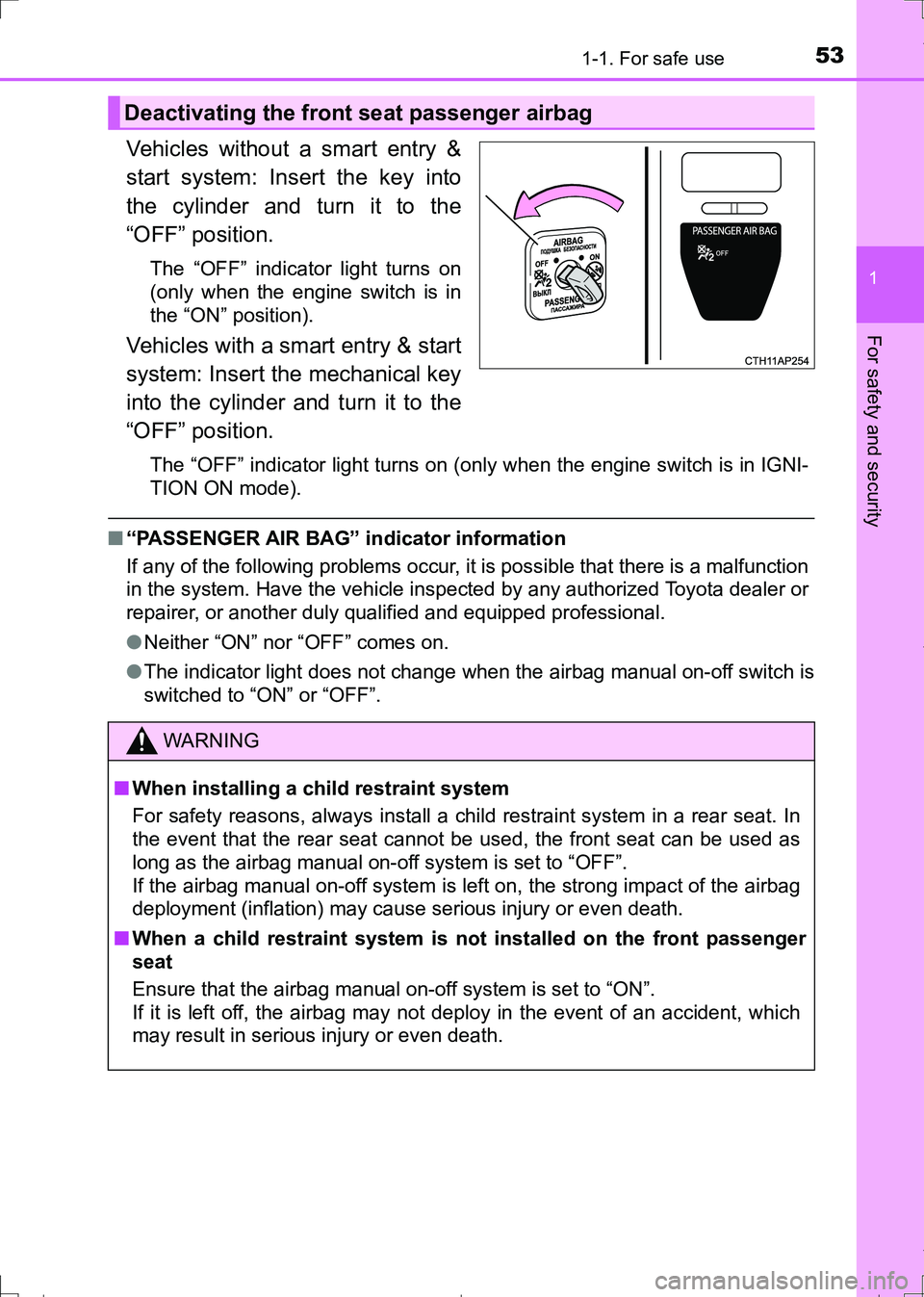
Vehicles without a smart entry &
start system: Insert the key into
the cylinder and turn it to the
“OFF” position.
The “OFF” indicator light turns on
(only when the engine switch is in
the “ON” position).
Vehicles with a smart entry & start
system: Insert the mechanical key
into the cylinder and turn it to the
“OFF” position.
The “OFF” indicator light turns on (only when the engine switch is in IGNI-
TION ON mode).
■“PASSENGER AIR BAG” indicator information
If any of the following problems occur, it is possible that there is a malfunction
in the system. Have the vehicle inspected by any authorized Toyota dealer or
repairer, or another duly qualified and equipped professional.
●Neither “ON” nor “OFF” comes on.
●The indicator light does not change when the airbag manual on-off switch is
switched to “ON” or “OFF”.
Deactivating the front seat passenger airbag
WARNING
■When installing a child restraint system
For safety reasons, always install a child restraint system in a rear seat. In
the event that the rear seat cannot be used, the front seat can be used as
long as the airbag manual on-off system is set to “OFF”.
If the airbag manual on-off system is left on, the strong impact of the airbag
deployment (inflation) may cause serious injury or even death.
■When a child restraint system is not installed on the front passenger
seat
Ensure that the airbag manual on-off system is set to “ON”.
If it is left off, the airbag may not deploy in the event of an accident, which
may result in serious injury or even death.
AURIS Touring Sports_OM_Europe_OM12L13E.book 53 ページ 2016年6月27日 月曜日 午後5時21分
Page 61 of 664
611-1. For safe use
1
For safety and security
AURIS Touring Sports_EE (12L13E)
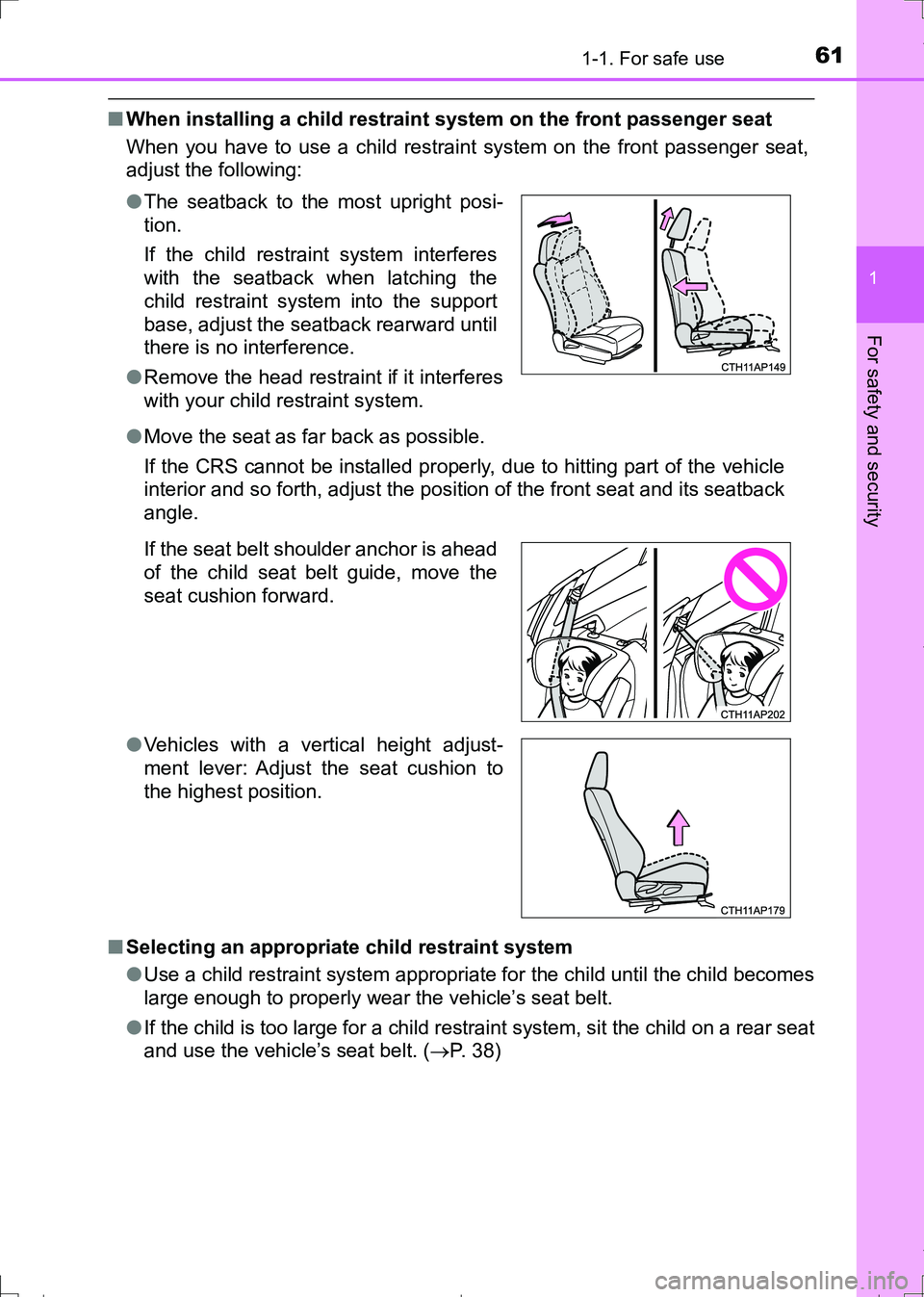
■When installing a child restraint system on the front passenger seat
When you have to use a child restraint system on the front passenger seat,
adjust the following:
■Selecting an appropriate child restraint system
●Use a child restraint system appropriate for the child until the child becomes
large enough to properly wear the vehicle’s seat belt.
●If the child is too large for a child restraint system, sit the child on a rear seat
and use the vehicle’s seat belt. (P. 38) ●The seatback to the most upright posi-
tion.
If the child restraint system interferes
with the seatback when latching the
child restraint system into the support
base, adjust the seatback rearward until
there is no interference.
●Remove the head restraint if it interferes
with your child restraint system.
●Move the seat as far back as possible.
If the CRS cannot be installed properly, due to hitting part of the vehicle
interior and so forth, adjust the position of the front seat and its seatback
angle.
If the seat belt shoulder anchor is ahead
of the child seat belt guide, move the
seat cushion forward.
●Vehicles with a vertical height adjust-
ment lever: Adjust the seat cushion to
the highest position.
AURIS Touring Sports_OM_Europe_OM12L13E.book 61 ページ 2016年6月27日 月曜日 午後5時21分
Page 62 of 664

621-1. For safe use
AURIS Touring Sports_EE (12L13E)
WARNING
■Using a child restraint system
The use of a child restraint system not suitable for the vehicle may not prop-
erly secure the infant or child. It may result in death or serious injury (in the
event of sudden braking or an accident).
■Child restraint precautions
●For effective protection in automobile accidents and sudden stops, a child
must be properly restrained, using a seat belt or child restraint system
depending on the age and size of the child. Holding a child in your arms is
not a substitute for a child restraint system. In an accident, the child can be
crushed against the windshield, or between you and the vehicle’s interior.
●Toyota strongly urges the use of a proper child restraint system that con-
forms to the size of the child, installed on the rear seat. According to acci-
dent statistics, the child is safer when properly restrained in the rear seat
than in the front seat.
●Never use a rear-facing child restraint system on the front passenger seat
when the airbag manual on-off switch is on. (P. 52)
In the event of an accident, the force of the rapid inflation of the front pas-
senger airbag can cause death or serious injury to the child.
●A forward-facing child restraint system may be installed on the front pas-
senger seat only when it is unavoidable. A child restraint system that
requires a top strap should not be used in the front passenger seat since
there is no top strap anchor for the front passenger seat. Adjust the
seatback as upright as possible and always move the seat as far back as
possible because the front passenger airbag could inflate with consider-
able speed and force. Otherwise, the child may be killed or seriously
injured.
●Do not allow the child to lean his/her head or any part of his/her body
against the door or the area of the seat, front and rear pillars or roof side
rails from which the SRS side airbags or SRS curtain shield airbags deploy
even if the child is seated in the child restraint system. It is dangerous if
the SRS side airbags and curtain shield airbags inflate, and the impact
could cause death or serious injury to the child.
●Make sure you have complied with all installation instructions provided by
the child restraint manufacturer and that the system is properly secured. If
it is not secured properly, it may cause death or serious injury to the child
in the event of a sudden stop or accident.
AURIS Touring Sports_OM_Europe_OM12L13E.book 62 ページ 2016年6月27日 月曜日 午後5時21分
Page 66 of 664

661-1. For safe use
AURIS Touring Sports_EE (12L13E)■
Forward-facing Child seat
Place the child restraint sys-
tem on the seat facing the
front of the vehicle.
If your child restraint system
interferes with a head restraint
and cannot be installed properly,
install the child restraint system
after removing the head
restraint. (P. 172)
Run the seat belt through the
child restraint system and
insert the plate into the
buckle. Make sure that the
belt is not twisted.
Install a locking clip near the
tab of the lap and shoulder
belt by inserting the lap and
shoulder webbing through
the recesses of the locking
clip. Buckle the belt again. If
the belt has any slack,
release the buckle and rein-
stall the locking clip.
1
2
3
AURIS Touring Sports_OM_Europe_OM12L13E.book 66 ページ 2016年6月27日 月曜日 午後5時21分
Page 67 of 664

671-1. For safe use
1
For safety and security
AURIS Touring Sports_EE (12L13E)■
Junior seat
Place the child restraint system on the seat facing the front of the
vehicle.
If your child restraint system interferes with a head restraint and cannot
be installed properly, install the child restraint system after removing the
head restraint. (P. 172)
Sit the child in the child
restraint system. Fit the seat
belt to the child restraint sys-
tem according to the manu-
facturer’s instructions and
insert the plate into the
buckle. Make sure that the
belt is not twisted.
Check that the shoulder belt is correctly positioned over the child’s
shoulder and that the lap belt is as low as possible. (P. 38)
1
High back typeBooster type
2
AURIS Touring Sports_OM_Europe_OM12L13E.book 67 ページ 2016年6月27日 月曜日 午後5時21分
Page 68 of 664

681-1. For safe use
AURIS Touring Sports_EE (12L13E)
Push the buckle release button
and fully retract the seat belt.
Removing a child restraint installed with a seat belt
AURIS Touring Sports_OM_Europe_OM12L13E.book 68 ページ 2016年6月27日 月曜日 午後5時21分