engine TOYOTA AVALON 2012 XX40 / 4.G Owners Manual
[x] Cancel search | Manufacturer: TOYOTA, Model Year: 2012, Model line: AVALON, Model: TOYOTA AVALON 2012 XX40 / 4.GPages: 580, PDF Size: 9.33 MB
Page 411 of 580
4
Maintenance and care
411
4-3. Do-it-yourself maintenance
CAUTION
■
Used engine oil
●Used engine oil contains potentially harmful contaminants which may
cause skin disorders such as inflammation or skin cancer, so care should
be taken to avoid prolonged and repeated contact. To remove used engine
oil from your skin, wash thoroughly with soap and water.
● Dispose of used oil and filters only in a safe and acceptable manner. Do
not dispose of used oil and filters in household trash, in sewers or onto the
ground.
Call your Toyota dealer, service station or auto parts store for information
concerning recycling or disposal.
● Do not leave used engine oil within the reach of children.
NOTICE
■To prevent serious engine damage
Check the oil level on regular basis.
■ When replacing the engine oil
●Be careful not to spill engine oil on the vehicle components.
● Avoid overfilling, or the engine could be damaged.
● Check the oil level on the dipstick every time you refill the vehicle.
● Be sure the engine oil filler cap is properly tightened.
Page 412 of 580
412 4-3. Do-it-yourself maintenance
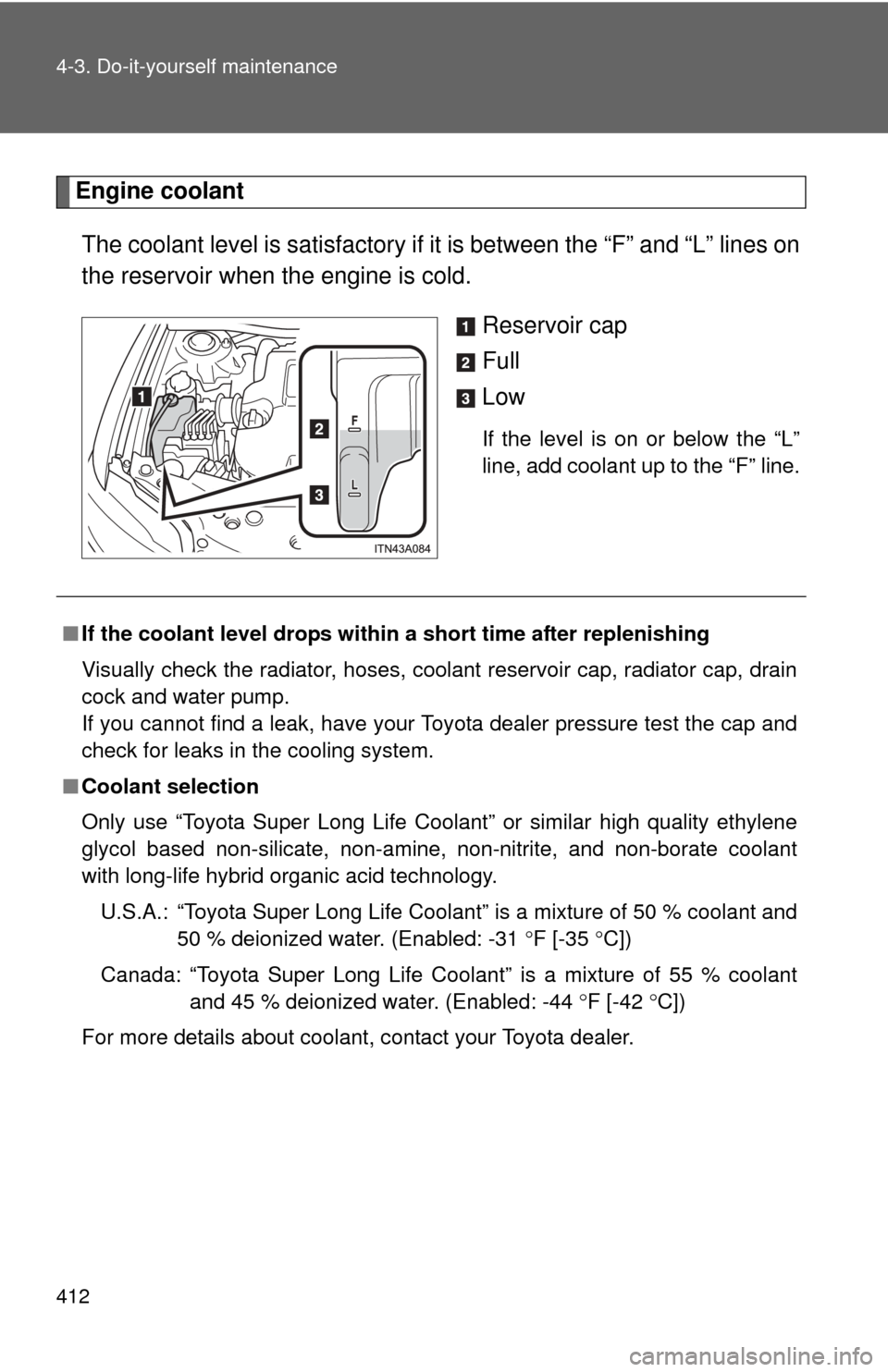
Engine coolantThe coolant level is sati sfactory if it is between the “F” and “L” lines on
the reservoir when the engine is cold.
Reservoir cap
Full
Low
If the level is on or below the “L”
line, add coolant up to the “F” line.
■If the coolant level drops within a short time after replenishing
Visually check the radiator, hoses, coolant reservoir cap, radiator cap, drain
cock and water pump.
If you cannot find a leak, have your Toyota dealer pressure test the cap and
check for leaks in the cooling system.
■ Coolant selection
Only use “Toyota Super Long Life Coolant” or similar high quality ethylene
glycol based non-silicate, non-amine, non-nitrite, and non-borate coolant
with long-life hybrid organic acid technology.
U.S.A.: “Toyota Super Long Life Coolant” is a mixture of 50 % coolant and 50 % deionized water. (Enabled: -31 F [-35 C])
Canada: “Toyota Super Long Life Coolant” is a mixture of 55 % coolant and 45 % deionized water. (Enabled: -44 F [-42 C])
For more details about coolant, contact your Toyota dealer.
Page 413 of 580
4
Maintenance and care
413
4-3. Do-it-yourself maintenance
Radiator and condenser
Check the radiator and condenser and clear any foreign objects.
If either of the above parts are extremely dirty or you are not sure of
their condition, have your vehicl e checked by your Toyota dealer.
CAUTION
■When the engine is hot
Do not remove the radiator cap.
The cooling system may be under pressure and may spray hot coolant if the
cap is removed, causing serious injuries, such as burns.
NOTICE
■When adding the coolant
Coolant is neither plain water nor stra ight antifreeze. The correct mixture of
water and anti freeze must be used to provide proper lubrication, corrosion
protection and cooling. Be sure to read the antifreeze or coolant label.
■ If you spill coolant
Be sure to wash it off with water to prevent it from damaging to parts or paint.
CAUTION
■When the engine is hot
Do not touch the radiator or condenser as they may be hot and cause seri-
ous injuries, such as burns.
Page 415 of 580
4
Maintenance and care
415
4-3. Do-it-yourself maintenance
Power steering fluid
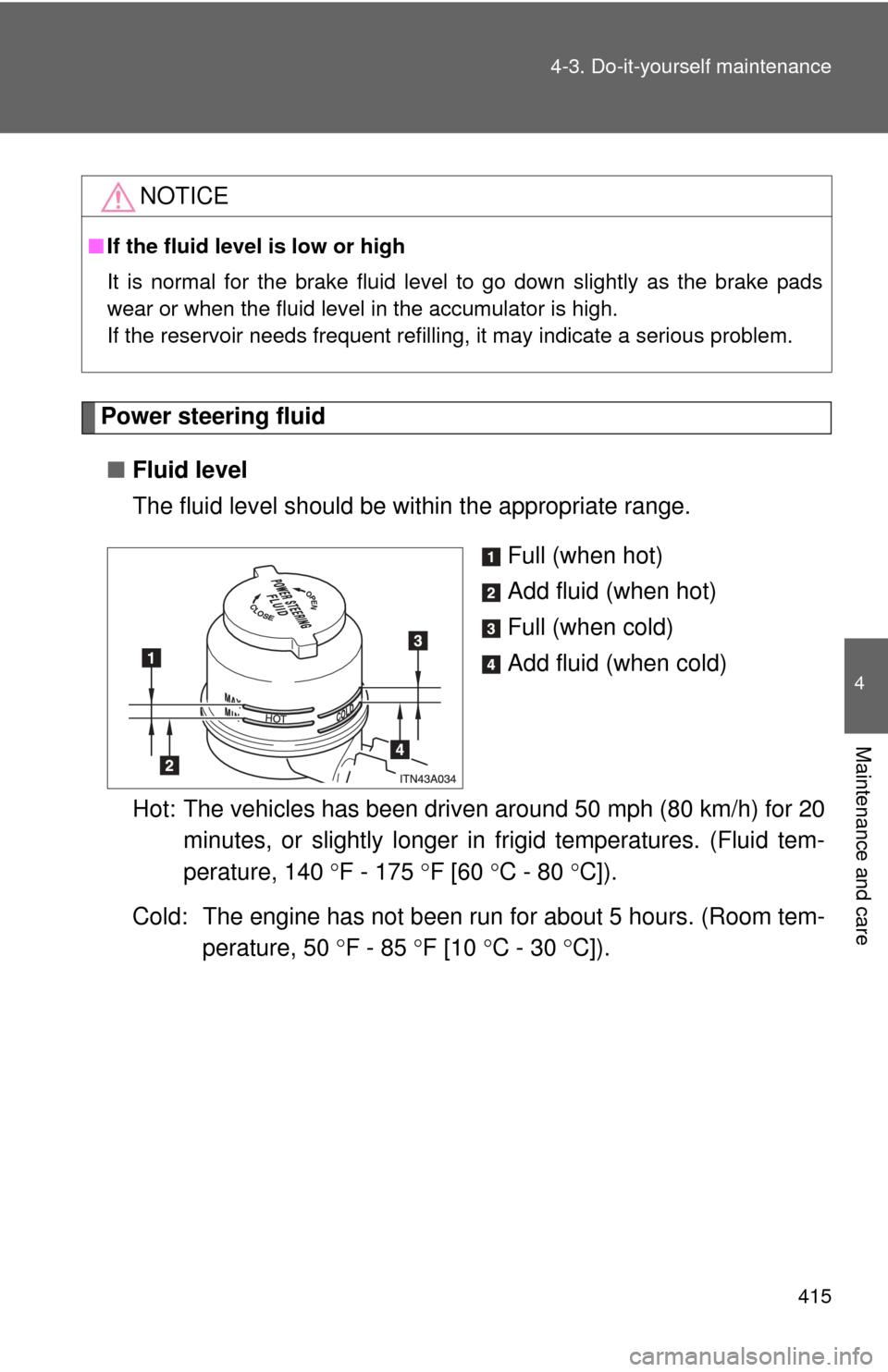
■ Fluid level
The fluid level should be within the appropriate range.
Full (when hot)
Add fluid (when hot)
Full (when cold)
Add fluid (when cold)
Hot: The vehicles has been driven around 50 mph (80 km/h) for 20 minutes, or slightly longer in frigid temperatures. (Fluid tem-
perature, 140 F - 175 F [60 C - 80 C]).
Cold: The engine has not been run for about 5 hours. (Room tem- perature, 50 F - 85 F [10 C - 30 C]).
NOTICE
■If the fluid level is low or high
It is normal for the brake fluid level to go down slightly as the brake pads
wear or when the fluid level in the accumulator is high.
If the reservoir needs frequent refilling, it may indicate a serious pro\
blem.
Page 419 of 580
4
Maintenance and care
419
4-3. Do-it-yourself maintenance
CAUTION
■
Emergency measures regarding electrolyte
●If electrolyte gets in your eyes
Flush your eyes with clean water for at least 15 minutes and get immedi-
ate medical attention. If possible, continue to apply water with a sponge or
cloth while traveling to the nearest medical facility.
● If electrolyte gets on your skin
Wash the affected area thoroughly. If you feel pain or a burning sensation,
seek medical attention immediately.
● If electrolyte gets on your clothes
It can soak through clothing on to your skin. Immediately take off the cloth-
ing and follow the procedure above if necessary.
● If you accidentally swallow electrolyte
Drink a large quantity of water or milk. Follow with milk of magnesia,
beaten raw egg or vegetable oil. Get emergency medical attention immedi-
ately.
NOTICE
■When recharging the battery
Never recharge the battery while the engine is running. Also, be sure all
accessories are turned off.
Page 420 of 580
420 4-3. Do-it-yourself maintenance
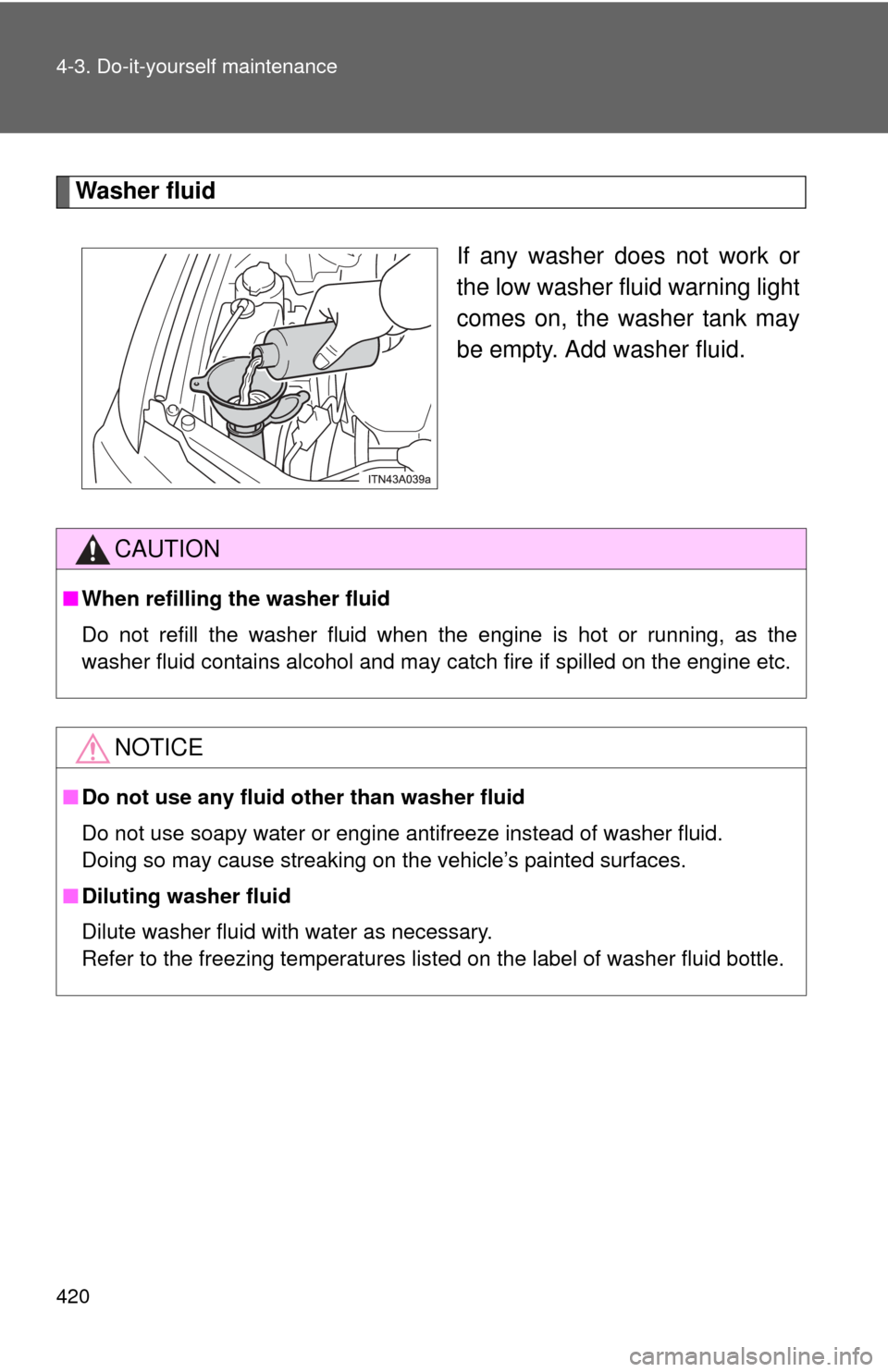
Washer fluidIf any washer does not work or
the low washer fluid warning light
comes on, the washer tank may
be empty. Add washer fluid.
CAUTION
■When refilling the washer fluid
Do not refill the washer fluid when the engine is hot or running, as the
washer fluid contains alcohol and may catch fire if spilled on the engine etc.
NOTICE
■Do not use any fluid other than washer fluid
Do not use soapy water or engine antifreeze instead of washer fluid.
Doing so may cause streaking on the vehicle’s painted surfaces.
■ Diluting washer fluid
Dilute washer fluid with water as necessary.
Refer to the freezing temperatures listed on the label of washer fluid bottle.
Page 423 of 580
4
Maintenance and care
423
4-3. Do-it-yourself maintenance
■
How to initialize the tire pressure warning system
Park the vehicle in safe place and turn the “ENGINE START
STOP” switch or the engine switch OFF.
While the vehicle is moving, in itialization is not performed.
Adjust the tire inflation pressure to the specified cold tire infla-
tion pressure level. ( P. 526)
Make sure to adjust the tire pressure to the specified cold tire
inflation pressure level. The ti re pressure warning system will
operate based on this pressure level.
Turn the “ENGINE START STOP” switch to IGNITION ON
mode (vehicles with smart key sy stem) or the engine switch to
the “ON” position (vehicles without smart key system).
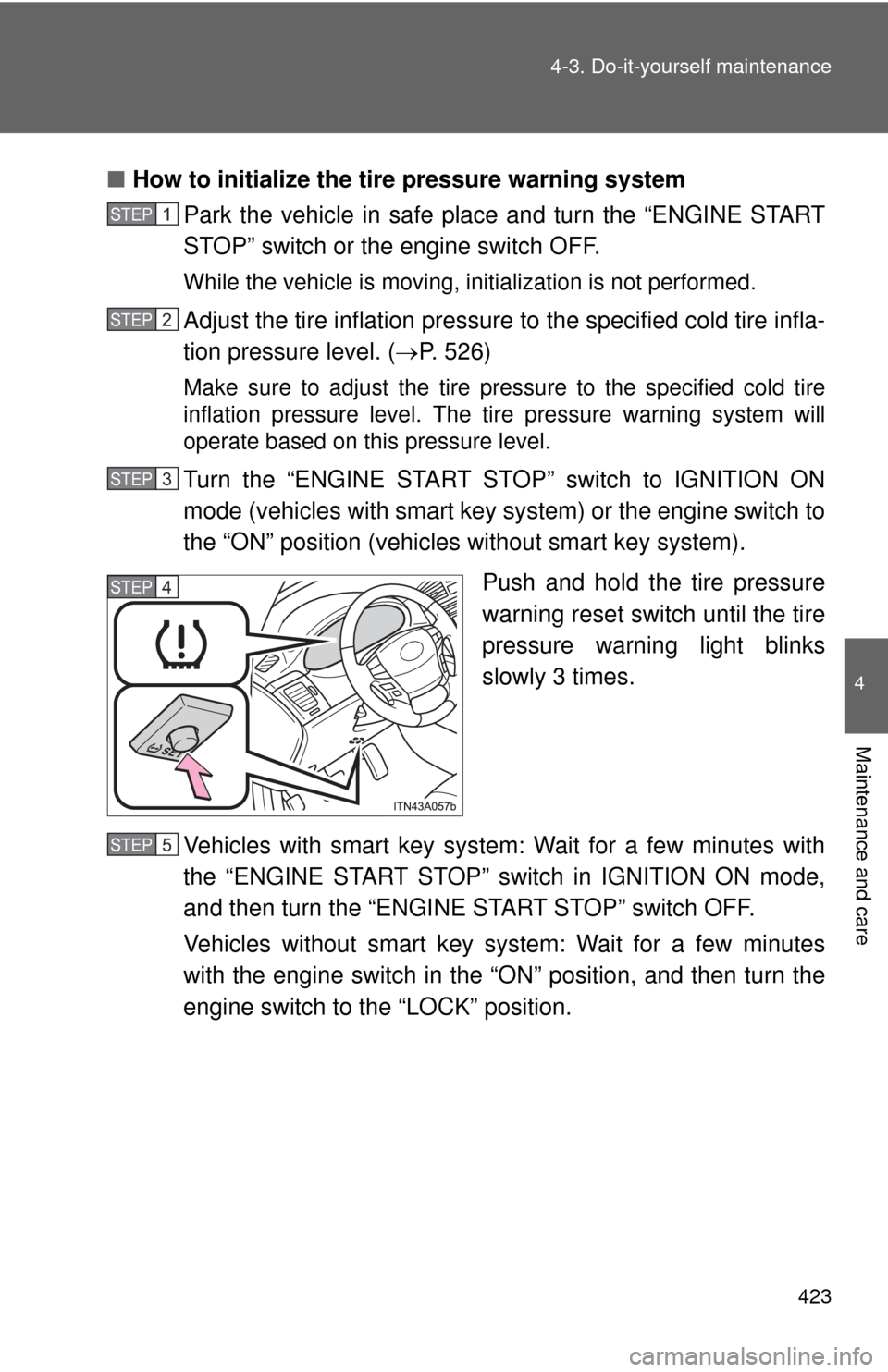
Push and hold the tire pressure
warning reset switch until the tire
pressure warning light blinks
slowly 3 times.
Vehicles with smart key system: Wait for a few minutes with
the “ENGINE START STOP” swit ch in IGNITION ON mode,
and then turn the “ENGINE START STOP” switch OFF.
Vehicles without smart key system: Wait for a few minutes
with the engine switch in the “O N” position, and then turn the
engine switch to the “LOCK” position.
STEP1
STEP2
STEP3
STEP4
STEP5
Page 437 of 580
437
4-3. Do-it-yourself maintenance
4
Maintenance and care
Air conditioning filter
The air conditioning filter must be changed regularly to maintain air
conditioning efficiency.
■ Removal method
Set the air conditioning system to recirculated mode.
The air conditioning filter case cannot be removed with the sys-
tem in the outside air mode.
Turn the “ENGINE START STOP” switch or the engine
switch OFF.
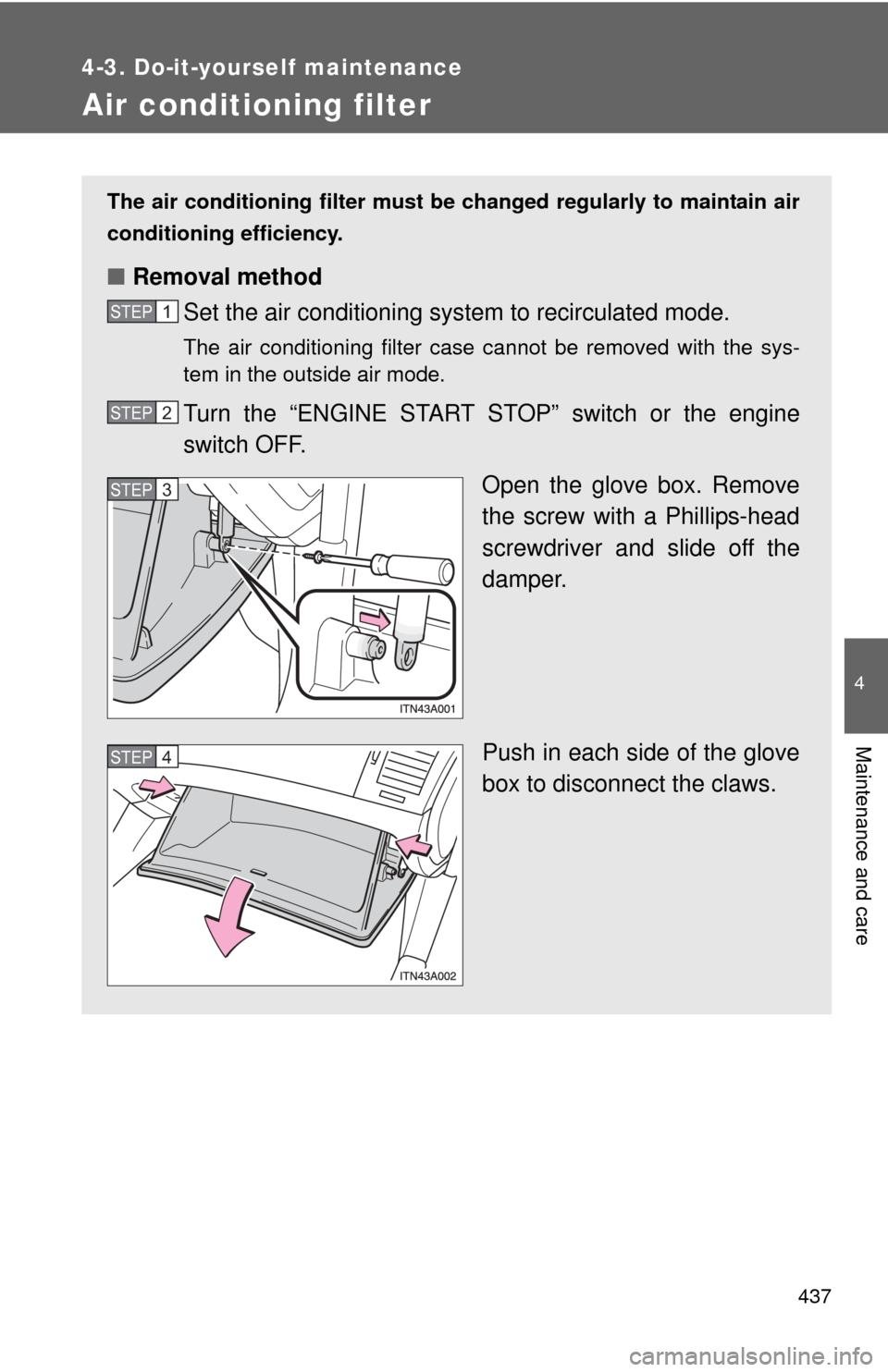
Open the glove box. Remove
the screw with a Phillips-head
screwdriver and slide off the
damper.
Push in each side of the glove
box to disconnect the claws.
STEP1
STEP2
STEP3
STEP4
Page 444 of 580
444
4-3. Do-it-yourself maintenance
Checking and replacing fuses
If any of the electrical components do not operate, a fuse may have
blown. If this happens, check and replace the fuses as necessary.
Turn the “ENGINE START STOP” switch or the engine
switch OFF.
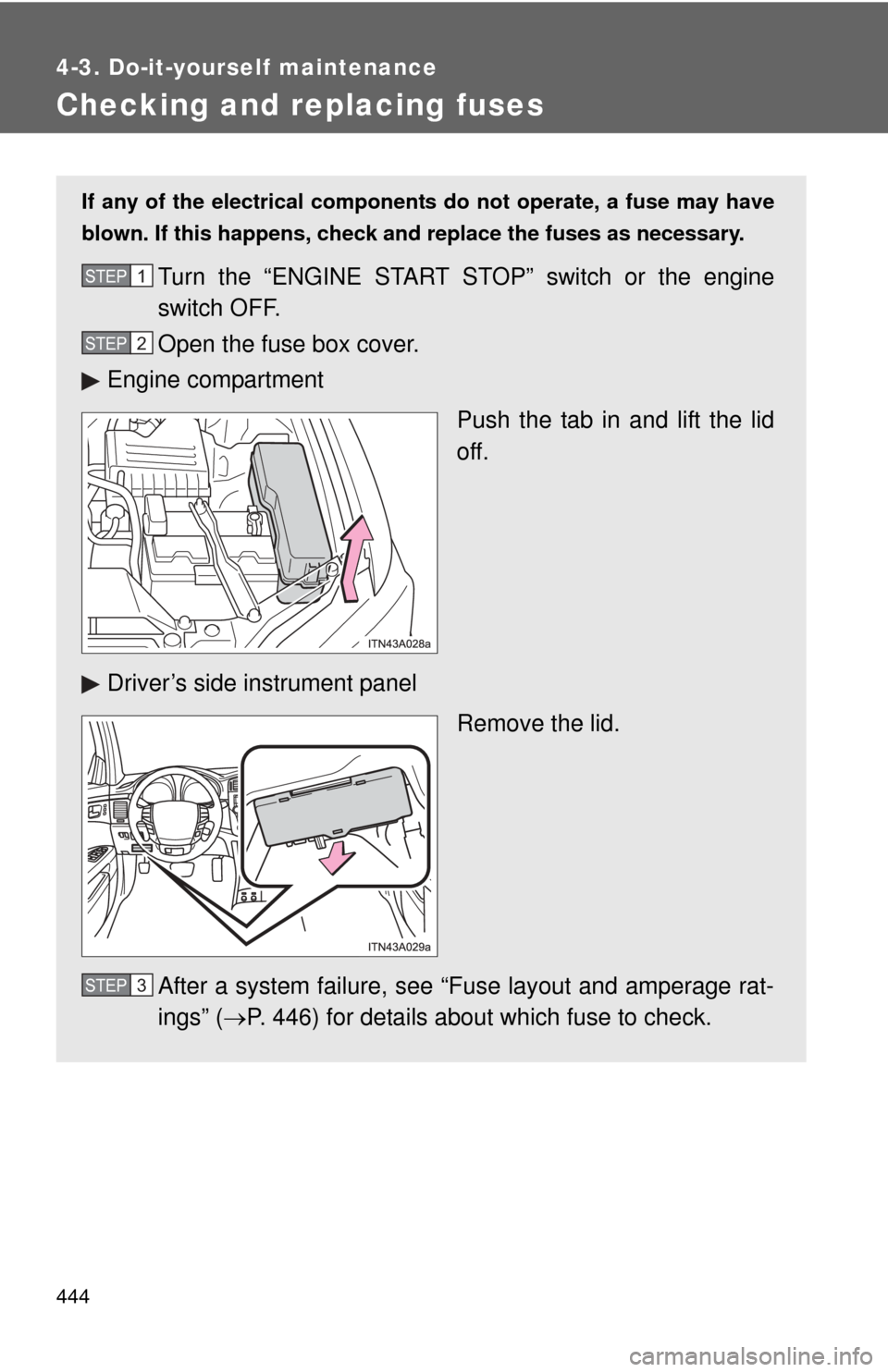
Open the fuse box cover.
Engine compartment
Push the tab in and lift the lid
off.
Driver’s side instrument panel Remove the lid.
After a system failure, see “Fuse layout and amperage rat-
ings” ( P. 446) for details about which fuse to check.STEP1
STEP2
STEP3
Page 446 of 580
446 4-3. Do-it-yourself maintenance
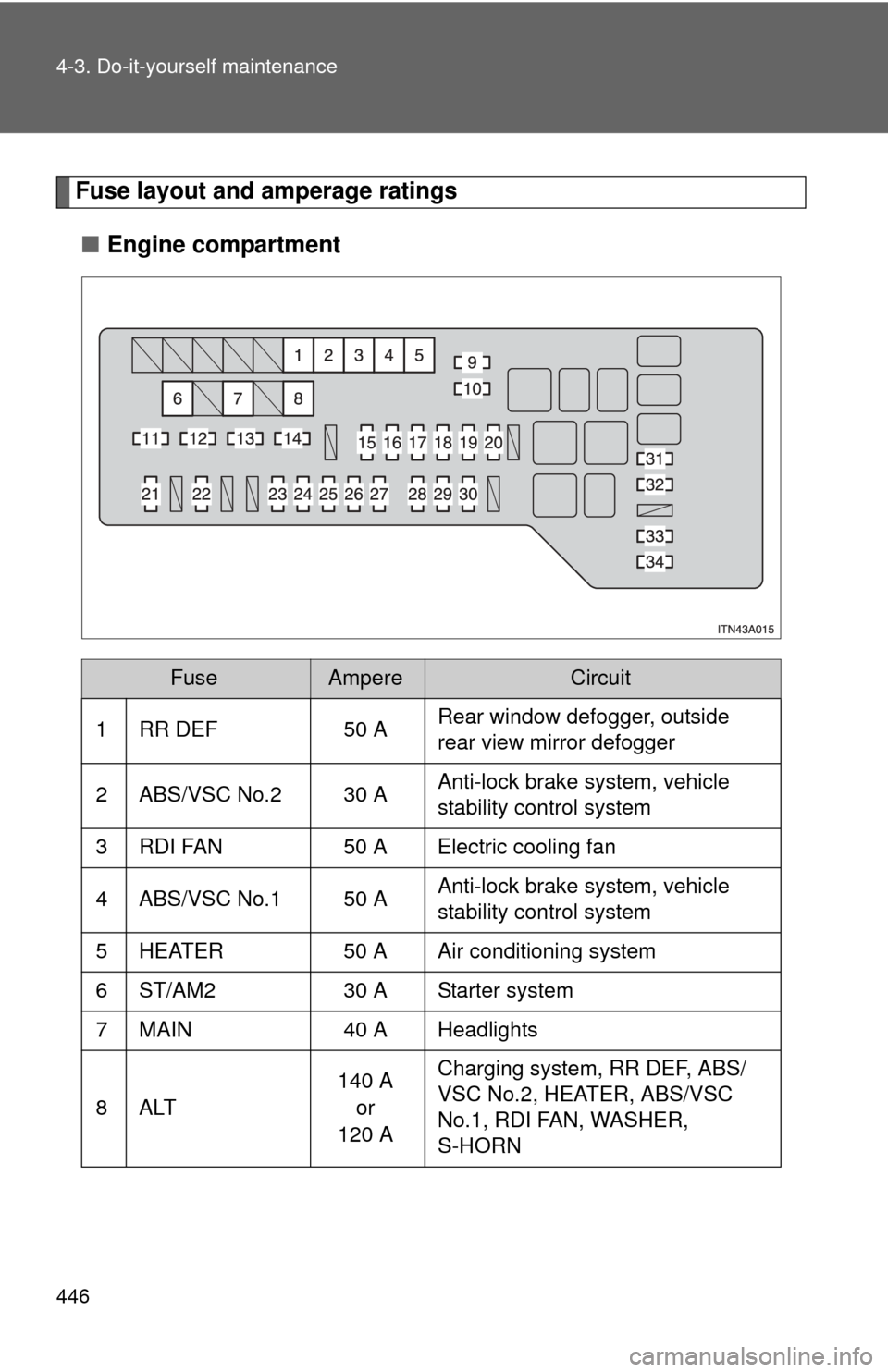
Fuse layout and amperage ratings■ Engine compartment
FuseAmpereCircuit
1 RR DEF 50 A Rear window defogger, outside
rear view mirror defogger
2 ABS/VSC No.2 30 A Anti-lock brake system, vehicle
stability control system
3 RDI FAN 50 A Electric cooling fan
4 ABS/VSC No.1 50 A Anti-lock brake system, vehicle
stability control system
5 HEATER 50 A Air conditioning system
6 ST/AM2 30 A Starter system
7 MAIN 40 A Headlights
8ALT 140 A
or
120 A Charging system, RR DEF, ABS/
VSC No.2, HEATER, ABS/VSC
No.1, RDI FAN, WASHER,
S-HORN