towing TOYOTA AVALON 2020 (in English) User Guide
[x] Cancel search | Manufacturer: TOYOTA, Model Year: 2020, Model line: AVALON, Model: TOYOTA AVALON 2020Pages: 540, PDF Size: 10.4 MB
Page 282 of 540

2824-5. Using the driving support systems
WARNING
■Sensors
Certain vehicle conditions and the surrounding environment may affect the
ability of a sensor to correctly detect an object. Particular instances where
this may occur are listed below.
● There is dirt, snow or ice on the sensor. (Wiping the sensors w ill resolve
this problem.)
● The sensor is frozen. (Thawing the area will resolve this probl em.)
In especially cold weather, if a sensor is frozen the screen ma y show an
abnormal display, or objects may not be detected.
● The sensor is covered in any way.
● The vehicle is leaning considerably to one side.
● On an extremely bumpy road, on an incline, on gravel, or on grass.
● The vicinity of the vehicle is noisy due to vehicle horns, moto rcycle
engines, air brakes of large vehicles, or other loud noises pro ducing ultra-
sonic waves.
● There is another vehicle equipped with parking assist sensors i n the vicin-
ity.
● The sensor is coated with a sheet of spray or heavy rain.
● The sensor is drenched with water on a flooded road.
● The vehicle is equipped with a fender pole or wireless antenna.
● Towing eyelets are installed.
● The bumper or sensor receives a strong impact.
● The vehicle is approaching a tall or curved curb.
● The detection range is reduced due to an object such as a sign.
● In harsh sunlight or intense cold weather.
● The area directly under the bumpers is not detected.
● If objects draw too close to the sensor.
● A non-genuine Toyota suspension (lowered suspension, etc.) is i nstalled.
● A backlit license plate is installed.
In addition to the examples above, there are instances in which , because of
their shape, signs and other objects may be judged by a sensor to be closer
than they are.
Page 297 of 540

2974-5. Using the driving support systems
4
Driving
NOTICE
■To prevent the system from malfunctioning
● If the area around a sensor is subjected to an impact, the syst em may not
operate properly due to the sensor being misaligned. Have the v ehicle
inspected by your Toyota dealer.
● When using a high pressure washer to wash the vehicle, do not spray the
sensors directly, as doing so may cause a sensor to malfunction .
● When using steam to clean the vehicle, do not direct steam too close to
the sensors as doing so may cause a sensor to malfunction.
■ To prevent a radar sensor from malfunctioning
● If the area around a radar sensor is subjected to an impact, th e system
may not operate properly due to a sensor malfunction. Have the vehicle
inspected by your Toyota dealer.
● Observe the radar sensor handling precautions. ( P. 264)
■ To prevent unnecessary operation of the Intelligent Clearance S onar
system
In the following situations, disable the Intelligent Clearance Sonar system
as the system may operate even though there is no possibility o f a collision.
● When inspecting the vehicle using a chassis roller, chassis dynamo or free
roller
● When loading the vehicle onto a boat, truck or other transport vessel
● If the suspension has been modified or tires of a size other th an specified
are installed
● If the front of the vehicle is raised or lowered due to the carried load
● When equipment that may obstruct a sensor is installed, such as a towing
eyelet, bumper protector (an additional trim strip, etc.), bicy cle carrier, or
snow plow
● When using an automatic car wash
Page 303 of 540
3034-5. Using the driving support systems
4
Driving
■Situations in which the Rear Cross Traffic Auto Brake function may not
operate properly
In some situations such as the following, this function may not operate prop-
erly.
● Objects and vehicles which the radar sensors are not designed t o detect
• Stationary objects
• Vehicles which are moving away from your vehicle
• Pedestrians, motorcycles, bicycles, etc.
*
• Objects which are extremely close to a radar sensor
• Vehicles which are approaching from the right or left at the r ear of the
vehicle at a traveling speed of less than approximately 5 mph ( 8 km/h)
• Vehicles which are approaching from the right or left at the r ear of the
vehicle at a traveling speed of more than approximately 15 mph (24 km/h)
*: Depending on conditions, detection of a vehicle and/or object may occur.
● Situations in which the radar sensors may not be able to detect an object
• When a sensor or the area around a sensor is extremely hot or cold
• If the rear bumper is covered with ice, snow, dirt, etc.
• If heavy rain or water strikes the vehicle
• When the detection area of a radar sensor is obstructed by an adjacent
vehicle
• If the vehicle is significantly tilted
• When equipment that may obstruct a sensor is installed, such a s a towing
eyelet, bumper protector (an additional trim strip, etc.), bicy cle carrier, or
snow plow
• If the suspension has been modified or tires of a size other than specified
are installed
• If the front of the vehicle is raised or lowered due to the ca rried load
• If a sticker or an electronic component, such as a backlit license plate
(especially fluorescent type), fog lights, a fender pole or wir eless antenna
is installed near a radar sensor
• If the orientation of a radar sensor has been changed due to a collision or
other impact or removal and installation
• When multiple vehicles are approaching with only a small gap between each vehicle
• When a vehicle is approaching at high speed
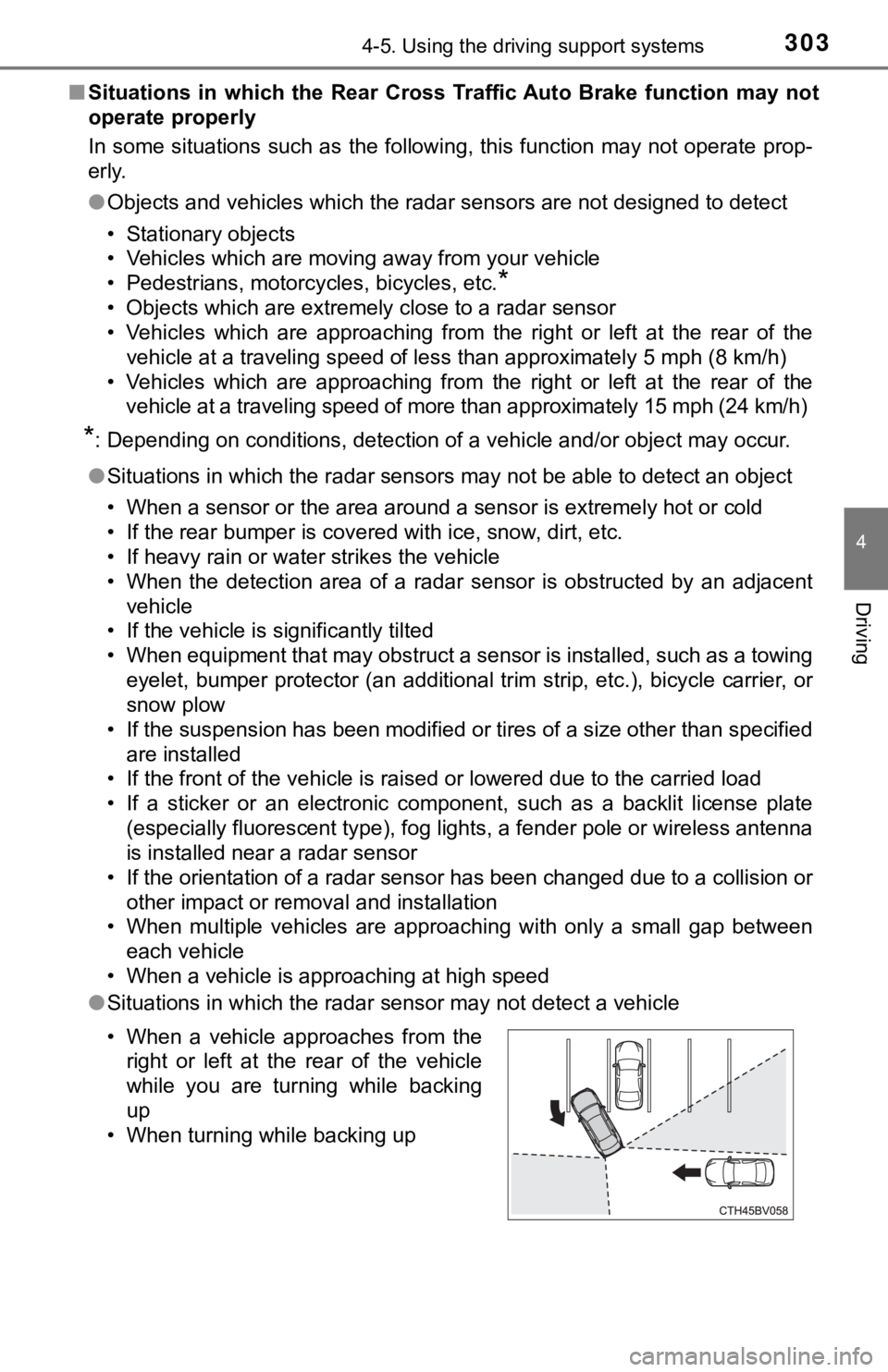
● Situations in which the radar sensor may not detect a vehicle
• When a vehicle approaches from the
right or left at the rear of the vehicle
while you are turning while backing
up
• When turning while backing up
Page 337 of 540
3375-3. Using the storage features
5
Interior features
●When storing a bottle, close the cap.
● The bottle may not be stored depending on its size or shape.
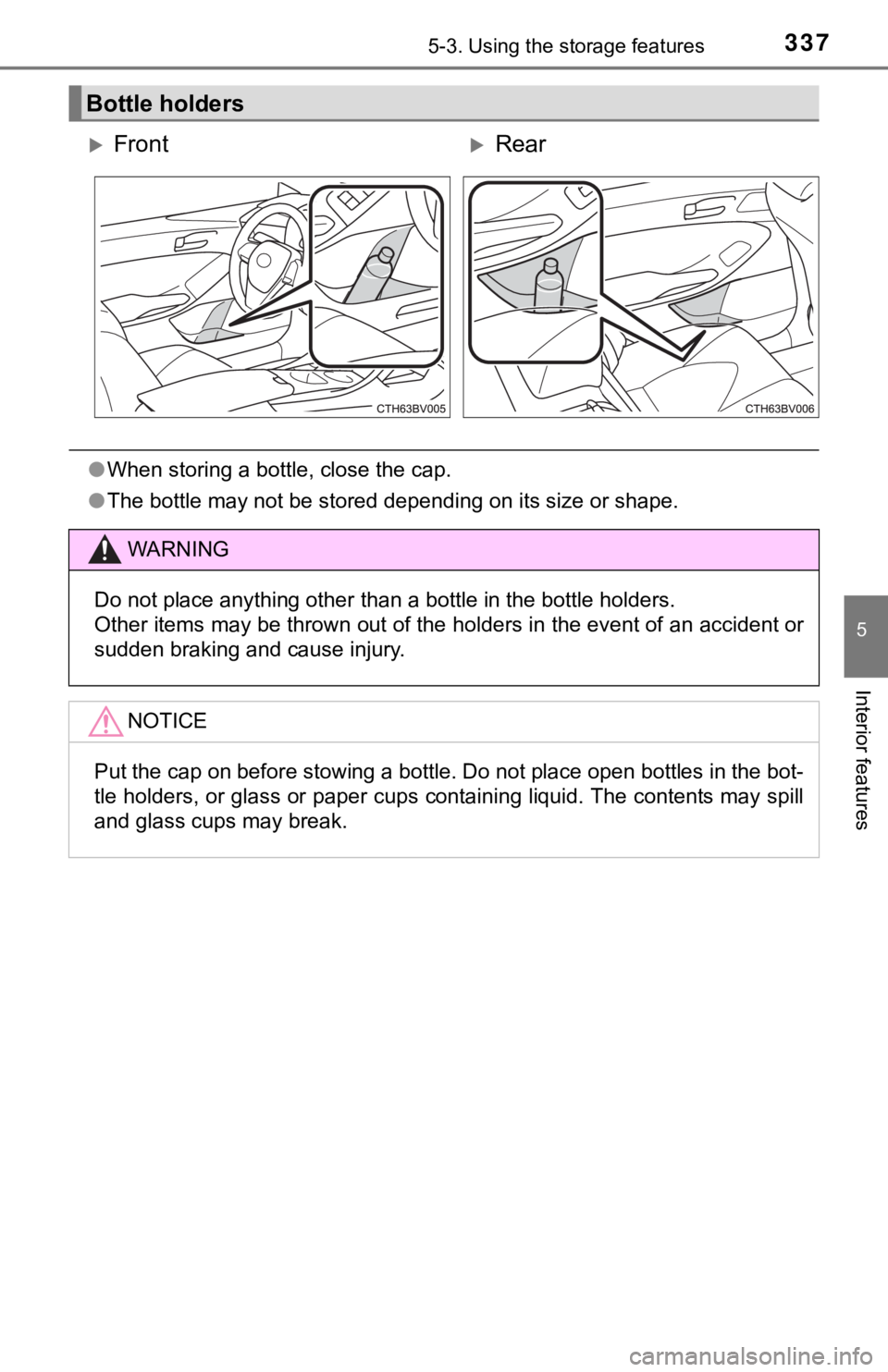
Bottle holders
FrontRear
WARNING
Do not place anything other than a bottle in the bottle holders .
Other items may be thrown out of the holders in the event of an accident or
sudden braking and cause injury.
NOTICE
Put the cap on before stowing a bottle. Do not place open bottles in the bot-
tle holders, or glass or paper cups containing liquid. The cont ents may spill
and glass cups may break.
Page 425 of 540
425
7
When trouble arises
7-2. Steps to take in an emergency
The following may indicate a problem with your transmission. Contact
your Toyota dealer or commercial towing service before towing.
● The engine is running but t he vehicle does not move.
● The vehicle makes an abnormal sound.
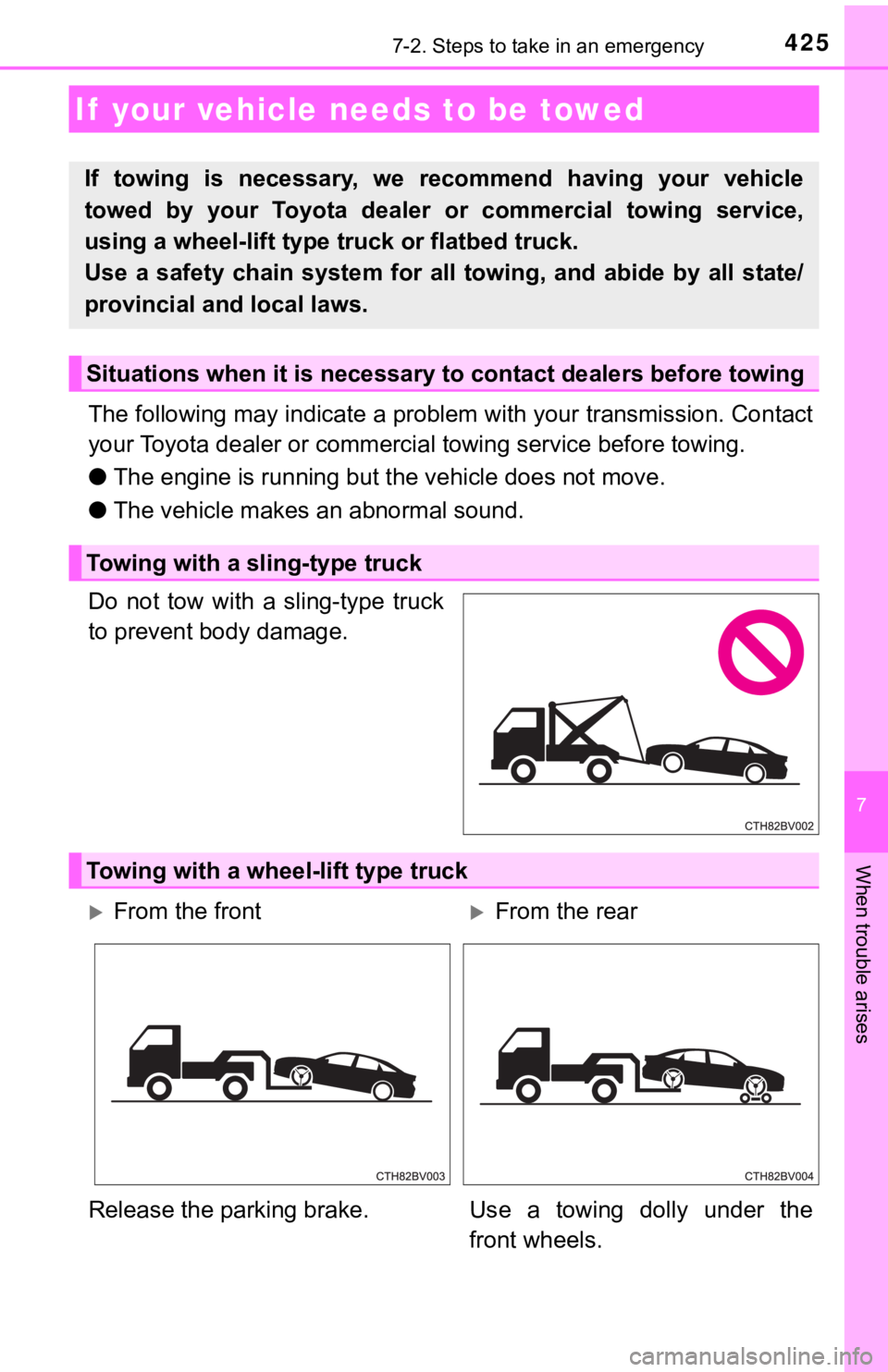
Do not tow with a sling-type truck
to prevent body damage.
If your vehicle needs to be towed
If towing is necessary, we recommend having your vehicle
towed by your Toyota dealer o r commercial towing service,
using a wheel-lift type t ruck or flatbed truck.
Use a safety chain system for all towing, and abide by all stat e/
provincial and local laws.
Situations when it is necessary to contact dealers before towing
Towing with a sling-type truck
Towing with a wheel-lift type truck
From the frontFrom the rear
Release the parking brake. Us e a towing dolly under the
front wheels.
Page 426 of 540
4267-2. Steps to take in an emergency
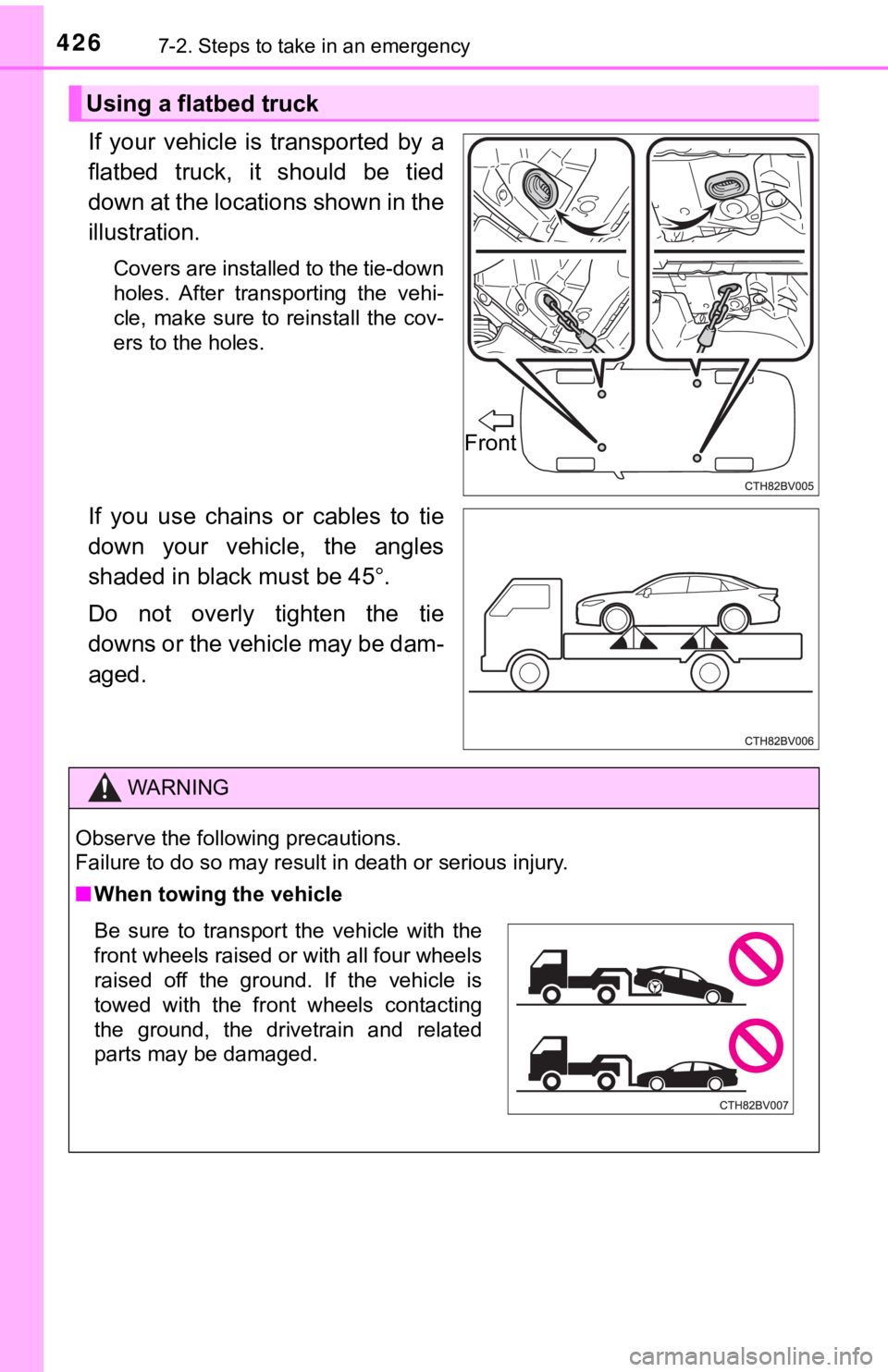
If your vehicle is transported by a
flatbed truck, it should be tied
down at the locations shown in the
illustration.
Covers are installed to the tie-down
holes. After transporting the vehi-
cle, make sure to reinstall the cov-
ers to the holes.
If you use chains or cables to tie
down your vehicle, the angles
shaded in black must be 45.
Do not overly tighten the tie
downs or the vehicle may be dam-
aged.
Using a flatbed truck
Front
WARNING
Observe the following precautions.
Failure to do so may result in death or serious injury.
■ When towing the vehicle
Be sure to transport the vehicle with the
front wheels raised or with all four wheels
raised off the ground. If the vehicle is
towed with the front wheels contacting
the ground, the drivetrain and related
parts may be damaged.
Page 427 of 540

4277-2. Steps to take in an emergency
7
When trouble arises
NOTICE
■To prevent damage to the vehicle when towing using a wheel-lift type
truck
● Do not tow the vehicle from the rear when the engine switch is off. The
steering lock mechanism is not strong enough to hold the front wheels
straight.
● When raising the vehicle, ensure adequate ground clearance for towing at
the opposite end of the raised vehicle. Without adequate clearance, the
vehicle could be damaged while being towed.
■ To prevent damage to the vehicle when towing with a sling-type truck
Do not tow with a sling-type truck, either from the front or re ar.
Page 449 of 540
4497-2. Steps to take in an emergency
7
When trouble arises
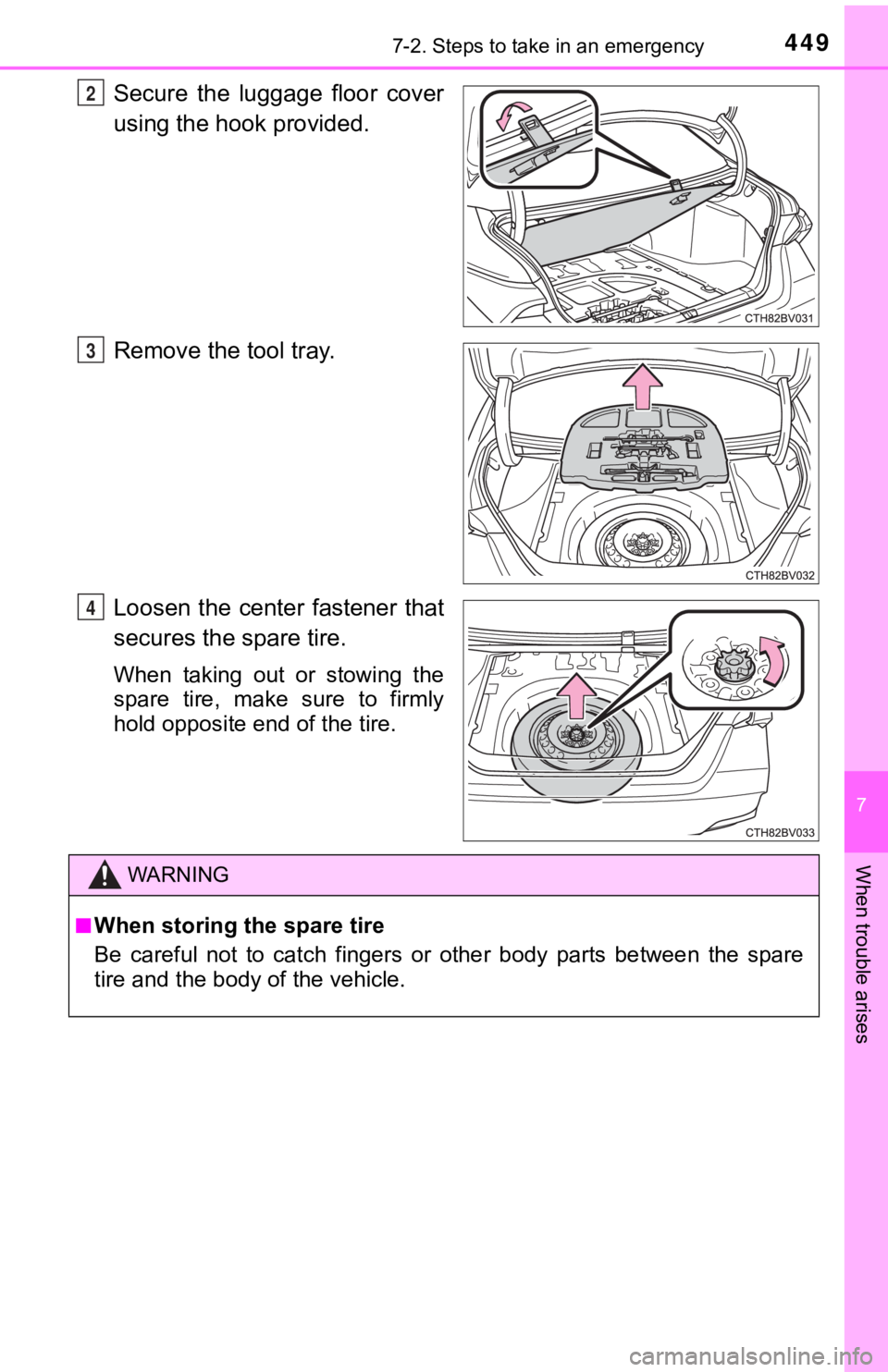
Secure the luggage floor cover
using the hook provided.
Remove the tool tray.
Loosen the center fastener that
secures the spare tire.
When taking out or stowing the
spare tire, make sure to firmly
hold opposite end of the tire.
2
3
4
WARNING
■When storing the spare tire
Be careful not to catch fingers or other body parts between the spare
tire and the body of the vehicle.
Page 470 of 540
4707-2. Steps to take in an emergency
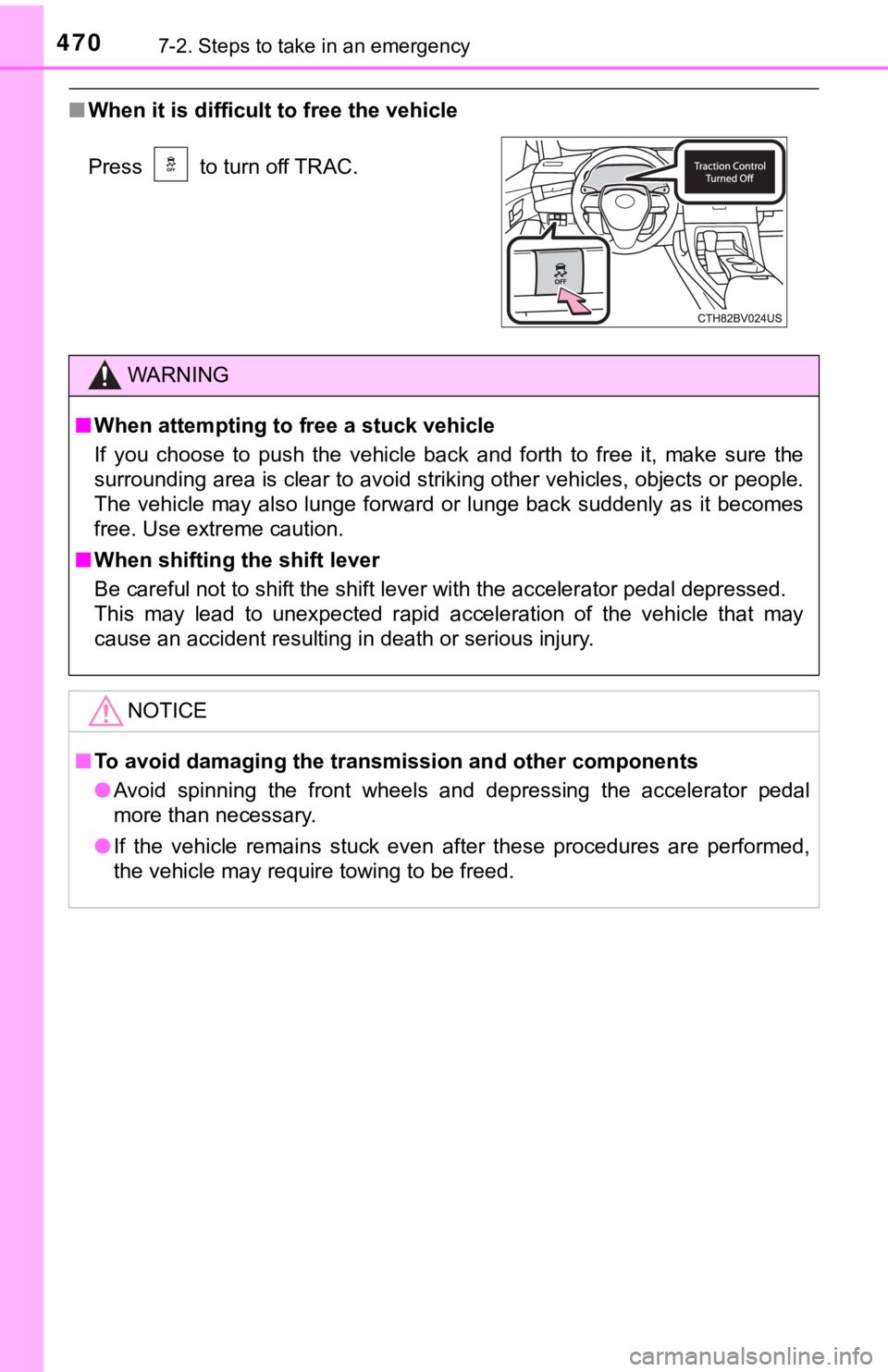
■When it is difficult to free the vehicle
Press to turn off TRAC.
WARNING
■ When attempting to f ree a stuck vehicle
If you choose to push the vehicle back and forth to free it, ma ke sure the
surrounding area is clear to avoid striking other vehicles, obj ects or people.
The vehicle may also lunge forward or lunge back suddenly as it becomes
free. Use extreme caution.
■ When shifting the shift lever
Be careful not to shift the shift lever with the accelerator pe dal depressed.
This may lead to unexpected rapid acceleration of the vehicle t hat may
cause an accident resulting in death or serious injury.
NOTICE
■ To avoid damaging the transmission and other components
● Avoid spinning the front wheels and depressing the accelerator pedal
more than necessary.
● If the vehicle remains stuck even after these procedures are pe rformed,
the vehicle may require towing to be freed.
Page 527 of 540

527Alphabetical index
Child safety ................................ 55Airbag precautions .................. 39
Battery precautions ....... 391, 465
Child restraint system ............. 56
How your child should wear the seat belt .......................... 32
Installing child restraints ......... 60
Moon roof precautions .......... 167
Power window lock switch .... 160
Power window precautions ... 163
Rear door child-protectors .... 128
Removed electronic key battery precautions ............. 415
Seat belt extender precautions ........................... 35
Seat belt precautions .............. 34
Seat heater precautions........ 329
Trunk precautions ................. 133
Child-protectors....................... 128
Cleaning ........................... 366, 369
Aluminum wheels.................. 367
Exterior ................................. 366
Interior................................... 369
Seat belts .............................. 370
Coat hooks ............................... 356
Condenser ................................ 388
Console box ............................. 336
Consumption
screen............................... 97, 116
Coolant Capacity ................................ 476
Checking ............................... 387
Preparing and checking before winter....................... 316
Cooling system ........................ 387 Engine overheating ............... 466
Cornering lights ....................... 203
Cruise control
Dynamic radar cruise control with full-speed range .......... 248 Cup holders ............................. 338
Curtain shield airbags............... 37
Customizable features ............ 497
Customized mode ................... 305
Daytime running light
system.................................... 204
Defogger Outside rear view mirrors ..... 324
Rear window ......................... 324
Windshield ............................ 324
Dimensions .............................. 472
Dinghy towing.......................... 183
Display Dynamic radar cruise control
with full-speed range .......... 248
LDA (Lane Departure Alert with steering control) .......... 243
Multi-information display ......... 93
Warning messages ............... 440
Do-it-yourself maintenance .... 379
Door courtesy lights
Location ................................ 332
Wattage ................................ 480
Door lock Doors .................................... 125
Smart key system ................. 125
Wireless remote control ........ 125
Doors ........................................ 125 Automatic door locking
and unlocking systems ....... 128
Door lock .............................. 127
Outside rear view mirrors ..... 157
Rear door child-protector ...... 128
Side doors ............................ 125
Side windows........................ 160
Drive-Start Control .................. 171
Driver’s seat belt reminder light ........................ 433
D