cooling TOYOTA AVALON 2020 Owners Manual (in English)
[x] Cancel search | Manufacturer: TOYOTA, Model Year: 2020, Model line: AVALON, Model: TOYOTA AVALON 2020Pages: 540, PDF Size: 10.4 MB
Page 308 of 540

3084-5. Using the driving support systems
■Operation of the air conditioning system in Eco drive mode
Eco drive mode controls the heating/cooling operations and fan speed of the
air conditioning system to enhance fuel efficiency ( P. 322). To improve air
conditioning performance, adjust the fan speed or turn off Eco drive mode.
■ Automatic deactivation of sport mode and custom mode
If the engine switch is turned off after driving in sport mode or custom mode,
the drive mode will be changed to normal mode.
Page 327 of 540

3275-1. Using the air conditioning system and defogger
5
Interior features
■Operation of the air conditioning system in Eco drive mode
●In the Eco drive mode, “ECO” is displayed on the air conditioni ng screen
and the air conditioning system is controlled as follows to pri oritize fuel effi-
ciency:
• Engine speed and compressor operation controlled to restrict h eating/
cooling capacity
• Fan speed restricted when automatic mode is selected
● To improve air conditioning performance, perform the following operations:
• Adjust the fan speed
• Turn off Eco drive mode
■ Ventilation and air conditioning odors
●To let fresh air in, set the air conditioning system to the out side air mode.
● During use, various odors from inside and outside the vehicle m ay enter into
and accumulate in the air conditioning system. This may then ca use odor to
be emitted from the vents.
● To reduce potential odors from occurring:
• It is recommended that the air conditioning system be set to o utside air
mode prior to turning the vehicle off.
• The start timing of the blower may be delayed for a short peri od of time
immediately after the air conditioning system is started in aut omatic
mode.
■ Air conditioning filter
P. 412
■ Customization
Some functions can be customized. ( P. 503)
Page 380 of 540
3806-3. Do-it-yourself maintenance
WARNING
The engine compartment contains many mechanisms and fluids that may
move suddenly, become hot, or become electrically energized. To avoid death
or serious injury, observe the following precautions.
■When working on the engine compartment
● Keep hands, clothing and tools away from the moving fan and eng ine
drive belt.
● Be careful not to touch the engine, radiator, exhaust manifold, etc. right
after driving as they may be hot. Oil and other fluids may also be hot.
● Do not leave anything that may burn easily, such as paper and r ags, in the
engine compartment.
● Do not smoke, cause sparks or expose an open flame to fuel or t he bat-
tery. Fuel and battery fumes are flammable.
● Be extremely cautious when working on the battery. It contains poisonous
and corrosive sulfuric acid.
■ When working near the electric cooling fan or radiator grille
Be sure the engine switch is off. With the engine switch in IGN ITION ON
mode, the electric cooling fan may automatically start to run if the air condi-
tioning is on and/or the coolant temperature is high. ( P. 388)
■ Safety glasses
Wear safety glasses to prevent flying or falling material, fluid spray, etc.
from getting in your eyes.
NOTICE
■If you remove the air cleaner filter
Driving with the air cleaner filter removed may cause excessive engine wear
due to dirt in the air.
Page 383 of 540
3836-3. Do-it-yourself maintenance
6
Maintenance and care
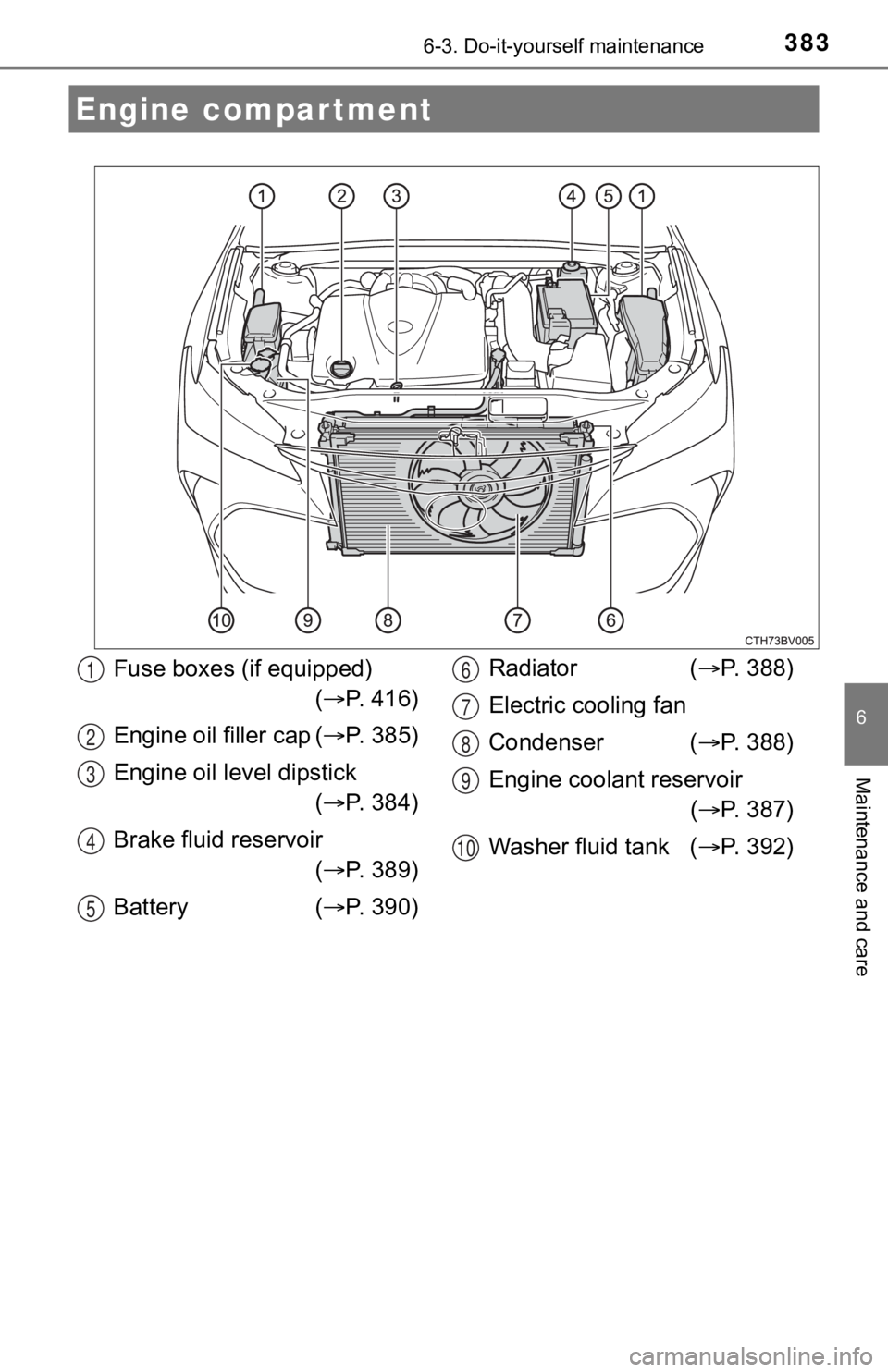
Engine compartment
Fuse boxes (if equipped)( P. 416)
Engine oil filler cap ( P. 385)
Engine oil level dipstick ( P. 384)
Brake fluid reservoir ( P. 389)
Battery ( P. 390) Radiator (
P. 388)
Electric cooling fan
Condenser ( P. 388)
Engine coolant reservoir ( P. 387)
Washer fluid tank ( P. 392)1
2
3
4
5
6
7
8
9
10
Page 387 of 540
3876-3. Do-it-yourself maintenance
6
Maintenance and care
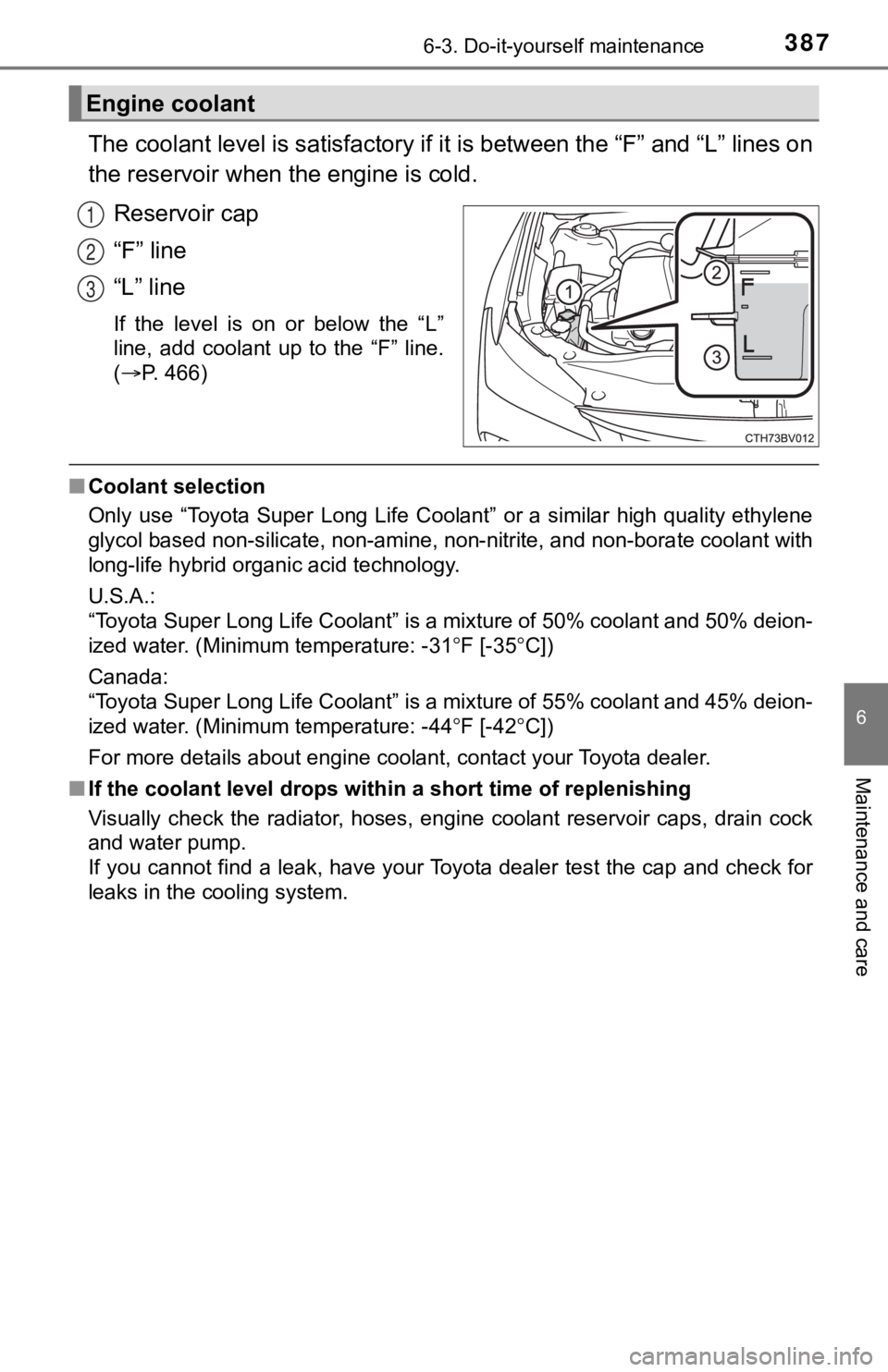
The coolant level is satisfactory if it is between the “F” and “L” lines on
the reservoir when the engine is cold.
Reservoir cap
“F” line
“L” line
If the level is on or below the “L”
line, add coolant up to the “F” line.
(P. 466)
■ Coolant selection
Only use “Toyota Super Long Life Coolant” or a similar high quality ethylene
glycol based non-silicate, non-amine, non-nitrite, and non-bora te coolant with
long-life hybrid organic acid technology.
U.S.A.:
“Toyota Super Long Life Coolant” is a mixture of 50% coolant and 50% deion-
ized water. (Minimum temperature: -31 F [-35 C])
Canada:
“Toyota Super Long Life Coolant” is a mixture of 55% coolant and 45% deion-
ized water. (Minimum temperature: -44 F [-42 C])
For more details about engine coolant, contact your Toyota deal er.
■ If the coolant level drops within a short time of replenishing
Visually check the radiator, hoses, engine coolant reservoir ca ps, drain cock
and water pump.
If you cannot find a leak, have your Toyota dealer test the cap and check for
leaks in the cooling system.
Engine coolant
1
2
3
Page 388 of 540
3886-3. Do-it-yourself maintenance
Check the radiator and condenser and clear away any foreign objects.
If either of the above parts is extremely dirty or you are not sure of
their condition, have your vehic le inspected by your Toyota dea ler.
WARNING
■When the engine is hot
Do not remove the engine coolant reservoir cap or the radiator cap.
The cooling system may be under pressure and may spray hot coolant if the
cap is removed, causing serious injuries, such as burns.
NOTICE
■When adding coolant
Coolant is neither plain water nor straight antifreeze. The cor rect mixture of
water and antifreeze must be used to provide proper lubrication , corrosion
protection and cooling. Be sure to read the antifreeze or coolant label.
■ If you spill coolant
Be sure to wash it off with water to prevent it from damaging p arts or paint.
Radiator and condenser
WARNING
■When the engine is hot
Do not touch the radiator or condenser as they may be hot and c ause seri-
ous injuries, such as burns.
Page 465 of 540
4657-2. Steps to take in an emergency
7
When trouble arises
WARNING
■When removing the battery terminals
Always remove the negative (-) terminal first. If the positive (+) terminal con-
tacts any metal in the surrounding area when the positive (+) terminal is
removed, a spark may occur, leading to a fire in addition to el ectrical shocks
and death or serious injury.
■ Avoiding battery fires or explosions
Observe the following precautions to prevent accidentally ignit ing the flam-
mable gas that may be emitted from the battery:
● Make sure each jumper cable is connected to the correct terminal and that
it is not unintentionally in contact with any other than the in tended terminal.
● Do not allow the other end of the jumper cable connected to the “+” termi-
nal to come into contact with any other parts or metal surfaces in the area,
such as brackets or unpainted metal.
● Do not allow the + and - clamps of the jumper cables to come into contact
with each other.
● Do not smoke, use matches, cigarette lighters or allow open fla me near
the battery.
■ Battery precautions
The battery contains poisonous and corrosive acidic electrolyte , while
related parts contain lead and lead compounds. Observe the foll owing pre-
cautions when handling the battery:
● When working with the battery, always wear safety glasses and t ake care
not to allow any battery fluids (acid) to come into contact wit h skin, clothing
or the vehicle body.
● Do not lean over the battery.
● In the event that battery fluid comes into contact with the skin or eyes,
immediately wash the affected area with water and seek medical attention.
Place a wet sponge or cloth over the affected area until medica l attention
can be received.
● Always wash your hands after handling the battery support, term inals, and
other battery-related parts.
● Do not allow children near the battery.
NOTICE
■When handling jumper cables
When connecting the jumper cables, ensure that they do not beco me entan-
gled in the cooling fan or engine drive belt.
Page 466 of 540
4667-2. Steps to take in an emergency
Stop the vehicle in a safe place and turn off the air conditioning sys-
tem, and then stop the engine.
If you see steam:
Carefully lift the hood after the steam subsides.
If you do not see steam:
Carefully lift the hood.
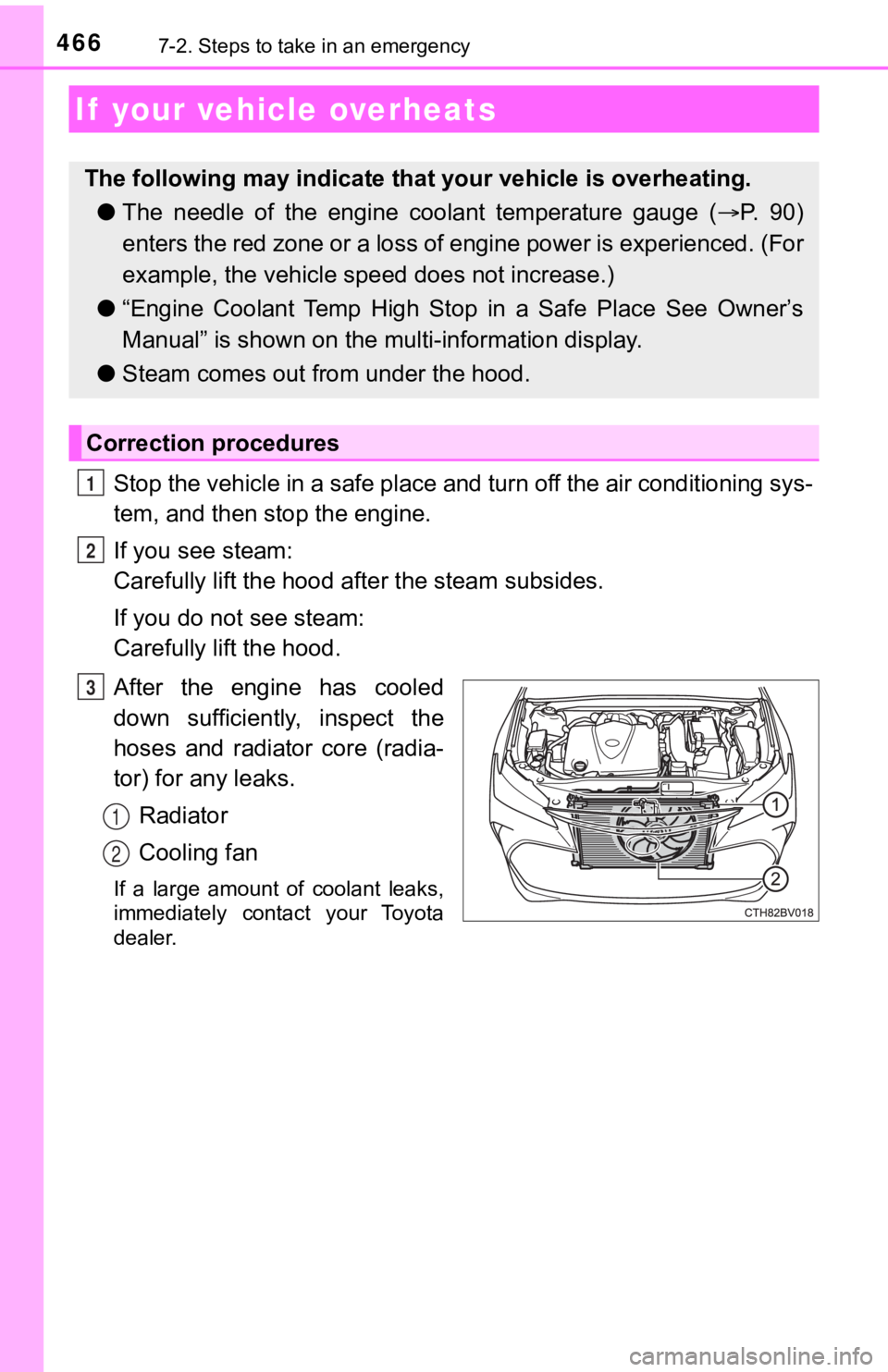
After the engine has cooled
down sufficiently, inspect the
hoses and radiator core (radia-
tor) for any leaks. Radiator
Cooling fan
If a large amount of coolant leaks,
immediately contact your Toyota
dealer.
If your vehicle overheats
The following may indicate that your vehicle is overheating.
● The needle of the engine c oolant temperature gauge (P. 90)
enters the red zone or a loss of engine power is experienced. ( For
example, the vehicle s peed does not increase.)
● “Engine Coolant Temp High Stop in a Safe Place See Owner’s
Manual” is shown on the mult i-information display.
● Steam comes out from under the hood.
Correction procedures
1
2
3
1
2
Page 467 of 540
4677-2. Steps to take in an emergency
7
When trouble arises
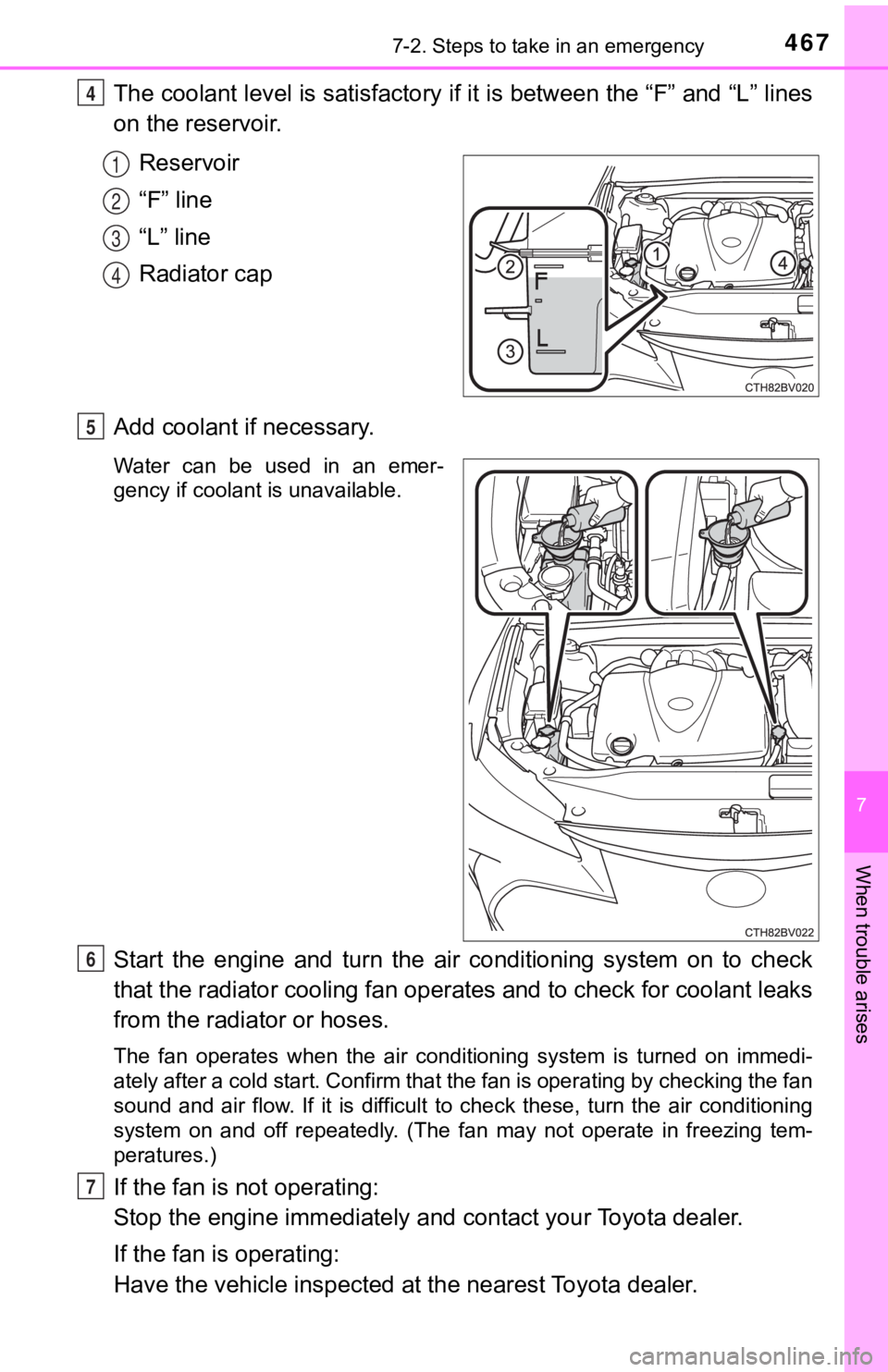
The coolant level is satisfactory if it is between the “F” and “L” lines
on the reservoir.
Reservoir
“F” line
“L” line
Radiator cap
Add coolant if necessary.
Water can be used in an emer-
gency if coolant is unavailable.
Start the engine and turn the ai r conditioning system on to check
that the radiator cooling fan operates and to check for coolant leaks
from the radiator or hoses.
The fan operates when the air conditioning system is turned on immedi-
ately after a cold start. Confirm that the fan is operating by checking the fan
sound and air flow. If it is difficult to check these, turn the air conditioning
system on and off repeatedly. (The fan may not operate in freez ing tem-
peratures.)
If the fan is not operating:
Stop the engine immediately and contact your Toyota dealer.
If the fan is operating:
Have the vehicle ins pected at the nearest Toyota dealer.
4
1
2
3
4
5
6
7
Page 468 of 540
4687-2. Steps to take in an emergency
WARNING
■To prevent an accident or injury when inspecting under the hood of
your vehicle
Observe the following precautions.
Failure to do so may result in serious injury such as burns.
● If steam is seen coming from under the hood, do not open the ho od until
the steam has subsided. The engine compartment may be very hot.
● Keep hands and clothing (especially a tie, a scarf or a muffler ) away from
the fan and belts. Failure to do so may cause the hands or clot hing to be
caught, resulting in serious injury.
● Do not loosen the radiator cap and the coolant reservoir cap wh ile the
engine and radiator are hot.
High temperature steam or coolant could spray out.
NOTICE
■ When adding engine coolant
Wait until the engine has cooled down before adding engine cool ant.
When adding coolant, do so slowly. Adding cool coolant to a hot engine too
quickly can cause damage to the engine.
■ To prevent damage to the cooling system
Observe the following precautions:
● Avoid contaminating the coolant with foreign matter (such as sa nd or dust
etc.).
● Do not use any coolant additives.