spare wheel TOYOTA AVALON 2020 Warranties & Maintenance Guides (in English)
[x] Cancel search | Manufacturer: TOYOTA, Model Year: 2020, Model line: AVALON, Model: TOYOTA AVALON 2020Pages: 260, PDF Size: 8.54 MB
Page 134 of 260
MICHELIN
132
tire or wheel, replace it with a properly inflated spare at once and have
your tires, including the spare, inspected by a tire professional.
A tire that hits a road hazard or object can be damaged but not have
any visible sign of damage on its surface. A tire damaged by an impact
can suddenly fail a day, a week, or even months later. You may not
recall having hit an object or a road hazard and may not see any tire
damage, but such an event may have damaged one or more of your
tires. Air loss, unusual tire wear, localized wear, or vibrations can also
be signs of internal tire damage and, accordingly, should be addressed
as promptly as are instances of visible tire damage.
If you suspect any damage to your tire or wheel from an impact with a
curb, pothole, debris on the road, or any other road hazard or object,
or if you feel or hear any unusual vibration, replace the tire and wheel\
with a properly inflated spare at once and immediately visit a qualified
tire professional.
Inspection
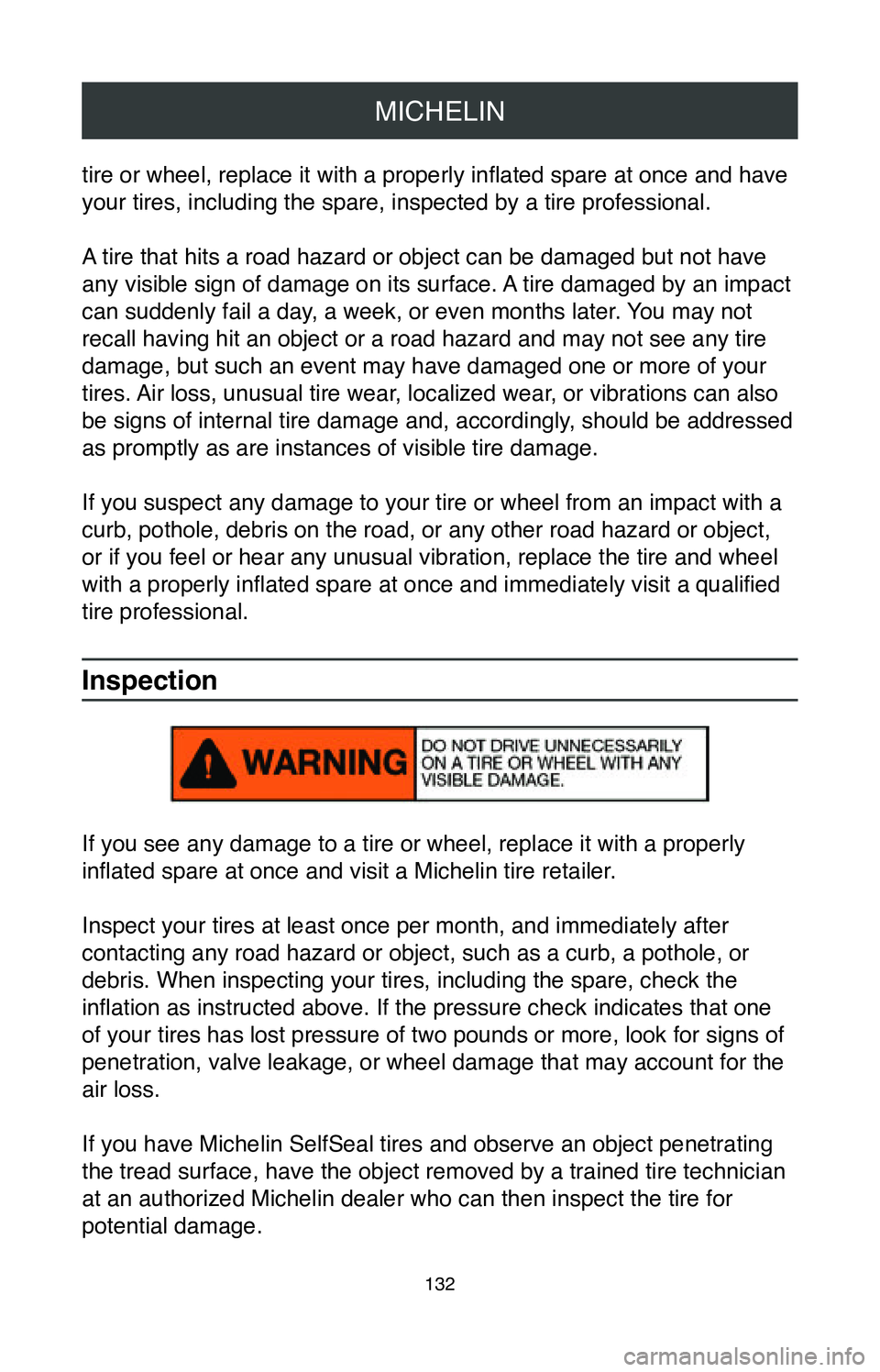
If you see any damage to a tire or wheel, replace it with a properly
inflated spare at once and visit a Michelin tire retailer.
Inspect your tires at least once per month, and immediately after
contacting any road hazard or object, such as a curb, a pothole, or
debris. When inspecting your tires, including the spare, check the
inflation as instructed above. If the pressure check indicates that one
of your tires has lost pressure of two pounds or more, look for signs of\
penetration, valve leakage, or wheel damage that may account for the
air loss.
If you have Michelin SelfSeal tires and observe an object penetrating
the tread surface, have the object removed by a trained tire technician
at an authorized Michelin dealer who can then inspect the tire for
potential damage.
Page 137 of 260
MICHELIN
135
Check How Your Tires Are Wearing at Least
Once Each Month
If your tires are wearing unevenly, such as the inside shoulder of the
tire wearing faster than the rest of the tread, or if you detect excessi\
ve
vibration, your vehicle may be out of alignment or balance. These
conditions not only shorten the life of your tires but adversely affect the
handling characteristics of your vehicle, which could be dangerous. If
you detect irregular wear or vibration, have your alignment and balance
checked immediately. Tires which have been run underinflated will
show more wear on the shoulders than in the center of the tread. Read
and follow the instructions on tire rotation and replacement below.
Tire Mixing
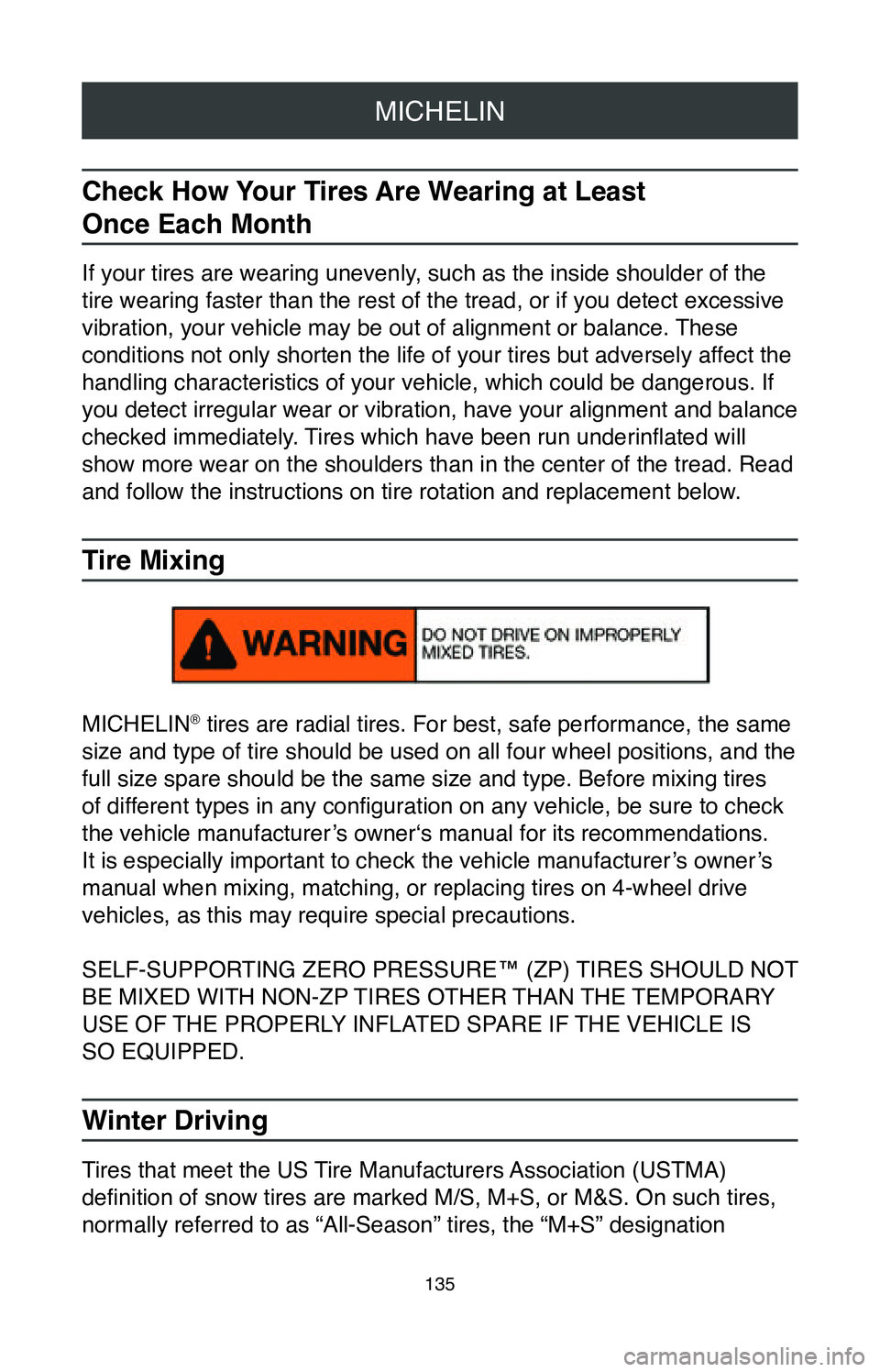
MICHELIN® tires are radial tires. For best, safe performance, the same
size and type of tire should be used on all four wheel positions, and th\
e
full size spare should be the same size and type. Before mixing tires
of different types in any configuration on any vehicle, be sure to check
the vehicle manufacturer’s owner‘s manual for its recommendations.
It is especially important to check the vehicle manufacturer’s owner’s
manual when mixing, matching, or replacing tires on 4-wheel drive
vehicles, as this may require special precautions.
SELF-SUPPORTING ZERO PRESSURE™ (ZP) TIRES SHOULD NOT
BE MIXED WITH NON-ZP TIRES OTHER THAN THE TEMPORARY
USE OF THE PROPERLY INFLATED SPARE IF THE VEHICLE IS
SO EQUIPPED.
Winter Driving
Tires that meet the US Tire Manufacturers Association (USTMA)
definition of snow tires are marked M/S, M+S, or M&S. On such tires,
normally referred to as “All-Season” tires, the “M+S” designation
Page 138 of 260
MICHELIN
136
is molded into the sidewall. Tires without this notation are not
recommended for winter driving in regions that experience
winter conditions.
Although All-Season tires are designed to provide reliable performance
in some winter conditions, the use of four winter tires is recommended
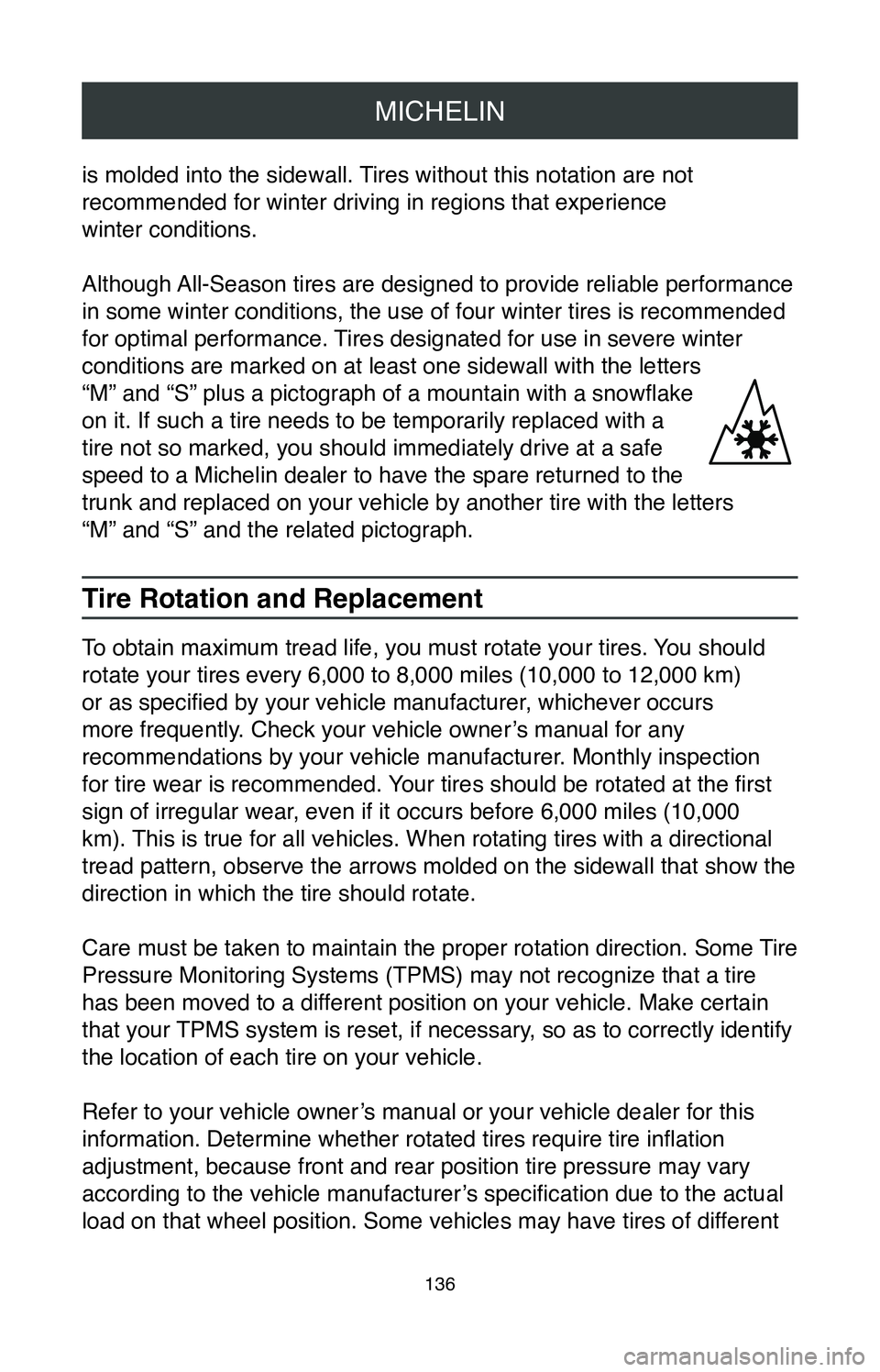
for optimal performance. Tires designated for use in severe winter
conditions are marked on at least one sidewall with the letters
“M” and “S” plus a pictograph of a mountain with a snowflake
on it. If such a tire needs to be temporarily replaced with a
tire not so marked, you should immediately drive at a safe
speed to a Michelin dealer to have the spare returned to the
trunk and replaced on your vehicle by another tire with the letters
“M” and “S” and the related pictograph.
Tire Rotation and Replacement
To obtain maximum tread life, you must rotate your tires. You should
rotate your tires every 6,000 to 8,000 miles (10,000 to 12,000 km)
or as specified by your vehicle manufacturer, whichever occurs
more frequently. Check your vehicle owner’s manual for any
recommendations by your vehicle manufacturer. Monthly inspection
for tire wear is recommended. Your tires should be rotated at the first
sign of irregular wear, even if it occurs before 6,000 miles (10,000
km). This is true for all vehicles. When rotating tires with a directional
tread pattern, observe the arrows molded on the sidewall that show the
direction in which the tire should rotate.
Care must be taken to maintain the proper rotation direction. Some Tire
Pressure Monitoring Systems (TPMS) may not recognize that a tire
has been moved to a different position on your vehicle. Make certain
that your TPMS system is reset, if necessary, so as to correctly identify
the location of each tire on your vehicle.
Refer to your vehicle owner’s manual or your vehicle dealer for this
information. Determine whether rotated tires require tire inflation
adjustment, because front and rear position tire pressure may vary
according to the vehicle manufacturer’s specification due to the actual
load on that wheel position. Some vehicles may have tires of different
Page 142 of 260
 MICHELIN
140
from the tires by raising the vehicle or by removing the tires from the \
vehicle. Failure to store tires in accordance with these instructions
could result in damage to your tires or p")
MICHELIN
140
from the tires by raising the vehicle or by removing the tires from the \
vehicle. Failure to store tires in accordance with these instructions
could result in damage to your tires or premature aging of the tires
and sudden tire failure. When tires are stored, be sure they are placed \
away from sources of heat and ozone such as hot pipes and electric
generators. Be sure that surfaces on which tires are stored are clean
and free from grease, gasoline or other substances which could
deteriorate the rubber. Tires exposed to these materials during storage
or driving could be subject to sudden failure.
One reason why your spare tire should be included in the tire rotation
schedule is that temperatures in a vehicle’s closed trunk, especially
in sunny geographical areas, can become high enough so that, over
a sustained period, they can cause small cracks or other changes to
the properties of a tire stored in the trunk. An accumulation of such
changes can weaken the tire and, especially if the tire is not kept
properly inflated, make it unsafe to use when it is needed.
Proper Tire Mounting
Tire mounting can be dangerous and must be done by professionally
trained persons using proper tools and procedures as specified by the
US Tire Manufacturers Association (USTMA).
Your tires should be mounted on wheels that are the correct size
and type and are in good, clean condition. Wheels that are bent,
chipped, rusted (steel wheels) or corroded (alloy wheels) may cause
tire damage. The inside of the tire must be free from foreign material.
Have your tire retailer check the wheels before mounting new tires.
Mismatched tires and rims can explode during mounting. Also,
mismatched tires and rims can result in dangerous tire failure on
the road. If a tire is mounted by error on the wrong-sized rim, do not
remount it on the proper rim – scrap it. It may have been damaged
internally (which is not externally visible) by having been dangerously
stretched and could fail on the highway, resulting in an accident.
Old valves may leak. When new tubeless tires are mounted, have
new valves of the correct type installed. Tubeless tires must be
mounted only on wheels designed for tubeless tires, i.e., wheels that
Page 143 of 260
MICHELIN
141
have safety humps or ledges. Always utilize valve caps capable of
containing the tire’s inflation, should the valve core leak. The valve
cap is the primary seal against air loss. Each tire and wheel assembly
should be balanced to ensure proper tire and vehicle performance and
to maintain tire warranty coverage. Tires and wheel assemblies that
are not balanced may cause steering difficulties, a bumpy ride, and
irregular tire wear.
Special Mounting Instructions For Self-Supporting
Zero Pressure™ (ZP) Tires
ZP tires can be more difficult to mount than conventional tires. They
should be mounted and demounted only by a properly trained tire
professional. ZP tires can generate a tremendous amount of heat
when run at low or zero pressure. ALWAYS ALLOW A ZP TIRE TO
COOL BEFORE ATTEMPTING TO HANDLE IT. FAILURE TO DO
SO COULD RESULT IN INJURY OR DEATH. Michelin
® ZP tires are
tubeless tires designed to operate in emergency conditions at low or
zero air inflation.
MICHELIN® Self Supporting Zero Pressure™ (Zp) Tires
and Special Sh-M (Symmetric Hump-Modified) Wheels
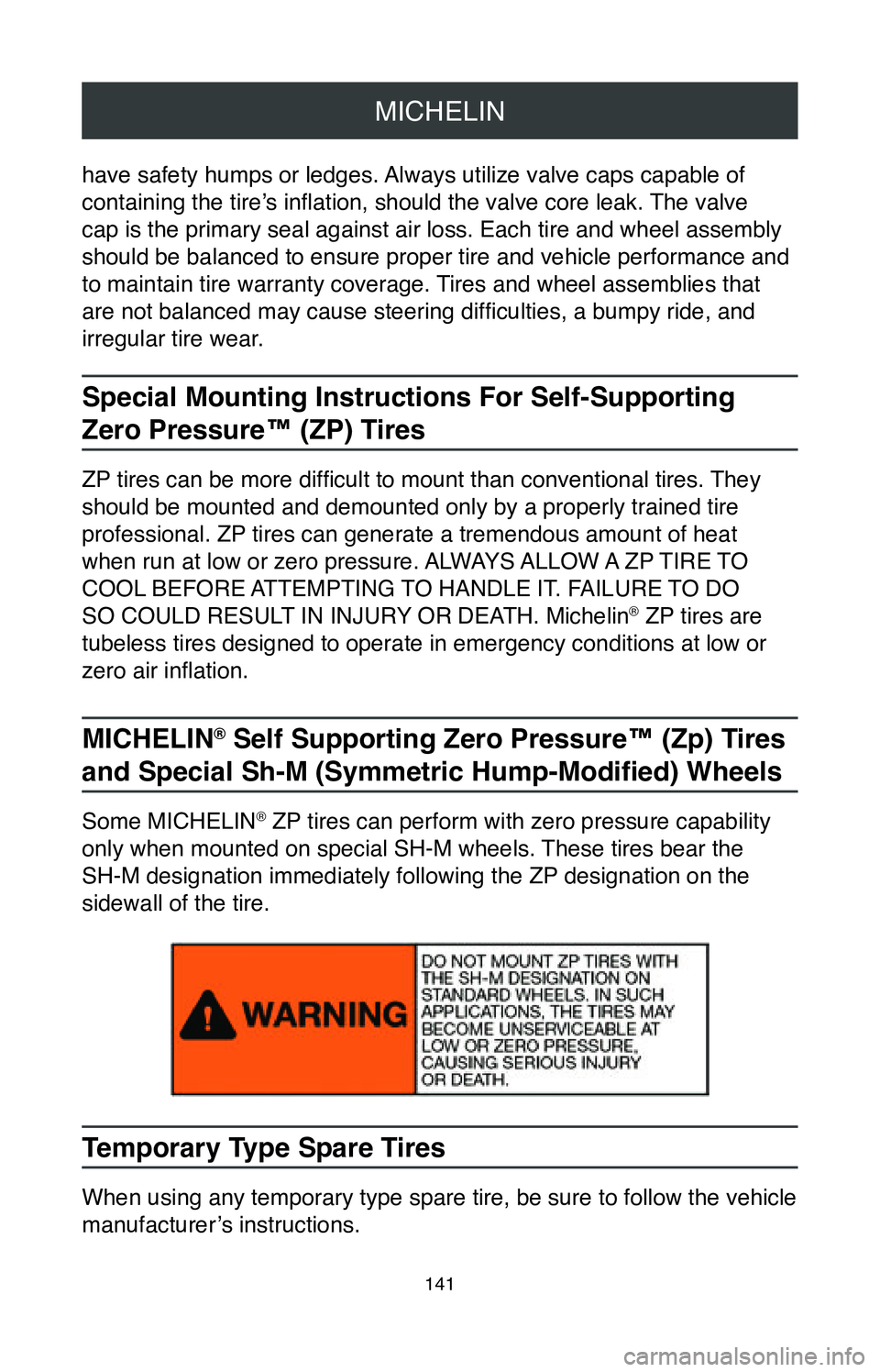
Some MICHELIN® ZP tires can perform with zero pressure capability
only when mounted on special SH-M wheels. These tires bear the
SH-M designation immediately following the ZP designation on the
sidewall of the tire.
Temporary Type Spare Tires
When using any temporary type spare tire, be sure to follow the vehicle \
manufacturer’s instructions.
Page 146 of 260
MICHELIN
144
SPEED THAT IS REASONABLE UNDER THE ROAD AND
WEATHER CONDITIONS.
•
AVOID DRIVING OVER POTHOLES, OBSTACLES, CURBS OR
EDGES OF PAVEMENT.
•
AVOID EXCESSIVE WHEEL SPINNING.
•
IF YOU SEE ANY DAMAGE TO A TIRE, REPLACE THE TIRE
WITH A PROPERLY INFLATED SPARE AND VISIT A QUALIFIED
TIRE PROFESSIONAL AT ONCE.
•
KEEP TIRES AND WHEELS PROPERLY ALIGNED, BALANCED,
AND ROTATED.
•
HAVE MOUNTING AND REPAIRS DONE BY A TIRE
PROFESSIONAL.
•
IF YOU HAVE ANY QUESTIONS, CONTACT YOUR MICHELIN
TIRE RETAILER.
FAILURE TO FOLLOW ANY OF THE RECOMMENDED
PRECAUTIONS CONTAINED IN THIS OWNER’S MANUAL CAN
LEAD TO ERRATIC VEHICLE BEHAVIOR OR TIRE DAMAGE,
POSSIBLY RESULTING IN AN ACCIDENT.
If you see or suspect any damage to your tires or wheels, contact your
local Michelin tire retailer, or visit our web site listed below for dealer
locations. If further assistance is required, contact:
IN THE USA 1-800-847-3435
or write:
Michelin North America, Inc.
Attention: Consumer Care Department
Post Office Box 19001
Greenville, SC 29602-9001
or visit: michelinman.com
Page 172 of 260
NITTO TIRE
170
• Find a safe place to pull off the road and allow the vehicle to
gradually decelerate. Apply light braking as required to stop safely.
•
Gradually pull over to the shoulder and come to a stop. Look for a
damaged tire on your vehicle.
•
Seek roadside assistance or change the damaged tire with your
spare tire.
•
Have all of your tires and the vehicle thoroughly inspected by a
tire professional.
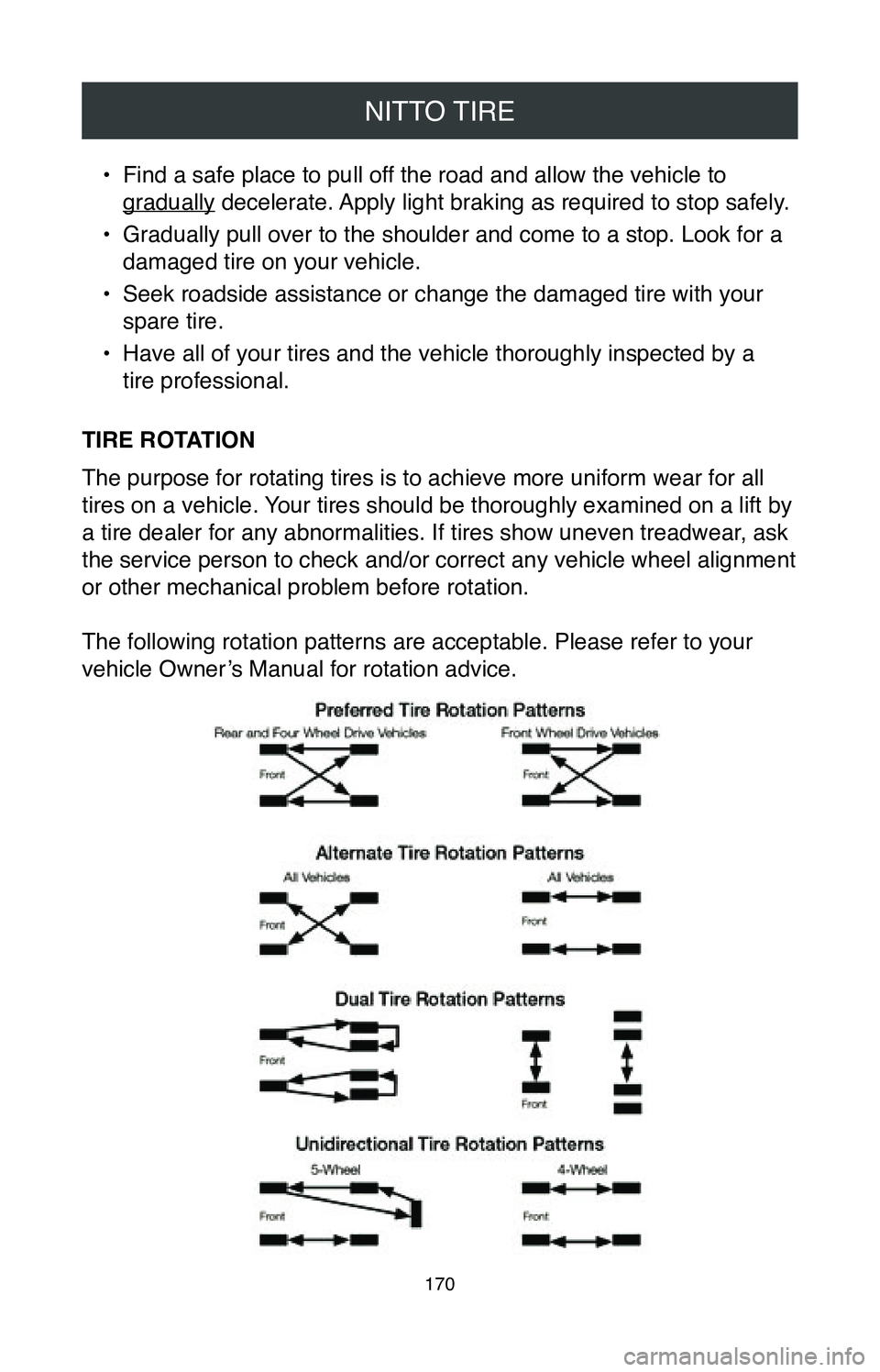
TIRE ROTATION
The purpose for rotating tires is to achieve more uniform wear for all
tires on a vehicle. Your tires should be thoroughly examined on a lift by
a tire dealer for any abnormalities. If tires show uneven treadwear, ask
the service person to check and/or correct any vehicle wheel alignment
or other mechanical problem before rotation.
The following rotation patterns are acceptable. Please refer to your
vehicle Owner’s Manual for rotation advice.
Page 173 of 260
NITTO TIRE
171
Full-size spare tires (not temporary spares) of the same size,
construction, and speed rating may be used in a five-tire
rotation pattern.
After rotation, check the inflation pressure of all the tires. The front
and rear tire pressures may vary according to the vehicle
manufacturer’s specifications.
Remember to follow your vehicle Owner’s Manual for tire rotation
intervals. Your Limited Warranty recommends Nitto brand tires to be
rotated as follows:
•
Every 3,500 miles or less for high performance (low profile) tires.
•
Every 7,500 miles or less for standard passenger and light
truck tires.
More frequent rotation or a thorough vehicle inspection may be
necessary if, upon inspection, irregular or erratic treadwear is
beginning to appear.
It is important to remember the following: •
These tire rotation recommendations do not take into account
different tire and construction types mixed on the vehicle.
•
Some tires cannot be rotated in the manner described. Such tires
include unidirectional tires. Unidirectional tread patterns must be
rotated front-to-rear only so that the direction of revolution does
not change.
•
Some vehicles are designed with different tire sizes on the front
and rear axles. Normally, such combinations will not allow rotation.
Prior to rotating, consult the vehicle Owner’s Manual.
•
For vehicles with dual rear wheels, see the vehicle Owner’s
Manual for the vehicle manufacturer’s procedures. If your vehicle
Owner’s Manual is not available, please contact the vehicle
manufacturer.
•
Some vehicles are equipped with wheels that limit the choice of
rotation pattern. Consult the vehicle Owner’s Manual.
•
Do not include temporary spare tires in the rotation pattern.
However, if your spare tire is the same size and type as a road tire
(for LT tires of the same size, type, and load rating), it should be
Page 227 of 260
TOYO TIRE
225
• Match tire size designations in pairs on an axle, except during the
temporary use of a spare tire.
•
If two radial tires and two non-radial tires are used on a vehicle, put
the radials on the rear axle. If radial and non-radial tires are used
on a vehicle equipped with dual rear tires, the radial tires may be
used on either axle.
SPEED-RATED TIRES •
If the vehicle Tire Information Placard and/or the vehicle Owner’s
Manual specifies speed-rated tires, the replacement tires must
have the same or higher speed rating to maintain vehicle speed
capability.
•
If a replacement tire has a lower speed capability than that
specified by the vehicle manufacturer, the vehicle’s speed must
be restricted to that of the replacement tire. Vehicle handling
could also be affected. Consult the vehicle Owner’s Manual or tire
manufacturer for recommendations.
•
If tires with different speed ratings are used, it is recommended
that the lower-speed-rated tires always be placed on the front axle.
This is to prevent a potential oversteer condition.
FOUR-WHEEL DRIVE (4WD) AND ALL-WHEEL DRIVE
(AWD) VEHICLES
If no instructions for tire mixing appear in the vehicle Owner’s Manual,
follow these guidelines: •
Do not mix tire sizes. All four tires must be marked with the same
tire size, unless otherwise specified by the vehicle manufacturer .
This also applies to winter/snow tires.
•
Do not mix tread pattern types such as all-terrain and all-season.
STUDLESS WINTER/SNOW TIRES •
It is always preferable to apply winter/snow tires to all wheel
positions, including dual tires, to maintain vehicle mobility
and control.
•
If winter/snow tires are applied to the front axle of any vehicle,
winter/snow tires must also be installed on the rear axle. DO NOT
apply winter/snow tires only to the front axle. This applies to all
Page 231 of 260
TOYO TIRE
229
If you experience a blowout or a sudden tire failure, the following
information should be helpful:•
When the tire failure occurs, you may hear a loud noise, or feel a
vibration, and/or the vehicle may pull toward the side of the failed
tire. Do not abruptly brake or turn.
•
Maintain steady pressure on the accelerator pedal.
•
Hold the steering wheel firmly and steer to maintain your
lane position.
•
Find a safe place to pull off the road and allow the vehicle to
gradually decelerate. Apply light braking as required to stop safely.
•
Gradually pull over to the shoulder and come to a stop. Look for a
damaged tire on your vehicle.
•
Seek roadside assistance or change the damaged tire with your
spare tire.
•
Have all of your tires and the vehicle thoroughly inspected by a
tire professional.
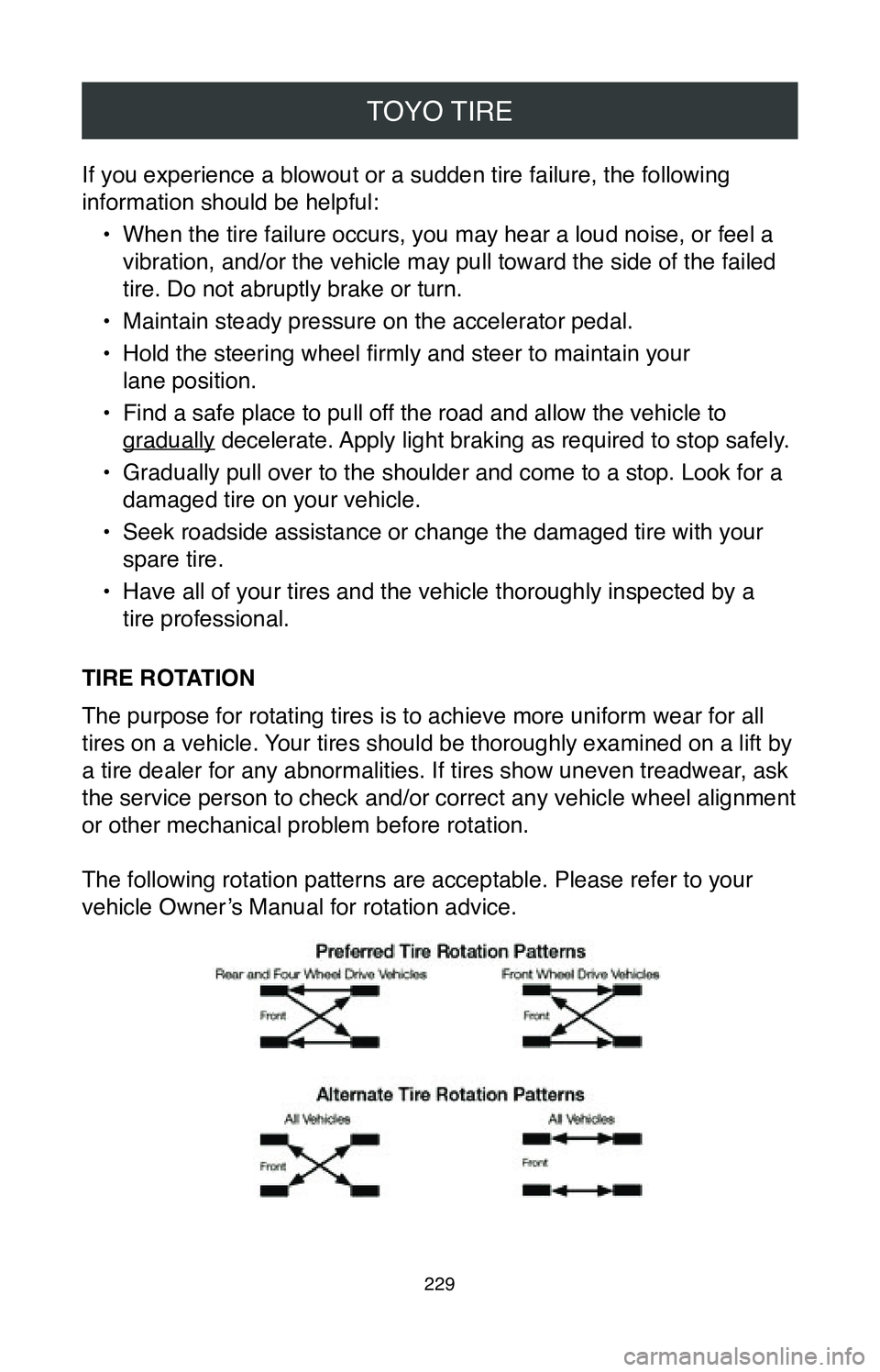
TIRE ROTATION
The purpose for rotating tires is to achieve more uniform wear for all
tires on a vehicle. Your tires should be thoroughly examined on a lift by
a tire dealer for any abnormalities. If tires show uneven treadwear, ask
the service person to check and/or correct any vehicle wheel alignment
or other mechanical problem before rotation.
The following rotation patterns are acceptable. Please refer to your
vehicle Owner’s Manual for rotation advice.