fuel TOYOTA AVALON 2022 Service Manual
[x] Cancel search | Manufacturer: TOYOTA, Model Year: 2022, Model line: AVALON, Model: TOYOTA AVALON 2022Pages: 572, PDF Size: 9.42 MB
Page 463 of 572

4637-2. Steps to take in an emergency
7
When trouble arises
WARNING
■Maintenance of the tires
Each tire, including the spare (if provided), should be checked monthly
when cold and inflated to the inflation pressure recommended by the
vehicle manufacturer on the vehicle placard or tire inflation p ressure
label (tire and load information label). (If your vehicle has t ires of a dif-
ferent size than the size indicated on the vehicle placard or t ire inflation
pressure label [tire and load information label], you should de termine
the proper tire inflation p ressure for those tires.)
As an added safety feature, your vehicle has been equipped with a tire
pressure monitoring system (TPMS -tire pressure warning system) that
illuminates a low tire pressure telltale (tire pressure warning light) when
one or more of your tires is significantly under-inflated. Acco rdingly,
when the low tire pressure telltale (tire pressure warning ligh t) illumi-
nates, you should stop and check your tires as soon as possible , and
inflate them to the proper pressure. Driving on a significantly under-
inflated tire causes the tire to overheat and can lead to tire failure.
Under-inflation also reduces fuel efficiency and tire tread lif e, and may
affect the vehicle’s handling and stopping ability.
Please note that the TPMS (tire pressure warning system) is not a sub-
stitute for proper tire maintenance, and it is the driver’s res ponsibility to
maintain correct tire pressure, even if under-inflation has not reached
the level to trigger illumination of the TPMS low tire pressure telltale (tire
pressure warning light).
Your vehicle has also been equipped with a TPMS (tire pressure warn-
ing system) malfunction indicato r to indicate when the system is not
operating properly. The TPMS (tire pressure warning system) mal func-
tion indicator is combined with the low tire pressure telltale (tire pressure
warning light). When the system detects a malfunction, the tell tale will
flash for approximately one minute and then remain continuously illumi-
nated. This sequence will continue upon subsequent vehicle star t-ups
as long as the malfunction exists . When the malfunction indicator is illu-
minated, the system may not be able to detect or signal low tir e pres-
sure as intended.
TPMS (tire pressure warning system) malfunctions may occur for a vari-
ety of reasons, including the installation of replacement or alternate tires
or wheels on the vehicle that prevent the TPMS (tire pressure w arning
system) from functioning properly. Always check the TPMS (tire pres-
sure warning system) malfunction telltale after replacing one or more
tires or wheels on your vehicle to ensure that the replacement or alter-
nate tires and wheels allow the TPMS (tire pressure warning system) to
continue to function properly.
Page 467 of 572
4677-2. Steps to take in an emergency
7
When trouble arises
■Warning messages
The warning messages explained below may differ from the actual messages
according to operation conditions and vehicle specifications.
■ System warning lights
The master warning light does not come on or flash in the following cases.
Instead, a separate system warning light will come on along wit h a message
shown on the multi-information display.
● Malfunction in the ABS
The ABS warning light comes on. ( P. 456)
● Malfunction in the tire pressure warning system
The tire pressure warning light comes on. ( P. 459)
● Remaining fuel level is low
The low fuel level warning light comes on. ( P. 458)
■ If a message instructing to refer to the Owner’s Manual is disp layed
● If the following messages are shown, there may be a malfunction .
Immediately stop the vehicle in a safe place and contact your T oyota dealer.
Continuing to drive the vehicle may be dangerous.
• “Low Braking Power Stop in a Safe Place See Owner’s Manual”
• “Oil Pressure Low Stop in a Safe Place See Owner’s Manual”
• “Charging System Malfunction Stop in a Safe Place See Owner’s Man-
ual”
● If the following message is shown, there may be a malfunction.
Immediately have the vehicle inspected by your Toyota dealer.
• “Smart Key System Malfunction See Owner’s Manual”
● If “Engine Coolant Temp High Stop in a Safe Place See Owner’s Manual” is
displayed, follow the instructions accordingly. ( P. 492)
■ If “Shift to P Before Exiting Vehicle” is shown
Message is displayed when the driver’s door is opened without t urning the
engine switch off with the shift lever in any position other than P.
Shift the shift lever to P.
■ If “Auto Power Off to Con serve Battery” is displayed
Power was turned off due to the automatic power off function.
Next time when starting the engine, increase the engine speed s lightly and
maintain that level for approximately 5 minutes to recharge the battery.
Page 482 of 572
4827-2. Steps to take in an emergency
One of the following may be the cause of the problem:
● There may not be sufficient fuel in the vehicle’s tank.
Refuel the vehicle.
● The engine may be flooded.
Try to restart the engine again following correct starting proc edures.
( P. 186)
● There may be a malf unction in the engine immobilizer system.
( P. 77)
One of the following may be the cause of the problem:
● The battery may be discharged. ( P. 487)
● The battery terminal connecti ons may be loose or corroded.
The engine starting system may be malfunctioning due to an elec trical
problem such as electronic key battery depletion or a blown fus e.
However, an interim measure is a vailable to start the engine.
( P. 483)
If the engine will not star t
If the engine will not start eve n though correct starting proce -
dures are being followed ( P. 186), consider each of the follow-
ing points:
The engine will not start even t hough the starter motor operates
normally.
The starter motor turns over slowly, the interior lights and he ad-
lights are dim, or the horn does not sound or sounds at a low
volume.
The starter motor d oes not turn over
Page 497 of 572

497
8Vehicle specifications
8-1. SpecificationsMaintenance data (fuel, oil level, etc.) .......... 498
Fuel information ................ 509
Tire information ................. 512
8-2. Customization Customizable features ...... 525
8-3. Items to initialize Items to initialize ............... 533
Page 498 of 572
4988-1.Specifications
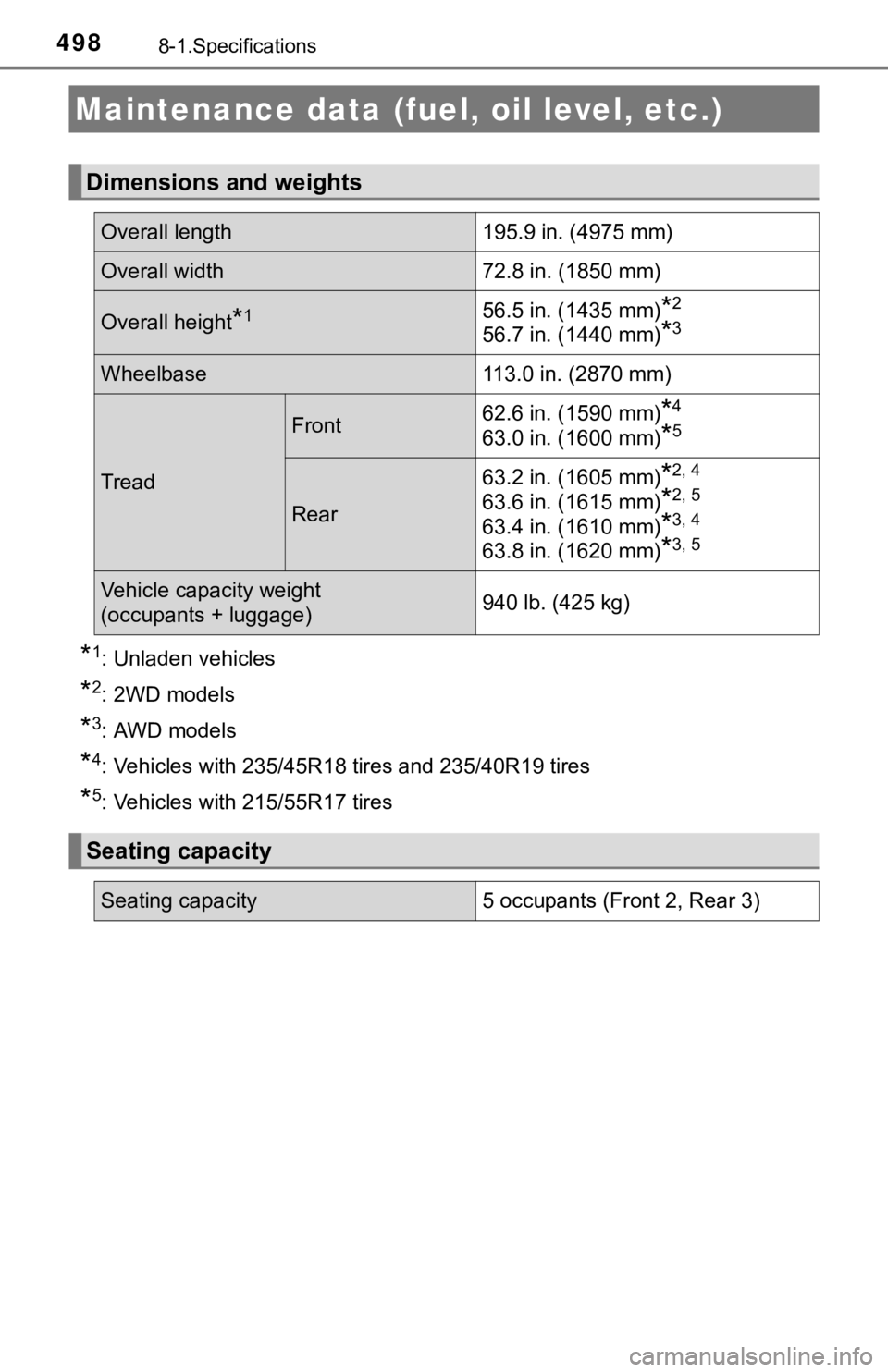
*1: Unladen vehicles
*2: 2WD models
*3: AWD models
*4: Vehicles with 235/45R18 tires and 235/40R19 tires
*5: Vehicles with 215/55R17 tires
Maintenance data (fuel, oil level, etc.)
Dimensions and weights
Overall length195.9 in. (4975 mm)
Overall width 72.8 in. (1850 mm)
Overall height*156.5 in. (1435 mm)*2
56.7 in. (1440 mm)*3
Wheelbase113.0 in. (2870 mm)
Tread
Front62.6 in. (1590 mm)*4
63.0 in. (1600 mm)*5
Rear63.2 in. (1605 mm)
*2, 4
63.6 in. (1615 mm)*2, 5
63.4 in. (1610 mm)*3, 4
63.8 in. (1620 mm)*3, 5
Vehicle capacity weight
(occupants + luggage)
940 lb. (425 kg)
Seating capacity
Seating capacity
5 occupants (Front 2, Rear 3)
Page 500 of 572
5008-1. Specifications
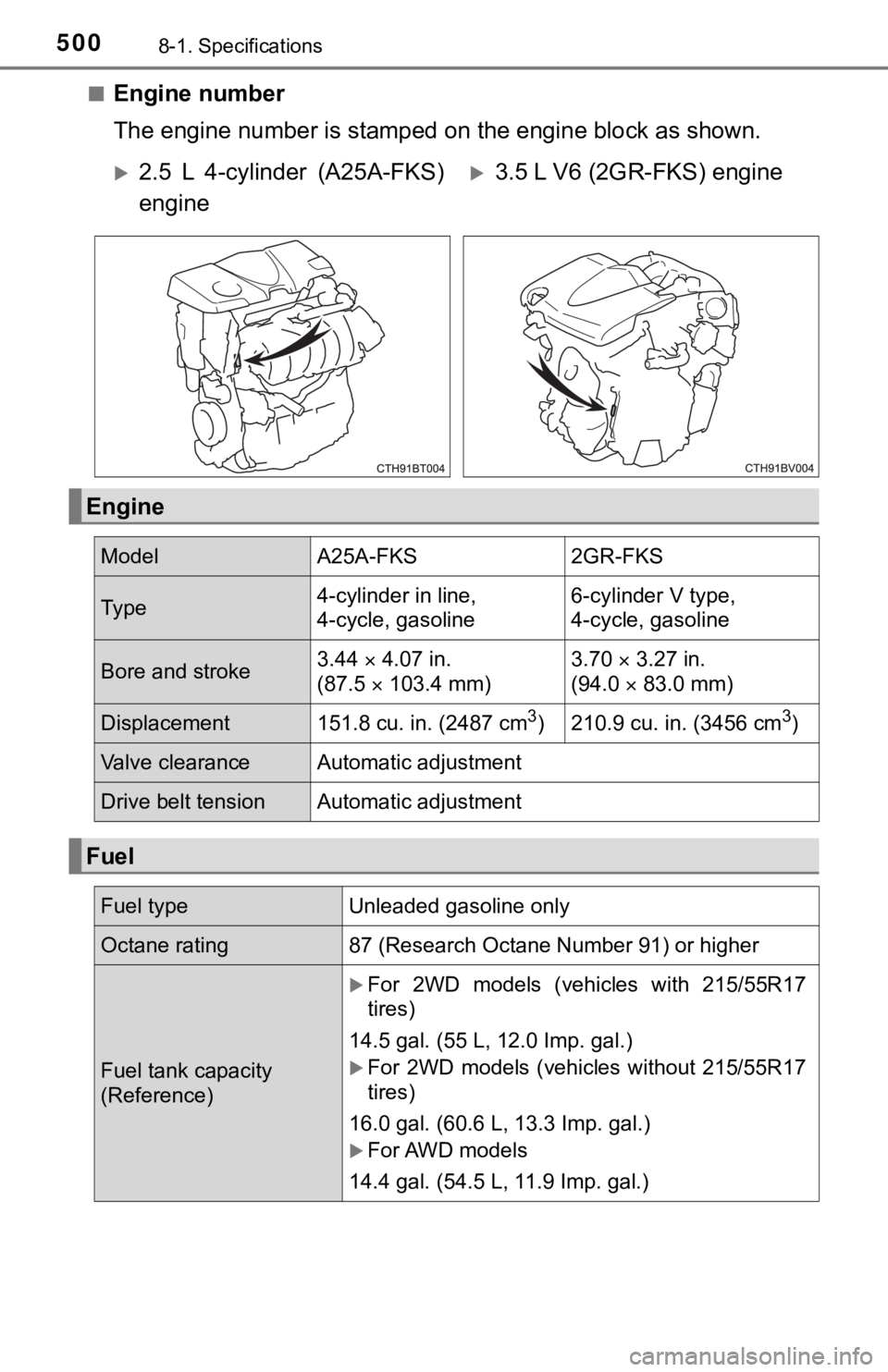
■Engine number
The engine number is stamped on the engine block as shown.
2.5 L 4-cylinder (A25A-FKS)
engine3.5 L V6 (2GR-FKS) engine
Engine
Model A25A-FKS 2GR-FKS
Ty p e4-cylinder in line,
4-cycle, gasoline 6-cylinder V type,
4-cycle, gasoline
Bore and stroke
3.44
4.07 in.
(87.5 103.4 mm) 3.70
3.27 in.
(94.0 83.0 mm)
Displacement 151.8 cu. in. (2487 cm3) 210.9 cu. in. (3456 cm3)
Valve clearance Automatic adjustment
Drive belt tension Automatic adjustment
Fuel
Fuel type Unleaded gasoline only
Octane rating87 (Research Octane Number 91) or higher
Fuel tank capacity
(Reference)
For 2WD models (vehicles with 215/55R17
tires)
14.5 gal. (55 L, 12.0 Imp. gal.)
For 2WD models (vehicles without 215/55R17
tires)
16.0 gal. (60.6 L, 13.3 Imp. gal.)
For AWD models
14.4 gal. (54.5 L, 11.9 Imp. gal.)
Page 501 of 572
![TOYOTA AVALON 2022 Service Manual 5018-1. Specifications
8
Vehicle specifications
■Oil capacity (Drain and refill [Reference*])
*: The engine oil capacity is a reference quantity to be used when changing
the engine oil. Warm up a](/img/14/59240/w960_59240-500.png "TOYOTA AVALON 2022 Service Manual 5018-1. Specifications
8
Vehicle specifications
■Oil capacity (Drain and refill [Reference*])
*: The engine oil capacity is a reference quantity to be used when changing
the engine oil. Warm up a")
5018-1. Specifications
8
Vehicle specifications
■Oil capacity (Drain and refill [Reference*])
*: The engine oil capacity is a reference quantity to be used when changing
the engine oil. Warm up and turn off the engine, wait more than 5 minutes,
and check the oil level on the dipstick.
■
Engine oil selection
2.5 L 4-cylinder (A25A-FKS) engine
“Toyota Genuine Motor Oil” is used in your Toyota vehicle. Use
Toyota approved “Toyota Genuine Motor Oil” or equivalent to sat -
isfy the following grade and viscosity.
Oil grade: ILSAC GF-6B multigrade engine oil
Recommended viscosity: SAE 0W-16
SAE 0W-16 is the best choice for
good fuel economy and good start-
ing in cold weather.
If SAE 0W-16 is not available, SAE
0W-20 oil may be used. However,
it must be replaced with SAE 0W-
16 at the next oil change.
Oil viscosity (0W-16 is explained here as an example):
• The 0W in 0W-16 indicates the characteristic of the oil which allows cold
startability. Oils with a lower value before the W allow for ea sier starting of
the engine in cold weather.
• The 16 in 0W-16 indicates the viscosity characteristic of the oil when the
oil is at high temperature. An oil with a higher viscosity (one with a higher
value) may be better suited if the vehicle is operated at high speeds, or
under extreme load conditions.
Lubrication system
With filterWithout filter
2.5 L 4-cylinder
(A25A-FKS) engine4.8 qt.
(4.5 L, 4.0 Imp. qt.)4.4 qt.
(4.2 L, 3.7 Imp. qt.)
3.5 L V6 (2GR-FKS)
engine5.7 qt.
(5.4 L, 4.8 Imp. qt.)5.6 qt.
(5.3 L, 4.7 Imp. qt.)
Outside temperature
Page 502 of 572
5028-1. Specifications
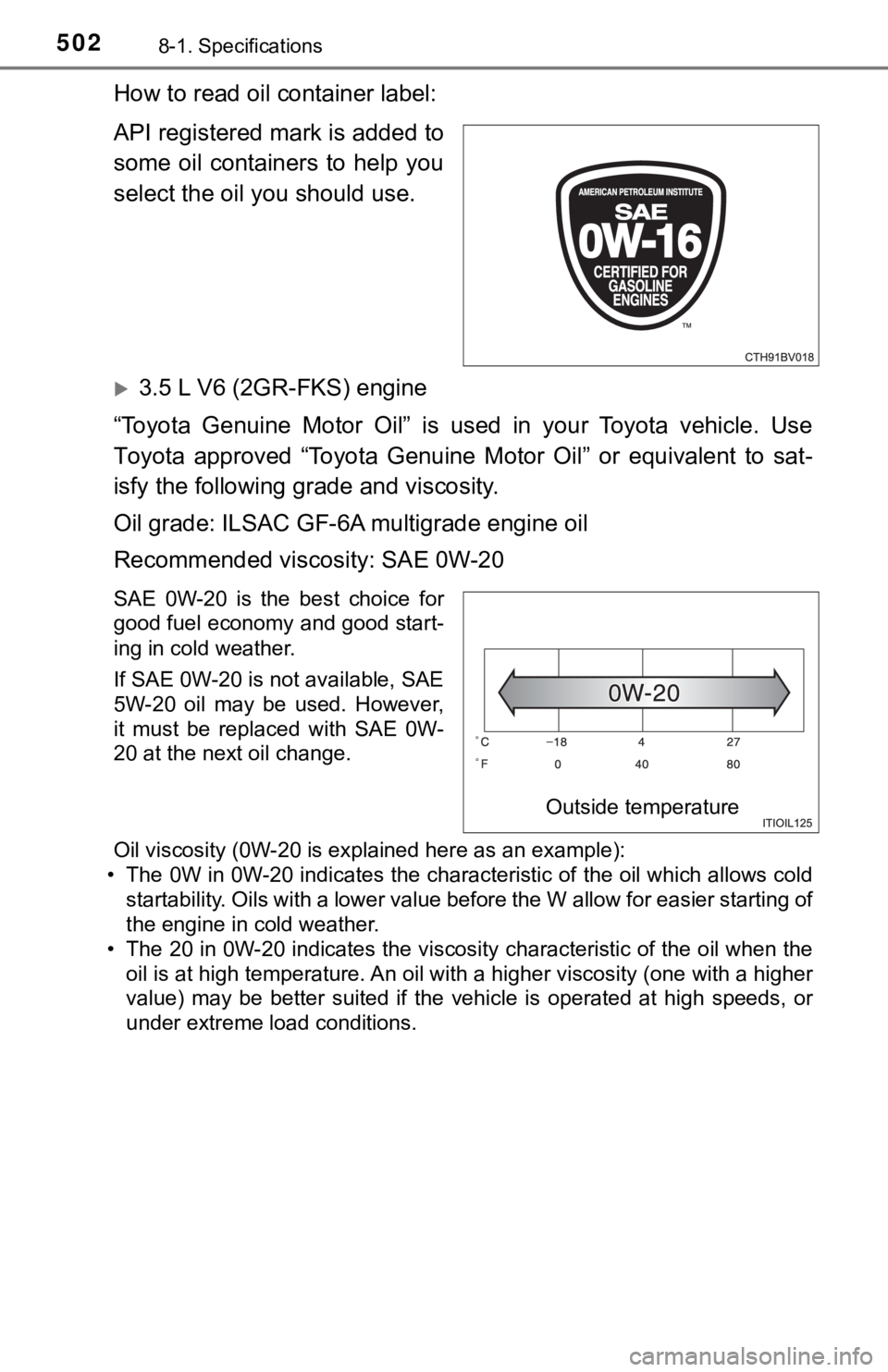
How to read oil container label:
API registered mark is added to
some oil containers to help you
select the oil you should use.
3.5 L V6 (2GR-FKS) engine
“Toyota Genuine Motor Oil” is used in your Toyota vehicle. Use
Toyota approved “Toyota Genuine Motor Oil” or equivalent to sat -
isfy the following grade and viscosity.
Oil grade: ILSAC GF-6A multigrade engine oil
Recommended viscosity: SAE 0W-20
SAE 0W-20 is the best choice for
good fuel economy and good start-
ing in cold weather.
If SAE 0W-20 is not available, SAE
5W-20 oil may be used. However,
it must be replaced with SAE 0W-
20 at the next oil change.
Oil viscosity (0W-20 is explained here as an example):
• The 0W in 0W-20 indicates the characteristic of the oil which allows cold
startability. Oils with a lower value before the W allow for ea sier starting of
the engine in cold weather.
• The 20 in 0W-20 indicates the viscosity characteristic of the oil when the
oil is at high temperature. An oil with a higher viscosity (one with a higher
value) may be better suited if the vehicle is operated at high speeds, or
under extreme load conditions.
Outside temperature
Page 509 of 572
5098-1. Specifications
8
Vehicle specifications
■Gasoline quality
In very few cases, driveability problems may be caused by the b rand of gaso-
line you are using. If driveability problems persist, try changing the brand of
gasoline. If this does not correct the problem, consult your To yota dealer.
■ Recommendation of the use of gaso line containing detergent additives
● Toyota recommends the use of gasoline that contains detergent a dditives to
avoid the build-up of engine deposits.
● All gasoline sold in the U.S.A. contains minimum detergent addi tives to
clean and/or keep clean intake systems, per EPA’s lowest additi ves concen-
tration program.
● Toyota strongly recommends the use of Top Tier Detergent Gasoli ne. For
more information on Top Tier Detergent Gasoline and a list of m arketers,
please go to the official website www.toptiergas.com.
Fuel information
You must only use unleaded gasoline.
Select octane rating 87 (Research Octane Number 91) or higher.
Use of unleaded gasoline with an octane rating lower than 87
may result in engine knocking. Persistent knocking can lead to
engine damage.
At minimum, the gasoline you use should meet the specifications of
ASTM D4814 in the U.S.A..
Page 510 of 572
5108-1. Specifications
■Recommendation of the use of low emissions gasoline
Gasolines containing oxygenates such as ethers and ethanol, as well as
reformulated gasolines, are available in some cities. These fue ls are typically
acceptable for use, providing they meet other fuel requirements .
Toyota recommends these fuels, since the formulations allow for reduced
vehicle emissions.
■ Non-recommendation of the use of blended gasoline
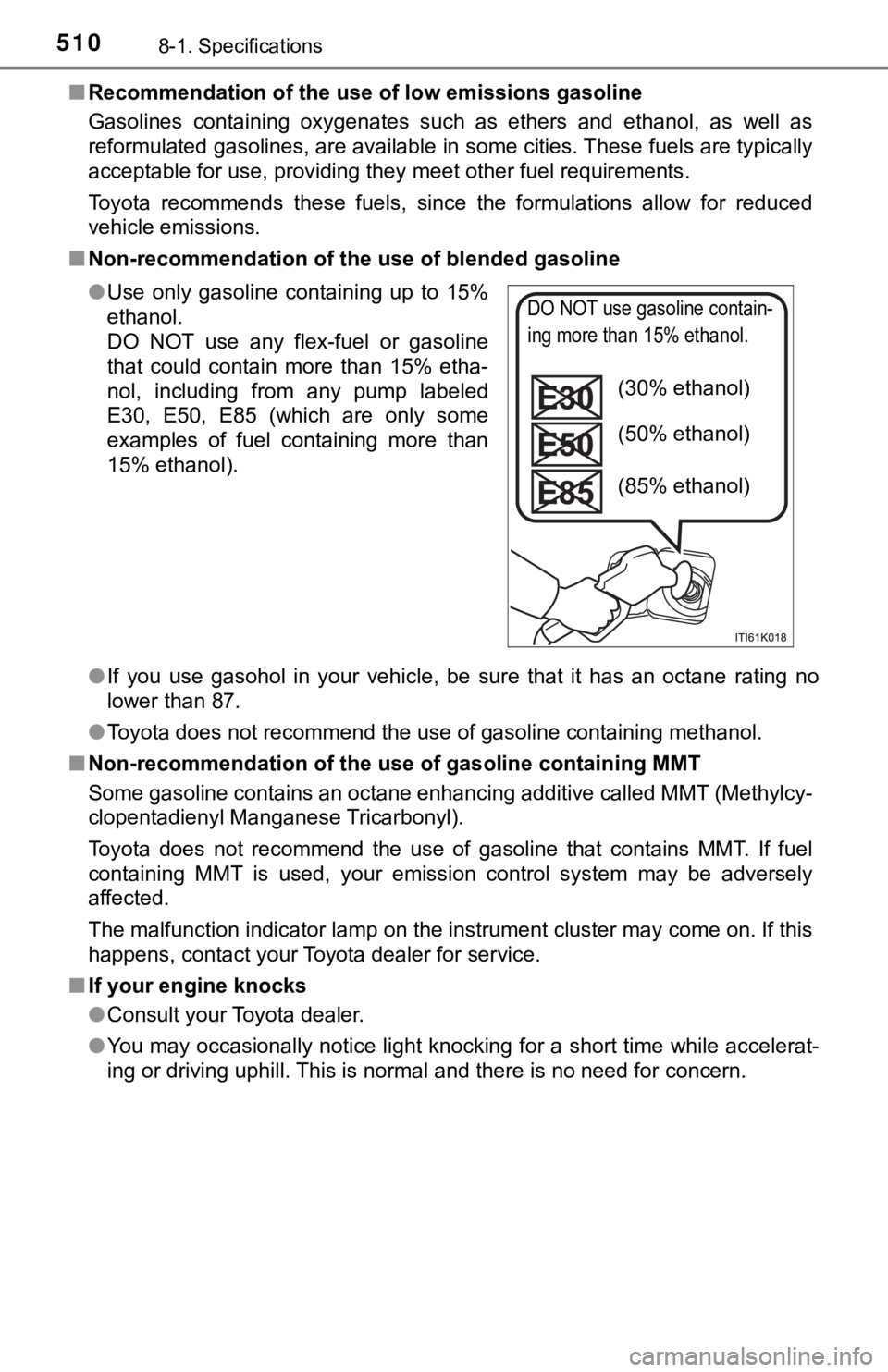
●If you use gasohol in your vehicle, be sure that it has an octa ne rating no
lower than 87.
● Toyota does not recommend the use of gasoline containing methan ol.
■ Non-recommendation of the use of gasoline containing MMT
Some gasoline contains an octane enhancing additive called MMT (Methylcy-
clopentadienyl Manganese Tricarbonyl).
Toyota does not recommend the use of gasoline that contains MMT. If fuel
containing MMT is used, your emission control system may be adv ersely
affected.
The malfunction indicator lamp on the instrument cluster may come on. If this
happens, contact your Toyota dealer for service.
■ If your engine knocks
●Consult your Toyota dealer.
● You may occasionally notice light knocking for a short time whi le accelerat-
ing or driving uphill. This is normal and there is no need for concern.
●
Use only gasoline containing up to 15%
ethanol.
DO NOT use any flex-fuel or gasoline
that could contain more than 15% etha-
nol, including from any pump labeled
E30, E50, E85 (which are only some
examples of fuel containing more than
15% ethanol).
DO NOT use gasoline contain-
ing more than 15% ethanol.
(30% ethanol)
(50% ethanol)
(85% ethanol)