belt TOYOTA AVALON 2022 Workshop Manual
[x] Cancel search | Manufacturer: TOYOTA, Model Year: 2022, Model line: AVALON, Model: TOYOTA AVALON 2022Pages: 572, PDF Size: 9.42 MB
Page 390 of 572

3906-1. Maintenance and care
■Caring for leather areas
Toyota recommends cleaning the interior of the vehicle at least twice a year to
maintain the quality of the vehicle's interior.
■ Shampooing the carpets
There are several commercial foaming-type cleaners available. U se a sponge
or brush to apply the foam. Rub in overlapping circles. Do not use water.
Wipe dirty surfaces and let them dry. Excellent results are obt ained by keep-
ing the carpet as dry as possible.
■ Seat belts
Clean with mild soap and lukewarm water using a cloth or sponge . Also
check the belts periodically for excessive wear, fraying or cut s.
WARNING
■ Water in the vehicle
● Do not splash or spill liquid in the vehicle.
Doing so may cause electrical components, etc., to malfunction or catch
fire.
● Do not get any of the SRS components or wiring in the vehicle interior wet.
(P. 38)
An electrical malfunction may cause the airbags to deploy or no t function
properly, resulting in death or serious injury.
● Vehicles with wireless charger:
Do not let the wireless charger ( P. 366) get wet. Failure to do so may
cause the charger to become hot and cause burns or could cause electric
shock resulting in death or serious injury.
■ Cleaning the interior (especially instrument panel)
Do not use polish wax or polish cleaner. The instrument panel m ay reflect
off the windshield, obstructing the driver’s view and leading to an accident,
resulting in death or serious injury.
Page 396 of 572
3966-2. Maintenance
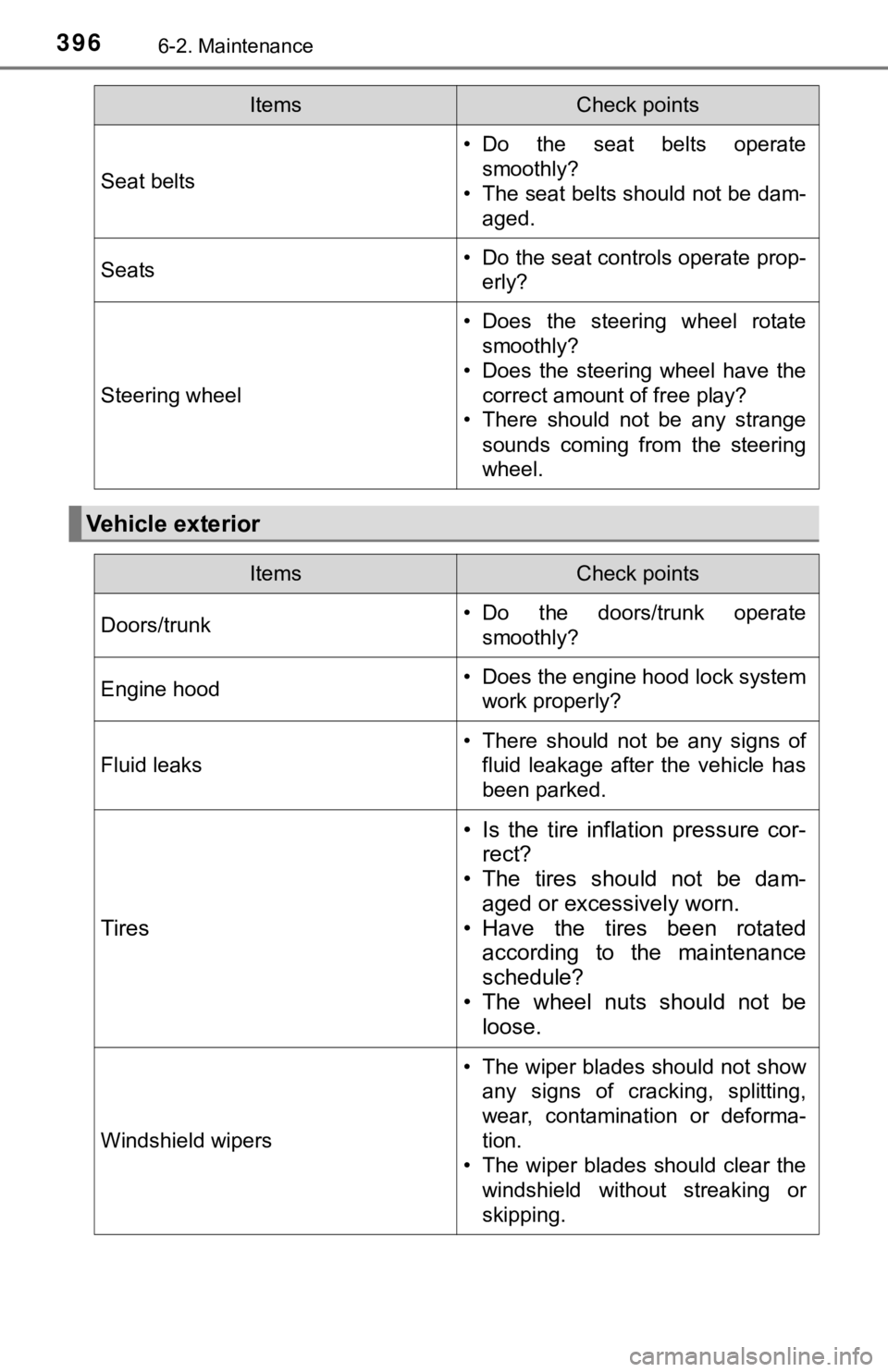
Seat belts
• Do the seat belts operatesmoothly?
• The seat belts should not be dam- aged.
Seats• Do the seat controls operate prop-erly?
Steering wheel
• Does the steering wheel rotatesmoothly?
• Does the steering wheel have the correct amount of free play?
• There should not be any strange
sounds coming from the steering
wheel.
Vehicle exterior
ItemsCheck points
ItemsCheck points
Doors/trunk• Do the doors/trunk operatesmoothly?
Engine hood• Does the engine hood lock systemwork properly?
Fluid leaks
• There should not be any signs offluid leakage after the vehicle has
been parked.
Tires
• Is the tire inflation pressure cor-rect?
• The tires should not be dam-
aged or excessively worn.
• Have the tires been rotated according to the maintenance
schedule?
• The wheel nuts should not be loose.
Windshield wipers
• The wiper blades should not show
any signs of cracking, splitting,
wear, contamination or deforma-
tion.
• The wiper blades should clear the windshield without streaking or
skipping.
Page 400 of 572
4006-3. Do-it-yourself maintenance
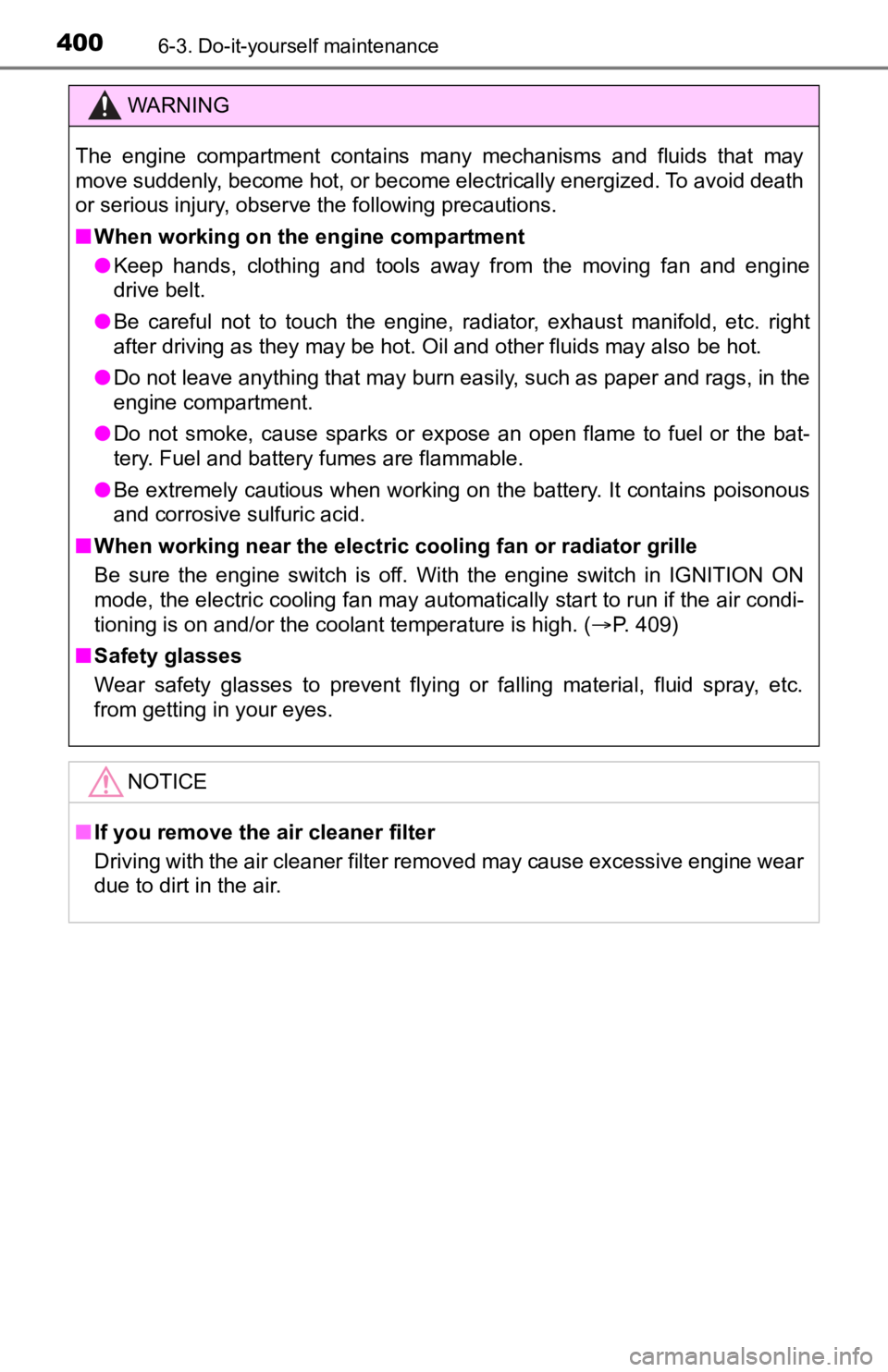
WARNING
The engine compartment contains many mechanisms and fluids that may
move suddenly, become hot, or become electrically energized. To avoid death
or serious injury, observe the following precautions.
■ When working on the engine compartment
● Keep hands, clothing and tools away from the moving fan and engine
drive belt.
● Be careful not to touch the engine, radiator, exhaust manifold, etc. right
after driving as they may be hot. Oil and other fluids may also be hot.
● Do not leave anything that may burn easily, such as paper and r ags, in the
engine compartment.
● Do not smoke, cause sparks or expose an open flame to fuel or t he bat-
tery. Fuel and battery fumes are flammable.
● Be extremely cautious when working on the battery. It contains poisonous
and corrosive sulfuric acid.
■ When working near the electric cooling fan or radiator grille
Be sure the engine switch is off. With the engine switch in IGNITION ON
mode, the electric cooling fan may automatically start to run if the air condi-
tioning is on and/or the coolant temperature is high. ( P. 409)
■ Safety glasses
Wear safety glasses to prevent flying or falling material, fluid spray, etc.
from getting in your eyes.
NOTICE
■If you remove the air cleaner filter
Driving with the air cleaner filter removed may cause excessive engine wear
due to dirt in the air.
Page 426 of 572

4266-3. Do-it-yourself maintenance
WARNING
■When inspecting or replacing tires
Observe the following precautions to prevent accidents.
Failure to do so may cause damage to parts of the drive train as well as
dangerous handling characteristics, which may lead to an accide nt
resulting in death o r serious injury.
●Do not mix tires of different ma kes, models or tread patterns.
Also, do not mix tires of remarkably different treadwear.
●Do not use tire sizes other th an those recommended by Toyota.
●Do not mix differently constructed tires (radial, bias-belted o r bias-ply
tires).
●Do not mix summer, all season and snow tires.
●Do not use tires that have been used on another vehicle.
Do not use tires if you do not kn ow how they were used previously.
■When initializing the tire pressure warning system
Do not initialize the tire press ure warning system without firs t adjusting
the tire inflation pressure to t he specified level. Otherwise, the tire pres-
sure warning light may not come on even if the tire inflation p ressure is
low, or it may come on when the tire inflation pressure is actu ally nor-
mal.
Page 452 of 572
4527-2. Steps to take in an emergency
When using a flat-bed truck to transport the vehicle, use tire strapping
belts. Refer to the owner's manual of the flat-bed truck for the tire
strapping method.
In order to suppress vehicle movement during transportation, se t the
parking brake and turn the engine switch off.
NOTICE
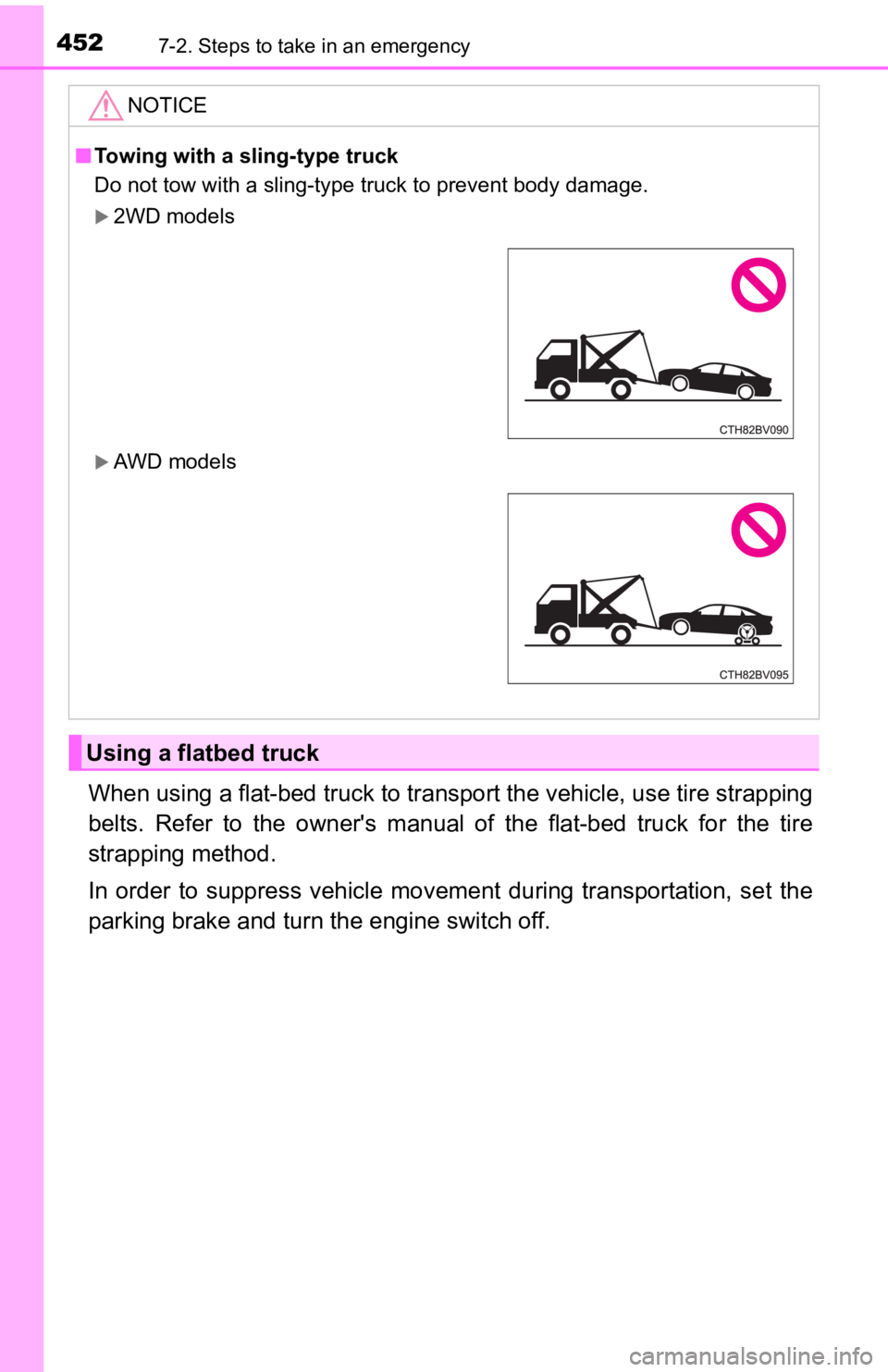
■ Towing with a sling-type truck
Do not tow with a sling-type truck to prevent body damage.
2WD models
AWD models
Using a flatbed truck
Page 456 of 572
4567-2. Steps to take in an emergency
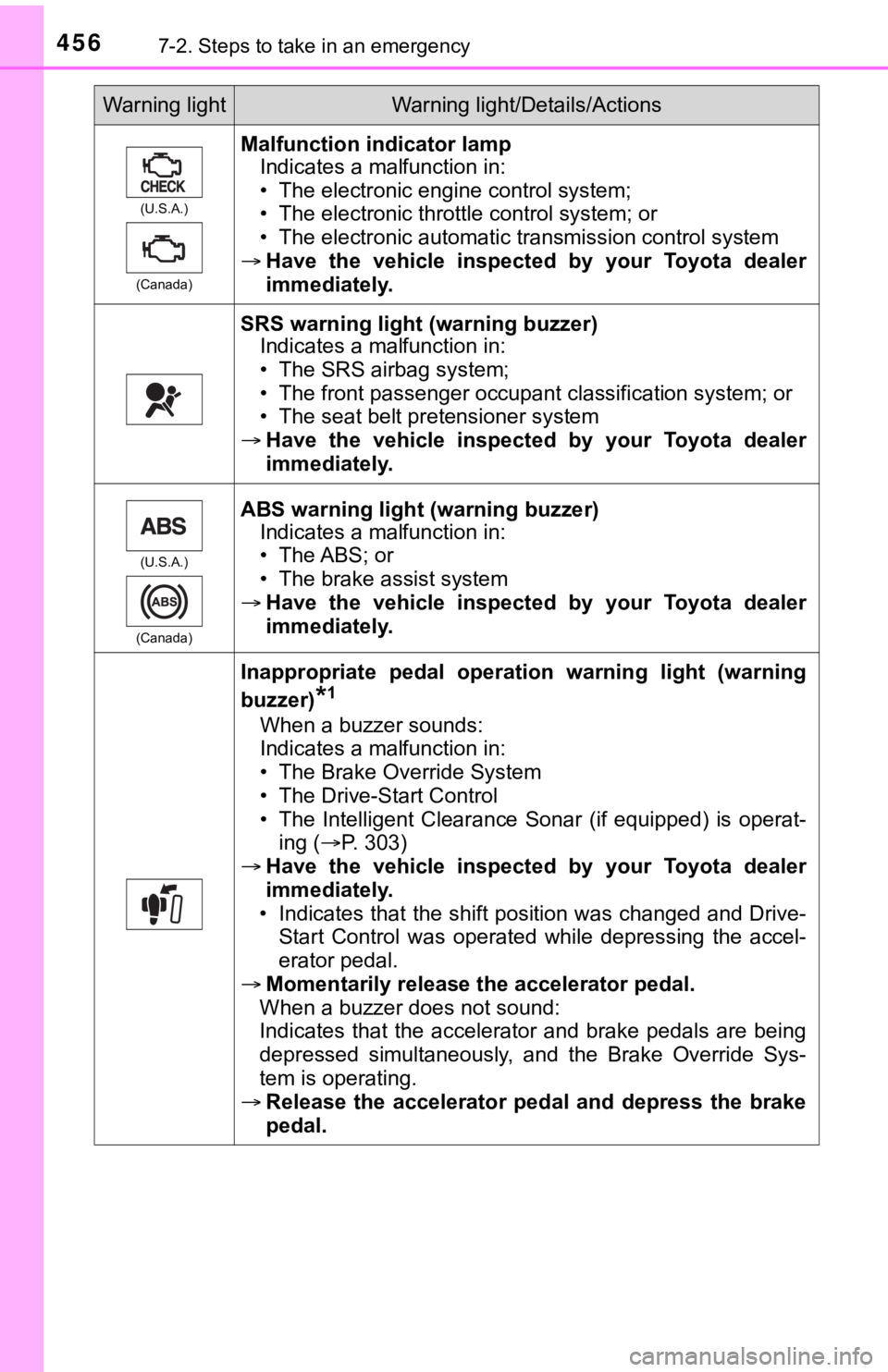
(U.S.A.)
(Canada)
Malfunction indicator lamp Indicates a malfunction in:
• The electronic engine control system;
• The electronic throttle control system; or
• The electronic automatic transmission control system
Have the vehicle inspected by your Toyota dealer
immediately.
SRS warning light (warning buzzer)
Indicates a malfunction in:
• The SRS airbag system;
• The front passenger occupant classification system; or
• The seat belt pretensioner system
Have the vehicle inspected by your Toyota dealer
immediately.
(U.S.A.)
(Canada)
ABS warning light (warning buzzer) Indicates a malfunction in:
• The ABS; or
• The brake assist system
Have the vehicle inspected by your Toyota dealer
immediately.
Inappropriate pedal operation warning light (warning
buzzer)
*1
When a buzzer sounds:
Indicates a malfunction in:
• The Brake Override System
• The Drive-Start Control
• The Intelligent Clearance Sonar (if equipped) is operat-
ing ( P. 303)
Have the vehicle inspected by your Toyota dealer
immediately.
• Indicates that the shift position was changed and Drive- Start Control was operated while depressing the accel-
erator pedal.
Momentarily release th e accelerator pedal.
When a buzzer does not sound:
Indicates that the accelerator and brake pedals are being
depressed simultaneously, and the Brake Override Sys-
tem is operating.
Release the accelerator pedal and depress the brake
pedal.
Warning lightWarning light/Details/Actions
Page 459 of 572
4597-2. Steps to take in an emergency
7
When trouble arises
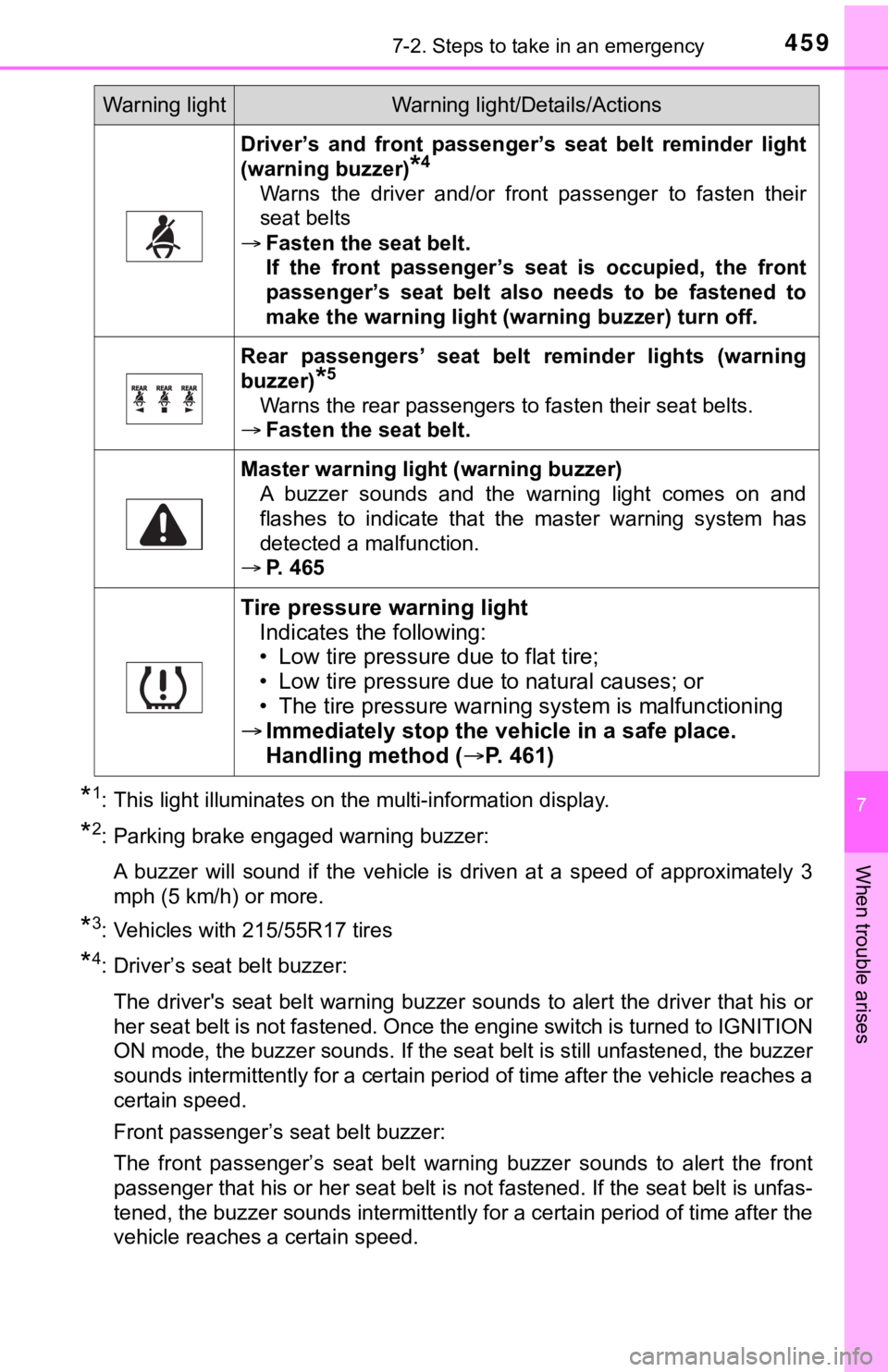
*1: This light illuminates on the multi-information display.
*2: Parking brake engaged warning buzzer:A buzzer will sound if the vehicle is driven at a speed of appr oximately 3
mph (5 km/h) or more.
*3: Vehicles with 215/55R17 tires
*4: Driver’s seat belt buzzer:
The driver's seat belt warning buzzer sounds to alert the drive r that his or
her seat belt is not fastened. Once the engine switch is turned to IGNITION
ON mode, the buzzer sounds. If the seat belt is still unfastene d, the buzzer
sounds intermittently for a certain period of time after the vehicle reaches a
certain speed.
Front passenger’s seat belt buzzer:
The front passenger’s seat belt warning buzzer sounds to alert the front
passenger that his or her seat belt is not fastened. If the sea t belt is unfas-
tened, the buzzer sounds intermittently for a certain period of time after the
vehicle reaches a certain speed.
Driver’s and front passenger’ s seat belt reminder light
(warning buzzer)
*4
Warns the driver and/or front passenger to fasten their
seat belts
Fasten the seat belt.
If the front passenger’s seat is occupied, the front
passenger’s seat belt also needs to be fastened to
make the warning light (warning buzzer) turn off.
Rear passengers’ seat belt reminder lights (warning
buzzer)
*5
Warns the rear passengers to fasten their seat belts.
Fasten the seat belt.
Master warning light (warning buzzer)
A buzzer sounds and the warning light comes on and
flashes to indicate that the master warning system has
detected a malfunction.
P. 465
Tire pressure warning light
Indicates the following:
• Low tire pressure due to flat tire;
• Low tire pressure due to natural causes; or
• The tire pressure warning system is malfunctioning
Immediately stop the veh icle in a safe place.
Handling method ( P. 4 6 1 )
Warning lightWarning light/Details/Actions
Page 460 of 572

4607-2. Steps to take in an emergency
*5: Rear passenger’s seat belt buzzer:The rear passengers’ seat belt warning buzzer sounds to alert t he rear
passenger that his or her seat belt is not fastened. If the sea t belt is unfas-
tened, the buzzer sounds intermittently for a certain period of time, after
the seat belt is fastened and unfastened and the vehicle reache s a certain
speed.
■ SRS warning light
This warning light system monitors the airbag sensor assembly, front impact
sensors, side impact sensors (front door), side impact sensors (front), side
impact sensors (rear), driver’s seat position sensor, driver’s seat belt buckle
switch, front passenger occupant classification system (ECU and sensors),
“AIR BAG ON” indicator light, “A IR BAG OFF” indicator light, seat belt preten-
sioners, airbags, interconnecting wiring and power sources. (P. 38)
■ Front passenger detection sensor, seat belt reminder and warnin g
buzzer
● If luggage is placed on the front passenger seat, the front pas senger detec-
tion sensor may cause the warning light to flash and the warnin g buzzer to
sound even if a passenger is not sitting in the seat.
● If a cushion is placed on the seat, the sensor may not detect a passenger,
and the warning light may not operate properly.
■ If the malfunction indicator lamp comes on while driving
First check the following:
●Is the fuel tank empty?
If it is, fill the fuel tank immediately.
● Is the fuel tank cap loose?
If it is, tighten it securely.
The light will go off after several driving trips.
If the light does not go off even after several trips, contact your Toyota dealer
as soon as possible.
■ Electric power steering system w arning light (warning buzzer)
When the battery charge becomes insufficient or the voltage tem porarily
drops, the electric power steering system warning light may com e on and the
warning buzzer may sound.
Page 491 of 572
4917-2. Steps to take in an emergency
7
When trouble arises
WARNING
■When removing the battery terminals
Always remove the negative (-) terminal first. If the positive (+) terminal con-
tacts any metal in the surrounding area when the positive (+) terminal is
removed, a spark may occur, leading to a fire in addition to el ectrical shocks
and death or serious injury.
■ Avoiding battery fires or explosions
Observe the following precautions to prevent accidentally ignit ing the flam-
mable gas that may be emitted from the battery:
● Make sure each jumper cable is connected to the correct terminal and that
it is not unintentionally in contact with any other than the in tended terminal.
● Do not allow the other end of the jumper cable connected to the “+” termi-
nal to come into contact with any other parts or metal surfaces in the area,
such as brackets or unpainted metal.
● Do not allow the + and - clamps of the jumper cables to come into contact
with each other.
● Do not smoke, use matches, cigarette lighters or allow open fla me near
the battery.
■ Battery precautions
The battery contains poisonous and corrosive acidic electrolyte, while
related parts contain lead and lead compounds. Observe the following pre-
cautions when handling the battery:
● When working with the battery, always wear safety glasses and take care
not to allow any battery fluids (acid) to come into contact with skin, clothing
or the vehicle body.
● Do not lean over the battery.
● In the event that battery fluid comes into contact with the skin or eyes,
immediately wash the affected area with water and seek medical attention.
Place a wet sponge or cloth over the affected area until medical attention
can be received.
● Always wash your hands after handling the battery support, terminals, and
other battery-related parts.
● Do not allow children near the battery.
NOTICE
■When handling jumper cables
When connecting the jumper cables, ensure that they do not beco me entan-
gled in the cooling fan or engine drive belt.
Page 494 of 572
4947-2. Steps to take in an emergency
Start the engine and turn the air conditioning system on to check
that the radiator cooling fan operates and to check for coolant leaks
from the radiator or hoses.
The fan operates when the air conditioning system is turned on immedi-
ately after a cold start. Confirm that the fan is operating by checking the fan
sound and air flow. If it is difficult to check these, turn the air conditioning
system on and off repeatedly. (The fan may not operate in freezing tem-
peratures.)
If the fan is not operating:
Stop the engine immediately and contact your Toyota dealer.
If the fan is operating:
Have the vehicle inspected at the neare st Toyota dealer.
WARNING
■To prevent an accident or injury when inspecting under the hood of
your vehicle
Observe the following precautions.
Failure to do so may result in serious injury such as burns.
● If steam is seen coming from under the hood, do not open the ho od until
the steam has subsided. The engine compartment may be very hot.
● Keep hands and clothing (especially a tie, a scarf or a muffler) away from
the fan and belts. Failure to do so may cause the hands or clothing to be
caught, resulting in serious injury.
● Do not loosen the radiator cap and the coolant reservoir cap while the
engine and radiator are hot.
High temperature steam or coolant could spray out.
NOTICE
■When adding engine coolant
Wait until the engine has cooled down before adding engine cool ant.
When adding coolant, do so slowly. Adding cool coolant to a hot engine too
quickly can cause damage to the engine.
■ To prevent damage to the cooling system
Observe the following precautions:
● Avoid contaminating the coolant with foreign matter (such as sa nd or dust
etc.).
● Do not use any coolant additives.
6
7