coolant temperature TOYOTA AVALON 2022 Owners Manual
[x] Cancel search | Manufacturer: TOYOTA, Model Year: 2022, Model line: AVALON, Model: TOYOTA AVALON 2022Pages: 572, PDF Size: 9.42 MB
Page 90 of 572
902. Instrument cluster
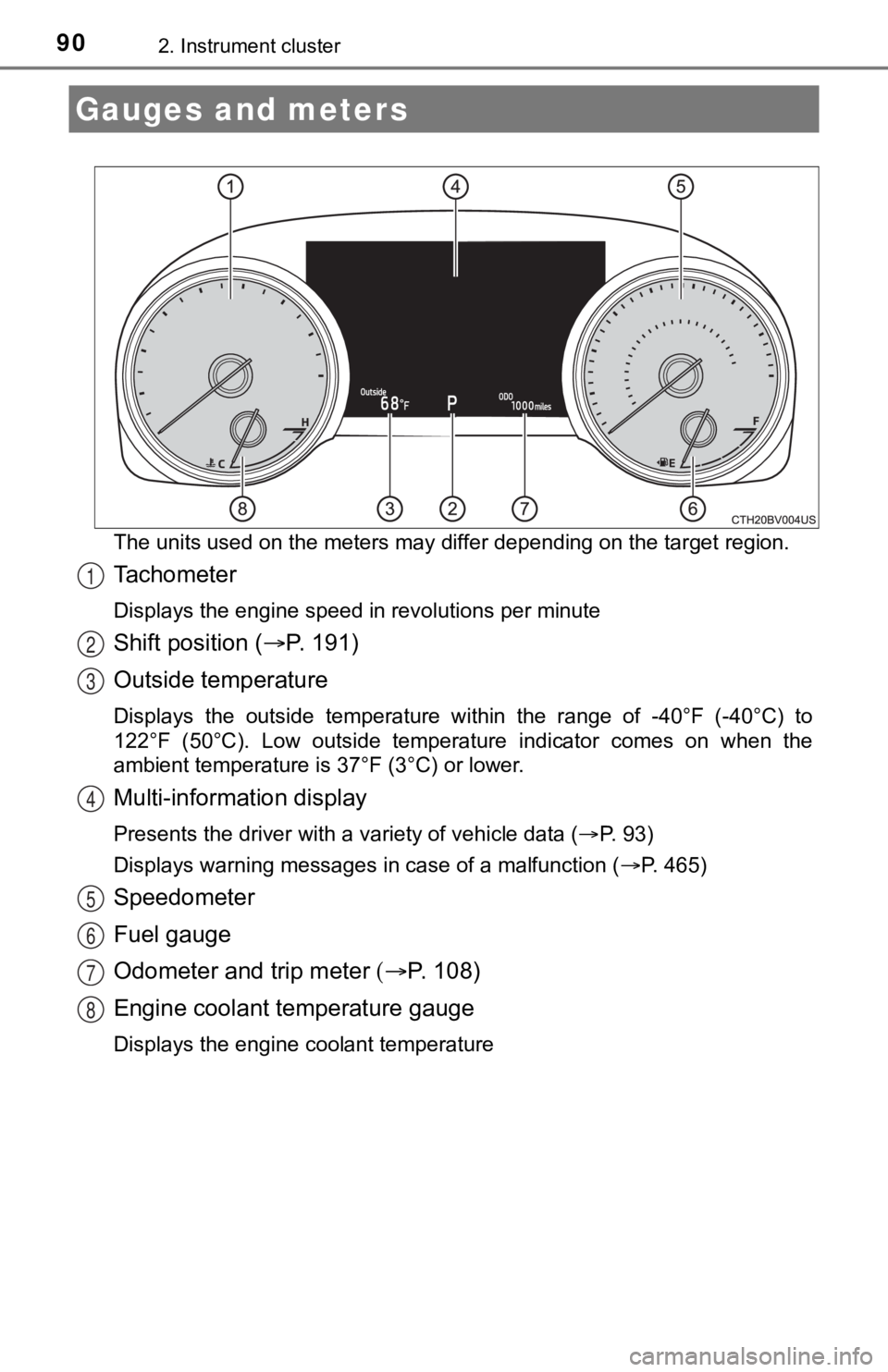
The units used on the meters may differ depending on the target region.
Tachometer
Displays the engine speed in revolutions per minute
Shift position (P. 1 9 1 )
Outside temperature
Displays the outside temperature within the range of -40°F (-40 °C) to
122°F (50°C). Low outside temperat ure indicator comes on when the
ambient temperature is 37°F (3°C) or lower.
Multi-information display
Presents the driver with a variety of vehicle data ( P. 93)
Displays warning messages in case of a malfunction ( P. 465)
Speedometer
Fuel gauge
Odometer and trip meter P. 1 0 8 )
Engine coolant temperature gauge
Displays the engine coolant temperature
Gauges and meters
1
2
3
4
5
6
7
8
Page 92 of 572
922. Instrument cluster
■The meters and display illuminate when
The engine switch is in IGNITION ON mode.
■ Brightness of the meters (day mode and night mode)
●The brightness of the meters is changed between day mode and ni ght
mode.
• Day mode: When the tail lights are off or when the tail lights are on but
the surrounding area is bright
• Night mode: When the tail lights are on and the surrounding area is dark
● When in night mode, the brightness will be reduced slightly unless the
meters are set to the maximum brightness level.
■ Outside temperature display
In the following situations, the correct outside temperature may not be dis-
played, or the display may take longer than normal to change:
●When stopped, or driving at low speeds (less than 16 mph [25 km/h])
● When the outside temperature has changed suddenly (at the entrance/exit
of a garage, tunnel, etc.)
● When “ ” or “E” is displayed, the system may be malfunctioning.
Take your vehicle to your Toyota dealer.
NOTICE
■To prevent damage to the engine and its components
● Do not let the indicator needle of the tachometer enter the red zone, which
indicates the maximum engine speed.
● The engine may be overheating if the engine coolant temperature gauge is
in the red zone (H). In this case, immediately stop the vehicle in a safe
place, and check the engine after it has cooled completely. ( P. 492)
Page 400 of 572
4006-3. Do-it-yourself maintenance
WARNING
The engine compartment contains many mechanisms and fluids that may
move suddenly, become hot, or become electrically energized. To avoid death
or serious injury, observe the following precautions.
■ When working on the engine compartment
● Keep hands, clothing and tools away from the moving fan and engine
drive belt.
● Be careful not to touch the engine, radiator, exhaust manifold, etc. right
after driving as they may be hot. Oil and other fluids may also be hot.
● Do not leave anything that may burn easily, such as paper and r ags, in the
engine compartment.
● Do not smoke, cause sparks or expose an open flame to fuel or t he bat-
tery. Fuel and battery fumes are flammable.
● Be extremely cautious when working on the battery. It contains poisonous
and corrosive sulfuric acid.
■ When working near the electric cooling fan or radiator grille
Be sure the engine switch is off. With the engine switch in IGNITION ON
mode, the electric cooling fan may automatically start to run if the air condi-
tioning is on and/or the coolant temperature is high. ( P. 409)
■ Safety glasses
Wear safety glasses to prevent flying or falling material, fluid spray, etc.
from getting in your eyes.
NOTICE
■If you remove the air cleaner filter
Driving with the air cleaner filter removed may cause excessive engine wear
due to dirt in the air.
Page 408 of 572
4086-3. Do-it-yourself maintenance
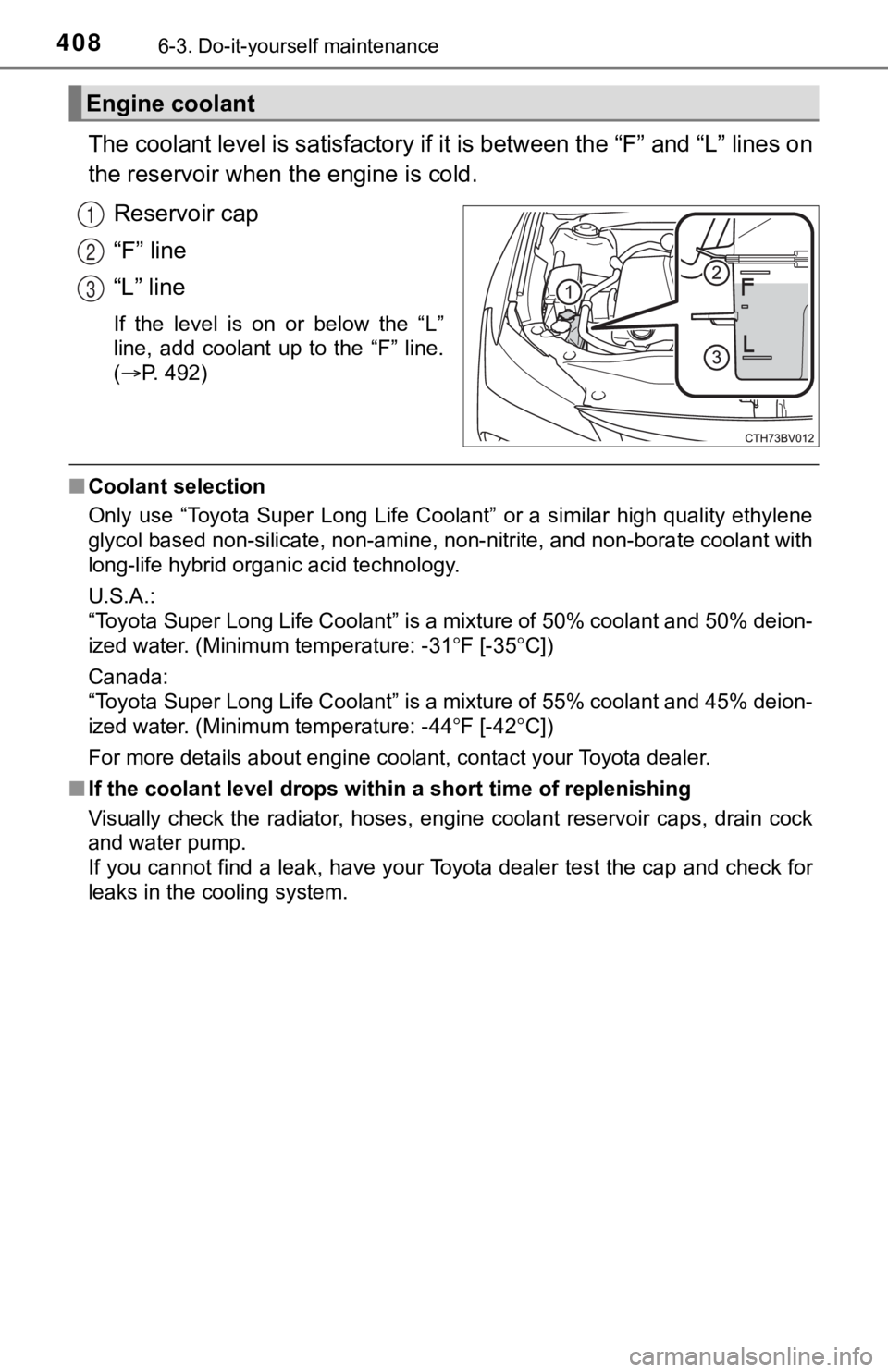
The coolant level is satisfactory if it is between the “F” and “L” lines on
the reservoir when the engine is cold.
Reservoir cap
“F” line
“L” line
If the level is on or below the “L”
line, add coolant up to the “F” line.
(P. 492)
■ Coolant selection
Only use “Toyota Super Long Life Coolant” or a similar high quality ethylene
glycol based non-silicate, non-amine, non-nitrite, and non-bora te coolant with
long-life hybrid organic acid technology.
U.S.A.:
“Toyota Super Long Life Coolant” is a mixture of 50% coolant and 50% deion-
ized water. (Minimum temperature: -31 F [-35 C])
Canada:
“Toyota Super Long Life Coolant” is a mixture of 55% coolant and 45% deion-
ized water. (Minimum temperature: -44 F [-42 C])
For more details about engine coolant, contact your Toyota deal er.
■ If the coolant level drops within a short time of replenishing
Visually check the radiator, hoses, engine coolant reservoir ca ps, drain cock
and water pump.
If you cannot find a leak, have your Toyota dealer test the cap and check for
leaks in the cooling system.
Engine coolant
1
2
3
Page 453 of 572
4537-2. Steps to take in an emergency
7
When trouble arises
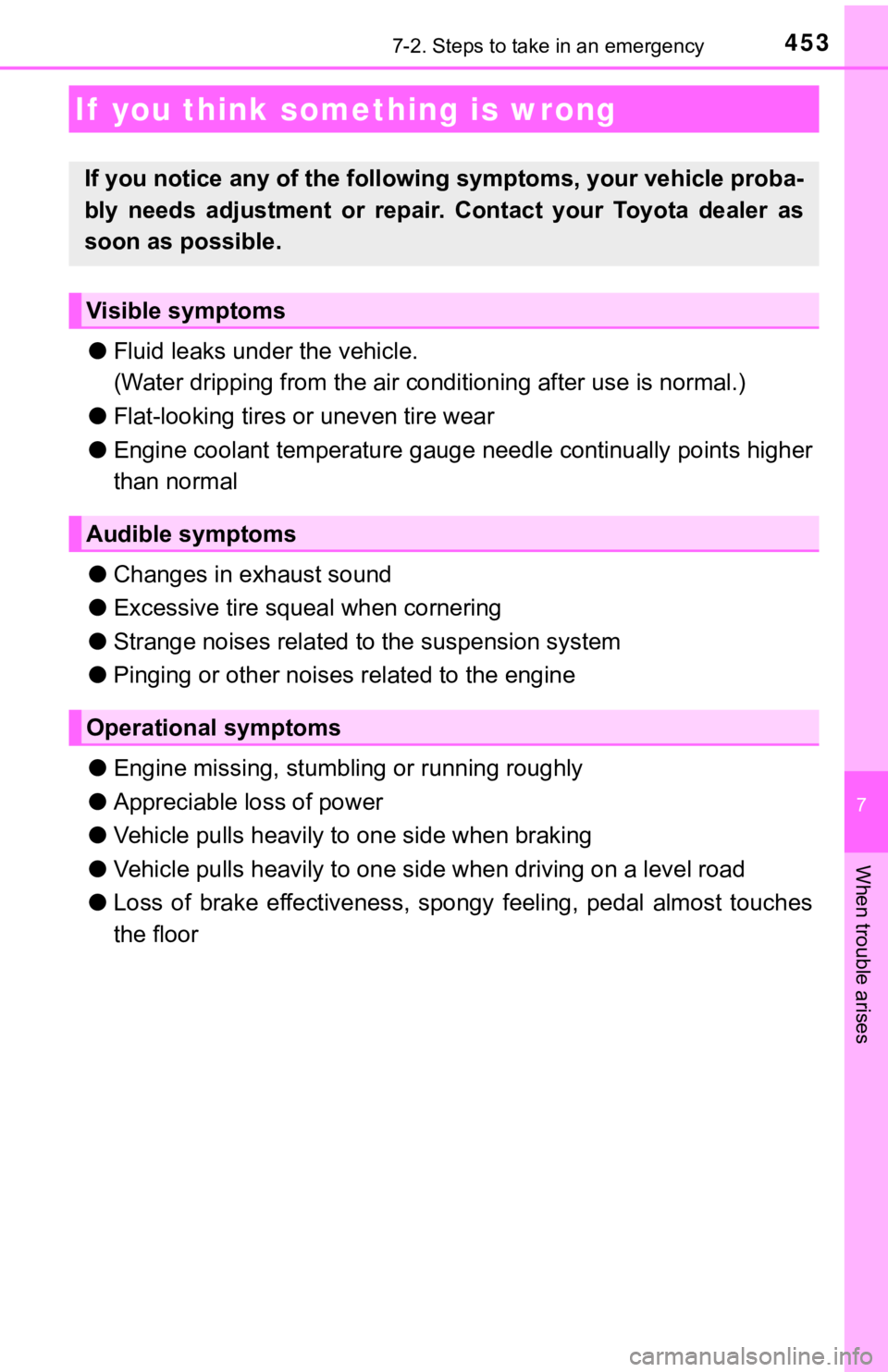
●Fluid leaks un der the vehicle.
(Water dripping from the air conditioning a fter use is normal.)
● Flat-looking tires or uneven tire wear
● Engine coolant temperature gauge needle continually points high er
than normal
● Changes in exhaust sound
● Excessive tire squeal when cornering
● Strange noises related to the suspension system
● Pinging or other noises related to the engine
● Engine missing, stumb ling or running roughly
● Appreciable loss of power
● Vehicle pulls heavily to one side when braking
● Vehicle pulls heavily to one s ide when driving on a level road
● Loss of brake effectiveness, spongy feeling, pedal almost touch es
the floor
If you think something is wrong
If you notice any of the followi ng symptoms, your vehicle proba -
bly needs adjustment or repair. Contact your Toyota dealer as
soon as possible.
Visible symptoms
Audible symptoms
Operational symptoms
Page 455 of 572
4557-2. Steps to take in an emergency
7
When trouble arises
If a warning light turns on or a war ning
buzzer sounds
Calmly perform the following actions if any of the warning ligh ts
comes on or flashes. If a light comes on or flashes, but then
goes off, this does not necessarily indicate a malfunction in the
system. However, if this continues to occur, have the vehicle
inspected by your Toyota dealer.
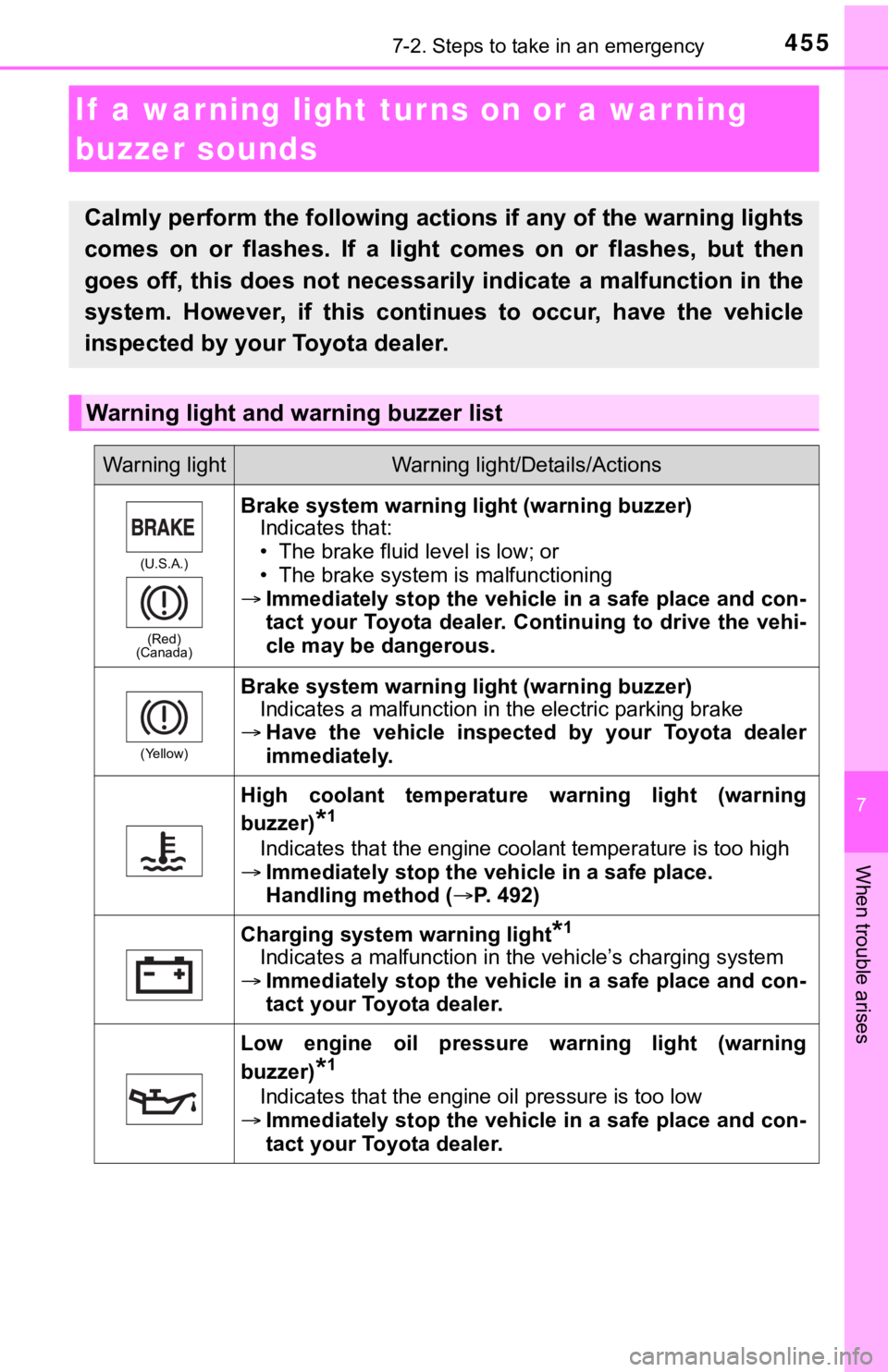
Warning light and w arning buzzer list
Warning lightWarning light/Details/Actions
(U.S.A.)
(Red)
(Canada)
Brake system warning li ght (warning buzzer)
Indicates that:
• The brake fluid level is low; or
• The brake system is malfunctioning
Immediately stop the vehicle in a safe place and con-
tact your Toyota dealer. Continuing to drive the vehi-
cle may be dangerous.
(Yellow)
Brake system warning li ght (warning buzzer)
Indicates a malfunction in the electric parking brake
Have the vehicle inspected by your Toyota dealer
immediately.
High coolant temperature warning light (warning
buzzer)
*1
Indicates that the engine coolant temperature is too high
Immediately stop the vehicle in a safe place.
Handling method ( P. 492)
Charging system warning light*1
Indicates a malfunction in the vehicle’s charging system
Immediately stop the vehicle in a safe place and con-
tact your Toyota dealer.
Low engine oil pressure warning light (warning
buzzer)
*1
Indicates that the engine oil pressure is too low
Immediately stop the vehicle in a safe place and con-
tact your Toyota dealer.
Page 492 of 572
4927-2. Steps to take in an emergency
Stop the vehicle in a safe place and turn off the air conditioning sys-
tem, and then stop the engine.
If you see steam:
Carefully lift the hood after the steam subsides.
If you do not see steam:
Carefully lift the hood.
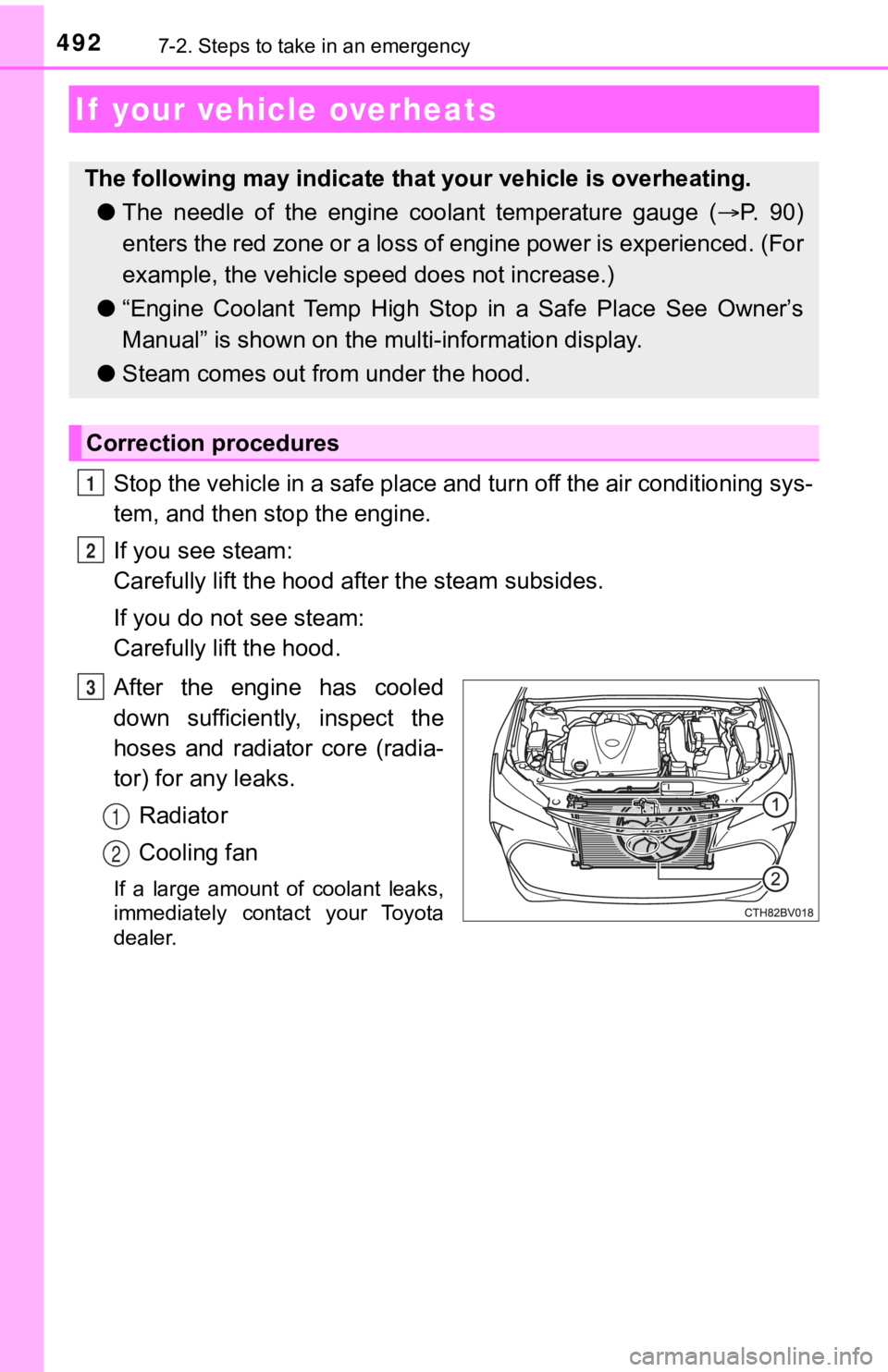
After the engine has cooled
down sufficiently, inspect the
hoses and radiator core (radia-
tor) for any leaks. Radiator
Cooling fan
If a large amount of coolant leaks,
immediately contact your Toyota
dealer.
If your vehicle overheats
The following may indicate that your vehicle is overheating.
● The needle of the engine c oolant temperature gauge (P. 90)
enters the red zone or a loss of engine power is experienced. ( For
example, the vehicle s peed does not increase.)
● “Engine Coolant Temp High Stop in a Safe Place See Owner’s
Manual” is shown on the mult i-information display.
● Steam comes out from under the hood.
Correction procedures
1
2
3
1
2
Page 494 of 572
4947-2. Steps to take in an emergency
Start the engine and turn the air conditioning system on to check
that the radiator cooling fan operates and to check for coolant leaks
from the radiator or hoses.
The fan operates when the air conditioning system is turned on immedi-
ately after a cold start. Confirm that the fan is operating by checking the fan
sound and air flow. If it is difficult to check these, turn the air conditioning
system on and off repeatedly. (The fan may not operate in freezing tem-
peratures.)
If the fan is not operating:
Stop the engine immediately and contact your Toyota dealer.
If the fan is operating:
Have the vehicle inspected at the neare st Toyota dealer.
WARNING
■To prevent an accident or injury when inspecting under the hood of
your vehicle
Observe the following precautions.
Failure to do so may result in serious injury such as burns.
● If steam is seen coming from under the hood, do not open the ho od until
the steam has subsided. The engine compartment may be very hot.
● Keep hands and clothing (especially a tie, a scarf or a muffler) away from
the fan and belts. Failure to do so may cause the hands or clothing to be
caught, resulting in serious injury.
● Do not loosen the radiator cap and the coolant reservoir cap while the
engine and radiator are hot.
High temperature steam or coolant could spray out.
NOTICE
■When adding engine coolant
Wait until the engine has cooled down before adding engine cool ant.
When adding coolant, do so slowly. Adding cool coolant to a hot engine too
quickly can cause damage to the engine.
■ To prevent damage to the cooling system
Observe the following precautions:
● Avoid contaminating the coolant with foreign matter (such as sa nd or dust
etc.).
● Do not use any coolant additives.
6
7
Page 559 of 572
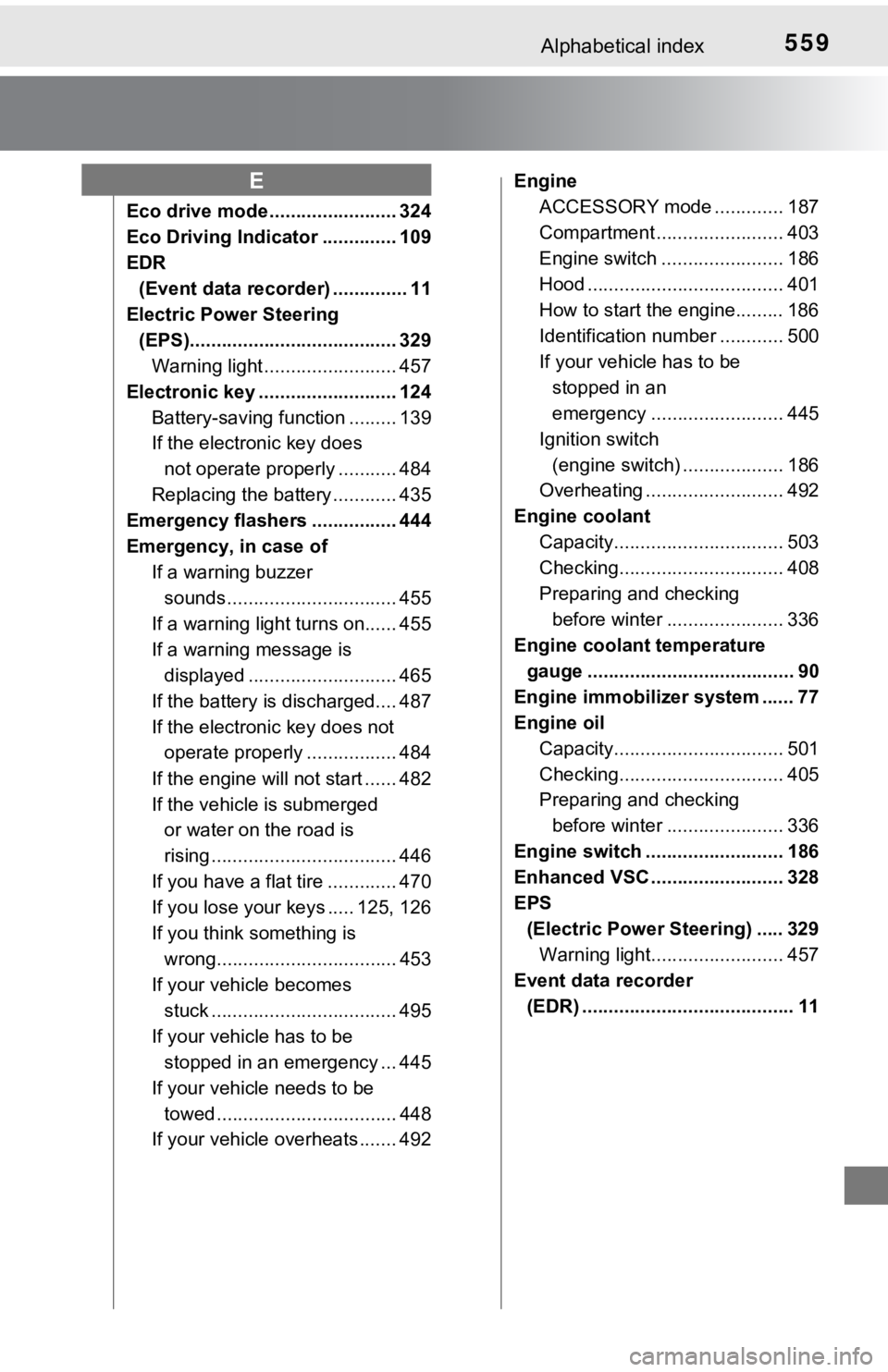
559Alphabetical index
Eco drive mode ........................ 324
Eco Driving Indicator .............. 109
EDR (Event data recorder) .............. 11
Electric Power Steering (EPS)....................................... 329 Warning light ......................... 457
Electronic key .......................... 124 Battery-saving function ......... 139
If the electronic key does not operate properly ........... 484
Replacing the battery ............ 435
Emergency flashers ................ 444
Emergency, in case of
If a warning buzzer sounds ................................ 455
If a warning light turns on...... 455
If a warning message is displayed ............................ 465
If the battery is discharged.... 487
If the electronic key does not operate properly ................. 484
If the engine will not start ...... 482
If the vehicle is submerged or water on the road is
rising ................................... 446
If you have a flat tire ............. 470
If you lose your keys ..... 125, 126
If you think something is wrong.................................. 453
If your vehicle becomes
stuck ................................... 495
If your vehicle has to be stopped in an emergency ... 445
If your vehicle needs to be towed .................................. 448
If your vehicle overheats ....... 492 Engine
ACCESSORY mode ............. 187
Compartment ........................ 403
Engine switch ....................... 186
Hood ..................................... 401
How to start the engine......... 186
Identification number ............ 500
If your vehicle has to be stopped in an
emergency ......................... 445
Ignition switch (engine switch) ................... 186
Overheating .......................... 492
Engine coolant Capacity................................ 503
Checking............................... 408
Preparing and checking before winter ...................... 336
Engine coolant temperature
gauge ....................................... 90
Engine immobilizer system ...... 77
Engine oil Capacity................................ 501
Checking............................... 405
Preparing and checking before winter ...................... 336
Engine switch .......................... 186
Enhanced VSC ......................... 328
EPS (Electric Power Steering) ..... 329 Warning light......................... 457
Event data recorder (EDR) ........................................ 11
E
Page 570 of 572

570Alphabetical index
Warning buzzersApproach warning ................. 272
Brake system ....... ................. 455
Downshifting ......................... 194
Electric power steering
system ......... ....................... 457
Intuitive parking assist .......... 298
Lane departure alert
function ............................... 248
Light reminder ....................... 207
Open door ............................. 131
Open hood ............................ 401
Open moon roof .................... 168
Open trunk ............................ 134
Parking brake........................ 457
Pre-collision warning............. 228
Seat belt reminder ................ 459
Vehicle sway warning ........... 250 Warning lights ........................... 85
ABS ...................................... 456
Brake hold operated indicator.............................. 457
Brake Override System ........ 456
Brake system ....... ................. 455
Charging system................... 455
Drive-Start Control ................ 456
Driver’s seat belt reminder ............................. 459
Electric power steering ......... 457
Front passenger’s seat belt reminder ...................... 459
High coolant temperature ..... 455
ICS OFF indicator ................. 458
Low engine oil pressure........ 455
Low fuel level ........................ 458
LTA indicator ........................ 457
Malfunction indicator lamp .... 456
Master warning light ............. 459
Parking brake indicator ......... 457
PCS warning light ................. 458
Rear passengers’ seat belt reminder light ..................... 459
Seat belt reminder light......... 459
Slip indicator ......................... 458
SRS ...................................... 456
Tire pressure ........................ 459
W