parking brake TOYOTA AVALON 2022 Owners Manual
[x] Cancel search | Manufacturer: TOYOTA, Model Year: 2022, Model line: AVALON, Model: TOYOTA AVALON 2022Pages: 572, PDF Size: 9.42 MB
Page 3 of 572

3
1
8 7 5 4
3
2
9
6
3-1. Key informationKeys .................................. 124
3-2. Opening, closing and locking the doors
Doors................................. 127
Trunk ................................. 133
Smart key system.............. 137
3-3. Adjusting the seats Front seats ........................ 144
Rear seats ......................... 146
Driving position memory ........................... 148
Head restraints .................. 153
3-4. Adjusting the steering wheel and mirrors
Steering wheel .................. 155
Inside rear view mirror....... 157
Outside rear view mirrors ............................. 159
3-5. Opening and closing the windows
Power windows ................. 162
Moon roof .......................... 166 4-1. Before driving
Driving the vehicle ............. 172
Cargo and luggage ............ 180
Vehicle load limits .............. 183
Trailer towing ..................... 184
Dinghy towing .................... 185
4-2. Driving procedures Engine (ignition) switch...... 186
Automatic transmission ..... 191
Turn signal lever ................ 197
Parking brake .................... 198
Brake Hold ......................... 202
4-3. Operating the lights and wipers
Headlight switch ................ 204
AHB (Automatic High Beam) .............................. 208
Windshield wipers and washer ............................. 212
4-4. Refueling Opening the fuel tank cap................................... 216
3Operation of each
component4Driving
Page 19 of 572
19Pictorial index
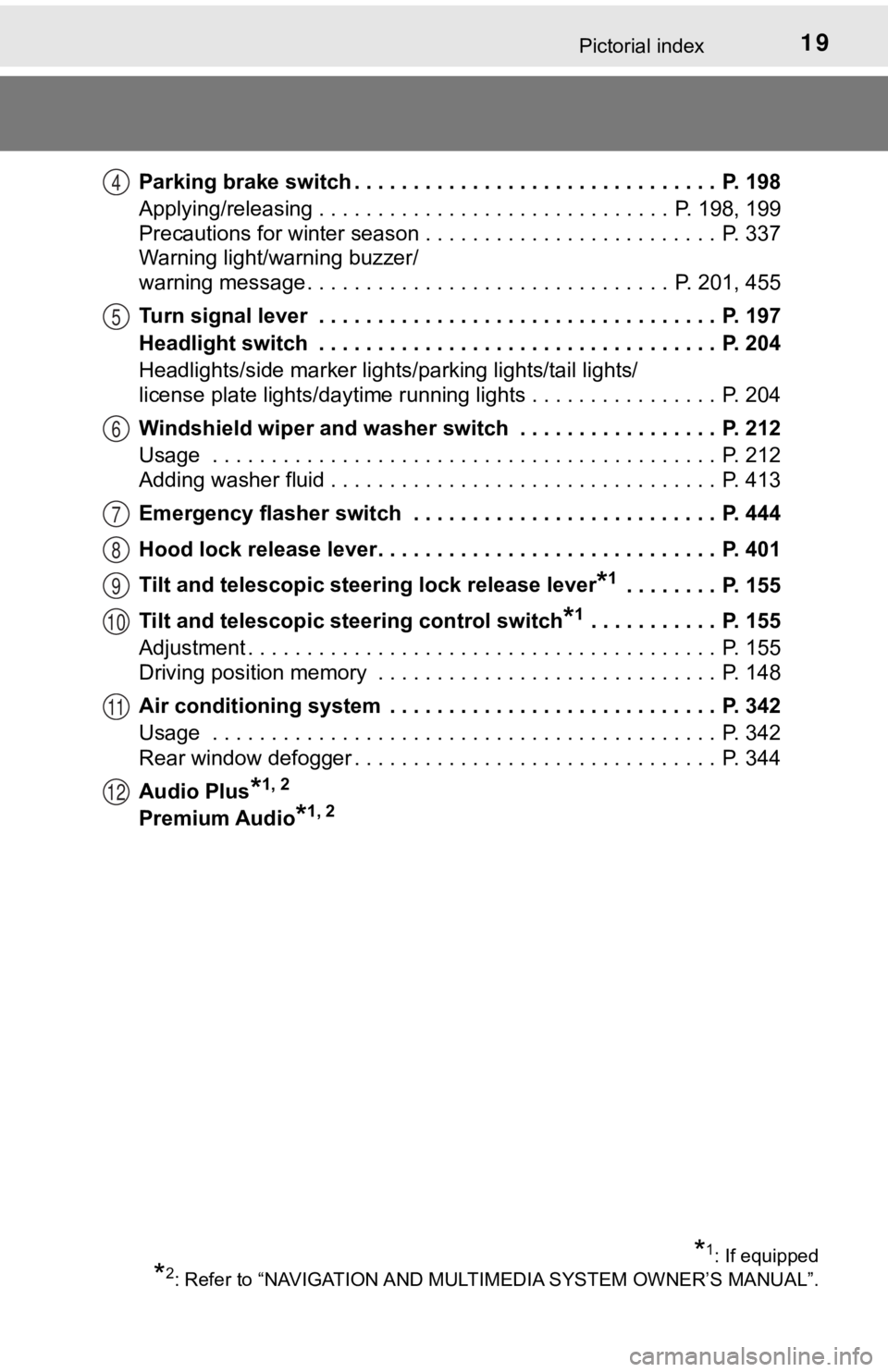
Parking brake switch . . . . . . . . . . . . . . . . . . . . . . . . . . . . . . . P. 198
Applying/releasing . . . . . . . . . . . . . . . . . . . . . . . . . . . . . . P. 198, 199
Precautions for winter season . . . . . . . . . . . . . . . . . . . . . . . . . P. 337
Warning light/warning buzzer/
warning message . . . . . . . . . . . . . . . . . . . . . . . . . . . . . . . P. 201, 455
Turn signal lever . . . . . . . . . . . . . . . . . . . . . . . . . . . . . . . . . . P. 197
Headlight switch . . . . . . . . . . . . . . . . . . . . . . . . . . . . . . . . . . P. 204
Headlights/side marker lights/parking lights/tail lights/
license plate lights/daytime running lights . . . . . . . . . . . . . . . . P. 204
Windshield wiper and washer switch . . . . . . . . . . . . . . . . . P. 212
Usage . . . . . . . . . . . . . . . . . . . . . . . . . . . . . . . . . . . . . . . . . . . P. 212
Adding washer fluid . . . . . . . . . . . . . . . . . . . . . . . . . . . . . . . . . P. 413
Emergency flasher switch . . . . . . . . . . . . . . . . . . . . . . . . . . P. 444
Hood lock release lever. . . . . . . . . . . . . . . . . . . . . . . . . . . . . P. 401
Tilt and telescopic steering lock release lever
*1 . . . . . . . . P. 155
Tilt and telescopic steering control switch
*1 . . . . . . . . . . . P. 155
Adjustment . . . . . . . . . . . . . . . . . . . . . . . . . . . . . . . . . . . . . . . . P. 155
Driving position memory . . . . . . . . . . . . . . . . . . . . . . . . . . . . . P. 148
Air conditioning system . . . . . . . . . . . . . . . . . . . . . . . . . . . . P. 342
Usage . . . . . . . . . . . . . . . . . . . . . . . . . . . . . . . . . . . . . . . . . . . P. 342
Rear window defogger . . . . . . . . . . . . . . . . . . . . . . . . . . . . . . . P. 344
Audio Plus
*1, 2
Premium Audio*1, 2
*1: If equipped
*2: Refer to “NAVIGATION AND MULT IMEDIA SYSTEM OWNER’S MANUAL”.
4
5
6
7
8
9
10
11
12
Page 85 of 572
852. Instrument cluster
2
Instrument cluster
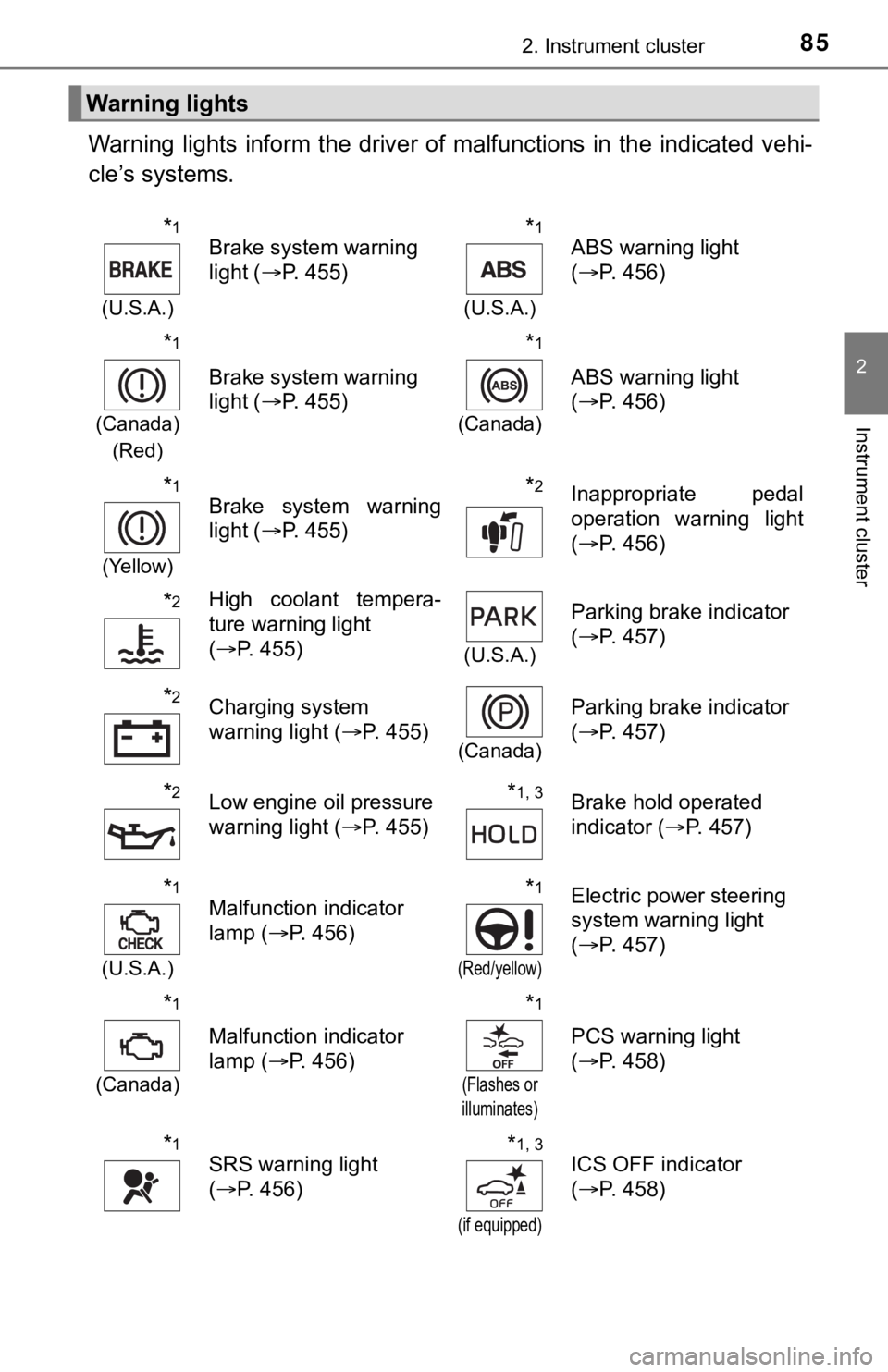
Warning lights inform the driver of malfunctions in the indicated vehi-
cle’s systems.
Warning lights
*1
(U.S.A.)
Brake system warning
light ( P. 455)*1
(U.S.A.)
ABS warning light
(P. 456)
*1
(Canada)
(Red)
Brake system warning
light ( P. 455)
*1
(Canada)
ABS warning light
(P. 456)
*1
(Yellow)
Brake system warning
light ( P. 455)*2Inappropriate pedal
operation warning light
(P. 456)
*2High coolant tempera-
ture warning light
(P. 455)
(U.S.A.)
Parking brake indicator
(P. 457)
*2Charging system
warning light ( P. 455)
(Canada)
Parking brake indicator
(P. 457)
*2Low engine oil pressure
warning light ( P. 455)*1, 3Brake hold operated
indicator ( P. 457)
*1
(U.S.A.)
Malfunction indicator
lamp ( P. 456)*1
(Red/yellow)
Electric power steering
system warning light
(P. 457)
*1
(Canada)
Malfunction indicator
lamp ( P. 456)
*1
(Flashes or
illuminates)
PCS warning light
( P. 458)
*1SRS warning light
(P. 456)*1, 3
(if equipped)
ICS OFF indicator
(P. 458)
Page 87 of 572
872. Instrument cluster
2
Instrument cluster
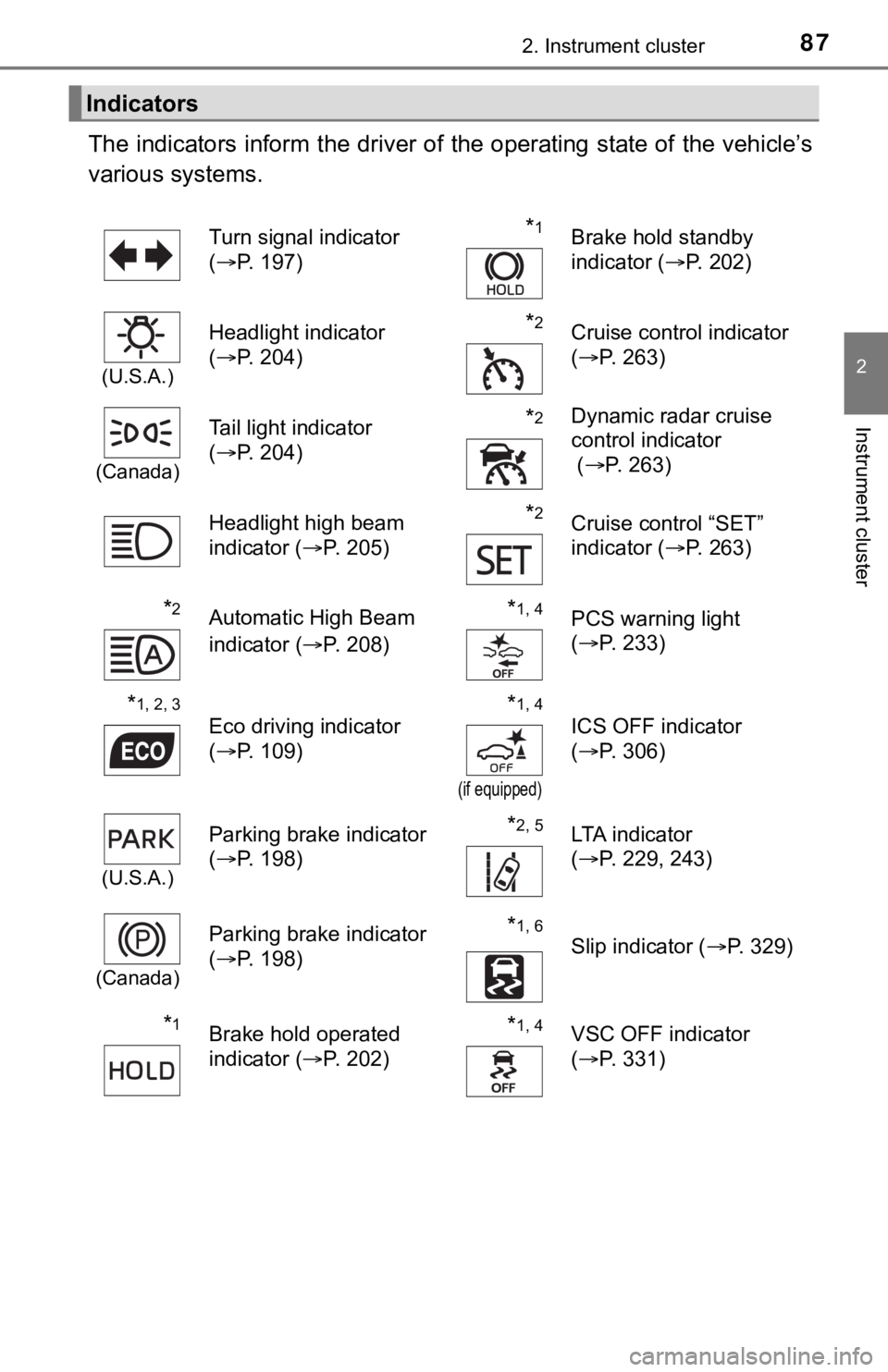
The indicators inform the driver of the operating state of the vehicle’s
various systems.
Indicators
Turn signal indicator
( P. 197)*1Brake hold standby
indicator ( P. 202)
(U.S.A.)
Headlight indicator
(P. 204)*2Cruise control indicator
(P. 263)
(Canada)
Tail light indicator
(P. 204) *2Dynamic radar cruise
control indicator
( P. 263)
Headlight high beam
indicator ( P. 205)
*2Cruise control “SET”
indicator (P. 263)
*2Automatic High Beam
indicator ( P. 208)*1, 4PCS warning light
(P. 233)
*1, 2, 3
Eco driving indicator
(P. 109)*1, 4
(if equipped)
ICS OFF indicator
(P. 306)
(U.S.A.)
Parking brake indicator
(P. 198)*2, 5LTA indicator
(P. 229, 243)
(Canada)
Parking brake indicator
(P. 198)*1, 6
Slip indicator ( P. 329)
*1Brake hold operated
indicator (P. 202)*1, 4VSC OFF indicator
(P. 331)
Page 147 of 572

1473-3. Adjusting the seats
3
Operation of each component
WARNING
■When folding the seatbacks down
Observe the following precautions. Failure to do so may result in death or
serious injury.
● Do not fold the seatbacks down while driving.
● Stop the vehicle on level ground, set the parking brake and shi ft the shift
lever to P.
● Do not allow anyone to sit on a folded seatback or in the trunk while driv-
ing.
● Do not allow children to enter the trunk.
■ When returning the seat t o its original position
● Ensure that the seat belt does not get caught between or behind the seats.
● If the seat belt has been released from its guide, pass the sea t belt through
its guide. ( P. 32)
■ Seat adjustment
Be careful not to get hands or feet pinched between the rear co nsole box
and the rear seat when folding down the rear seatback.
■ After returning the seatback to the upright position
Observe the following precautions. Failure to do so may result in death or
serious injury.
● Make sure the seatback is securely locked by pressing it forwar d and rear-
ward on the top.
● Check that the seat belts are not twisted or caught in the seatback.
● Make sure that the seat belt is passed through its guide.
NOTICE
■When the right seatback is folded down
Make sure the luggage loaded in the enlarged trunk will not damage the
webbing of the rear center seat belt.
Page 171 of 572

171
4Driving
4-1. Before drivingDriving the vehicle ............. 172
Cargo and luggage ........... 180
Vehicle load limits ............. 183
Trailer towing..................... 184
Dinghy towing ................... 185
4-2. Driving procedures Engine (ignition) switch ..... 186
Automatic transmission ..... 191
Turn signal lever................ 197
Parking brake .................... 198
Brake Hold ........................ 202
4-3. Operating the lights and wipers
Headlight switch ................ 204
AHB (Automatic High Beam) ............................. 208
Windshield wipers and washer ............................ 212
4-4. Refueling Opening the fuel tank cap .................................. 216 4-5. Using the driving
support systems
Toyota Safety Sense 2.5+...................... 220
PCS (Pre-Collision System)........................... 228
LTA (Lane Tracing Assist) ............................. 243
RSA (Road Sign Assist) .... 258
Dynamic radar cruise control with full-speed
range............................... 263
BSM (Blind Spot Monitor)........................... 279
• BSM function ................ 283
• RCTA function .............. 286
Rear Camera Detection function (vehicles with
panoramic view
monitor)........................... 291
Intuitive parking assist....... 295
Intelligent Clearance Sonar (ICS) ..................... 303
Driving mode select switches .......................... 324
Driving assist systems ...... 328
4-6. Driving tips Winter driving tips ............. 336
Page 172 of 572
1724-1. Before driving
P. 1 8 6
With the brake pedal depressed , shift the shift lever to D.
( P. 191)
Release the parking brake. ( P. 1 9 9 )
Gradually release the brake pedal and gently depress the accele ra-
tor pedal to accelerate the vehicle.
With the shift lever in D , depress the brake pedal.
If necessary, set the parking brake.
If the vehicle is to be stopped for an extended period of time, shift the shift
lever to P or N. ( P. 191)
With the shift lever in D , depress the brake pedal.
Set the parking brake ( P. 198), and shift the shift lever to P ( P.
191).
Press the engine switch to stop the engine.
Lock the door, making sure that you have the key on your person.
If parking on a hill, block the wheels as needed.
Make sure that the parking brake is set and shift the shift lev er to D.
Gently depress the accelerator pedal.
Release the parking brake.
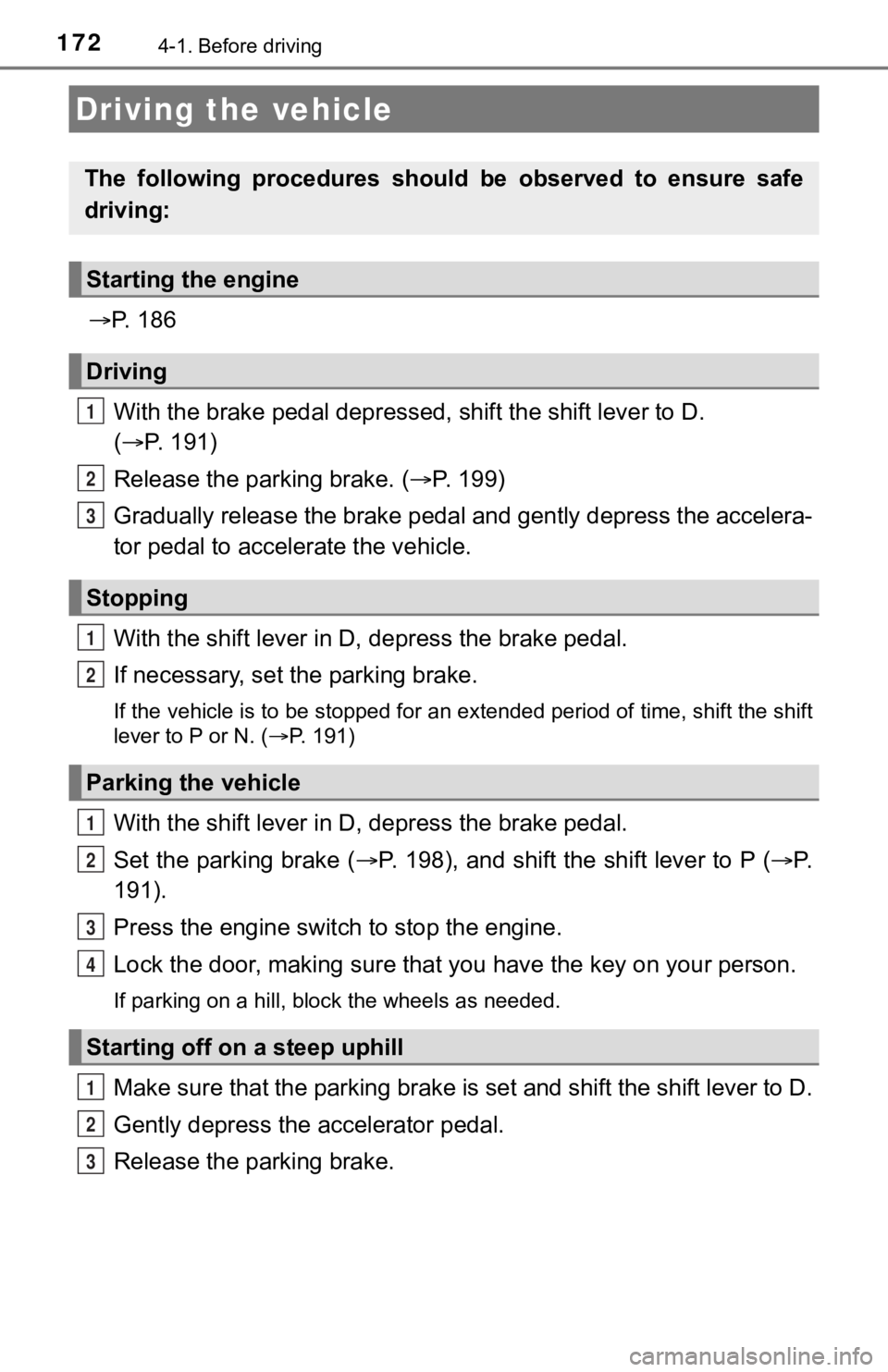
Driving the vehicle
The following procedures should be observed to ensure safe
driving:
Starting the engine
Driving
Stopping
Parking the vehicle
Starting off on a steep uphill
1
2
3
1
2
1
2
3
4
1
2
3
Page 177 of 572

1774-1. Before driving
4
Driving
WARNING
Observe the following precautions.
Failure to do so may result in death or serious injury.
■If you hear a squealing or scraping noise (brake pad wear limit indica-
tors)
Have the brake pads checked and replaced by your Toyota dealer as soon
as possible.
Rotor damage may result if the pads are not replaced when neede d.
It is dangerous to drive the vehicle when the wear limits of the brake pads
and/or those of the brake discs are exceeded.
■ When the vehicle is stopped
● Do not race the engine.
If the shift lever is any position other than P or N, the vehicle may acceler-
ate suddenly and unexpectedly, causing an accident.
● In order to prevent accidents due to the vehicle rolling away, always keep
depressing the brake pedal while the engine is running, and apply the
parking brake as necessary.
● If the vehicle is stopped on an incline, in order to prevent ac cidents caused
by the vehicle rolling forward or backward, always depress the brake pedal
and securely apply the parking brake as needed.
● Avoid revving or racing the engine.
Running the engine at high speed while the vehicle is stopped may cause
the exhaust system to overheat, which could result in a fire if combustible
material is nearby.
■ When the vehicle is parked
● Do not leave glasses, cigarette lighters, spray cans, or soft drink cans in
the vehicle when it is in the sun.
Doing so may result in the following:
• Gas may leak from a cigarette lighter or spray can, and may le ad to a
fire.
• The temperature inside the vehicle may cause the plastic lenses and
plastic material of glasses to deform or crack.
• Soft drink cans may fracture, causing the contents to spray ov er the
interior of the vehicle, and may also cause a short circuit in the vehicle’s
electrical components.
● Do not leave cigarette lighters in the vehicle. If a cigarette lighter is in a
place such as the glove box or on the floor, it may be lit accidentally when
luggage is loaded or the seat is adjusted, causing a fire.
● Do not attach adhesive discs to the windshield or windows. Do not place
containers such as air fresheners on the instrument panel or da shboard.
Adhesive discs or containers may act as lenses, causing a fire in the vehi-
cle.
Page 178 of 572

1784-1. Before driving
WARNING
Observe the following precautions.
Failure to do so may result in death or serious injury.● Do not leave a door or window open if the curved glass is coated with a
metallized film such as a silver-colored one. Reflected sunligh t may cause
the glass to act as a lens, causing a fire.
■ When the vehicle is parked
● Always apply the parking brake, shift the shift lever to P, stop the engine
and lock the vehicle.
Do not leave the vehicle unattended while the engine is running.
If the vehicle is parked with the shift lever in P but the park ing brake is not
set, the vehicle may start to move, possibly leading to an accident.
● Do not touch the exhaust pipes while the engine is running or i mmediately
after turning the engine off.
Doing so may cause burns.
■ When taking a nap in the vehicle
Always turn the engine off. Otherwise, if you accidentally move the shift
lever or depress the accelerator pedal, this could cause an acc ident or fire
due to engine overheating. Additionally, if the vehicle is parked in a poorly
ventilated area, exhaust gases may collect and enter the vehicl e, leading to
death or a serious health hazard.
■ When braking
● When the brakes are wet, drive more cautiously.
Braking distance increases when the brakes are wet, and this may cause
one side of the vehicle to brake differently than the other side. Also, the
parking brake may not securely hold the vehicle.
● If the brake booster device does not operate, do not follow oth er vehicles
closely and avoid hills or shar p turns that require braking.
In this case, braking is still possible, but the brake pedal should be
depressed more firmly than usual. Also, the braking distance will increase.
Have your brakes fixed immediately.
● Do not pump the brake pedal if the engine stalls.
Each push on the brake pedal uses up the reserve for the power-assisted
brakes.
● The brake system consists of 2 individual hydraulic systems; if one of the
systems fails, the other will still operate. In this case, the brake pedal
should be depressed more firmly than usual and the braking dist ance will
increase.
Have your brakes fixed immediately.
■ If the vehicle becomes stuck (AWD models)
Do not spin the wheels excessively when any of the tires is up in the air, or
the vehicle is stuck in sand, mud, etc. This may damage the driveline com-
ponents or propel the vehicle forward or backward, causing an accident.
Page 179 of 572
1794-1. Before driving
4
Driving
NOTICE
■When driving the vehicle
● Do not depress the accelerator and brake pedals at the same tim e during
driving, as this may restrain the engine output.
● Do not use the accelerator pedal or depress the accelerator and brake
pedals at the same time to hold the vehicle on a hill.
■ When parking the vehicle
Always set the parking brake and shift the shift lever to P. Failure to do so
may cause the vehicle to move or the vehicle may accelerate sud denly if
the accelerator pedal is accidentally depressed.
■ Avoiding damage to vehicle parts
● Do not turn the steering wheel fully in either direction and ho ld it there for
an extended period of time.
Doing so may damage the power steering motor.
● When driving over bumps in the road, drive as slowly as possible to avoid
damaging the wheels, underside of the vehicle, etc.
■ If you get a flat tire while driving
A flat or damaged tire may cause the following situations. Hold the steering
wheel firmly and gradually depress the brake pedal to slow down the vehi-
cle.
● It may be difficult to control your vehicle.
● The vehicle will make abnormal sounds or vibrations.
● The vehicle will lean abnormally.
Information on what to do in case of a flat tire ( P. 470)
■ When encountering flooded roads
Do not drive on a road that has flooded after heavy rain etc. D oing so may
cause the following serious damage to the vehicle:
● Engine stalling
● Short in electrical components
● Engine damage caused by water immersion
In the event that you drive on a flooded road and the vehicle i s flooded, be
sure to have your Toyota dealer check the following:
● Brake function
● Changes in quantity and quality of oil and fluid used for the e ngine, tran-
saxle, transfer (AWD models), rear differential (AWD models), e tc.
● Lubricant condition for the propeller shaft (AWD models), beari ngs and
suspension joints (where possible), and the function of all joints, bearings,
etc.