trailer TOYOTA AVALON 2022 Owners Manual
[x] Cancel search | Manufacturer: TOYOTA, Model Year: 2022, Model line: AVALON, Model: TOYOTA AVALON 2022Pages: 572, PDF Size: 9.42 MB
Page 3 of 572

3
1
8 7 5 4
3
2
9
6
3-1. Key informationKeys .................................. 124
3-2. Opening, closing and locking the doors
Doors................................. 127
Trunk ................................. 133
Smart key system.............. 137
3-3. Adjusting the seats Front seats ........................ 144
Rear seats ......................... 146
Driving position memory ........................... 148
Head restraints .................. 153
3-4. Adjusting the steering wheel and mirrors
Steering wheel .................. 155
Inside rear view mirror....... 157
Outside rear view mirrors ............................. 159
3-5. Opening and closing the windows
Power windows ................. 162
Moon roof .......................... 166 4-1. Before driving
Driving the vehicle ............. 172
Cargo and luggage ............ 180
Vehicle load limits .............. 183
Trailer towing ..................... 184
Dinghy towing .................... 185
4-2. Driving procedures Engine (ignition) switch...... 186
Automatic transmission ..... 191
Turn signal lever ................ 197
Parking brake .................... 198
Brake Hold ......................... 202
4-3. Operating the lights and wipers
Headlight switch ................ 204
AHB (Automatic High Beam) .............................. 208
Windshield wipers and washer ............................. 212
4-4. Refueling Opening the fuel tank cap................................... 216
3Operation of each
component4Driving
Page 171 of 572

171
4Driving
4-1. Before drivingDriving the vehicle ............. 172
Cargo and luggage ........... 180
Vehicle load limits ............. 183
Trailer towing..................... 184
Dinghy towing ................... 185
4-2. Driving procedures Engine (ignition) switch ..... 186
Automatic transmission ..... 191
Turn signal lever................ 197
Parking brake .................... 198
Brake Hold ........................ 202
4-3. Operating the lights and wipers
Headlight switch ................ 204
AHB (Automatic High Beam) ............................. 208
Windshield wipers and washer ............................ 212
4-4. Refueling Opening the fuel tank cap .................................. 216 4-5. Using the driving
support systems
Toyota Safety Sense 2.5+...................... 220
PCS (Pre-Collision System)........................... 228
LTA (Lane Tracing Assist) ............................. 243
RSA (Road Sign Assist) .... 258
Dynamic radar cruise control with full-speed
range............................... 263
BSM (Blind Spot Monitor)........................... 279
• BSM function ................ 283
• RCTA function .............. 286
Rear Camera Detection function (vehicles with
panoramic view
monitor)........................... 291
Intuitive parking assist....... 295
Intelligent Clearance Sonar (ICS) ..................... 303
Driving mode select switches .......................... 324
Driving assist systems ...... 328
4-6. Driving tips Winter driving tips ............. 336
Page 180 of 572

1804-1. Before driving
Cargo capacity depends on the total weight of the occupants.
(Cargo capacity) = (Total load capacity) — (Total weight of occ upants)
Steps for Determining Correct Load Limit —
(1) Locate the statement “The co mbined weight of occupants and
cargo should never exceed XXX kg or XXX lbs.” on your vehicle’s
placard.
(2) Determine the combined weight of the driver and passengers t hat
will be riding in your vehicle.
(3) Subtract the combined weight of the driver and passengers fr om
XXX kg or XXX lbs.
(4) The resulting figure equals the available amount of cargo an d lug-
gage load capacity.
For example, if the “XXX” amount equals 1400 lbs. and there wil l be
five 150 lb passengers in your vehicle, the amount of available
cargo and luggage load capacity is 650 lbs. (1400 750 (5150) =
650 lbs.)
(5) Determine the combined weight of luggage and cargo being loa ded
on the vehicle. That weight may n ot safely exceed the available
cargo and luggage load capac ity calculated in Step 4.
(6) If your vehicle will be towing a trailer, load from your tra iler will be
transferred to your vehicle. Consult this manual to determine h ow
this reduces the available cargo and luggage load capacity of y our
vehicle.
( P. 183)
Toyota does not recommend towing a trailer with your vehicle. Y our
vehicle is not desig ned for trailer towing.
Cargo and luggage
Take notice of the following information about storage precau-
tions, cargo capacity and load:
Capacity and distribution
Page 183 of 572
1834-1. Before driving
4
Driving
◆Total load capacity (vehicle capacity weight): (P. 498)
Total load capacity means the co mbined weight of occupants, cargo
and luggage.
◆Seating capacity: ( P. 498)
Seating capacity means the max imum number of occupants whose
estimated average weight is 150 lb. (68 kg) per person.
◆Towing capacity
Toyota does not recommend towing a trailer with your vehicle.
◆Cargo capacity
Cargo capacity may increase or decrease depending on the weight
and the number of occupants.
■Total load capacity and seating capacity
These details are also described on the tire and loading inform ation label.
( P. 428)
Vehicle load limits
Vehicle load limits include total load capacity, seating capaci t y,
towing capacity and cargo capacity.
WARNING
■Overloading the vehicle
Do not overload the vehicle.
It may not only cause damage to the tires, but also degrade steering
and braking ability, resulting in an accident.
Page 184 of 572
1844-1. Before driving
Trailer towing
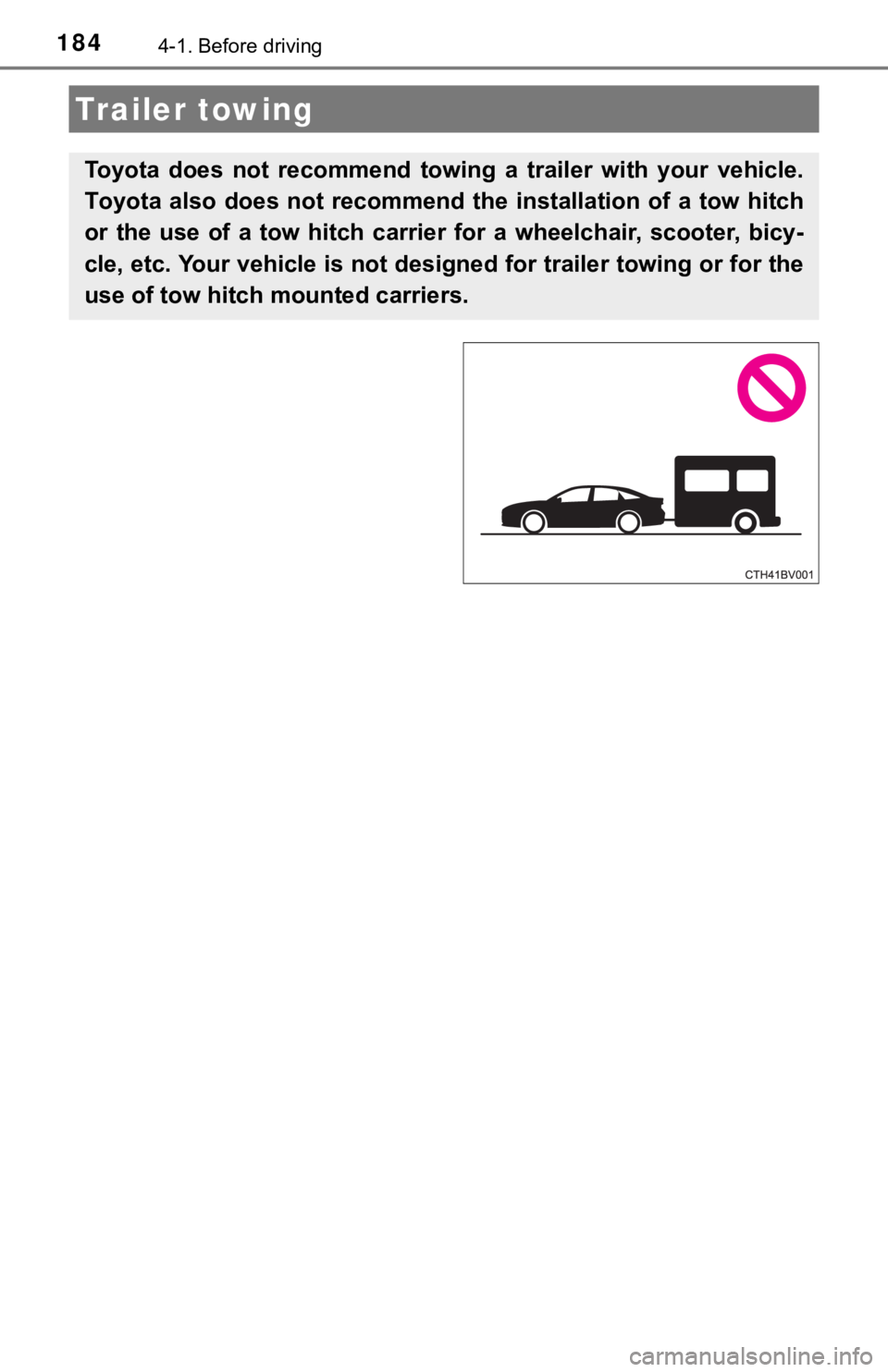
Toyota does not recommend towing a trailer with your vehicle.
Toyota also does not recommend the installation of a tow hitch
or the use of a tow hitch carrier for a wheelchair, scooter, bi cy-
cle, etc. Your vehicle is not des igned for trailer towing or for the
use of tow hitch mounted carriers.
Page 211 of 572

2114-3. Operating the lights and wipers
4
Driving
• When the windshield is obscured by fog, mist, ice, dirt, etc.
• When the windshield is cracked or damaged
• When the camera sensor is deformed or dirty
• When the temperature of the camera sensor is extremely high
• When the surrounding brightness level is equal to that of head lights, tail
lights or fog lights
• When headlights or tail lights of vehicles ahead are turned off, dirty, changing color, or not aimed properly
• When the vehicle is hit by water, snow, dust, etc. from a prec eding vehi-
cle
• When driving through an area of intermittently changing brightness and
darkness
• When frequently and repeatedly driving ascending/descending roads, or roads with rough, bumpy or uneven surfaces (such as stone-paved
roads, gravel roads, etc.)
• When frequently and repeatedly taking curves or driving on a w inding
road
• When there is a highly reflective object ahead of the vehicle, such as a sign or mirror
• When the back of a preceding vehicle is highly reflective, such as a con-
tainer on a truck
• When the vehicle's headlights are damaged or dirty, or are not aimed
properly
• When the vehicle is listing or titling due to a flat tire, a trailer being towed, etc.
• When the headlights are changed between the high beams and low
beams repeatedly in an abnormal manner
• When the driver believes that the high beams may be flashing or dazzling pedestrians or other drivers
■ Temporarily lowering sensor sensitivity
The sensitivity of the sensor can be temporarily lowered.
Turn the engine switch off while the following conditions are m et.
• The headlight switch is in the or position.
• The headlight switch lever is in the original position.
• Automatic High Beam switch is on.
Turn the engine switch to the IGNITION ON mode.
Within 60 seconds after , repeat pushing the headlight switch lever to the
high beam position then pulling it to the original position qui ckly 10 times,
then leave the lever in the original position.
If the sensitivity is changed, the Automatic High Beam indicato r is turn on
and off 3 times.
1
2
32
4
Page 240 of 572
2404-5. Using the driving support systems
• If a vehicle ahead is narrow, such as a personal mobility vehi cle
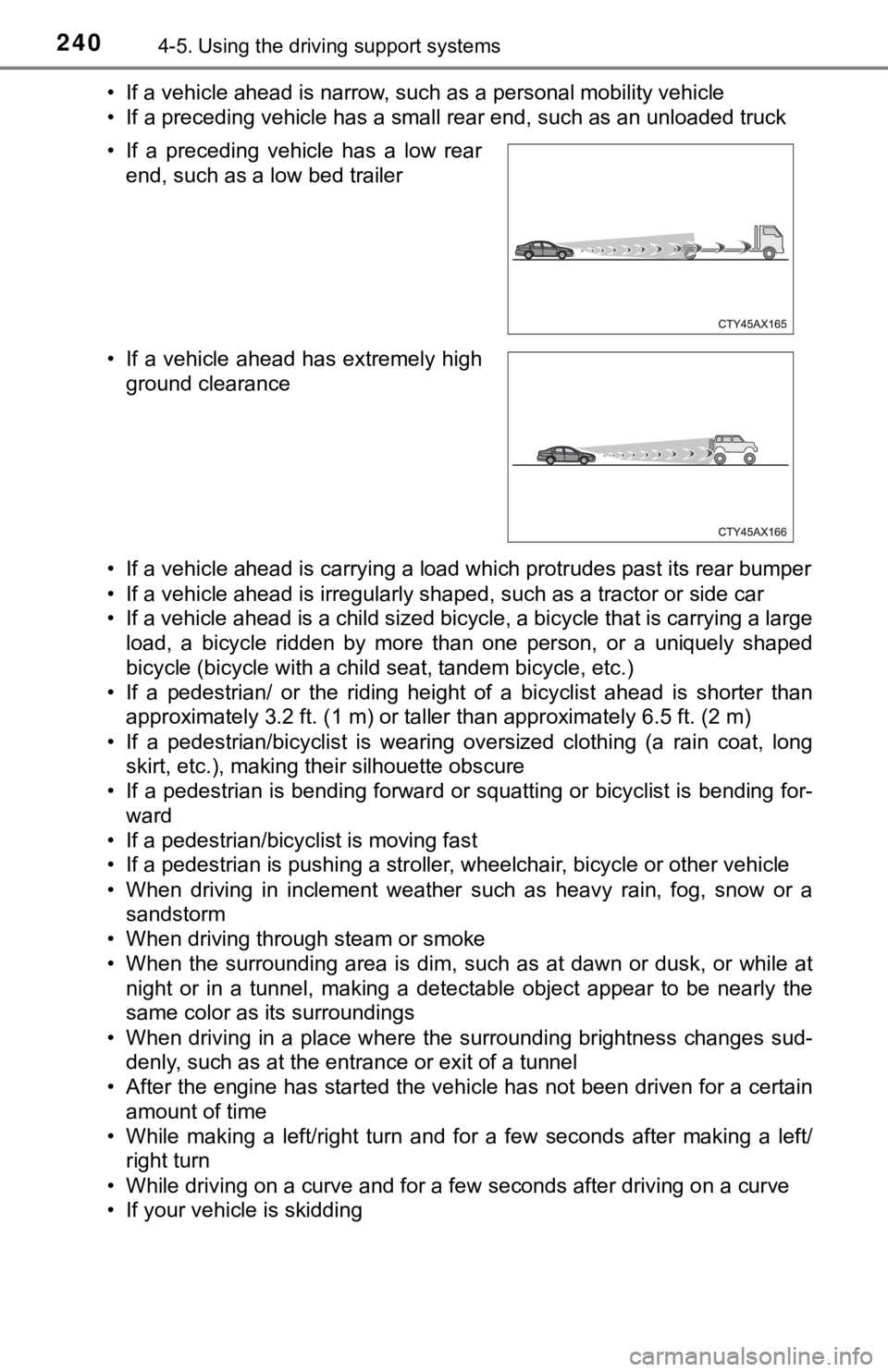
• If a preceding vehicle has a small rear end, such as an unload ed truck
• If a vehicle ahead is carrying a load which protrudes past its rear bumper
• If a vehicle ahead is irregularly shaped, such as a tractor or side car
• If a vehicle ahead is a child sized bicycle, a bicycle that is carrying a large
load, a bicycle ridden by more than one person, or a uniquely shaped
bicycle (bicycle with a child seat, tandem bicycle, etc.)
• If a pedestrian/ or the riding height of a bicyclist ahead is shorter than
approximately 3.2 ft. (1 m) or taller than approximately 6.5 ft. (2 m)
• If a pedestrian/bicyclist is wearing oversized clothing (a rai n coat, long
skirt, etc.), making their silhouette obscure
• If a pedestrian is bending forward or squatting or bicyclist i s bending for-
ward
• If a pedestrian/bicyclist is moving fast
• If a pedestrian is pushing a stroller, wheelchair, bicycle or other vehicle
• When driving in inclement weather such as heavy rain, fog, snow or a sandstorm
• When driving through steam or smoke
• When the surrounding area is dim, such as at dawn or dusk, or while at
night or in a tunnel, making a detectable object appear to be n early the
same color as its surroundings
• When driving in a place where the surrounding brightness changes sud- denly, such as at the entrance or exit of a tunnel
• After the engine has started the vehicle has not been driven for a certain
amount of time
• While making a left/right turn and for a few seconds after mak ing a left/
right turn
• While driving on a curve and for a few seconds after driving o n a curve
• If your vehicle is skidding • If a preceding vehicle has a low rear
end, such as a low bed trailer
• If a vehicle ahead has extremely high ground clearance
Page 277 of 572
2774-5. Using the driving support systems
4
Driving
■When the sensor may not be correctly detect ing the vehicle ahead
In the case of the following and depending on the conditions, o perate the
brake pedal when deceleration of the system is insufficient or operate the
accelerator pedal when acceleration is required.
As the sensor may not be able to correctly detect these types o f vehicles, the
approach warning ( P. 272) may not be activated.
● Vehicles that cut in suddenly
● Vehicles traveling at low speeds
● Vehicles that are not moving in the same lane
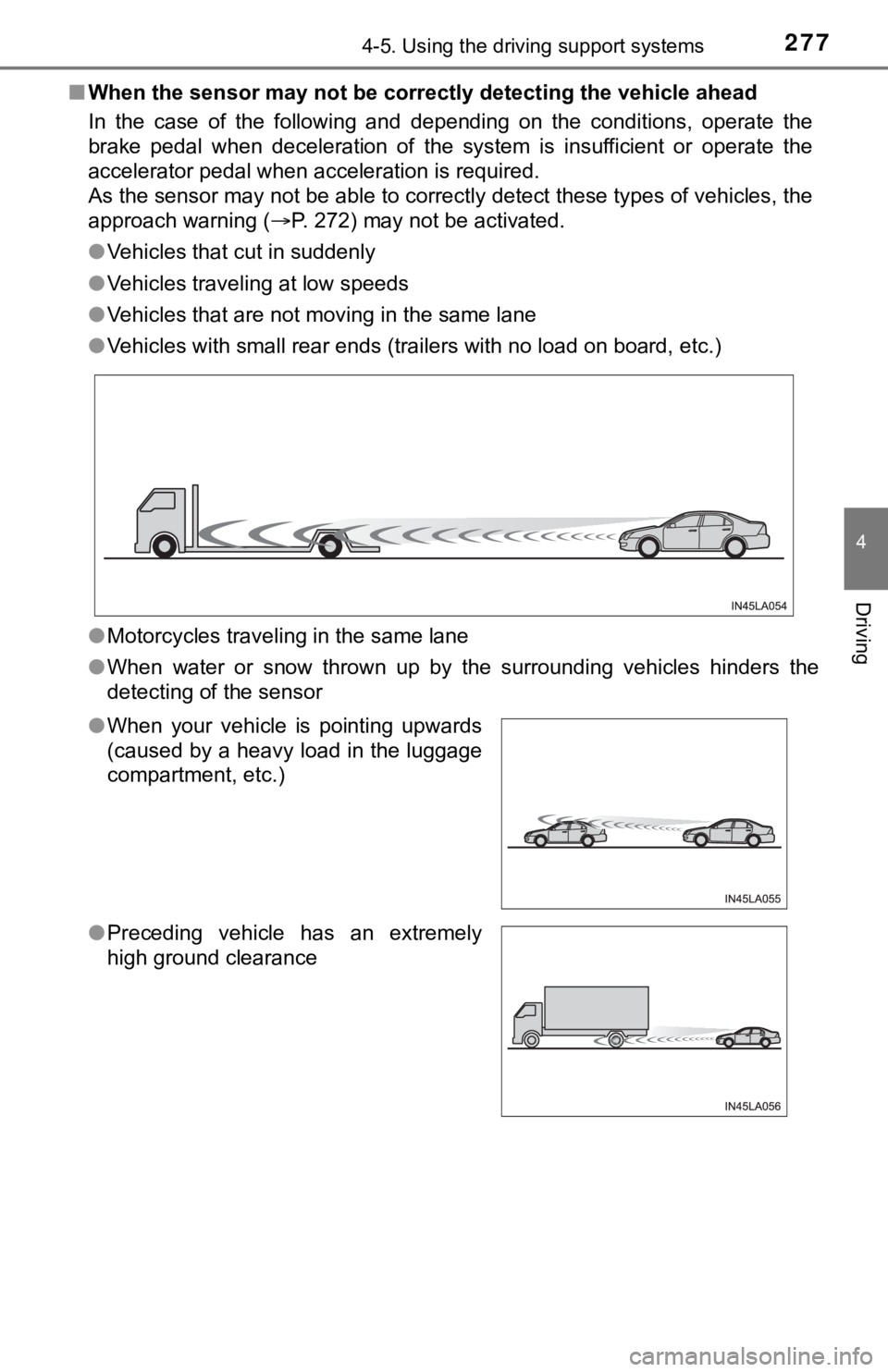
● Vehicles with small rear ends (trailers with no load on board, etc.)
● Motorcycles traveling in the same lane
● When water or snow thrown up by the surrounding vehicles hinders the
detecting of the sensor
●When your vehicle is pointing upwards
(caused by a heavy load in the luggage
compartment, etc.)
● Preceding vehicle has an extremely
high ground clearance
Page 568 of 572

568Alphabetical index
Tachometer ................................ 90
Tail lightsLight switch ........................... 204
Replacing light bulbs............. 441
Theft deterrent system Alarm ...................................... 80
Engine immobilizer system ..... 77
Tire inflation pressure ............. 428 Maintenance data ................. 506
Warning light ......................... 459
Tire information ....................... 512 Glossary................................ 519
Size ....................................... 515
Tire identification number ..... 514
Uniform Tire Quality Grading............................... 517
Tire pressure warning system Initializing .............................. 416
Installing tire pressure warning valve and
transmitters......................... 416
Registering ID codes ............ 417
Warning light ......................... 459 Tires .......................................... 414
Chains .................................. 337
Checking............................... 414
Glossary ............................... 519
If you have a flat tire ............. 470
Inflation pressure .................. 506
Replacing.............................. 470
Rotating tires ........................ 414
Size....................................... 506
Snow tires ............................. 338
Spare tire .............................. 470
Tire pressure warning system .......... ...................... 415
Uniform Tire Quality Grading .............................. 517
Warning light......................... 459
Tools ......................................... 471
Top tether strap ......................... 67
Total load capacity .................. 183
Towing Dinghy towing ....................... 185
Emergency towing ................ 448
Trailer towing ........................ 184
T
Page 569 of 572

569Alphabetical index
Toyota parking assist monitor
*
Toyota Safety Sense 2.5+ ....... 220 Automatic High Beam ........... 208
Dynamic radar cruise control with full-speed range .......... 263
LTA (Lane Tracing
Assist)................................. 243
PCS (Pre-Collision System) .............................. 228
RSA (Road Sign Assist)........ 258
TRAC (Traction Control) ......... 328
Traction Control (TRAC) ......... 328
Trailer towing .......................... 184
Transmission Automatic transmission......... 191
Driving mode select
switches.............................. 324
If the shift lever cannot be
shifted from P ..................... 195
Paddle shift switches ............ 193
S mode ................................. 192
Trip information ....................... 118
Trip meters ................................. 90
Trunk......................................... 133 Cargo net .............................. 361
Grocery bag hooks ............... 361
Internal trunk release lever ... 134
Smart key system ................. 133
Trunk light ............................. 134
Trunk opener ........................ 133
Wireless remote control ........ 133 Trunk light
Trunk light ............................. 134
Wattage ................................ 508
Turn signal lights Replacing light bulbs................................... 441
Turn signal lever ................... 197
USB charging port................... 364
Vanity lights ............................. 362 Wattage ................................ 508
Vanity mirrors .......................... 362 Vanity lights .......................... 362
Vehicle data recording ................ 9
Vehicle identification number ................................... 499
Vehicle Stability Control (VSC) ...................................... 328
VSC
(Vehicle Stability Control) .... 328
U
V