towing TOYOTA AVALON HYBRID 2019 Owners Manual (in English)
[x] Cancel search | Manufacturer: TOYOTA, Model Year: 2019, Model line: AVALON HYBRID, Model: TOYOTA AVALON HYBRID 2019Pages: 556, PDF Size: 9.73 MB
Page 2 of 556

TABLE OF CONTENTS2
For your information....................... 6
Reading this manual .................... 12
How to search .............................. 13
Pictorial index .............................. 14
1-1. For safe useBefore driving ...................... 24
For safe driving ................... 26
Seat belts ............................ 28
SRS airbags ........................ 34
Front passenger occupant classification system ......... 48
Safety information for children ............................. 53
Child restraint systems ........ 54
Installing child restraints ...... 58
Exhaust gas precautions ..... 68
1-2. Hybrid system Hybrid system features ....... 69
Hybrid system precautions ....................... 73
1-3. Theft deterrent system Immobilizer system ............. 80
Alarm ................................... 82
2. Instrument cluster Warning lights and
indicators ........................... 86
Gauges and meters............. 92
Multi-information display ..... 96
Head-up display ................ 115
Energy monitor/ consumption screen ........ 122 3-1. Key information
Keys................................... 128
3-2. Opening, closing and locking the doors
Doors ................................. 132
Trunk ................................. 138
Smart key system .............. 142
3-3. Adjusting the seats Front seats......................... 149
Rear seats ......................... 151
Driving position memory ........................... 153
Head restraints .................. 158
3-4. Adjusting the steering wheel and mirrors
Steering wheel ................... 160
Inside rear view mirror ....... 162
Outside rear view mirrors ............................. 164
3-5. Opening and closing the windows
Power windows.................. 167
Moon roof .......................... 171
4-1. Before driving Driving the vehicle ............. 176
Cargo and luggage ............ 184
Vehicle load limits .............. 187
Trailer towing ..................... 188
Dinghy towing .................... 189
1For safety and security
2Instrument cluster
3Operation of each
component
4Driving
Page 16 of 556
16Pictorial index
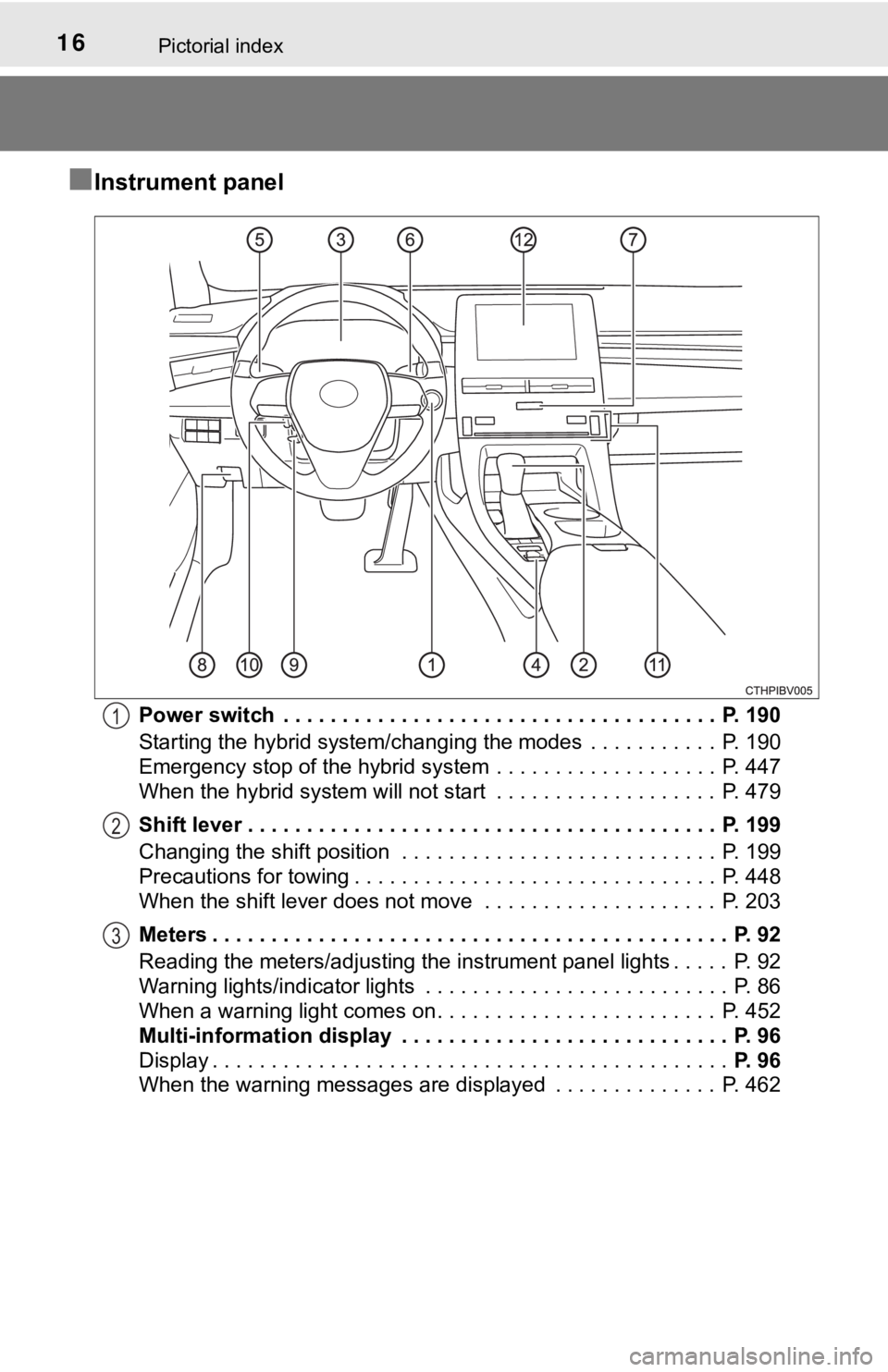
■Instrument panel
Power switch . . . . . . . . . . . . . . . . . . . . . . . . . . . . . . . . . . . . . P. 190
Starting the hybrid system/changing the modes . . . . . . . . . . . P. 190
Emergency stop of the hybrid system . . . . . . . . . . . . . . . . . . . P. 447
When the hybrid system will not start . . . . . . . . . . . . . . . . . . . P. 479
Shift lever . . . . . . . . . . . . . . . . . . . . . . . . . . . . . . . . . . . . . . . . P. 199
Changing the shift position . . . . . . . . . . . . . . . . . . . . . . . . . . . P. 199
Precautions for towing . . . . . . . . . . . . . . . . . . . . . . . . . . . . . . . P. 448
When the shift lever does not move . . . . . . . . . . . . . . . . . . . . P. 203
Meters . . . . . . . . . . . . . . . . . . . . . . . . . . . . . . . . . . . . . . . . . . . . P. 92
Reading the meters/adjusting the instrument panel lights . . . . . P. 92
Warning lights/indicator lights . . . . . . . . . . . . . . . . . . . . . . . . . . P. 86
When a warning light comes on . . . . . . . . . . . . . . . . . . . . . . . . P. 452
Multi-information display . . . . . . . . . . . . . . . . . . . . . . . . . . . . P. 96
Display . . . . . . . . . . . . . . . . . . . . . . . . . . . . . . . . . . . . . . . . . . . . P. 96
When the warning messages are displayed . . . . . . . . . . . . . . P. 4621
2
3
Page 77 of 556

771-2. Hybrid system
1
For safety and security
WARNING
■Road accident cautions
Observe the following precautions to reduce the risk of death o r serious
injury:
● Pull your vehicle off the road, apply the parking brake, shift the shift lever
to P, and turn the hybrid system off.
● Do not touch the high voltage parts, cables and connectors.
● If electric wires are exposed inside or outside your vehicle, a n electric
shock may occur. Never touch exposed electric wires.
● If a fluid leak occurs, do not touch the fluid as it may be str ong alkaline
electrolyte from the hybrid battery (traction battery). If it c omes into contact
with your skin or eyes, wash it off immediately with a large am ount of water
or, if possible, boric acid solution. Seek immediate medical at tention.
● If a fire occurs in the hybrid vehicle, leave the vehicle as soon as possible.
Never use a fire extinguisher that is not meant for electric fires. Using even
a small amount of water may be dangerous.
● If your vehicle needs to be towed, do so with front wheels raised. If the
wheels connected to the electric motor (traction motor) are on the ground
when towing, the motor may continue to generate electricity. Th is may
cause a fire. ( P. 448)
● Carefully inspect the ground under the vehicle. If you find that liquid has
leaked onto the ground, the fuel system may have been damaged. Leave
the vehicle as soon as possible.
● If electrolyte is leaking from the hybrid battery (traction bat tery), do not
approach the vehicle.
Even in the unlikely event that the hybrid battery (traction ba ttery) is dam-
aged, the internal construction of the battery will prevent a l arge amount
of electrolyte from leaking out. However, any electrolyte that does leak out
will give off a vapor. This vapor is an irritant to skin and ey es and could
cause acute poisoning if inhaled.
Page 175 of 556

175
4Driving
4-1. Before drivingDriving the vehicle ............. 176
Cargo and luggage ........... 184
Vehicle load limits ............. 187
Trailer towing..................... 188
Dinghy towing ................... 189
4-2. Driving procedures Power (ignition) switch ...... 190
EV drive mode .................. 196
Hybrid transmission........... 199
Turn signal lever................ 205
Parking brake .................... 206
Brake Hold ........................ 210
4-3. Operating the lights and wipers
Headlight switch ................ 212
Automatic High Beam ....... 216
Windshield wipers and washer ..................... 220
4-4. Refueling Opening the fuel tank cap .......................... 224 4-5. Using the driving
support systems
Toyota Safety Sense P ..... 229
PCS (Pre-Collision System) .... 236
LDA (Lane Departure Alert with steering
control) ............................ 247
Dynamic radar cruise control with full-speed
range............................... 258
BSM (Blind Spot Monitor) ........ 271
• BSM function ................ 275
• RCTA function .............. 277
Rear Camera Detection function ........................... 282
Intuitive parking assist....... 286
Intelligent Clearance Sonar (ICS) ..................... 294
Driving mode select switches .......................... 315
Driving assist systems ...... 317
4-6. Driving tips Hybrid vehicle driving tips....................... 324
Winter driving tips ............. 327
Page 184 of 556

1844-1. Before driving
Cargo capacity depends on the total weight of the occupants.
(Cargo capacity) = (Total load capacity) — (Total weight of occ upants)
Steps for Determining Correct Load Limit —
(1) Locate the statement “The co mbined weight of occupants and
cargo should never exceed XXX kg or XXX lbs.” on your vehicle’s
placard.
(2) Determine the combined weight of the driver and passengers t hat
will be riding in your vehicle.
(3) Subtract the combined weight of the driver and passengers fr om
XXX kg or XXX lbs.
(4) The resulting figure equals the available amount of cargo an d lug-
gage load capacity.
For example, if the “XXX” amount equals 1400 lbs. and there wil l be
five 150 lb passengers in your vehicle, the amount of available
cargo and luggage load capacity is 650 lbs. (1400 750 (5150) =
650 lbs.)
(5) Determine the combined weight of luggage and cargo being loa ded
on the vehicle. That weight may n ot safely exceed the available
cargo and luggage load capac ity calculated in Step 4.
(6) If your vehicle will be towing a trailer, load from your tra iler will be
transferred to your vehicle. Consult this manual to determine h ow
this reduces the available cargo and luggage load capacity of y our
vehicle.
( P. 187)
Toyota does not recommend towing a trailer with your vehicle. Y our
vehicle is not desig ned for trailer towing.
Cargo and luggage
Take notice of the following information about storage precau-
tions, cargo capacity and load:
Capacity and distribution
Page 187 of 556
1874-1. Before driving
4
Driving
◆Total load capacity (vehicle capacity weight): (P. 4 9 8 )
Total load capacity means the co mbined weight of occupants, cargo
and luggage.
◆Seating capacity: 5 occupants (Front 2, Rear 3)
Seating capacity means the max imum number of occupants whose
estimated average weight is 1 50 lb. (68 kg) per person.
◆Towing capacity
Toyota does not recommend towing a trailer with your vehicle.
◆Cargo capacity
Cargo capacity may increase or decrease depending on the weight
and the number of occupants.
■Total load capacity and seating capacity
These details are also described on the tire and loading inform ation label.
( P. 427)
Vehicle load limits
Vehicle load limits include total load capacity, seating capaci ty,
towing capacity and cargo capacity.
WARNING
■Overloading the vehicle
Do not overload the vehicle.
It may not only cause damage to the tires, but also degrade steering
and braking ability, res ulting in an accident.
Page 188 of 556
1884-1. Before driving
Trailer towing
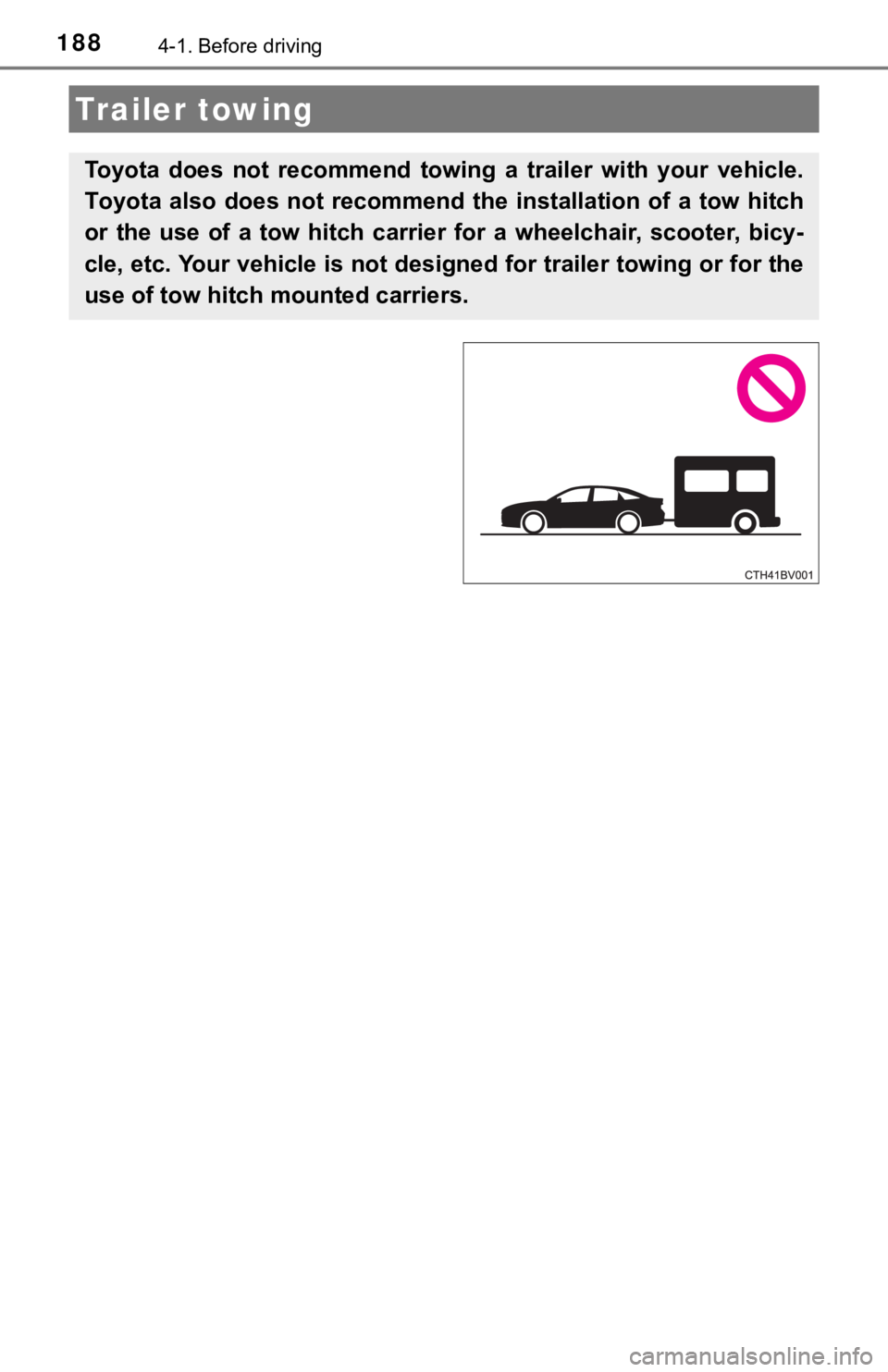
Toyota does not recommend towing a trailer with your vehicle.
Toyota also does not recommend the installation of a tow hitch
or the use of a tow hitch carrier for a wheelchair, scooter, bi cy-
cle, etc. Your vehicle is not des igned for trailer towing or for the
use of tow hitch mounted carriers.
Page 189 of 556
1894-1. Before driving
4
Driving
Dinghy towing
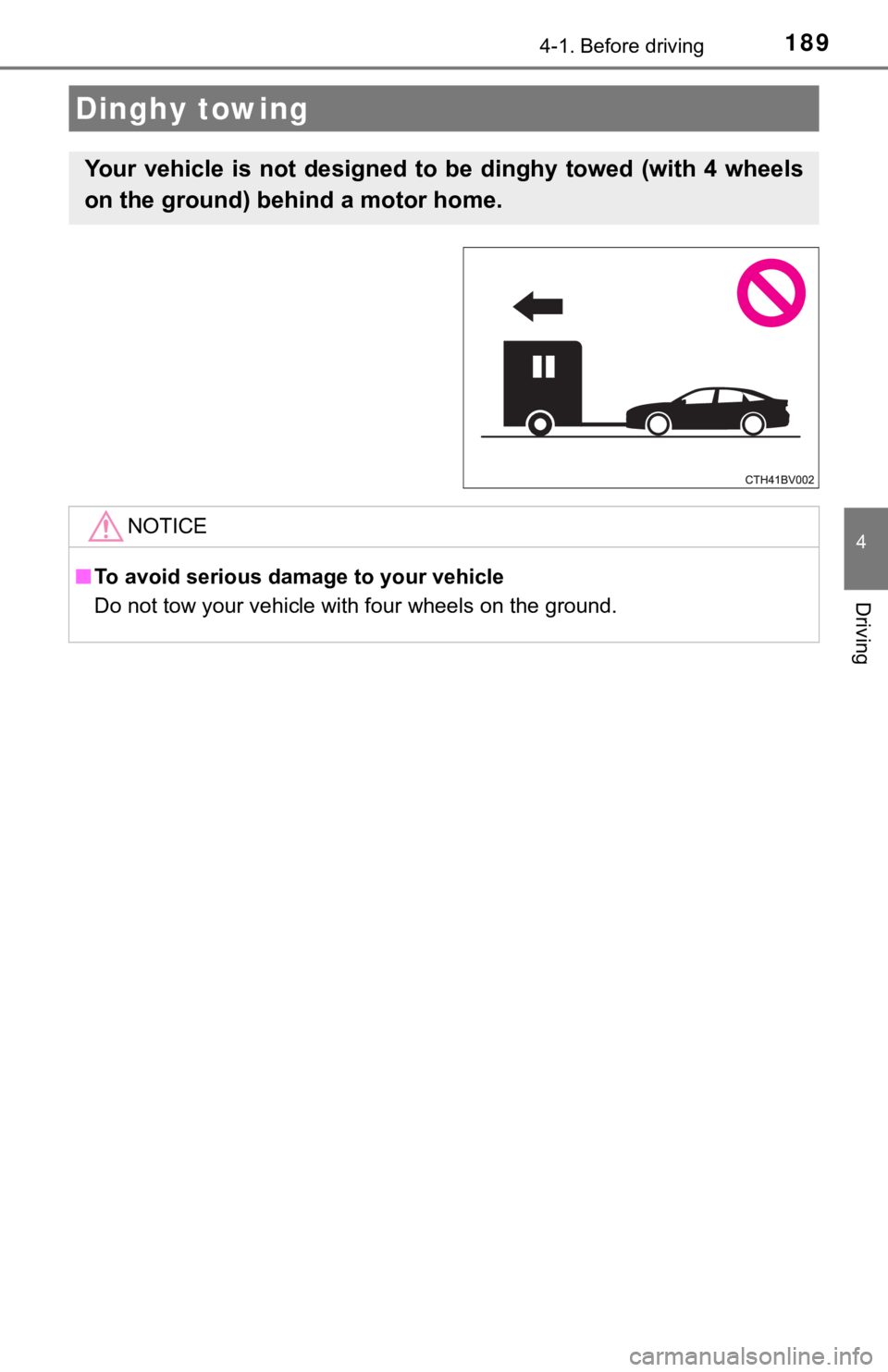
Your vehicle is not designed to be dinghy towed (with 4 wheels
on the ground) behind a motor home.
NOTICE
■To avoid serious damage to your vehicle
Do not tow your vehicle with four wheels on the ground.
Page 238 of 556

2384-5. Using the driving support systems
WARNING
■When to disable the pre-collision system
In the following situations, disable the system, as it may not operate prop-
erly, possibly leading to an accident resulting in death or ser ious injury:
● When the vehicle is being towed
● When your vehicle is towing another vehicle
● When transporting the vehicle via truck, boat, train or similar means of
transportation
● When the vehicle is raised on a lift with the hybrid system on and the tires
are allowed to rotate freely
● When inspecting the vehicle using a drum tester such as a chass is dyna-
mometer or speedometer tester, or when using an on vehicle whee l bal-
ancer
● When a strong impact is applied to the front bumper or front gr ille, due to
an accident or other reasons
● If the vehicle cannot be driven in a stable manner, such as when the vehi-
cle has been in an accident or is malfunctioning
● When the vehicle is driven in a sporty manner or off-road
● When the tires are not properly inflated
● When the tires are very worn
● When tires of a size other than specified are installed
● When tire chains are installed
● When a compact spare tire or an emergency tire puncture repair kit is used
● If equipment (snow plow, etc.) that may obstruct the radar sens or or cam-
era sensor is temporarily installed to the vehicle
Page 285 of 556

2854-5. Using the driving support systems
4
Driving
●In some situations, such as the following, the rear camera dete ction function
may operate even though there are no pedestrians in the detection area.
• When a three dimensional object, such as a pole, traffic cone, fence, or parked vehicle, is detected
• When a moving object, such as a car or motorcycle is detected
• When backing up toward moving objects such as flags or puddles , or air-
borne matter, such as smoke, steam, rain, or snow
• When there is a pattern on the road, due to the road being mad e of cob-
blestone or gravel or having tram rails, traces of repair, white lines,
pedestrian crossings or fallen leaves on the surface
• When backing up on a metal cover (grating), such as those used for
drainage ditches
• When backing up toward the roadside or a bump in the road
• When an object is reflected in a puddle or on a wet road surfa ce
• When there are shadows on the road
• When backing up over a bump in the road
• If the vehicle is significantly tilted, such as when carrying a heavy load
• When backing up toward an incline/decline
• If the suspension has been modified or tires of a size other than specified are installed
• If the rear of the vehicle is raised or lowered due to the carried load
• If an electronic component, such as a backlit license plate or rear fog
light, is installed near the rear camera
• If a bumper protector, such as an additional trim strip, is installed to the rear bumper
• If the orientation of the rear camera has been changed due to a collision
or other impact, or removal and installation
• If a towing eyelet is installed to the rear of the vehicle
• When the rear camera is obscured (dirt, snow, ice, etc. are at tached) or
scratched
• When water is flowing over the rear camera lens
• If there is a flashing light in the detection area, such as th e emergency
flashers of another vehicle
■ Situations in which the rear cam era detection function may be difficult to
notice
● If buzzer may be difficult to hear if the surrounding area is noisy, the volume
of the audio system volume is high, the air conditioning system is being
used, etc.
● If the temperature in the cabin is extremely high or low, the a udio system
screen may not operate correctly.