head light TOYOTA AVENSIS 2012 User Guide
[x] Cancel search | Manufacturer: TOYOTA, Model Year: 2012, Model line: AVENSIS, Model: TOYOTA AVENSIS 2012Pages: 772, PDF Size: 34.43 MB
Page 96 of 772
96 1-2. Opening, closing and locking the doors
AVENSIS_EE (OM20B44E)
CAUTION
Do not pull on the back door damper stay to close the back door, and do
not hang on the back door damper stay.
Doing so may cause hands to be caught or the back door damper stay to
break, causing an accident.
If a bicycle carrier or similar heavy object is attached to the back door, it
may fall closed again after being opened, causing someone’s hands, head
or neck to be caught and injured. When installing an accessory part to the
back door, using a genuine Toyota part is recommended.
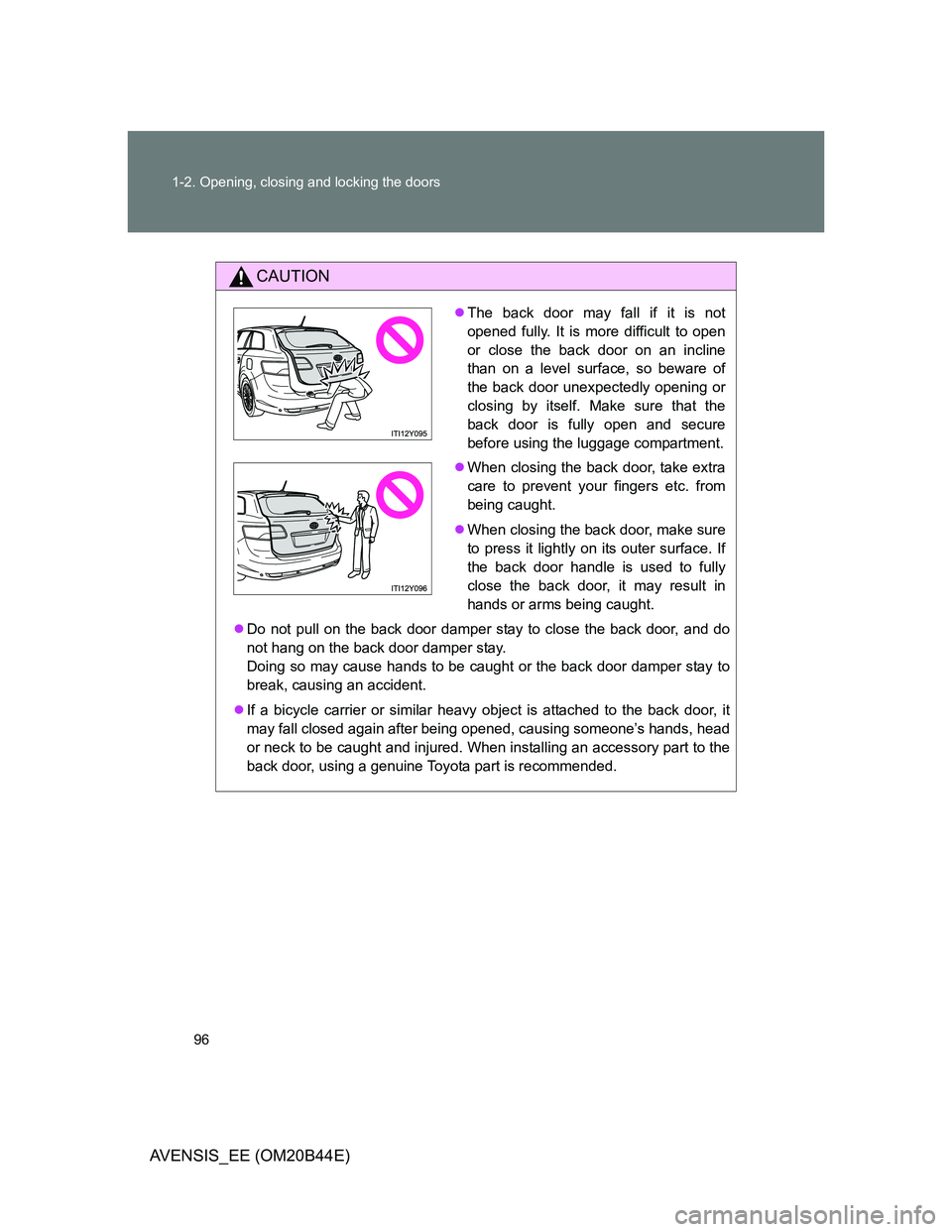
The back door may fall if it is not
opened fully. It is more difficult to open
or close the back door on an incline
than on a level surface, so beware of
the back door unexpectedly opening or
closing by itself. Make sure that the
back door is fully open and secure
before using the luggage compartment.
When closing the back door, take extra
care to prevent your fingers etc. from
being caught.
When closing the back door, make sure
to press it lightly on its outer surface. If
the back door handle is used to fully
close the back door, it may result in
hands or arms being caught.
Page 99 of 772
99 1-3. Adjustable components (seats, mirrors, steering wheel)
1
Before driving
AVENSIS_EE (OM20B44E)
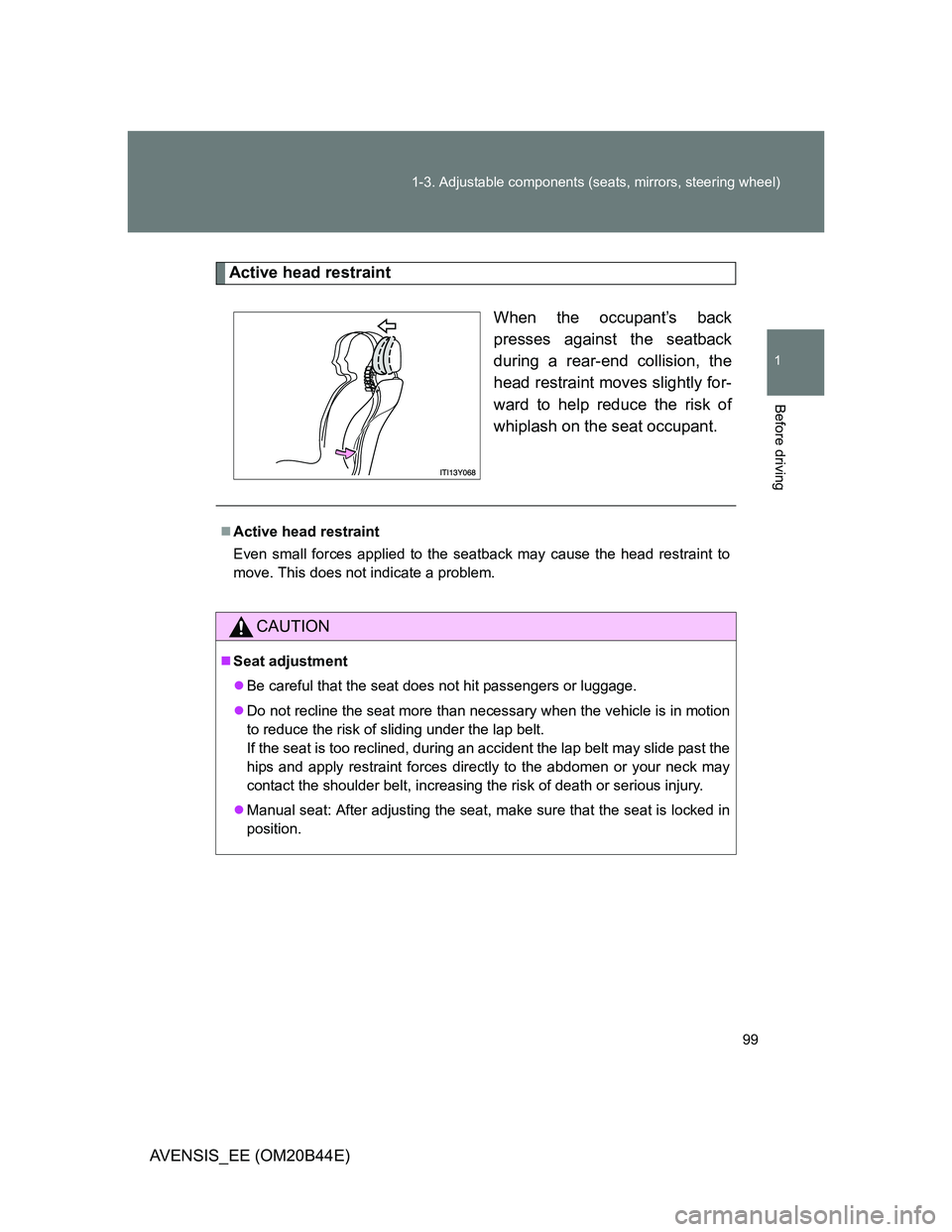
Active head restraint
When the occupant’s back
presses against the seatback
during a rear-end collision, the
head restraint moves slightly for-
ward to help reduce the risk of
whiplash on the seat occupant.
Active head restraint
Even small forces applied to the seatback may cause the head restraint to
move. This does not indicate a problem.
CAUTION
Seat adjustment
Be careful that the seat does not hit passengers or luggage.
Do not recline the seat more than necessary when the vehicle is in motion
to reduce the risk of sliding under the lap belt.
If the seat is too reclined, during an accident the lap belt may slide past the
hips and apply restraint forces directly to the abdomen or your neck may
contact the shoulder belt, increasing the risk of death or serious injury.
Manual seat: After adjusting the seat, make sure that the seat is locked in
position.
Page 119 of 772
119
1
1-3. Adjustable components (seats, mirrors, steering wheel)
Before driving
AVENSIS_EE (OM20B44E)
Inside rear view mirror
Glare from the headlights of vehicles behind can be reduced by
using the following functions.
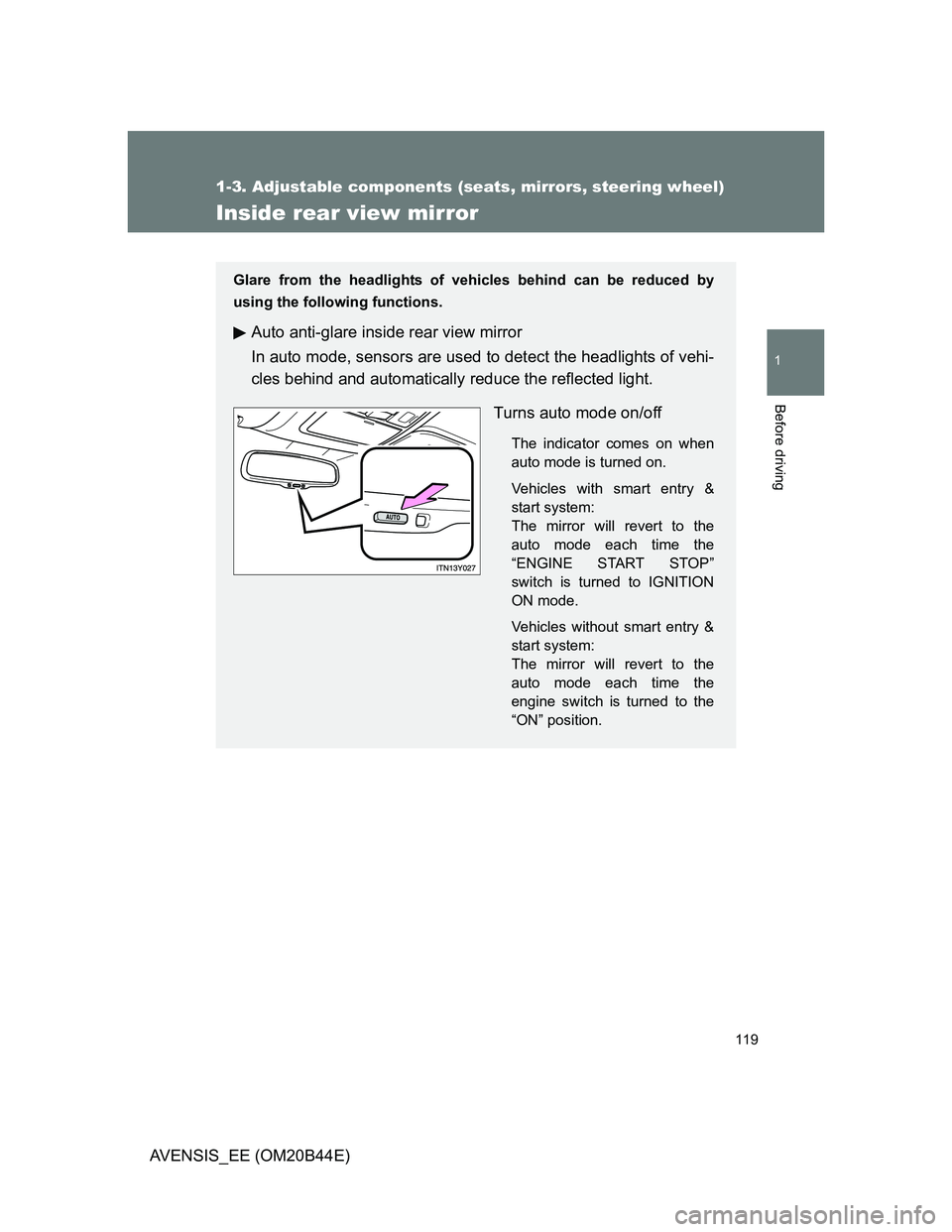
Auto anti-glare inside rear view mirror
In auto mode, sensors are used to detect the headlights of vehi-
cles behind and automatically reduce the reflected light.
Turns auto mode on/off
The indicator comes on when
auto mode is turned on.
Vehicles with smart entry &
start system:
The mirror will revert to the
auto mode each time the
“ENGINE START STOP”
switch is turned to IGNITION
ON mode.
Vehicles without smart entry &
start system:
The mirror will revert to the
auto mode each time the
engine switch is turned to the
“ON” position.
Page 157 of 772
157 1-7. Safety information
1
Before driving
AVENSIS_EE (OM20B44E)
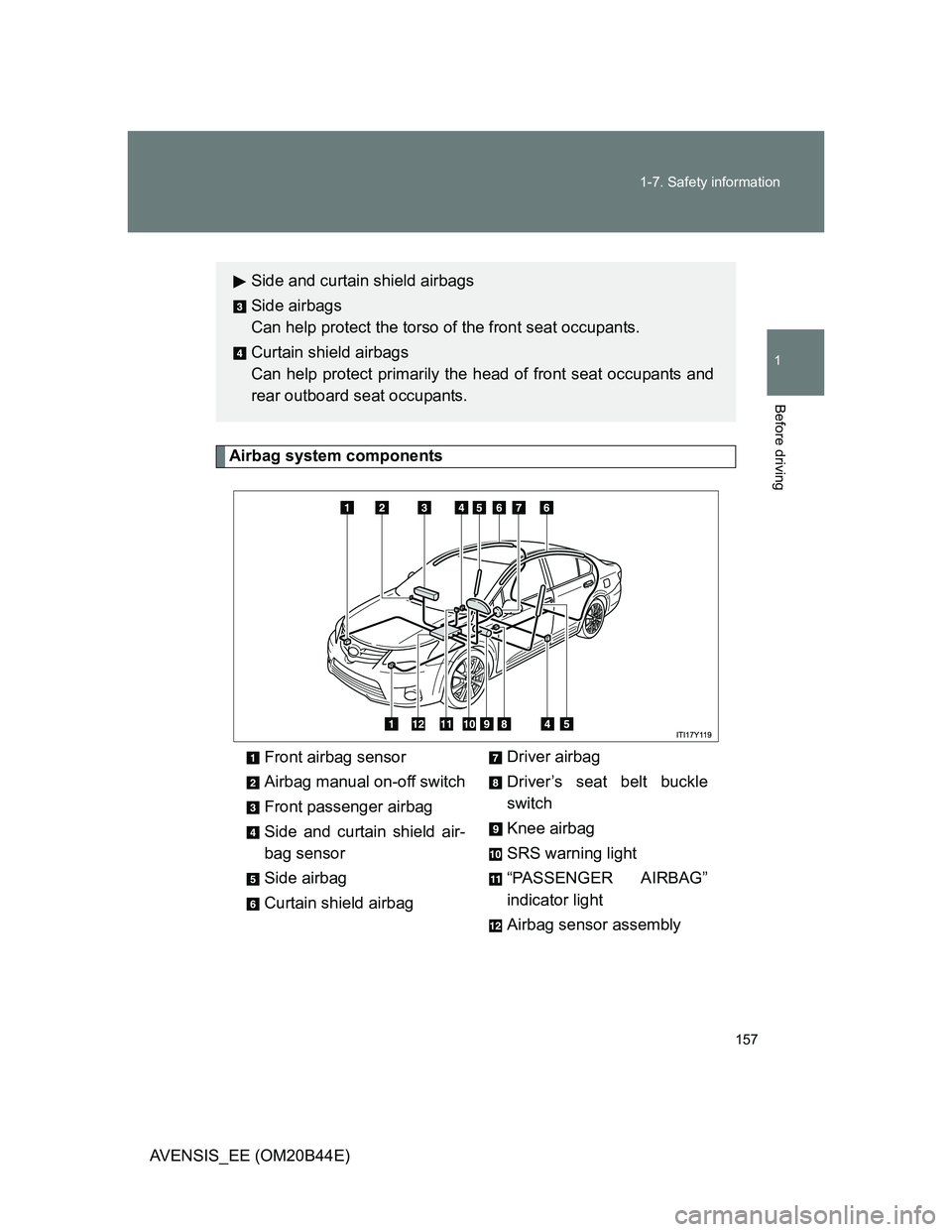
Airbag system components
Front airbag sensor
Airbag manual on-off switch
Front passenger airbag
Side and curtain shield air-
bag sensor
Side airbag
Curtain shield airbagDriver airbag
Driver’s seat belt buckle
switch
Knee airbag
SRS warning light
“PASSENGER AIRBAG”
indicator light
Airbag sensor assembly
Side and curtain shield airbags
Side airbags
Can help protect the torso of the front seat occupants.
Curtain shield airbags
Can help protect primarily the head of front seat occupants and
rear outboard seat occupants.
Page 163 of 772
163 1-7. Safety information
1
Before driving
AVENSIS_EE (OM20B44E)
CAUTION
SRS airbag precautions
Observe the following precautions regarding the airbags.
Failure to do so may cause death or serious injury.
The driver and all passengers in the vehicle must wear their seat belts
properly.
The SRS airbags are supplemental devices to be used with the seat belts.
The SRS driver airbag deploys with considerable force, and can cause
death or serious injury especially if the driver is very close to the airbag.
Since the risk zone for the driver’s airbag is the first 50 - 75 mm (2 - 3 in.)
of inflation, placing yourself 250 mm (10 in.) from your driver airbag pro-
vides you with a clear margin of safety. This distance is measured from the
center of the steering wheel to your breastbone. If you sit less than 250
mm (10 in.) away now, you can change your driving position in several
ways:
• Move your seat to the rear as far as you can while still reaching the
pedals comfortably.
• Slightly recline the back of the seat.
Although vehicle designs vary, many drivers can achieve the 250 mm
(10 in.) distance, even with the driver seat all the way forward, simply
by reclining the back of the seat somewhat. If reclining the back of your
seat makes it hard to see the road, raise yourself by using a firm, non-
slippery cushion, or raise the seat if your vehicle has that feature.
• If your steering wheel is adjustable, tilt it downward. This points the air-
bag toward your chest instead of your head and neck.
The seat should be adjusted as recommended above, while still maintaining
control of the foot pedals, steering wheel, and your view of the instrument
panel controls.
Page 193 of 772
2When driving
193
AVENSIS_EE (OM20B44E)
2-1. Driving procedures
Driving the vehicle ............ 194
Engine (ignition) switch
(vehicles with smart
entry & start system)....... 210
Engine (ignition) switch
(vehicles without smart
entry & start system)....... 215
Multidrive .......................... 219
Automatic transmission .... 225
Manual transmission......... 232
Turn signal lever ............... 236
Parking brake ................... 237
Horn .................................. 241
2-2. Instrument cluster
Gauges and meters .......... 242
Indicators and warning
lights ............................... 245
Multi-information
display ............................ 2492-3. Operating the lights
and wipers
Headlight switch................ 262
Fog light switch ................. 267
Windshield wipers
and washer ..................... 269
Rear window wiper
and washer (wagon) ....... 274
2-4. Using other driving systems
Cruise control.................... 275
Dynamic radar cruise
control ............................. 281
Speed limiter ..................... 300
Toyota parking
assist-sensor .................. 303
Rear view monitor
system ............................ 308
LKA (Lane-Keeping
Assist) ............................. 318
Driving assist systems ...... 327
PCS (Pre-Crash
Safety) ............................ 333
2-5. Driving information
Cargo and luggage ........... 342
Winter driving tips ............. 344
Trailer towing .................... 348
Page 202 of 772
202 2-1. Driving procedures
AVENSIS_EE (OM20B44E)
CAUTION
Use engine braking (downshift) to maintain a safe speed when driving
down a steep hill.
Using the brakes continuously may cause the brakes to overheat and lose
effectiveness. (P. 220, 226)
When stopped on an inclined surface, use the brake pedal and parking
brake to prevent the vehicle from rolling backward or forward and causing
an accident.
Do not adjust the position of the steering wheel, the seat, or the inside or
outside rear view mirrors while driving.
Doing so may result in a loss of vehicle control that can cause accidents
that may result in death or serious injury.
Always check that all passengers’ arms, heads or other parts of their bod-
ies are not outside the vehicle, as this may result in death or serious injury.
When driving on slippery road surfaces
Sudden braking, acceleration and steering may cause tire slippage and
reduce your ability to control the vehicle, resulting in an accident.
Sudden acceleration, engine braking due to shift changing, or changes in
engine speed could cause the vehicle to skid, resulting in an accident.
After driving through a puddle, lightly depress the brake pedal to make
sure that the brakes are functioning properly. Wet brake pads may prevent
the brakes from functioning properly. If the brakes on only one side are wet
and not functioning properly, steering control may be affected, resulting in
an accident.
Page 244 of 772
244 2-2. Instrument cluster
AVENSIS_EE (OM20B44E)
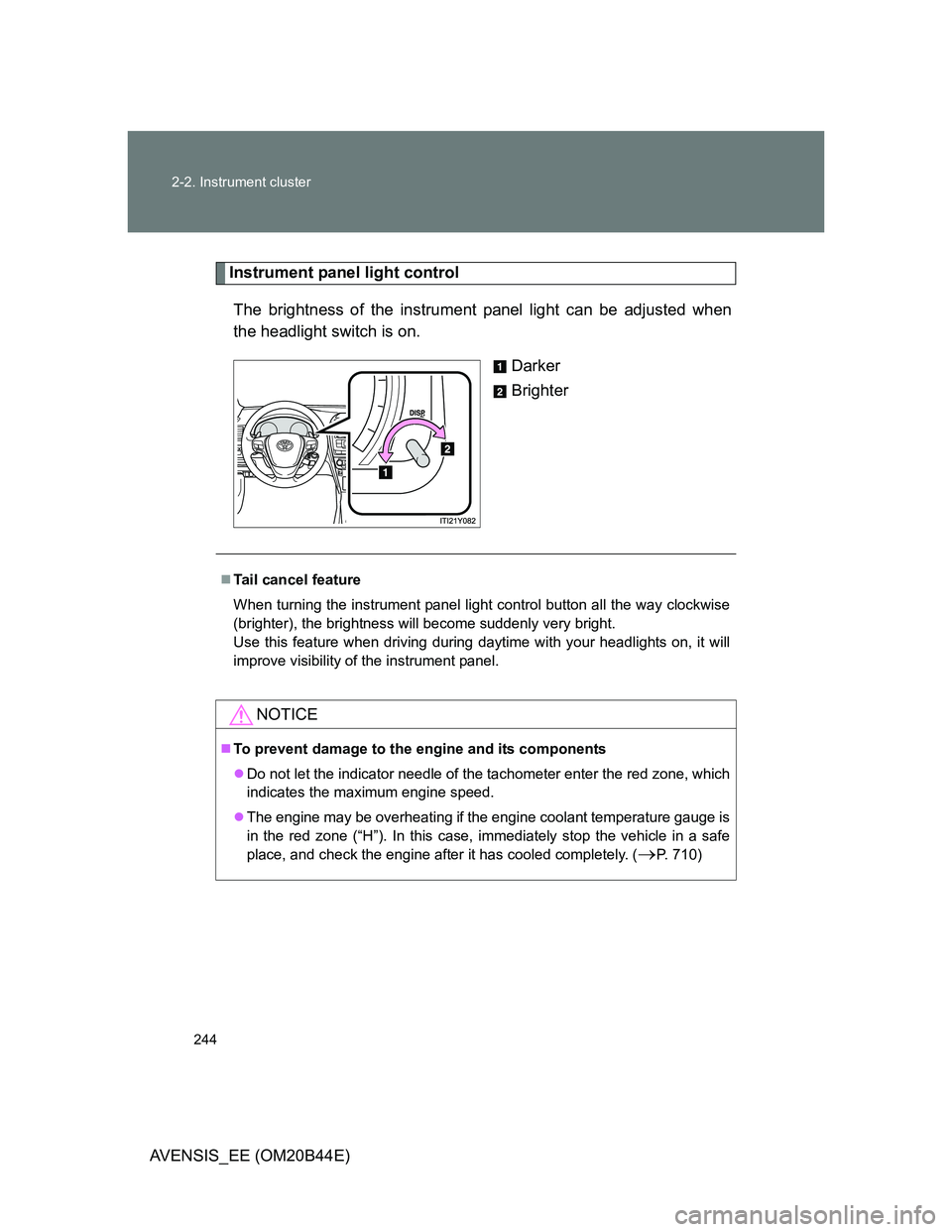
Instrument panel light control
The brightness of the instrument panel light can be adjusted when
the headlight switch is on.
Darker
Brighter
Tail cancel feature
When turning the instrument panel light control button all the way clockwise
(brighter), the brightness will become suddenly very bright.
Use this feature when driving during daytime with your headlights on, it will
improve visibility of the instrument panel.
NOTICE
To prevent damage to the engine and its components
Do not let the indicator needle of the tachometer enter the red zone, which
indicates the maximum engine speed.
The engine may be overheating if the engine coolant temperature gauge is
in the red zone (“H”). In this case, immediately stop the vehicle in a safe
place, and check the engine after it has cooled completely. (
P. 710)
Page 246 of 772
246 2-2. Instrument cluster
AVENSIS_EE (OM20B44E)
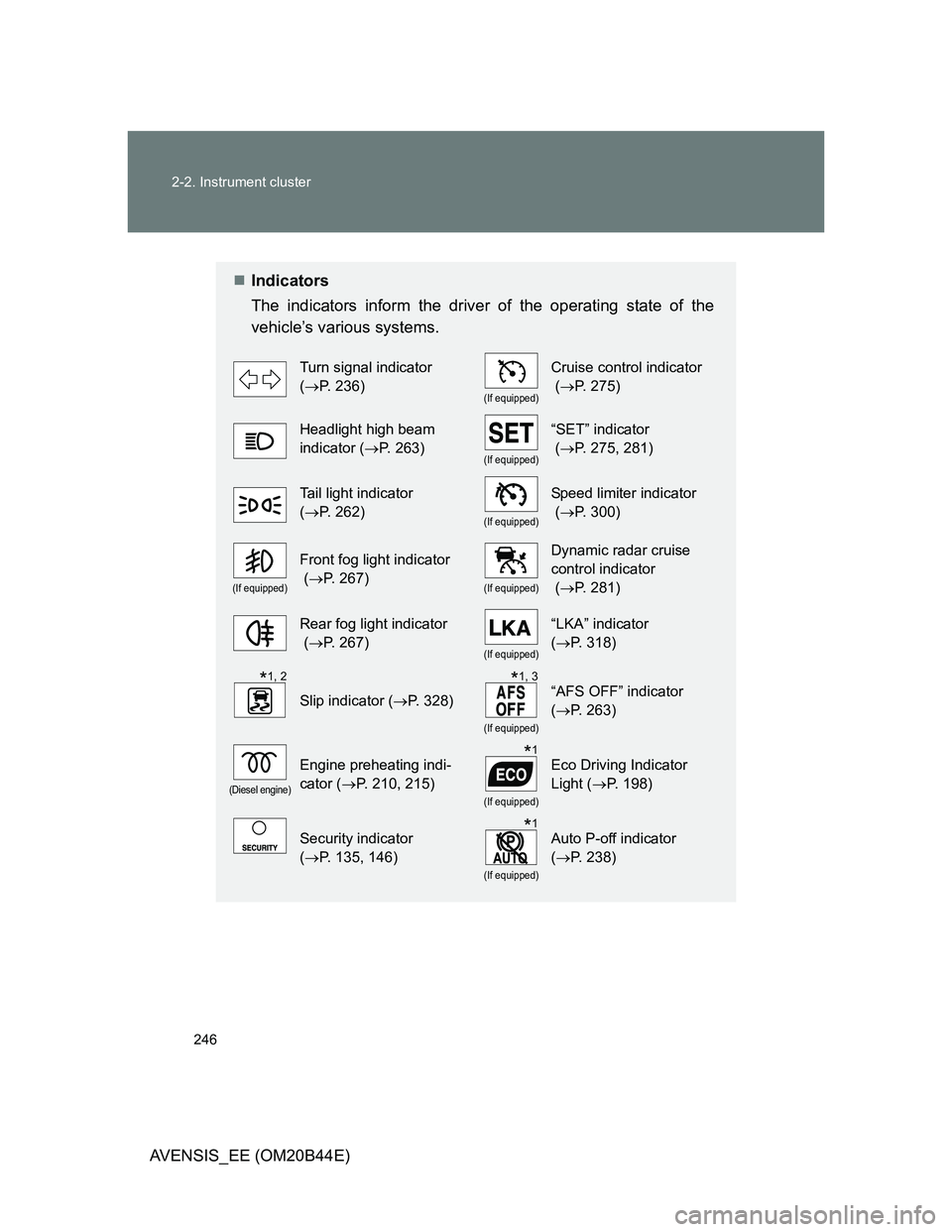
Indicators
The indicators inform the driver of the operating state of the
vehicle’s various systems.
Turn signal indicator
(P. 236)
(If equipped)
Cruise control indicator
(P. 275)
Headlight high beam
indicator (P. 263)
(If equipped)
“SET” indicator
(P. 275, 281)
Tail light indicator
(P. 262)
(If equipped)
Speed limiter indicator
(P. 300)
(If equipped)
Front fog light indicator
(P. 267)
(If equipped)
Dynamic radar cruise
control indicator
(P. 281)
Rear fog light indicator
(P. 267)
(If equipped)
“LKA” indicator
(P. 318)
Slip indicator (P. 328)
(If equipped)
“AFS OFF” indicator
(P. 263)
(Diesel engine)
Engine preheating indi-
cator (P. 210, 215)
(If equipped)
Eco Driving Indicator
Light (P. 198)
Security indicator
(P. 135, 146)
(If equipped)
Auto P-off indicator
(P. 238)
*1, 2*1, 3
*1
*1
Page 262 of 772
262
AVENSIS_EE (OM20B44E)
2-3. Operating the lights and wipers
Headlight switch
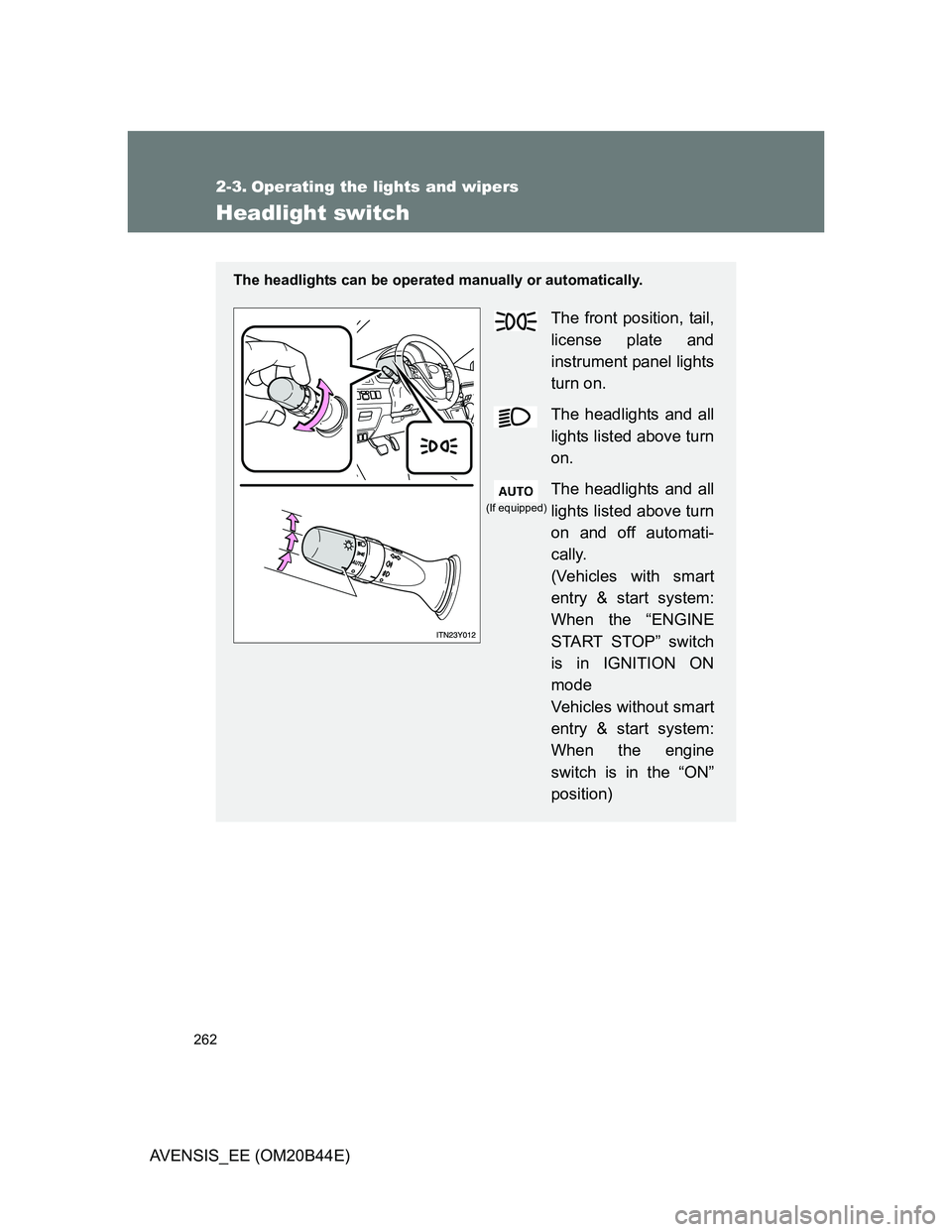
The headlights can be operated manually or automatically.
The front position, tail,
license plate and
instrument panel lights
turn on.
The headlights and all
lights listed above turn
on.
The headlights and all
lights listed above turn
on and off automati-
cally.
(Vehicles with smart
entry & start system:
When the “ENGINE
START STOP” switch
is in IGNITION ON
mode
Vehicles without smart
entry & start system:
When the engine
switch is in the “ON”
position)
(If equipped)