head light TOYOTA AVENSIS 2012 Owner's Manual
[x] Cancel search | Manufacturer: TOYOTA, Model Year: 2012, Model line: AVENSIS, Model: TOYOTA AVENSIS 2012Pages: 772, PDF Size: 34.43 MB
Page 263 of 772
263 2-3. Operating the lights and wipers
2
When driving
AVENSIS_EE (OM20B44E)
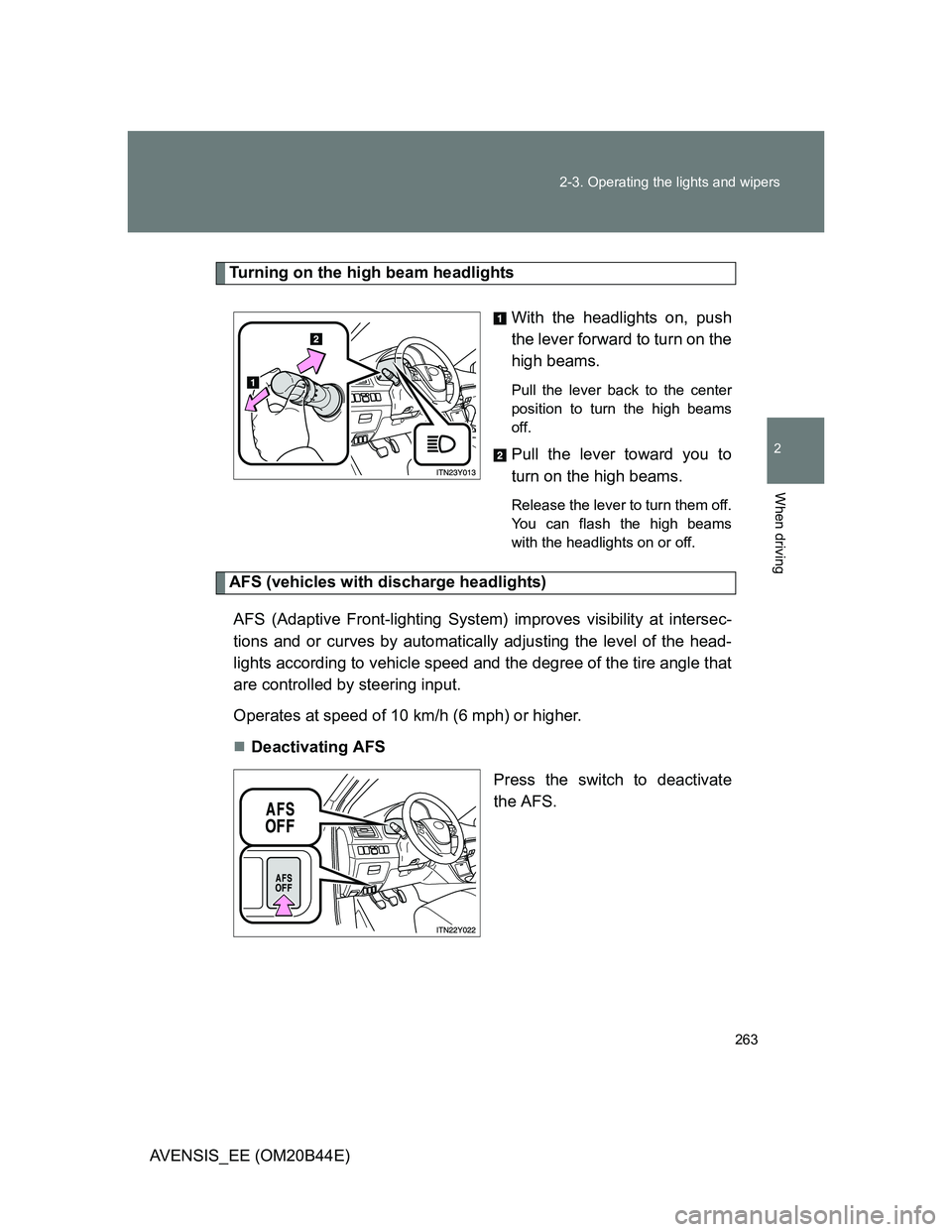
Turning on the high beam headlights
With the headlights on, push
the lever forward to turn on the
high beams.
Pull the lever back to the center
position to turn the high beams
off.
Pull the lever toward you to
turn on the high beams.
Release the lever to turn them off.
You can flash the high beams
with the headlights on or off.
AFS (vehicles with discharge headlights)
AFS (Adaptive Front-lighting System) improves visibility at intersec-
tions and or curves by automatically adjusting the level of the head-
lights according to vehicle speed and the degree of the tire angle that
are controlled by steering input.
Operates at speed of 10 km/h (6 mph) or higher.
Deactivating AFS
Press the switch to deactivate
the AFS.
Page 264 of 772
264 2-3. Operating the lights and wipers
AVENSIS_EE (OM20B44E)
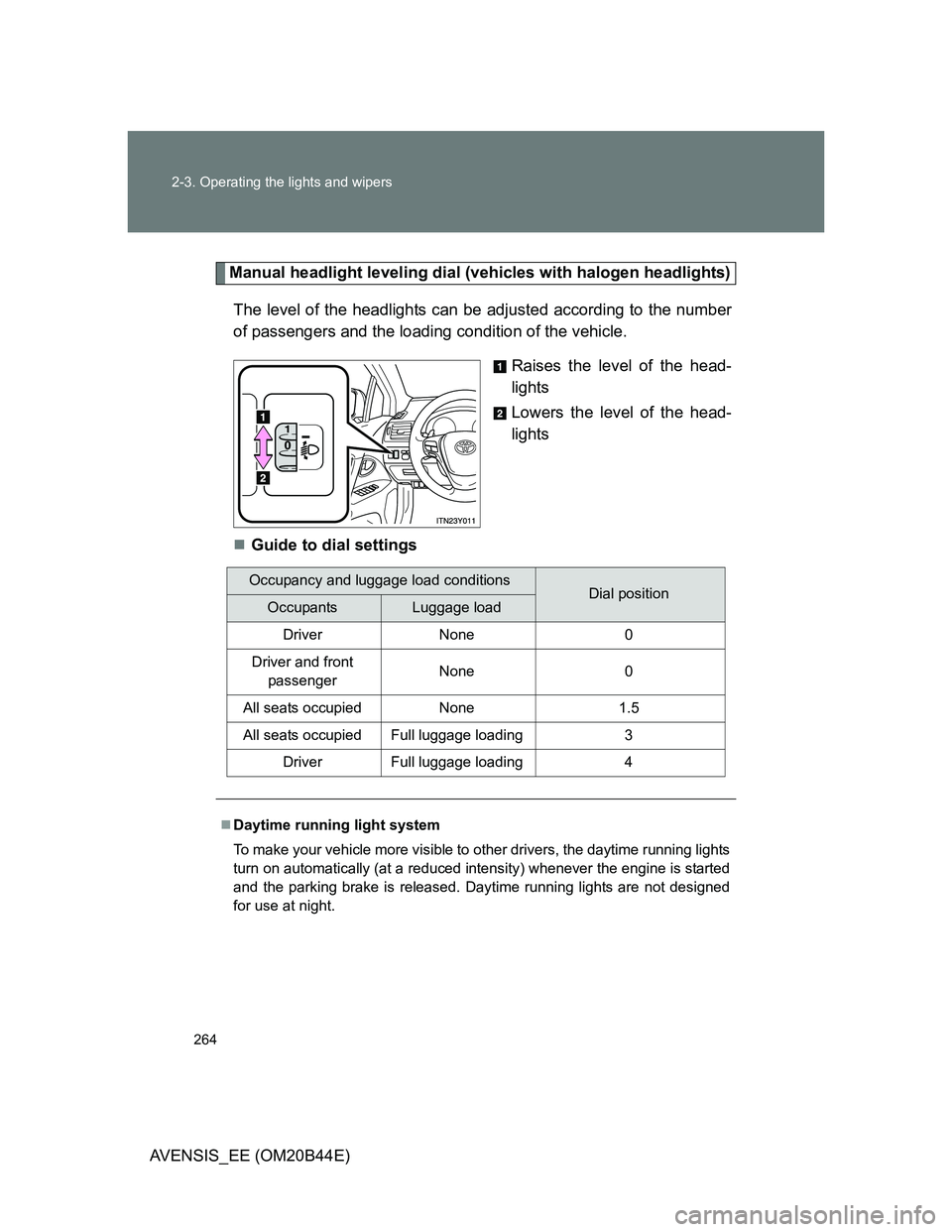
Manual headlight leveling dial (vehicles with halogen headlights)
The level of the headlights can be adjusted according to the number
of passengers and the loading condition of the vehicle.
Raises the level of the head-
lights
Lowers the level of the head-
lights
Guide to dial settings
Occupancy and luggage load conditionsDial positionOccupantsLuggage load
Driver None 0
Driver and front
passengerNone 0
All seats occupied None 1.5
All seats occupied Full luggage loading 3
Driver Full luggage loading 4
Daytime running light system
To make your vehicle more visible to other drivers, the daytime running lights
turn on automatically (at a reduced intensity) whenever the engine is started
and the parking brake is released. Daytime running lights are not designed
for use at night.
Page 265 of 772
265 2-3. Operating the lights and wipers
2
When driving
AVENSIS_EE (OM20B44E)
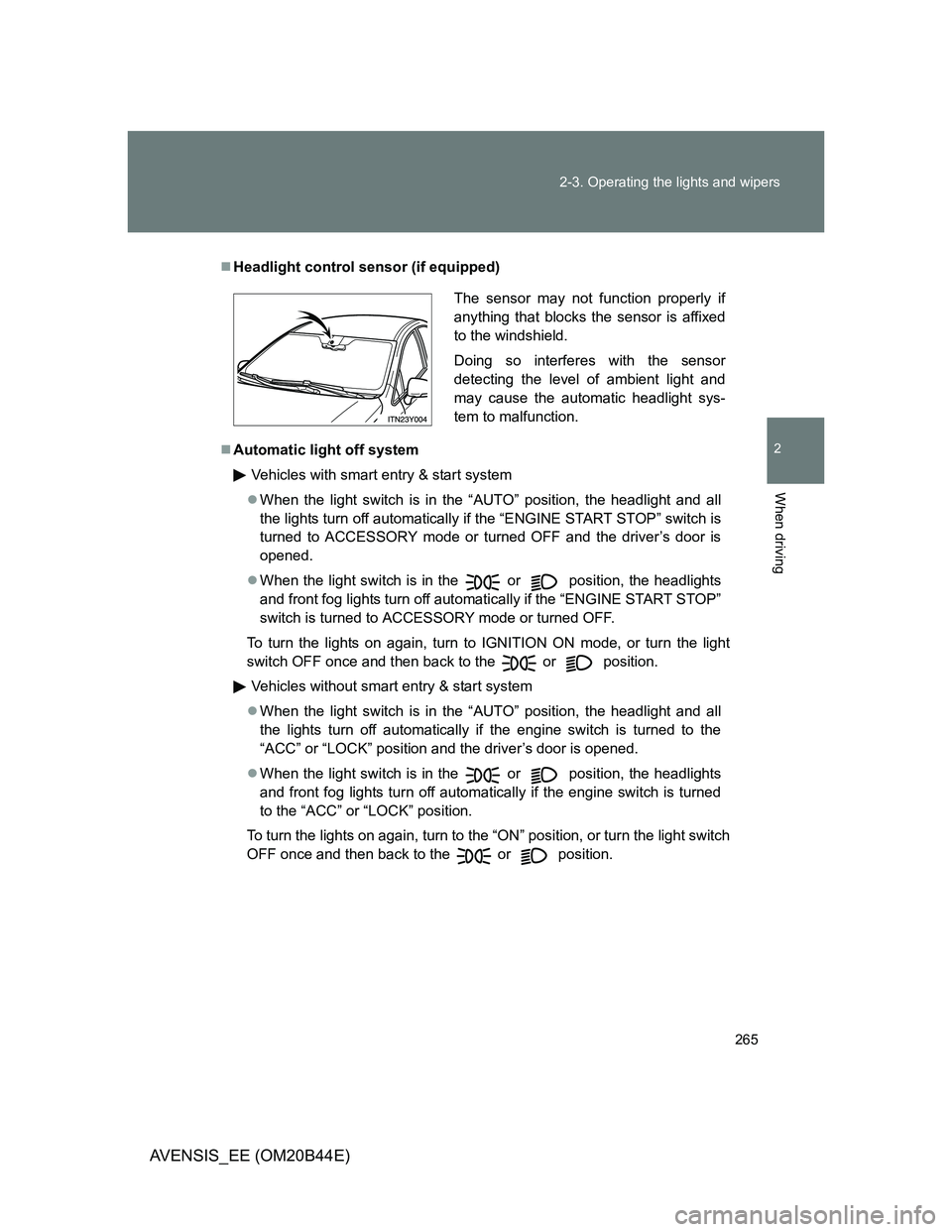
Headlight control sensor (if equipped)
Automatic light off system
Vehicles with smart entry & start system
When the light switch is in the “AUTO” position, the headlight and all
the lights turn off automatically if the “ENGINE START STOP” switch is
turned to ACCESSORY mode or turned OFF and the driver’s door is
opened.
When the light switch is in the or position, the headlights
and front fog lights turn off automatically if the “ENGINE START STOP”
switch is turned to ACCESSORY mode or turned OFF.
To turn the lights on again, turn to IGNITION ON mode, or turn the light
switch OFF once and then back to the or position.
Vehicles without smart entry & start system
When the light switch is in the “AUTO” position, the headlight and all
the lights turn off automatically if the engine switch is turned to the
“ACC” or “LOCK” position and the driver’s door is opened.
When the light switch is in the or position, the headlights
and front fog lights turn off automatically if the engine switch is turned
to the “ACC” or “LOCK” position.
To turn the lights on again, turn to the “ON” position, or turn the light switch
OFF once and then back to the or position.
The sensor may not function properly if
anything that blocks the sensor is affixed
to the windshield.
Doing so interferes with the sensor
detecting the level of ambient light and
may cause the automatic headlight sys-
tem to malfunction.
Page 266 of 772
266 2-3. Operating the lights and wipers
AVENSIS_EE (OM20B44E)
Light reminder buzzer
Vehicles with smart entry & start system
A buzzer sounds when the “ENGINE START STOP” switch is turned OFF
or to ACCESSORY mode and the driver’s door is opened while the lights
are turned on.
Vehicles without smart entry & start system
A buzzer sounds when the engine switch is turned to the “LOCK” or
“ACC” position and the driver’s door is opened while the lights are turned
on.
Automatic headlight leveling system (vehicles with discharge head-
lights)
The level of the headlights is automatically adjusted according to the number
of passengers and the loading condition of the vehicle to ensure that the
headlights do not interfere with other road users.
If the indicator flashes...
It may indicate a malfunction in the system. Contact any authorized Toyota
dealer or repairer, or another duly qualified and equipped professional.
Customization that can be configured at any authorized Toyota dealer
or repairer, or another duly qualified and equipped professional
Settings of the light sensor sensitivity can be changed.
(Customizable features P. 751)
NOTICE
To prevent battery discharge
Do not leave the lights on longer than necessary when the engine is not run-
ning.
Page 267 of 772
267
2-3. Operating the lights and wipers
2
When driving
AVENSIS_EE (OM20B44E)
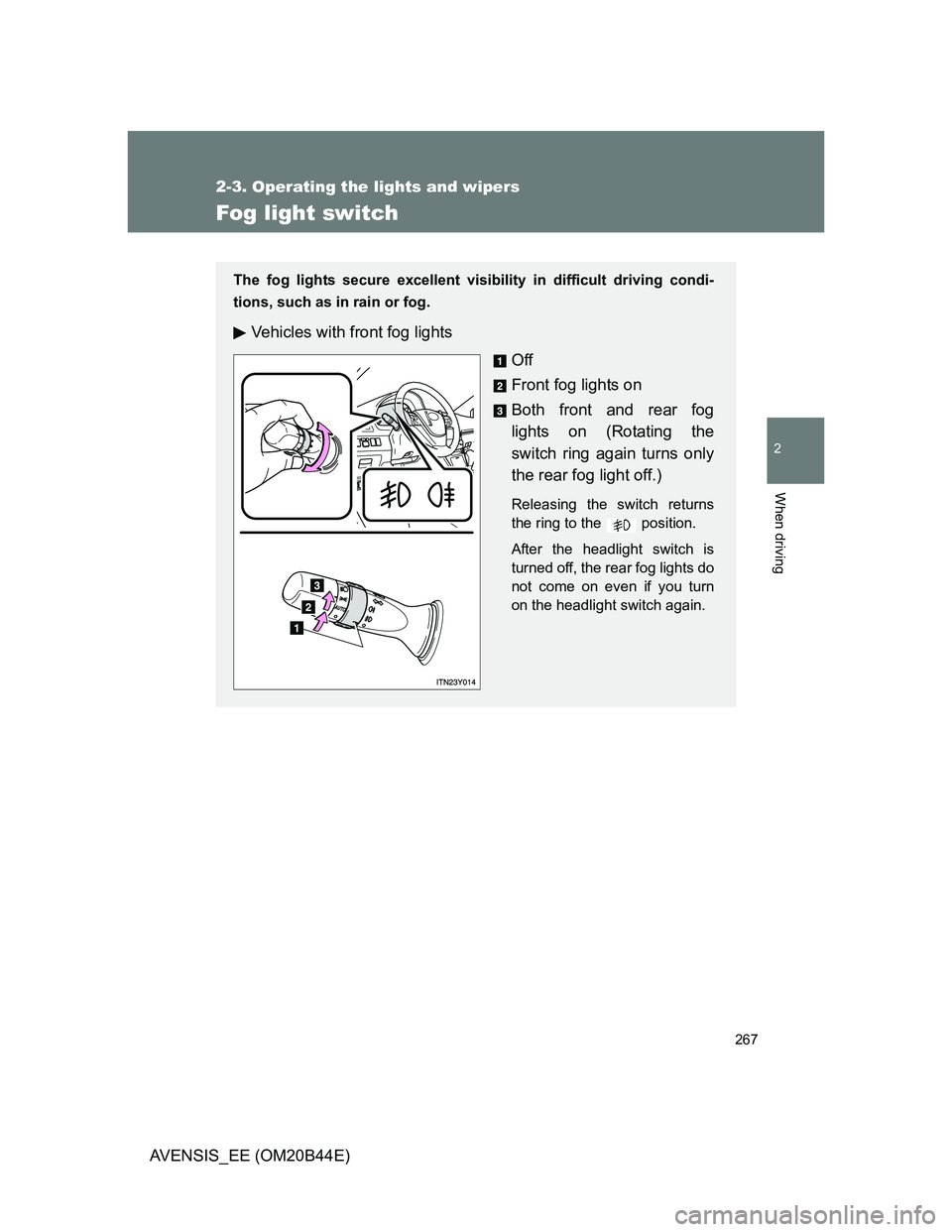
Fog light switch
The fog lights secure excellent visibility in difficult driving condi-
tions, such as in rain or fog.
Vehicles with front fog lights
Off
Front fog lights on
Both front and rear fog
lights on (Rotating the
switch ring again turns only
the rear fog light off.)
Releasing the switch returns
the ring to the position.
After the headlight switch is
turned off, the rear fog lights do
not come on even if you turn
on the headlight switch again.
Page 268 of 772
268 2-3. Operating the lights and wipers
AVENSIS_EE (OM20B44E)
Fog lights can be used when
Vehicles with front fog lights
Front fog lights: The headlights or front position lights are turned on.
Rear fog lights: The front fog lights are turned on.
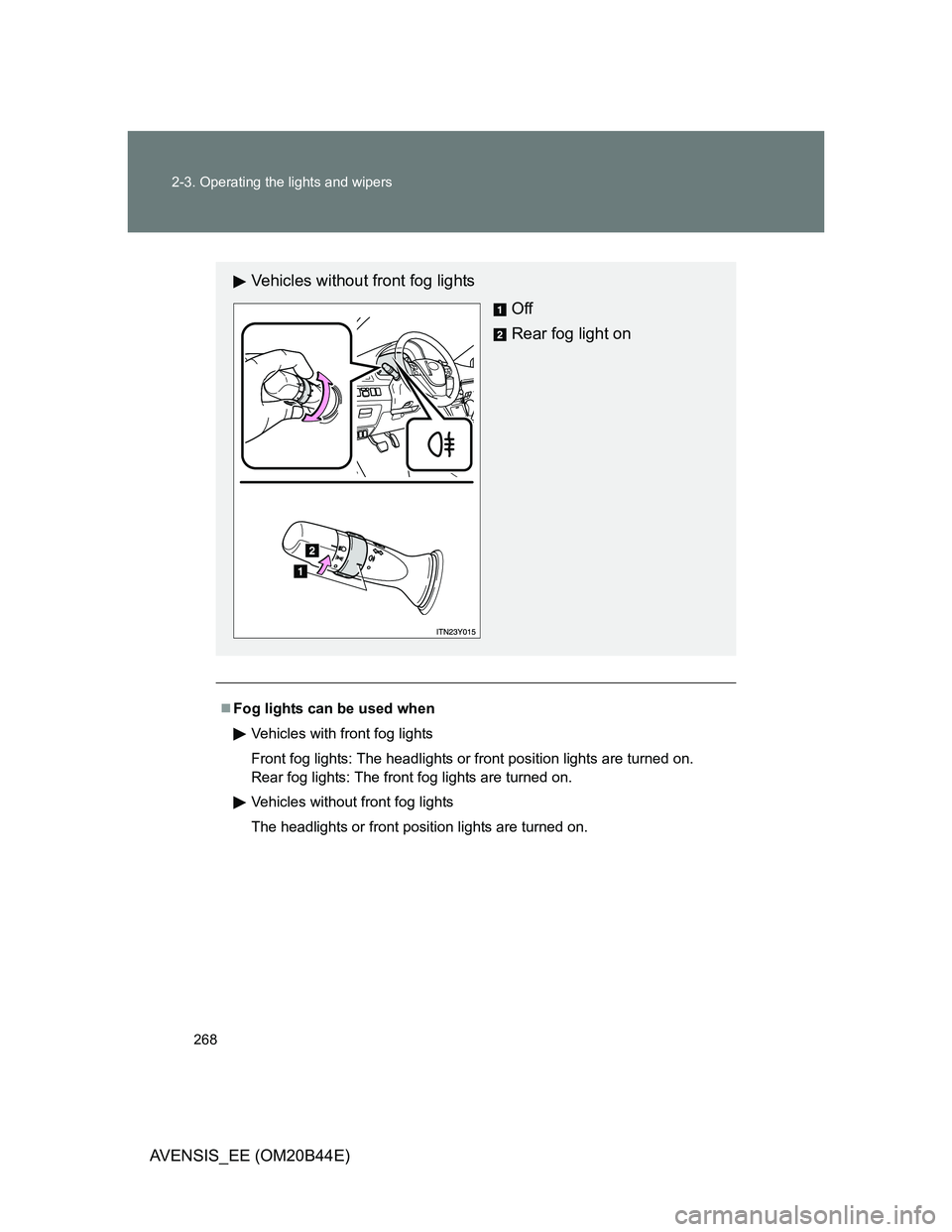
Vehicles without front fog lights
The headlights or front position lights are turned on.
Vehicles without front fog lights
Off
Rear fog light on
Page 270 of 772
270 2-3. Operating the lights and wipers
AVENSIS_EE (OM20B44E)
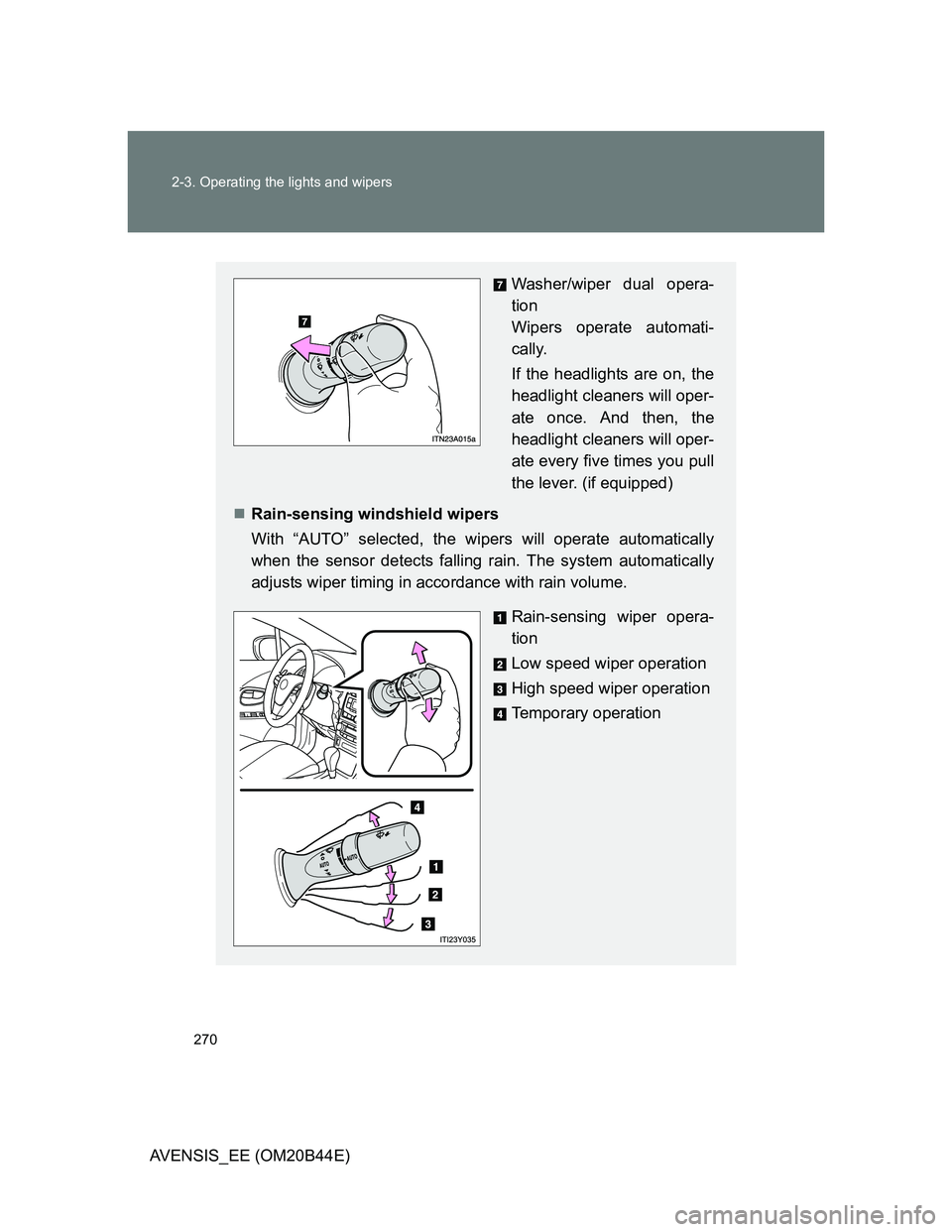
Washer/wiper dual opera-
tion
Wipers operate automati-
cally.
If the headlights are on, the
headlight cleaners will oper-
ate once. And then, the
headlight cleaners will oper-
ate every five times you pull
the lever. (if equipped)
Rain-sensing windshield wipers
With “AUTO” selected, the wipers will operate automatically
when the sensor detects falling rain. The system automatically
adjusts wiper timing in accordance with rain volume.
Rain-sensing wiper opera-
tion
Low speed wiper operation
High speed wiper operation
Temporary operation
Page 271 of 772
271 2-3. Operating the lights and wipers
2
When driving
AVENSIS_EE (OM20B44E)
The windshield wiper and washer can be operated when
Vehicles with smart entry & start system
The “ENGINE START STOP” switch is in IGNITION ON mode.
Vehicles without smart entry & start system
The engine switch is in the “ON” position.
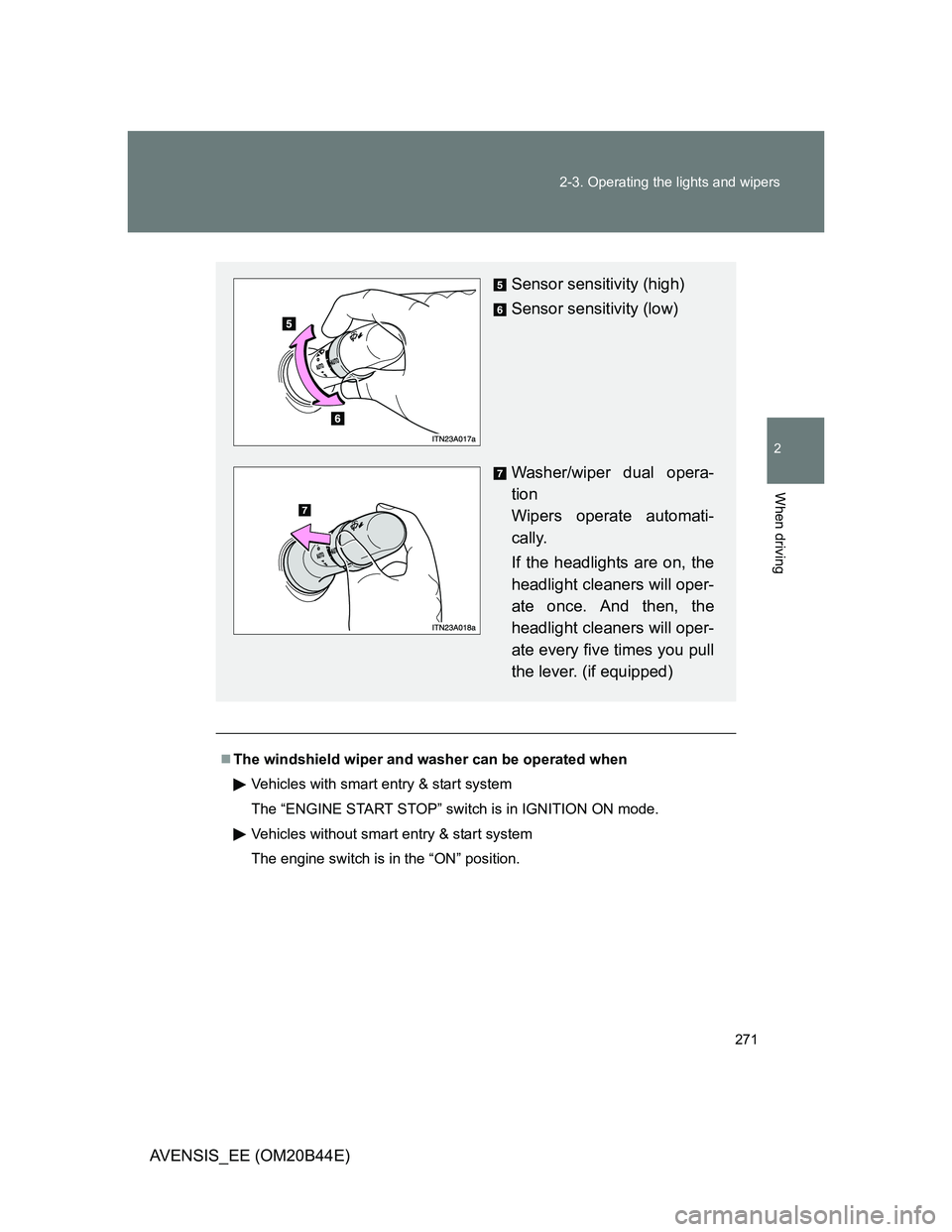
Sensor sensitivity (high)
Sensor sensitivity (low)
Washer/wiper dual opera-
tion
Wipers operate automati-
cally.
If the headlights are on, the
headlight cleaners will oper-
ate once. And then, the
headlight cleaners will oper-
ate every five times you pull
the lever. (if equipped)
Page 313 of 772
313 2-4. Using other driving systems
2
When driving
AVENSIS_EE (OM20B44E)
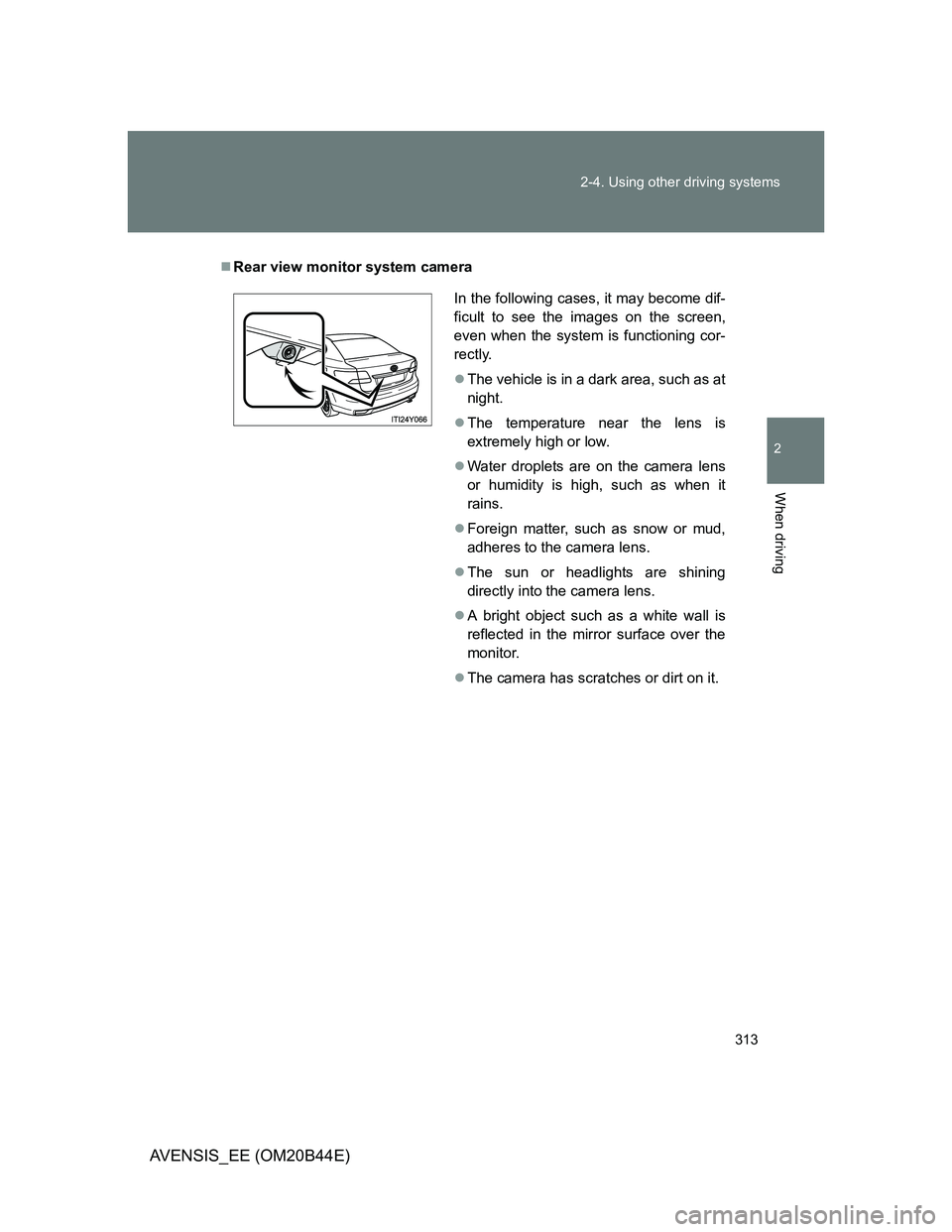
Rear view monitor system camera
In the following cases, it may become dif-
ficult to see the images on the screen,
even when the system is functioning cor-
rectly.
The vehicle is in a dark area, such as at
night.
The temperature near the lens is
extremely high or low.
Water droplets are on the camera lens
or humidity is high, such as when it
rains.
Foreign matter, such as snow or mud,
adheres to the camera lens.
The sun or headlights are shining
directly into the camera lens.
A bright object such as a white wall is
reflected in the mirror surface over the
monitor.
The camera has scratches or dirt on it.
Page 325 of 772
325 2-4. Using other driving systems
2
When driving
AVENSIS_EE (OM20B44E)
NOTICE
In the following situations, the LKA will not work, or will not perform
reliably
When lane markers are interrupted or are not present, such as before a
tollbooth.
When lane markers are only on one side of the road.
When driving on a sharp curve.
When lanes are extremely narrow or extremely wide.
When the vehicle leans to one side an unusual amount due to a heavy
load or improper tire inflation pressure.
When the following distance between your vehicle and the vehicle ahead
is extremely short.
When the lane markers are broken or “Raised pavement marker”.
When lane markers are obscured or partially obscured by sand, dirt, etc.
When driving on a particularly bright road surface, such as concrete.
When driving on a road surface that is bright due to reflected light.
When driving in a location where the light level changes rapidly, such as
the entrance to or exit from a tunnel.
When sunlight or the headlights of oncoming vehicles are shining directly
into the camera lens.
When driving on roads that are branching or merging.
When pavement lane markers are difficult to see due to rain, snow, fog,
etc.
When driving on a road surface that is wet due to rain, previous rainfall,
standing water, etc.
When the vehicle experiences strong up-and-down motion such as when
driving on an extremely rough road or on a seam in the pavement.
When headlight brightness is reduced due to dirt on the lenses, or when
the headlights are misaligned.
When driving with a strong crosswind.