snow TOYOTA AVENSIS 2012 Owner's Manual
[x] Cancel search | Manufacturer: TOYOTA, Model Year: 2012, Model line: AVENSIS, Model: TOYOTA AVENSIS 2012Pages: 772, PDF Size: 34.43 MB
Page 335 of 772
335 2-4. Using other driving systems
2
When driving
AVENSIS_EE (OM20B44E)
Obstacles not detected
The sensor cannot detect plastic obstacles such as pylons. There may also
be occasions when the radar sensor cannot detect pedestrians, animals,
bicycles, motorcycles, trees, or snowdrifts.
The pre-crash safety is operational when
Pre-crash seat belts (Type A):
• Vehicle speed is greater than about 30 km/h (19 mph).
• The system detects sudden braking or skidding.
• The front occupants are wearing a seat belt.
Pre-crash seat belts (Type B):
• Vehicle speed is above 5 km/h (4 mph).
• The relative speed difference between your vehicle and another vehi-
cle that is ahead of your vehicle, or the speed at which your vehicle is
approaching an obstacle is greater than 30 km/h (19 mph).
• The front occupants are wearing a seat belt.
Pre-crash brake assist:
• Vehicle speed is above 30 km/h (19 mph).
• The relative speed difference between your vehicle and another vehi-
cle that is ahead of your vehicle, or the speed at which your vehicle is
approaching an obstacle is greater than 30 km/h (19 mph).
• The brake pedal is depressed.
Pre-crash braking:
• The pre-crash braking OFF switch is not pressed.
• Vehicle speed is above 15 km/h (10 mph).
• The relative speed difference between your vehicle and another vehi-
cle that is ahead of your vehicle, or the speed at which your vehicle is
approaching an obstacle is greater than 15 km/h (10 mph).
Page 337 of 772
337 2-4. Using other driving systems
2
When driving
AVENSIS_EE (OM20B44E)
Situations in which the pre-crash safety system does not function
properly
The system may not function effectively in situations such as the following:
On roads with sharp bends or uneven surfaces
If a vehicle suddenly moves in front of your vehicle, such as at an inter-
section
If a vehicle suddenly cuts in front of your vehicle, such as when overtak-
ing
In inclement weather such as heavy rain, fog, snow or sand storms
When your vehicle is skidding with the VSC system off
When the axis of the radar is out of adjustment
When an extreme change in vehicle height occurs
When there is a malfunction in the system
Warning lights and/or warning messages will turn on or flash. (P. 624)
Page 344 of 772
344
2-5. Driving information
AVENSIS_EE (OM20B44E)
Winter driving tips
Carry out the necessary preparations and inspections before driving
the vehicle in winter. Always drive the vehicle in a manner appropri-
ate to the prevailing weather conditions.
Pre-winter preparations
Use fluids that are appropriate to the prevailing outside tem-
peratures.
• Engine oil
• Engine coolant
• Washer fluid
Have a service technician inspect the level and specific grav-
ity of battery electrolyte.
Have the vehicle fitted with four snow tires or purchase a set
of tire chains for the front tires.
Ensure that all tires are the same size and brand, and that chains
match the size of the tires.
Page 345 of 772
345 2-5. Driving information
2
When driving
AVENSIS_EE (OM20B44E)
Before driving the vehicle
Perform the following according to the driving conditions.
Do not try to forcibly open a window or move a wiper that is
frozen. Pour warm water over the frozen area to melt the ice.
Wipe away the water immediately to prevent it from freezing.
To ensure proper operation of the climate control system fan,
remove any snow that has accumulated on the air inlet vents
in front of the windshield.
Remove any ice that has accumulated on the vehicle chassis.
Periodically check for and remove any excess ice or snow
that may have accumulated in the wheel well or on the
brakes.
When driving the vehicle
Accelerate the vehicle slowly and drive at a reduced speed suit-
able to road conditions.
When parking the vehicle
Park the vehicle and move the shift lever to “P” (Multidrive or
automatic transmission) or “R” (manual transmission) without
setting the parking brake. The parking brake may freeze up, pre-
venting it from being released. If necessary, block the wheels to
prevent inadvertent sliding or creeping.
Page 347 of 772
347 2-5. Driving information
2
When driving
AVENSIS_EE (OM20B44E)
CAUTION
Driving with snow tires
Observe the following precautions to reduce the risk of accidents.
Failing to do so may result in a loss of vehicle control and cause death or
serious injury.
Use tires of the size specified for your vehicle.
Maintain the recommended level of tire inflation pressure.
Do not drive at speeds in excess of the speed limit or the speed limit spec-
ified for the snow tires being used.
Snow tires should be installed on all wheels.
Driving with tire chains
Observe the following precautions to reduce the risk of accidents.
Failing to do so may result in the vehicle being unable to be driven safely,
and may cause death or serious injury.
Do not drive in excess of the speed limit specified for the tire chains being
used or 50 km/h (30 mph), whichever is lower.
Avoid driving on bumpy road surfaces or over potholes.
Avoid sudden turns and braking, as use of chains may adversely affect
vehicle handling.
Slow down sufficiently before entering a curve to ensure that vehicle con-
trol is maintained.
Page 380 of 772
380 3-1. Using the air conditioning system and defogger
AVENSIS_EE (OM20B44E)
NOTICE
To prevent damage to your vehicle
Do not turn the heater on and off repeatedly in 5 minute intervals as this
can shorten the life of the heater components. If the engine must be turned
on and off repeatedly within short intervals (such as when the vehicle is
being used for delivery purposes), turn the heater off.
Do not modify or open the heater without consulting any authorized Toyota
dealer or repairer, or another duly qualified and equipped professional.
This may cause a heater malfunction or a fire.
Be careful not to splash water or spill liquid directly on the heater or on the
heater fuel pump. This may cause the heater to malfunction.
Keep the intake and exhaust pipes of the heater free from water, snow,
ice, mud, etc. If the pipes become clogged, this can cause the heater to
malfunction.
If you notice anything unusual, such as a fluid leak, smoke or poor opera-
tion, turn off the heater and have your vehicle checked by any authorized
Toyota dealer or repairer, or another duly qualified and equipped profes-
sional.
Page 553 of 772
553 4-3. Do-it-yourself maintenance
4
Maintenance and care
AVENSIS_EE (OM20B44E)
When to replace your vehicle’s tires
Tires should be replaced if:
You have tire damage such as cuts, splits, cracks deep enough to
expose the fabric or bulges indicating internal damage
A tire goes flat repeatedly or cannot be properly repaired due to the size
or location of a cut or other damage
If you are not sure, consult with any authorized Toyota dealer or repairer, or
another duly qualified and equipped professional.
Tire life
Any tire over 6 years old must be checked by a qualified technician even if
they have seldom or never been used or damage is not obvious.
If the tread wears down 4 mm (0.16 in.) or more on snow tires
The effectiveness of snow tires is lost.
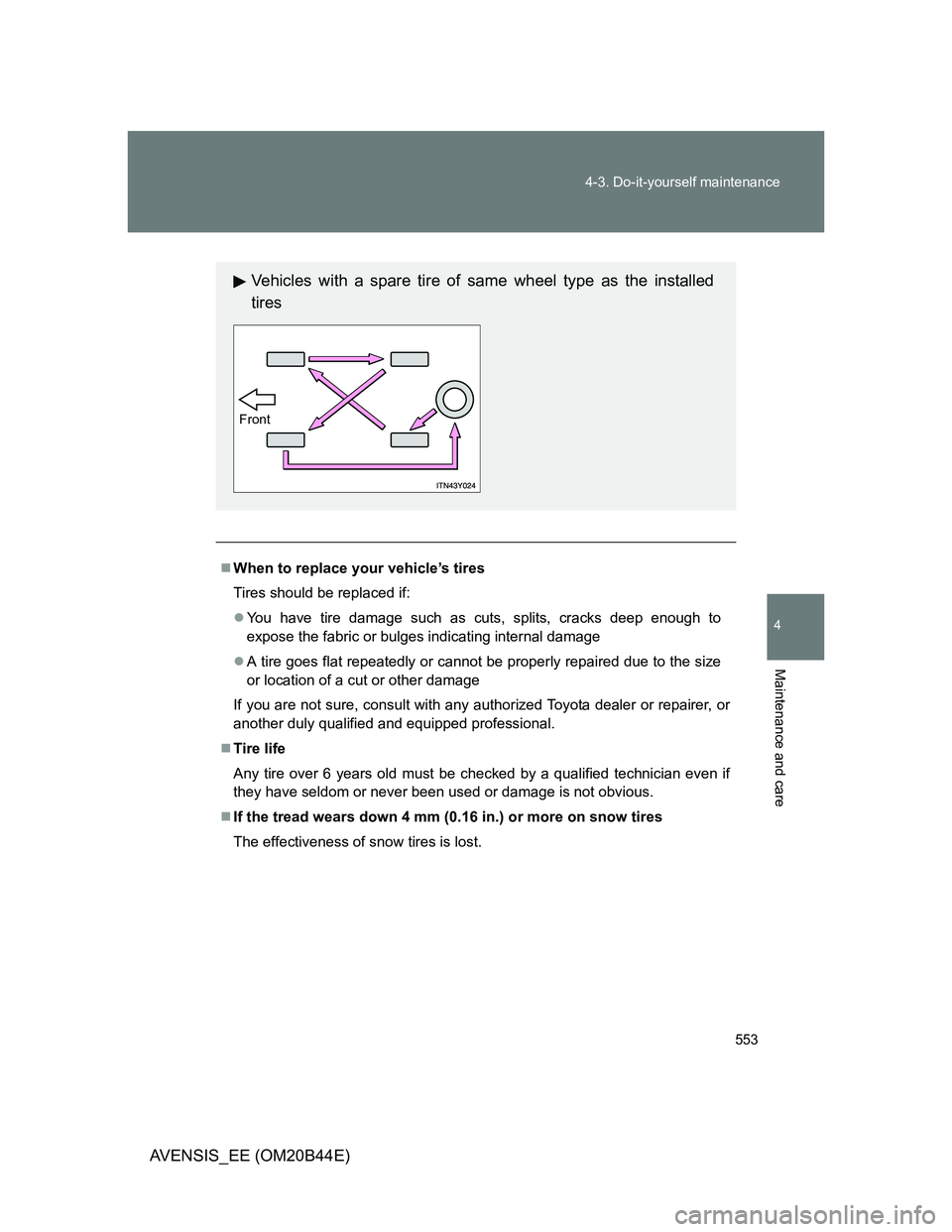
Vehicles with a spare tire of same wheel type as the installed
tires
Front
Page 554 of 772
554 4-3. Do-it-yourself maintenance
AVENSIS_EE (OM20B44E)
Low profile tires (225/45R18 tires)
Generally, low profile tires will wear more rapidly and tire grip performance
will be reduced on snowy and/or icy roads when compared to standard tires.
Be sure to use snow tires or tire chains on snowy and/or icy roads and drive
carefully at a speed appropriate for road and weather conditions.
CAUTION
When inspecting or replacing tires
Observe the following precautions to prevent accidents.
Failure to do so may cause damage to parts of the drive train, as well as
dangerous handling characteristics, which may lead to an accident resulting
in death or serious injury.
Do not mix tires of different makes, models or tread patterns.
Also, do not mix tires of remarkably different treadwear.
Do not use tire sizes other than those recommended by Toyota.
Do not mix differently constructed tires (radial, bias-belted or bias-ply
tires).
Do not mix summer, all season and snow tires.
Do not use tires that have been used on another vehicle.
Do not use tires if you do not know how they were used previously.
Page 656 of 772
656 5-2. Steps to take in an emergency
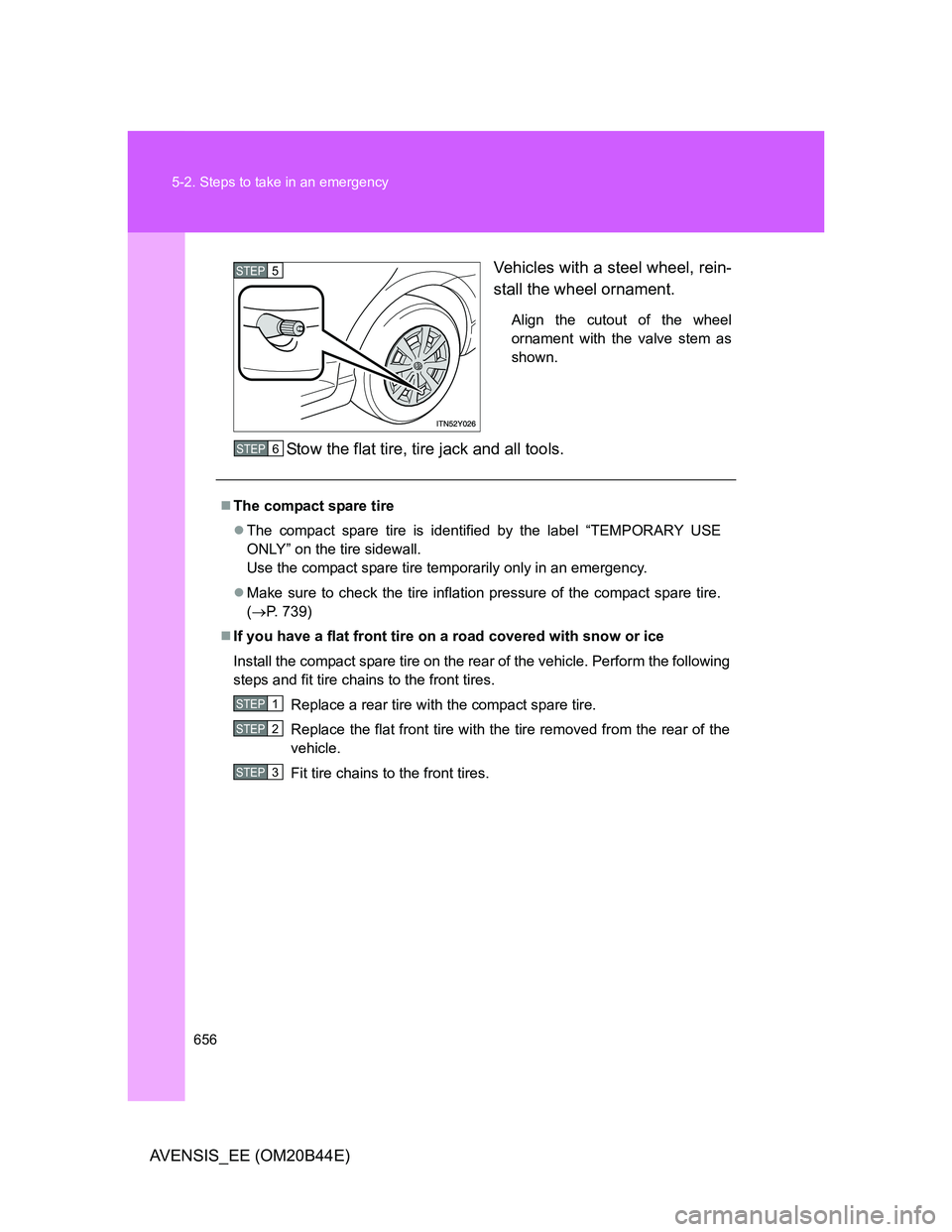
AVENSIS_EE (OM20B44E)Vehicles with a steel wheel, rein-
stall the wheel ornament.
Align the cutout of the wheel
ornament with the valve stem as
shown.
Stow the flat tire, tire jack and all tools.
STEP5
The compact spare tire
The compact spare tire is identified by the label “TEMPORARY USE
ONLY” on the tire sidewall.
Use the compact spare tire temporarily only in an emergency.
Make sure to check the tire inflation pressure of the compact spare tire.
(P. 739)
If you have a flat front tire on a road covered with snow or ice
Install the compact spare tire on the rear of the vehicle. Perform the following
steps and fit tire chains to the front tires.
Replace a rear tire with the compact spare tire.
Replace the flat front tire with the tire removed from the rear of the
vehicle.
Fit tire chains to the front tires.
STEP6
STEP1
STEP2
STEP3
Page 670 of 772
670 5-2. Steps to take in an emergency
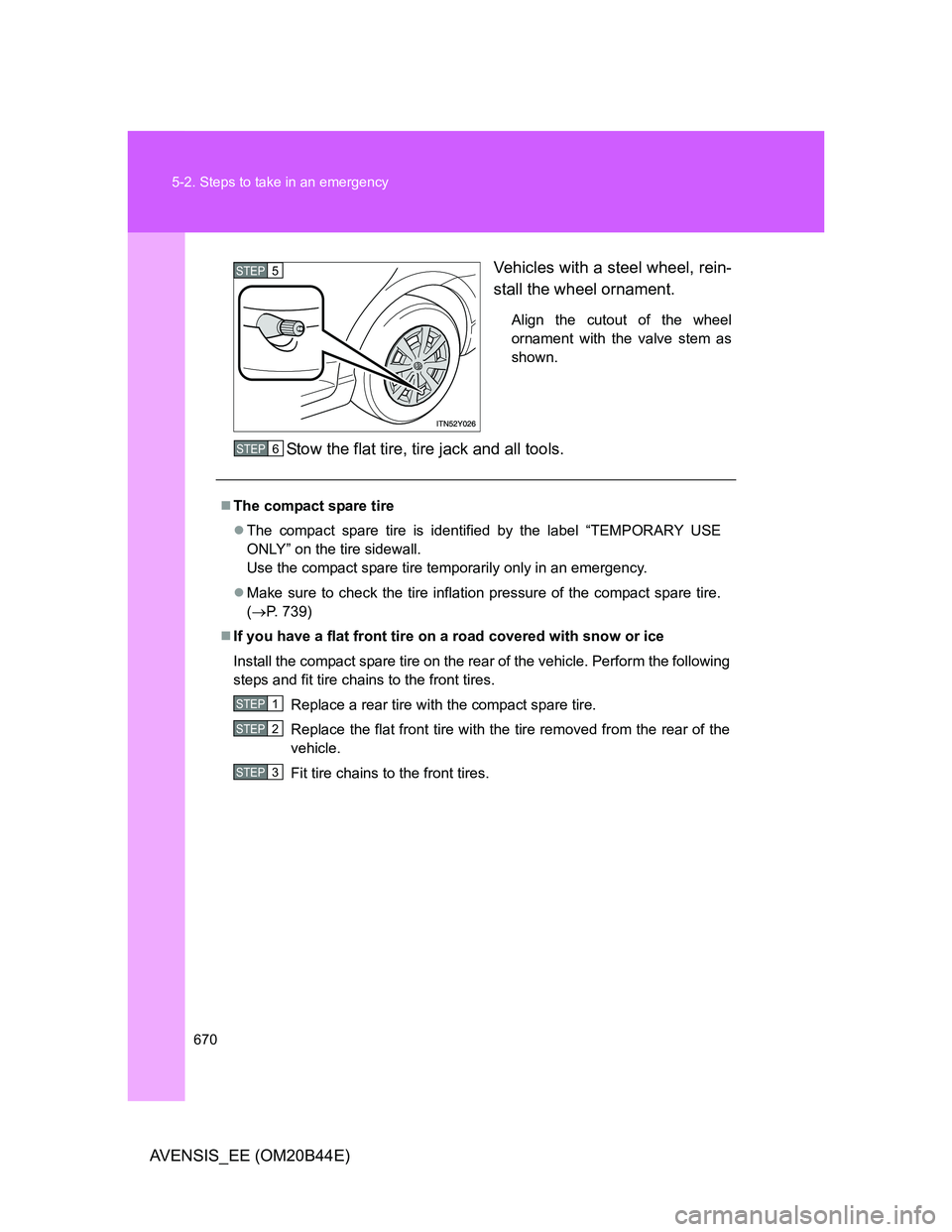
AVENSIS_EE (OM20B44E)Vehicles with a steel wheel, rein-
stall the wheel ornament.
Align the cutout of the wheel
ornament with the valve stem as
shown.
Stow the flat tire, tire jack and all tools.
STEP5
The compact spare tire
The compact spare tire is identified by the label “TEMPORARY USE
ONLY” on the tire sidewall.
Use the compact spare tire temporarily only in an emergency.
Make sure to check the tire inflation pressure of the compact spare tire.
(P. 739)
If you have a flat front tire on a road covered with snow or ice
Install the compact spare tire on the rear of the vehicle. Perform the following
steps and fit tire chains to the front tires.
Replace a rear tire with the compact spare tire.
Replace the flat front tire with the tire removed from the rear of the
vehicle.
Fit tire chains to the front tires.
STEP6
STEP1
STEP2
STEP3