lights TOYOTA AVENSIS 2012 Workshop Manual
[x] Cancel search | Manufacturer: TOYOTA, Model Year: 2012, Model line: AVENSIS, Model: TOYOTA AVENSIS 2012Pages: 772, PDF Size: 34.43 MB
Page 586 of 772
586 4-3. Do-it-yourself maintenance
AVENSIS_EE (OM20B44E)
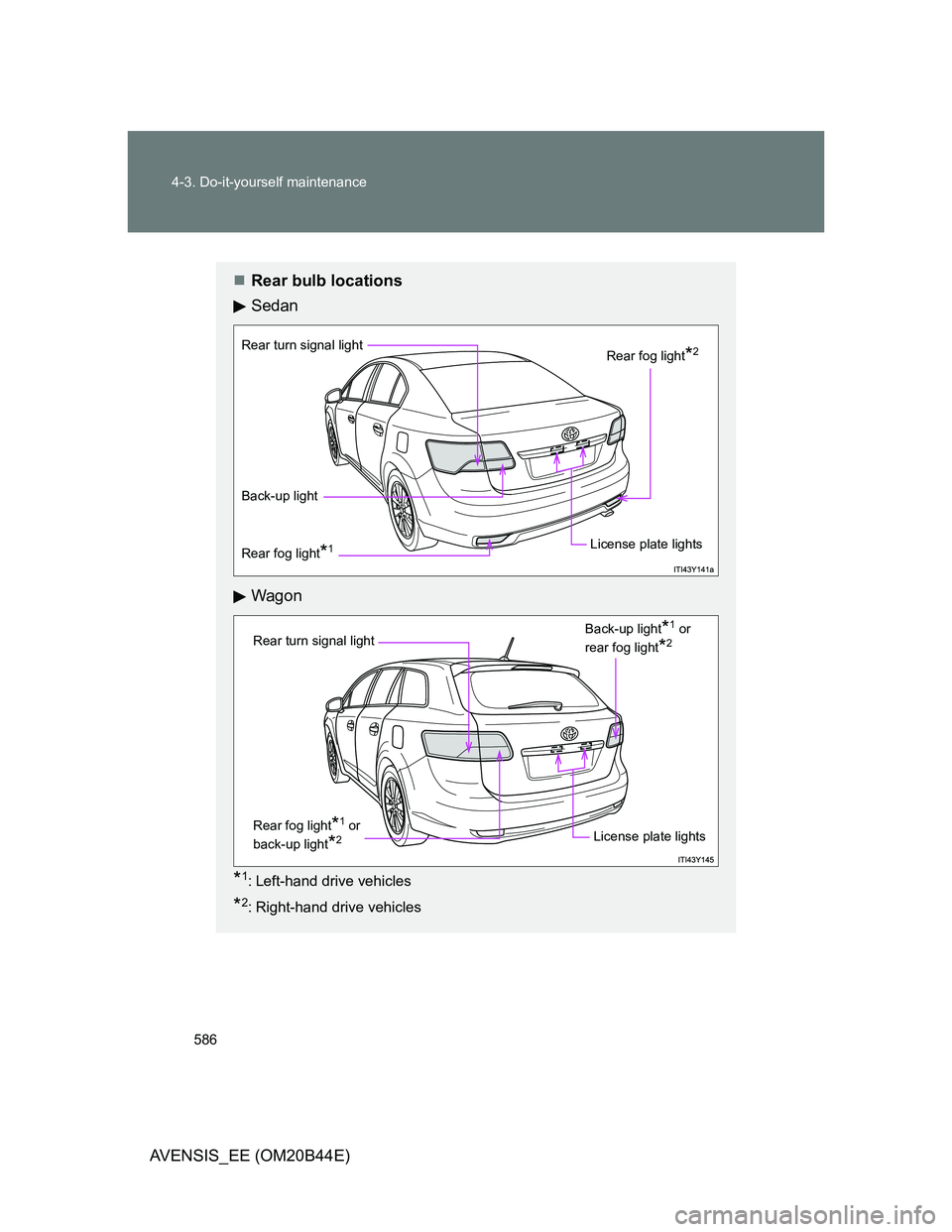
Rear bulb locations
Sedan
Wagon
*1: Left-hand drive vehicles
*2: Right-hand drive vehicles
Rear turn signal light
Rear fog light*1
Back-up light
License plate lightsRear fog light
*2
Rear turn signal light
Rear fog light*1 or
back-up light
*2
Back-up light*1 or
rear fog light
*2
License plate lights
Page 599 of 772
599 4-3. Do-it-yourself maintenance
4
Maintenance and care
AVENSIS_EE (OM20B44E)Replacing the following bulbs
If any of the lights listed below has burnt out, have it replaced by
any authorized Toyota dealer or repairer, or another duly qualified
and equipped professional.
Headlight low or high beams (vehicles with discharge head-
lights)
Front position/daytime running lights (vehicles with discharge
headlights)
Side turn signal lights
Stop lights
Tail lights
High mounted stoplight
Page 601 of 772
601 4-3. Do-it-yourself maintenance
4
Maintenance and care
AVENSIS_EE (OM20B44E)
Condensation build-up on the inside of the lens
Contact any authorized Toyota dealer or repairer, or another duly qualified
and equipped professional, for more information in the following situations.
Temporary condensation build-up on the inside of the headlight lens does
not indicate a malfunction.
Large drops of water are built up on the inside of the lens.
Water has built up inside the headlight.
Discharge headlights
If voltage to the discharge bulbs is insufficient, the bulbs may not come on,
or may go out temporarily. The discharge bulbs will come on when normal
power is restored.
LED lights
The front position/daytime running (vehicles with discharge headlights), side
turn signal, stop, tail lights and high mounted stoplight consist of a number of
LEDs. If any of the LEDs burn out, take your vehicle to any authorized
Toyota dealer or repairer, or another duly qualified and equipped profes-
sional to have the light replaced.
Page 602 of 772
602 4-3. Do-it-yourself maintenance
AVENSIS_EE (OM20B44E)
CAUTION
Replacing light bulbs
Turn off the headlights. Do not attempt to replace the bulb immediately
after turning off the headlights.
The bulbs become very hot and may cause burns.
Do not touch the glass portion of the light bulb with bare hands. Hold the
bulb by the plastic or metal portion.
If the bulb is scratched or dropped, it may blow out or crack.
Fully install light bulbs and any parts used to secure them. Failing to do so
may result in heat damage, fire, or water entering the headlight unit. This
may damage the headlights or cause condensation to build up on the lens.
Do not attempt to repair or disassemble light bulbs, connectors, electric
circuits or component parts.
Doing so may result in death or serious injury due to electric shock.
Discharge headlights
Contact any authorized Toyota dealer or repairer, or another duly qualified
and equipped professional, before replacing discharge headlights (includ-
ing light bulbs).
Do not touch the high-intensity discharge headlight’s high voltage socket
when the headlights are turned on.
An extremely high voltage of 20000 V will be discharged and could result
in serious injury or death by electric shock.
To prevent damage or fire
Make sure bulbs are fully seated and locked.
Page 604 of 772
604
AVENSIS_EE (OM20B44E)
5-1. Essential information
Emergency flashers
Emergency flashers
If the emergency flashers are used for a long time while the engine is not
operating, the battery may discharge.
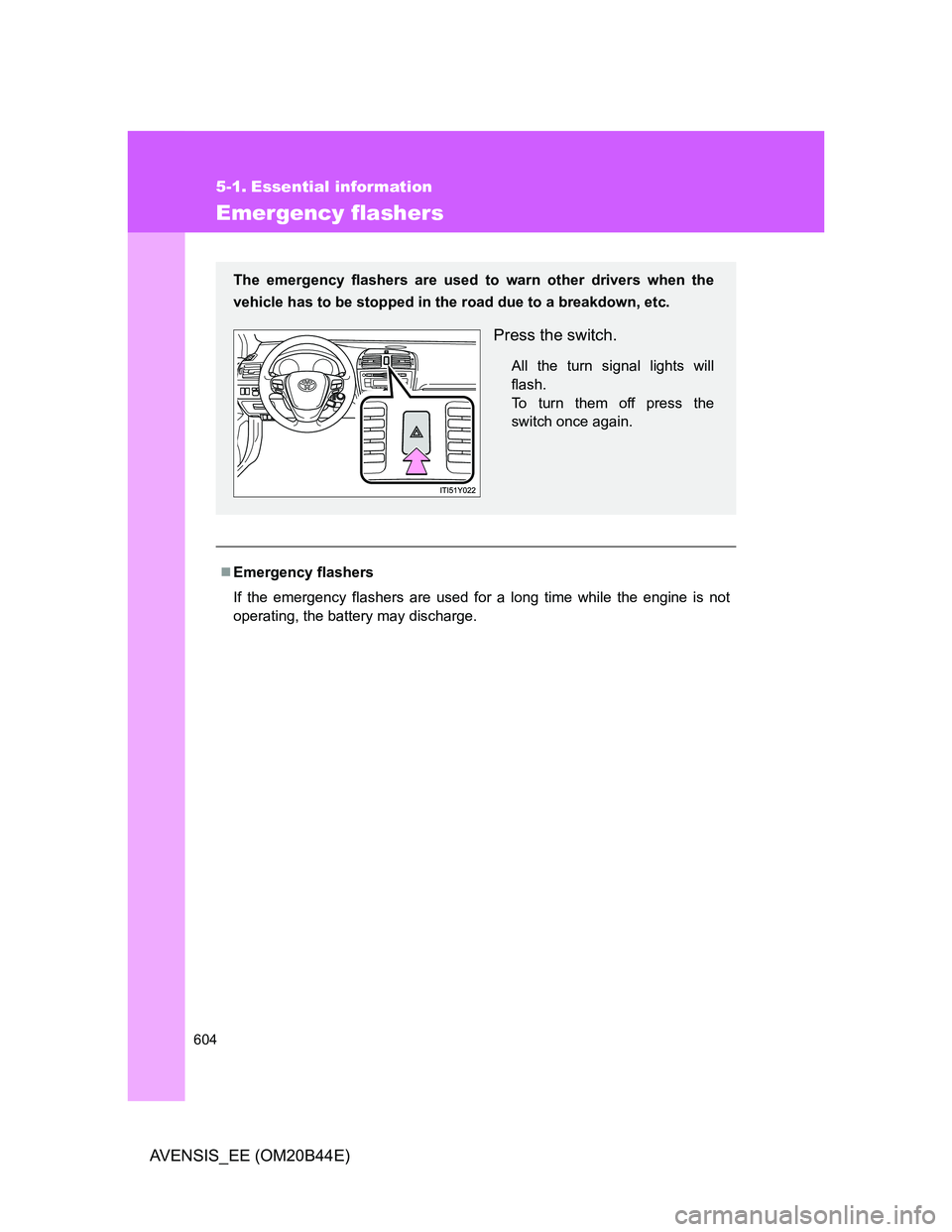
The emergency flashers are used to warn other drivers when the
vehicle has to be stopped in the road due to a breakdown, etc.
Press the switch.
All the turn signal lights will
flash.
To turn them off press the
switch once again.
Page 617 of 772
5
617
When trouble arises
AVENSIS_EE (OM20B44E)
5-2. Steps to take in an emergency
If a war ning light tur ns on or a war ning buzzer sounds...
Stop the vehicle immediately. Continuing to drive the vehicle
may be dangerous.
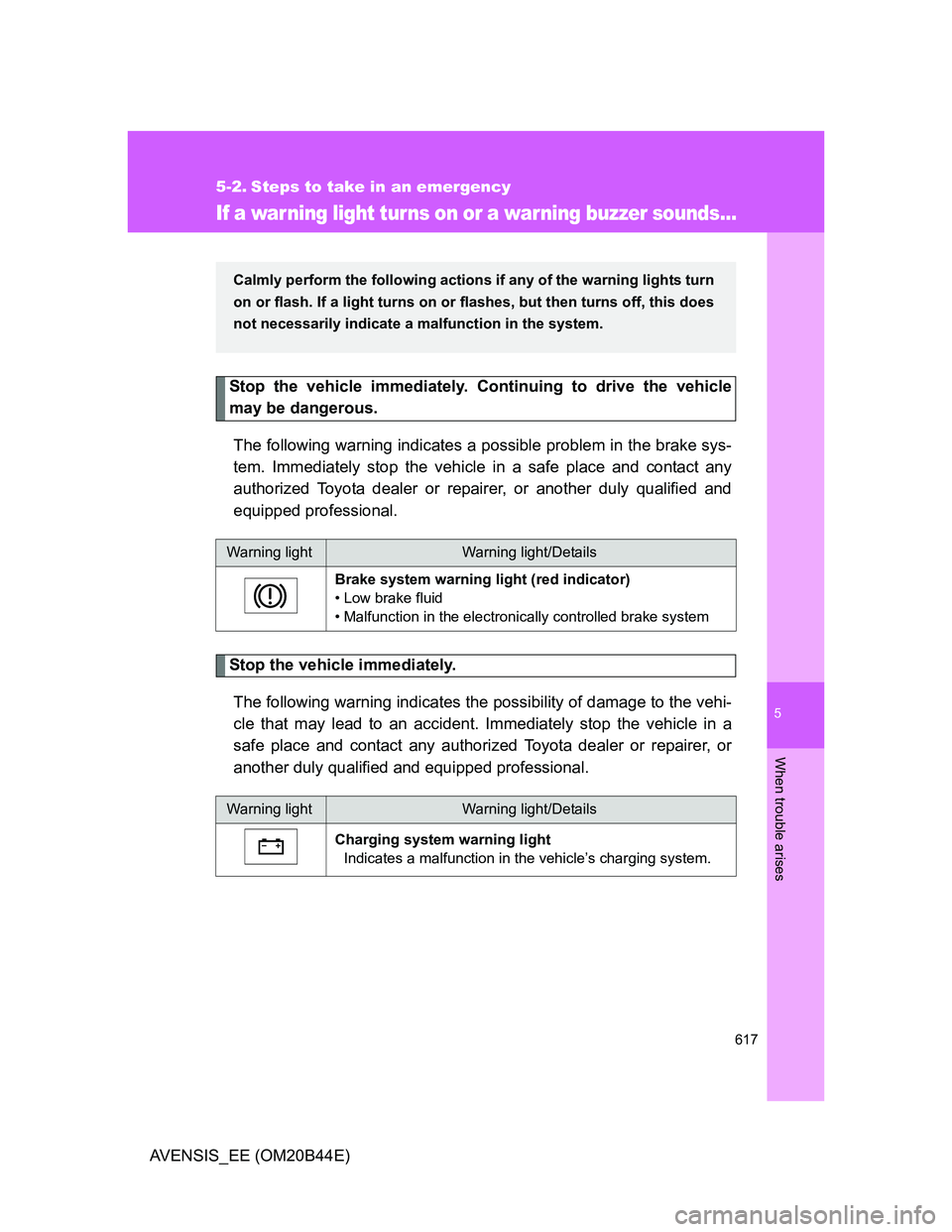
The following warning indicates a possible problem in the brake sys-
tem. Immediately stop the vehicle in a safe place and contact any
authorized Toyota dealer or repairer, or another duly qualified and
equipped professional.
Stop the vehicle immediately.
The following warning indicates the possibility of damage to the vehi-
cle that may lead to an accident. Immediately stop the vehicle in a
safe place and contact any authorized Toyota dealer or repairer, or
another duly qualified and equipped professional.
Warning lightWarning light/Details
Brake system warning light (red indicator)
• Low brake fluid
• Malfunction in the electronically controlled brake system
Warning lightWarning light/Details
Charging system warning light
Indicates a malfunction in the vehicle’s charging system.
Calmly perform the following actions if any of the warning lights turn
on or flash. If a light turns on or flashes, but then turns off, this does
not necessarily indicate a malfunction in the system.
Page 636 of 772
636 5-2. Steps to take in an emergency
AVENSIS_EE (OM20B44E)
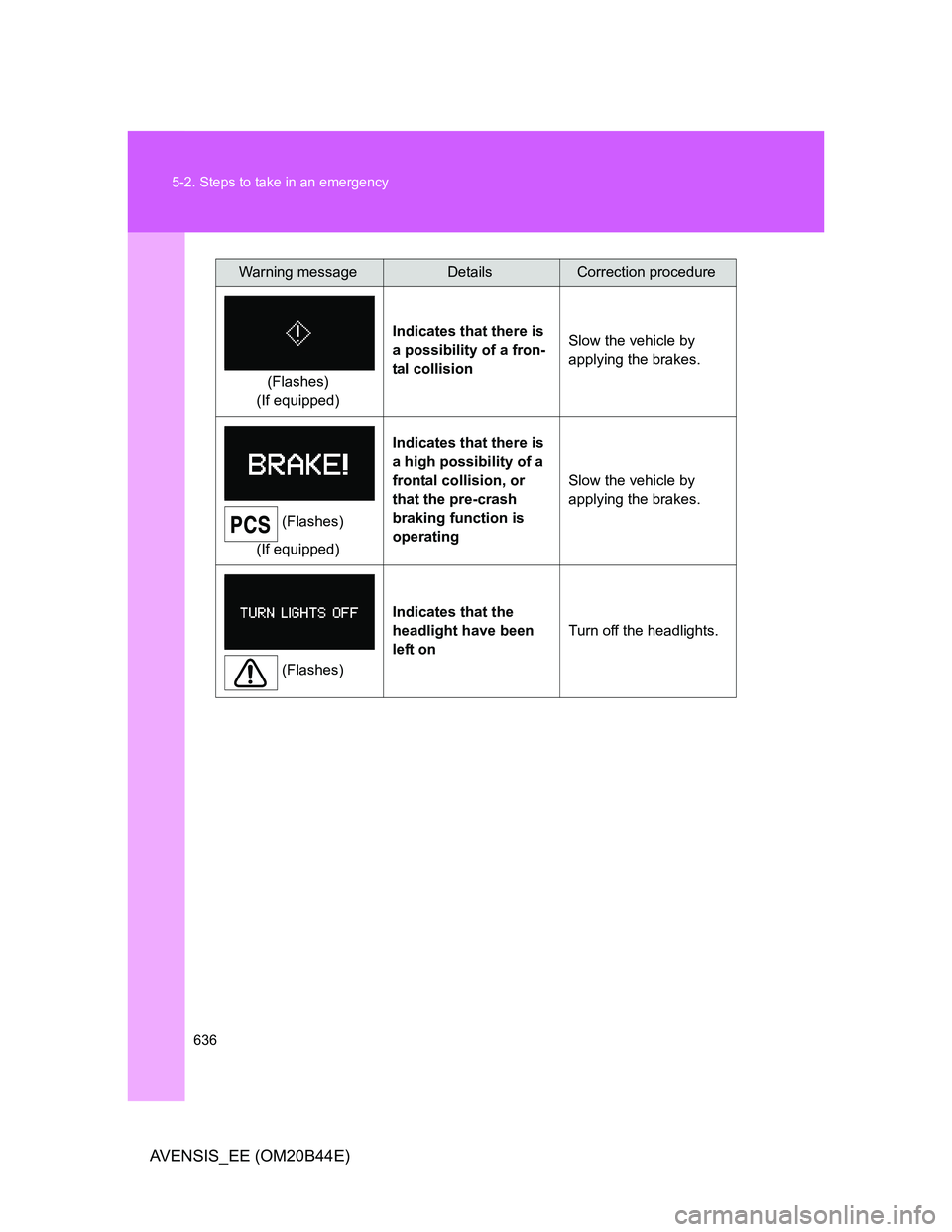
(Flashes)
(If equipped)Indicates that there is
a possibility of a fron-
tal collisionSlow the vehicle by
applying the brakes.
(Flashes)
(If equipped)Indicates that there is
a high possibility of a
frontal collision, or
that the pre-crash
braking function is
operatingSlow the vehicle by
applying the brakes.
(Flashes)Indicates that the
headlight have been
left onTurn off the headlights.
Warning messageDetailsCorrection procedure
Page 689 of 772
5
689
5-2. Steps to take in an emergency
When trouble arises
AVENSIS_EE (OM20B44E)
If the engine will not start
If the engine still does not start after following the correct starting
procedure (P. 210, 215) or releasing the steering lock (P. 213,
217), confirm the following points.
The engine will not start even if you are carrying the correct
key
One of the following may be the cause of the problem.
There may not be sufficient fuel in the vehicle’s tank.
Gasoline engine: Refuel the vehicle.
Diesel engine: (P. 713)
The engine may be flooded. (gasoline engine)
Try to restart the engine once more following correct starting
procedures. (P. 210, 215)
There may be a malfunction in the engine immobilizer system.
(P. 135)
The starter motor turns over slowly, the personal/interior
lights and headlights are dim, or the horn does not sound or
sounds at a low volume
One of the following may be the cause of the problem.
The battery may be discharged. (P. 705)
The battery terminal connections may be loose or corroded.
Page 690 of 772
690 5-2. Steps to take in an emergency
AVENSIS_EE (OM20B44E)
The starter motor does not turn over (vehicles with smart
entry & start system)
The engine starting system may be malfunctioning due to an
electrical problem such as an open circuit or a blown fuse. How-
ever, an interim measure is available to start the engine.
(P. 691)
The starter motor does not turn over, the personal/interior
lights and headlights do not turn on, or the horn does not
sound
One of the following may be the cause of the problem.
One or both of the battery terminals may be disconnected.
The battery may be discharged. (P. 705)
There may be a malfunction in the steering lock system. (vehi-
cles with smart entry & start system)
Contact any authorized Toyota dealer or repairer, or another duly
qualified and equipped professional, if the problem cannot be
repaired, or if repair procedures are unknown.
Page 708 of 772
708 5-2. Steps to take in an emergency
AVENSIS_EE (OM20B44E)
Starting the engine when the battery is discharged (vehicles with a
Multidrive or automatic transmission)
The engine cannot be started by push-starting.
Avoiding a discharged battery
Turn off the headlights and the audio system while the engine is turned
off.
Turn off any unnecessary electrical components when the vehicle is run-
ning at a low speed for an extended period, such as in heavy traffic, etc.
Charging the battery
The electricity stored in the battery will discharge gradually even when the
vehicle is not in use, due to natural discharge and the draining effects of cer-
tain electrical appliances. If the vehicle is left for a long time, the battery may
discharge, and the engine may be unable to start. (The battery recharges
automatically during driving.)
CAUTION
Avoiding battery fires or explosions
Observe the following precautions to prevent accidentally igniting the flam-
mable gas that may be emitted from the battery.
Make sure the jumper cable is connected to the correct terminal and that it
is not unintentionally in contact with any part other than the intended termi-
nal.
Do not allow the jumper cables to come into contact with the “+” and “-” ter-
minals.
Do not allow open flame or use matches, cigarette lighters or smoke near
the battery.