brakes TOYOTA AVENSIS 2013 (in English) User Guide
[x] Cancel search | Manufacturer: TOYOTA, Model Year: 2013, Model line: AVENSIS, Model: TOYOTA AVENSIS 2013Pages: 772, PDF Size: 34.43 MB
Page 333 of 772

333
2-4. Using other driving systems
2
When driving
AVENSIS_EE (OM20B44E)
PCS (Pre-Crash Safety)
: If equipped
When the radar sensor detects possibility of a frontal collision, the
pre-crash safety systems such as the brakes and seat belts are
automatically engaged to lessen impact and injuries to occupants
as well as vehicle damage.
Pre-crash seat belts
If the pre-crash sensor detects that a collision is unavoidable,
the pre-crash safety system will retract the seat belt before the
collision occurs.
The same will happen if the driver makes an emergency braking
or loses control of the vehicle. (P. 110)
However, when the VSC system is disabled, the system will not
operate in the event of skidding.
Pre-crash brake assist
When there is a high possibility of a frontal collision, the system
applies greater braking force in relation to how strongly the
brake pedal is depressed.
Pre-crash braking
When there is a high possibility of a frontal collision, the system
warns the driver using a warning light, warning display and
buzzer. If the system determines that a collision is unavoidable,
the brakes are automatically applied to reduce the collision
speed. Pre-crash braking can be disabled using the pre-crash
braking OFF switch.
Page 336 of 772

336 2-4. Using other driving systems
AVENSIS_EE (OM20B44E)
Conditions that may trigger the system even if there is no possibility of
a collision
When there is an object by the roadside at the entrance to a curve
When passing an oncoming vehicle on a curve
When driving over a narrow iron bridge
When there is a metal object on the road surface
When driving on an uneven road surface
When passing an oncoming vehicle on a right-turn (right-hand drive vehi-
cles) or left-turn (left-hand drive vehicles)
When your vehicle rapidly closes on the vehicle in front
When a grade separation/interchange, sign, billboard, or other structure
appears to be directly in the vehicle’s line of travel
When the steep angle of the road causes a metal object located beneath
the road surface to be seen ahead of the vehicle
When an extreme change in vehicle height occurs
When the axis of the radar is out of adjustment
When passing through certain toll gates
When passing through an overpass
When the system is activated in the situations described above there is also
a possibility that the seat belts will retract quickly and the brakes will be
applied with a force greater than normal. When the seat belt is locked in the
restricted position, stop the vehicle in a safe place, release the seat belt and
refasten.
Page 345 of 772

345 2-5. Driving information
2
When driving
AVENSIS_EE (OM20B44E)
Before driving the vehicle
Perform the following according to the driving conditions.
Do not try to forcibly open a window or move a wiper that is
frozen. Pour warm water over the frozen area to melt the ice.
Wipe away the water immediately to prevent it from freezing.
To ensure proper operation of the climate control system fan,
remove any snow that has accumulated on the air inlet vents
in front of the windshield.
Remove any ice that has accumulated on the vehicle chassis.
Periodically check for and remove any excess ice or snow
that may have accumulated in the wheel well or on the
brakes.
When driving the vehicle
Accelerate the vehicle slowly and drive at a reduced speed suit-
able to road conditions.
When parking the vehicle
Park the vehicle and move the shift lever to “P” (Multidrive or
automatic transmission) or “R” (manual transmission) without
setting the parking brake. The parking brake may freeze up, pre-
venting it from being released. If necessary, block the wheels to
prevent inadvertent sliding or creeping.
Page 355 of 772

355 2-5. Driving information
2
When driving
AVENSIS_EE (OM20B44E)Sudden acceleration/steering input/cornering
Executing sharp turns when towing may result in the trailer collid-
ing with your vehicle. Decelerate well in advance when approach-
ing turns and take them slowly and carefully to avoid sudden
braking.
Important points regarding turning
The wheels of the trailer will travel closer to the inside of the curve
than the wheels of the vehicle. To make allowance for this, take the
turns wider than you would normally.
Important points regarding stability
Vehicle movement resulting from uneven road surfaces and strong
crosswinds will affect handling. The vehicle may also be rocked by
passing buses or large trucks. Frequently check behind when mov-
ing alongside such vehicles. As soon as such vehicle movement
occurs, immediately start to decelerate smoothly by slowly apply-
ing the brakes. Always steer the vehicle straight ahead while brak-
ing.
Passing other vehicles
Consider the total combined length of your vehicle and trailer, and
ensure that the vehicle-to-vehicle distance is sufficient before exe-
cuting lane changes.
Page 606 of 772

606 5-1. Essential information
AVENSIS_EE (OM20B44E)
Emergency towing
If a tow truck is not available, in an emergency your vehicle may be
temporarily towed using a cable or chain secured to the emergency
towing eyelets or hook. This should only be attempted on hard, sur-
faced roads for short distances at low speeds.
A driver must be in the vehicle to steer and operate the brakes. The
vehicle’s wheels, drive train, axles, steering and brakes must be in
good condition.
Towing eyelets (front)
Towing hook (rear)
Page 607 of 772

5
607 5-1. Essential information
When trouble arises
AVENSIS_EE (OM20B44E)
Emergency towing procedure
Vehicles with smart entry & start system
Release the parking brake.
Put the shift lever in “N”.
The “ENGINE START STOP” switch must be in ACCESSORY
mode (engine off) or IGNITION ON mode (engine running).
Vehicles without smart entry & start system
Release the parking brake.
Put the shift lever in “N”.
Put the engine switch in the “ACC” (engine off) or “ON” position
(engine running).
CAUTION
While towing
Use extreme caution when towing the vehicle.
Avoid sudden starts or erratic driving maneuvers which place excessive
stress on the emergency towing eyelets and the cables or chains. Always
be cautious of the surroundings and other vehicles while towing.
If the engine is not running, the power assist for the brakes and steering
will not function, making steering and braking more difficult.
STEP1
STEP2
STEP3
STEP1
STEP2
STEP3
Page 636 of 772

636 5-2. Steps to take in an emergency
AVENSIS_EE (OM20B44E)
(Flashes)
(If equipped)Indicates that there is
a possibility of a fron-
tal collisionSlow the vehicle by
applying the brakes.
(Flashes)
(If equipped)Indicates that there is
a high possibility of a
frontal collision, or
that the pre-crash
braking function is
operatingSlow the vehicle by
applying the brakes.
(Flashes)Indicates that the
headlight have been
left onTurn off the headlights.
Warning messageDetailsCorrection procedure
Page 703 of 772
5
703 5-2. Steps to take in an emergency
When trouble arises
AVENSIS_EE (OM20B44E)
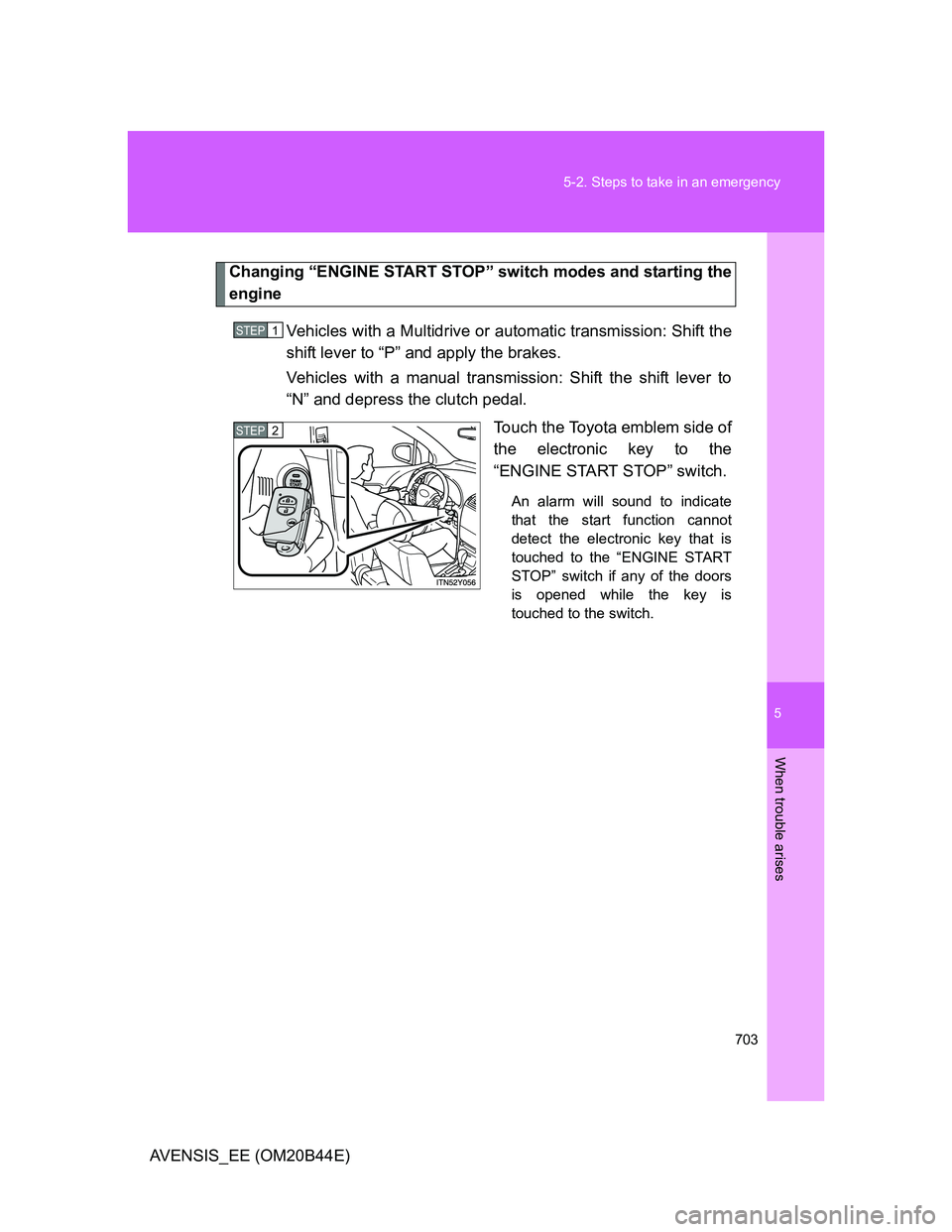
Changing “ENGINE START STOP” switch modes and starting the
engine
Vehicles with a Multidrive or automatic transmission: Shift the
shift lever to “P” and apply the brakes.
Vehicles with a manual transmission: Shift the shift lever to
“N” and depress the clutch pedal.
Touch the Toyota emblem side of
the electronic key to the
“ENGINE START STOP” switch.
An alarm will sound to indicate
that the start function cannot
detect the electronic key that is
touched to the “ENGINE START
STOP” switch if any of the doors
is opened while the key is
touched to the switch.
STEP1
STEP2
Page 717 of 772

5
717 5-2. Steps to take in an emergency
When trouble arises
AVENSIS_EE (OM20B44E)
CAUTION
If the engine has to be turned off while driving
Power assist for the brakes and steering wheel will be lost, making the
brake pedal harder to depress and the steering wheel heavier to turn.
Decelerate as much as possible before turning off the engine.
Vehicles without smart entry & start system: Never attempt to remove the
key, as doing so will lock the steering wheel.
Vehicles without smart entry &
start system: Stop the engine
by turning the engine switch to
the “ACC” position.
Stop the vehicle in a safe place by the road.STEP4
STEP5
Page 738 of 772

738 6-1. Specifications
AVENSIS_EE (OM20B44E)
Clutch
Brakes
*: Minimum pedal clearance when depressed with a force of 490 N (50 kgf, 110
lbf) while the engine is running
Steering
Pedal free play 5 15 mm (0.2 0.6 in.)
Fluid typeSAE J1703 or FMVSS No. 116 DOT 3 or
SAE J1704 or FMVSS No. 116 DOT 4
Pedal clearance*
Left-hand drive vehicles
Right-hand drive vehicles59 mm (2.32 in.) Min.
58 mm (2.28 in.) Min.
Pedal free play 1 6 mm (0.04 0.24 in.)
Fluid typeSAE J1703 or FMVSS No. 116 DOT 3 or
SAE J1704 or FMVSS No. 116 DOT 4
Free playLess than 30 mm (1.18 in.)