check engine TOYOTA AVENSIS 2018 Service Manual
[x] Cancel search | Manufacturer: TOYOTA, Model Year: 2018, Model line: AVENSIS, Model: TOYOTA AVENSIS 2018Pages: 660, PDF Size: 63.16 MB
Page 466 of 660
4667-3. Do-it-yourself maintenance
AVENSIS_OM_OM20C79E_(EE)
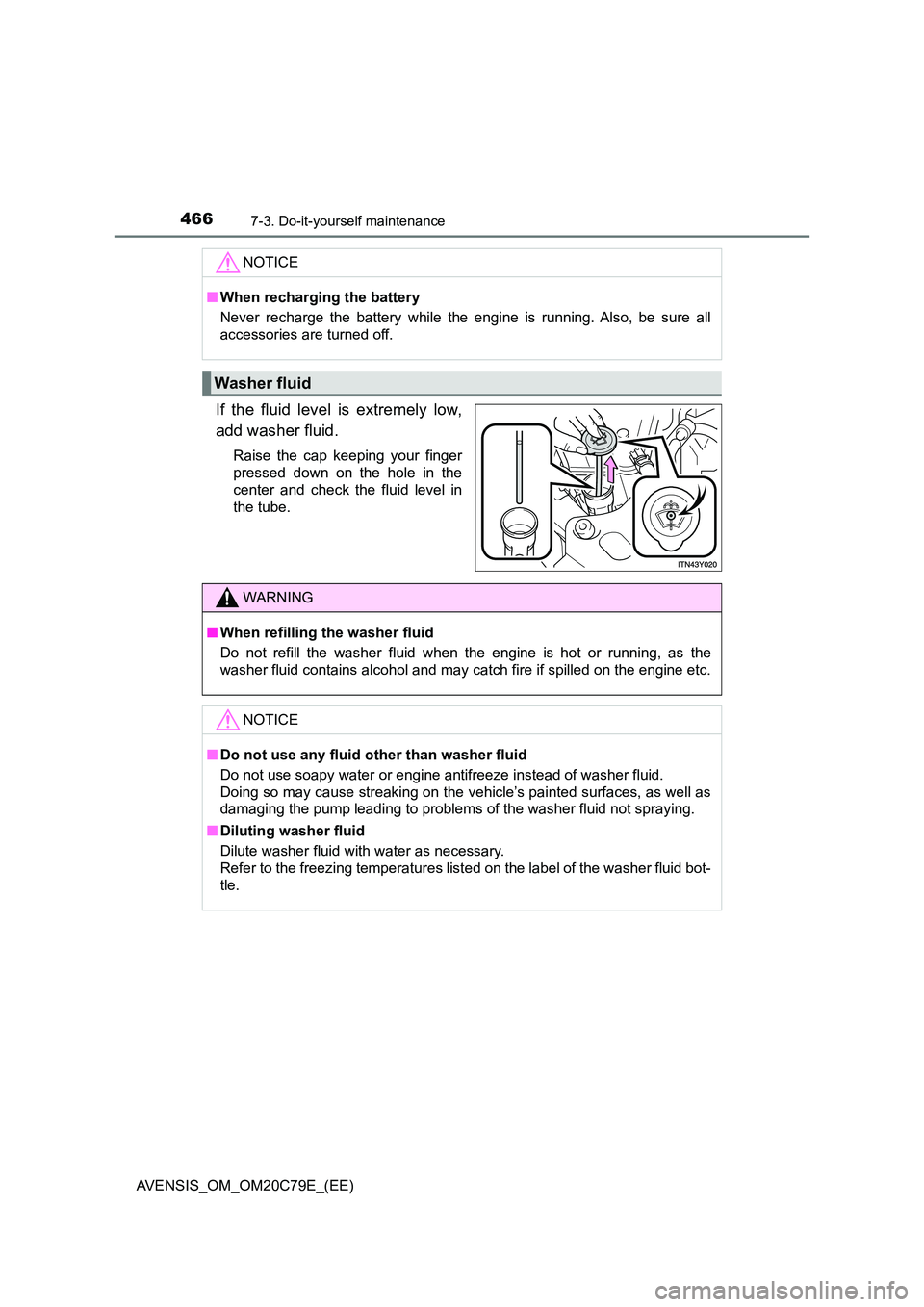
If the fluid level is extremely low,
add washer fluid.
Raise the cap keeping your finger
pressed down on the hole in the
center and check the fluid level in
the tube.
NOTICE
■ When recharging the battery
Never recharge the battery while the engine is running. Also, be sure all
accessories are turned off.
Washer fluid
WARNING
■ When refilling the washer fluid
Do not refill the washer fluid when the engine is hot or running, as the
washer fluid contains alcohol and may catch fire if spilled on the engine etc.
NOTICE
■ Do not use any fluid other than washer fluid
Do not use soapy water or engine antifreeze instead of washer fluid.
Doing so may cause streaking on the vehicle’s painted surfaces, as well as
damaging the pump leading to problems of the washer fluid not spraying.
■ Diluting washer fluid
Dilute washer fluid with water as necessary.
Refer to the freezing temperatures list ed on the label of the washer fluid bot-
tle.
Page 496 of 660
4967-3. Do-it-yourself maintenance
AVENSIS_OM_OM20C79E_(EE)
Checking and replacing fuses
Turn the engine switch to the “LOCK” position (vehicles without
smart entry & start system) or off (vehicles with smart entry & start
system).
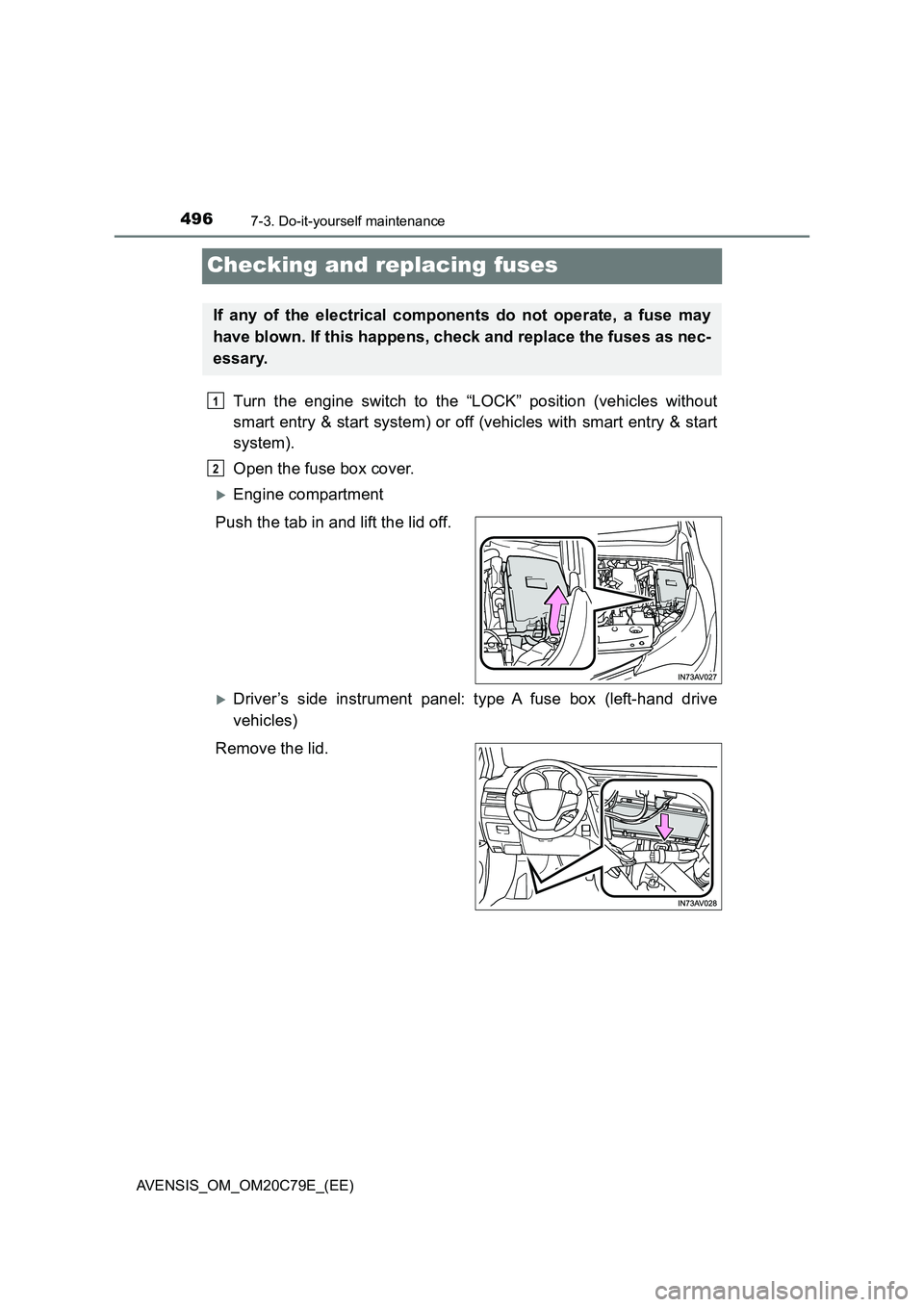
Open the fuse box cover.
Engine compartment
Push the tab in and lift the lid off.
Driver’s side instrument panel: type A fuse box (left-hand drive
vehicles)
Remove the lid.
If any of the electrical components do not operate, a fuse may
have blown. If this happens, check and replace the fuses as nec-
essary.
1
2
Page 501 of 660
5017-3. Do-it-yourself maintenance
AVENSIS_OM_OM20C79E_(EE)
7
Maintenance and care
Light bulbs
Check the wattage of the light bulb to be replaced. (P. 625)
P. 4 5 5
■Front
You may replace the following bulbs by yourself. The difficulty
level of replacement varies depending on the bulb. As there is a
danger that components may be damaged, we recommend that
replacement is carried out by any authorized Toyota retailer or
Toyota authorized repairer, or any reliable repairer.
Preparing for light bulb replacement
Removing the engine compartment cover
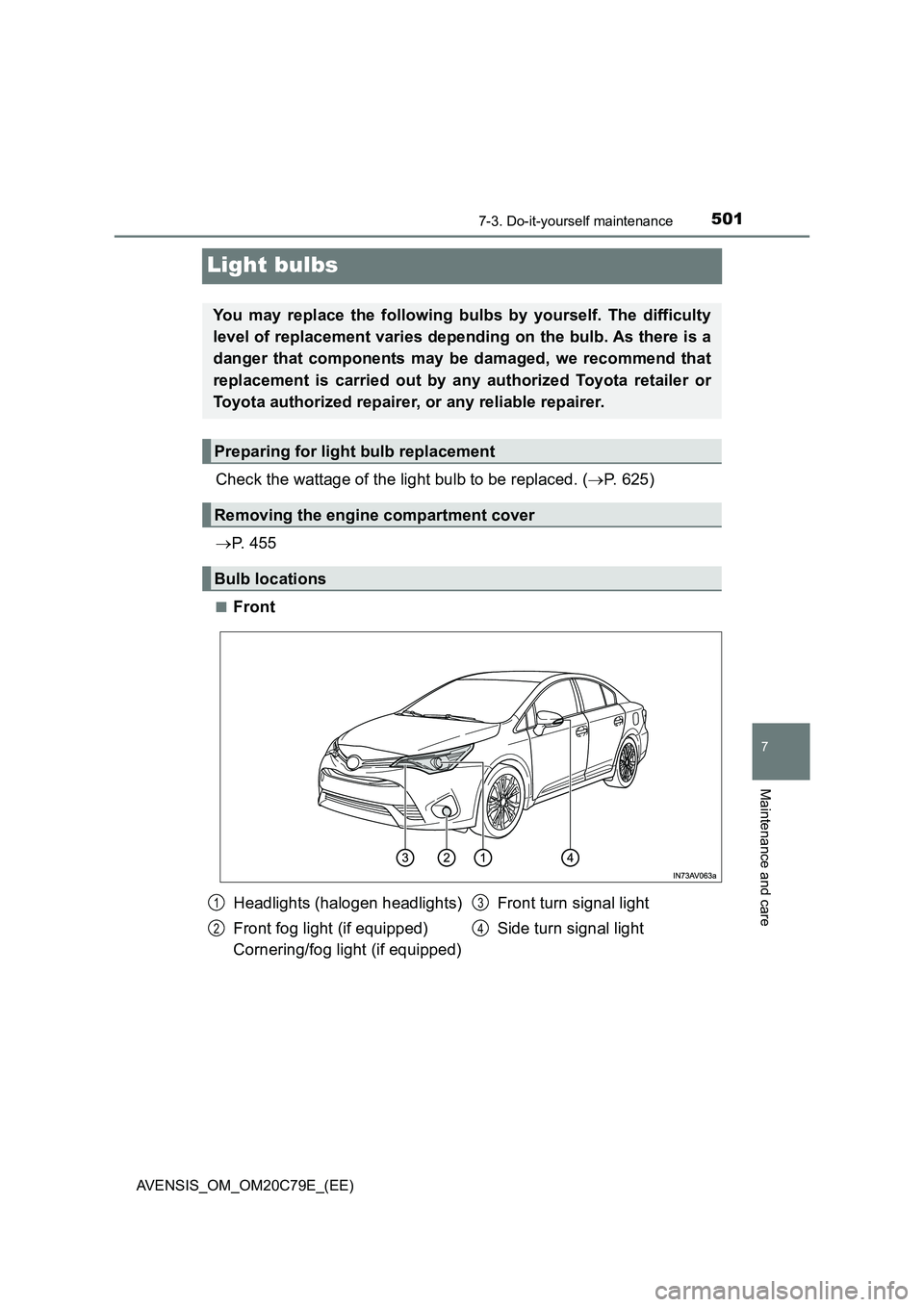
Bulb locations
Headlights (halogen headlights)
Front fog light (if equipped)
Cornering/fog light (if equipped)Front turn signal light
Side turn signal light1
2
3
4
Page 535 of 660
5358-2. Steps to take in an emergency
AVENSIS_OM_OM20C79E_(EE)
8
When trouble arises
■If the tire pressure warning light frequently comes on after blinking for 1
minute (vehicles with tire pressure warning system)
If the tire pressure warning light frequently comes on after blinking for 1 min-
ute when the engine switch is turned to the “ON” position (vehicles without
smart entry & start system) or IGNITION ON mode (vehicles with smart entry
& start system), have it checked by any authorized Toyota retailer or Toyota
authorized repairer, or any reliable repairer.
If the tire pressure warning light frequently comes on after blinking for 1 min-
ute when you change between registered wheel sets, confirm the correct
wheel set has been selected.
■ If the malfunction indicator lamp comes on while driving
For some models, the malfunction indicator lamp will come on if the fuel tank
becomes completely empty. If the fuel tank is empty, refuel the vehicle imme-
diately. The malfunction indicator lamp will go off after several trips.
If the malfunction indicator lamp does not go off, contact any authorized
Toyota retailer or Toyota authorized repairer, or any reliable repairer.
■ Front passenger detection sensor, seat belt reminder and warning
buzzer
● If luggage is placed on the front passenger seat, the front passenger detec-
tion sensor may cause the warning light to flash and the warning buzzer to
sound even if a passenger is not sitting in the seat.
● If a cushion is placed on the seat, the sensor may not detect a passenger,
and the warning light may not operate properly.
Page 543 of 660
5438-2. Steps to take in an emergency
AVENSIS_OM_OM20C79E_(EE)
8
When trouble arises
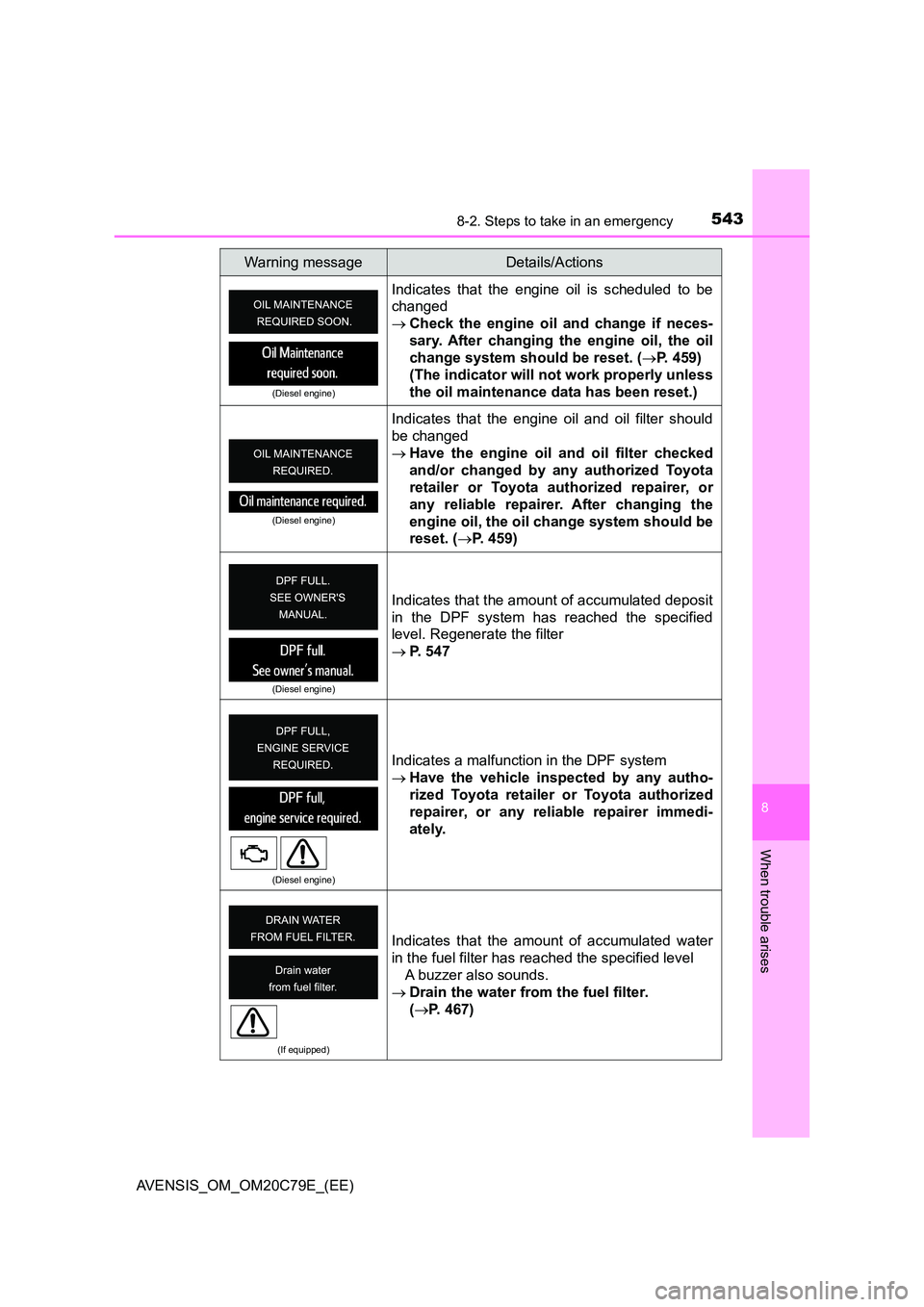
(Diesel engine)
Indicates that the engine oil is scheduled to be
changed
Check the engine oil and change if neces-
sary. After changing the engine oil, the oil
change system should be reset. ( P. 459)
(The indicator will not work properly unless
the oil maintenance data has been reset.)
(Diesel engine)
Indicates that the engine oil and oil filter should
be changed
Have the engine oil and oil filter checked
and/or changed by any authorized Toyota
retailer or Toyota authorized repairer, or
any reliable repairer. After changing the
engine oil, the oil change system should be
reset. ( P. 459)
(Diesel engine)
Indicates that the amount of accumulated deposit
in the DPF system has reached the specified
level. Regenerate the filter
P. 547
(Diesel engine)
Indicates a malfunction in the DPF system
Have the vehicle inspected by any autho-
rized Toyota retailer or Toyota authorized
repairer, or any reliable repairer immedi-
ately.
(If equipped)
Indicates that the amount of accumulated water
in the fuel filter has reached the specified level
A buzzer also sounds.
Drain the water from the fuel filter.
( P. 467)
Warning messageDetails/Actions
Page 555 of 660
5558-2. Steps to take in an emergency
AVENSIS_OM_OM20C79E_(EE)
8
When trouble arises
●Stop the vehicle in a safe place on a hard, flat surface.
● Set the parking brake.
● Shift the shift lever to P (Multidrive) or N (manual transmission).
● Stop the engine.
● Turn on the emergency flashers. (P. 518)
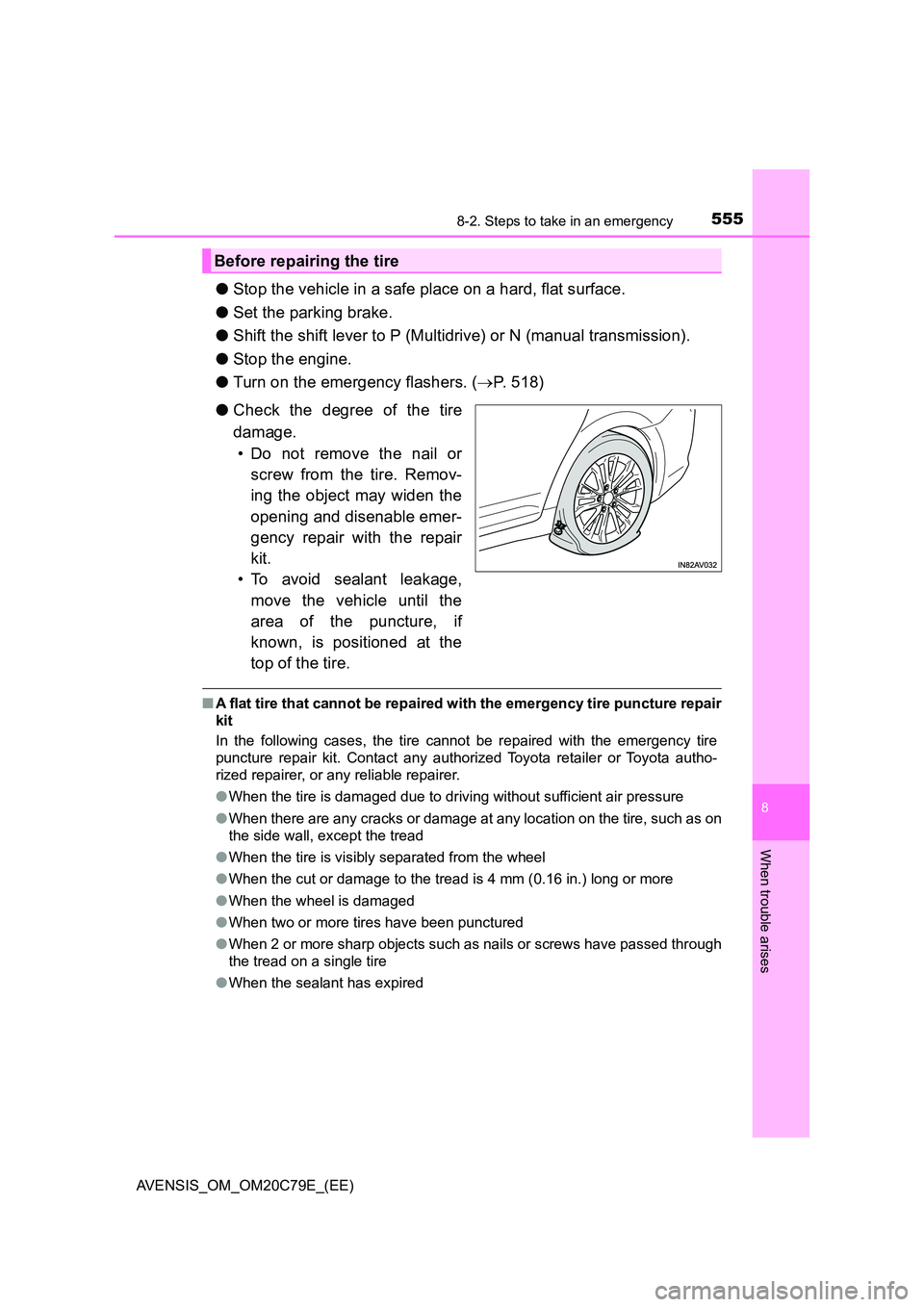
● Check the degree of the tire
damage.
• Do not remove the nail or
screw from the tire. Remov-
ing the object may widen the
opening and disenable emer-
gency repair with the repair
kit.
• To avoid sealant leakage,
move the vehicle until the
area of the puncture, if
known, is positioned at the
top of the tire.
■ A flat tire that cannot be repaired with the emergency tire puncture repair
kit
In the following cases, the tire c annot be repaired with the emergency tire
puncture repair kit. Contact any authorized Toyota retailer or Toyota autho-
rized repairer, or any reliable repairer.
● When the tire is damaged due to driving without sufficient air pressure
● When there are any cracks or damage at any location on the tire, such as on
the side wall, except the tread
● When the tire is visibly separated from the wheel
● When the cut or damage to the tread is 4 mm (0.16 in.) long or more
● When the wheel is damaged
● When two or more tires have been punctured
● When 2 or more sharp objects such as nails or screws have passed through
the tread on a single tire
● When the sealant has expired
Before repairing the tire
Page 561 of 660
5618-2. Steps to take in an emergency
AVENSIS_OM_OM20C79E_(EE)
8
When trouble arises
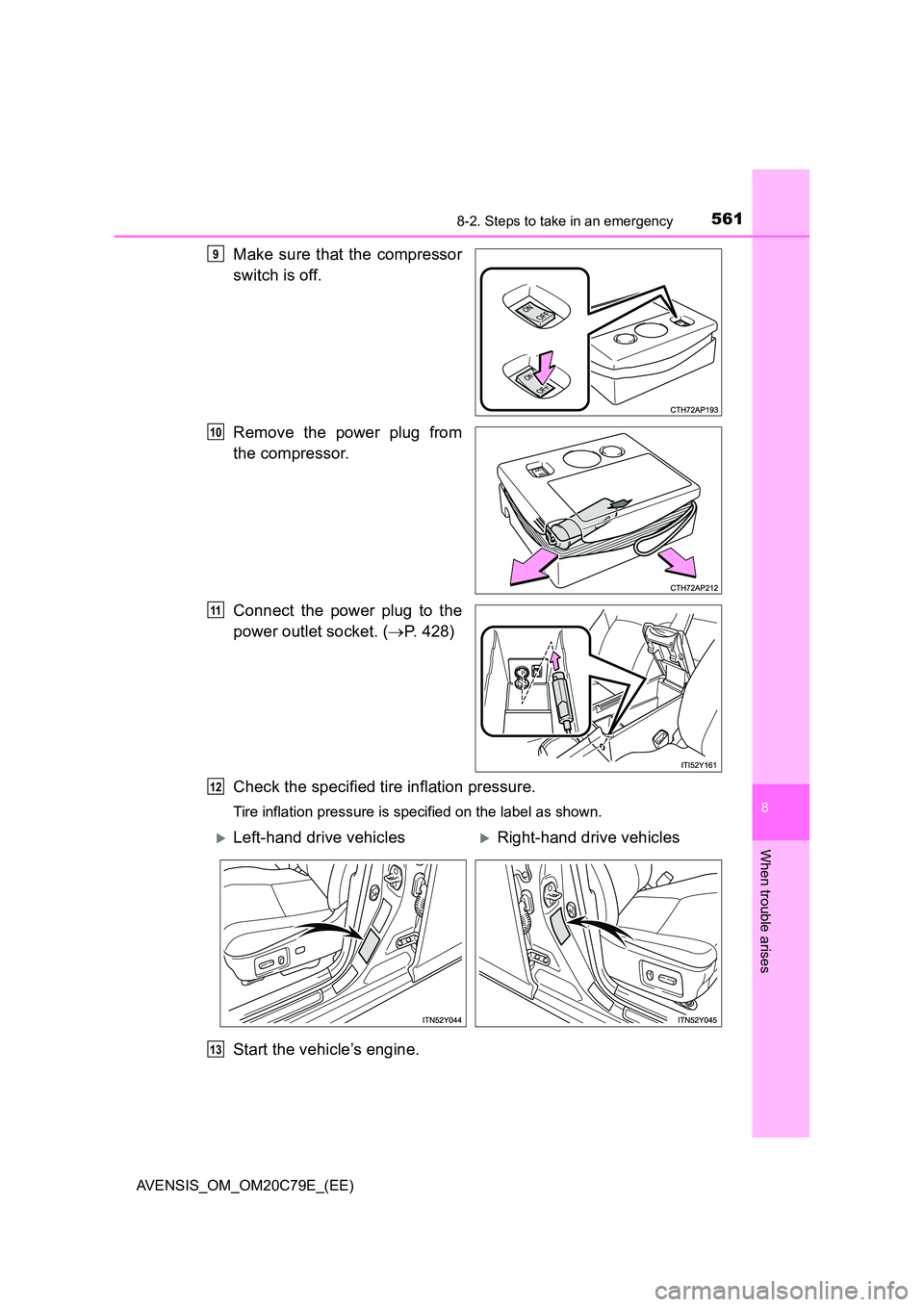
Make sure that the compressor
switch is off.
Remove the power plug from
the compressor.
Connect the power plug to the
power outlet socket. ( P. 428)
Check the specified tire inflation pressure.
Tire inflation pressure is specified on the label as shown.
Start the vehicle’s engine.
9
10
11
12
Left-hand drive vehiclesRight-hand drive vehicles
13
Page 573 of 660
5738-2. Steps to take in an emergency
AVENSIS_OM_OM20C79E_(EE)
8
When trouble arises
WARNING
■Using the tire jack
Improper use of the tire jack may cause the vehicle to suddenly fall off the
jack, leading to death or serious injury.
● Do not use the tire jack for any purpose other than replacing tires or install-
ing and removing tire chains.
● Only use the tire jack that comes with this vehicle for replacing a flat tire.
Do not use it on other vehicles, and do not use other tire jacks for replac-
ing tires on this vehicle.
● Always check that the tire jack is securely set to the jack point.
● Do not put any part of your body under the vehicle supported by the jack.
● Do not start or run the engine while your vehicle is supported by the jack.
● Do not raise the vehicle while someone is in it.
● When raising the vehicle, do not put an object on or under the jack.
● Do not raise the vehicle to a height greater than that required to replace
the tire.
● Use a jack stand if it is necessary to get under the vehicle.
Take particular care when lowering the vehicle to ensure that no one work-
ing on or near the vehicle will be injured.
Page 588 of 660
5888-2. Steps to take in an emergency
AVENSIS_OM_OM20C79E_(EE)
If the parking brake cannot be released
●Vehicles with Multidrive: Shift the shift lever to P.
● Vehicles with manual transmission: Shift the shift lever to 1 or R.
● Turn the engine switch to the “LOCK” position (vehicles without
smart entry & start system) or off (vehicles with smart entry & start
system).
● Check that the parking brake indicator is off.
● Chock the tires.
● Stop the vehicle on a hard, flat surface.
In the event that the battery is discharged or switch operation
does not release the parking brake, the parking brake can be
released manually using the procedure below. This procedure
should be performed only if necessary, such as in an emer-
gency.
If the switch cannot be operated even when the battery is nor-
mal, the parking brake system may be malfunctioning. Have the
vehicle inspected by any authorized Toyota retailer or Toyota
authorized repairer, or any reliable repairer immediately.
Before releasing the parking brake manually
Page 591 of 660
5918-2. Steps to take in an emergency
AVENSIS_OM_OM20C79E_(EE)
8
When trouble arises
■When the seal is damaged
The seal needs to replace by any authorized Toyota retailer or Toyota autho-
rized repairer, or any reliable repairer.
If the trunk/luggage compartment has flooded with water when the seal has
been broken or is missing (for example, if the vehicle has been left outside in
the rain with the trunk lid open or removed), the parking brake system will
need to be replaced.
■ Manual operation of the parking brake
The parking brake cannot be set manually.
WARNING
■ When releasing the parking brake manually
Vehicles without smart entry & start system
● Shift the shift lever to P (Multidrive) or 1 or R (manual transmission), turn
the engine switch to “LOCK” position and chock the tires.
Failure to do so may cause the vehicle to move, resulting in an accident.
● Turn the engine switch to “LOCK” position and check that the parking
brake indicator is off.
Failure to do so may cause the system to operate and turn the parking
brake release tool that is inserted, resulting in an injury.
Vehicles with smart entry & start system
● Shift the shift lever to P (Multidrive) or 1 or R (manual transmission), turn
the engine switch off and chock the tires.
Failure to do so may cause the vehicle to move, resulting in an accident.
● Turn the engine switch off and check that the parking brake indicator is off.
Failure to do so may cause the system to operate and turn the parking
brake release tool that is inserted, resulting in an injury.
NOTICE
■ When releasing the parking brake manually
● Be sure to turn the tool as far as it will go.
Stopping midway will cause switch operation to cancel and will cause the
parking brake system to fail.
● Use designated releasing tool only.
Using commercially available tool may damage the releasing hole and
unable to remove the hole.