warning light TOYOTA AVENSIS 2018 Workshop Manual
[x] Cancel search | Manufacturer: TOYOTA, Model Year: 2018, Model line: AVENSIS, Model: TOYOTA AVENSIS 2018Pages: 660, PDF Size: 63.16 MB
Page 472 of 660
4727-3. Do-it-yourself maintenance
AVENSIS_OM_OM20C79E_(EE)
Vehicles with color display
Press or of the meter control switch to select .
(P. 1 1 2 )
Press or of the meter control switch to select the settings
menu and then press to display the menu.
Select “ Setup” and then press to display the menu.
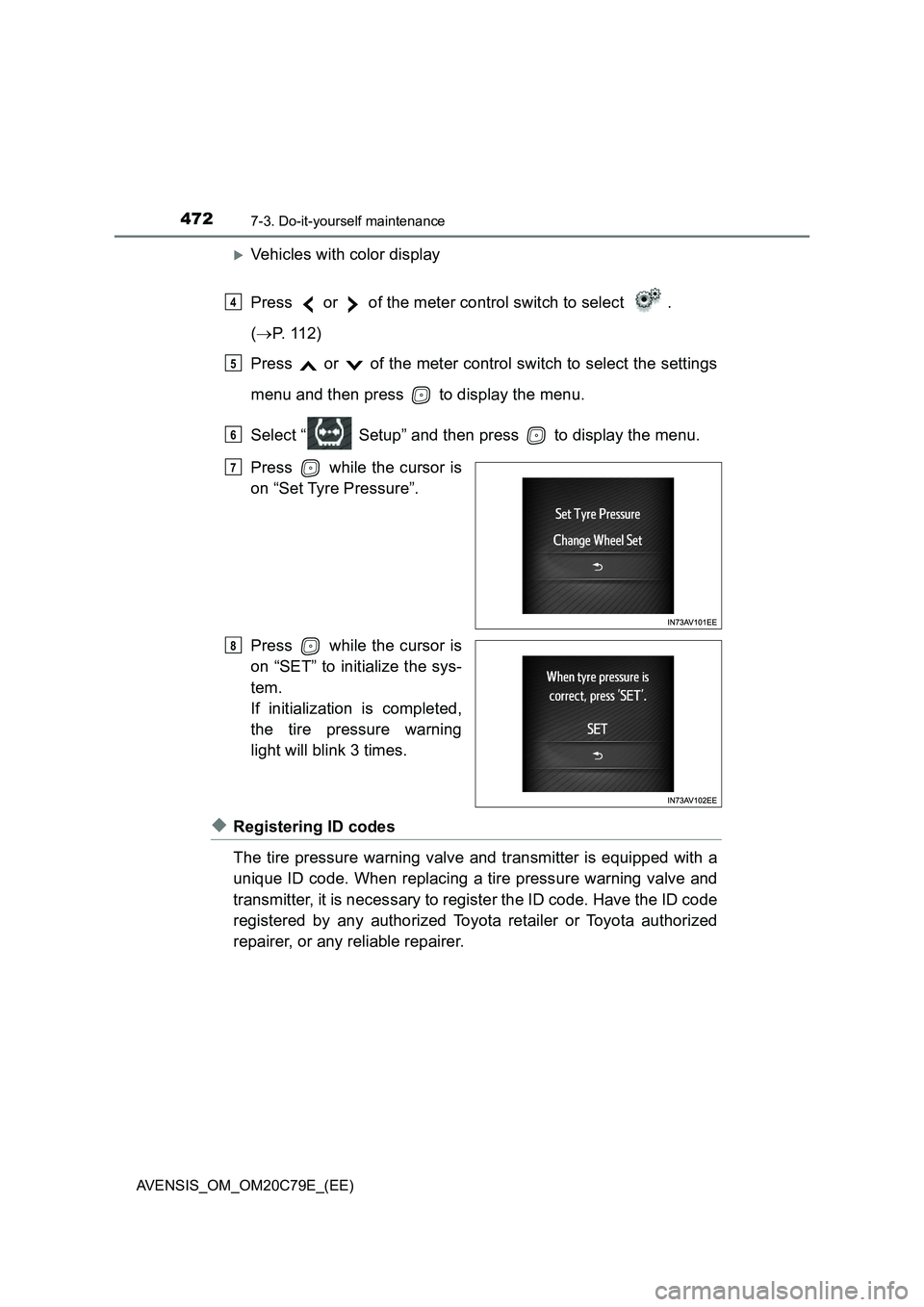
Press while the cursor is
on “Set Tyre Pressure”.
Press while the cursor is
on “SET” to initialize the sys-
tem.
If initialization is completed,
the tire pressure warning
light will blink 3 times.
◆Registering ID codes
The tire pressure warning valve and transmitter is equipped with a
unique ID code. When replacing a tire pressure warning valve and
transmitter, it is necessary to register the ID code. Have the ID code
registered by any authorized Toyota retailer or Toyota authorized
repairer, or any reliable repairer.
4
5
6
7
8
Page 474 of 660
4747-3. Do-it-yourself maintenance
AVENSIS_OM_OM20C79E_(EE)
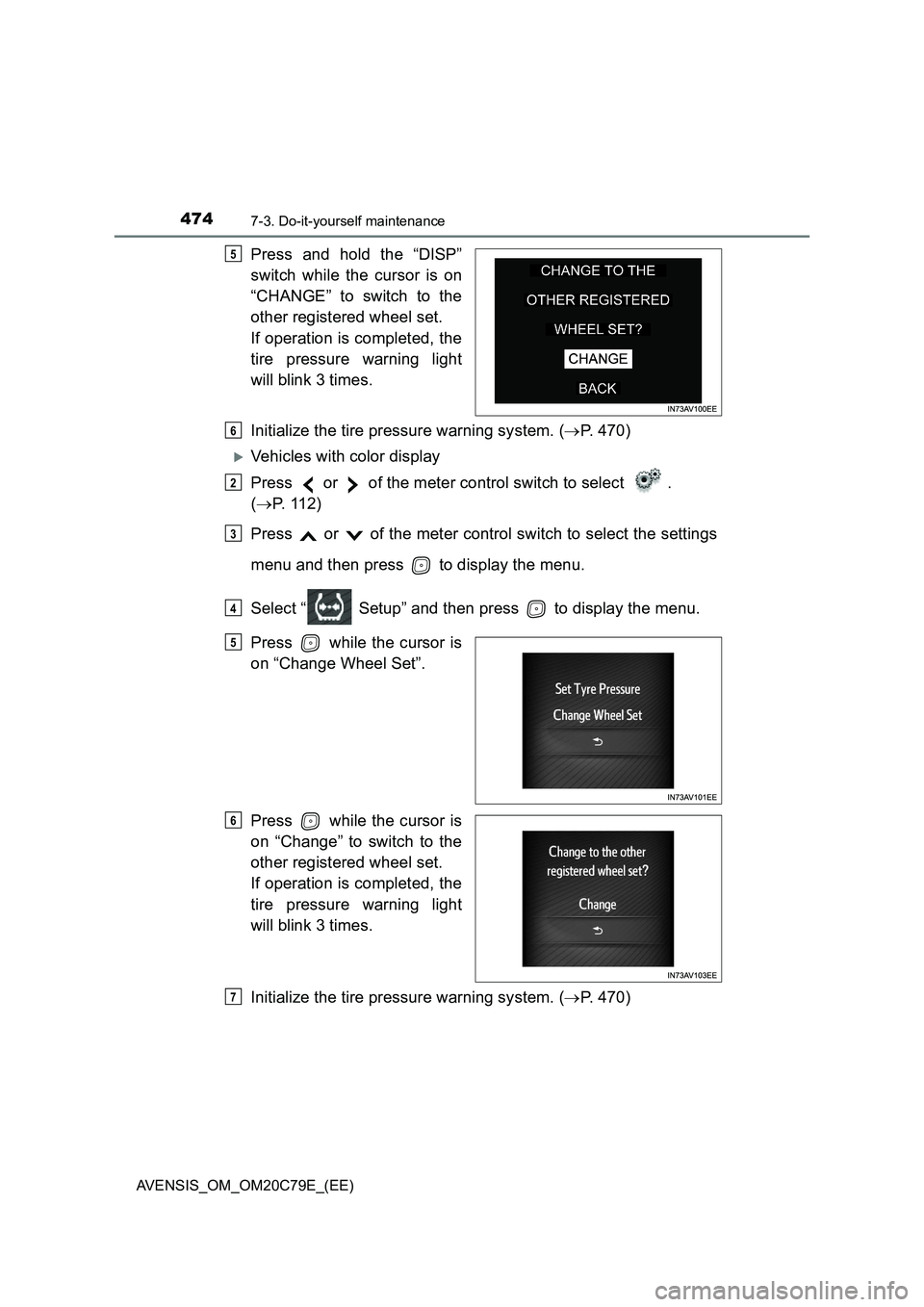
Press and hold the “DISP”
switch while the cursor is on
“CHANGE” to switch to the
other registered wheel set.
If operation is completed, the
tire pressure warning light
will blink 3 times.
Initialize the tire pressure warning system. (P. 470)
Vehicles with color display
Press or of the meter control switch to select .
(P. 1 1 2 )
Press or of the meter control switch to select the settings
menu and then press to display the menu.
Select “ Setup” and then press to display the menu.
Press while the cursor is
on “Change Wheel Set”.
Press while the cursor is
on “Change” to switch to the
other registered wheel set.
If operation is completed, the
tire pressure warning light
will blink 3 times.
Initialize the tire pressure warning system. (P. 470)
5
6
2
3
4
5
6
7
Page 475 of 660
4757-3. Do-it-yourself maintenance
AVENSIS_OM_OM20C79E_(EE)
7
Maintenance and care
■When to replace your vehicle’s tires
Tires should be replaced if:
●The treadwear indicators are showing on a tire.
●You have tire damage such as cuts, splits, cracks deep enough to expose
the fabric or bulges indicating internal damage
●A tire goes flat repeatedly or cannot be properly repaired due to the size or
location of a cut or other damage
If you are not sure, consult with any authorized Toyota retailer or Toyota
authorized repairer, or any reliable repairer.
■Replacing tires and wheels (vehicles with the tire pressure warning sys-
tem)
If the ID code of the tire pressure warning valve and transmitter is not regis-
tered, the tire pressure warning system will not work properly. After driving for
about 10 minutes, the tire pressure warning light blinks for 1 minute and stays
on to indicate a system malfunction.
■Tire life
Any tire over 6 years old must be checked by a qualified technician even if it
has seldom or never been used or damage is not obvious.
■Routine tire inflation pressure checks (vehicles with the tire pressure
warning system)
The tire pressure warning system does not replace routine tire inflation pres-
sure checks. Make sure to check tire inflation pressure as part of your routine
of daily vehicle checks.
■If the tread on snow tires wears down below 4 mm (0.16 in.)
The effectiveness of the tires as snow tires is lost.
Page 477 of 660
4777-3. Do-it-yourself maintenance
AVENSIS_OM_OM20C79E_(EE)
7
Maintenance and care
■Warning performance of the tire pressure warning system (if equipped)
The warning of the tire pressure warning system will change in accordance
with the conditions under which it was initialized. For this reason, the system
may give a warning even if the tire pressure does not reach a low enough
level, or if the pressure is higher than the pressure that was adjusted to when
the system was initialized.
■When initialization of the tire pressure warning system has failed (if
equipped)
Initialization can be completed in a few minutes. However, in the following
cases, the settings have not been recorded and the system will not operate
properly. If repeated attempts to record tire inflation pressure settings are
unsuccessful, have the vehicle inspected by any authorized Toyota retailer or
Toyota authorized repairer, or any reliable repairer.
●When operating the initialization of the system, the tire pressure warning
light does not blink 3 times.
●After driving for a certain period of time since the initialization has been
completed, the warning light comes on after blinking for 1 minute.
■Low profile tires (225/45R18 tires)
Generally, low profile tires will wear more rapidly and tire grip performance
will be reduced on snowy and/or icy roads when compared to standard tires.
Be sure to use snow tires or tire chains on snowy and/or icy roads and drive
carefully at a speed appropriate for road and weather conditions.
Page 484 of 660
4847-3. Do-it-yourself maintenance
AVENSIS_OM_OM20C79E_(EE)
WARNING
■When inspecting or replacing tires
Observe the following precautions to prevent accidents.
Failure to do so may cause damage to par ts of the drive train, as well as
dangerous handling characteristics, which may lead to an accident resulting
in death or serious injury.
● Do not mix tires of different makes, models or tread patterns.
Also, do not mix tires of remarkably different treadwear.
● Do not use tire sizes other than those recommended by Toyota.
● Do not mix differently constructed tires (radial, bias-belted or bias-ply
tires).
● Do not mix summer, all season and snow tires.
● Do not use tires that have been used on another vehicle.
Do not use tires if you do not know how they were used previously.
● Vehicles with a compact spare tire: Do not tow if your vehicle has a com-
pact spare tire installed.
■ When initializing the tire pressure warning system (if equipped)
Do not initialize tire inflation pressure without first adjusting the tire inflation
pressure to the specified level. Otherwise, the tire pressure warning light
may not come on even if the tire inflation pressure is low, or it may come on
when the tire inflation pressure is actually normal.
NOTICE
■ Repairing or replacing tires, wheels, tire pressure warning valves,
transmitters and tire valve caps (vehicles with the tire pressure warn-
ing system)
● When removing or fitting the wheels, tires or the tire pressure warning
valves and transmitters, contact any authorized Toyota retailer or Toyota
authorized repairer, or any reliable repairer as the tire pressure warning
valves and transmitters may be damaged if not handled correctly.
● Make sure to install the tire valve caps. If the tire valve caps are not
installed, water could enter the tire pressure warning valves and the tire
pressure warning valves may seize.
● When replacing tire valve caps, do not use tire valve caps other than those
specified. The cap may become stuck.
Page 500 of 660
5007-3. Do-it-yourself maintenance
AVENSIS_OM_OM20C79E_(EE)
■After a fuse is replaced
● If the lights do not turn on even after the fuse has been replaced, a bulb may
need replacement. ( P. 501)
● If the replaced fuse blows again, have the vehicle inspected by any autho-
rized Toyota retailer or Toyota authorized repairer, or any reliable repairer.
■ If there is an overload in the circuits
The fuses are designed to blow, protecting the wiring harness from damage.
WARNING
■ To prevent system breakdowns and vehicle fire
Observe the following precautions.
Failing to do so may cause damage to the vehicle, and possibly a fire or
injury.
● Never use a fuse of a higher amperage rating than indicated, or use any
other object in place of a fuse.
● Always use a genuine Toyota fuse or equivalent.
Never replace a fuse with a wire, even as a temporary fix.
● Do not modify the fuse or the fuse box.
NOTICE
■Before replacing fuses
Have the cause of electrical overload determined and repaired by any
authorized Toyota retailer or Toyota authorized repairer, or any reliable
repairer, as soon as possible.
Page 516 of 660
5167-3. Do-it-yourself maintenance
AVENSIS_OM_OM20C79E_(EE)
WARNING
■Replacing light bulbs
● Turn off the headlights. Do not attempt to replace the bulb immediately
after turning off the headlights.
The bulbs become very hot and may cause burns.
● Do not touch the glass portion of the light bulb with bare hands. When it is
unavoidable to hold the glass portion, use and hold with a clean dry cloth
to avoid getting moisture and oils on the bulb.
Also, if the bulb is scratched or dropped, it may blow out or crack.
● Fully install light bulbs and any parts used to secure them. Failing to do so
may result in heat damage, fire, or water entering the headlight unit. This
may damage the headlights or cause condensation to build up on the lens.
● Do not attempt to repair or disassemble light bulbs, connectors, electric
circuits or component parts.
Doing so may result in death or serious injury due to electric shock.
■ To prevent damage or fire
Make sure bulbs are fully seated and locked.
Page 517 of 660
517
8When trouble arises
AVENSIS_OM_OM20C79E_(EE)
8-1. Essential information
Emergency flashers ........... 518
If your vehicle has to
be stopped in an
emergency ....................... 519
8-2. Steps to take in an
emergency
If your vehicle needs to
be towed .......................... 521
If you think something is
wrong ............................... 528
Fuel pump shut off system
(gasoline engine) ............. 529
If a warning light turns on
or a warning buzzer
sounds ............................. 530
If a warning message is
displayed ......................... 537
If you have a flat tire
(vehicles with
emergency tire
puncture repair kit)........... 554
If you have a flat tire
(vehicles with spare
tire) .................................. 570
If the engine will not
start.................................. 586
If the parking brake
cannot be released .......... 588
If the electronic key does
not operate properly ........ 592
If the vehicle battery is
discharged ....................... 595
If your vehicle overheats .... 600
If the vehicle becomes
stuck ................................ 603
Page 530 of 660
5308-2. Steps to take in an emergency
AVENSIS_OM_OM20C79E_(EE)
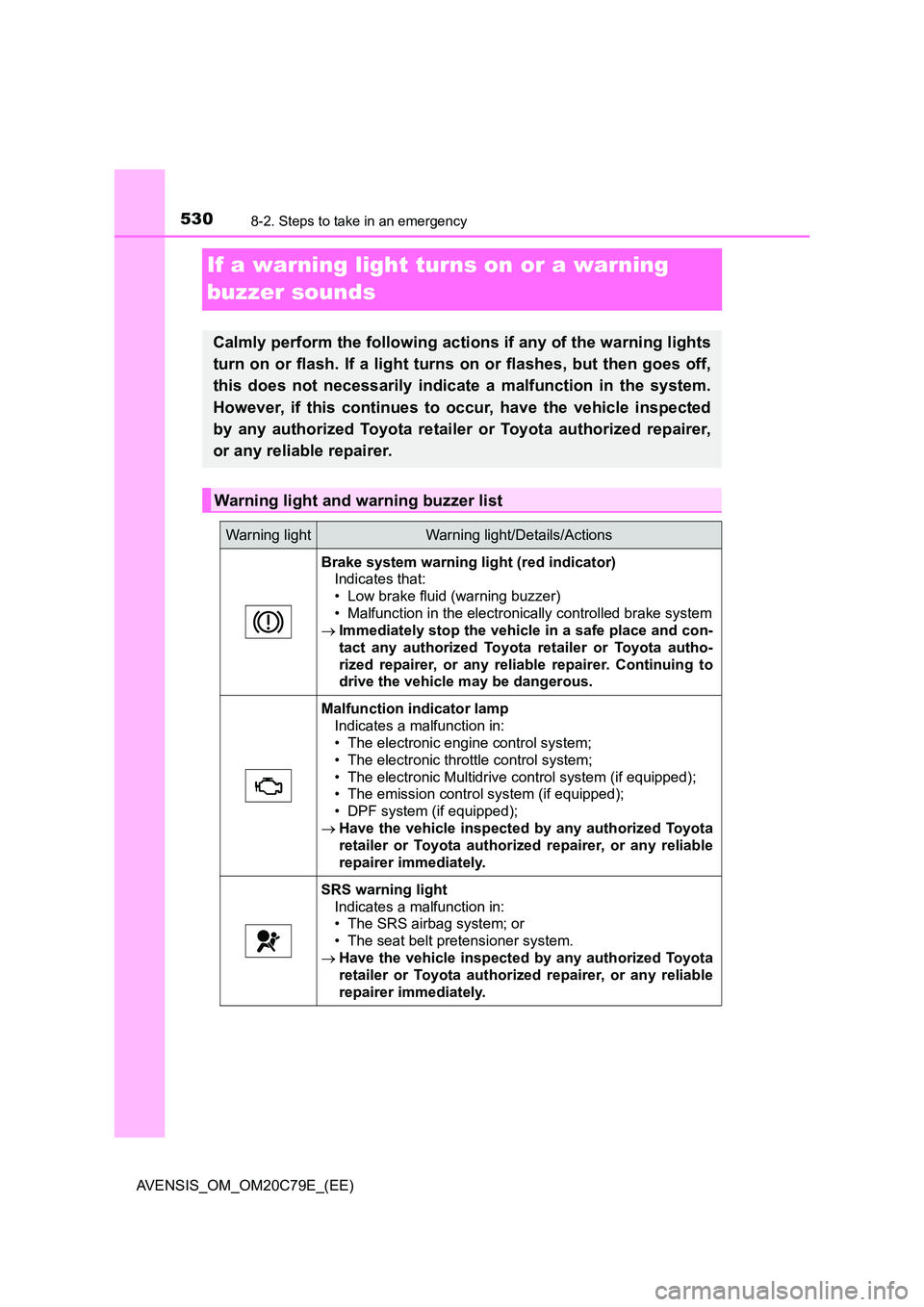
If a warning light turns on or a warning
buzzer sounds
Calmly perform the following actions if any of the warning lights
turn on or flash. If a light turns on or flashes, but then goes off,
this does not necessarily indicate a malfunction in the system.
However, if this continues to occur, have the vehicle inspected
by any authorized Toyota retailer or Toyota authorized repairer,
or any reliable repairer.
Warning light and warning buzzer list
Warning lightWarning light/Details/Actions
Brake system warning light (red indicator)
Indicates that:
• Low brake fluid (warning buzzer)
• Malfunction in the electronically controlled brake system
Immediately stop the vehicle in a safe place and con-
tact any authorized Toyota retailer or Toyota autho-
rized repairer, or any reliable repairer. Continuing to
drive the vehicle may be dangerous.
Malfunction indicator lamp
Indicates a malfunction in:
• The electronic engine control system;
• The electronic throttle control system;
• The electronic Multidrive control system (if equipped);
• The emission control system (if equipped);
• DPF system (if equipped);
Have the vehicle inspected by any authorized Toyota
retailer or Toyota authorized repairer, or any reliable
repairer immediately.
SRS warning light
Indicates a malfunction in:
• The SRS airbag system; or
• The seat belt pretensioner system.
Have the vehicle inspected by any authorized Toyota
retailer or Toyota authorized repairer, or any reliable
repairer immediately.
Page 531 of 660
5318-2. Steps to take in an emergency
AVENSIS_OM_OM20C79E_(EE)
8
When trouble arises
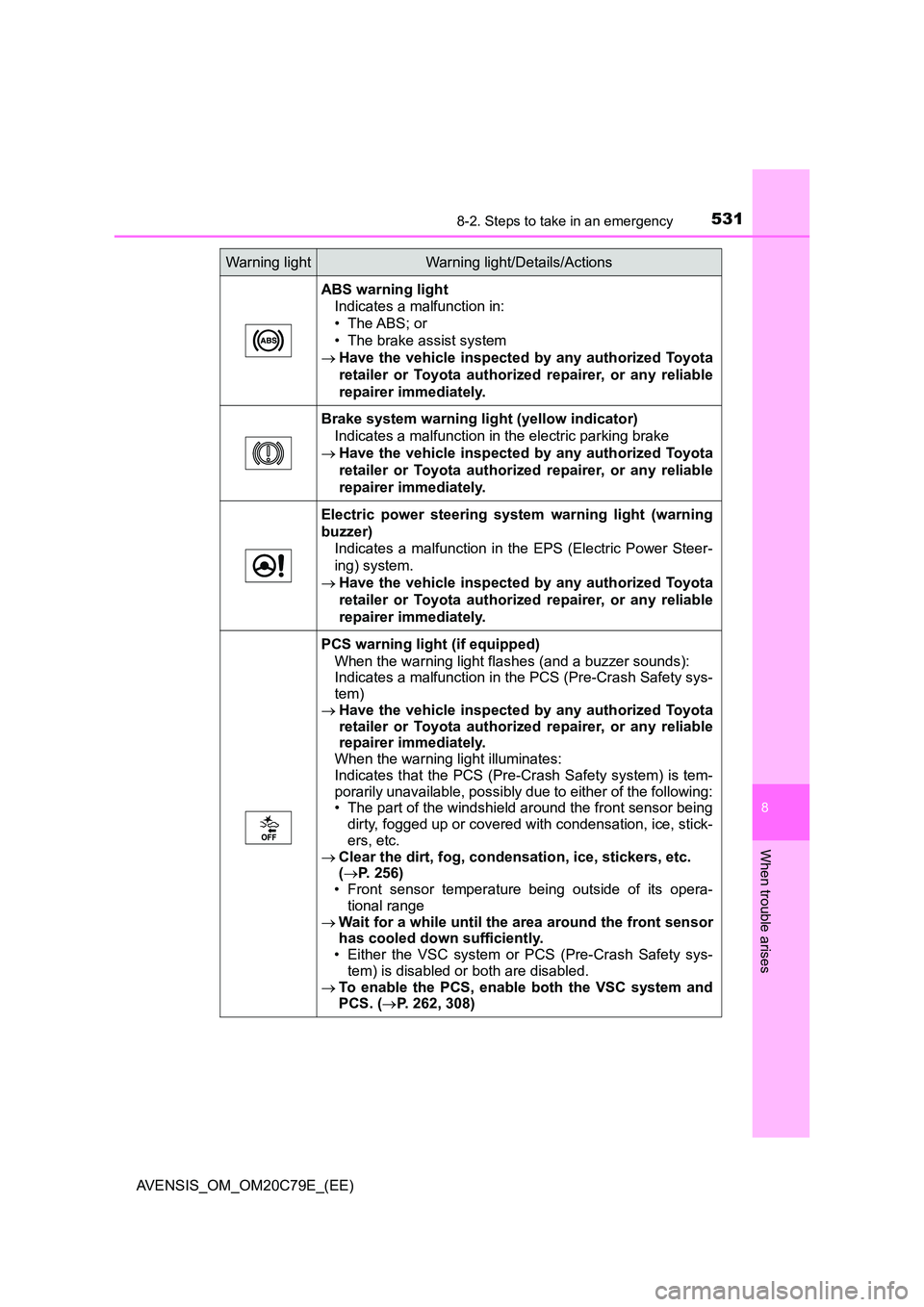
ABS warning light
Indicates a malfunction in:
• The ABS; or
• The brake assist system
Have the vehicle inspected by any authorized Toyota
retailer or Toyota authorized repairer, or any reliable
repairer immediately.
Brake system warning light (yellow indicator)
Indicates a malfunction in the electric parking brake
Have the vehicle inspected by any authorized Toyota
retailer or Toyota authorized repairer, or any reliable
repairer immediately.
Electric power steering system warning light (warning
buzzer)
Indicates a malfunction in the EPS (Electric Power Steer-
ing) system.
Have the vehicle inspected by any authorized Toyota
retailer or Toyota authorized repairer, or any reliable
repairer immediately.
PCS warning light (if equipped)
When the warning light flashes (and a buzzer sounds):
Indicates a malfunction in the PCS (Pre-Crash Safety sys-
tem)
Have the vehicle inspected by any authorized Toyota
retailer or Toyota authorized repairer, or any reliable
repairer immediately.
When the warning light illuminates:
Indicates that the PCS (Pre-Crash Safety system) is tem-
porarily unavailable, possibly due to either of the following:
• The part of the windshield around the front sensor being
dirty, fogged up or covered with condensation, ice, stick-
ers, etc.
Clear the dirt, fog, condensation, ice, stickers, etc.
( P. 256)
• Front sensor temperature being outside of its opera-
tional range
Wait for a while until the area around the front sensor
has cooled down sufficiently.
• Either the VSC system or PCS (Pre-Crash Safety sys-
tem) is disabled or both are disabled.
To enable the PCS, enable both the VSC system and
PCS. ( P. 262, 308)
Warning lightWarning light/Details/Actions