manual transmission TOYOTA AYGO 2013 (in English) User Guide
[x] Cancel search | Manufacturer: TOYOTA, Model Year: 2013, Model line: AYGO, Model: TOYOTA AYGO 2013Pages: 372, PDF Size: 14.28 MB
Page 121 of 372
121 2-1. Driving procedures
2
When driving
AYGO_WE_99G80E
CAUTION
When the vehicle is parked
Do not leave glasses, cigarette lighters, spray cans, or soft drink cans in
the vehicle when it is in the sun.
Doing so may result in the following:
• Gas may leak from a cigarette lighter or spray can, and may lead to a
fire.
• The temperature inside the vehicle may cause the plastic lenses and
plastic material of glasses to deform or crack.
• Soft drink cans may fracture, causing the contents to spray over the
interior of the vehicle, and may also cause a short circuit in the vehi-
cle’s electrical components.
Do not leave cigarette lighters in the vehicle. If a cigarette lighter is in a
place such as the glove box or on the floor, it may be lit accidentally when
luggage is loaded or the seat is adjusted, causing a fire.
Do not attach adhesive discs to the windshield or windows. Do not place
containers such as air fresheners on the instrument panel or dashboard.
Adhesive discs or containers may act as lenses, causing a fire in the vehi-
cle.
Do not leave a door or window open if the curved glass is coated with a
metallized film such as a silver-colored one. Reflected sunlight may cause
the glass to act as a lens, causing a fire.
On vehicles with a multi-mode manual transmission, always apply the
parking brake, shift the shift lever to E, M or R, stop the engine and lock
the vehicle.
Do not leave the vehicle unattended while the engine is running.
Do not touch the exhaust pipes while the engine is running or immediately
after turning the engine off.
Doing so may cause burns.
Do not leave the engine running in an area with snow build-up, or where it
is snowing. If snowbanks build up around the vehicle while the engine is
running, exhaust gases may collect and enter the vehicle. This may lead
to death or a serious health hazard.
Page 122 of 372
122 2-1. Driving procedures
AYGO_WE_99G80E
CAUTION
On vehicles with a multi-mode manual transmission, do not turn off the
engine until 1st or reverse is engaged properly and completely. Confirm
that the gear is engaged by viewing the gear position indicator.
Parking the vehicle without a gear engaged may cause the vehicle to
move result in an accident.
Exhaust gases
Exhaust gases include harmful carbon monoxide (CO), which is colorless
and odorless. Inhaling exhaust gases may lead to death or a serious health
hazard.
If the vehicle is in a poorly ventilated area, stop the engine. In a closed
area, such as a garage, exhaust gases may collect and enter the vehicle.
This may lead to death or a serious health hazard.
The exhaust system should be checked occasionally. If there is a hole or
crack caused by corrosion, damage to a joint or abnormal exhaust noise,
be sure to have the vehicle inspected and repaired by any authorized
Toyota dealer or repairer, or another duly qualified and equipped
professional. Failure to do so may allow exhaust gases to enter the
vehicle, resulting in death or a serious health hazard.
When taking a nap in the vehicle
Always turn the engine off. Otherwise, if you accidentally move the shift lever
or depress the accelerator pedal, this could cause an accident or fire due to
engine overheating. Additionally, if the vehicle is parked in a poorly venti-
lated area, exhaust gases may collect and enter the vehicle, leading to
death or a serious health hazard.
Page 124 of 372
124 2-1. Driving procedures
AYGO_WE_99G80E
NOTICE
When driving the vehicle
Vehicles with a multi-mode manual transmission
Do not depress the accelerator and brake pedals at the same time during
driving, as this may restrain driving torque.
Do not use the accelerator pedal or starting assist system to hold the vehi-
cle on a hill.
Doing so may damage the clutch.
Vehicles with a manual transmission
Do not depress the accelerator and brake pedals at the same time during
driving, as this may restrain driving torque.
Do not shift gears unless the clutch pedal is fully depressed. After shifting,
do not release the clutch pedal abruptly. Doing so may damage the clutch,
transmission and gears.
Observe the following to prevent the clutch from being damaged.
• Do not rest your foot on the clutch pedal while driving.
Doing so may cause clutch trouble.
• Do not use any gears other than the 1st gear when starting off and
moving forward.
Doing so may damage the clutch.
• Do not use the clutch to hold the vehicle when stopping on an uphill
grade.
Doing so may damage the clutch.
Do not shift the shift lever to R when the vehicle is still moving. Doing so
may damage the clutch, transmission and gears.
Avoiding damage to vehicle parts
Do not turn the steering wheel fully in either direction and hold it there for
an extended period of time.
Doing so may damage the power steering motor.
When driving over bumps in the road, drive as slowly as possible to avoid
damaging the wheels, underside of the vehicle, etc.
Page 126 of 372
126
2-1. Driving procedures
AYGO_WE_99G80E
Engine (ignition) switch
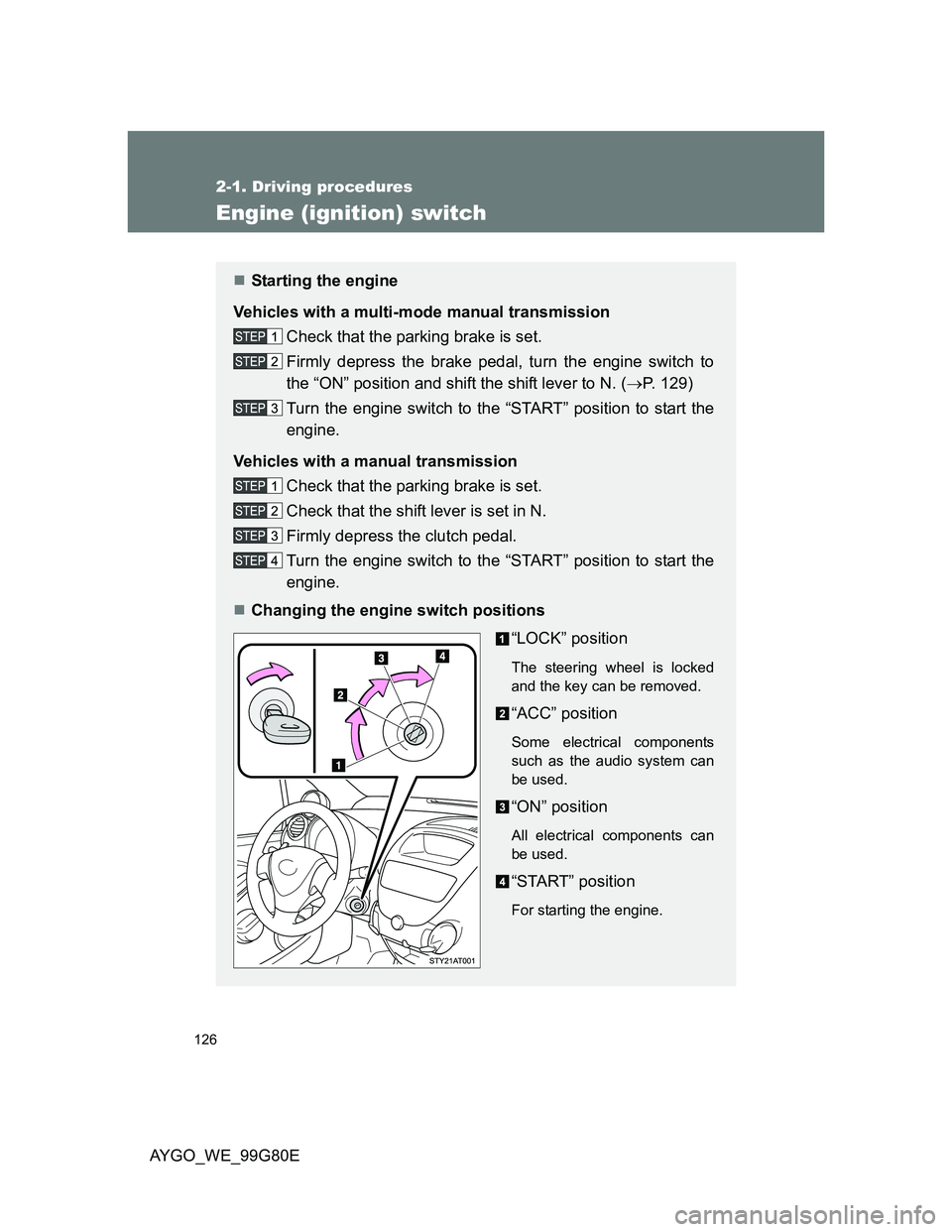
Starting the engine
Vehicles with a multi-mode manual transmission
Check that the parking brake is set.
Firmly depress the brake pedal, turn the engine switch to
the “ON” position and shift the shift lever to N. (P. 129)
Turn the engine switch to the “START” position to start the
engine.
Vehicles with a manual transmission
Check that the parking brake is set.
Check that the shift lever is set in N.
Firmly depress the clutch pedal.
Turn the engine switch to the “START” position to start the
engine.
Changing the engine switch positions
“LOCK” position
The steering wheel is locked
and the key can be removed.
“ACC” position
Some electrical components
such as the audio system can
be used.
“ON” position
All electrical components can
be used.
“START” position
For starting the engine.
Page 129 of 372
129
2-1. Driving procedures
2
When driving
AYGO_WE_99G80E
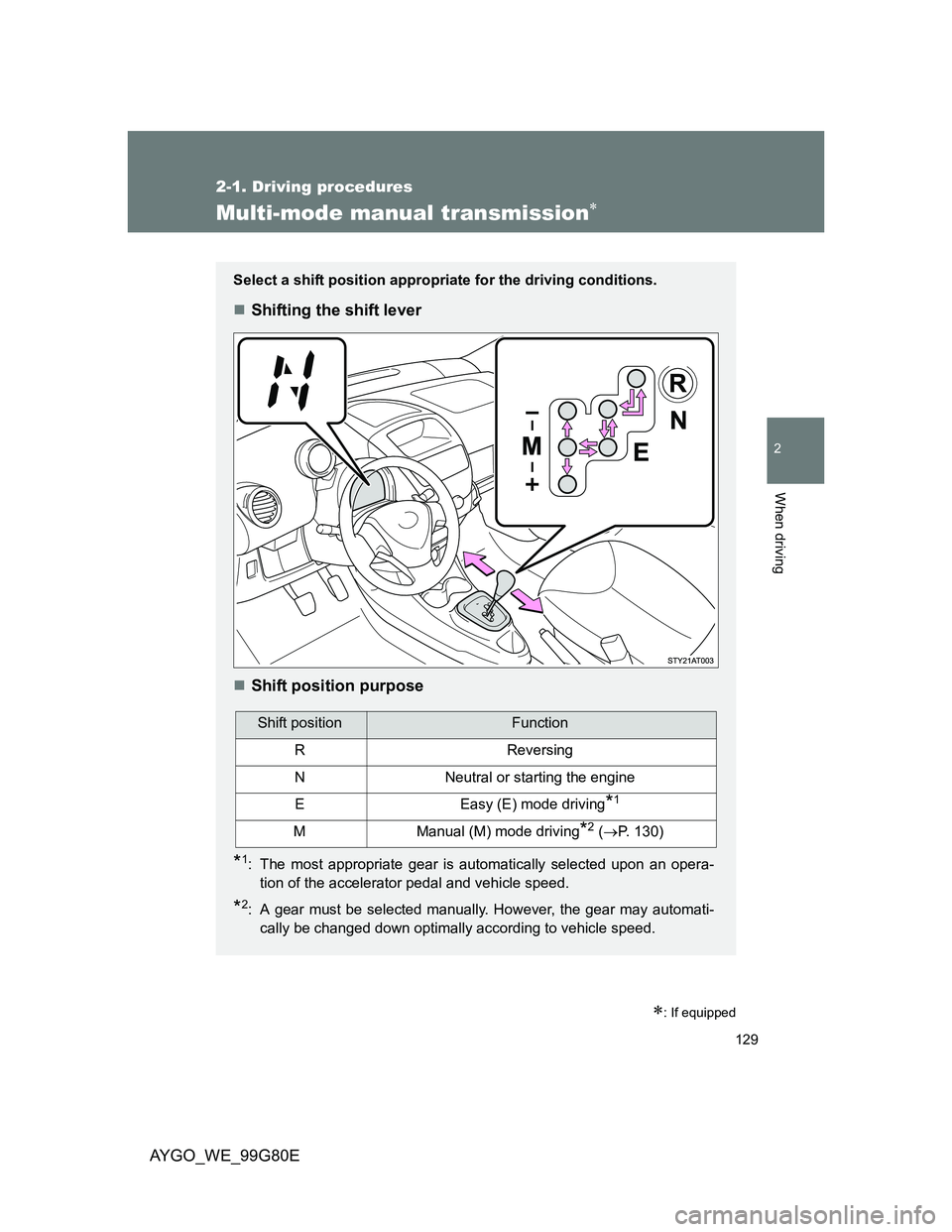
Multi-mode manual transmission
: If equipped
Select a shift position appropriate for the driving conditions.
Shifting the shift lever
Shift position purpose
*1: The most appropriate gear is automatically selected upon an opera-
tion of the accelerator pedal and vehicle speed.
*2: A gear must be selected manually. However, the gear may automati-
cally be changed down optimally according to vehicle speed.
Shift positionFunction
RReversing
NNeutral or starting the engine
EEasy (E) mode driving*1
MManual (M) mode driving*2 (P. 130)
Page 132 of 372
132 2-1. Driving procedures
AYGO_WE_99G80E
Maximum allowable speeds
Observe the following maximum allowable speeds in each gear.
If the shift lever cannot be shifted
With the shift lever in N
Depress the brake pedal to shift the shift lever. If the shift lever cannot be
shifted with your foot on the brake, there may be a problem with the shift
lock system. (P. 330)
With the shift lever in a position other than N
P. 330
If the driver’s door is opened when the shift lever is in a position other
than N and the engine is running
A buzzer will sound. Close the driver’s door.
If the “M” indicator does not come on even after shifting the shift lever
to M
This may indicate a malfunction in the multi-mode manual transmission sys-
tem. Have the vehicle inspected by any authorized Toyota dealer or repairer,
or another duly qualified and equipped professional immediately.
(In this situation, the transmission will operate in the same manner as when
the shift lever is in E.)
GearMaximum speed
km/h (mph)
1 51 (31)
2 95 (59)
3 139 (86)
Page 134 of 372
134
2-1. Driving procedures
AYGO_WE_99G80E
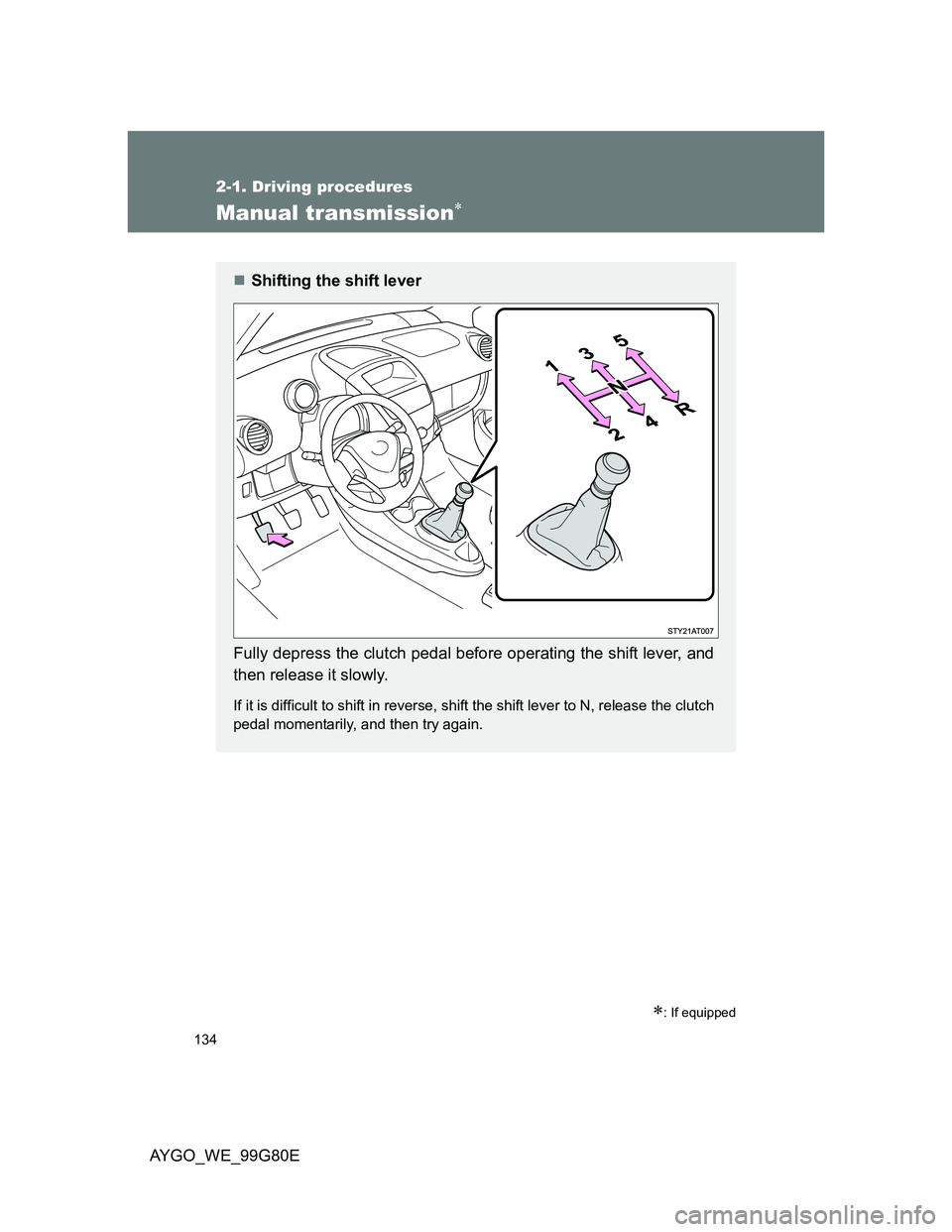
Manual transmission
: If equipped
Shifting the shift lever
Fully depress the clutch pedal before operating the shift lever, and
then release it slowly.
If it is difficult to shift in reverse, shift the shift lever to N, release the clutch
pedal momentarily, and then try again.
Page 142 of 372
142 2-2. Instrument cluster
AYGO_WE_99G80E
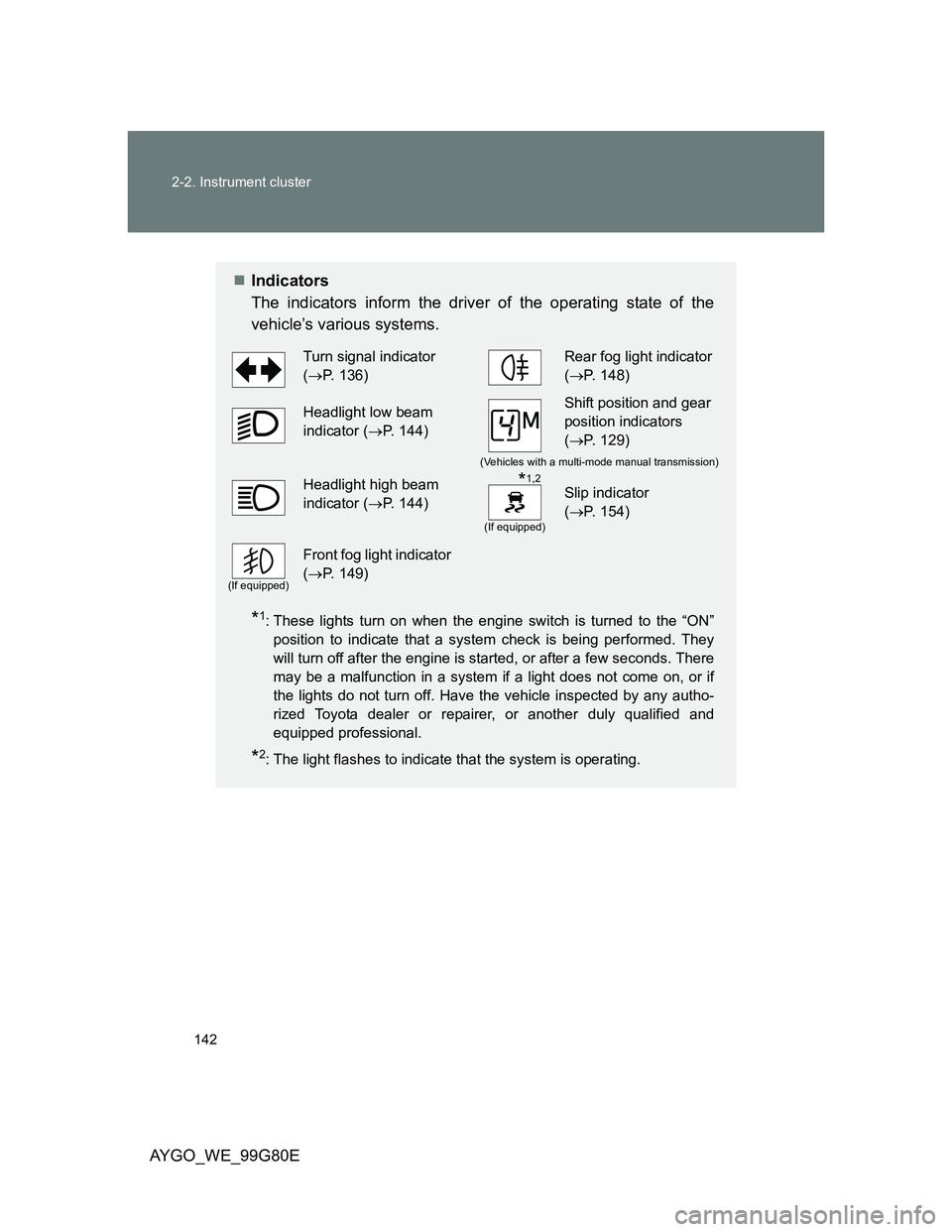
Indicators
The indicators inform the driver of the operating state of the
vehicle’s various systems.
*1: These lights turn on when the engine switch is turned to the “ON”
position to indicate that a system check is being performed. They
will turn off after the engine is started, or after a few seconds. There
may be a malfunction in a system if a light does not come on, or if
the lights do not turn off. Have the vehicle inspected by any autho-
rized Toyota dealer or repairer, or another duly qualified and
equipped professional.
*2: The light flashes to indicate that the system is operating.
Turn signal indicator
(P. 136)Rear fog light indicator
(P. 148)
Headlight low beam
indicator (P. 144)Shift position and gear
position indicators
(P. 129)
Headlight high beam
indicator (P. 144)
(Vehicles with a multi-mode manual transmission)
*1,2
(If equipped)
Slip indicator
(P. 154)
(If equipped)
Front fog light indicator
(P. 149)
Page 160 of 372
160 2-5. Driving information
AYGO_WE_99G80E
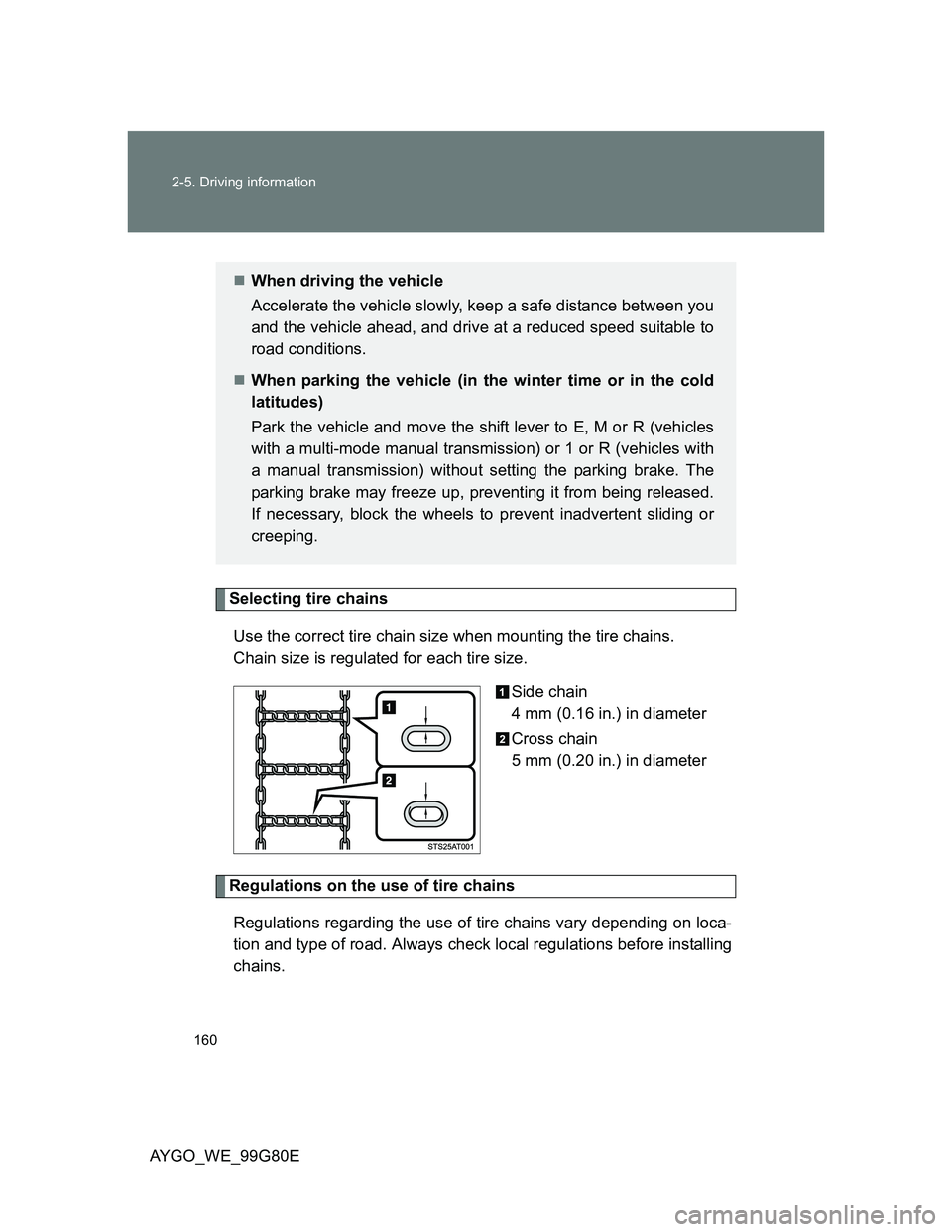
Selecting tire chains
Use the correct tire chain size when mounting the tire chains.
Chain size is regulated for each tire size.
Side chain
4 mm (0.16 in.) in diameter
Cross chain
5 mm (0.20 in.) in diameter
Regulations on the use of tire chains
Regulations regarding the use of tire chains vary depending on loca-
tion and type of road. Always check local regulations before installing
chains.
When driving the vehicle
Accelerate the vehicle slowly, keep a safe distance between you
and the vehicle ahead, and drive at a reduced speed suitable to
road conditions.
When parking the vehicle (in the winter time or in the cold
latitudes)
Park the vehicle and move the shift lever to E, M or R (vehicles
with a multi-mode manual transmission) or 1 or R (vehicles with
a manual transmission) without setting the parking brake. The
parking brake may freeze up, preventing it from being released.
If necessary, block the wheels to prevent inadvertent sliding or
creeping.
Page 194 of 372
194 3-3. Using the audio system (Type B)
AYGO_WE_99G80E
Selecting a play mode
Press the “MENU” button.
Press (Radio).
Press one of to select.
“TA”: The TA (Traffic Announcement) function gives
priority to TA alert messages. To operate, this
function needs good reception of a radio station
transmitting this type of message. When a traffic
report is transmitted, the current audio source
(Radio, CD, USB, etc.) is interrupted automati-
cally to play the TA message. Normal playback
of the audio source resumes at the end of the
transmission of the message.
“RDS”: RDS, if displayed, enables you to continue lis-
tening to the same station by automatically
retuning to alternative frequencies. However, in
certain conditions, coverage of an RDS station
may not be assured throughout the country as
radio stations do not cover 100% of the territory.
This explains the loss of reception of the station
during a journey.
“TXT”: Radio text is information transmitted by the radio
station related to the current program or song.
“Write freq.”: Enter a frequency manually.
Press (+ or -) to select the desired fre-
quency.
Press (OK) to save the setting.