engine TOYOTA AYGO 2019 Owners Manual (in English)
[x] Cancel search | Manufacturer: TOYOTA, Model Year: 2019, Model line: AYGO, Model: TOYOTA AYGO 2019Pages: 504, PDF Size: 67.32 MB
Page 442 of 504
4428-2. Steps to take in an emergency
AYGO_OM_Europe_OM99R19E
If you have a flat tire (vehicles with a spare
tire)
● Stop the vehicle in a safe place on a hard, flat surface.
● Set the parking brake.
● Shift the shift lever to E, M or R (multi-mode manual transmission)
or R (manual transmission).
● Stop the engine.
● Turn on the emergency flashers. (P. 406)
Your vehicle is equipped with a spare tire. The flat tire can be
replaced with the spare tire.
For details about tires: P. 3 7 2
WARNING
■If you have a flat tire
Do not continue driving with a flat tire.
Driving even a short distance with a flat tire can damage the tire and the
wheel beyond repair, which could result in an accident.
Before jacking up the vehicle
Page 444 of 504
4448-2. Steps to take in an emergency
AYGO_OM_Europe_OM99R19E
WARNING
■Using the tire jack
Observe the following precautions.
Improper use of the tire jack may cause the vehicle to suddenly fall off the
jack, leading to death or serious injury.
● Do not use the tire jack for any purpose other than replacing tires or install-
ing and removing tire chains.
● Only use the tire jack that comes with this vehicle for replacing a flat tire.
Do not use it on other vehicles, and do not use other tire jacks for replac-
ing tires on this vehicle.
● Put the jack properly in its jack point.
● Do not put any part of your body under the vehicle while it is supported by
the jack.
● Do not start the engine or drive the vehicle while the vehicle is supported
by the jack.
● Do not raise the vehicle while someone is inside.
● When raising the vehicle, do not put an object on or under the jack.
● Do not raise the vehicle to a height greater than that required to replace
the tire.
● Use a jack stand if it is necessary to get under the vehicle.
● Stop the vehicle on firm, flat and level ground, firmly set the parking brake
and shift the shift lever to E, M or R (multi-mode manual transmission) or R
(manual transmission). Block the wheel diagonally opposite to the one
being changed if necessary.
● When lowering the vehicle, make sure that there is no-one near the vehi-
cle. If there are people nearby, warn them vocally before lowering.
Page 453 of 504
4538-2. Steps to take in an emergency
8
When trouble arises
AYGO_OM_Europe_OM99R19E
WARNING
■When using the compact spare tire
● Remember that the compact spare tire provided is specifically designed
for use with your vehicle. Do not use your compact spare tire on another
vehicle.
● Do not use more than one compact spare tire simultaneously.
● Replace the compact spare tire with a standard tire as soon as possible.
● Avoid sudden acceleration, abrupt steering, sudden braking and shifting
operations that cause sudden engine braking.
■ When the compact spare tire is attached
The vehicle speed may not be correctly detected, and the following systems
may not operate correctly:
• ABS
• Brake assist
• VSC
•TRC
• PCS (Pre-Collision system) (if equipped)
• LDA (Lane Departure Alert) (if equipped)
• EPS
• Tire pressure warning system (if equipped)
■ Speed limit when using the compact spare tire
Do not drive at speeds in excess of 80 km/h (50 mph) when a compact
spare tire is installed on the vehicle.
The compact spare tire is not designed for driving at high speeds. Failure to
observe this precaution may lead to an accident causing death or serious
injury.
■ After using the tools and jack
Before driving, make sure all the tools and jack are securely in place in their
storage location to reduce the possibility of personal injury during a collision
or sudden braking.
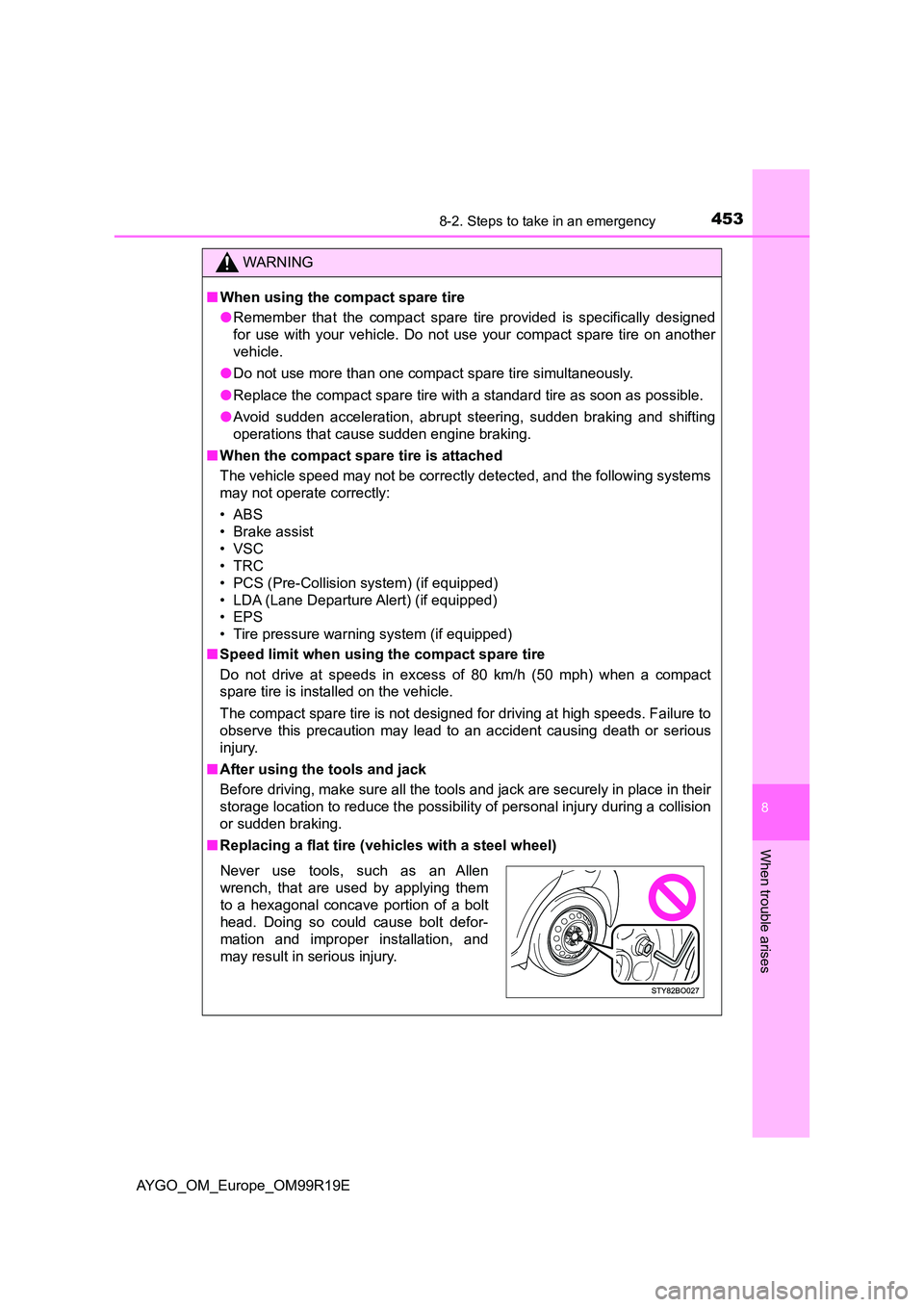
■ Replacing a flat tire (vehicles with a steel wheel)
Never use tools, such as an Allen
wrench, that are used by applying them
to a hexagonal concave portion of a bolt
head. Doing so could cause bolt defor-
mation and improper installation, and
may result in serious injury.
Page 455 of 504

4558-2. Steps to take in an emergency
8
When trouble arises
AYGO_OM_Europe_OM99R19E
If the engine will not start
One of the following may be the cause of the problem:
● There may not be sufficient fuel in the vehicle’s tank.
Refuel the vehicle.
● The engine may be flooded.
Try to restart the engine again following correct starting procedures.
( P. 182, 185)
● There may be a malfunction in the engine immobilizer system.
( P. 7 6 )
One of the following may be the cause of the problem:
● The battery may be discharged. (P. 461)
● The battery terminal connections may be loose or corroded.
The engine starting system may be malfunctioning due to an electrical
problem such as an open circuit or a blown fuse. However, an interim
measure is available to start the engine. ( P. 456)
If the engine will not start even though correct starting proce-
dures are being followed ( P. 182, 185), consider each of the fol-
lowing points:
The engine will not start even though the starter motor operates
normally.
The starter motor turns over slowly, the interior lights and head-
lights are dim, or the horn does not sound or sounds at a low
volume.
The starter motor does not turn over (vehicles with a smart entry
& start system).
Page 456 of 504
4568-2. Steps to take in an emergency
AYGO_OM_Europe_OM99R19E
One of the following may be the cause of the problem:
● One or both of the battery terminals may be disconnected.
● The battery may be discharged. (P. 461)
● There may be a malfunction in the steering lock system (vehicles
with a smart entry & start system).
Contact any authorized Toyota retailer or Toyota authorized repairer, or any
reliable repairer if the problem cannot be repaired, or if repair procedures
are unknown.
When the engine does not start, the following steps can be used as an
interim measure to start the engine if the engine switch is functioning
normally:
Set the parking brake.
Shift the shift lever to N.
Turn the engine switch to ACCESSORY mode.
Press and hold the engine switch for about 15 seconds while
depressing the brake pedal (multi-mode manual transmission) or
clutch pedal (manual transmission) firmly.
Even if the engine can be started using the above steps, the system
may be malfunctioning. Have the vehicle inspected by any authorized
Toyota retailer or Toyota authorized repairer, or any reliable repairer.
The starter motor does not turn over, the interior lights and head-
lights do not turn on, or the horn does not sound.
Emergency start function
Page 458 of 504

4588-2. Steps to take in an emergency
AYGO_OM_Europe_OM99R19E
If the electronic key does not operate properly
(vehicles with a smart entry & start system)
Use the mechanical key (P. 1 1 2 )
in order to perform the following
operations:
Locks all the doors
Unlocks all the doors
If communication between the electronic key and vehicle is
interrupted ( P. 132) or the electronic key cannot be used
because the battery is depleted, the smart entry & start system
and wireless remote control cannot be used. In such cases, the
doors can be opened and the engine can be started by following
the procedure below.
Locking and unlocking the doors
1
2
Page 459 of 504
4598-2. Steps to take in an emergency
8
When trouble arises
AYGO_OM_Europe_OM99R19E
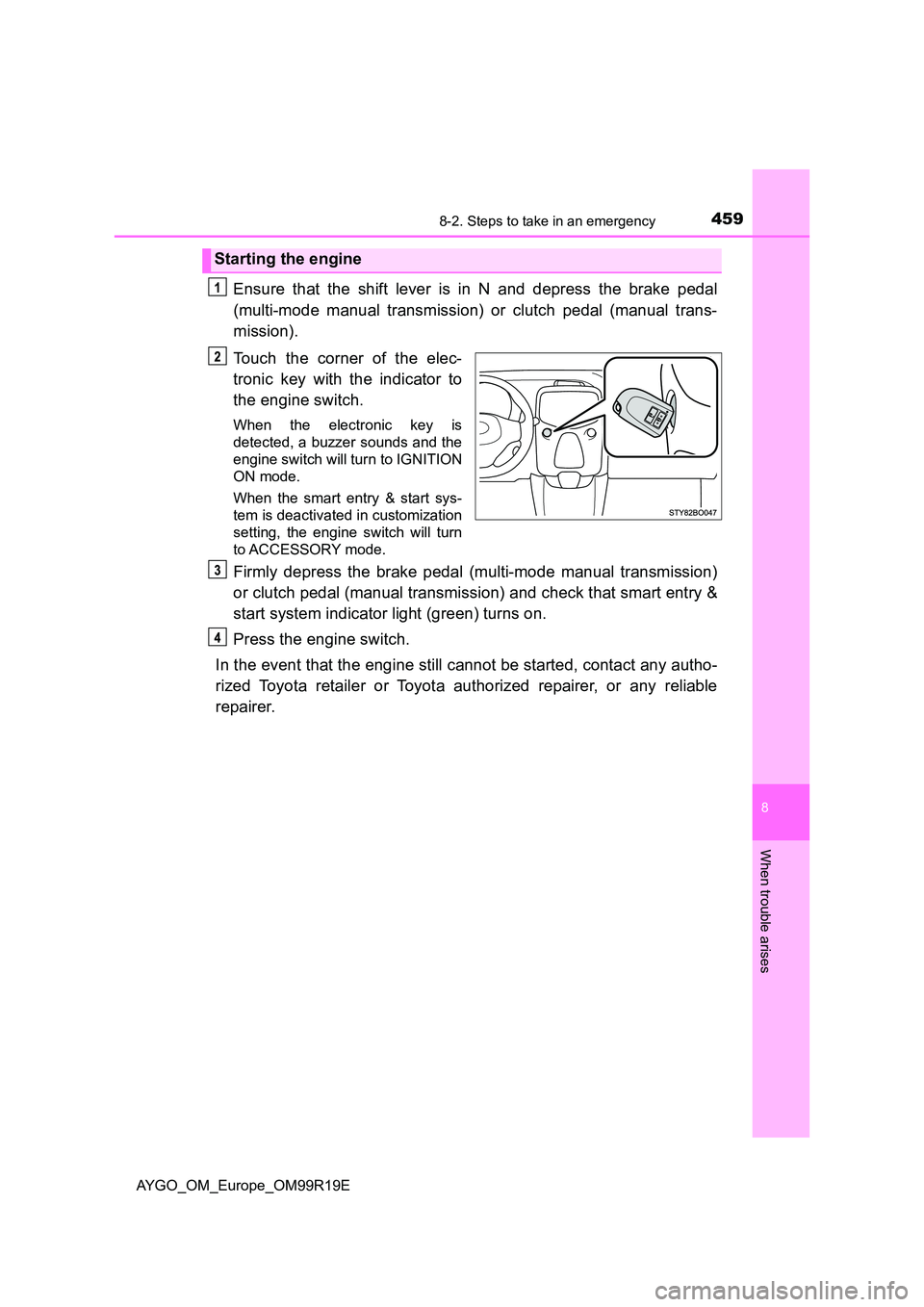
Ensure that the shift lever is in N and depress the brake pedal
(multi-mode manual transmission) or clutch pedal (manual trans-
mission).
Touch the corner of the elec-
tronic key with the indicator to
the engine switch.
When the electronic key is
detected, a buzzer sounds and the
engine switch will turn to IGNITION
ON mode.
When the smart entry & start sys-
tem is deactivated in customization
setting, the engine switch will turn
to ACCESSORY mode.
Firmly depress the brake pedal (multi-mode manual transmission)
or clutch pedal (manual transmission) and check that smart entry &
start system indicator light (green) turns on.
Press the engine switch.
In the event that the engine still cannot be started, contact any autho-
rized Toyota retailer or Toyota authorized repairer, or any reliable
repairer.
Starting the engine
Page 460 of 504
4608-2. Steps to take in an emergency
AYGO_OM_Europe_OM99R19E
■Stopping the engine
Shift the shift lever to N and press the engine switch as you normally do when
stopping the engine.
■ Replacing the key battery
As the above procedure is a temporary measure, it is recommended that the
electronic key battery be replaced immediately when the battery is depleted.
( P. 383)
■ Changing engine switch modes
Release the brake pedal (multi-mode m anual transmission) or clutch pedal
(manual transmission) and press t he engine switch in step above.
The engine does not start and modes will be changed each time the switch is
pressed. ( P. 187)
■ When the electronic key does not work properly
● Make sure that the smart entry & start system has not been deactivated in
the customization setting. If it is off, turn the function on.
(Customizable features: P. 485)
● Check if battery-saving mode is set. If it is set, cancel the function.
( P. 132)
Page 461 of 504
4618-2. Steps to take in an emergency
8
When trouble arises
AYGO_OM_Europe_OM99R19E
If the vehicle battery is discharged
If you have a set of jumper (or booster) cables and a second vehicle
with a 12-volt battery, you can jump start your vehicle by following the
steps below.
Open the hood. ( P. 358)
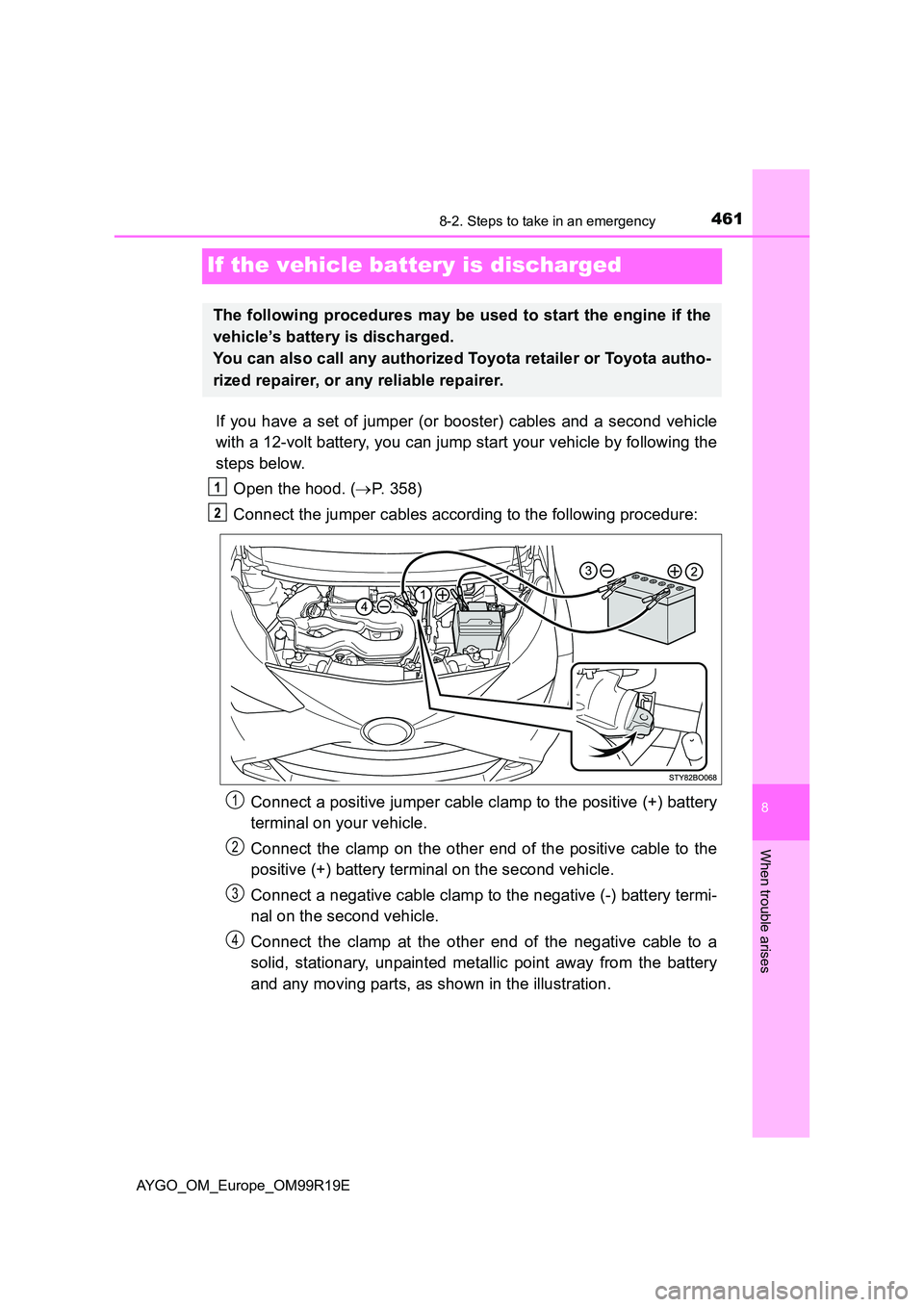
Connect the jumper cables according to the following procedure:
Connect a positive jumper cable clamp to the positive (+) battery
terminal on your vehicle.
Connect the clamp on the other end of the positive cable to the
positive (+) battery terminal on the second vehicle.
Connect a negative cable clamp to the negative (-) battery termi-
nal on the second vehicle.
Connect the clamp at the other end of the negative cable to a
solid, stationary, unpainted metallic point away from the battery
and any moving parts, as shown in the illustration.
The following procedures may be used to start the engine if the
vehicle’s battery is discharged.
You can also call any authorized Toyota retailer or Toyota autho-
rized repairer, or any reliable repairer.
1
2
3
4
Page 462 of 504
4628-2. Steps to take in an emergency
AYGO_OM_Europe_OM99R19E
Start the engine of the second vehicle. Increase the engine speed
slightly and maintain at that level for approximately 5 minutes to
recharge the battery of your vehicle.
Vehicles with a smart entry & start system only: Open and close
any of the doors of your vehicle with the engine switch off.
Vehicles without a smart entry & start system:
Maintain the engine speed of the second vehicle and start the
engine of your vehicle.
Vehicles with a smart entry & start system:
Maintain the engine speed of the second vehicle and start the
engine of your vehicle by turning the engine switch to IGNITION
ON mode.
Once the vehicle’s engine has started, remove the jumper cables in
the exact reverse order from which they were connected.
Once the engine starts, have the vehicle inspected at any authorized
Toyota retailer or Toyota authorized repairer, or any reliable repairer
as soon as possible.
■ To prevent battery discharge
● Turn off the headlights and the audio system while the engine is off.
● Turn off any unnecessary electrical components when the vehicle is running
at a low speed for an extended period, such as in heavy traffic.
■ Charging the battery
The electricity stored in the battery will discharge gradually even when the
vehicle is not in use, due to natural discharge and the draining effects of cer-
tain electrical appliances. If the vehicle is left for a long time, the battery may
discharge, and the engine may be unable to start. (The battery recharges
automatically during driving.)