Air pressure TOYOTA AYGO X 2022 Owners Manual (in English)
[x] Cancel search | Manufacturer: TOYOTA, Model Year: 2022, Model line: AYGO X, Model: TOYOTA AYGO X 2022Pages: 494, PDF Size: 92.53 MB
Page 3 of 494
1
6
5
4
3
2
7
8
Owner's Manual_Europe_M99V08_en
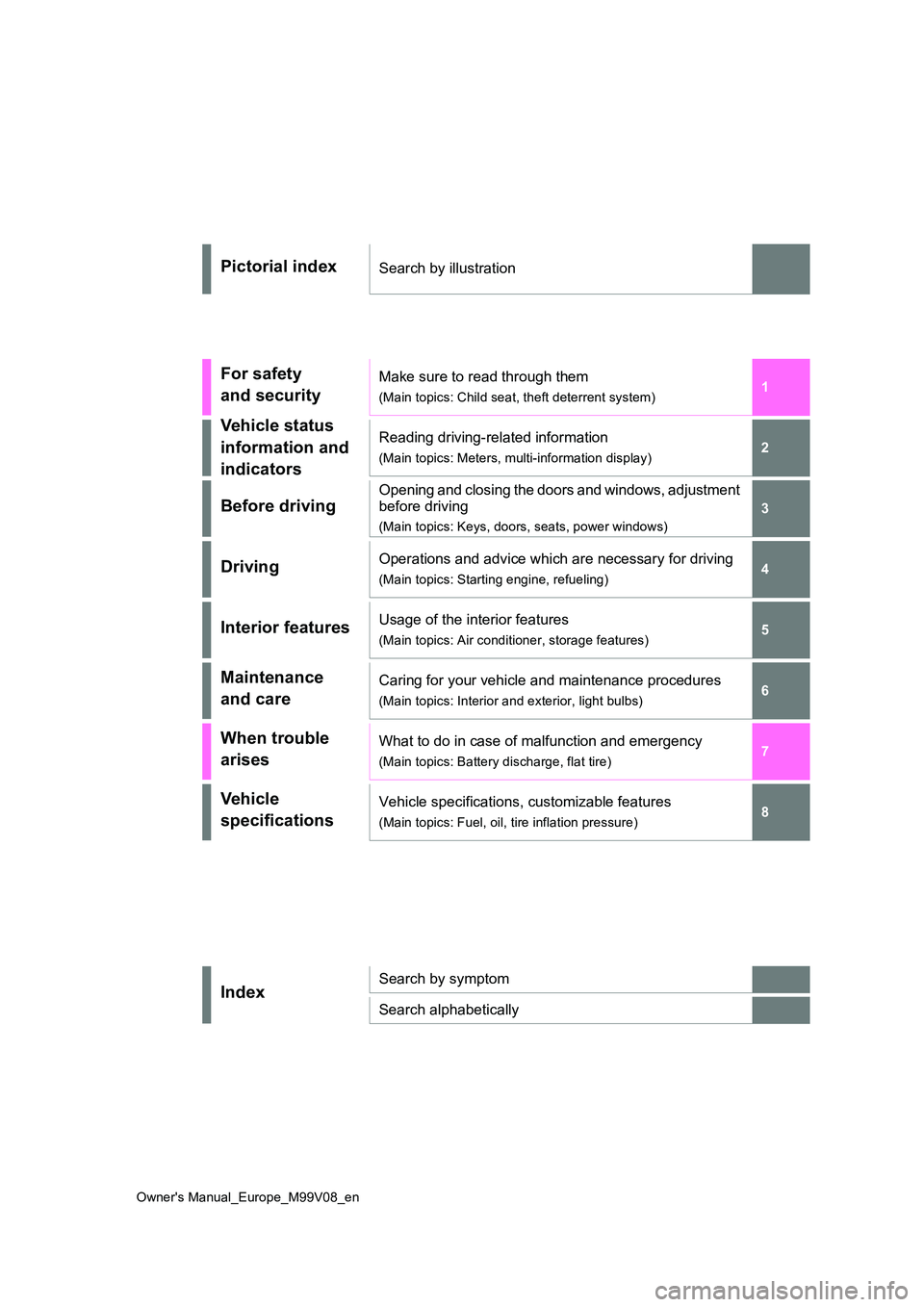
Pictorial indexSearch by illustration
For safety
and security
Make sure to read through them
(Main topics: Child seat, theft deterrent system)
Vehicle status
information and
indicators
Reading driving-related information
(Main topics: Meters, multi-information display)
Before driving
Opening and closing the doors and windows, adjustment
before driving
(Main topics: Keys, doors, seats, power windows)
DrivingOperations and advice which are necessary for driving
(Main topics: Starting engine, refueling)
Interior featuresUsage of the interior features
(Main topics: Air conditioner, storage features)
Maintenance
and care
Caring for your vehicle and maintenance procedures
(Main topics: Interior and exterior, light bulbs)
When trouble
arises
What to do in case of malfunction and emergency
(Main topics: Battery discharge, flat tire)
Vehicle
specifications
Vehicle specifications, customizable features
(Main topics: Fuel, oil, tire inflation pressure)
IndexSearch by symptom
Search alphabetically
Page 6 of 494
4
Owner's Manual_Europe_M99V08_en
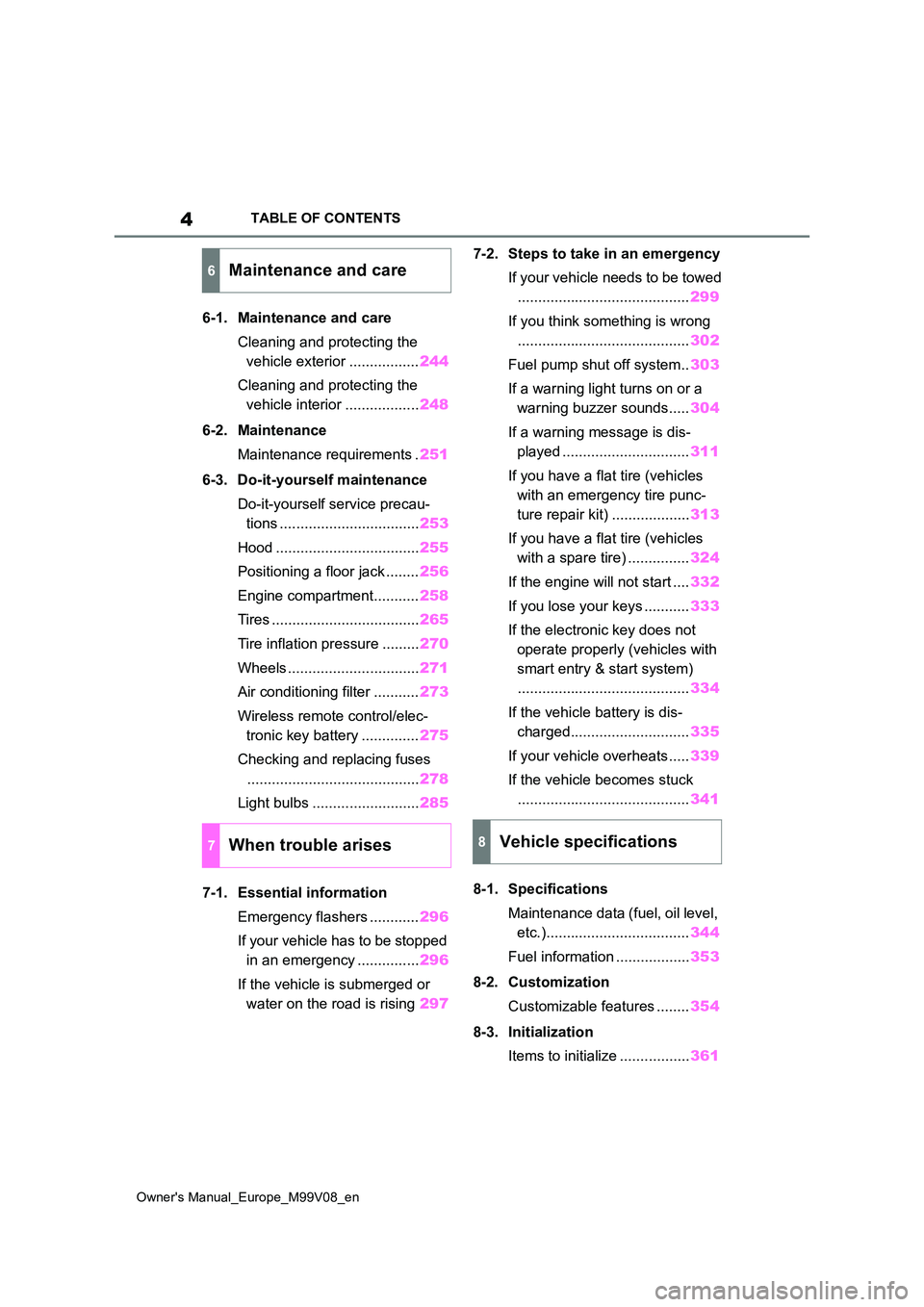
TABLE OF CONTENTS
6-1. Maintenance and care
Cleaning and protecting the
vehicle exterior ................. 244
Cleaning and protecting the
vehicle interior .................. 248
6-2. Maintenance
Maintenance requirements . 251
6-3. Do-it-yourself maintenance
Do-it-yourself service precau-
tions .................................. 253
Hood ................................... 255
Positioning a floor jack ........ 256
Engine compartment........... 258
Tires .................................... 265
Tire inflation pressure ......... 270
Wheels ................................ 271
Air conditioning filter ........... 273
Wireless remote control/elec-
tronic key battery .............. 275
Checking and replacing fuses
.......................................... 278
Light bulbs .......................... 285
7-1. Essential information
Emergency flashers ............ 296
If your vehicle has to be stopped
in an emergency ............... 296
If the vehicle is submerged or
water on the road is rising 297
7-2. Steps to take in an emergency
If your vehicle needs to be towed
.......................................... 299
If you think something is wrong
.......................................... 302
Fuel pump shut off system.. 303
If a warning light turns on or a
warning buzzer sounds..... 304
If a warning message is dis-
played ............................... 311
If you have a flat tire (vehicles
with an emergency tire punc-
ture repair kit) ................... 313
If you have a flat tire (vehicles
with a spare tire) ............... 324
If the engine will not start .... 332
If you lose your keys ........... 333
If the electronic key does not
operate properly (vehicles with
smart entry & start system)
.......................................... 334
If the vehicle battery is dis-
charged............................. 335
If your vehicle overheats ..... 339
If the vehicle becomes stuck
.......................................... 341
8-1. Specifications
Maintenance data (fuel, oil level,
etc.)................................... 344
Fuel information .................. 353
8-2. Customization
Customizable features ........ 354
8-3. Initialization
Items to initialize ................. 361
6Maintenance and care
7When trouble arises8Vehicle specifications
Page 79 of 494
77
2
Owner's Manual_Europe_M99V08_en
2-1. Instrument cluster
Vehicle status information and indicators
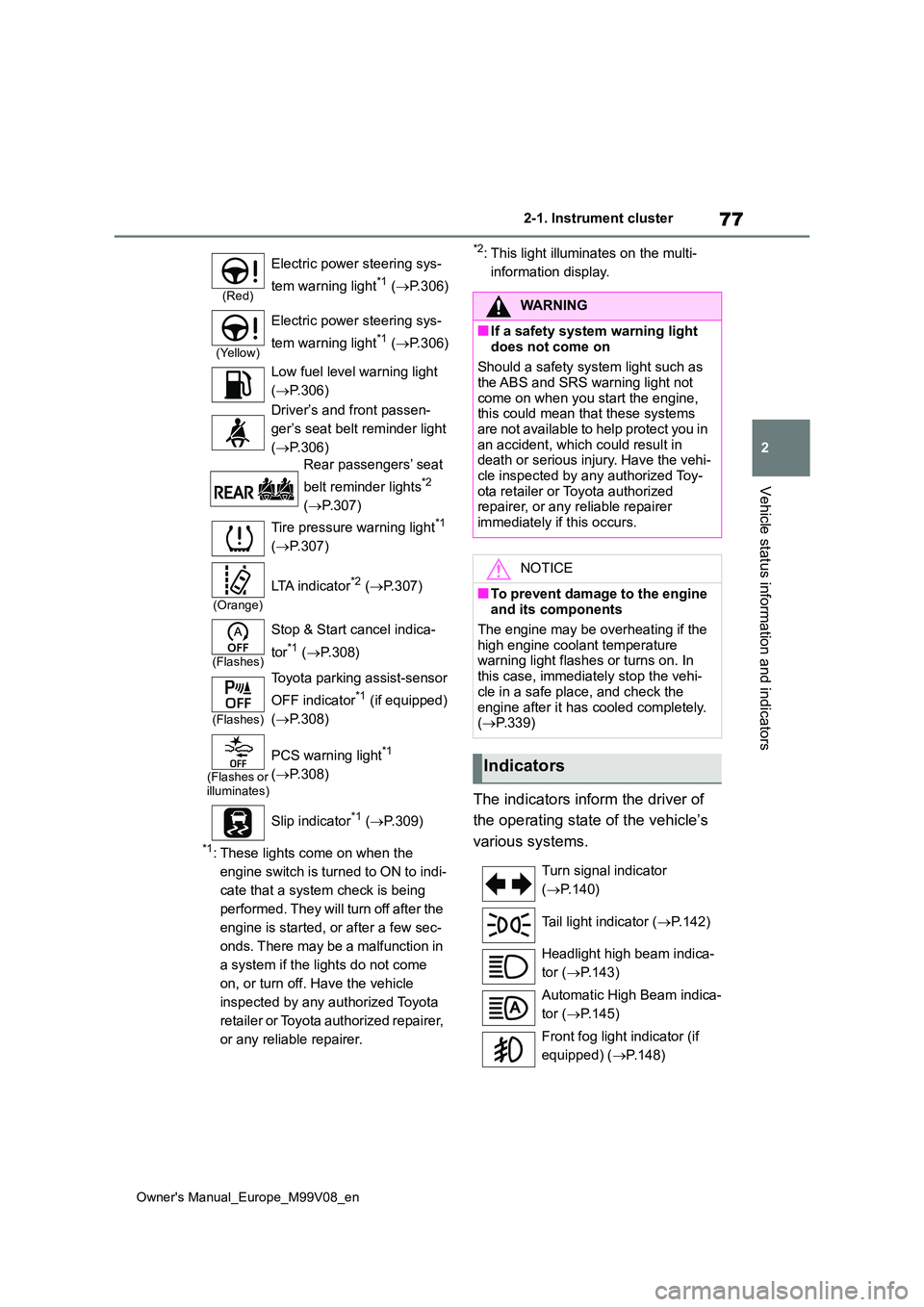
*1: These lights come on when the
engine switch is turned to ON to indi-
cate that a system check is being
performed. They will turn off after the
engine is started, or after a few sec-
onds. There may be a malfunction in
a system if the lights do not come
on, or turn off. Have the vehicle
inspected by any authorized Toyota
retailer or Toyota authorized repairer,
or any reliable repairer.
*2: This light illuminates on the multi-
information display.
The indicators inform the driver of
the operating state of the vehicle’s
various systems.
(Red)
Electric power steering sys-
tem warning light*1 ( P.306)
(Yellow)
Electric power steering sys-
tem warning light*1 ( P.306)
Low fuel level warning light
( P.306)
Driver’s and front passen-
ger’s seat belt reminder light
( P.306)
Rear passengers’ seat
belt reminder lights*2
( P.307)
Tire pressure warning light*1
( P.307)
(Orange)
LTA indicator*2 (P.307)
(Flashes)
Stop & Start cancel indica-
tor*1 ( P.308)
(Flashes)
Toyota parking assist-sensor
OFF indicator*1 (if equipped)
( P.308)
(Flashes or illuminates)
PCS warning light*1
( P.308)
Slip indicator*1 ( P.309)
WARNING
■If a safety system warning light
does not come on
Should a safety system light such as the ABS and SRS warning light not
come on when you start the engine, this could mean that these systems are not available to help protect you in
an accident, which could result in death or serious injury. Have the vehi-cle inspected by any authorized Toy-
ota retailer or Toyota authorized repairer, or any reliable repairer immediately if this occurs.
NOTICE
■To prevent damage to the engine and its components
The engine may be overheating if the high engine coolant temperature warning light flashes or turns on. In
this case, immediately stop the vehi- cle in a safe place, and check the
engine after it has cooled completely. ( P.339)
Indicators
Turn signal indicator
( P.140)
Tail light indicator ( P.142)
Headlight high beam indica-
tor ( P.143)
Automatic High Beam indica-
tor ( P.145)
Front fog light indicator (if
equipped) ( P.148)
Page 173 of 494
171
4
Owner's Manual_Europe_M99V08_en
4-5. Using the driving support systems
Driving
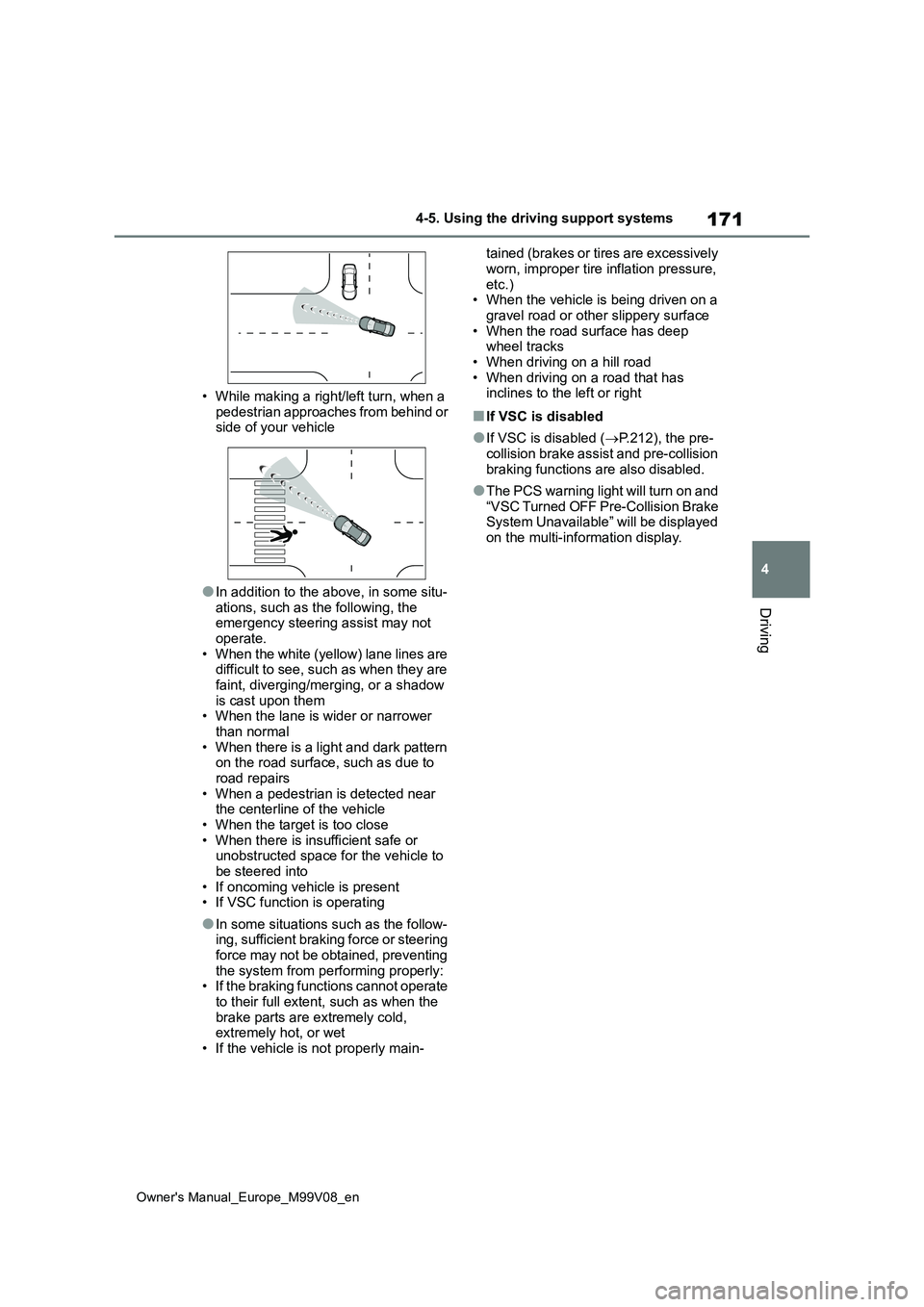
• While making a right/left turn, when a
pedestrian approaches from behind or side of your vehicle
●In addition to the above, in some situ-ations, such as the following, the emergency steering assist may not
operate. • When the white (yellow) lane lines are difficult to see, such as when they are
faint, diverging/merging, or a shadow is cast upon them• When the lane is wider or narrower
than normal • When there is a light and dark pattern on the road surface, such as due to
road repairs • When a pedestrian is detected near the centerline of the vehicle
• When the target is too close • When there is insufficient safe or unobstructed space for the vehicle to
be steered into • If oncoming vehicle is present• If VSC function is operating
●In some situations such as the follow-ing, sufficient braking force or steering
force may not be obtained, preventing the system from performing properly:• If the braking functions cannot operate
to their full extent, such as when the brake parts are extremely cold, extremely hot, or wet
• If the vehicle is not properly main-
tained (brakes or tires are excessively
worn, improper tire inflation pressure, etc.)• When the vehicle is being driven on a
gravel road or other slippery surface • When the road surface has deep wheel tracks
• When driving on a hill road • When driving on a road that has inclines to the left or right
■If VSC is disabled
●If VSC is disabled ( P.212), the pre- collision brake assist and pre-collision
braking functions are also disabled.
●The PCS warning light will turn on and
“VSC Turned OFF Pre-Collision Brake System Unavailable” will be displayed on the multi-information display.
Page 176 of 494

174
Owner's Manual_Europe_M99V08_en
4-5. Using the driving support systems
WARNING
●Vehicle is driven where the road diverges, merges, etc.
●Repair marks of asphalt, white (yel-low) lines, etc., are present due to
road repair.
●There are shadows on the road that
run parallel with, or cover, the white (yellow) lines.
●The vehicle is driven in an area without white (yellow) lines, such as in front of a tollgate or checkpoint,
or at an intersection, etc.
●The white (yellow) lines are
cracked, “Raised pavement marker” or stones are present.
●The white (yellow) lines cannot be seen or are difficult to see due to sand, etc.
●The vehicle is driven on a road sur-face that is wet due to rain, pud-dles, etc.
●The traffic lines are yellow (which may be more difficult to recognize
than lines that are white).
●The white (yellow) lines cross over
a curb, etc.
●The vehicle is driven on a bright
surface, such as concrete.
●If the edge of the road is not clear
or straight.
●The vehicle is driven on a surface
that is bright due to reflected light, etc.
●The vehicle is driven in an area where the brightness changes sud-denly, such as at the entrances and
exits of tunnels, etc.
●Light from the headlights of an
oncoming vehicle, the sun, etc., enters the camera.
●The vehicle is driven on a slope.
●The vehicle is driven on a road
which tilts left or right, or a winding road.
●The vehicle is driven on an unpaved or rough road.
●The traffic lane is excessively nar-row or wide.
●The vehicle is extremely tilted due to carrying heavy luggage or having improper tire pressure.
●The distance to the preceding vehi-cle is extremely short.
●The vehicle is moving up and down a large amount due to road condi-
tions during driving (poor roads or road seams).
Page 208 of 494
206
Owner's Manual_Europe_M99V08_en
4-5. Using the driving support systems
■The system can be operated when
●The engine switch is in ON.
●Toyota parking assist-sensor function is on.
●The vehicle speed is less than about 10 km/h (6 mph).
●The shift lever is in other than P.
■If “Clean Parking Assist Sensor” is displayed on the multi-information display
A sensor may be covered with water
drops, ice, snow, dirt, etc. Remove the
water drops, ice, snow, dirt, etc., from the sensor to return the system to nor-mal.
Also, due to ice forming on a sensor at low temperatures, a warning message may be displayed or the sensor may not
be able to detect an object. Once the ice melts, the system will return to normal.
If a warning message is displayed even
if the sensor is clean, there may be a sensor malfunction. Have the vehicle inspected by any authorized Toyota
retailer or Toyota authorized repairer, or any reliable repairer.
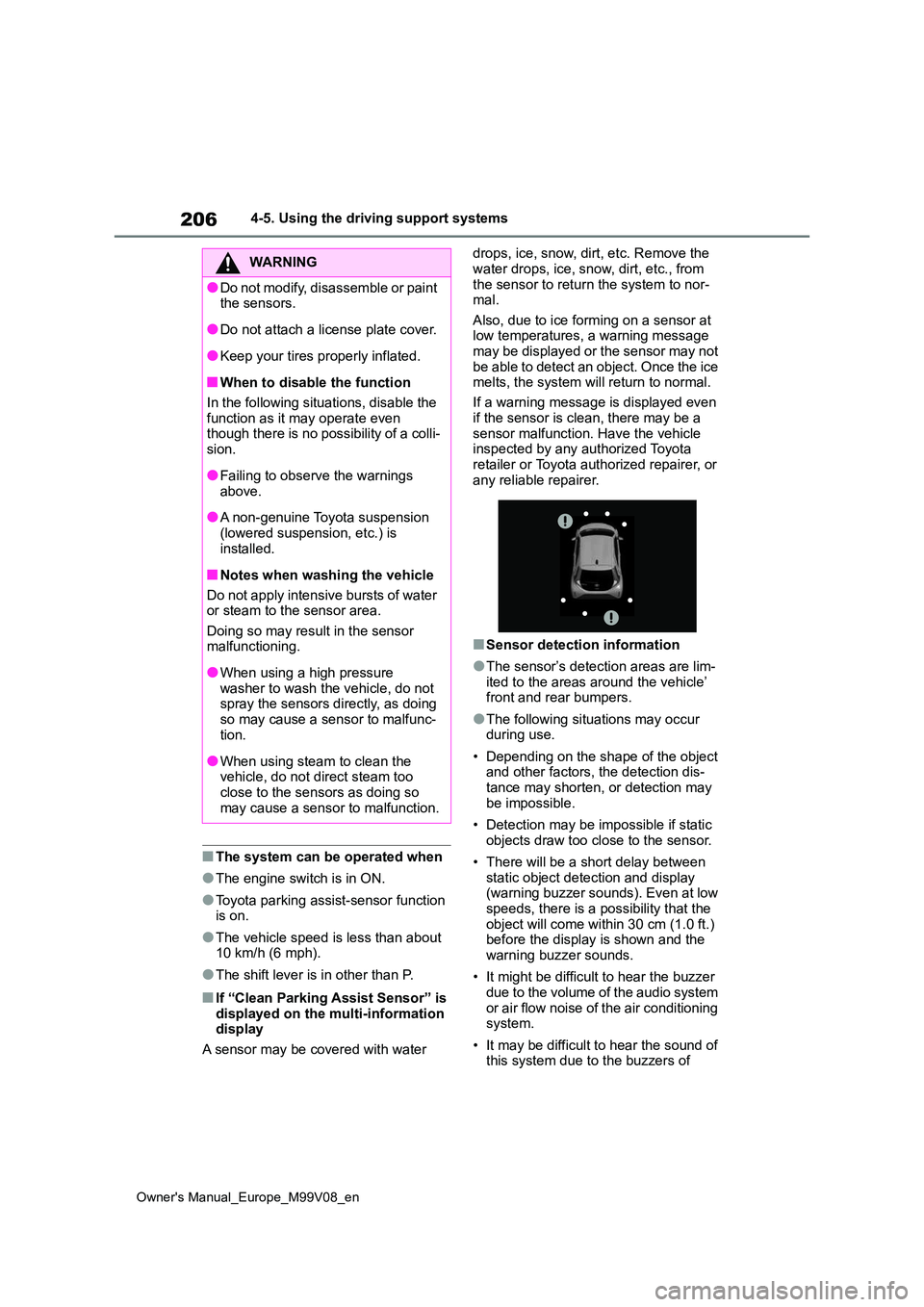
■Sensor detection information
●The sensor’s detection areas are lim-
ited to the areas around the vehicle’ front and rear bumpers.
●The following situations may occur during use.
• Depending on the shape of the object and other factors, the detection dis-tance may shorten, or detection may
be impossible.
• Detection may be impossible if static
objects draw too close to the sensor.
• There will be a short delay between
static object detection and display (warning buzzer sounds). Even at low speeds, there is a possibility that the
object will come within 30 cm (1.0 ft.) before the display is shown and the warning buzzer sounds.
• It might be difficult to hear the buzzer due to the volume of the audio system
or air flow noise of the air conditioning system.
• It may be difficult to hear the sound of this system due to the buzzers of
WARNING
●Do not modify, disassemble or paint the sensors.
●Do not attach a license plate cover.
●Keep your tires properly inflated.
■When to disable the function
In the following situations, disable the function as it may operate even though there is no possibility of a colli-
sion.
●Failing to observe the warnings
above.
●A non-genuine Toyota suspension
(lowered suspension, etc.) is installed.
■Notes when washing the vehicle
Do not apply intensive bursts of water or steam to the sensor area.
Doing so may result in the sensor malfunctioning.
●When using a high pressure washer to wash the vehicle, do not spray the sensors directly, as doing
so may cause a sensor to malfunc- tion.
●When using steam to clean the vehicle, do not direct steam too close to the sensors as doing so
may cause a sensor to malfunction.
Page 218 of 494
216
Owner's Manual_Europe_M99V08_en
4-6. Driving tips
4-6.Driving tips
Use fluids that are appropriate to
the prevailing outside tempera-
tures.
• Engine oil
• Engine coolant
• Washer fluid
Have a service technician
inspect the condition of the bat-
tery.
Have the vehicle fitted with four
snow tires or purchase a set of
tire chains for the front tires.
Ensure that all tires are the same size
and brand, and that chains match the
size of the tires*.
*: Tire chains cannot be mounted on
18-inch tires.
Winter driving tips
Carry out the necessary prepa-
rations and inspections before
driving the vehicle in winter.
Always drive the vehicle in a
manner appropriate to the pre-
vailing weather conditions.
Pre-winter preparations
WARNING
■Driving with snow tires
Observe the following precautions to
reduce the risk of accidents. Failure to do so may result in a loss of vehicle control and cause death or
serious injury.
●Use tires of the size specified.
( P.350)
●Maintain the recommended level of air pressure.
●Do not drive at speeds in excess of the speed limit or the speed limit specified for the snow tires being
used.
●Use snow tires on all, not just some
wheels.
■Driving with tire chains (except
18-inch tires)
Observe the following precautions to reduce the risk of accidents.
Failure to do so may result in the vehi- cle being unable to be driven safely, and may cause death or serious
injury.
●Do not drive in excess of the speed
limit specified for the tire chains being used, or 50 km/h (30 mph), whichever is lower.
●Avoid driving on bumpy road sur-faces or over potholes.
●Avoid sudden acceleration, abrupt steering, sudden braking and shift-
ing operations that cause sudden engine braking.
●Slow down sufficiently before enter-ing a curve to ensure that vehicle control is maintained.
●Do not use LTA (Lane Tracing Assist) system.
NOTICE
■Repairing or replacing snow tires
Request repairs or replacement of snow tires from any authorized Toyota
retailer or Toyota authorized repairer, or any reliable repairer or legitimate tire retailers.
This is because the removal and attachment of snow tires affects the operation of the tire pressure warning
valves and transmitters.
Page 245 of 494
6
243
Owner's Manual_Europe_M99V08_en
6
Maintenance and care
Maintenance and care
6-1. Maintenance and care
Cleaning and protecting the
vehicle exterior ............... 244
Cleaning and protecting the
vehicle interior ................ 248
6-2. Maintenance
Maintenance requirements 251
6-3. Do-it-yourself maintenance
Do-it-yourself service precau-
tions ................................ 253
Hood ................................. 255
Positioning a floor jack...... 256
Engine compartment ........ 258
Tires .................................. 265
Tire inflation pressure ....... 270
Wheels.............................. 271
Air conditioning filter ......... 273
Wireless remote control/elec-
tronic key battery ............ 275
Checking and replacing fuses
....................................... 278
Light bulbs ........................ 285
Page 247 of 494
245
6
Owner's Manual_Europe_M99V08_en
6-1. Maintenance and care
Maintenance and care
make sure to observe the following
precautions. • Do not use acidic, alkaline or abrasive detergent
• Do not use hard brushes • Do not use detergent on the wheels when they are hot, such as after driv-
ing or parking in hot weather
■Wheels and wheel ornaments (vehi- cles with matte black painted wheels)
As matte black painted wheels require different cleaning methods than conven-tional aluminum wheels, be sure to
observer the following. For details, con- sult any authorized Toyota retailer or Toyota authorized repairer, or any reli-
able repairer.
●Remove dirt using water. If the wheels
are excessively dirty, use a sponge or soft cloth dampened with a diluted neutral detergent to remove the dirt.
●When using detergent, make sure to rinse it off with water immediately.
Then use a soft cloth to wipe off the water.
●To prevent the matte black paint from being damaged, make sure to observe the following precautions:
• Do not scrub or polish the wheels using a brush or dry cloth.• Do not use any wheel coatings or
abrasive detergents. • When using an automatic car wash, disable/do not select the wheel brush
function (if such an option is avail- able).• Do not use a high pressure washer or
steam cleaner. • Do not use detergent on the wheels when they are hot, such as after driv-
ing or parking in hot weather.
■Brake pads and calipers
Rust may form if the vehicle is parked with wet brake pads or disc rotors, caus-
ing them to stick. Before parking the vehicle after it is washed, drive slowly and apply the brakes several times to
dry the parts.
■Bumpers
Do not scrub with abrasive cleaners.
■Plated portions (if equipped)
If dirt cannot be removed, clean the parts as follows:
●Use a soft cloth dampened with an approximately 5% solution of neutral
detergent and water to clean the dirt off.
●Wipe the surface with a dry, soft cloth to remove any remaining moisture.
●To remove oily deposits, use alcohol wet wipes or a similar product.
WARNING
■When washing the vehicle
Do not apply water to the inside of the engine compartment. Doing so may cause the electrical components, etc.
to catch fire.
■When cleaning the windshield
(vehicles with rain-sensing wind- shield wipers)
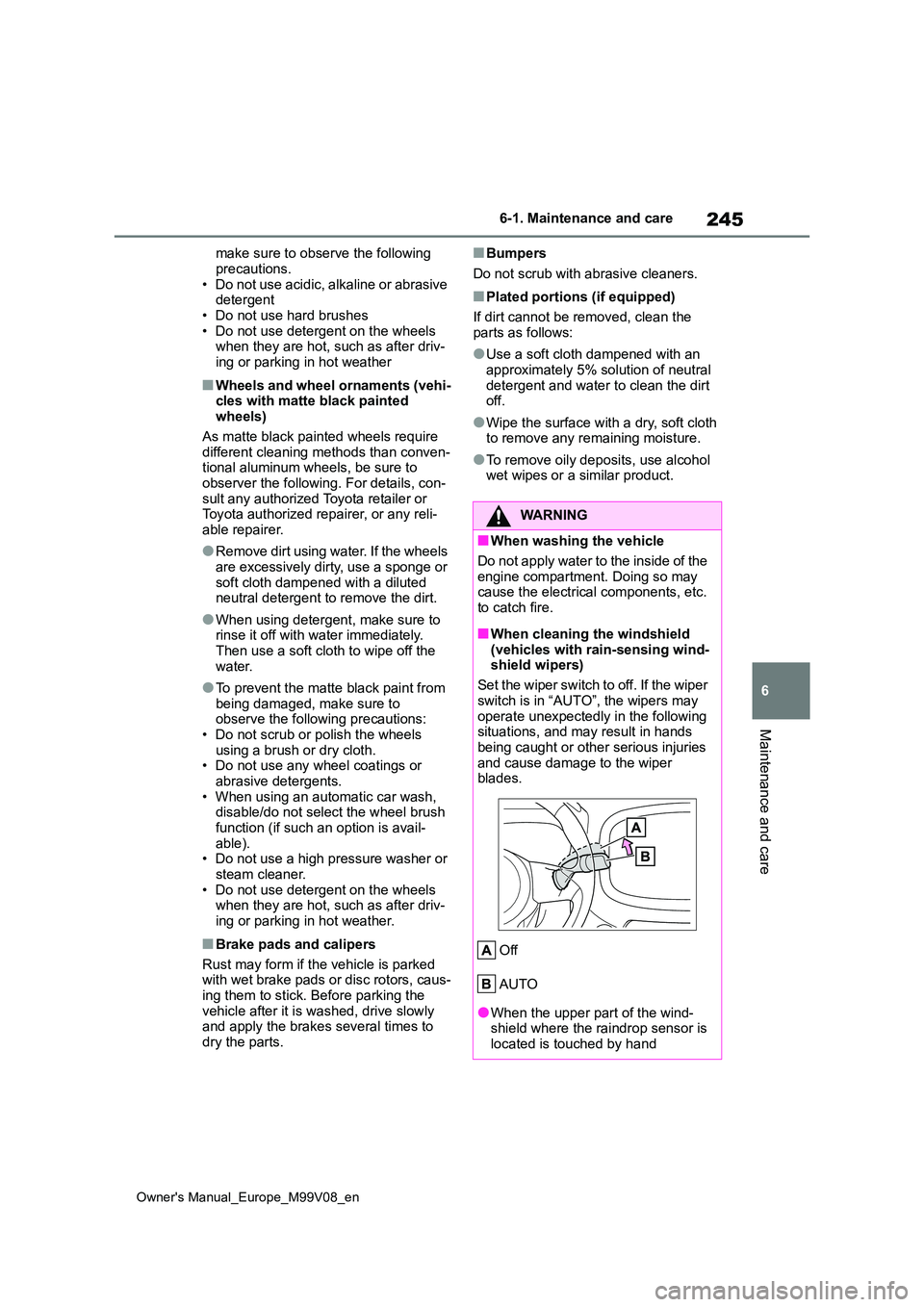
Set the wiper switch to off. If the wiper
switch is in “AUTO”, the wipers may operate unexpectedly in the following situations, and may result in hands
being caught or other serious injuries and cause damage to the wiper blades.
Off
AUTO
●When the upper part of the wind- shield where the raindrop sensor is located is touched by hand
Page 249 of 494
247
6
Owner's Manual_Europe_M99V08_en
6-1. Maintenance and care
Maintenance and care
NOTICE
■When using a high pressure car wash
●Vehicles with rear view monitor sys-tem: When washing the vehicle, do not spray the camera or its sur-
rounding area directly with a high pressure washer. Shock applied from high pressure water may
cause the device to not operate normally.
●Do not spray water directly on the radar which is equipped behind the radar cover in the radiator grille.
Otherwise it may cause the device to be damaged.
●Do not bring the nozzle tip close to boots (rubber or resin manufac-tured cover), connectors or the fol-
lowing parts. The parts may be damaged if they come into contact with high-pressure water.
• Traction related parts
• Steering parts
• Suspension parts
• Brake parts
●Keep the cleaning nozzle at least 30 cm (11.9 in.) away from the vehi-cles body. Otherwise resin section,
such as moldings and bumpers, may be deformed and damaged. Also, do not continuously hold the
nozzle in the same place.
●Do not spray the lower part of the
windshield continuously. If water enters the air conditioning system intake located near the lower part of
the windshield, the air conditioning system may not operate correctly.
●Do not wash the underside of the vehicle using a high pressure car washer.
■Cleaning the canvas top (if equipped)
●Remove bird droppings from the
fabric immediately, as their corro- sive effect an make the damage in the outer canvas fabric.
●Do not use organic substances (gasoline, kerosene, benzene or
strong solvents), which may be toxic or cause damage.
●Do not use harsh or abrasive clean-ers as they may damage the top material.
●Do not use water-repellents, wax or other preservative finishes as they
may stain the top material.
●Never use a high-pressure washer
to clean the canvas top. Increased high water pressure may force water past the sealing.
●Do not use automatic car wash machine. It is possible to damage
the outer canvas fabric.