service TOYOTA BZ4X 2022 (in English) User Guide
[x] Cancel search | Manufacturer: TOYOTA, Model Year: 2022, Model line: BZ4X, Model: TOYOTA BZ4X 2022Pages: 674, PDF Size: 120.02 MB
Page 89 of 674
87
2
Owners Manual_Europe_M42D76_en
2-1. Electric vehicle system
Electric Vehicle system
DC charging inlet
Traction battery
Electric motor (traction mo tor)/Inverter (front/rear*)
Air conditioning compressor
*: AWD models only
■Electromagnetic waves
●High-voltage parts and cables on the battery electric vehicles incorporate electro-magnetic shielding, and there-
fore emit approximately the same amount of electromagnetic waves as conventional gasoline-powered vehi-
cles or home electronic appliances.
●Your vehicle may cause sound inter-
ference in some third party-produced radio parts.
■Traction battery (Lithium-ion bat-tery)
The traction battery has a limited service life.
The traction battery capacity (the ability
to store energy) reduces with time and use in the same way as other recharge-able batteries. The extent at which
capacity reduces changes drastically depending on the environment (outside temperature, etc.) and usage conditions,
such as how the vehicle is driven and how the traction battery is charged.
This is a natural characteristic of lithium-
ion batteries, and is not a malfunction. Also, even though the driving range decreases when the traction battery
capacity reduces, vehicle performance does not significantly become worse. In order to reduce the possibility of the
capacity reducing, follow the directions listed on P.119, “Capacity reduction of the traction battery”.
■Starting the EV system in an
extremely cold environment
When the traction battery is extremely cold (below approximately -30°C [-
22°F]) due to the temperature outside of
the vehicle, it may not be possible to start the EV system. In this case, try to
start the EV system again after the tem- perature of the traction battery increases due to the outside temperature increas-
ing, etc.
■Declaration of conformity
This model conforms to hydrogen emis- sions according to regulation ECE100
(Battery electric vehicle safety).
WARNING
■High-voltage precautions
The vehicle has high voltage DC and AC systems as well as a 12-volt sys-tem.
DC and AC high voltage systems are very dangerous and can cause severe burns and electric shock that
may result in death or serious injury.
●Never touch, disassemble, remove, or replace the high voltage parts,
cables (orange) or their connectors.
●The EV system will become hot
after starting as the system uses high voltage. Be careful of both the high voltage and the high tempera-
ture, and always obey the warning labels attached to the vehicle.
Page 90 of 674
88
Owners Manual_Europe_M42D76_en
2-1. Electric vehicle system
WARNING
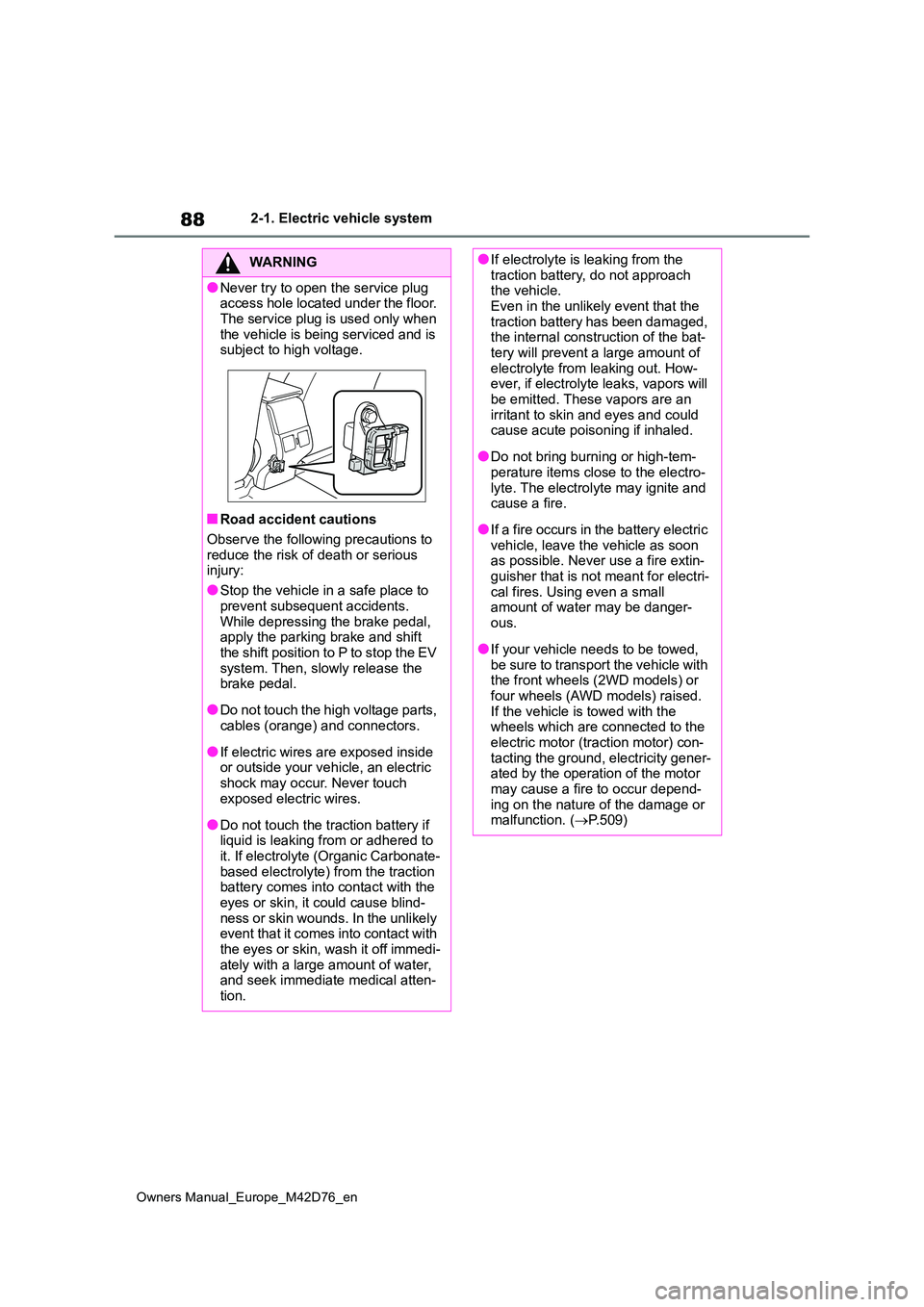
●Never try to open the service plug access hole located under the floor.
The service plug is used only when the vehicle is being serviced and is subject to high voltage.
■Road accident cautions
Observe the following precautions to
reduce the risk of death or serious injury:
●Stop the vehicle in a safe place to
prevent subsequent accidents. While depressing the brake pedal, apply the parking brake and shift
the shift position to P to stop the EV system. Then, slowly release the brake pedal.
●Do not touch the high voltage parts, cables (orange) and connectors.
●If electric wires are exposed inside or outside your vehicle, an electric
shock may occur. Never touch exposed electric wires.
●Do not touch the traction battery if liquid is leaking from or adhered to it. If electrolyte (Organic Carbonate-
based electrolyte) from the traction battery comes into contact with the eyes or skin, it could cause blind-
ness or skin wounds. In the unlikely event that it comes into contact with the eyes or skin, wash it off immedi-
ately with a large amount of water, and seek immediate medical atten-tion.
●If electrolyte is leaking from the traction battery, do not approach the vehicle.
Even in the unlikely event that the traction battery has been damaged, the internal construction of the bat-
tery will prevent a large amount of electrolyte from leaking out. How-ever, if electrolyte leaks, vapors will
be emitted. These vapors are an irritant to skin and eyes and could cause acute poisoning if inhaled.
●Do not bring burning or high-tem-perature items close to the electro-
lyte. The electrolyte may ignite and cause a fire.
●If a fire occurs in the battery electric vehicle, leave the vehicle as soon as possible. Never use a fire extin-
guisher that is not meant for electri- cal fires. Using even a small amount of water may be danger-
ous.
●If your vehicle needs to be towed,
be sure to transport the vehicle with the front wheels (2WD models) or four wheels (AWD models) raised.
If the vehicle is towed with the wheels which are connected to the electric motor (traction motor) con-
tacting the ground, electricity gener- ated by the operation of the motor may cause a fire to occur depend-
ing on the nature of the damage or malfunction. ( P.509)
Page 103 of 674
101
2
Owners Manual_Europe_M42D76_en
2-2. Charging
Electric Vehicle system
This product must be grounded. In
case of malfunction or break down,
grounding provides a path of least
resistance for electric current to
reduce the risk of electric shock.
This product is equipped with a
grounding conductor and a ground-
ing plug. The grounding plug must
be plugged into an appropriate
socket that is properly installed and
grounded in accordance with all
local codes and ordinances.
The CCID (Charging Circuit Inter-
rupting Device) has the following
safety features.
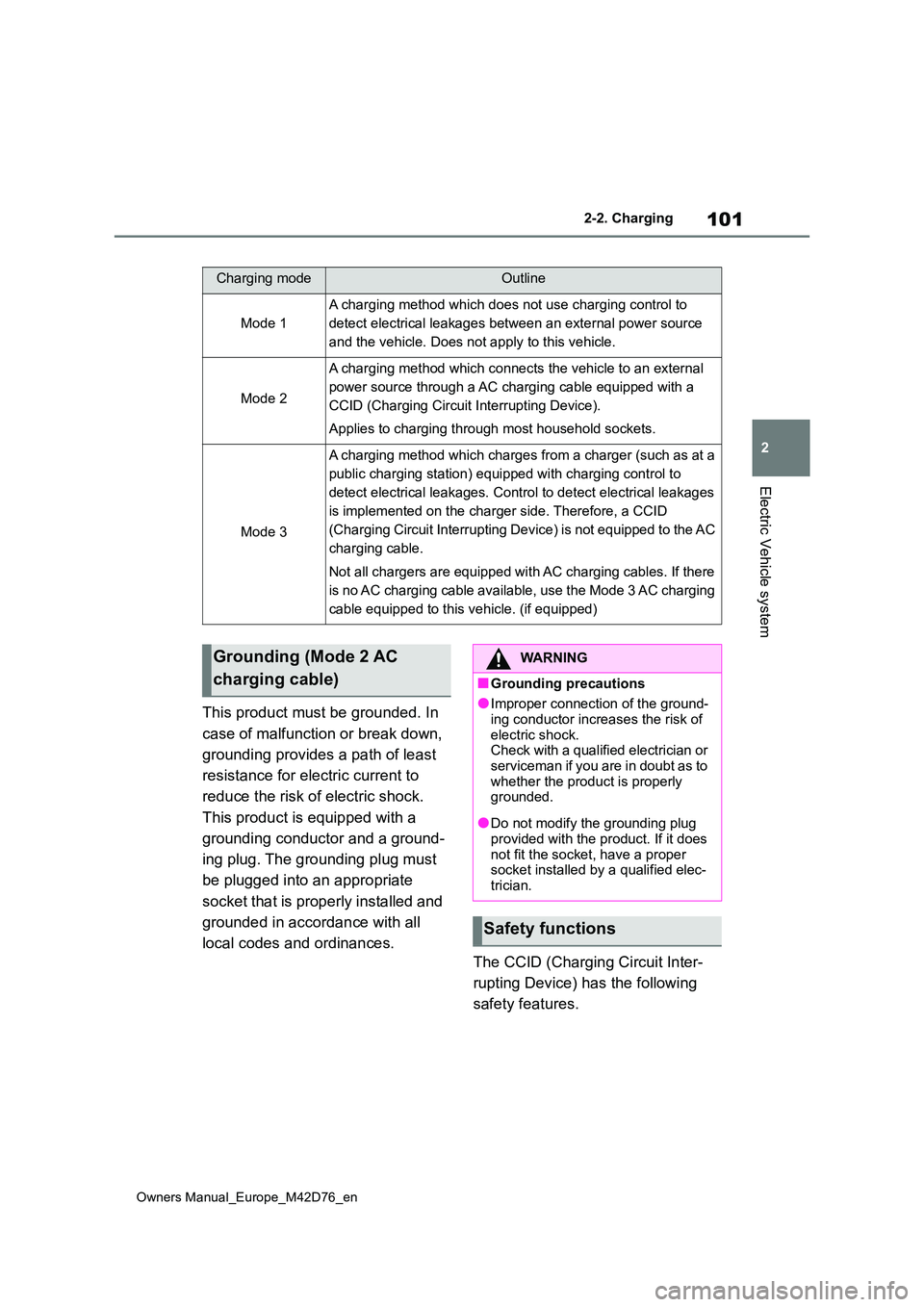
Charging modeOutline
Mode 1
A charging method which does not use charging control to
detect electrical leakages between an external power source
and the vehicle. Does not apply to this vehicle.
Mode 2
A charging method which connects the vehicle to an external
power source through a AC charging cable equipped with a
CCID (Charging Circuit Interrupting Device).
Applies to charging through most household sockets.
Mode 3
A charging method which charges from a charger (such as at a
public charging station) equipped with charging control to
detect electrical leakages. Control to detect electrical leakag es
is implemented on the charger side. Therefore, a CCID
(Charging Circuit Interrupting Device) is not equipped to the A C
charging cable.
Not all chargers are equipped with AC charging cables. If there
is no AC charging cable available, use the Mode 3 AC charging
cable equipped to this vehicle. (if equipped)
Grounding (Mode 2 AC
charging cable)
WARNING
■Grounding precautions
●Improper connection of the ground-
ing conductor increases the risk of electric shock.Check with a qualified electrician or
serviceman if you are in doubt as to whether the product is properly grounded.
●Do not modify the grounding plug provided with the product. If it does
not fit the socket, have a proper socket installed by a qualified elec-trician.
Safety functions
Page 275 of 674
273
5
Owners Manual_Europe_M42D76_en
5-4. Using the driving support systems
Driving
5-4.Using the d riving s upport sy ste ms
This Owner’s Manual contains
information for Ver. 1. For the latest
information about the controls, use,
warnings/precautions, etc., of each
function of Toyota Safety Sense
refer to the Digital Owner’s Manual
at the Owner’s Manual website.
If the software of this system has
been updated after initial purchase
of the vehicle, before using this sys-
tem, be sure to read the Owner’s
Manual which corresponds to the
software version of the system.
■Precautions for use
●Be aware that some functions may temporarily be disabled if a legal or
safety related issue occurs.
●If a connected services contract has
not been entered or has expired, soft- ware updates will not be able to be performed wirelessly.
If the software of this system has
been updated after initial purchase
of the vehicle, to access the appro-
priate Owner’s Manual, it is neces-
sary to check the software version
of the system and then visit the
Owner’s Manual website.
■Checking the current software
version on the multimedia dis-
play
The current software version can
be checked from the driving assist
function update notification.
■Using your vehicle’s Toyota
Safety Sense version
1 Access the following URL using
a computer or smartphone:
https://www.toyota-europe.com/ manual?parameter=om42d76e.
Software update
It is necessary to enter a con-
nected services contract, pro-
vided by Toyota to use these
functions. For details, contact
any authorized Toyota retailer
or Toyota authorized repairer,
or any reliable repairer.
WARNING
■For safe use
When the Toyota Safety Sense soft- ware is updated, the operating meth-ods of functions may change. Using
this system without knowing the cor- rect operating methods may lead to an accident resulting in death or seri-
ous injury.
●Make sure to read the Digital
Owner’s Manual which corresponds to the software version of the sys-tem, available at the Owner’s Man-
ual website, before using this system.
Content of the Toyota Safety
Sense Owner’s Manual
Checking your vehicle’s
Toyota Safety Sense version
Page 413 of 674
411
5
Owners Manual_Europe_M42D76_en
5-5. Driving tips
Driving
5-5.Driving tips
Use fluids that are appropriate to
the prevailing outside tempera-
tures.
• Power control unit coolant
• Heater coolant
• Washer fluid
Have a service technician
inspect the condition of the 12-
volt battery.
Have the vehicle fitted with four
snow tires or purchase a set of
tire chains for the front tires.
Ensure that all tires are the same size
and brand, and that chains match the
size of the tires.
Perform the following according to
Winter driving tips
Carry out the necessary prepa-
rations and inspections before
driving the vehicle in winter.
Always drive the vehicle in a
manner appropriate to the pre-
vailing weather conditions.
Preparation for winter
WARNING
■Driving with snow tires
Observe the following precautions to
reduce the risk of accidents. Failure to do so may result in a loss of vehicle control and cause death or
serious injury.
●Use tires of the specified size.
●Maintain the recommended level of air pressure.
●Do not drive at speeds in excess of the speed limit or the speed limit specified for the snow tires being
used.
●Use snow tires on all, not just some
wheels.
■Driving with tire chains
Observe the following precautions to reduce the risk of accidents.Failure to do so may result in the vehi-
cle being unable to be driven safely, and may cause death or serious injury.
●Do not drive in excess of the speed limit specified for the tire chains being used, or 50 km/h (30 mph),
whichever is lower.
●Avoid driving on bumpy road sur-
faces or over potholes.
●Avoid sudden acceleration, abrupt
steering, sudden braking and shift- ing operations that cause sudden regenerative braking.
●Slow down sufficiently before enter-ing a curve to ensure that vehicle
control is maintained.
●Do not use LTA (Lane Tracing
Assist).
NOTICE
■Repairing or replacing snow tires
Request repairs or replacement of
snow tires from any authorized Toyota retailer or Toyota authorized repairer, or any reliable repairer or legitimate
tire retailers. This is because the removal and attachment of snow tires affects the
operation of the tire pressure warning valves and transmitters.
Before driving the vehicle
Page 457 of 674
7
455
Owners Manual_Europe_M42D76_en
7
Maintenance and care
Maintenance and care
7-1. Maintenance and care
Cleaning and protecting the
vehicle exterior ............... 456
Cleaning and protecting the
vehicle interior ................ 459
7-2. Maintenance
Maintenance requirements 463
7-3. Do-it-yourself maintenance
Do-it-yourself service precau-
tions ................................ 465
Hood ................................. 467
Positioning a floor jack...... 468
Motor compartment .......... 470
Tires .................................. 476
Replacing the tire.............. 488
Tire inflation pressure ....... 494
Wheels.............................. 495
Air conditioning filter ......... 496
Electronic key battery ....... 499
Checking and replacing fuses
....................................... 501
Light bulbs ........................ 504
Page 465 of 674
463
7
Owners Manual_Europe_M42D76_en
7-2. Maintenance
Maintenance and care
7-2.Mainte nance
■Where to go for maintenance ser-
vice?
In order to maintain your vehicle in the best possible condition, Toyota recom-
mends that maintenance service opera- tions as well as other inspections and repairs be carried out by authorized
Toyota retailers or Toyota authorized repairers, or any reliable repairers. For repairs and services covered by your
warranty, please visit an authorized Toyota retailer or repairer, who will use genuine Toyota parts in repairing any
difficulties you may encounter. There can also be advantages in utilizing authorized Toyota retailers or repairers
for non-warranty repairs and services, as members of the Toyota network will be able to expertly assist you with any
difficulties you may encounter.
Your Toyota retailer or Toyota authorized
repairer, or any reliable repairer will per- form all of the scheduled maintenance on your vehicle reliably and economi-
cally due to their experience with Toyota vehicles.
Scheduled maintenance should be
performed at specified intervals
according to the maintenance
schedule.
For full details of your maintenance
schedule, read the “Toyota Service
Booklet” or “Toyota Warranty Booklet”.
What about do-it-yourself mainte-
nance?
Many of the maintenance items are
easy to do yourself if you have a little
mechanical ability and a few basic
automotive tools.
Note, however, that some maintenance
tasks require special tools and skills.
These are best performed by qualified
technicians. Even if you’re an experi-
enced do-it-yourself mechanic, we rec-
ommend that repairs and maintenance
be conducted by any authorized Toyota
retailer or Toyota authorized repairer, or
any reliable repairer. Any authorized
Toyota retailer or repairer will keep a
record of maintenance, which could be
useful should you ever require War-
ranty Service. Should you choose to
select a qualified and equipped profes-
sional other than an authorized Toyota
repairer to service or maintain your
vehicle, we recommend that you
Maintenance require-
ments
To ensure safe and economical
driving, day-to-day care and
regular maintenance are
essential. Toyota recommends
the maintenance below.
WARNING
■If your vehicle is not properly
maintained
Improper maintenance could result in serious damage to the vehicle and
possible death or serious injury.
■Handling of the 12-volt battery
12-volt battery posts, terminals and related accessories contain lead and
lead compounds which are known to cause brain damage. Wash your hands after handling. ( P.473)
Scheduled maintenance
Do-it-yourself maintenance
Page 466 of 674
464
Owners Manual_Europe_M42D76_en
7-2. Maintenance
request that a record of maintenance
be kept.
■Does your vehicle need repairs?
Be on the alert for changes in perfor- mance and sounds, and visual tip-offs
that indicate service is needed. Some important clues are:
●Appreciable loss of power
●Strange noises
●A fluid leak under the vehicle (How-ever, water dripping from the air con-
ditioning system after use is normal.)
●Flat-looking tires, excessive tire
squeal when cornering, uneven tire wear
●Vehicle pulls to one side when driven straight on a level road
●Strange noises related to suspension movement
●Loss of brake effectiveness, spongy feeling brake pedal, pedal almost touches the floor, vehicle pulls to one
side when braking
If you notice any of these clues, take your vehicle to any authorized Toyota
retailer or Toyota authorized repairer, or any reliable repairer as soon as possi-ble. Your vehicle may need adjustment
or repair.
Page 498 of 674
496
Owners Manual_Europe_M42D76_en
7-3. Do-it-yourself maintenance
Use only Toyota wheel bolts and
wrenches designed for use with
your aluminum wheels.
When rotating, repairing or
changing your tires, check that
the wheel bolts are still tight after
driving 1600 km (1000 miles).
Be careful not to damage the
aluminum wheels when using
tire chains.
Use only Toyota genuine balance
weights or equivalent and a plas-
tic or rubber hammer when bal-
ancing your wheels.
1 Turn the power switch off.
Confirm that the charging connector is
not connected. Also, do not use the Remote Air Conditioning System during the procedure.
2 Open the front passenger’s
door.
By keeping the door open, unexpected operation of the Remote Air Condition-
ing System can be prevent. ( P.427)
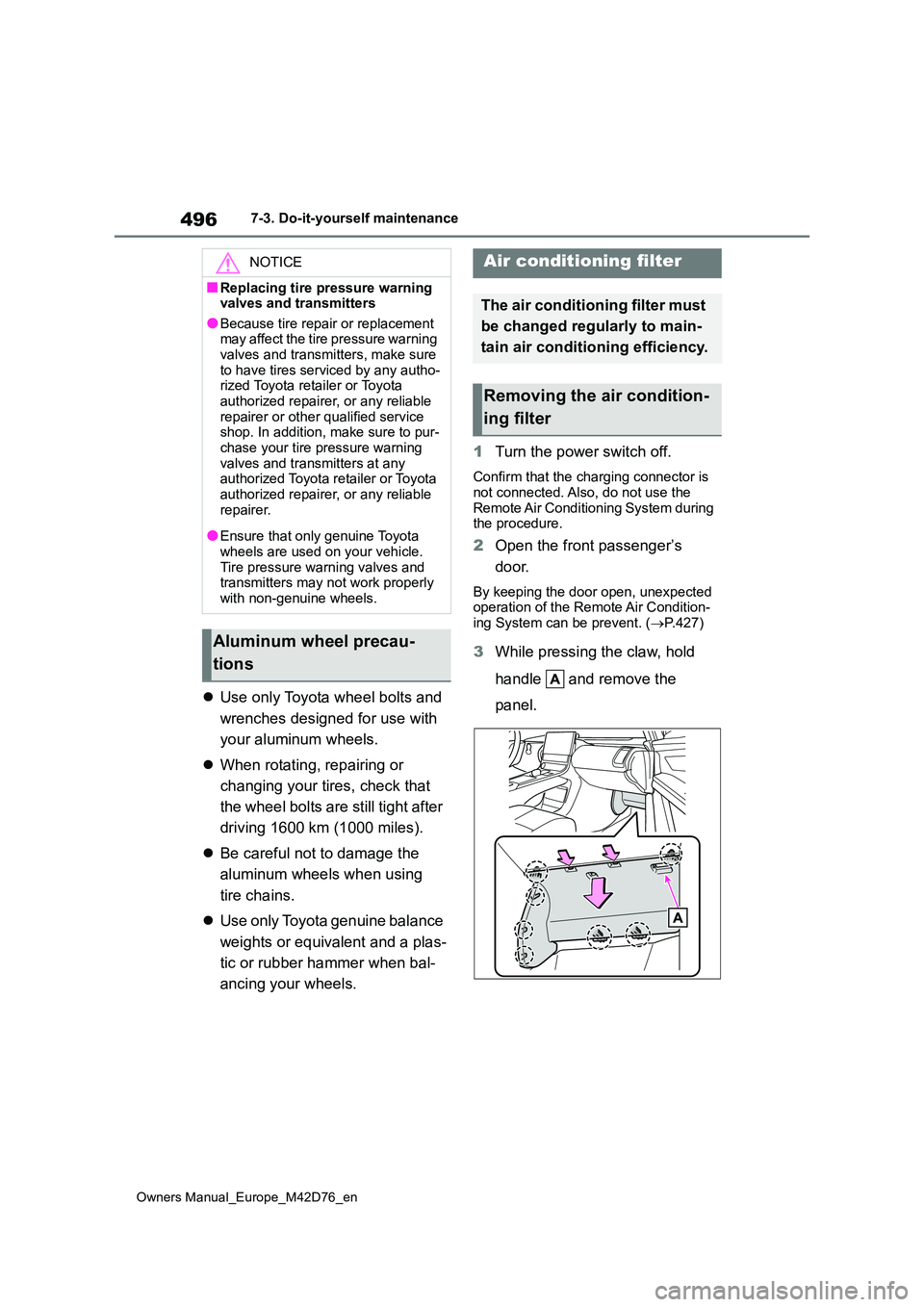
3While pressing the claw, hold
handle and remove the
panel.
NOTICE
■Replacing tire pressure warning valves and transmitters
●Because tire repair or replacement may affect the tire pressure warning valves and transmitters, make sure
to have tires serviced by any autho- rized Toyota retailer or Toyota authorized repairer, or any reliable
repairer or other qualified service shop. In addition, make sure to pur-chase your tire pressure warning
valves and transmitters at any authorized Toyota retailer or Toyota authorized repairer, or any reliable
repairer.
●Ensure that only genuine Toyota
wheels are used on your vehicle. Tire pressure warning valves and transmitters may not work properly
with non-genuine wheels.
Aluminum wheel precau-
tions
Air conditioning filter
The air conditioning filter must
be changed regularly to main-
tain air conditioning efficiency.
Removing the air condition-
ing filter
Page 500 of 674
498
Owners Manual_Europe_M42D76_en
7-3. Do-it-yourself maintenance
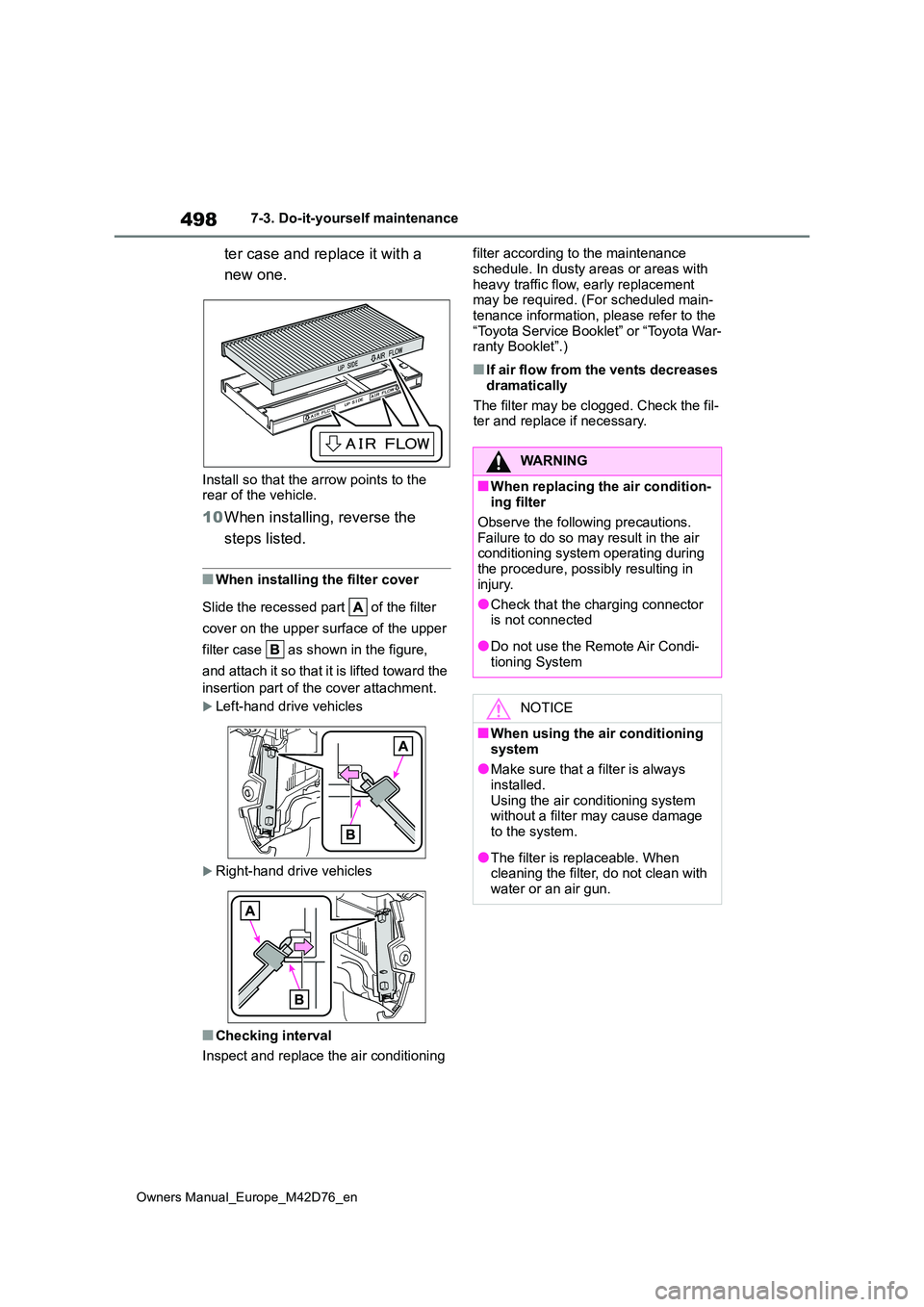
ter case and replace it with a
new one.
Install so that the arrow points to the rear of the vehicle.
10 When installing, reverse the
steps listed.
■When installing the filter cover
Slide the recessed part of the filter
cover on the upper surface of the upper
filter case as shown in the figure,
and attach it so that it is lifted toward the
insertion part of the cover attachment.
Left-hand drive vehicles
Right-hand drive vehicles
■Checking interval
Inspect and replace the air conditioning
filter according to the maintenance
schedule. In dusty areas or areas with heavy traffic flow, early replacement may be required. (For scheduled main-
tenance information, please refer to the “Toyota Service Booklet” or “Toyota War-ranty Booklet”.)
■If air flow from the vents decreases
dramatically
The filter may be clogged. Check the fil- ter and replace if necessary.
WARNING
■When replacing the air condition-ing filter
Observe the following precautions.
Failure to do so may result in the air conditioning system operating during the procedure, possibly resulting in
injury.
●Check that the charging connector is not connected
●Do not use the Remote Air Condi-tioning System
NOTICE
■When using the air conditioning
system
●Make sure that a filter is always installed.
Using the air conditioning system without a filter may cause damage to the system.
●The filter is replaceable. When cleaning the filter, do not clean with
water or an air gun.