maintenance TOYOTA BZ4X 2022 Owners Manual (in English)
[x] Cancel search | Manufacturer: TOYOTA, Model Year: 2022, Model line: BZ4X, Model: TOYOTA BZ4X 2022Pages: 674, PDF Size: 120.02 MB
Page 3 of 674
1
6
5
4
3
2
8
7
9
Owners Manual_Europe_M42D76_en
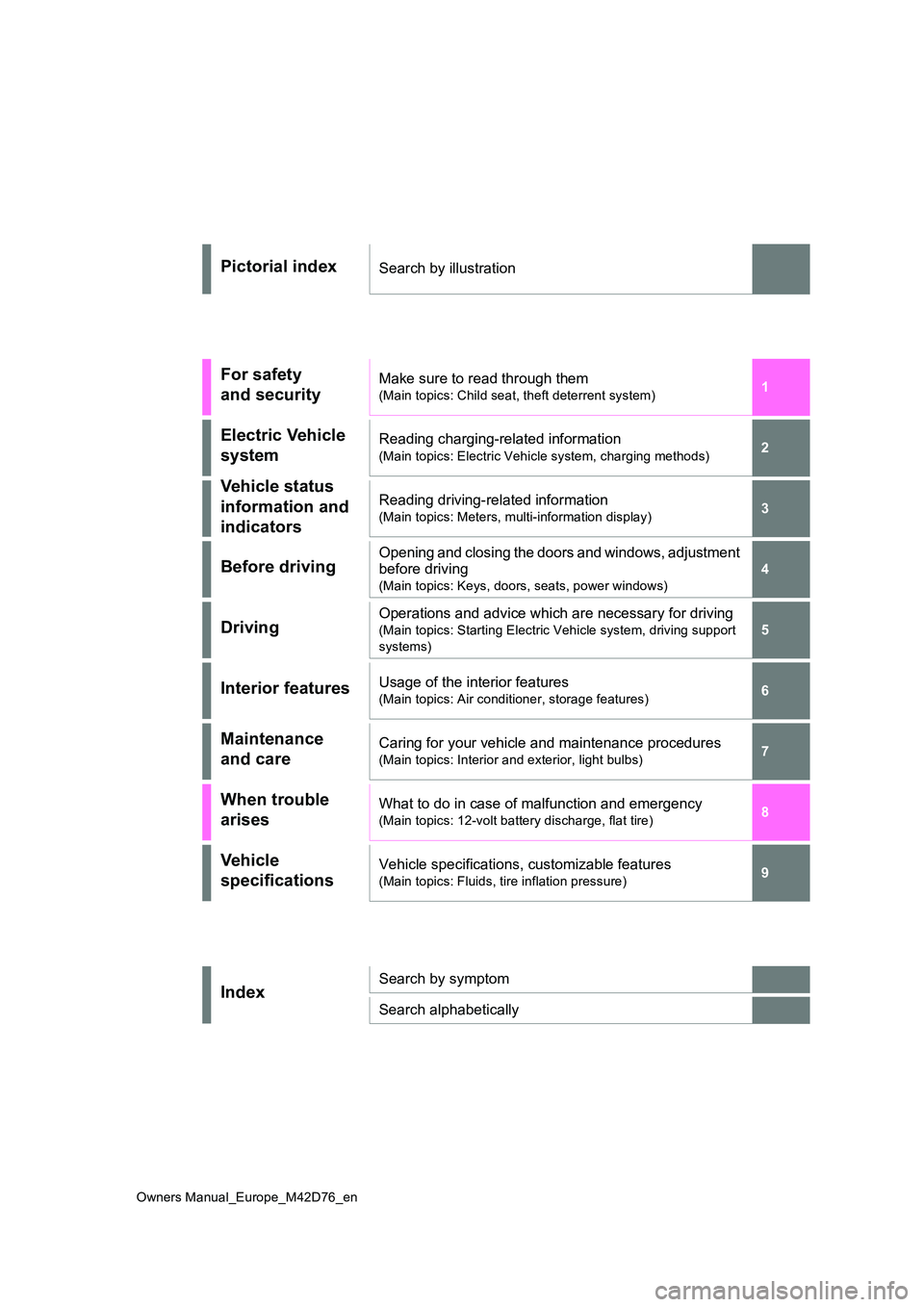
Pictorial indexSearch by illustration
For safety
and security
Make sure to read through them
(Main topics: Child seat, theft deterrent system)
Electric Vehicle
system
Reading charging-related information
(Main topics: Electric Vehicle system, charging methods)
Vehicle status
information and
indicators
Reading driving-related information
(Main topics: Meters, multi-information display)
Before drivingOpening and closing the doors and windows, adjustment
before driving
(Main topics: Keys, doors, seats, power windows)
DrivingOperations and advice which are necessary for driving
(Main topics: Starting Electric Vehicle system, driving support
systems)
Interior featuresUsage of the interior features
(Main topics: Air conditioner, storage features)
Maintenance
and care
Caring for your vehicle and maintenance procedures
(Main topics: Interior and exterior, light bulbs)
When trouble
arises
What to do in case of malfunction and emergency
(Main topics: 12-volt battery discharge, flat tire)
Vehicle
specifications
Vehicle specifications, customizable features
(Main topics: Fluids, tire inflation pressure)
IndexSearch by symptom
Search alphabetically
Page 6 of 674
4
Owners Manual_Europe_M42D76_en
TABLE OF CONTENTS
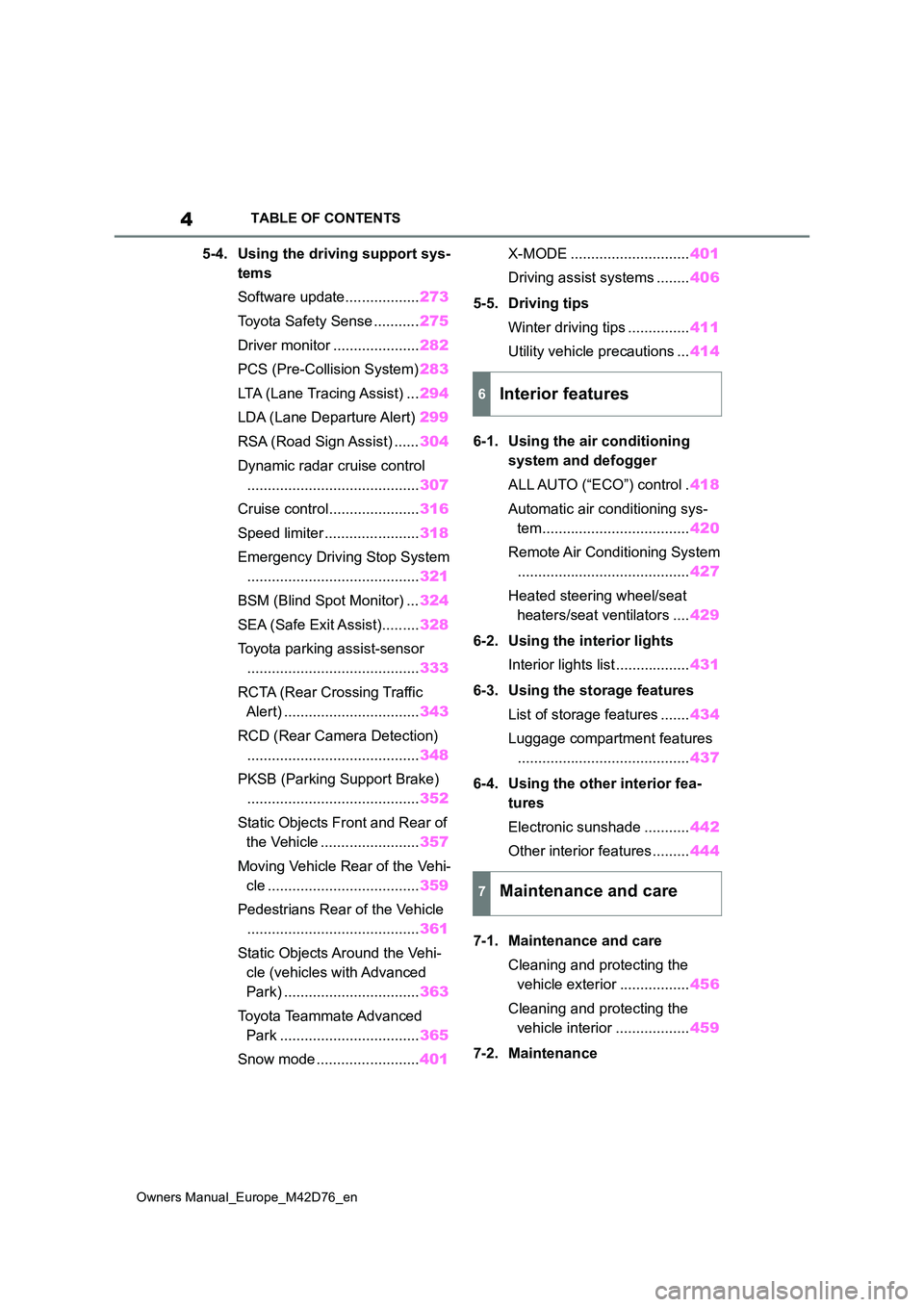
5-4. Using the driving support sys-
tems
Software update.................. 273
Toyota Safety Sense ........... 275
Driver monitor ..................... 282
PCS (Pre-Collision System) 283
LTA (Lane Tracing Assist) ... 294
LDA (Lane Departure Alert) 299
RSA (Road Sign Assist) ...... 304
Dynamic radar cruise control
.......................................... 307
Cruise control...................... 316
Speed limiter ....................... 318
Emergency Driving Stop System
.......................................... 321
BSM (Blind Spot Monitor) ... 324
SEA (Safe Exit Assist)......... 328
Toyota parking assist-sensor
.......................................... 333
RCTA (Rear Crossing Traffic
Alert) ................................. 343
RCD (Rear Camera Detection)
.......................................... 348
PKSB (Parking Support Brake)
.......................................... 352
Static Objects Front and Rear of
the Vehicle ........................ 357
Moving Vehicle Rear of the Vehi-
cle ..................................... 359
Pedestrians Rear of the Vehicle
.......................................... 361
Static Objects Around the Vehi-
cle (vehicles with Advanced
Park) ................................. 363
Toyota Teammate Advanced
Park .................................. 365
Snow mode ......................... 401
X-MODE ............................. 401
Driving assist systems ........ 406
5-5. Driving tips
Winter driving tips ............... 411
Utility vehicle precautions ... 414
6-1. Using the air conditioning
system and defogger
ALL AUTO (“ECO”) control . 418
Automatic air conditioning sys-
tem.................................... 420
Remote Air Conditioning System
.......................................... 427
Heated steering wheel/seat
heaters/seat ventilators .... 429
6-2. Using the interior lights
Interior lights list .................. 431
6-3. Using the storage features
List of storage features ....... 434
Luggage compartment features
.......................................... 437
6-4. Using the other interior fea-
tures
Electronic sunshade ........... 442
Other interior features ......... 444
7-1. Maintenance and care
Cleaning and protecting the
vehicle exterior ................. 456
Cleaning and protecting the
vehicle interior .................. 459
7-2. Maintenance
6Interior features
7Maintenance and care
Page 7 of 674
5
Owners Manual_Europe_M42D76_en
TABLE OF CONTENTS
1
6
5
4
3
2
8
7
9
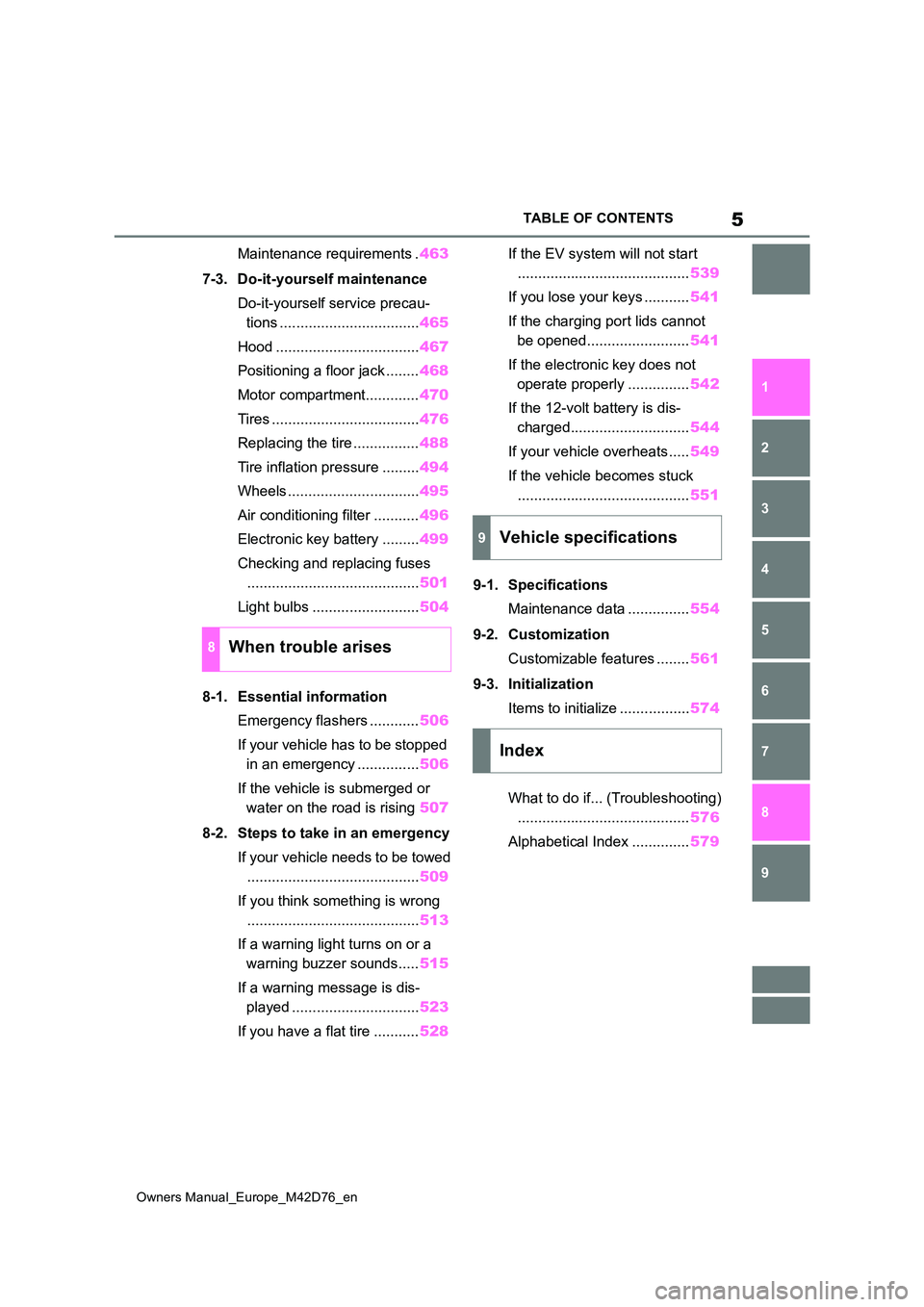
Maintenance requirements . 463
7-3. Do-it-yourself maintenance
Do-it-yourself service precau-
tions .................................. 465
Hood ................................... 467
Positioning a floor jack ........ 468
Motor compartment............. 470
Tires .................................... 476
Replacing the tire ................ 488
Tire inflation pressure ......... 494
Wheels ................................ 495
Air conditioning filter ........... 496
Electronic key battery ......... 499
Checking and replacing fuses
.......................................... 501
Light bulbs .......................... 504
8-1. Essential information
Emergency flashers ............ 506
If your vehicle has to be stopped
in an emergency ............... 506
If the vehicle is submerged or
water on the road is rising 507
8-2. Steps to take in an emergency
If your vehicle needs to be towed
.......................................... 509
If you think something is wrong
.......................................... 513
If a warning light turns on or a
warning buzzer sounds..... 515
If a warning message is dis-
played ............................... 523
If you have a flat tire ........... 528
If the EV system will not start
.......................................... 539
If you lose your keys ........... 541
If the charging port lids cannot
be opened......................... 541
If the electronic key does not
operate properly ............... 542
If the 12-volt battery is dis-
charged............................. 544
If your vehicle overheats ..... 549
If the vehicle becomes stuck
.......................................... 551
9-1. Specifications
Maintenance data ............... 554
9-2. Customization
Customizable features ........ 561
9-3. Initialization
Items to initialize ................. 574
What to do if... (Troubleshooting)
.......................................... 576
Alphabetical Index .............. 579
8When trouble arises
9Vehicle specifications
Index
Page 77 of 674
75
1
Owners Manual_Europe_M42D76_en
1-4. Theft deterrent system
For safety and security
1-4.Theft de terre nt sys te m
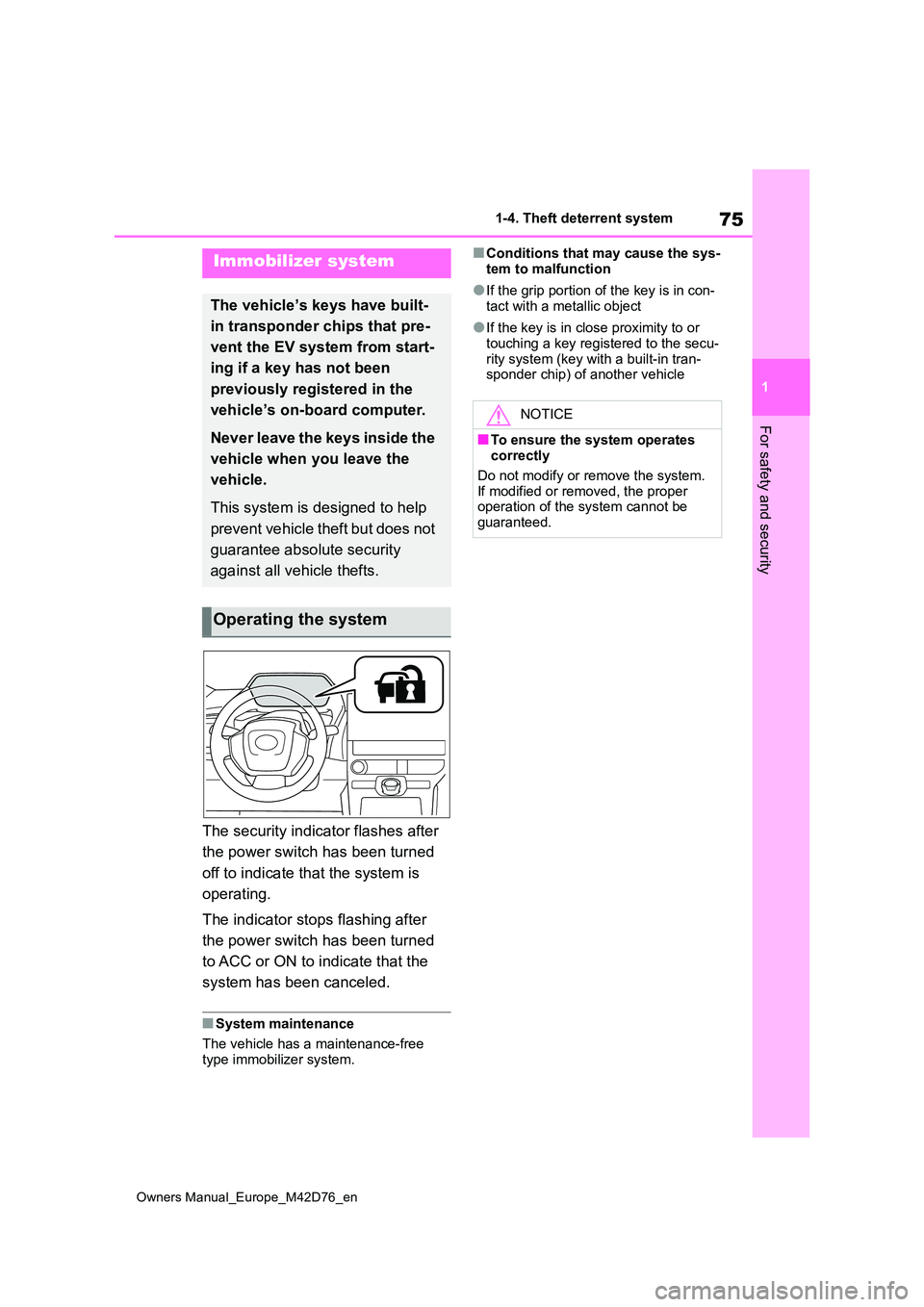
The security indicator flashes after
the power switch has been turned
off to indicate that the system is
operating.
The indicator stops flashing after
the power switch has been turned
to ACC or ON to indicate that the
system has been canceled.
■System maintenance
The vehicle has a maintenance-free type immobilizer system.
■Conditions that may cause the sys-
tem to malfunction
●If the grip portion of the key is in con-
tact with a metallic object
●If the key is in close proximity to or
touching a key registered to the secu- rity system (key with a built-in tran-sponder chip) of another vehicle
Immobilizer system
The vehicle’s keys have built-
in transponder chips that pre-
vent the EV system from start-
ing if a key has not been
previously registered in the
vehicle’s on-board computer.
Never leave the keys inside the
vehicle when you leave the
vehicle.
This system is designed to help
prevent vehicle theft but does not
guarantee absolute security
against all vehicle thefts.
Operating the system
NOTICE
■To ensure the system operates correctly
Do not modify or remove the system.
If modified or removed, the proper operation of the system cannot be guaranteed.
Page 79 of 674
77
1
Owners Manual_Europe_M42D76_en
1-4. Theft deterrent system
For safety and security
*: If equipped
■Items to check before locking
the vehicle
To prevent unexpected triggering of
the alarm and vehicle theft, make
sure of the following.
Nobody is in the vehicle.
The windows are closed before
the alarm is set.
No valuables or other personal
items are left in the vehicle.
■Setting
Close the doors and hood, and lock
all the doors using the entry func-
tion or wireless remote control. The
system will be set automatically
after 30 seconds.
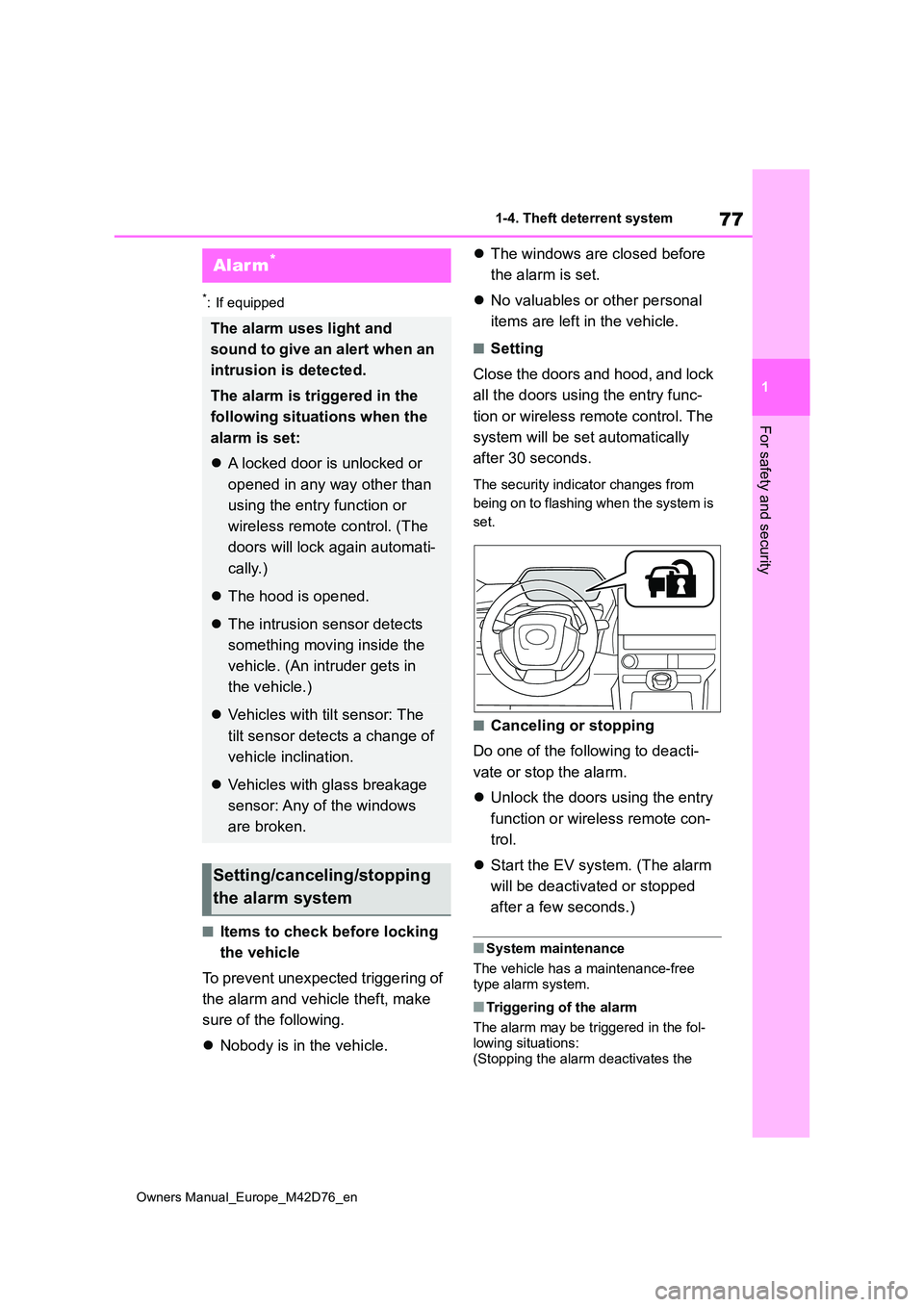
The security indicator changes from
being on to flashing when the system is
set.
■Canceling or stopping
Do one of the following to deacti-
vate or stop the alarm.
Unlock the doors using the entry
function or wireless remote con-
trol.
Start the EV system. (The alarm
will be deactivated or stopped
after a few seconds.)
■System maintenance
The vehicle has a maintenance-free type alarm system.
■Triggering of the alarm
The alarm may be triggered in the fol-
lowing situations: (Stopping the alarm deactivates the
Alarm*
The alarm uses light and
sound to give an alert when an
intrusion is detected.
The alarm is triggered in the
following situations when the
alarm is set:
A locked door is unlocked or
opened in any way other than
using the entry function or
wireless remote control. (The
doors will lock again automati-
cally.)
The hood is opened.
The intrusion sensor detects
something moving inside the
vehicle. (An intruder gets in
the vehicle.)
Vehicles with tilt sensor: The
tilt sensor detects a change of
vehicle inclination.
Vehicles with glass breakage
sensor: Any of the windows
are broken.
Setting/canceling/stopping
the alarm system
Page 86 of 674
84
Owners Manual_Europe_M42D76_en
2-1. Electric vehicle system
■Charging the traction battery
Be sure to maintain the traction battery charge level suitable for your driving needs.
If the traction battery fully discharges, the vehicle cannot be driven at all. When the battery becomes low, charge it as
soon as possible.
■If the traction battery becomes low
●If the traction battery becomes low,
the traction battery charge warning light comes on or flashes and a mes-sage will be displayed on the multi-
information display. ( P.517)
●If the traction battery is completely
discharged, the EV system cannot be started and driving will not be possi-ble. When the traction battery
becomes low, charge it as soon as possible.
■Sounds and vibrations specific to an battery electric vehicle
Because there is no engine sound or vibration, it is easy to mistake the bat-tery electric vehicle for being off when it
is actually still running, as indicated by the “READY” indicator being illuminated. For safety, make sure to always shift the
shift position to P and apply the parking brake when parked.
Before and after the EV system is
started, the following sounds and vibra- tions may occur. However, these sounds and/or vibrations are not signs of mal-
functions:
●The brake system operation sound
may be heard from the front of the vehicle when the driver’s door is opened.
●Motor sounds may be heard from the motor compartment or luggage com-
partment.
●Electrical relay sounds may be heard
from the motor compartment when the EV system starts or stops.
●Relay operating sounds such as a snap or soft clank will be emitted from the traction battery in the following sit-
uations:
• When the EV system is started or stopped• When charging starts or completes
• When the vehicle is driven the first time after the traction battery has been charged using DC charging
●Sounds may be heard due to regener-ative braking when the brake pedal is
depressed or as the accelerator pedal is released.
●Cooling fan operating sounds from the radiator.
●The operation sound of the air condi-tioning system (air conditioning com-pressor, blower motor).
■Maintenance, repair, recycling, and
disposal
Contact any authorized Toyota retailer or Toyota authorized repairer, or any reli-
able repairer regarding maintenance, repair, recycling and disposal. Do not dispose of the vehicle yourself.
A sound which changes in accor-
dance with the driving speed, will
be played in order to warn people
nearby of the vehicle’s approach.
This sound may be heard inside the
vehicle. The sound will stop when
the vehicle speed exceeds approxi-
mately 25 km/h (15 mph).
■Acoustic Vehicle Alerting System
In the following cases, the Acoustic Vehicle Alerting System may be difficult
for surrounding people to hear.
●In very noisy areas
●In the wind or the rain
Also, as the Acoustic Vehicle Alerting
System is installed on the front of the
Acoustic Vehicle Alerting
System
Page 241 of 674
239
5
Owners Manual_Europe_M42D76_en
5-1. Before driving
Driving
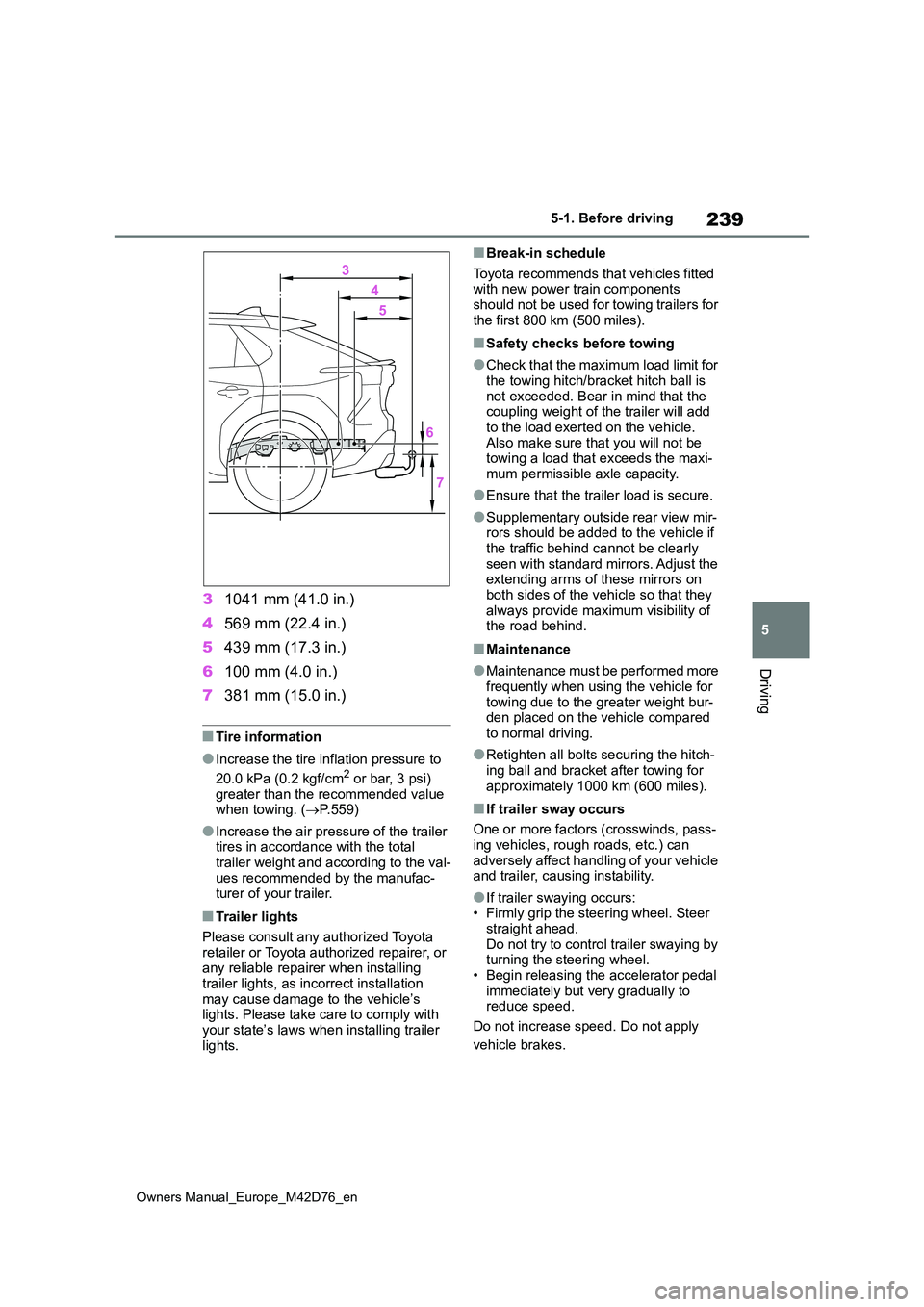
31041 mm (41.0 in.)
4 569 mm (22.4 in.)
5 439 mm (17.3 in.)
6 100 mm (4.0 in.)
7 381 mm (15.0 in.)
■Tire information
●Increase the tire inflation pressure to
20.0 kPa (0.2 kgf/cm2 or bar, 3 psi) greater than the recommended value when towing. ( P.559)
●Increase the air pressure of the trailer tires in accordance with the total
trailer weight and according to the val- ues recommended by the manufac-turer of your trailer.
■Trailer lights
Please consult any authorized Toyota retailer or Toyota authorized repairer, or any reliable repairer when installing
trailer lights, as incorrect installation may cause damage to the vehicle’s lights. Please take care to comply with
your state’s laws when installing trailer lights.
■Break-in schedule
Toyota recommends that vehicles fitted with new power train components should not be used for towing trailers for
the first 800 km (500 miles).
■Safety checks before towing
●Check that the maximum load limit for
the towing hitch/bracket hitch ball is not exceeded. Bear in mind that the coupling weight of the trailer will add
to the load exerted on the vehicle. Also make sure that you will not be towing a load that exceeds the maxi-
mum permissible axle capacity.
●Ensure that the trailer load is secure.
●Supplementary outside rear view mir- rors should be added to the vehicle if
the traffic behind cannot be clearly seen with standard mirrors. Adjust the extending arms of these mirrors on
both sides of the vehicle so that they always provide maximum visibility of the road behind.
■Maintenance
●Maintenance must be performed more frequently when using the vehicle for
towing due to the greater weight bur- den placed on the vehicle compared to normal driving.
●Retighten all bolts securing the hitch-ing ball and bracket after towing for
approximately 1000 km (600 miles).
■If trailer sway occurs
One or more factors (crosswinds, pass- ing vehicles, rough roads, etc.) can
adversely affect handling of your vehicle and trailer, causing instability.
●If trailer swaying occurs:• Firmly grip the steering wheel. Steer straight ahead.
Do not try to control trailer swaying by turning the steering wheel.• Begin releasing the accelerator pedal
immediately but very gradually to reduce speed.
Do not increase speed. Do not apply
vehicle brakes.
Page 418 of 674
416
Owners Manual_Europe_M42D76_en
5-5. Driving tips
NOTICE
■Inspection after off-road driving
●Sand and mud that has accumu-
lated around brake discs may affect braking efficiency and may damage brake system components.
●Always perform a maintenance inspection after each day of off-road
driving that has taken you through rough terrain, sand, mud, or water.
Page 457 of 674
7
455
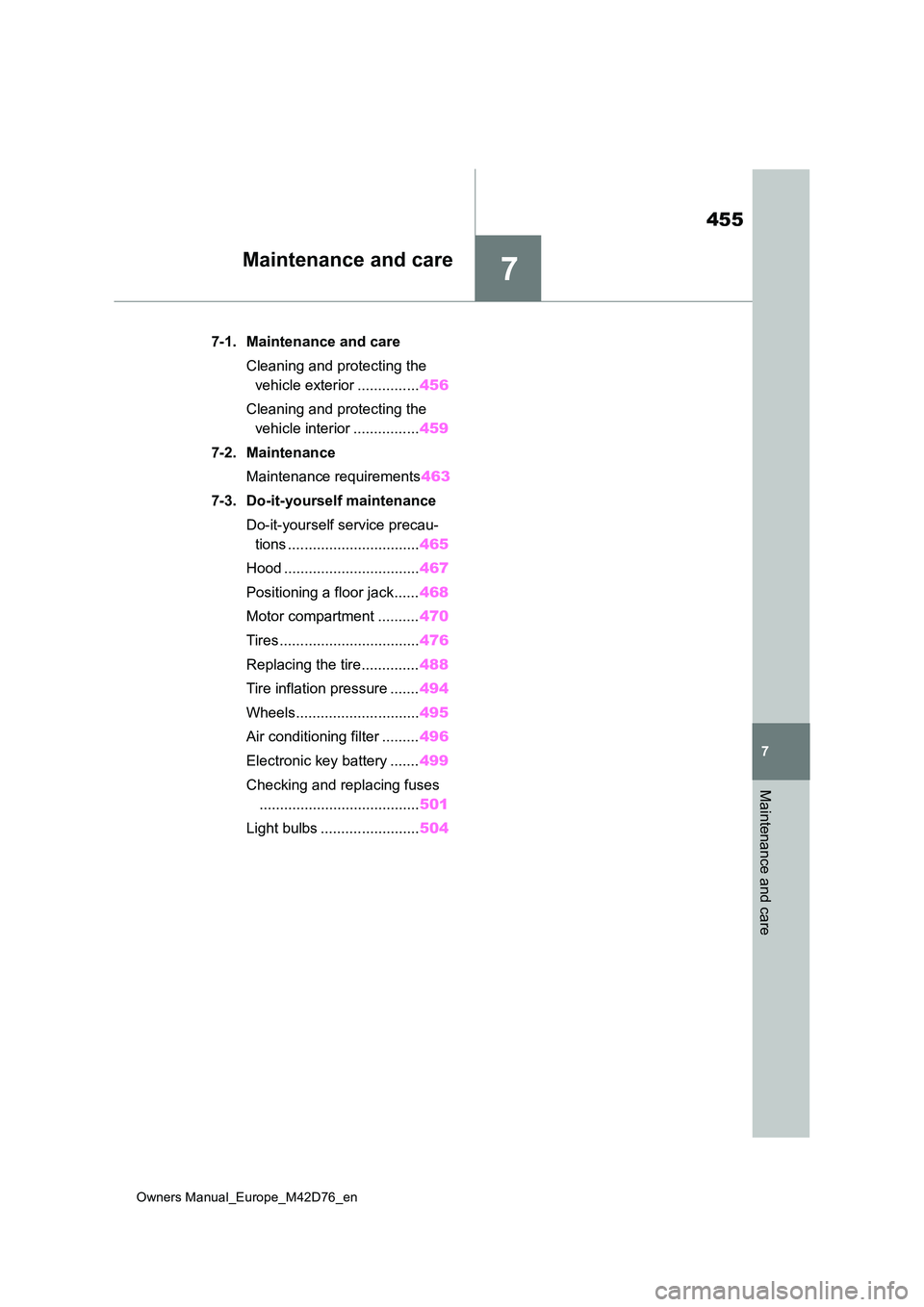
Owners Manual_Europe_M42D76_en
7
Maintenance and care
Maintenance and care
7-1. Maintenance and care
Cleaning and protecting the
vehicle exterior ............... 456
Cleaning and protecting the
vehicle interior ................ 459
7-2. Maintenance
Maintenance requirements 463
7-3. Do-it-yourself maintenance
Do-it-yourself service precau-
tions ................................ 465
Hood ................................. 467
Positioning a floor jack...... 468
Motor compartment .......... 470
Tires .................................. 476
Replacing the tire.............. 488
Tire inflation pressure ....... 494
Wheels.............................. 495
Air conditioning filter ......... 496
Electronic key battery ....... 499
Checking and replacing fuses
....................................... 501
Light bulbs ........................ 504
Page 458 of 674
456
Owners Manual_Europe_M42D76_en
7-1. Maintenance and care
7-1.Mainte nance a nd care
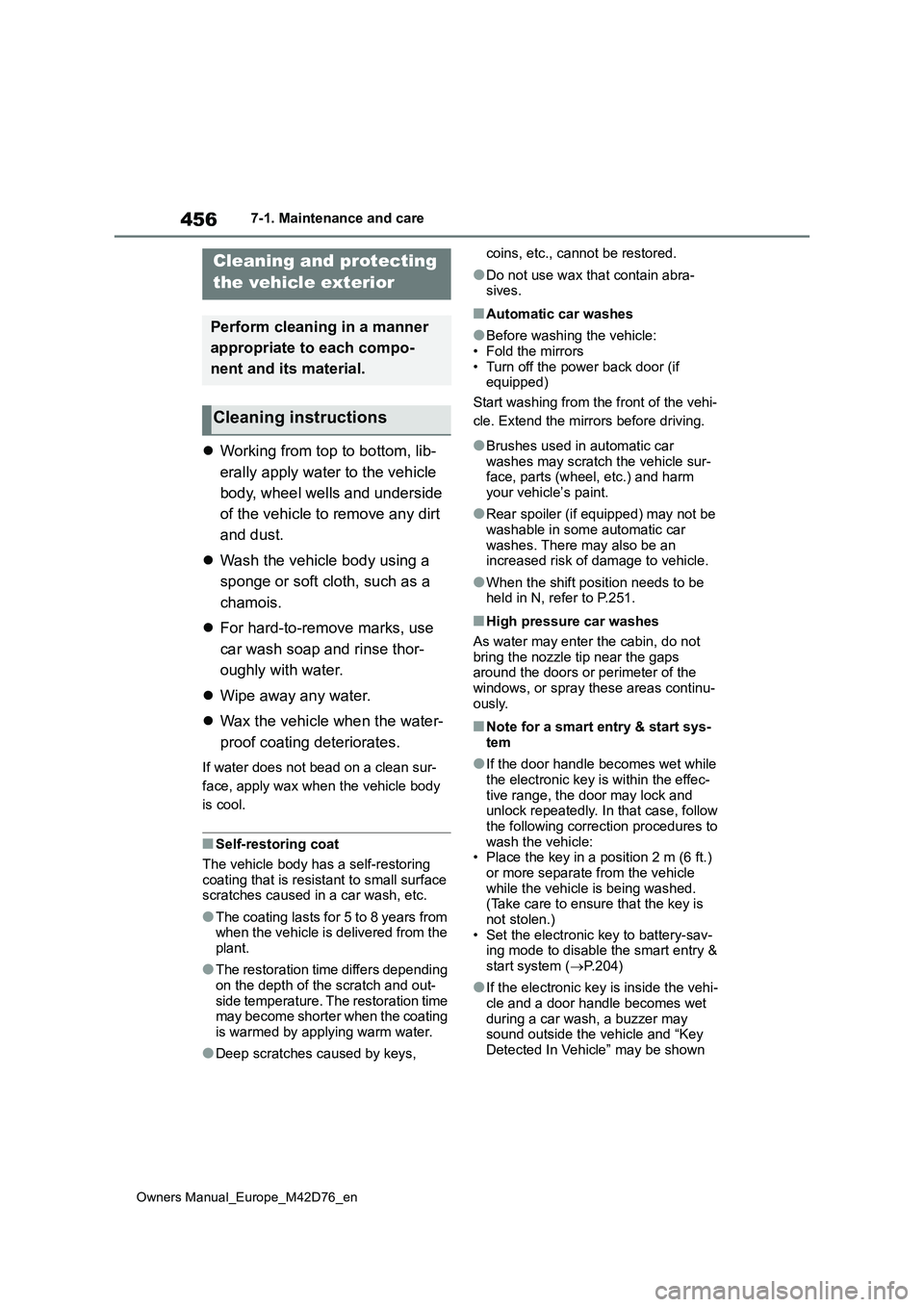
Working from top to bottom, lib-
erally apply water to the vehicle
body, wheel wells and underside
of the vehicle to remove any dirt
and dust.
Wash the vehicle body using a
sponge or soft cloth, such as a
chamois.
For hard-to-remove marks, use
car wash soap and rinse thor-
oughly with water.
Wipe away any water.
Wax the vehicle when the water-
proof coating deteriorates.
If water does not bead on a clean sur-
face, apply wax when the vehicle body
is cool.
■Self-restoring coat
The vehicle body has a self-restoring coating that is resistant to small surface scratches caused in a car wash, etc.
●The coating lasts for 5 to 8 years from when the vehicle is delivered from the
plant.
●The restoration time differs depending
on the depth of the scratch and out- side temperature. The restoration time may become shorter when the coating
is warmed by applying warm water.
●Deep scratches caused by keys,
coins, etc., cannot be restored.
●Do not use wax that contain abra- sives.
■Automatic car washes
●Before washing the vehicle:• Fold the mirrors
• Turn off the power back door (if equipped)
Start washing from the front of the vehi-
cle. Extend the mirrors before driving.
●Brushes used in automatic car washes may scratch the vehicle sur-face, parts (wheel, etc.) and harm
your vehicle’s paint.
●Rear spoiler (if equipped) may not be
washable in some automatic car washes. There may also be an increased risk of damage to vehicle.
●When the shift position needs to be held in N, refer to P.251.
■High pressure car washes
As water may enter the cabin, do not bring the nozzle tip near the gaps around the doors or perimeter of the
windows, or spray these areas continu- ously.
■Note for a smart entry & start sys-tem
●If the door handle becomes wet while the electronic key is within the effec-
tive range, the door may lock and unlock repeatedly. In that case, follow the following correction procedures to
wash the vehicle: • Place the key in a position 2 m (6 ft.) or more separate from the vehicle
while the vehicle is being washed. (Take care to ensure that the key is not stolen.)
• Set the electronic key to battery-sav- ing mode to disable the smart entry & start system ( P.204)
●If the electronic key is inside the vehi- cle and a door handle becomes wet
during a car wash, a buzzer may sound outside the vehicle and “Key Detected In Vehicle” may be shown
Cleaning and protecting
the vehicle exterior
Perform cleaning in a manner
appropriate to each compo-
nent and its material.
Cleaning instructions