spare tire TOYOTA C-HR 2020 Warranties & Maintenance Guides (in English)
[x] Cancel search | Manufacturer: TOYOTA, Model Year: 2020, Model line: C-HR, Model: TOYOTA C-HR 2020Pages: 260, PDF Size: 8.54 MB
Page 67 of 260
CONTINENTAL TIRE
65
Limited Warranty and Adjustment Policy for
Original Equipment Passenger Car & Light Truck
Tires (Including Temporary Spare Tires)
Eligibility
This Limited Warranty and Adjustment Policy (“Warranty”) applies to
the original owner of new Continental brand Passenger (PASS), Light
Truck (LT) and Temporary Spare (TS) tires that are the new vehicle
original equipment tires bearing the Continental brand name and
D.O.T.Tire Identification Number, operated in normal service, and used
on the same vehicle on which they were originally installed according
to the vehicle manufacturer’s recommendations.
Tire(s) on any vehicle registered and normally operated outside the
United States and Canada are excluded from eligibility under this
Limited Warranty and Adjustment Policy.
What Is the Adjustment Policy and How Long Is It
Applicable?
Basic Coverage
Eligible tires are covered by this Warranty for a maximum of 72 months
from the date of purchase, determined by the new vehicle registration
date or new vehicle sales invoice showing date of purchase.
Where to Go for Warranty Replacement
Contact the dealer where you purchased your vehicle or an
alternate authorized Continental brand tire dealer (Authorized Dealer)
to determine the eligible warranty coverage for your tires and how
to proceed.
Free Replacement Period
PASS & LT
If an eligible Continental brand PASS or LT tire becomes unserviceable
from a warrantable condition, other than those listed under Section
3, during the first 12 months or first 2/32nd of an inch (1.6 mm)
of treadwear (whichever comes first), it will be replaced with a
Page 68 of 260
CONTINENTAL TIRE
66
**comparable new Continental brand tire FREE OF CHARGE,
including mounting and balancing (excluding on line orders). Owner
pays all applicable taxes.
Temporary Spare
If a TS Tire becomes unserviceable from a condition other than those
listed in Section 3, during the first 1/32nd (0.8 mm) of treadwear, then it
will be replaced with a **comparable new Continental brand TS tire
FREE OF CHARGE, including mounting and balancing.The owner
pays all applicable taxes. After this “Free Replacement Period” for your
TS tire expires, no warranty claim will be accepted.
After the Free Replacement Period
The tire (except TS tire) may still be eligible for a pro rata replacement
up to 72 months from date of original purchase until the tread is worn
down to the tread wear indicators (2/32nd of an inch or 1.6 mm of
tread remaining). If an eligible tire becomes unserviceable under the
stipulations of this Limited Warranty and Adjustment policy it will be
replaced with a **comparable new Continental brand tire, charging the
owner a pro-rated amount. Owner pays all applicable taxes (including
F.E.T.), mounting and balancing charges.
The replacement tire price will be determined by multiplying the
percentage of the useable tread worn by the Dealers Selling Price
(excluding all applicable taxes) at the time of the adjustment. The
useable tread is the original tread down to the tread wear indicators
(2/32nd of an inch or 1.6 mm of tread remaining.)
**A “comparable” new Continental brand tire may be of either the same
tire line or the same basic construction but with a different sidewall or
tread configuration. If a higher priced tire is selected, the consumer will
pay the difference in price.
What Is Not Covered by This Warranty the Following
Are Not Covered
• Road Hazard: Any tire with road hazard damage, that includes,
but is not limited to: cuts, snags, punctures, bruises, and
impact breaks.
Page 73 of 260
 CONTINENTAL TIRE
71
liner or sidewall making it impossible to determine the tire suitability\
for repair or reuse. CTA does not recommend any repair to or reuse
of Continental SSR tires. You may vi")
CONTINENTAL TIRE
71
liner or sidewall making it impossible to determine the tire suitability\
for repair or reuse. CTA does not recommend any repair to or reuse
of Continental SSR tires. You may visit www.continentaltire.com and
select Customer Care FAQ’s to obtain additional SSR information.
Temporary Sparetire Owners
CTA does not recommend any repair to or reuse of punctured
Temporary Spare Tires.
ContiSeal™Tire Owners
A ContiSeal™ tire differs from a non-ContiSeal™ tire in that it has a
sticky, viscous layer from shoulder to shoulder along the inner liner.
This layer is an integral part of the ContiSeal™ tires. It is not des\
igned
or intended to act as a permanent puncture repair (See information
below). If an object up to 3/16ths (5 mm) diameter penetrates the
tread of the ContiSeal™ tire, this sticky, viscous layer is designed to
surround and adhere to the puncturing object and prevent air loss from
the tire by providing a near instantaneous seal. If the puncturing object
becomes dislodged from the tire, the material is designed to seal most
holes made by objects up to 3/16” (5 mm) diameter. While ContiSeal™
tires significantly reduce the incidence of flats, they are not designed
to be driven under inflated or in a flat condition. In all other aspects,
ContiSeal™ tires perform exactly like non-ContiSeal™ tires. As with
any tire, regularly inspect ContiSeal™ tires for evidence of cuts,
punctures, and loss of inflation pressure. At a minimum, ContiSeal™
tires should be inspected once or twice a month and always before
a long trip. Punctures or damage not attended to promptly can result
in loss of inflation pressure and/or damage to the tire. ContiSeal™
as soon as possible. The trained specialist, must inspect the tire
carefully and, according to industry standards, to determine whether
a permanent repair can be made or whether the tire must be removed
from service and scrapped. A permanent repair will require removal
of the tire from the rim and application of a repair method specifically
approved for the ContiSeal™ tires. ContiSeal™ tires are identified by a
symbol on the tire sidewall.
Page 76 of 260
FALKEN
74
Original Equipment Limited Warranty and Tire
Care Guide
Tire Care and Recommendations
Proper Inflation and Fuel Economy
Ensure maximum performance and a long life from your tires by
checking the air pressures at least once a month and set them to
the vehicle manufacturer’s recommended pressure(s) listed on the
vehicle’s tire placard or in your owner’s manual. Always check and
adjust your air pressure when your tires are cold, preferably first thing
in the morning before driving. Never release air pressure from tires
when they are hot. Wait until the tires cool down and recheck, adding
air or releasing as required. Falken endorses the use of nitrogen in
your tires because it helps your tires maintain optimal pressure for
longer periods of time and reduces the amount of moisture inside of
the tire and wheel assembly.
*Some plus size applications may require different air pressure(s)
than what is listed on your vehicle’s placard or owner’s manual. In this
case, please consult your tire dealer or Falken Tires for proper inflation
pressure(s).
Tire Inflation Pressure
Tires need to be properly inflated to effectively operate and perform
as intended. Tires carry the weight of the vehicle, passengers, and
cargo as well as bear the forces of braking, accelerating, and turning. \
The vehicle manufacturer sets the inflation pressures for the original
equipment tires that are on your vehicle.
Driving with improperly inflated tires is dangerous. An under inflated
tire will generate excessive heat build-up that will cause damage to
the internal structure and inner liner of the tire. Besides tire damage,\
improper tire inflation pressures can also affect your vehicle’s ride
and handling, tire tread wear, and fuel economy. It is recommended
to always keep all of your tires, including the spare, at the vehicle
manufacturer’s recommended inflation pressures and be sure to check
the air pressure monthly and before going on long road trips or carrying
extra weight in your vehicle.
Page 77 of 260
FALKEN
75
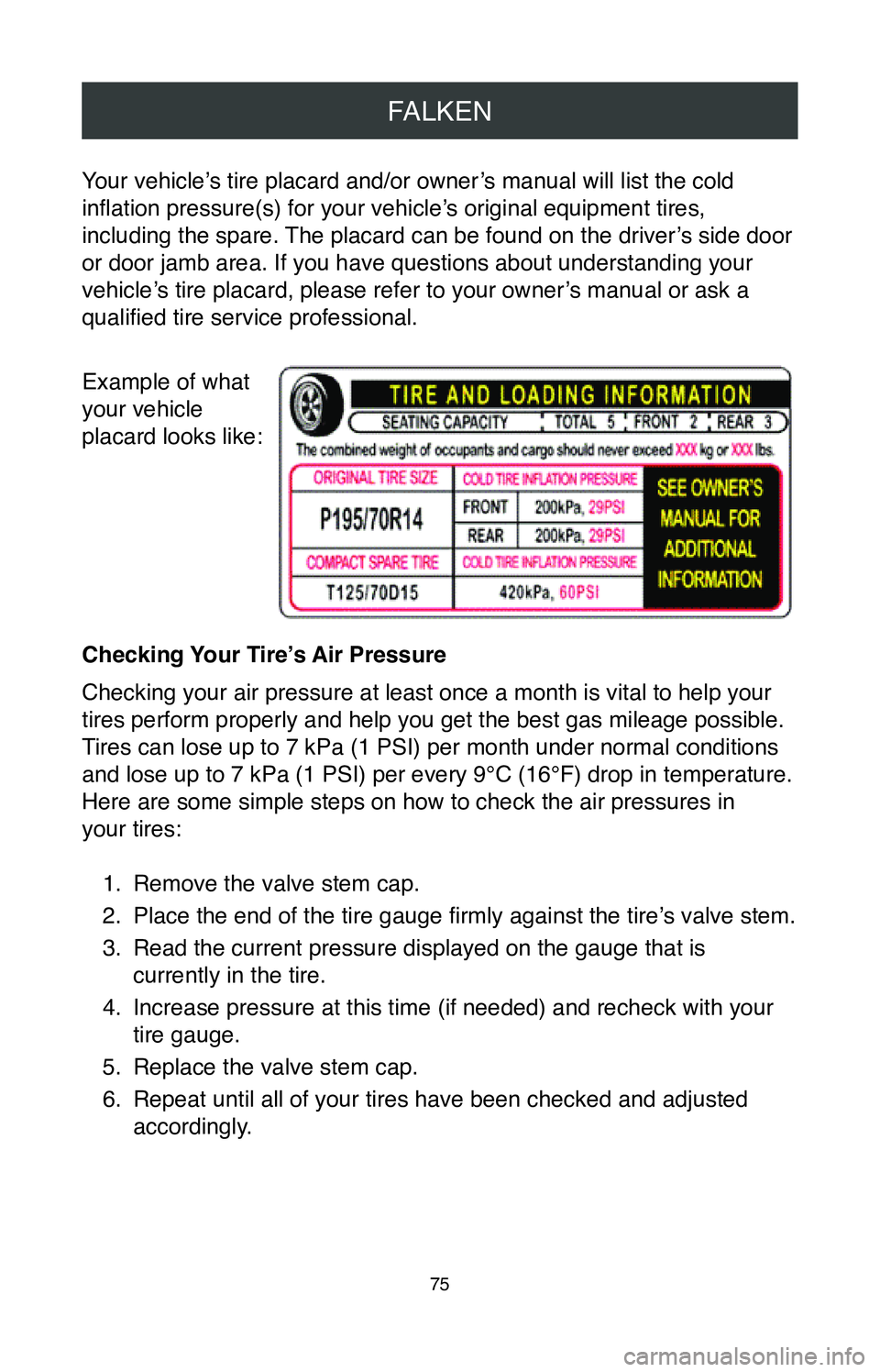
Your vehicle’s tire placard and/or owner’s manual will list the cold
inflation pressure(s) for your vehicle’s original equipment tires,
including the spare. The placard can be found on the driver’s side door
or door jamb area. If you have questions about understanding your
vehicle’s tire placard, please refer to your owner’s manual or ask a
qualified tire service professional.
Example of what
your vehicle
placard looks like:
Checking Your Tire’s Air Pressure
Checking your air pressure at least once a month is vital to help your
tires perform properly and help you get the best gas mileage possible.
Tires can lose up to 7 kPa (1 PSI) per month under normal conditions
and lose up to 7 kPa (1 PSI) per every 9°C (16°F) drop in temperature.
Here are some simple steps on how to check the air pressures in
your tires:1.
Remove the valve stem cap.
2.
Place the end of the tire gauge firmly against the tire’s valve stem.
3.
Read the current pressure displayed on the gauge that is
currently in the tire.
4.
Increase pressure at this time (if needed) and recheck with your
tire gauge.
5.
Replace the valve stem cap.
6.
Repeat until all of your tires have been checked and adjusted
accordingly.
Page 78 of 260
FALKEN
76
Tire Pressure Monitoring System (TPMS)
A tire pressure monitoring system (TPMS) is a safety system found
in most vehicles manufactured after 2005. There are pressure
sensing transmitters mounted inside of each tire that sends readings
to the central computer (ECU) in your vehicle. The TPMS system will
alert you when one or more of your tires are underinflated by 25%
or more by turning on a warning light on your vehicle’s dashboard or
heads up display (HUD) screen. This means that one or more of your
tires may have a low-pressure condition. Follow the instructions in your
owner’s manual.
Rotation and Wear
Falken recommends rotating your tires at least every 8,000km (5,000
miles) and periodically inspecting your tires to make sure they are
free of road hazards (such as nails, screws, large wood splinters, etc.)
that might penetrate your tires causing them to lose air pressure and
to ensure they are wearing evenly. Common irregular wear patterns
are: misalignment wear, where the tire shows excessive outer or inner
tread wear. Tire sidewalls should also be inspected for cuts, snags,
bruises, and weather cracking. If any of these noted conditions are
present during inspection, we recommend returning to your servicing
tire dealer to be corrected to ensure long tire life. ***Never include a
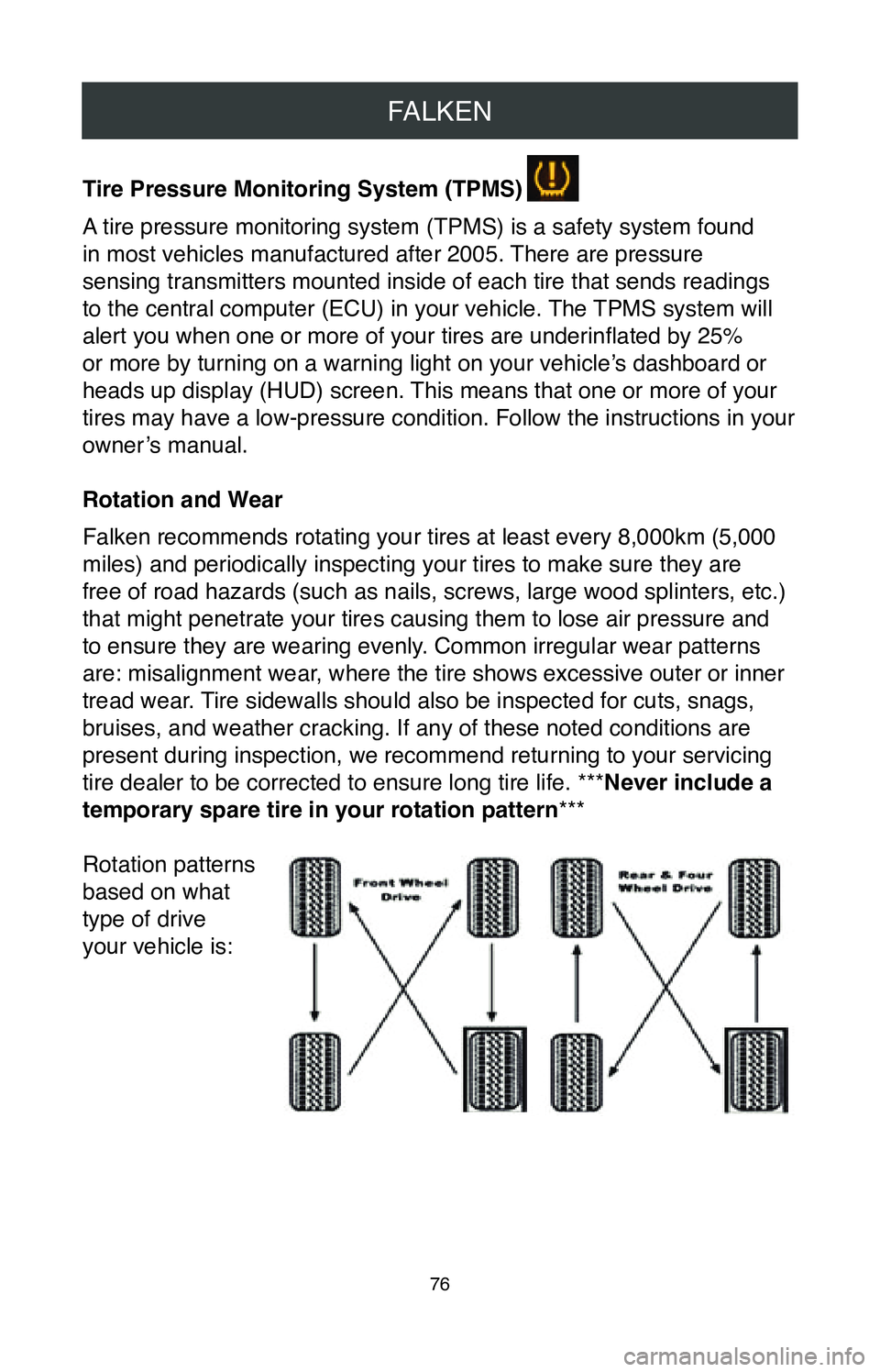
temporary spare tire in your rotation pattern***
Rotation patterns
based on what
type of drive
your vehicle is:
Page 79 of 260
FALKEN
77
Tire Replacement
Falken recommends replacing your tires when the tread wears down
to the wear bars at 1.6mm (2/32 of an inch), which are located across
the tread in several locations around the tire. If only two tires are be\
ing
replaced, the two new tires should always be installed on the rear of
the vehicle to aid in preventing your vehicle from hydroplaning, even
if your car is front wheel drive. It’s always recommended to have your
new tires balanced during installation, and alignment checked if the
previous tires show and irregular wear. Tires that have been in use for
6 (six) years or more should continue to be inspected by a qualified tire
specialist, at least annually. It is recommended that any tires 10 (ten)
years old or older from the date of manufacture, including spare tires, \
be replaced with new tires as a precaution even if such tires appear
serviceable and even if they have not reached the legal worn out limit
at 1.6mm (2/32 of an inch).
Tire Repairs
In the event that you get a flat tire while driving, it is best to find a
nearby, safe place to stop and install your spare tire or call a tow truck.
The less distance that you drive on your low or flat tire, the better
chances your tire has of being repairable. Once you are able to get
to your local servicing tire dealer, have them dismount the tire from
the rim and thoroughly inspect the inside of the tire. It is important t\
o
know the difference between a proper tire repair and an improper one
because it can be critical to you and your vehicle’s safety. An improper
repair could pose a safety threat to you and your family and could
also affect your tire’s manufacturer warranty. Here are some tips in
determining if your damaged tire can be properly repaired or not:•
Always have the tire removed from the wheel and inspected before
any repair is performed.
•
Tires with less than 1.6mm (2/32 of an inch) of tread should NOT
be repaired.
•
Never repair a tire with a puncture larger than 6mm
(1/4 of an inch).
•
Repairs should be limited to the tread area only.
•
Repairs cannot overlap one another.
Page 80 of 260
FALKEN
78
• A plug and patch or plug/patch combo should be used to effectively
repair a tire puncture.
•
If anything seems questionable at any time during the repair
process, ask your service advisor for more details and/or call the
tire manufacturer to make sure the tire’s warranty isn’t
being voided.
Tire Mix Usage
SAFETY WARNING
Never mix tires of different size or construction and/or type on any axle.
(Except for temporary use as a spare tire.) Always refer to the vehicle’s
owner manual for proper tire fitments.
Tire Speed Ratings
Falken recommends replacing your tire(s) with the same speed rating
as the original tires equipped on your vehicle.
It is okay to use a lower speed rated tire when using winter tires.
However, speeds should be reduced to match the tires new “maximum”
speed capability.
Any tire that is repaired, damaged, abused, altered from its original
state or retreaded voids the speed rating on that particular tire and
should be considered a non-speed rated tire.
SAFETY WARNING
Falken does not recommend the use of mixing different speed ratings
on a vehicle. This can cause poor handling and unpredictable steering.
High Performance, Low Aspect Ratio Tires
Various new vehicles come equipped with high performance and/or
low aspect ratio tires from the factory. These tires generally provide
increased vehicle handling characteristics, but may also have
engineering performance trade-offs related with their designs. Low
aspect ratio tires have reduced sidewall heights and may be more
vulnerable to damage from road hazards, potholes, and other objects,
Page 82 of 260
FALKEN
80
Speed Limits
SAFETY WARNING
Operating your vehicle in excess of the posted speed limit or the
maximum speed allotted by driving conditions has the potential to be
dangerous. Higher driving speeds create excessive heat buildup in a
tire, leading to a possible tire failure.
Tire Spinning
SAFETY WARNING
Spinning a tire to get a stuck vehicle out of mud, ice, snow, sand,
or wet grass can be potentially dangerous. A spinning tire at a
speedometer reading above 55 km/h (35 mph) can be capable of
disintegrating a tire with explosive force. In some circumstances, a tir\
e
may be spinning at twice the speed displayed on the speedometer.
This can cause serious injury or death to you, a passenger, or
bystander. Never spin a tire above 55 km/h (35 mph).
Limited Warranty
This limited warranty applies to Falken brand Original Equipment
Passenger Car, Temporary Spare, and Light Truck steel belted radial
tires bearing the complete description and serial number required by
the Department of Transportation (DOT). This warranty is effective only
to tires for which claims are made within 6 (six) years of the date of
production, based on the tire DOT serial number.
What Is Covered and for How Long
Falken tires that are originally equipped on this vehicle are warranted \
against any defects in the materials and workmanship for the usable
life of the original tread. The limited warranty terminates at the flush
appearance of the tread wear indicators at 1.6mm (2/32 of an inch)
remaining tread depth.
a.
Free Replacement
If a tire becomes unserviceable due to such defect within the first
1.6mm (2/32 of an inch) of tread wear, the tire will be replaced
Page 107 of 260
KENDA
105
Check Tire Inflation Pressures (Including The Spare,
At Least’ Once a Month When Tires Are Cold and
Before Long Trips. All Tires Lose Air Over Time.
Failure to maintain correct inflation may result in improper vehicle
handling, and may cause rapid and irregular tire wear, sudden tire
destruction, loss of vehicle control and serious personal injury or death.
Therefore, inflation pressures should be checked at least once a month
and always prior to long distance trips. Any tire is susceptible to losing
air pressure if not properly maintained.
Pressures should be checked when tires are cold; in other words,
before they have been driven on. Driving, even for a short distance,
causes tires to heat up and air pressure to increase.
High Speed Driving Can Be Dangerous
Correct inflation pressure is especially important. However, at high
speeds, even with the correct inflation pressures, a road hazard, for
example, is more difficult to avoid and if contact is made, has a greater
chance of causing tire damage than at a lower speed. Moreover,
driving at high speed reduces the reaction time available to avoid
accidents and bring your vehicle to a safe stop. Never exceed the legal \
speed limit.
Inspect Your Tires
Do Not Drive on a Damaged Tire or Wheel
Any time you see any damage to your tires or wheels replace with
spare at once and immediately see your tire dealer. When inspecting
your tires, including the spare, check your air pressures. If your
pressure check indicates that one of your tires has lost pressure of two\
pounds or more, look for signs of penetrations, valve leakage, or wheel \
damage that may account for the air loss.
Always look for bulges, cracks, cuts, penetrations and abnormal tire
wear particularly on the edges of the tire tread which may be caused
by misalignment or underinflatlon. If any such damage is found, the tire