spare tire TOYOTA C-HR 2020 Warranties & Maintenance Guides (in English)
[x] Cancel search | Manufacturer: TOYOTA, Model Year: 2020, Model line: C-HR, Model: TOYOTA C-HR 2020Pages: 260, PDF Size: 8.54 MB
Page 113 of 260
MAXXIS
111
MAXXIS
111
Limited Warranty
This Limited Warranty applies only to Maxxis brand radial tires installed
as original equipment on new passenger cars and light trucks, and to
Maxxis brand temporary spare tires included with new passenger cars
and light trucks.
The Maxxis brand tires to which this Limited Warranty applies are
referred to in this Limited Warranty as Tire or Tires. New passenger
cars and light trucks are referred to as a Vehicle. Maxxis-authorized
dealers that accept warranty claims are referred to as Maxxis Dealers.
Vehicle Manufacturer authorized dealers that accept warranty claims
are referred to as Vehicle Manufacturer Dealers.
Notice: Any implied warranty or condition, whether statutory
or otherwise, including that of merchantability or fitness for
a particular purpose, is limited to the duration of this written
Limited Warranty. Maxxis is not responsible for loss of time,
inconvenience, loss of use of vehicle, and/or costs of towing or
transportation, or any other consequential, incidental or indirect
damages. Some States (or Provinces) do not allow limitations on
how long an implied warranty or condition lasts, so the above
limitation may not apply to you. Some States (or Provinces) do
not allow the exclusion or limitation of incidental or consequential
damages, so these limitations or exclusions may not apply to you.
Eligibility for Limited Warranty
In order for the Tire or Tires to be covered by this Limited
Warranty, all of the following conditions must be met:•
The Tire was installed or supplied as original equipment on a
new Vehicle.
•
The Tire bears the prescribed tire identification number,
as applicable.
•
The Tire has been used only on the Vehicle on which it
was originally installed or supplied, and the installation was
in accordance with Vehicle manufacturer’s and/or Maxxis’
recommendations.
Page 114 of 260

MAXXIS
11 2
• The Tire has been properly cared for, and reasonable and
necessary maintenance has been performed, in accordance with
the Vehicle Owner’s Manual and/or this Limited Warranty.
•
The Tire has been operated only under normal service conditions.
•
The Tire’s owner resides in the United States or Canada.
What Is Warranted and for How Long
• Failures, defects, and malfunctions due to defective materials
and/or defective workmanship.
•
Ride problems, vibration problems, and/or out-of-round
•
Tires, if the Tire is within the first 1/32nd inch of tread depth
(0.8 mm).
•
Within 60 months from the date of your purchase of the new
Vehicle, or at least 2/32nd inch (1.6 mm) of tread depth remaining
on the Tire, whichever comes first, except if the Tire is a temporary
spare tire, in which case the tire must be within the first 1/32nds
inch (0.8 mm) of tread depth.
What Is Not Covered by this Limited Warranty Policy
• Tire failure, defect, malfunction or damage resulting from
improper operation or maintenance such as, but not limited to,
overloading, excessive speed and inflation practices causing
excessive operational temperatures that exceed specifications,
misapplication, tire/wheel imbalance, vandalism, use of puncture
sealants and/or chemical corrosion.
•
Road hazards, including but not limited to cuts, snags, punctures,
bruises, impact brakes, tire plugs, and/or any other damage
caused by tire repair.
•
Ride problems, vibration problems, and/or out-of-round Tires,
if Maxxis determines the problem is not the result of a defect
covered under this Limited Warranty, regardless of the tread depth
of the Tire.
•
Irregular treadwear resulting from improper wheel alignment, under
or over inflation, tire abuse (such as spinning), improper mounting
or dismounting, vehicle mechanical problems (such as faulty, worn
Page 116 of 260
MAXXIS
11 4
Replacement of Tires
• If you make a warranty claim in accordance with this Limited
Warranty, and the Tire* is within the first 25% of original, usable
tread, or the warranty claim is made 12 months from the date of
your purchase of the new Vehicle (whichever comes first), the Tire
will be promptly replaced with a comparable tire, without charge to
you (Free Replacement).
* If your warranty claim is with respect to a temporary spare tire,
the tire must be within the first 1/32nd inch (0.8 mm) of tread
depth, and the warranty claim does not have to be made within 12
months from the date of purchase.
•
During the Free Replacement period, mounting and balancing are
free of charge.
•
After the Free Replacement period and Vehicle Manufacturer’s
warranty period, the credit of the Tire will be calculated on a pro-
rated basis.
•
Remaining usable tread is computed as a percentage of the
original, usable tread. The credit amount will be calculated by
multiplying the Tire’s market retail price at the time of the warranty
claim by the remaining usable tread.
•
Original, usable tread does not include the last 2/32nds inch
(1.6 mm) of tread depth.
•
You are responsible for payment of labor costs of mounting and
balancing and applicable taxes, charges for services that you
request but that are not covered by this Limited Warranty, and any
shipping expenses after the Free Replacement period.
•
A “comparable tire” may either be a new Maxxis brand tire
of the same line as the Tire, or if the Tire is out of production
or unavailable, a new Maxxis brand tire of the same basic
construction and quality, with different sidewall or treadwear
configuration. If the same tire or a comparable new Maxxis tire is
available, and you request a higher-priced tire as a replacement,
the difference in price will be paid by you.
Page 118 of 260

MAXXIS
11 6
of internal damage will require dismounting of the tire and
examination by trained tire personnel.
•
Improper tire mounting and inflation procedures may cause the tire
beads to break with explosive force during installation of the tire on
the rim. Tire and rim must match in size. Rim parts must match by
manufacturer’s design. Clean rim. Lubricate rim and beads. Do not
exceed the maximum recommended pressure to seat the beads.
Only trained tire personnel should mount tires.
•
Use of worn-out tires (less than 2/32nd inch (1.6 mm) of tread
depth) increases the probability of tire failure.
•
Excessive speeds create heat buildup in a tire, leading to possible
tire failure.
•
Maxxis strongly recommends tire rotation every 5,000 to 7,500
miles (8,000 to 12,000 kilometers).
•
The Maxxis brand temporary spare tire weighs less than a
conventional radial tire. The temporary tire should be used only in
emergencies and returned to the trunk as soon as it is convenient
to have your standard tire repaired or replaced.
Contact Information
Any time you see damage to your Tires or wheels, immediately
contact a Vehicle Manufacturer Dealer or Maxxis Dealer. If
further assistance is required, please contact:
Maxxis International - U.S.A.
1-866-509-7067
Or write:
Maxxis Technology Center
480 Old Peachtree Road
Suwanee, GA 30024
USA
Page 125 of 260
MICHELIN
123
Safety Maintenance Information
Read this Owner’s Manual, the information on the sidewall of your
tires, your vehicle owner’s manual and the tire information placard
that came on your vehicle, for essential safety and maintenance
information.
While you should have complete confidence in your new MICHELIN
®
tires, it’s important to register your tires so we can contact you
about any new safety developments. For online tire registration, visit
tireregistration.com.
Tire Failure – Safety Warning
Any tire may fail as a result of an improperly repaired puncture,
impact damage, improper inflation, overloading, a crack, a bulge or
other distortion, or other conditions resulting from use or misuse. Tire
failures, such as a rapid air loss or a tread and belt detachment, may
increase risk of injury, death, or property damage. To reduce the risk
ofa tire failure, you should thoroughly read and follow the instructions\
in this manual, your vehicle owner’s manual, the tire information
placard on the vehicle (located in the vehicle’s door jamb, inside
the fuel hatch, or on the glove compartment door), and tire sidewall
information regarding safety warnings, proper tire use, and proper
tire maintenance.
Controlling a Vehicle When a Tire Failure Occurs
If a tire failure occurs, you may hear a loud noise, feel a vibration, o\
r
feel the vehicle pull toward the side of the failed tire. If that happen\
s,
DO NOT BRAKE OR ABRUPTLY TURN THE STEERING WHEEL.
Instead, slowly remove your foot from the accelerator and hold the
steering wheel firmly while steering to remain in your lane. Once
the vehicle has slowed and is fully in your control, apply the brakes
gently, safely pull over to the shoulder, and come to a stop in the
safest location possible. Inspect all tires. If any tire looks flat or low ,
or shows detachment or any other damage, replace the wheel and
tire with a properly inflated spare after first inspecting the spare for
Page 126 of 260
MICHELIN
124
visible damage. Bumps, bulges, or cracks in any tire may indicate
detachment within the tire body and require inspection by a qualified
tire professional. If any tire, including the spare, has bumps, bulges, \
cracks, or other visible damage, do not resume driving with that tire. I\
f
you have no other option, you should drive as slowly and cautiously as
possible until you can obtain towing or mechanical assistance. If the
spare tire is not properly inflated, do not resume driving with that tire
unless you have no other option, in which case you should drive only
as slowly as is safely possible in the traffic conditions until you can
both get the spare tire properly inflated and have it checked by a tire
professional to ensure that it is safe to use.
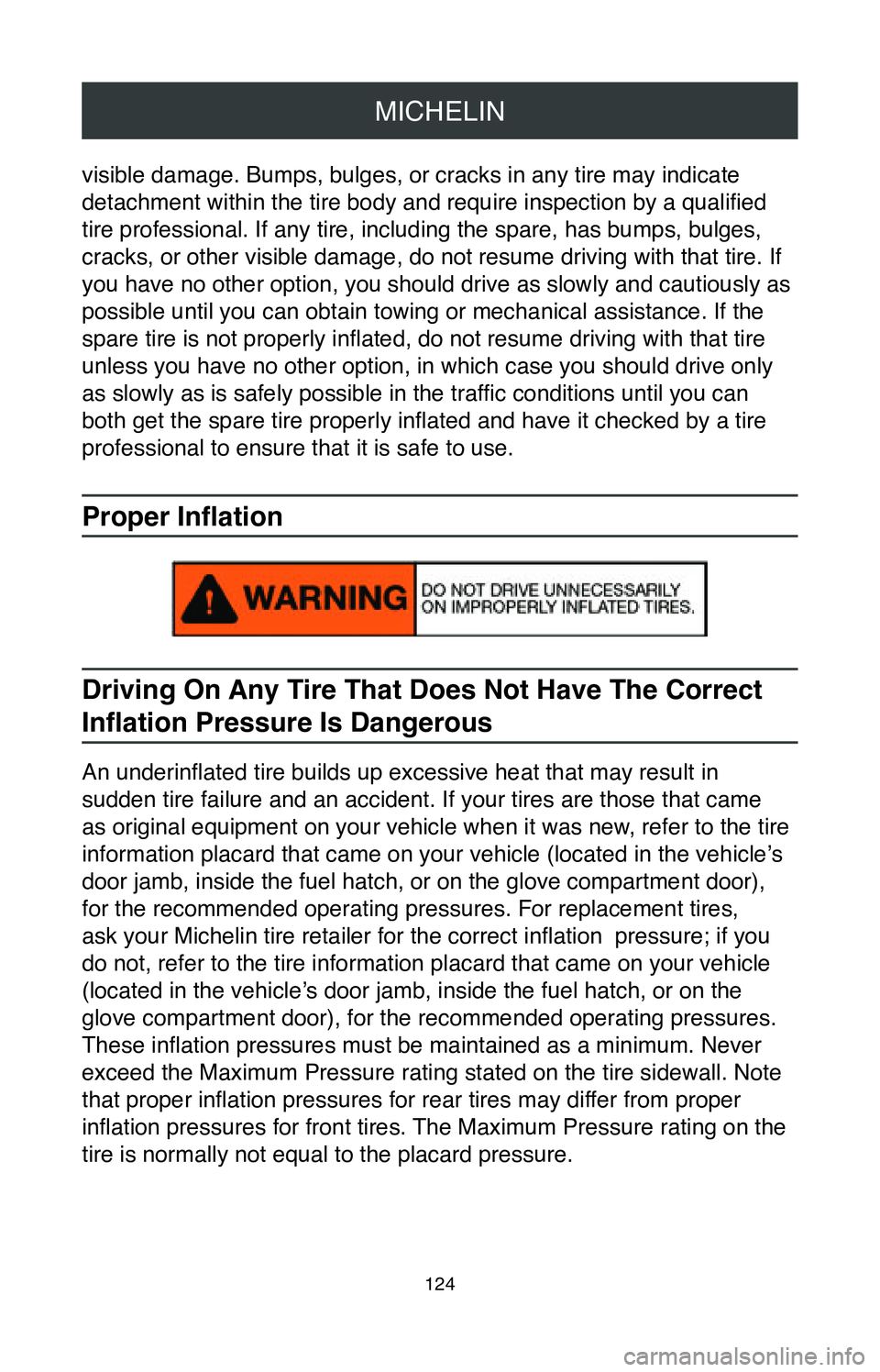
Proper Inflation
Driving On Any Tire That Does Not Have The Correct
Inflation Pressure Is Dangerous
An underinflated tire builds up excessive heat that may result in
sudden tire failure and an accident. If your tires are those that came
as original equipment on your vehicle when it was new, refer to the tire
information placard that came on your vehicle (located in the vehicle’s
door jamb, inside the fuel hatch, or on the glove compartment door),
for the recommended operating pressures. For replacement tires,
ask your Michelin tire retailer for the correct inflation pressure; if you
do not, refer to the tire information placard that came on your vehicle \
(located in the vehicle’s door jamb, inside the fuel hatch, or on the
glove compartment door), for the recommended operating pressures.
These inflation pressures must be maintained as a minimum. Never
exceed the Maximum Pressure rating stated on the tire sidewall. Note
that proper inflation pressures for rear tires may differ from proper
inflation pressures for front tires. The Maximum Pressure rating on the
tire is normally not equal to the placard pressure.
Page 127 of 260
MICHELIN
125
Check the Cold Inflation Pressure in All Your Tires,
Including the Spare, at Least Once Each Month
Failure to maintain correct inflation may result in improper vehicle
handling and may cause rapid and irregular tire wear, sudden tire
failure, loss of vehicle control, and an accident. Therefore, inflation
pressures should be checked at least once each month and before
every long-distance trip. This applies to all tires, including sealant
types and self-supporting tires, which are as susceptible to losing air
pressure as any other type of tire if not properly maintained. Pressures\
should be checked before the tires have been driven on or after they
have been allowed to cool down to the ambient air temperature.
Driving for even a short distance causes tires to heat up and their air \
pressure to increase, and recommended tire pressures are for tires
that have not been heated by recent driving on them.
Underinflation and Overinflation Must Be Checked
with a Tire Pressure Gauge
Tires must be checked monthly with a tire pressure gauge. It is
impossible to determine whether tires are properly inflated by simply
looking at them. It is almost impossible to feel or hear when a tire is \
being run underinflated or overinflated. Use an accurate tire pressure
gauge to check tire pressure each month. Small and inexpensive tire
pressure gauges are available. You should keep one in your vehicle’s
glove box or trunk and use it monthly and as otherwise needed.
Self-Supporting Zero Pressure™ (ZP) Tires at Low
or Zero Air Pressure
The handling characteristics of a vehicle with a deflated Self-
Supporting Zero Pressure (ZP) tire (whether front or rear) are not
the same as those of a vehicle with normally inflated tires. Avoid
high speeds and hard cornering whenever a low-pressure warning is
activated. Even a Self-Supporting Zero Pressure (ZP) tire can build
up excessive heat when run underinflated for an extended period of
time. The length of time and distance a Self-Supporting Zero Pressure
(ZP) tire will perform at low or zero inflation will depend on the severity
Page 128 of 260
MICHELIN
126
of the event causing air loss, the ambient temperature, the speed at
which the tire is operated, and the conditions under which the tire
is operated. In particular, hard braking, cornering, and other sharp
maneuvers will greatly reduce the length of time the tire can perform at\
low or zero inflation. Continuous use of an underinflated tire may lead
to sudden tire failure and an accident. If a tire at low or zero pressur\
e
begins to vibrate or cause difficulty in vehicle handling, replace it
immediately with the temporary spare. If Self-Supporting Zero Pressure
(ZP) tires are supplied as original equipment, refer to the vehicle
owner’s manual for complete details on the low tire pressure warning
system designed to alert you in the event of a low pressure condition.
MICHELIN
® SELF-SUPPORTING ZERO PRESSURE™ (ZP) TIRES
MUST BE USED ONLY WITH AN OPERATIONAL, MICHELIN
APPROVED, LOW TIRE PRESSURE WARNING SYSTEM. Otherwise,
all provisions of the limited warranty are void. For a list of approved \
systems, see your Michelin tire retailer or call 1-800-847- 3435. NOTE:
Some MICHELIN Self-Supporting Zero Pressure (ZP) tires can only be
mounted on special SH-M (Symmetric Hump - Modified) wheels. These
tires bear the special SH-M designation, molded into the sidewall of
the tire, next to the ZP designation. DO NOT MOUNT A TIRE WITH
THE SH-M DESIGNATION ON THE SIDEWALL ON A STANDARD
WHEEL. DOING SO VOIDS THIS LIMITED WARRANTY AND COULD
CAUSE THE TIRE TO BECOME UNSERVICEABLE AT LOW OR
ZERO PRESSURE, RESULTING IN SERIOUS PERSONAL INJURY
OR DEATH. For a list of approved systems, see your participating
Michelin
® tire retailer, or call 1-800-847-3435. For all types of tires,
consult your vehicle owner’s manual or the tire information placard
that came on your vehicle (located in the vehicle’s door jamb, inside
the fuel hatch, or on the glove compartment door) for recommended
operating pressures. Recommended operating pressures will be
provided by a Michelin tire retailer for self-supporting ZP tires. These
inflation pressures must be maintained as a minimum. Never exceed
the Maximum Pressure rating shown on the tire sidewall.
Page 129 of 260
MICHELIN
127
For Self-Supporting Zero Pressure (ZP) Tires, Check
Inflation Pressures as Soon as Possible Following a
Low Pressure Warning
Be certain to ensure that your vehicle’s Tire Pressure Monitoring
System (TPMS) is functioning and is correctly calibrated. Refer to your
vehicle owner’s manual or your vehicle dealer. Low pressure warning
systems are designed to alert the driver to a low inflation situation
in at least one tire on the vehicle. While your ZP tires are designed
to provide continued mobility in the event of an air loss, the sooner
you respond to a warning and take corrective action, the greater the
likelihood that the tire can be returned to service. Always visually
inspect your Self-Supporting tires and use a pressure gauge to check
the inflation in all 4 tires following any low pressure warning (unless
advised to do otherwise by the manufacturer of your low pressure
warning system). If the tire pressure is at or below 18 PSI, proceed to\
the Michelin tire retailer for ZP tires (or a representative of your vehicle
manufacturer if advised to do so in your vehicle owner’s manual) and
have the tire demounted and thoroughly inspected for possible internal
damage. If you are unable to see any damage to the tire, and the tire
pressure is more than 18 PSI, reinflate your tire to the proper inflation.
When tires have cooled, check inflation again. If any tire has lost more
than 5 PSI from the previous pressure check, have the tire inspected
at once by a Michelin tire retailer (or representative of your vehicle
manufacturer if your vehicle owner’s manual so advises.) Failure to do
so may cause irreparable damage to the tire and result in sudden tire
failure and an accident.
Tire Pressure Monitoring Systems (TPMS)
Your vehicle is likely equipped with a Tire Pressure Monitoring System
(TPMS) that is designed to monitor the pressure of tires mounted on
your vehicle and sends a signal to the driver if a tire pressure falls
below a predetermined level. A TPMS should not replace monthly
manual pressure checks for all four tires and the spare. You should
manually monitor and check tire pressure inflation with a pressure
gauge. Your tires should have the recommended pressure listed by
your vehicle’s manufacturer. This information can be found in the
Page 130 of 260
MICHELIN
128
vehicle owner’s manual and is on a placard located in the vehicle’s
door jamb, inside the fuel hatch, or on the glove compartment door. If
you have plus-size tires that require a higher inflation pressure, your
tire pressure monitoring system will require re-calibration to the new
proper inflation pressure. Refer to your tire dealer/installer of plus-size
tires for proper inflation pressure. You should check air pressure in all
your tires, including the spare, once each month and before every long
trip. Regardless whether your spare is a full-size spare or a mini-spare,
make sure that it is properly inflated. If the TPMS generates improper
monitoring or signals, you should consult your vehicle owner’s manual
and follow up with your vehicle’s manufacturer.
TIRE SPINNING
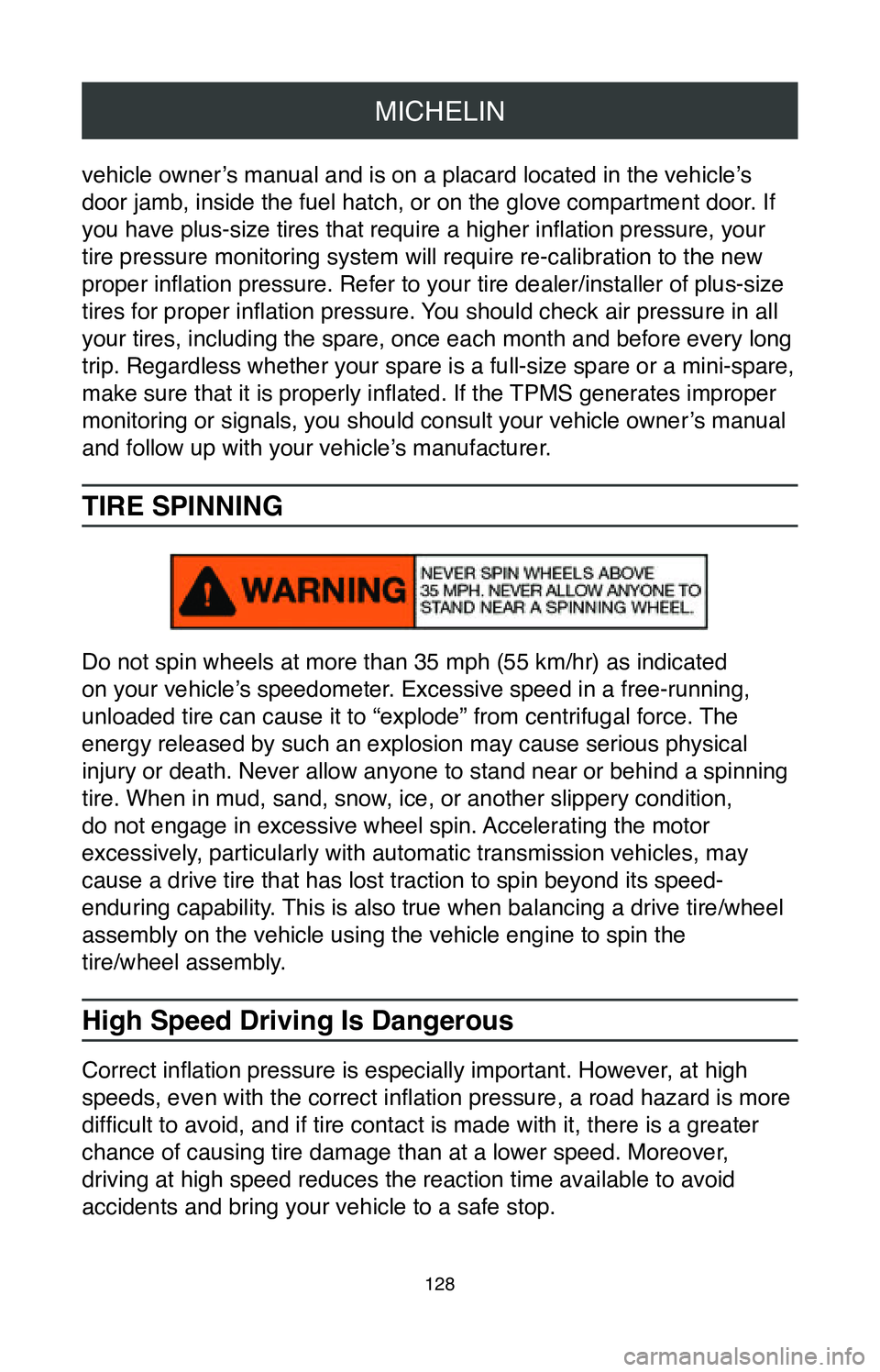
Do not spin wheels at more than 35 mph (55 km/hr) as indicated
on your vehicle’s speedometer. Excessive speed in a free-running,
unloaded tire can cause it to “explode” from centrifugal force. The
energy released by such an explosion may cause serious physical
injury or death. Never allow anyone to stand near or behind a spinning
tire. When in mud, sand, snow, ice, or another slippery condition,
do not engage in excessive wheel spin. Accelerating the motor
excessively, particularly with automatic transmission vehicles, may
cause a drive tire that has lost traction to spin beyond its speed-
enduring capability. This is also true when balancing a drive tire/wheel
assembly on the vehicle using the vehicle engine to spin the
tire/wheel assembly.
High Speed Driving Is Dangerous
Correct inflation pressure is especially important. However, at high
speeds, even with the correct inflation pressure, a road hazard is more
difficult to avoid, and if tire contact is made with it, there is a greater
chance of causing tire damage than at a lower speed. Moreover,
driving at high speed reduces the reaction time available to avoid
accidents and bring your vehicle to a safe stop.