inflation pressure TOYOTA C_HR HYBRID 2016 User Guide
[x] Cancel search | Manufacturer: TOYOTA, Model Year: 2016, Model line: C_HR HYBRID, Model: TOYOTA C_HR HYBRID 2016Pages: 712, PDF Size: 49.31 MB
Page 544 of 712
5447-3. Do-it-yourself maintenance
C-HR_HV_OM_Europe_OM10538E
■How to initialize the tire pressure warning system
Park the vehicle in a safe place and turn the power switch off.
Initialization cannot be performed while the vehicle is moving.
Adjust the tire inflation pressure to the specified cold tire inflation
pressure level. ( P. 674)
Make sure to adjust the tire pressure to the specified cold tire inflation
pressure level. The tire pressure warning system will operate based on
this pressure level.
Turn the power switch to ON mode.
Press “ ” or “” of the meter control switch to select .
( P. 129)
Press “ ” or “” of the meter control switch to select the “Vehicle
Settings” and then press to display the menu.
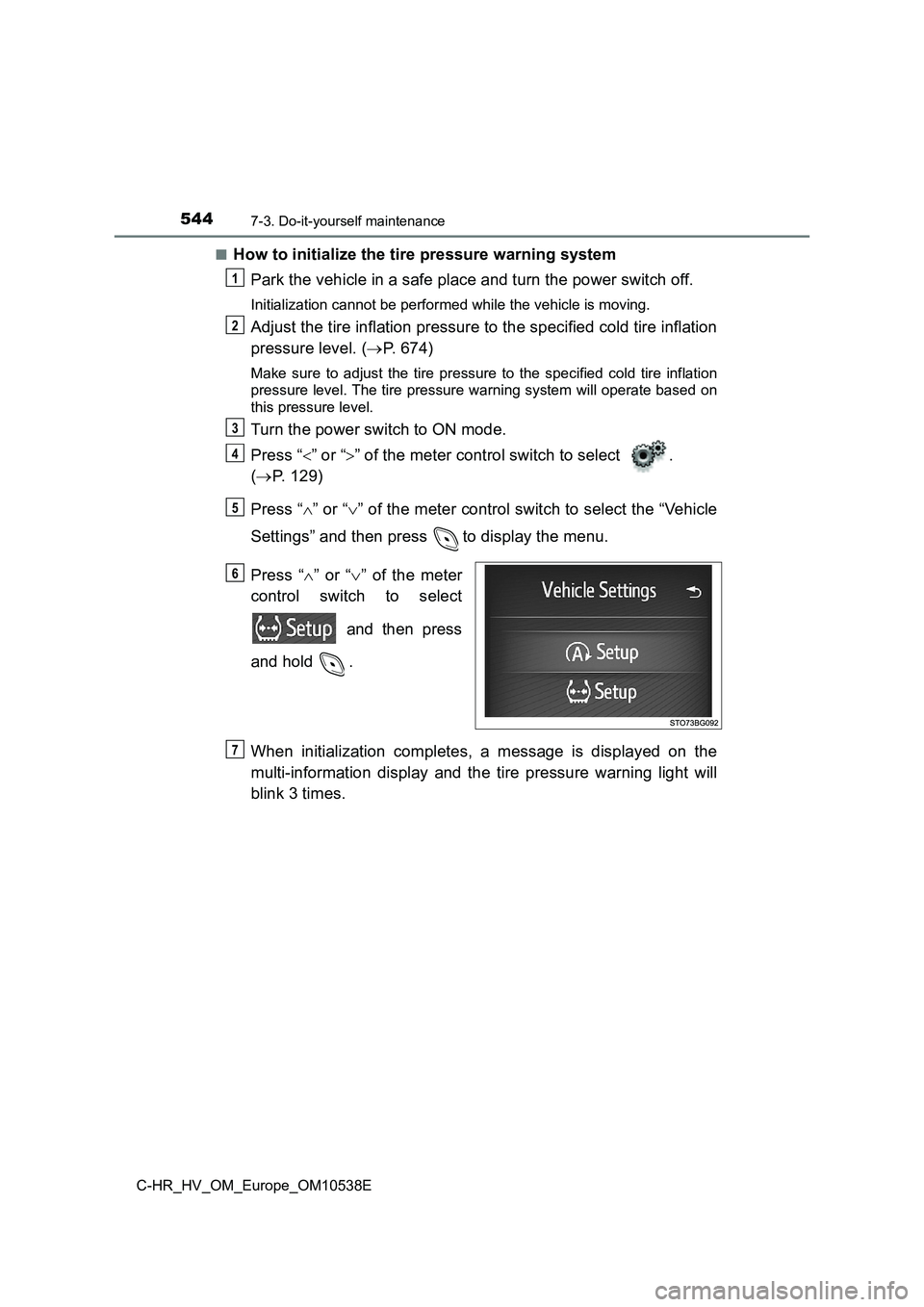
Press “ ” or “” of the meter
control switch to select
and then press
and hold .
When initialization completes, a message is displayed on the
multi-information display and the tire pressure warning light will
blink 3 times.
1
2
3
4
5
6
7
Page 545 of 712
5457-3. Do-it-yourself maintenance
C-HR_HV_OM_Europe_OM10538E
7
Maintenance and care
◆Registering ID codes
The tire pressure warning valve and transmitter is equipped with a
unique ID code. When replacing a tire pressure warning valve and
transmitter, it is necessary to register the ID code. Have the ID code
registered by any authorized Toyota retailer or Toyota authorized
repairer, or any reliable repairer.
■ When to replace your vehicle’s tires
Tires should be replaced if:
● The treadwear indicators are showing on a tire.
● You have tire damage such as cuts, splits, cracks deep enough to expose
the fabric, and bulges indicating internal damage.
● A tire goes flat repeatedly or cannot be properly repaired due to the size or
location of a cut or other damage.
If you are not sure, consult with any authorized Toyota retailer or Toyota
authorized repairer, or any reliable repairer.
■ Replacing tires and wheels
If the ID code of the tire pressure warning valve and transmitter is not regis-
tered, the tire pressure warning system will not work properly. After driving for
about 10 minutes, the tire pressure warning light blinks for 1 minute and stays
on to indicate a system malfunction.
■ Tire life
Any tire over 6 years old must be checked by a qualified technician even if it
has seldom or never been used, or damage is not obvious.
■ Routine tire inflation pressure check
The tire pressure warning system does not replace routine tire inflation pres-
sure checks. Make sure to check tire inflation pressure as part of your routine
of daily vehicle checks.
■ If the tread on snow tires wears down below 4 mm (0.16 in.)
The effectiveness of the tires as snow tires is lost.
Page 546 of 712
5467-3. Do-it-yourself maintenance
C-HR_HV_OM_Europe_OM10538E
■ Situations in which the tire pressure warning system may not operate
properly
● In the following cases, the tire pressure warning system may not operate
properly.
• If non-genuine Toyota wheels are used.
• A tire has been replaced with a tire t hat is not an OE (Original Equipment)
tire.
• A tire has been replaced with a tire that is not of the specified size.
• Tire chains, etc., are equipped.
• An auxiliary-supported run-flat tire is equipped.
• If a window tint that affects the radio wave signals is installed.
• If there is a lot of snow or ice on the vehicle, particularly around the
wheels or wheel housings.
• If the tire inflation pressure is extremely higher than the specified level.
• If wheels without the tire pressure warning valves and transmitters are
used.
• If the ID code on the tire pressure warning valves and transmitters is not
registered in the tire pressure warning computer.
● Performance may be affected in the following situations.
• Near a TV tower, electric power plant, gas station, radio station, large dis-
play, airport or other facility that generates strong radio waves or electri-
cal noise
• When carrying a portable radio, cellular phone, cordless phone or other
wireless communication device
● When the vehicle is parked, the time taken for the warning to start or go off
could be extended.
● When tire inflation pressure declines rapidly for example when a tire has
burst, the warning may not function.
Page 547 of 712
5477-3. Do-it-yourself maintenance
C-HR_HV_OM_Europe_OM10538E
7
Maintenance and care
■The initialization operation
● Make sure to carry out initialization after adjusting the tire inflation pressure.
Also, make sure the tires are cold before carrying out initialization or tire
inflation pressure adjustment.
● If you have accidentally turned the power switch off during initialization, it is
not necessary to press the reset switch again as initialization will restart
automatically when the power switch has been turned to ON mode for the
next time.
● If you accidentally press the reset switch when initialization is not necessary,
adjust the tire inflation pressure to the specified level when the tires are
cold, and conduct initialization again.
■ Warning performance of the tire pressure warning system
The warning of the tire pressure warning system will change in accordance
with the conditions under which it was initialized. For this reason, the system
may give a warning even if the tire pressure does not reach a low enough
level, or if the pressure is higher than the pressure that was adjusted to when
the system was initialized.
■ When initialization of the tire pressure warning system has failed
Initialization can be completed in a few minutes. However, in the following
cases, the settings have not been recorded and the system will not operate
properly. If repeated attempts to record tire inflation pressure settings are
unsuccessful, have the vehicle inspected by any authorized Toyota retailer or
Toyota authorized repairer, or any reliable repairer as soon as possible.
● When operating the initialization of the system, the tire pressure warning
light does not flash 3 times and the setting message does not appear on the
multi-information display.
● After driving for a certain period of time since the initialization has been
completed, the warning light comes on after blinking for 1 minute.
■ Registering ID codes
The ID codes of the tire pressure warning valve and transmitters for two sets
of wheels can be registered.
It is not necessary to register the ID codes when replacing normal tires with
snow tires, if the ID codes for the wheels of both normal tires and snow tires
are registered beforehand.
For information about changing ID codes, ask any authorized Toyota retailer
or Toyota authorized repairer, or any reliable repairer as soon as possible.
Page 551 of 712
5517-3. Do-it-yourself maintenance
C-HR_HV_OM_Europe_OM10538E
7
Maintenance and care
WARNING
■When inspecting or replacing tires
Observe the following precautions to prevent accidents.
Failure to do so may cause damage to parts of the drivetrain as well as dan-
gerous handling characteristics, which may lead to an accident resulting in
death or serious injury.
● Do not mix tires of different makes, models or tread patterns.
Also, do not mix tires of remarkably different treadwear.
● Do not use tire sizes other than those recommended by Toyota.
● Do not mix differently constructed tires (radial, bias-belted or bias-ply
tires).
● Do not mix summer, all season and snow tires.
● Do not use tires that have been used on another vehicle.
Do not use tires if you do not know how they were used previously.
● Vehicles with a compact spare tire: Do not tow if your vehicle has a com-
pact spare tire installed.
■ When initializing the tire pressure warning system
Do not initialize the tire pressure wa rning system without first adjusting the
tire inflation pressure to the specified level. Otherwise, the tire pressure
warning light may not come on even if the tire inflation pressure is low, or it
may come on when the tire inflation pressure is actually normal.
Page 552 of 712
5527-3. Do-it-yourself maintenance
C-HR_HV_OM_Europe_OM10538E
NOTICE
■Repairing or replacing tires, wheels, tire pressure warning valves,
transmitters and tire valve caps
● When removing or fitting the wheels, tires or the tire pressure warning
valves and transmitters, contact any authorized Toyota retailer or Toyota
authorized repairer, or any reliable repairer as the tire pressure warning
valves and transmitters may be damaged if not handled correctly.
● Make sure to install the tire valve caps. If the tire valve caps are not
installed, water could enter the tire pressure warning valves and the tire
pressure warning valves could be bound.
● When replacing tire valve caps, do not use tire valve caps other than those
specified.
The cap may become stuck.
■ Driving on rough roads
Take particular care when driving on roads with loose surfaces or potholes.
These conditions may cause losses in tire inflation pressure, reducing the
cushioning ability of the tires. In addition, driving on rough roads may cause
damage to the tires themselves, as well as the vehicle’s wheels and body.
■ To avoid damage to the tire pressure warning valves and transmitters
When a tire is repaired with liquid sealants, the tire pressure warning valve
and transmitter may not operate properly. If a liquid sealant is used, contact
any authorized Toyota retailer or Toyota authorized repairer, or any reliable
repairer or other qualified service shop as soon as possible. After use of liq-
uid sealant, make sure to replace the tire pressure warning valve and trans-
mitter when repairing or replacing the tire. ( P. 543)
■ If tire inflation pressure of each tire becomes low while driving
Do not continue driving, or your tires and/or wheels may be ruined.
Page 553 of 712
5537-3. Do-it-yourself maintenance
C-HR_HV_OM_Europe_OM10538E
7
Maintenance and care
Tire inflation pressure
■Effects of incorrect tire inflation pressure
Driving with incorrect tire inflation pressure may result in the following:
● Reduced fuel economy
● Reduced driving comfort and poor handling
● Reduced tire life due to wear
● Reduced safety
● Damage to the drivetrain
If a tire needs frequent inflating, have it checked by any authorized Toyota
retailer or Toyota authorized repairer, or any reliable repairer.
■ Instructions for checking tire inflation pressure
When checking tire inflation pressure, observe the following:
● Check only when the tires are cold.
If your vehicle has been parked for at least 3 hours or has not been driven
for more than 1.5 km or 1 mile, you will get an accurate cold tire inflation
pressure reading.
● Always use a tire pressure gauge.
It is difficult to judge if a tire is properly inflated based only on its appear-
ance.
● It is normal for the tire inflation pressure to be higher after driving as heat is
generated in the tire. Do not reduce tire inflation pressure after driving.
● Passengers and luggage weight should be placed so that the vehicle is bal-
anced.
Make sure to maintain proper tire inflation pressure. Tire infla-
tion pressure should be checked at least once per month. How-
ever, Toyota recommends that tire inflation pressure be checked
once every two weeks. ( P. 674)
Page 554 of 712
5547-3. Do-it-yourself maintenance
C-HR_HV_OM_Europe_OM10538E
WARNING
■Proper inflation is critical to save tire performance
Keep your tires properly inflated.
If the tires are not properly inflated, the following conditions may occur
which could lead to an accident resulting in death or serious injury:
● Excessive wear
● Uneven wear
● Poor handling
● Possibility of blowouts resulting from overheated tires
● Air leaking from between tire and wheel
● Wheel deformation and/or tire damage
● Greater possibility of tire damage while driving (due to road hazards,
expansion joints, sharp edges in the road, etc.)
NOTICE
■ When inspecting and adjusting tire inflation pressure
Be sure to put the tire valve caps back on.
If a valve cap is not installed, dirt or moisture may get into the valve and
cause an air leak, resulting in decreased tire inflation pressure.
Page 599 of 712
5998-2. Steps to take in an emergency
C-HR_HV_OM_Europe_OM10538E
8
When trouble arises
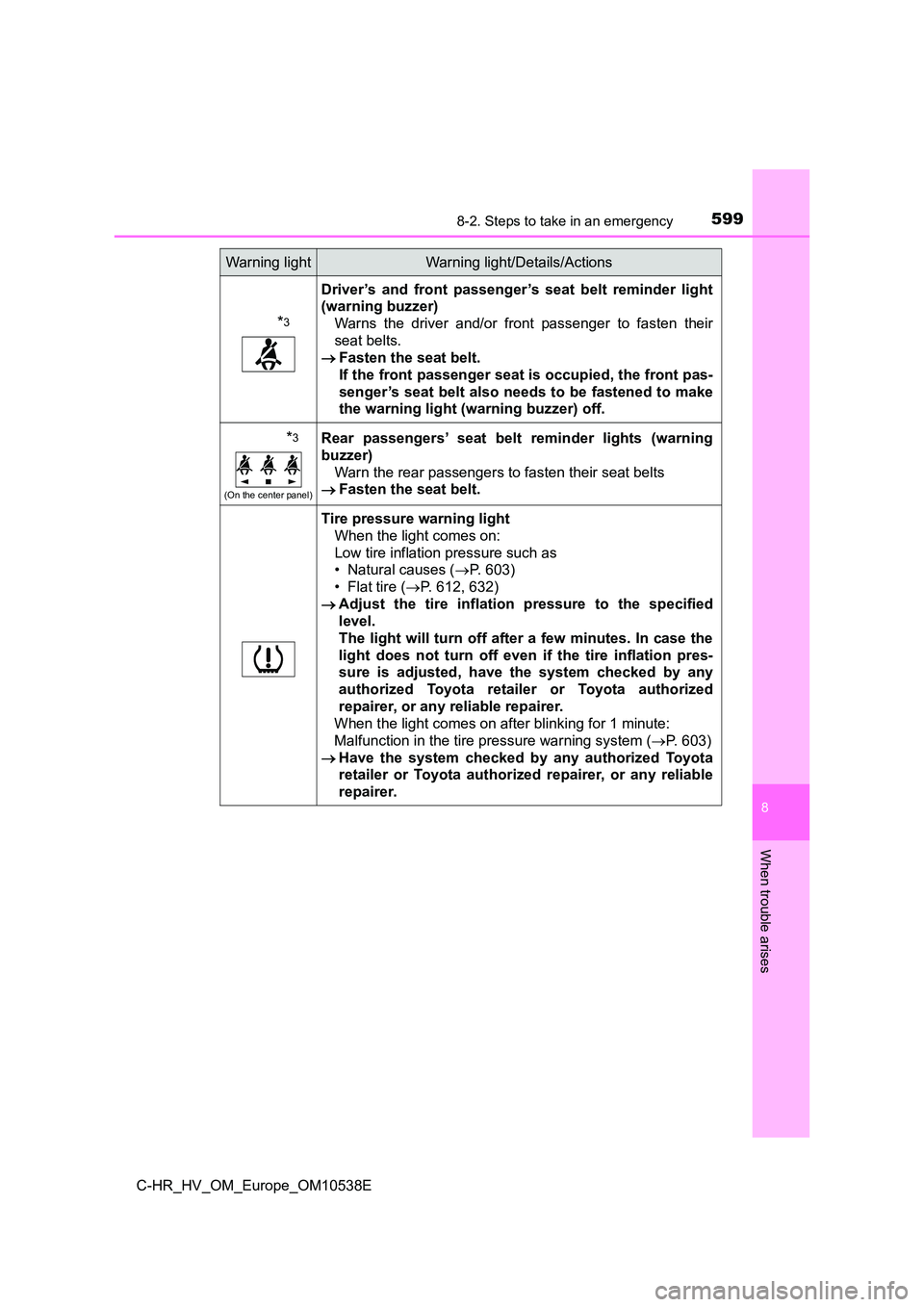
*3
Driver’s and front passenger’s seat belt reminder light
(warning buzzer)
Warns the driver and/or front passenger to fasten their
seat belts.
Fasten the seat belt.
If the front passenger seat is occupied, the front pas-
senger’s seat belt also need s to be fastened to make
the warning light (warning buzzer) off.
*3
(On the center panel)
Rear passengers’ seat belt reminder lights (warning
buzzer)
Warn the rear passengers to fasten their seat belts
Fasten the seat belt.
Tire pressure warning light
When the light comes on:
Low tire inflation pressure such as
• Natural causes ( P. 603)
• Flat tire ( P. 612, 632)
Adjust the tire inflation pressure to the specified
level.
The light will turn off after a few minutes. In case the
light does not turn off even if the tire inflation pres-
sure is adjusted, have the system checked by any
authorized Toyota retailer or Toyota authorized
repairer, or any reliable repairer.
When the light comes on after blinking for 1 minute:
Malfunction in the tire pressure warning system ( P. 603)
Have the system checked by any authorized Toyota
retailer or Toyota authorized repairer, or any reliable
repairer.
Warning lightWarning light/Details/Actions
Page 602 of 712
6028-2. Steps to take in an emergency
C-HR_HV_OM_Europe_OM10538E
■Electric power steering system warning light (warning buzzer)
When the 12-volt battery charge becomes insufficient or the voltage tempo-
rarily drops, the electric power steering system warning light may come on
and the warning buzzer may sound.
■ If the malfunction indicator lamp comes on while driving
For some models, the malfunction indicator lamp will come on if the fuel tank
becomes completely empty. If the fuel tank is empty, refuel the vehicle imme-
diately. The malfunction indicator lamp will go off after several trips.
If the malfunction indicator lamp does not go off, contact any authorized
Toyota retailer or Toyota authorized repairer, or any reliable repairer.
■ Front passenger detection sensor, seat belt reminder and warning
buzzer
● If luggage is placed on the front passenger seat, the front passenger detec-
tion sensor may cause the warning light to flash and the warning buzzer to
sound even if a passenger is not sitting in the seat.
● If a cushion is placed on the seat, the sensor may not detect a passenger,
and the warning light may not operate properly.
■ When the tire pressure warning light comes on
Inspect the appearance of the tire to check that the tire is not punctured.
If the tire is punctured: P. 612, 632
If the tire is not punctured:
Carry out the following procedure after the tire temperature has lowered suffi-
ciently.
● Check the tire inflation pressure and adjust to the appropriate level.
● If the warning light does not go out even after several minutes, check that
the tire inflation pressure is at the specified level and carry out initialization.
( P. 544)
The warning light may come on again if the above operations are conducted
without first allowing the tire temperature to lower sufficiently.