service TOYOTA C_HR HYBRID 2016 Owners Manual
[x] Cancel search | Manufacturer: TOYOTA, Model Year: 2016, Model line: C_HR HYBRID, Model: TOYOTA C_HR HYBRID 2016Pages: 712, PDF Size: 49.31 MB
Page 6 of 712
TABLE OF CONTENTS6
C-HR_HV_OM_Europe_OM10538E
7-1. Maintenance and care
Cleaning and protecting
the vehicle exterior ..........512
Cleaning and protecting
the vehicle interior ...........517
7-2. Maintenance
Maintenance
requirements....................520
7-3. Do-it-yourself maintenance
Do-it-yourself service
precautions ......................523
Hood ..................................526
Positioning a floor jack .......528
Engine compartment..........529
Tires ...................................541
Tire inflation pressure ........553
Wheels ...............................555
Air conditioning filter ..........558
Electronic key battery ........561
Checking and replacing
fuses ................................564
Light bulbs .........................568
8-1. Essential information
Emergency flashers .......... 586
If your vehicle has to
be stopped in an
emergency ...................... 587
8-2. Steps to take in an
emergency
If your vehicle needs
to be towed ..................... 588
If you think something is
wrong .............................. 594
If a warning light turns
on or a warning buzzer
sounds ............................ 595
If a warning message
is displayed ..................... 606
If you have a flat tire
(vehicles with
an emergency tire
puncture repair kit) ......... 612
If you have a flat tire
(vehicles with
a spare tire) ..................... 632
If the hybrid system will
not start ........................... 646
If the electronic key does
not operate properly ........ 648
If the 12-volt battery is
discharged ...................... 651
If your vehicle
overheats ........................ 657
If the vehicle becomes
stuck................................ 662
7Maintenance and care8When trouble arises
Page 92 of 712
921-3. Hybrid system
C-HR_HV_OM_Europe_OM10538E
Hybrid system precautions
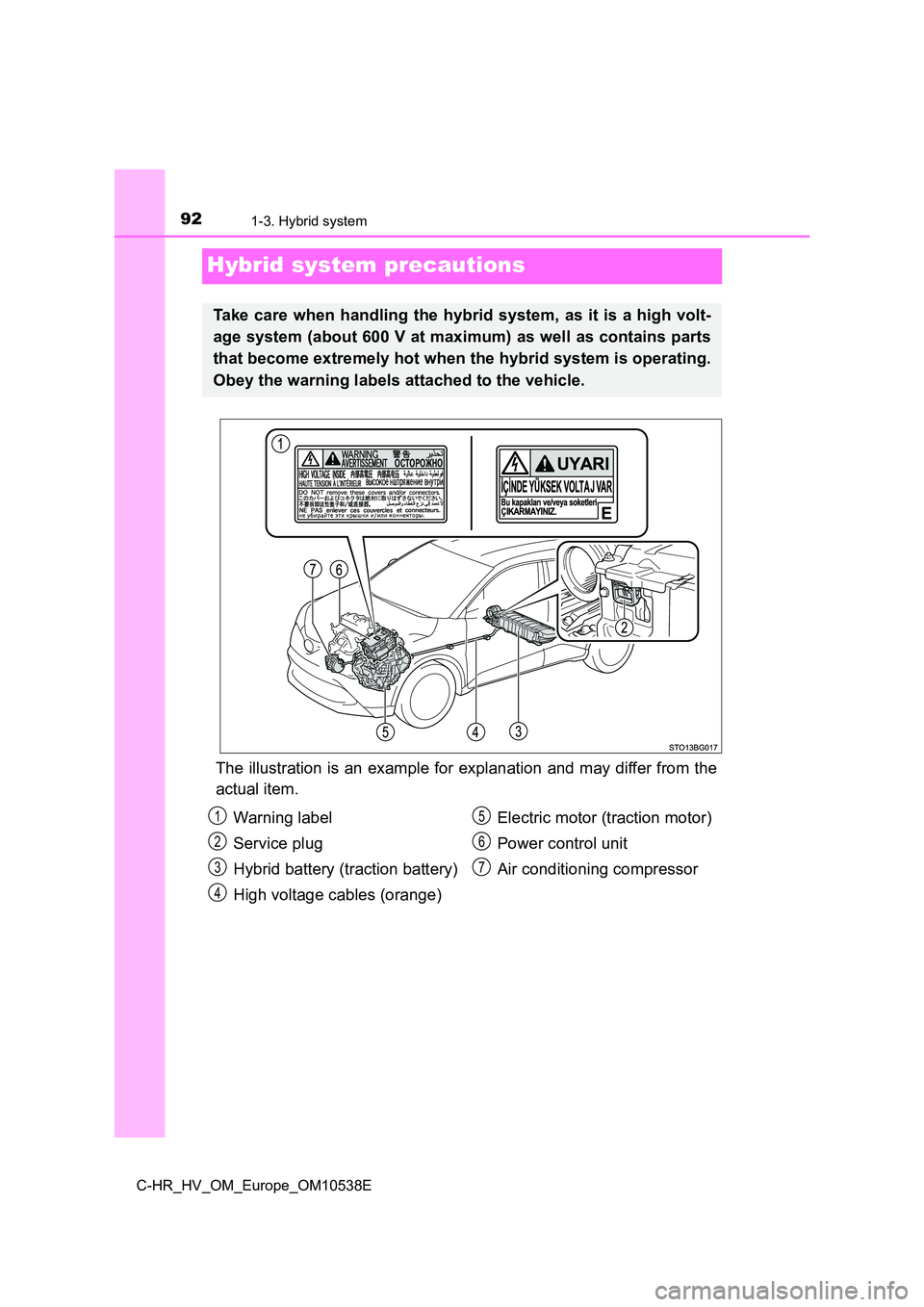
The illustration is an example for explanation and may differ from the
actual item.
Take care when handling the hybrid system, as it is a high volt-
age system (about 600 V at maximum) as well as contains parts
that become extremely hot when the hybrid system is operating.
Obey the warning labels attached to the vehicle.
Warning label
Service plug
Hybrid battery (traction battery)
High voltage cables (orange)
Electric motor (traction motor)
Power control unit
Air conditioning compressor
1
2
3
4
5
6
7
Page 94 of 712
941-3. Hybrid system
C-HR_HV_OM_Europe_OM10538E
■If a warning light comes on, a warning message is displayed, or the
12-volt battery is disconnected
The hybrid system may not start. In this case, try to start the system again. If
the “READY” indicator does not come on, contact any authorized Toyota
retailer or Toyota authorized repairer, or any reliable repairer.
■ Running out of fuel
When the vehicle has run out of fuel and the hybrid system cannot be started,
refuel the vehicle with at least enough gasoline to make the low fuel level
warning light ( P. 598) go off. If there is only a small amount of fuel, the
hybrid system may not be able to start. (The standard amount of fuel is about
7.5 L [2.0 gal., 1.7 Imp.gal.], when the vehicle is on a level surface. This value
may vary when the vehicle is on a slope. Add extra fuel when the vehicle is
inclined.)
■ Electromagnetic waves
● High voltage parts and cables on hybrid vehicles incorporate electromag-
netic shielding, and therefore emit approximately the same amount of elec-
tromagnetic waves as conventional gasoline powered vehicles or home
electronic appliances.
● Your vehicle may cause sound interference in some third party-produced
radio parts.
■ Hybrid battery (traction battery)
The hybrid battery (traction battery) has a limited service life. The lifespan of
the hybrid battery (traction battery) can change in accordance with driving
style and driving conditions.
■ Declaration of conformity
This model conforms to hydrogen emissions according to regulation ECE100
(Battery electric vehicle safety).
Page 95 of 712
951-3. Hybrid system
1
For safety and security
C-HR_HV_OM_Europe_OM10538E
WARNING
■High voltage precautions
This vehicle has high voltage DC and AC systems as well as a 12-volt sys-
tem. DC and AC high voltage is very dangerous and can cause severe
burns and electric shock that may result in death or serious injury.
● Never touch, disassemble, remove or replace the high voltage parts,
cables or their connectors.
● The hybrid system will become hot after starting as the system uses high
voltage. Be careful of both the high voltage and the high temperature, and
always obey the warning labels attached to the vehicle.
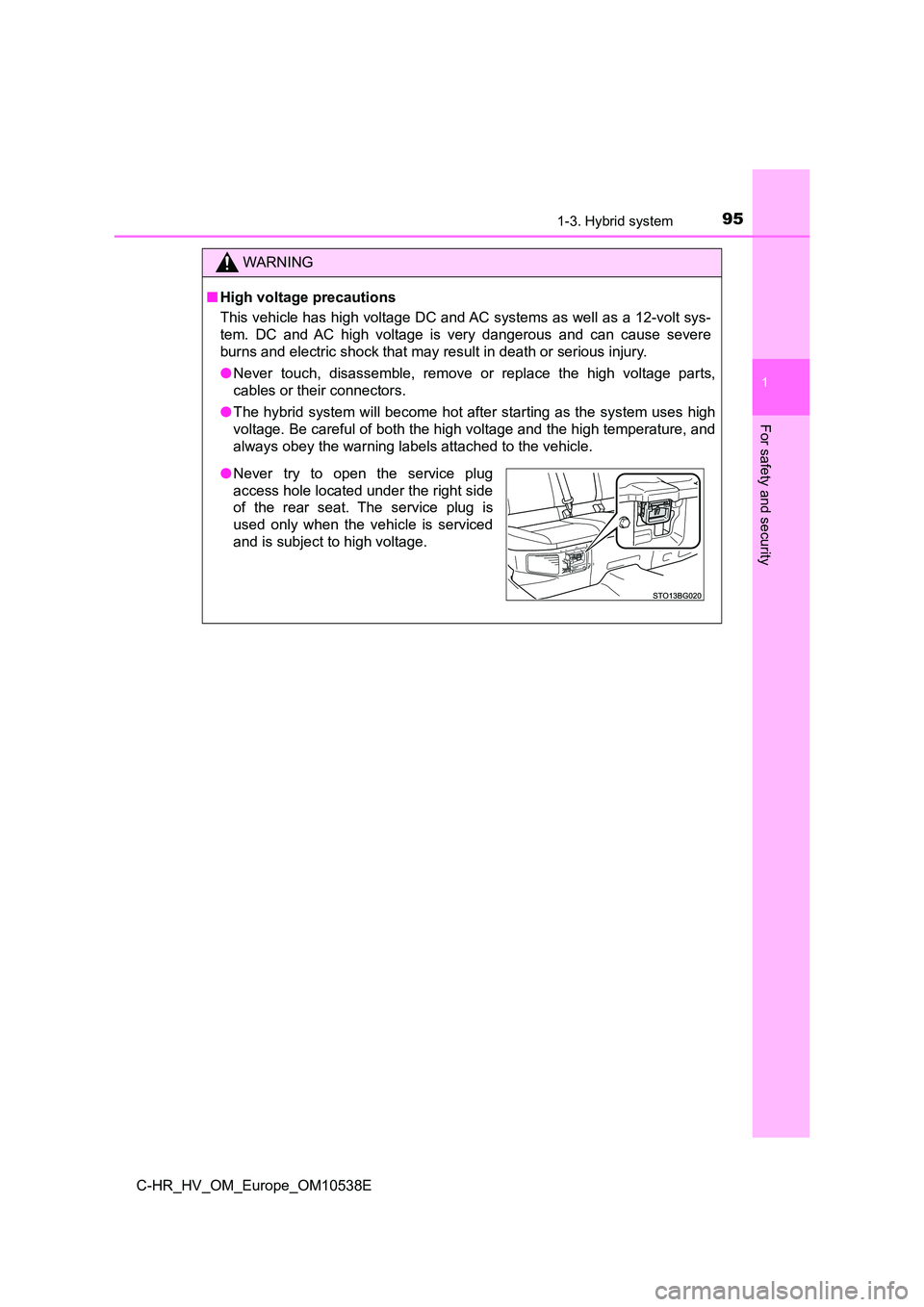
● Never try to open the service plug
access hole located under the right side
of the rear seat. The service plug is
used only when the vehicle is serviced
and is subject to high voltage.
Page 97 of 712
971-3. Hybrid system
1
For safety and security
C-HR_HV_OM_Europe_OM10538E
WARNING
■Hybrid battery (traction battery)
● Never resell, hand over or modify the hybrid battery. To prevent accidents,
hybrid batteries that have been removed from a disposed vehicle are col-
lected through any authorized Toyota retailer or Toyota authorized repairer,
or any reliable repairer. Do not dispose of the battery yourself.
Unless the battery is properly collected, the following may occur, resulting
in death or serious injury:
• The hybrid battery may be illegally disposed of or dumped, and it is haz-
ardous to the environment or someone may touch a high voltage part,
resulting in an electric shock.
• The hybrid battery is intended to be used exclusively with your hybrid
vehicle. If the hybrid battery is used outside of your vehicle or modified
in any way, accidents such as electric shock, heat generation, smoke
generation, an explosion and electrolyte leakage may occur.
When reselling or handing over your vehicle, the possibility of an accident
is extremely high because the person receiving the vehicle may not be
aware of these dangers.
● If your vehicle is disposed of without the hybrid battery having been
removed, there is a danger of serious electric shock if high voltage parts,
cables and their connectors are touched. In the event that your vehicle
must be disposed of, the hybrid battery must be disposed of by any autho-
rized Toyota retailer or Toyota authorized repairer, or any reliable repairer
or a qualified service shop. If the hybrid battery is not disposed of properly,
it may cause electric shock that can result in death or serious injury.
Page 412 of 712
4124-6. Driving tips
C-HR_HV_OM_Europe_OM10538E
Winter driving tips
●Use fluids that are appropriate to the prevailing outside tempera-
tures.
• Engine oil
• Engine/power control unit coolant
• Washer fluid
● Have a service technician inspect the condition of the 12-volt bat-
tery.
● Have the vehicle fitted with four snow tires or purchase a set of tire
chains for the front tires*.
Ensure that all tires are the same size and brand, and that chains match
the size of the tires.
*: Tire chains cannot be mounted on 18 inch tires.
Perform the following according to the driving conditions:
● Do not try to forcibly open a window or move a wiper that is frozen.
Pour warm water over the frozen area to melt the ice. Wipe away
the water immediately to prevent it from freezing.
● To ensure proper operation of the climate control system fan,
remove any snow that has accumulated on the air inlet vents in
front of the windshield.
● Check for and remove any excess ice or snow that may have accu-
mulated on the exterior lights, vehicle’s roof, chassis, around the
tires or on the brakes.
● Remove any snow or mud from the bottom of your shoes before
getting in the vehicle.
Carry out the necessary preparations and inspections before
driving the vehicle in winter. Always drive the vehicle in a man-
ner appropriate to the prevailing weather conditions.
Preparation for winter
Before driving the vehicle
Page 472 of 712
4725-10. Bluetooth®
C-HR_HV_OM_Europe_OM10538E
Bluetooth®
■When using the Bluetooth® audio/phone
● In the following situations, the system may not function.
• The portable player does not support Bluetooth®
• The cellular phone is located outside the service area
• The Bluetooth® device is switched off
• The Bluetooth® device has a low battery
• The Bluetooth® device is not connected to the system
• The Bluetooth® device is behind the seat or in the glove box or console
box, or metal material covers or touches the device
● There may be a delay if a cellular phone connection is made during Blue-
tooth® audio play.
● Depending on the type of portable audio player that is connected to the sys-
tem, operation may differ slightly and certain functions may not be available.
■ When transferring ownership of the vehicle
Be sure to initialize the system to prevent personal data from being improp-
erly accessed. ( P. 460)
Page 511 of 712
511
7Maintenance and care
C-HR_HV_OM_Europe_OM10538E
7-1. Maintenance and care
Cleaning and protecting
the vehicle exterior .......... 512
Cleaning and protecting
the vehicle interior ........... 517
7-2. Maintenance
Maintenance
requirements.................... 520
7-3. Do-it-yourself maintenance
Do-it-yourself service
precautions ...................... 523
Hood .................................. 526
Positioning a floor jack ....... 528
Engine compartment.......... 529
Tires ................................... 541
Tire inflation pressure ........ 553
Wheels ............................... 555
Air conditioning filter .......... 558
Electronic key battery ........ 561
Checking and replacing
fuses ................................ 564
Light bulbs ......................... 568
Page 520 of 712
5207-2. Maintenance
C-HR_HV_OM_Europe_OM10538E
Maintenance requirements
Scheduled maintenance should be performed at specified intervals
according to the maintenance schedule.
For full details of your maintenance schedule, refer to the “Toyota Service
Booklet” or “Toyota Warranty Booklet”.
What about do-it-yourself maintenance?
Many maintenance items are easy to do yourself if you have a little
mechanical ability and a few basic automotive tools.
Note, however, that some maintenance tasks require special tools and
skills. These are best performed by qualified technicians. Even if you’re an
experienced do-it-yourself mechanic, we recommend that repairs and
maintenance be conducted by any authorized Toyota retailer or Toyota
authorized repairer, or any reliable repairer. Any authorized Toyota retailers
or repairer will keep a record of maintenance, which could be useful should
you ever require Warranty Service. Should you choose to select a qualified
and equipped professional other than an authorized Toyota repairer to ser-
vice or maintain your vehicle, we recommend that you request that a
record of maintenance be kept.
To ensure safe and economical driving, day-to-day care and reg-
ular maintenance are essential. Toyota recommends the follow-
ing maintenance:
Scheduled maintenance
Do-it-yourself maintenance
Page 521 of 712
5217-2. Maintenance
C-HR_HV_OM_Europe_OM10538E
7
Maintenance and care
■Where to go for maintenance service?
In order to maintain your vehicle in the best possible condition, Toyota recom-
mends that maintenance service operations as well as other inspections and
repairs be carried out by authorized Toyota retailers or repairers or other duly
qualified and equipped professionals. For repairs and services covered by
your warranty, please visit an authorized Toyota retailers or repairer, who will
use genuine Toyota parts in repairing any difficulties you may encounter.
There can also be advantages in utilizing authorized Toyota retailers or
repairers for non-warranty repairs and services, as members of the Toyota
network will be able to expertly assist you with any difficulties you may
encounter.
Your authorized Toyota retailer or Toyo ta authorized repairer, or any reliable
repairer will perform all of the scheduled maintenance on your vehicle reliably
and economically due to their experience with Toyota vehicles.
■ Does your vehicle need repairs?
Be on the alert for changes in performance and sounds, and visual tip-offs
that indicate service is needed. Some important clues are:
● Engine misses, stumbling or pinging
● Appreciable loss of power
● Strange engine noises
● A fluid leak under the vehicle (However, water dripping from the air condi-
tioning system after use is normal.)
● Change in exhaust sound (This may indicate a dangerous carbon monoxide
leak. Drive with the windows open and have the exhaust system checked
immediately.)
● Flat-looking tires, excessive tire squeal when cornering, uneven tire wear
● Vehicle pulls to one side when driven straight on a level road
● Strange noises related to suspension movement
● Loss of brake effectiveness, spongy feeling brake pedal, pedal almost
touches the floor, vehicle pulls to one side when braking
● Engine coolant temperature continually higher than normal (P. 600, 657)
If you notice any of these clues, take your vehicle to any authorized Toyota
retailer or Toyota authorized repairer, or any reliable repairer as soon as pos-
sible. Your vehicle may need adjustment or repair.