trailer TOYOTA C_HR HYBRID 2016 Owners Manual
[x] Cancel search | Manufacturer: TOYOTA, Model Year: 2016, Model line: C_HR HYBRID, Model: TOYOTA C_HR HYBRID 2016Pages: 712, PDF Size: 49.31 MB
Page 3 of 712
3
1
6
5
4
3
2
C-HR_HV_OM_Europe_OM10538E
9
8
7
3-1. Key information
Keys ...................................144
3-2. Opening, closing and
locking the doors
Side doors..........................149
Back door...........................157
Smart entry & start
system .............................163
3-3. Adjusting the seats
Front seats .........................178
Rear seats .........................180
Head restraints ..................182
3-4. Adjusting the steering
wheel and mirrors
Steering wheel ...................186
Inside rear view mirror .......188
Outside rear view
mirrors .............................190
3-5. Opening and closing the
windows
Power windows ..................193
4-1. Before driving
Driving the vehicle ............. 200
Cargo and luggage............ 211
Trailer towing..................... 212
4-2. Driving procedures
Power (ignition) switch ...... 221
EV drive mode................... 228
Hybrid transmission........... 231
Turn signal lever................ 235
Parking brake .................... 236
Brake hold ......................... 241
4-3. Operating the lights
and wipers
Headlight switch ................ 244
Automatic High Beam ....... 249
Fog light switch ................. 254
Windshield wipers and
washer ............................ 256
Rear window wiper and
washer ............................ 259
4-4. Refueling
Opening the fuel tank
cap .................................. 261
3Operation of each
component4Driving
Page 199 of 712
199
4Driving
C-HR_HV_OM_Europe_OM10538E
4-1. Before driving
Driving the vehicle ............. 200
Cargo and luggage ............ 211
Trailer towing ..................... 212
4-2. Driving procedures
Power (ignition) switch ....... 221
EV drive mode ................... 228
Hybrid transmission ........... 231
Turn signal lever ................ 235
Parking brake .................... 236
Brake hold ......................... 241
4-3. Operating the lights
and wipers
Headlight switch ................ 244
Automatic High Beam ........ 249
Fog light switch .................. 254
Windshield wipers and
washer ............................. 256
Rear window wiper and
washer ............................. 259
4-4. Refueling
Opening the fuel tank
cap ................................... 261
4-5. Using the driving
support systems
Toyota Safety Sense ......... 267
PCS (Pre-Collision
System) ........................... 274
LDA (Lane Departure Alert
with steering control) ....... 289
RSA (Road Sign Assist)..... 301
Dynamic radar cruise
control with full-speed
range ............................... 307
Cruise control..................... 322
Driving mode select ........... 328
Speed limiter ...................... 330
BSM
(Blind Spot Monitor) ......... 335
• BSM function ................. 341
• RCTA function ............... 346
Toyota parking
assist-sensor ................... 351
S-IPA (Simple Intelligent
Parking Assist
System) ........................... 363
Driving assist systems ....... 402
4-6. Driving tips
Hybrid vehicle driving
tips ................................... 409
Winter driving tips .............. 412
Page 203 of 712
2034-1. Before driving
4
Driving
C-HR_HV_OM_Europe_OM10538E
■ Breaking in your new Toyota
To extend the life of the vehicle, observing the following precautions is recom-
mended:
● For the first 300 km (200 miles):
Avoid sudden stops.
● For the first 800 km (500 miles):
Do not tow a trailer.
● For the first 1600 km (1000 miles):
• Do not drive at extremely high speeds.
• Avoid sudden acceleration.
• Do not drive at a constant speed for extended periods.
■ Operating your vehicle in a foreign country
Comply with the relevant vehicle registration laws and confirm the availability
of the correct fuel. ( P. 669)
■ Eco-friendly driving
P. 127
WARNING
Observe the following precautions.
Failure to do so may result in death or serious injury.
■ When starting the vehicle
Always keep your foot on the brake pedal while stopped with the “READY”
indicator is illuminated. This prevents the vehicle from creeping.
Page 212 of 712
2124-1. Before driving
C-HR_HV_OM_Europe_OM10538E
Trailer towing
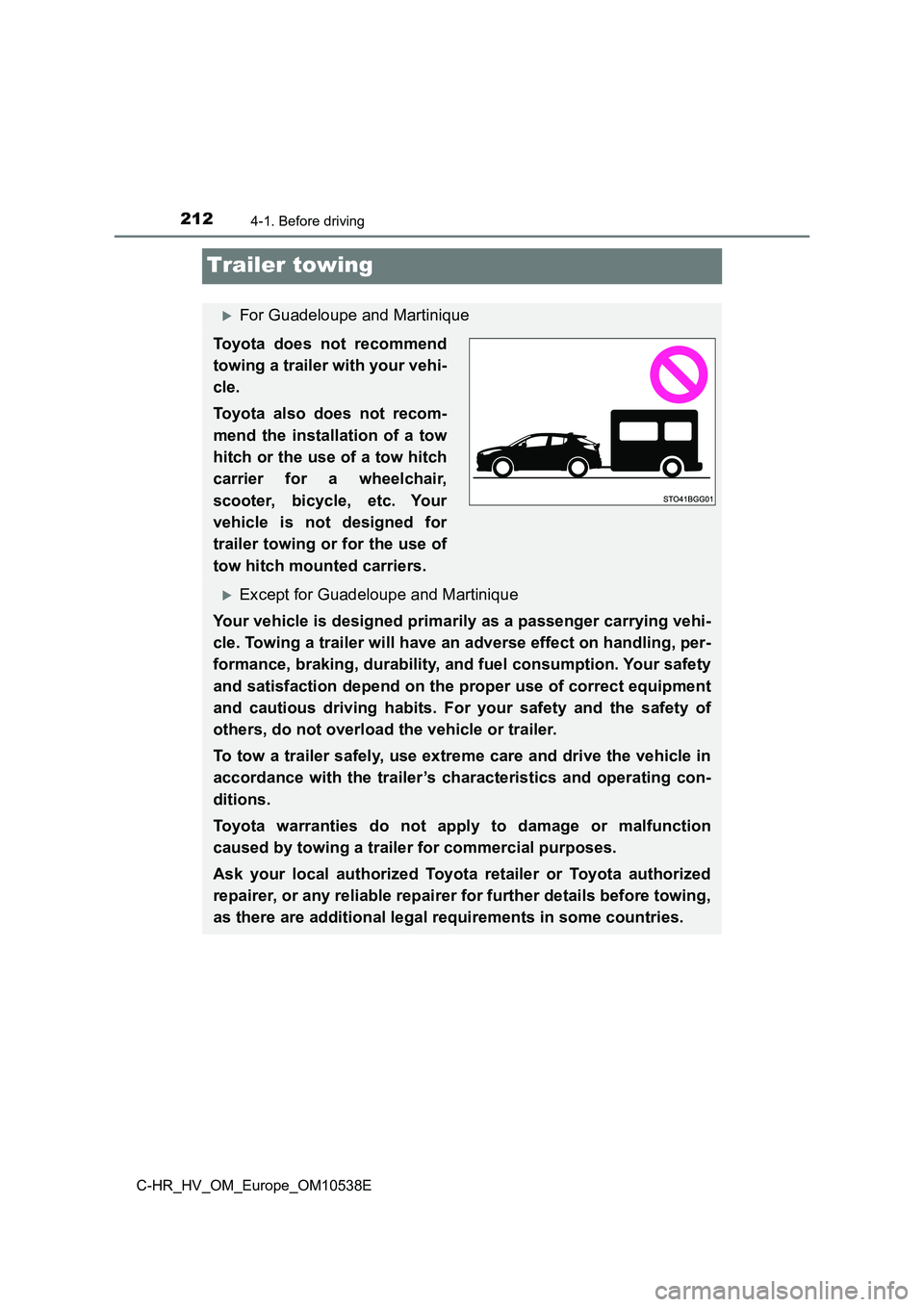
For Guadeloupe and Martinique
Toyota does not recommend
towing a trailer with your vehi-
cle.
Toyota also does not recom-
mend the installation of a tow
hitch or the use of a tow hitch
carrier for a wheelchair,
scooter, bicycle, etc. Your
vehicle is not designed for
trailer towing or for the use of
tow hitch mounted carriers.
Except for Guadeloupe and Martinique
Your vehicle is designed primarily as a passenger carrying vehi-
cle. Towing a trailer will have an adverse effect on handling, per-
formance, braking, durability, and fuel consumption. Your safety
and satisfaction depend on the proper use of correct equipment
and cautious driving habits. For your safety and the safety of
others, do not overload the vehicle or trailer.
To tow a trailer safely, use extreme care and drive the vehicle in
accordance with the trailer’s characteristics and operating con-
ditions.
Toyota warranties do not apply to damage or malfunction
caused by towing a trailer for commercial purposes.
Ask your local authorized Toyota retailer or Toyota authorized
repairer, or any reliable repairer for further details before towing,
as there are additional legal requirements in some countries.
Page 213 of 712
2134-1. Before driving
4
Driving
C-HR_HV_OM_Europe_OM10538E
◆Weight limits
Check the allowable towing capacity, GVM (Gross Vehicle Mass),
MPAC (Maximum Permissible Axle Capacity), and permissible
drawbar load before towing. ( P. 666)
◆Towing hitch/bracket
Toyota recommends the use of the Toyota hitch/bracket for your
vehicle. Other products of a suitable nature and comparable quality
may also be used.
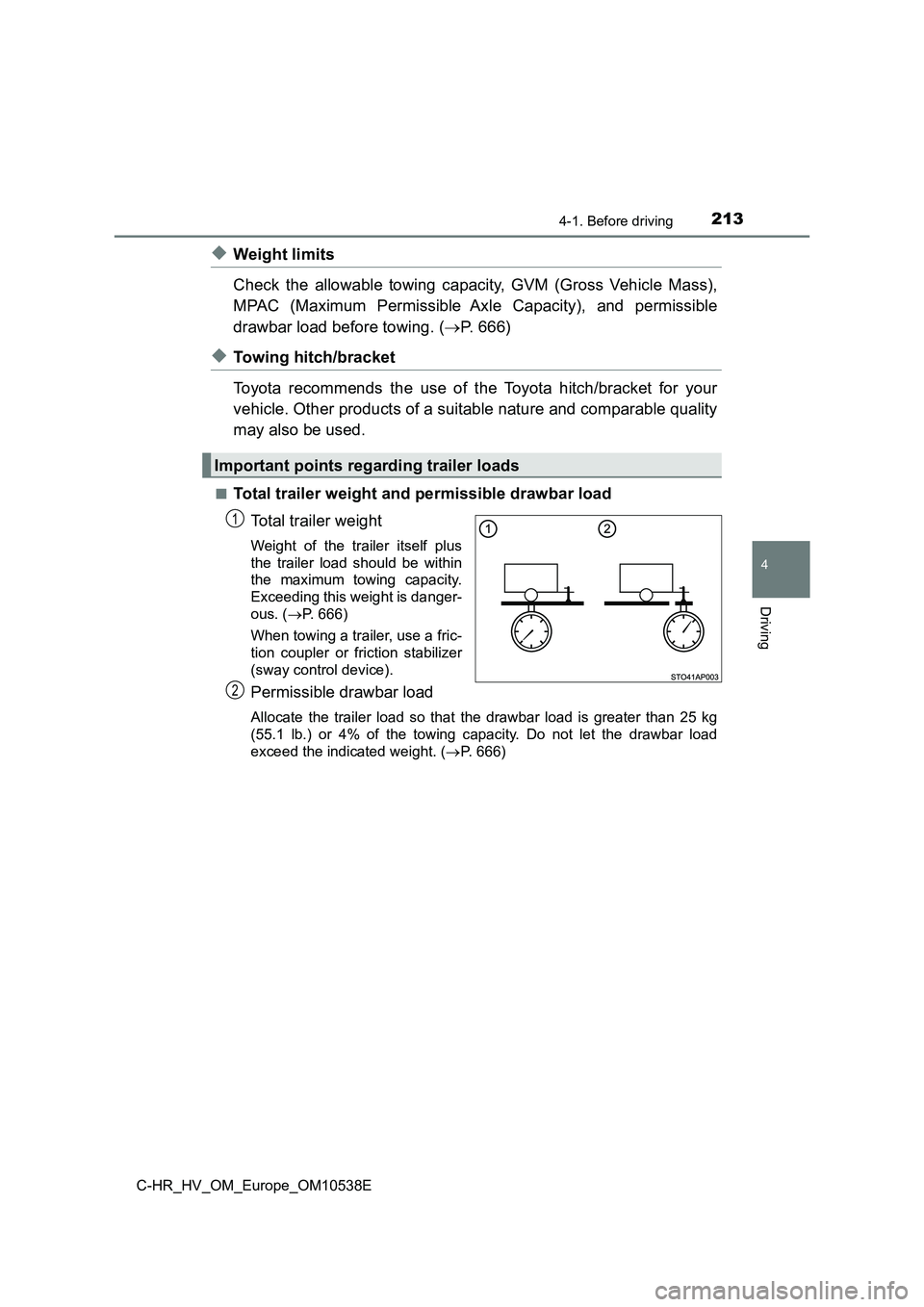
■Total trailer weight and permissible drawbar load
Total trailer weight
Weight of the trailer itself plus
the trailer load should be within
the maximum towing capacity.
Exceeding this weight is danger-
ous. ( P. 666)
When towing a trailer, use a fric-
tion coupler or friction stabilizer
(sway control device).
Permissible drawbar load
Allocate the trailer load so that the drawbar load is greater than 25 kg
(55.1 lb.) or 4% of the towing c apacity. Do not let the drawbar load
exceed the indicated weight. ( P. 666)
Important points regarding trailer loads
1
2
Page 214 of 712
2144-1. Before driving
C-HR_HV_OM_Europe_OM10538E
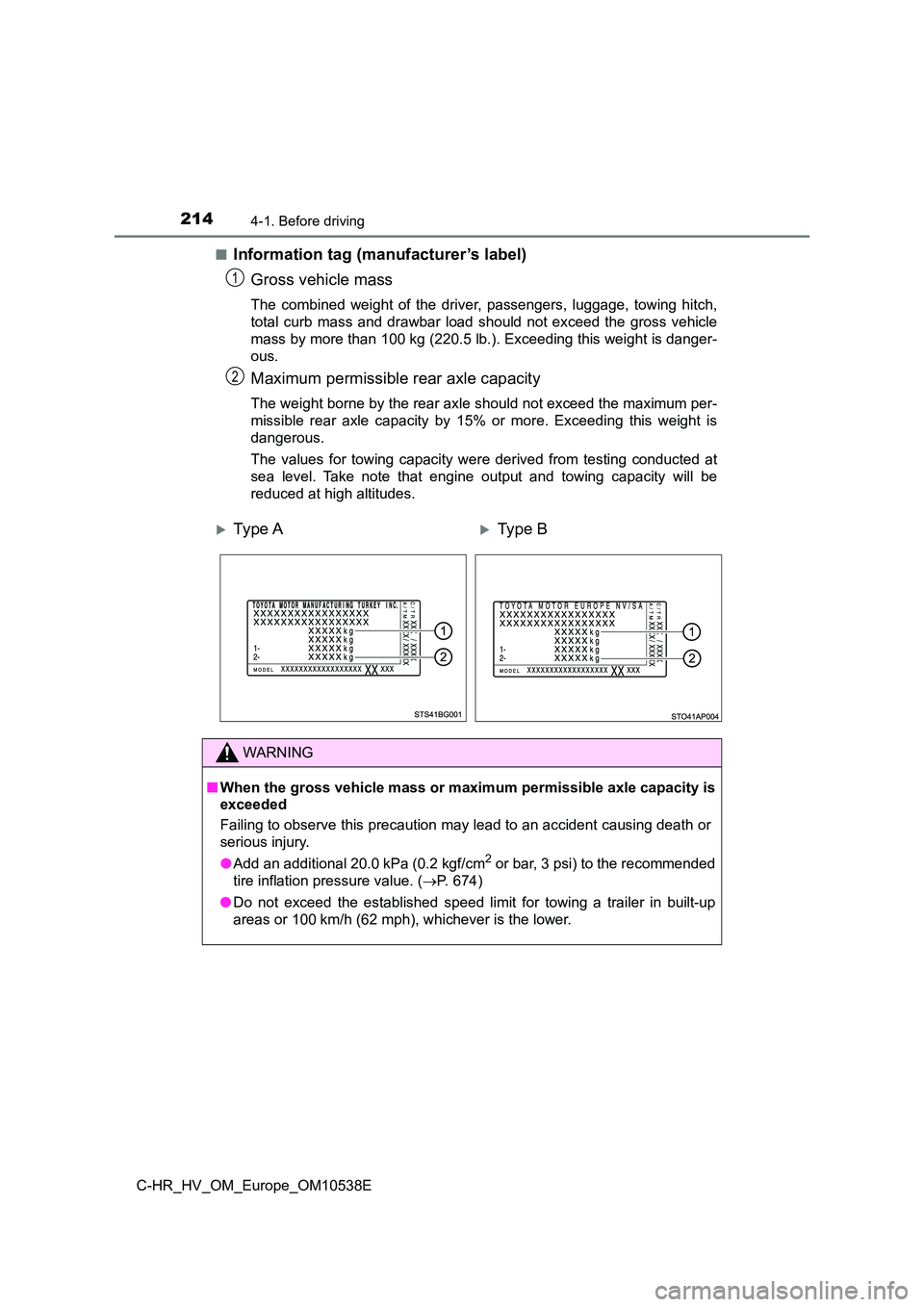
■Information tag (manufacturer’s label)
Gross vehicle mass
The combined weight of the driver, passengers, luggage, towing hitch,
total curb mass and drawbar load should not exceed the gross vehicle
mass by more than 100 kg (220.5 lb.). Exceeding this weight is danger-
ous.
Maximum permissible rear axle capacity
The weight borne by the rear axle should not exceed the maximum per-
missible rear axle capacity by 15% or more. Exceeding this weight is
dangerous.
The values for towing capacity were derived from testing conducted at
sea level. Take note that engine output and towing capacity will be
reduced at high altitudes.
Ty pe AType B
WARNING
■ When the gross vehicle mass or maximum permissible axle capacity is
exceeded
Failing to observe this precaution may lead to an accident causing death or
serious injury.
● Add an additional 20.0 kPa (0.2 kgf/cm2 or bar, 3 psi) to the recommended
tire inflation pressure value. ( P. 674)
● Do not exceed the established speed limit for towing a trailer in built-up
areas or 100 km/h (62 mph), whichever is the lower.
1
2
Page 216 of 712
2164-1. Before driving
C-HR_HV_OM_Europe_OM10538E
■Tire information
● Increase the tire inflation pressure to 20.0 kPa (0.2 kgf/cm2 or bar, 3 psi)
greater than the recommended value when towing. ( P. 674)
● Increase the air pressure of the trailer tires in accordance with the total
trailer weight and according to the values recommended by the manufac-
turer of your trailer.
■ Tr a i l e r l i g h ts
Please consult at any authorized retailer or Toyota authorized repairer, or any
reliable repairer when installing trailer lights, as incorrect installation may
cause damage to the vehicle’s lights. Please take care to comply with your
state’s laws when installing trailer lights.
■ Break-in schedule
Toyota recommends that vehicles fitted with new power train components
should not be used for towing trailers for the first 800 km (500 miles).
■ Safety checks before towing
● Check that the maximum load limit for the towing hitch/bracket and hitch ball
is not exceeded. Bear in mind that the coupling weight of the trailer will add
to the load exerted on the vehicle. Also make sure that the total load exerted
on the vehicle is within the range of the weight limits. ( P. 213)
● Ensure that the trailer load is secure.
● Supplementary outside rear view mirrors should be added to the vehicle if
the traffic behind cannot be clearly seen with standard mirrors. Adjust the
extending arms of these mirrors on both sides of the vehicle so that they
always provide maximum visibility of the road behind.
■ Maintenance
● Maintenance must be performed more frequently when using the vehicle for
towing due to the greater weight burden placed on the vehicle compared to
normal driving.
● Retighten all bolts securing the hitching ball and bracket after towing for
approximately 1000 km (600 miles).
Page 218 of 712
2184-1. Before driving
C-HR_HV_OM_Europe_OM10538E
Your vehicle will handle differently when towing a trailer. In order to
avoid accident, death or serious injury, keep the following in mind
when towing:
■Checking connections between trailer and lights
Stop the vehicle and check the operation of the connection between
the trailer and lights after driving for a brief period as well as before
starting off.
■Practicing driving with a coupled trailer
● Get the feel for turning, stopping and reversing with the trailer
coupled by practicing in an area with no or light traffic.
● When reversing with a coupled trailer, hold the section of the
steering wheel nearest to you and rotate clockwise to turn the
trailer left or counterclockwise to turn it right. Always rotate a little
at a time to prevent steering error. Have someone guide you
when reversing to lessen the risk of an accident.
■Increasing vehicle-to-vehicle distance
At a speed of 10 km/h (6 mph), the distance to the vehicle running
ahead of you should be equivalent to or greater than the combined
length of your vehicle and trailer. Avoid sudden braking that may
cause skidding. Otherwise, the vehicle may spin out of control. This
is especially true when driving on wet or slippery road surfaces.
■Sudden acceleration/steering input/cornering
Executing sharp turns when towing may result in the trailer colliding
with your vehicle. Decelerate well in advance when approaching
turns and take them slowly and carefully to avoid sudden braking.
■Important points regarding turning
The wheels of the trailer will travel closer to the inside of the curve
than the wheels of the vehicle. To make allowance for this, take the
turns wider than you would normally do.
Guidance
Page 219 of 712
2194-1. Before driving
4
Driving
C-HR_HV_OM_Europe_OM10538E
■Important points regarding stability
Vehicle movement resulting from uneven road surfaces and strong
crosswinds will affect handling. The vehicle may also be rocked by
passing buses or large trucks. Frequently check behind when mov-
ing alongside such vehicles. As soon as such vehicle movement
occurs, immediately start to decelerate smoothly by slowly applying
the brakes. Always steer the vehicle straight ahead while braking.
■Passing other vehicles
Consider the total combined length of your vehicle and trailer and
ensure that the vehicle-to-vehicle distance is sufficient before exe-
cuting lane changes.
■Transmission information
To maintain engine braking efficiency and charging system perfor-
mance when using engine braking, do not use the transmission in
D. Shift the shift lever to B.
■If the engine overheats
Towing a loaded trailer up a long, steep incline in temperatures
exceeding 30 C (85F) may result in the engine overheating. If the
engine coolant temperature gauge indicates that the engine is over-
heating, turn the air conditioning off immediately, leave the road and
stop the vehicle in a safe place. ( P. 657)
■When parking the vehicle
Always place wheel chocks under the wheels of both the vehicle
and trailer. Firmly set the parking brake and shift the shift lever to P.
Page 220 of 712
2204-1. Before driving
C-HR_HV_OM_Europe_OM10538E
WARNING
Follow all the instructions described in this section.
Failure to do so could cause an accident resulting in death or serious injury.
■ Trailer towing precautions
When towing, make sure that none of the weight limits are exceeded.
( P. 2 1 3 )
■ To avoid accident or injury
● Vehicles with a compact spare tire:
Do not tow a trailer when the compact spare tire is installed on your vehi-
cle.
● Vehicles with an emergency tire puncture repair kit:
Do not tow a trailer when the tire installed is repaired with the emergency
tire puncture repair kit.
● Do not use the following systems when trailer towing.
• Cruise control*
• Dynamic radar cruise control with full-speed range*
• LDA (Lane-Departure Alert with steering control)*
• PCS (Pre-Collision System)*
• BSM (Blind Spot Monitor)*
*: If equipped
■ Vehicle speed in towing
Observe the legal maximum speeds for trailer towing.
■ Before descending hills or long declines
Reduce speed and downshift. However, never downshift suddenly while
descending steep or long downhill grades.
■ Operation of the brake pedal
Do not hold the brake pedal depressed often or for long periods of time.
Doing so may result in the brake overheating or reduce braking effects.
NOTICE
■ Do not directly splice trailer lights
Directly splicing trailer lights may damage your vehicle’s electrical system
and cause a malfunction.