trailer TOYOTA C_HR HYBRID 2016 User Guide
[x] Cancel search | Manufacturer: TOYOTA, Model Year: 2016, Model line: C_HR HYBRID, Model: TOYOTA C_HR HYBRID 2016Pages: 712, PDF Size: 49.31 MB
Page 253 of 712
2534-3. Operating the lights and wipers
4
Driving
C-HR_HV_OM_Europe_OM10538E
● In the situations shown below, the system may not be able to accurately
detect surrounding brightness levels. This may cause the low beams to
remain on or the high beams to cause problems for pedestrians, vehicles
ahead or other parties. In these cases, manually switch between the high
and low beams.
• In bad weather (rain, snow, fog, sandstorms, etc.)
• The windshield is obscured by fog, mist, ice, dirt, etc.
• The windshield is cracked or damaged.
• The camera sensor is deformed or dirty.
• The camera sensor temperature is extremely high.
• Surrounding brightness levels are equal to those of headlights, tail lights
or fog lights.
• Vehicles ahead have headlights that are either switched off, dirty, are
changing color, or ar e not aimed properly.
• When driving through an area of intermittently changing brightness and
darkness.
• When frequently and repeatedly driving ascending/descending roads, or
roads with rough, bumpy or uneven surfaces (such as stone-paved
roads, gravel tracks, etc.).
• When frequently and repeatedly taking curves or driving on a winding
road.
• There is a highly reflective object ahead of the vehicle, such as a sign or
a mirror.
• The back of a vehicle ahead is highly reflective, such as a container on a
truck.
• The vehicle’s headlights are damaged or dirty.
• The vehicle is listing or tilting, due to a flat tire, a trailer being towed, etc.
• The high beam and low beam are repeatedly being switched between in
an abnormal manner.
• The driver believes that the high beam may be causing problems or dis-
tress to other drivers or pedestrians nearby.
■ If “Headlight System Malfunction. Visit Your Dealer.” is displayed on the
multi-information display
The system may be malfunctioning. Have the vehicle inspected by any autho-
rized Toyota retailer or Toyota authorized repairer, or any reliable repairer.
Page 285 of 712
2854-5. Using the driving support systems
4
Driving
C-HR_HV_OM_Europe_OM10538E
■ Situations in which the system may not operate properly
● In some situations such as the following, a vehicle may not be detected by
the radar sensor and camera sensor, preventing the system from operating
properly:
• If an oncoming vehicle is approaching your vehicle
• If a vehicle ahead is a motorcycle or bicycle
• When approaching the side or front of a vehicle
• If a preceding vehicle has a small rear end, such as an unloaded truck
• If a vehicle ahead is carrying a load which protrudes past its rear bumper
• If a vehicle ahead is irregularly shaped, such as a tractor or side car
• If the sun or other light is shining directly on a vehicle ahead
• If a vehicle cuts in front of your vehicle or emerges from beside a vehicle
• If a vehicle ahead makes an abrupt maneuver (such as sudden swerving,
acceleration or deceleration)
• When suddenly cutting behind a preceding vehicle
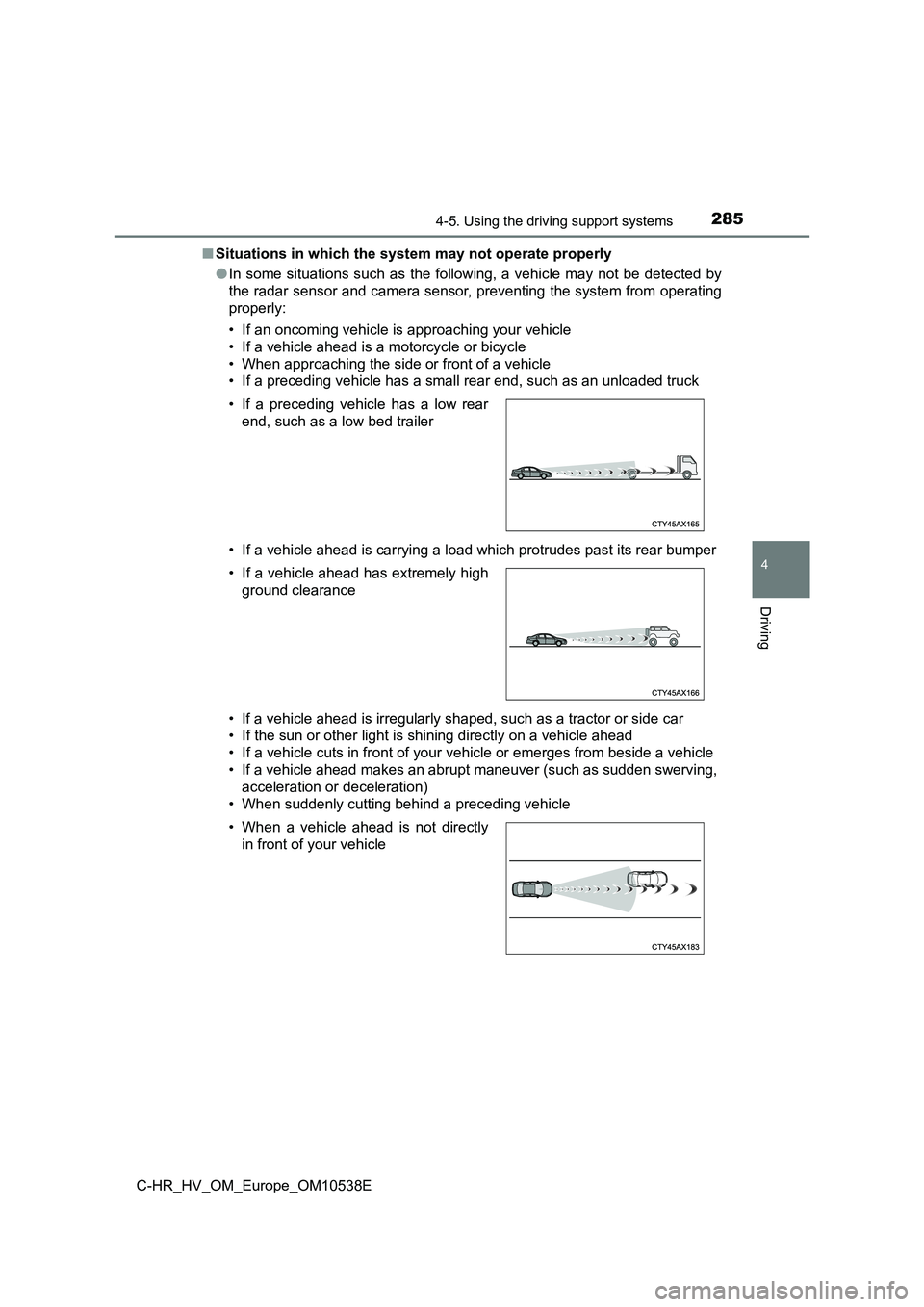
• If a preceding vehicle has a low rear
end, such as a low bed trailer
• If a vehicle ahead has extremely high
ground clearance
• When a vehicle ahead is not directly
in front of your vehicle
Page 293 of 712
2934-5. Using the driving support systems
4
Driving
C-HR_HV_OM_Europe_OM10538E
WARNING
■Situations unsuitable for LDA system
Do not use the LDA system in the following situations.
The system may not operate properly and lead to an accident, resulting in
death or serious injury.
● A compact spare tire (if equipped), tire chains, etc., are equipped.
● When the tires have been excessively worn, or when the tire inflation pres-
sure is low.
● Tires which differ by structure, manufacturer, brand or tread pattern are
used.
● Objects or patterns that could be mistaken for white (yellow) lines are
present on the side of the road (guardrails, curbs, reflective poles, etc.).
● Vehicle is driven on a snow-covered road.
● White (yellow) lines are difficult to see due to rain, snow, fog, dust, etc.
● Asphalt repair marks, white (yellow) line marks, etc., are present due to
road repair.
● Vehicle is driven in a temporary lane or restricted lane due to construction
work.
● Vehicle is driven on a road surface which is slippery due to rainy weather,
fallen snow, freezing, etc.
● Vehicle is driven in traffic lanes other than on highways and freeways.
● Vehicle is driven in a construction zone.
● Vehicle is towing a trailer or another vehicle.
■ Preventing LDA system malfunctions and operations performed by
mistake
● Do not modify the headlights or place stickers, etc., on the surface of the
lights.
● Do not modify the suspension, etc. If the suspension, etc., needs to be
replaced, contact any authorized Toyota retailer or Toyota authorized
repairer, or any reliable repairer.
● Do not install or place anything on the hood or grille. Also, do not install a
grille guard (bull bars, kangaroo bar, etc.).
● If your windshield needs repairs, contact any authorized Toyota retailer or
Toyota authorized repairer, or any reliable repairer.
Page 309 of 712
3094-5. Using the driving support systems
4
Driving
C-HR_HV_OM_Europe_OM10538E
WARNING
■To avoid inadvertent dynamic radar cruise control with full-speed
range activation
Switch the dynamic radar cruise control with full-speed range off using the
“ON-OFF” button when not in use.
■ Situations unsuitable for dynamic radar cruise control with full-speed
range
Do not use dynamic radar cruise control with full-speed range in any of the
following situations.
Doing so may result in inappropriate speed control and could cause an acci-
dent resulting in death or serious injury.
● Roads where there are pedestrians, cyclists, etc.
● In heavy traffic
● On roads with sharp bends
● On winding roads
● On slippery roads, such as those covered with rain, ice or snow
● On steep downhills, or where there are sudden changes between sharp up
and down gradients
Vehicle speed may exceed the set speed when driving down a steep hill.
● At entrances to freeways and highways
● When weather conditions are bad enough that they may prevent the sen-
sors from detecting correctly (fog, snow, sandstorm, heavy rain, etc.)
● When there is rain, snow, etc., on the front surface of the radar sensor or
camera sensor
● In traffic conditions that require frequent repeated acceleration and decel-
eration
● When your vehicle is towing a trailer or during emergency towing
● When an approach warning buzzer is heard often
Page 320 of 712
3204-5. Using the driving support systems
C-HR_HV_OM_Europe_OM10538E
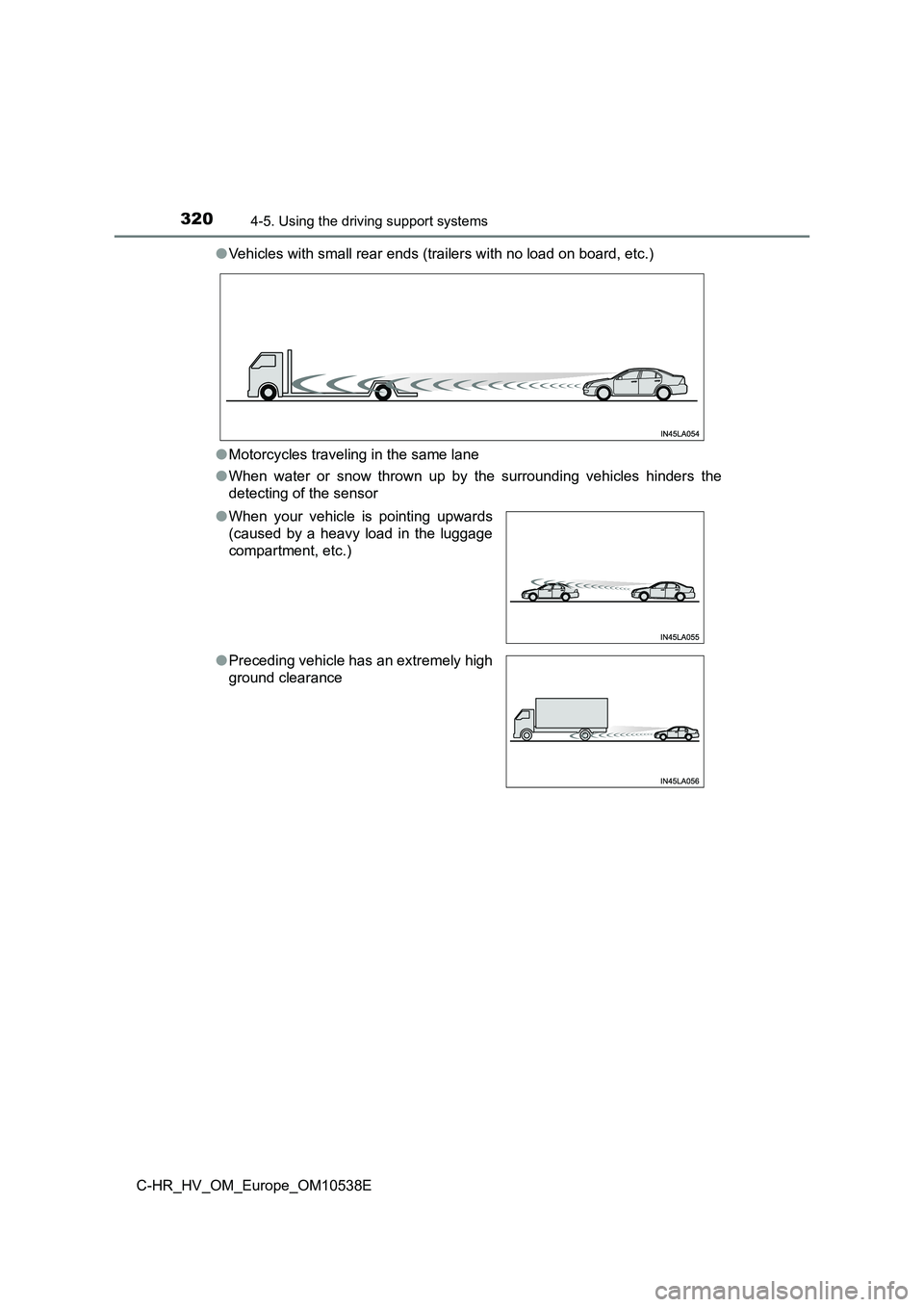
● Vehicles with small rear ends (trailers with no load on board, etc.)
● Motorcycles traveling in the same lane
● When water or snow thrown up by the surrounding vehicles hinders the
detecting of the sensor
● When your vehicle is pointing upwards
(caused by a heavy load in the luggage
compartment, etc.)
● Preceding vehicle has an extremely high
ground clearance
Page 327 of 712
3274-5. Using the driving support systems
4
Driving
C-HR_HV_OM_Europe_OM10538E
WARNING
■To avoid operating the cruise control by mistake
Switch the cruise control off using the “ON-OFF” button when not in use.
■ Situations unsuitable for cruise control
Do not use cruise control in any of the following situations.
Doing so may result in loss of control and could cause an accident resulting
in death or serious injury.
● In heavy traffic
● On roads with sharp bends
● On winding roads
● On slippery roads, such as those covered with rain, ice or snow
● On steep downhills
Vehicle speed may exceed the set speed when driving down a steep hill.
● When your vehicle is towing a trailer or during emergency towing
Page 334 of 712
3344-5. Using the driving support systems
C-HR_HV_OM_Europe_OM10538E
WARNING
■To avoid operating the speed limiter by mistake
Keep the speed limiter switch off when not in use.
■ Situations unsuitable for speed limiter
Do not use the speed limiter in either of the following situations.
Doing so may result in control of the vehicle being lost and could cause a
serious or fatal accident.
● On slippery roads, such as those covered with rain, ice or snow
● On steep hills
● When towing a trailer or emergency towing
NOTICE
When a warning is issued using the meter display and buzzer after exceed-
ing the set speed limit on a steep decline, depress the brake pedal to decel-
erate.
Page 398 of 712
3984-5. Using the driving support systems
C-HR_HV_OM_Europe_OM10538E
WARNING
●Do not use the system in the following situations, as the system may be
unable to correctly assist you in reaching the target parking spot and may
lead to an unexpected accident.
• On sharp bends
• During bad weather such as heavy rain, fog, snow, or a sandstorm
• When the tires slid while attempting to park
• When fallen leaves or snow has accumulated in a parking space
• When items such as a towing bracket, trailer, bicycle carrier, etc., are
installed on the rear of the vehicle
• When a vehicle, where the front/rear end is above the detection area
such as a truck or bus, or vehicle with a towing bracket, trailer, bicycle
carrier, etc., is parked at the front or rear of the parking space
• If the sensor is covered by the front bumper cover, etc.
• If a vehicle or obstacle is not in a suitable position at the front or rear of
the parking space
• In an area that is not a parking lot
• A parking lot that is not paved, such as a sand or gravel parking lot
• A parking lot that has a slope or undulations in the road
• A frozen, snow-covered or slippery road
• The asphalt is melting due to hot weather
• There is an obstacle between the vehicle and the target parking spot
• Using tire chains or compact spare tire (if equipped)
● Do not use tire other than that provided by the manufacturer. The system
may not operate properly. When replacing tires, contact any authorized
Toyota retailer or Toyota authorized repairer, or any reliable repairer.
● The system may not be able position the vehicle in the set location in the
following situations.
• The tires are extremely worn or the tire pressure is low
• The vehicle is carrying very heavy load
• The vehicle is tilted due to having luggage, etc., located on one side of
the vehicle
• There are road heaters installed in the parking lot to prevent the road
surface from freezing.
In any other situations when the set position and vehicle position greatly
differ, have the vehicle inspected by any authorized Toyota retailer or Toy-
ota authorized repairer, or any reliable repairer.
Page 675 of 712
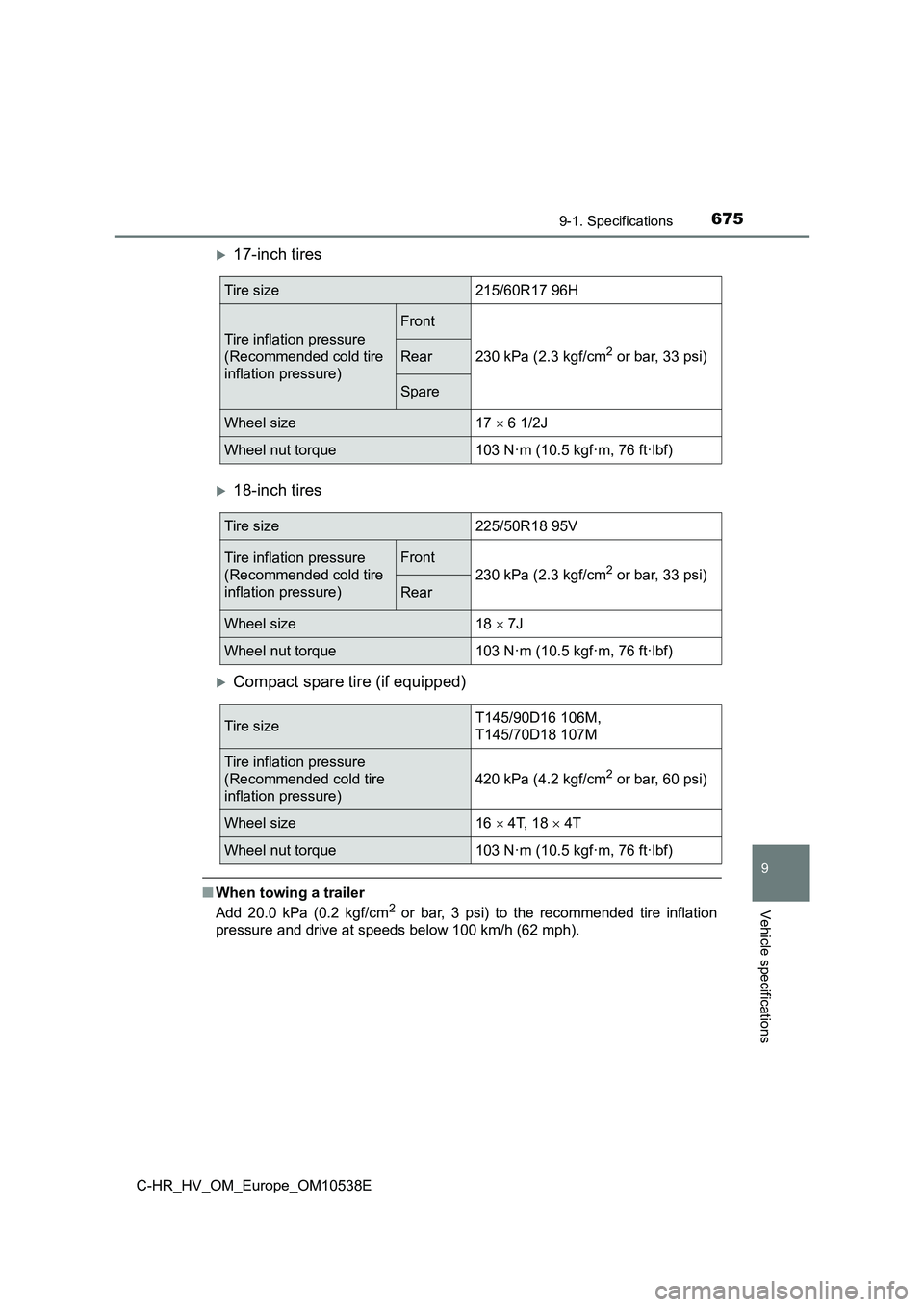
6759-1. Specifications
C-HR_HV_OM_Europe_OM10538E
9
Vehicle specifications
17-inch tires
18-inch tires
Compact spare tire (if equipped)
■When towing a trailer
Add 20.0 kPa (0.2 kgf/cm2 or bar, 3 psi) to the recommended tire inflation
pressure and drive at speeds below 100 km/h (62 mph).
Tire size215/60R17 96H
Tire inflation pressure
(Recommended cold tire
inflation pressure)
Front
230 kPa (2.3 kgf/cm2 or bar, 33 psi)Rear
Spare
Wheel size17 6 1/2J
Wheel nut torque103 N·m (10.5 kgf·m, 76 ft·lbf)
Tire size225/50R18 95V
Tire inflation pressure
(Recommended cold tire
inflation pressure)
Front
230 kPa (2.3 kgf/cm2 or bar, 33 psi)
Rear
Wheel size18 7J
Wheel nut torque103 N·m (10.5 kgf·m, 76 ft·lbf)
Tire sizeT145/90D16 106M,
T145/70D18 107M
Tire inflation pressure
(Recommended cold tire
inflation pressure)
420 kPa (4.2 kgf/cm2 or bar, 60 psi)
Wheel size16 4T, 18 4T
Wheel nut torque103 N·m (10.5 kgf·m, 76 ft·lbf)
Page 709 of 712
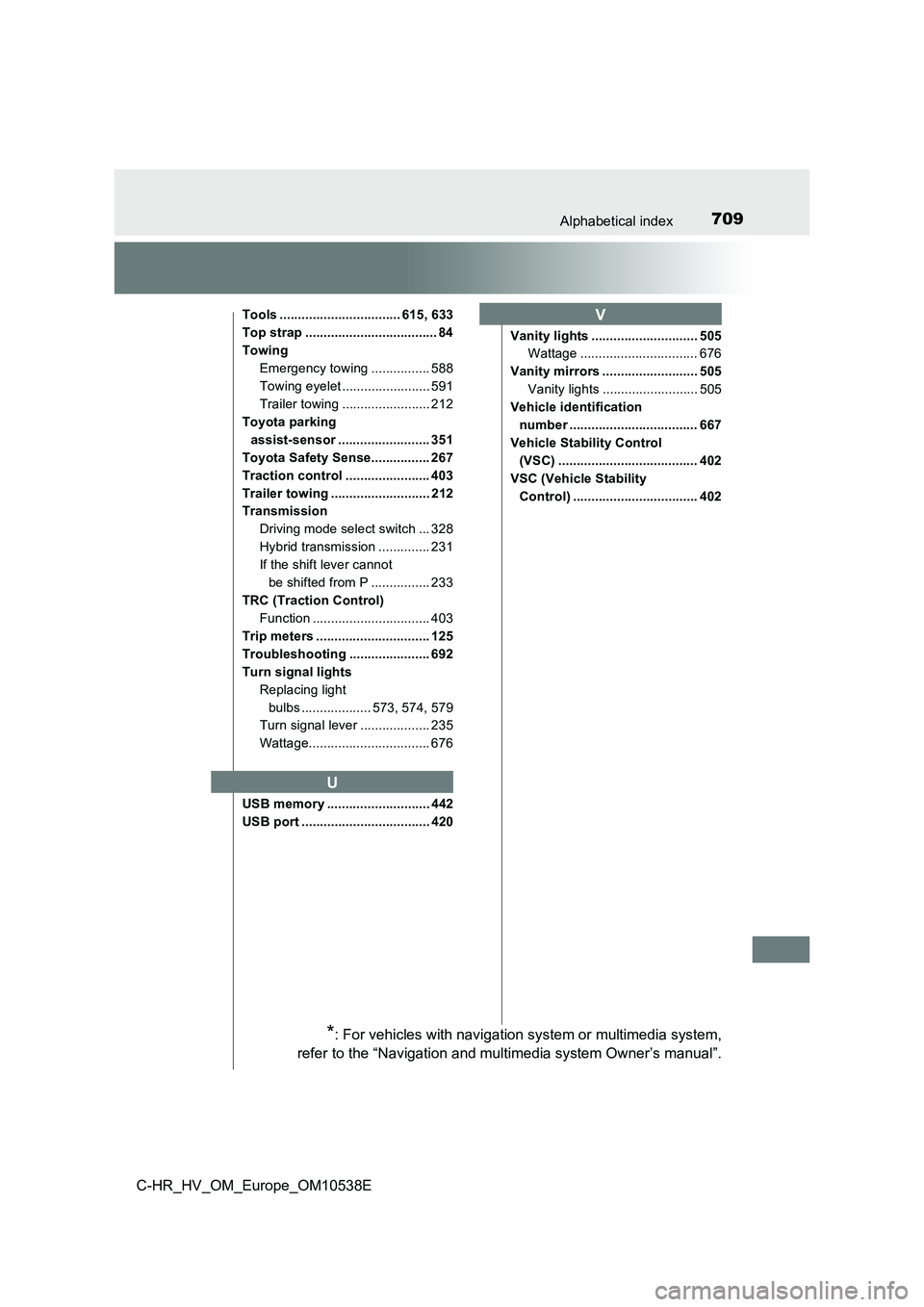
709Alphabetical index
C-HR_HV_OM_Europe_OM10538E
Tools ................................. 615, 633
Top strap .................................... 84
Towing
Emergency towing ................ 588
Towing eyelet ........................ 591
Trailer towing ........................ 212
Toyota parking
assist-sensor ......................... 351
Toyota Safety Sense................ 267
Traction control ....................... 403
Trailer towing ........................... 212
Transmission
Driving mode select switch ... 328
Hybrid transmission .............. 231
If the shift lever cannot
be shifted from P ................ 233
TRC (Traction Control)
Function ................................ 403
Trip meters ............................... 125
Troubleshooting ...................... 692
Turn signal lights
Replacing light
bulbs ................... 573, 574, 579
Turn signal lever ................... 235
Wattage................................. 676
USB memory ............................ 442
USB port ................................... 420
Vanity lights ............................. 505
Wattage ................................ 676
Vanity mirrors .......................... 505
Vanity lights .......................... 505
Vehicle identification
number ................................... 667
Vehicle Stability Control
(VSC) ...................................... 402
VSC (Vehicle Stability
Control) .................................. 402
U
V
*: For vehicles with navigation system or multimedia system,
refer to the “Navigation and multimedia system Owner’s manual”.