check engine TOYOTA CAMRY 2000 Service Repair Manual
[x] Cancel search | Manufacturer: TOYOTA, Model Year: 2000, Model line: CAMRY, Model: TOYOTA CAMRY 2000Pages: 4770, PDF Size: 86.41 MB
Page 323 of 4770
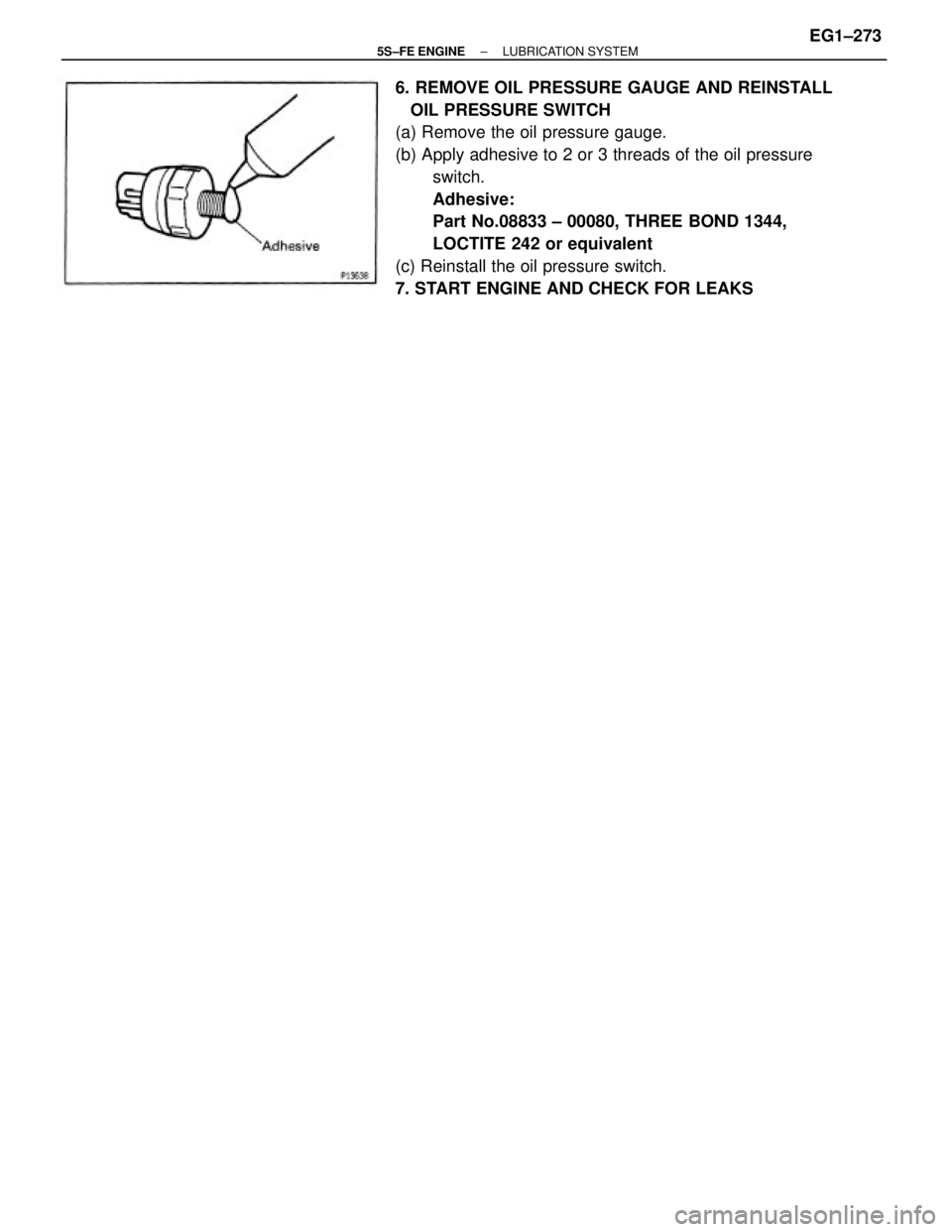
6. REMOVE OIL PRESSURE GAUGE AND REINSTALL
OIL PRESSURE SWITCH
(a) Remove the oil pressure gauge.
(b) Apply adhesive to 2 or 3 threads of the oil pressure
switch.
Adhesive:
Part No.08833 ± 00080, THREE BOND 1344,
LOCTITE 242 or equivalent
(c) Reinstall the oil pressure switch.
7. START ENGINE AND CHECK FOR LEAKS
± 5S±FE ENGINELUBRICATION SYSTEMEG1±273
Page 324 of 4770
OIL AND FILTER REPLACEMENT
CAUTION:
wProlonged and repeated contact with mineral oil will
result in the removal of natural fats from the skin,
leading to dryness, irritation and dermatitis. In addi±
tion, used engine oil contains potentially harmful
contaminants which may cause skin cancer.
wCare should be taken, therefore, when changing
engine, oil to minimize the frequency and length of
time your skin is exposed to used engine oil. Protec±
tive clothing and gloves that cannot be penetrated
by oil should be worn. The skin should be thorought±
hly washed with soap and water, or use water±less
hand cleaner, to remove any used engine oil. Do not
use gasoline, thinners, or solvents.
wIn order to preserve the environment, used oil and
used oil filter must be disposed of only at designated
disposal sites.
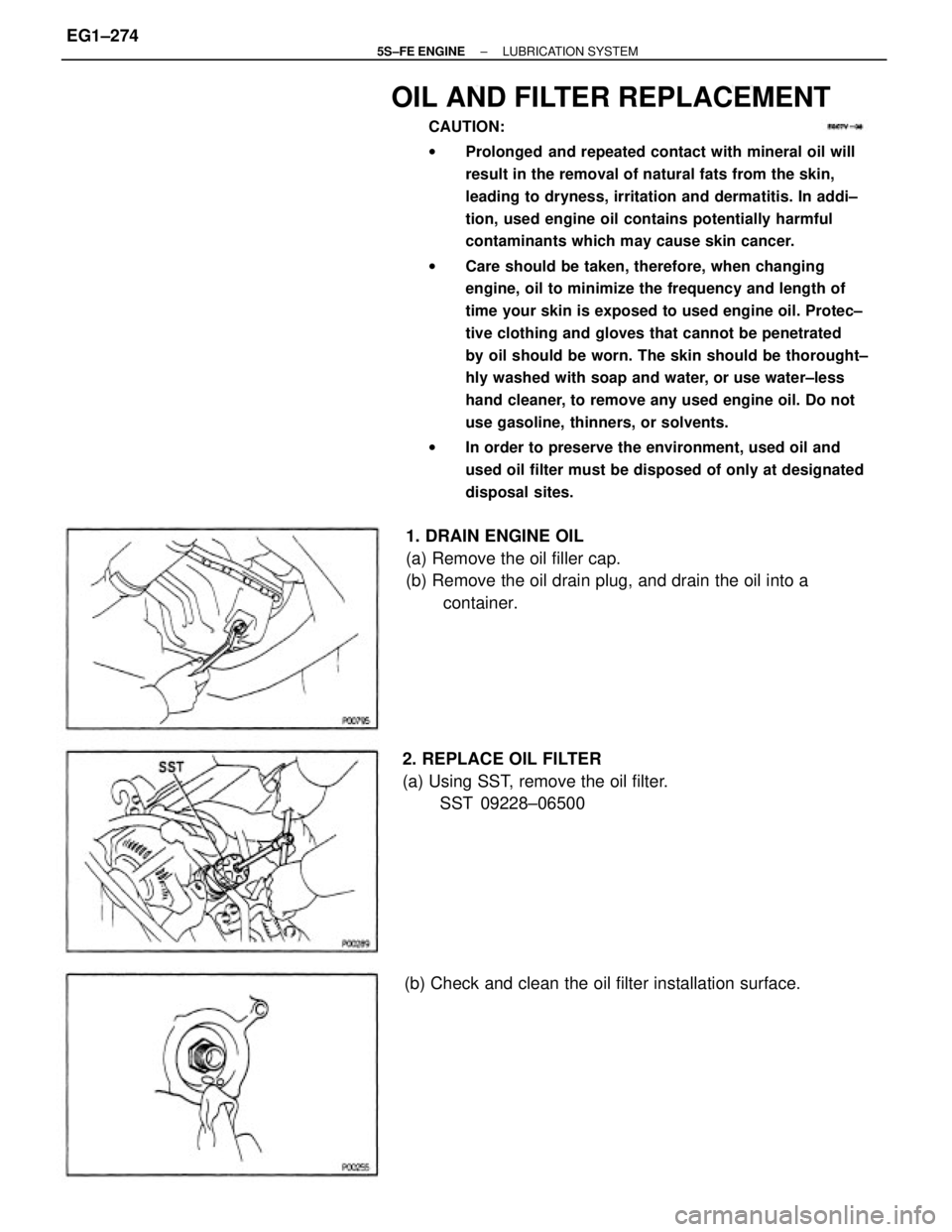
1. DRAIN ENGINE OIL
(a) Remove the oil filler cap.
(b) Remove the oil drain plug, and drain the oil into a
container.
2. REPLACE OIL FILTER
(a) Using SST, remove the oil filter.
SST 09228±06500
(b) Check and clean the oil filter installation surface.
± 5S±FE ENGINELUBRICATION SYSTEMEG1±274
Page 325 of 4770
3. FILL WITH ENGINE OIL
(a) Clean and install the oil drain plug with a new gasket.
Torque: 39 N±m (400 kgf±cm, 29 ft±lbf)
(b) Fill with new engine oil.
Oil grade: (See step 1 on page EG1±272)
Capacity (M/T):
Drain and refill
w/ Oil filter change
3.6 liters (3.8 US qts, 3.2 Imp. qts)
w/o Oil filter change
3.4 liters (3.6 US qts, 3.0 Imp. qts)
Dry fill
4.2 liters (4.4 US qts, 3.7 Imp. qts)
Capacity (A/T):
Drain and refill
w/ Oil filter change
3.6 liters (3.8 US qts, 3.2 Imp. qts)
w/o Oil filter change
3.4 liters (3.6 US qts, 3.0 Imp. qts)
Dry fill
4.3 liters (4.5 US qts, 3.8 Imp. qts)
(c) Reinstall the oil filler cap.
4. START ENGINE AND CHECK FOR LEAKS
5. RECHECK ENGINE OIL LEVEL
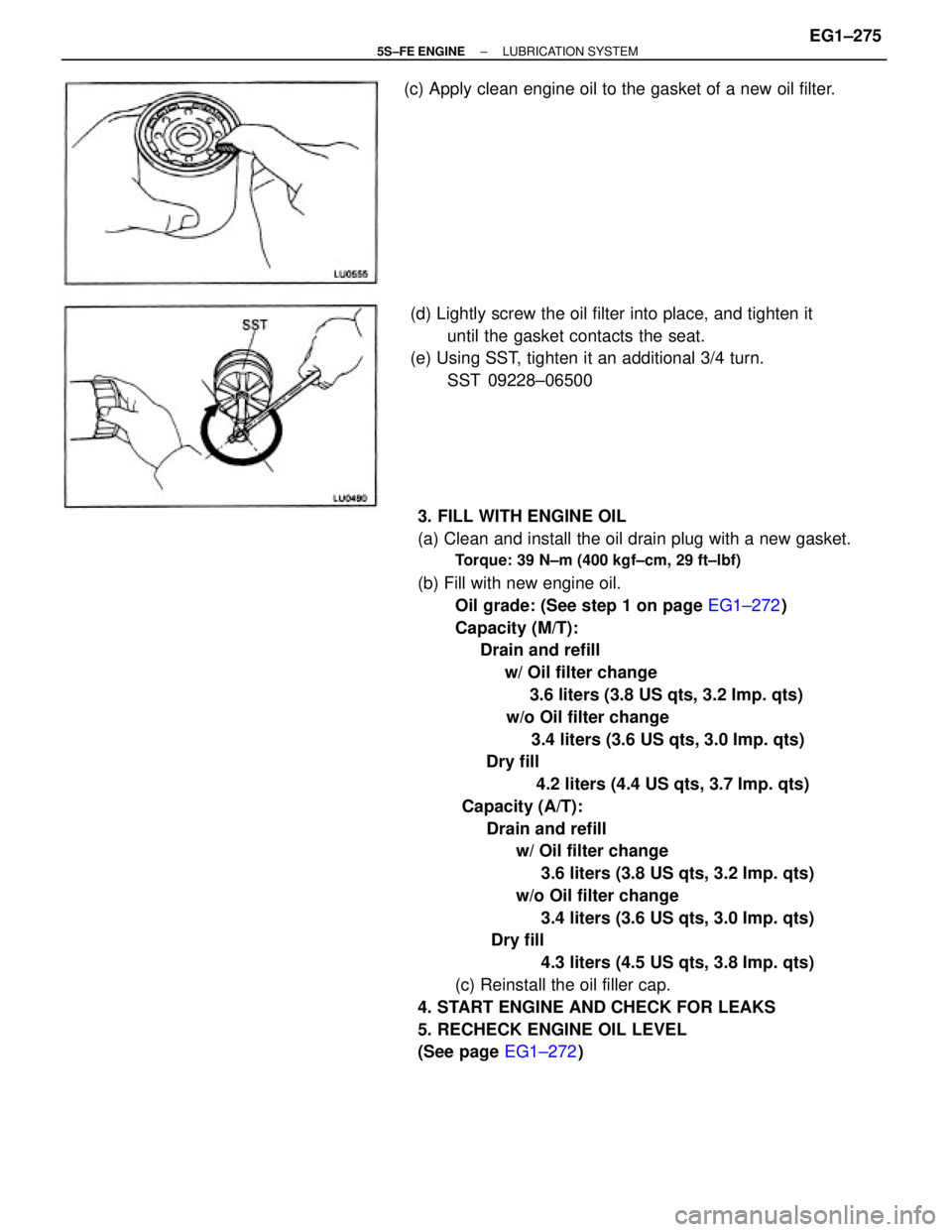
(See page EG1±272) (d) Lightly screw the oil filter into place, and tighten it
until the gasket contacts the seat.
(e) Using SST, tighten it an additional 3/4 turn.
SST 09228±06500 (c) Apply clean engine oil to the gasket of a new oil filter.
± 5S±FE ENGINELUBRICATION SYSTEMEG1±275
Page 330 of 4770
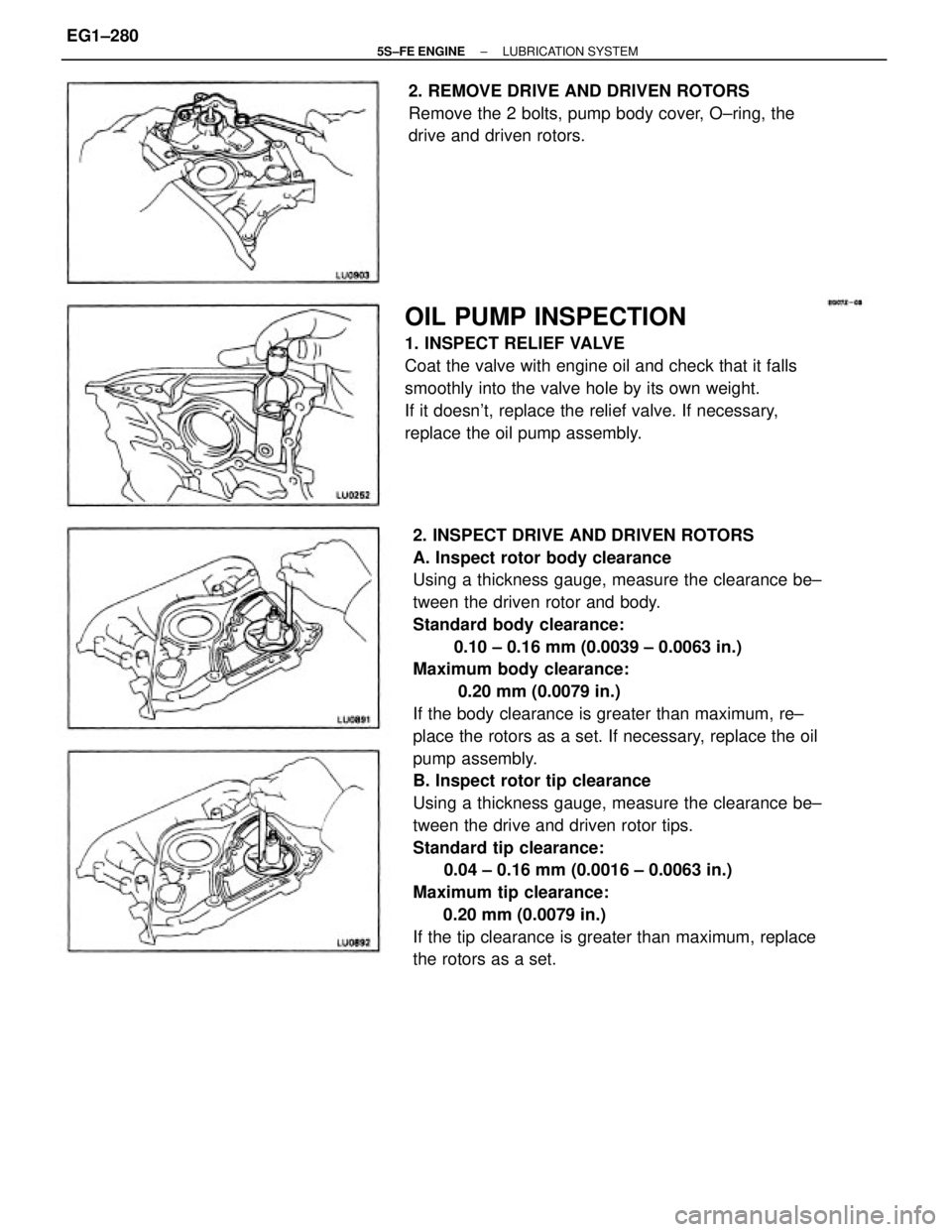
2. INSPECT DRIVE AND DRIVEN ROTORS
A. Inspect rotor body clearance
Using a thickness gauge, measure the clearance be±
tween the driven rotor and body.
Standard body clearance:
0.10 ± 0.16 mm (0.0039 ± 0.0063 in.)
Maximum body clearance:
0.20 mm (0.0079 in.)
If the body clearance is greater than maximum, re±
place the rotors as a set. If necessary, replace the oil
pump assembly.
B. Inspect rotor tip clearance
Using a thickness gauge, measure the clearance be±
tween the drive and driven rotor tips.
Standard tip clearance:
0.04 ± 0.16 mm (0.0016 ± 0.0063 in.)
Maximum tip clearance:
0.20 mm (0.0079 in.)
If the tip clearance is greater than maximum, replace
the rotors as a set.
OIL PUMP INSPECTION
1. INSPECT RELIEF VALVE
Coat the valve with engine oil and check that it falls
smoothly into the valve hole by its own weight.
If it doesn't, replace the relief valve. If necessary,
replace the oil pump assembly.2. REMOVE DRIVE AND DRIVEN ROTORS
Remove the 2 bolts, pump body cover, O±ring, the
drive and driven rotors.
± 5S±FE ENGINELUBRICATION SYSTEMEG1±280
Page 334 of 4770
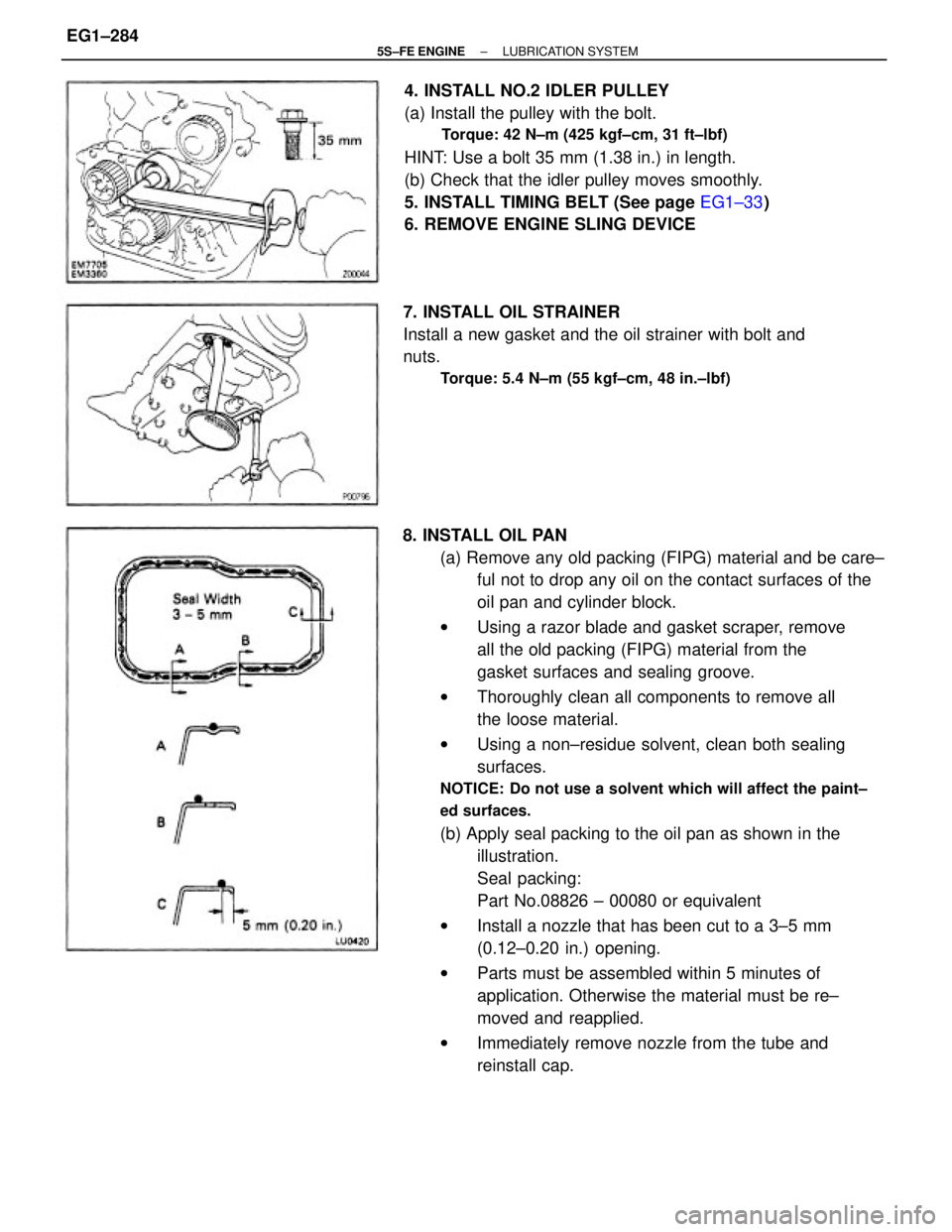
8. INSTALL OIL PAN
(a) Remove any old packing (FIPG) material and be care±
ful not to drop any oil on the contact surfaces of the
oil pan and cylinder block.
wUsing a razor blade and gasket scraper, remove
all the old packing (FIPG) material from the
gasket surfaces and sealing groove.
wThoroughly clean all components to remove all
the loose material.
wUsing a non±residue solvent, clean both sealing
surfaces.
NOTICE: Do not use a solvent which will affect the paint±
ed surfaces.
(b) Apply seal packing to the oil pan as shown in the
illustration.
Seal packing:
Part No.08826 ± 00080 or equivalent
wInstall a nozzle that has been cut to a 3±5 mm
(0.12±0.20 in.) opening.
wParts must be assembled within 5 minutes of
application. Otherwise the material must be re±
moved and reapplied.
wImmediately remove nozzle from the tube and
reinstall cap. 4. INSTALL NO.2 IDLER PULLEY
(a) Install the pulley with the bolt.
Torque: 42 N±m (425 kgf±cm, 31 ft±lbf)
HINT: Use a bolt 35 mm (1.38 in.) in length.
(b) Check that the idler pulley moves smoothly.
5. INSTALL TIMING BELT (See page EG1±33)
6. REMOVE ENGINE SLING DEVICE
7. INSTALL OIL STRAINER
Install a new gasket and the oil strainer with bolt and
nuts.
Torque: 5.4 N±m (55 kgf±cm, 48 in.±lbf)
± 5S±FE ENGINELUBRICATION SYSTEMEG1±284
Page 335 of 4770
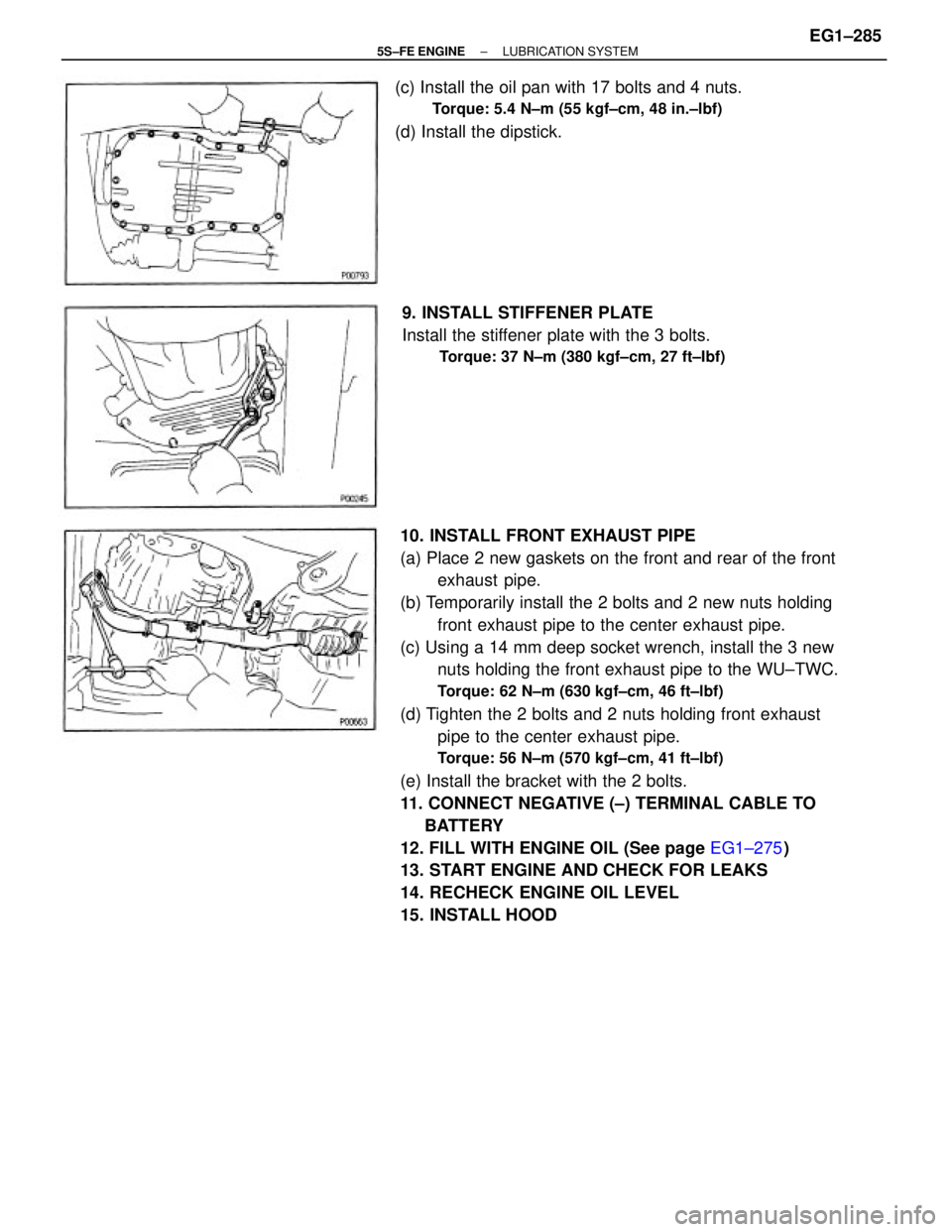
10. INSTALL FRONT EXHAUST PIPE
(a) Place 2 new gaskets on the front and rear of the front
exhaust pipe.
(b) Temporarily install the 2 bolts and 2 new nuts holding
front exhaust pipe to the center exhaust pipe.
(c) Using a 14 mm deep socket wrench, install the 3 new
nuts holding the front exhaust pipe to the WU±TWC.
Torque: 62 N±m (630 kgf±cm, 46 ft±lbf)
(d) Tighten the 2 bolts and 2 nuts holding front exhaust
pipe to the center exhaust pipe.
Torque: 56 N±m (570 kgf±cm, 41 ft±lbf)
(e) Install the bracket with the 2 bolts.
11. CONNECT NEGATIVE (±) TERMINAL CABLE TO
BATTERY
12. FILL WITH ENGINE OIL (See page EG1±275)
13. START ENGINE AND CHECK FOR LEAKS
14. RECHECK ENGINE OIL LEVEL
15. INSTALL HOOD (c) Install the oil pan with 17 bolts and 4 nuts.
Torque: 5.4 N±m (55 kgf±cm, 48 in.±lbf)
(d) Install the dipstick.
9. INSTALL STIFFENER PLATE
Install the stiffener plate with the 3 bolts.
Torque: 37 N±m (380 kgf±cm, 27 ft±Ibf)
± 5S±FE ENGINELUBRICATION SYSTEMEG1±285
Page 337 of 4770
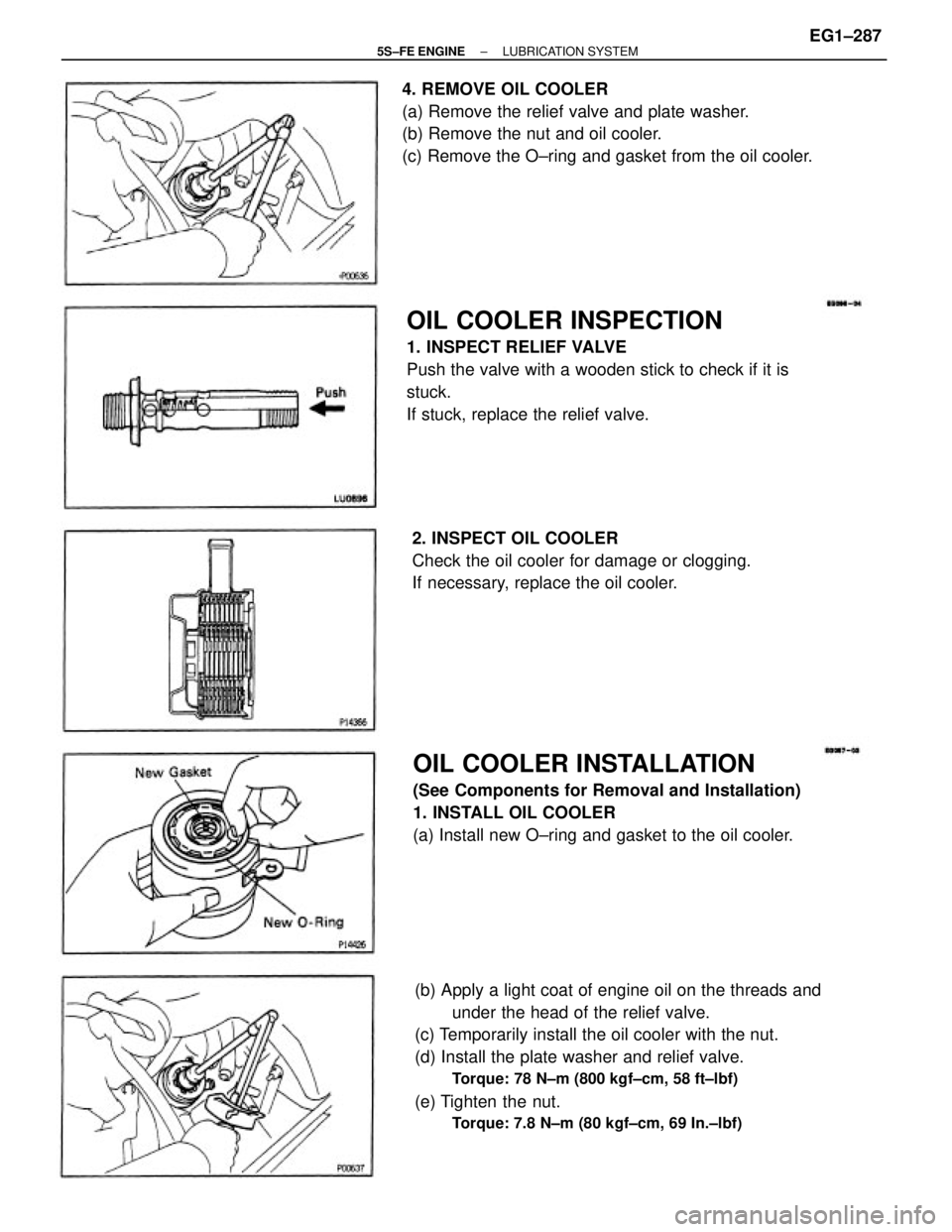
(b) Apply a light coat of engine oil on the threads and
under the head of the relief valve.
(c) Temporarily install the oil cooler with the nut.
(d) Install the plate washer and relief valve.
Torque: 78 N±m (800 kgf±cm, 58 ft±lbf)
(e) Tighten the nut.
Torque: 7.8 N±m (80 kgf±cm, 69 In.±lbf)
OIL COOLER INSPECTION
1. INSPECT RELIEF VALVE
Push the valve with a wooden stick to check if it is
stuck.
If stuck, replace the relief valve.
OIL COOLER INSTALLATION
(See Components for Removal and Installation)
1. INSTALL OIL COOLER
(a) Install new O±ring and gasket to the oil cooler. 4. REMOVE OIL COOLER
(a) Remove the relief valve and plate washer.
(b) Remove the nut and oil cooler.
(c) Remove the O±ring and gasket from the oil cooler.
2. INSPECT OIL COOLER
Check the oil cooler for damage or clogging.
If necessary, replace the oil cooler.
± 5S±FE ENGINELUBRICATION SYSTEMEG1±287
Page 338 of 4770
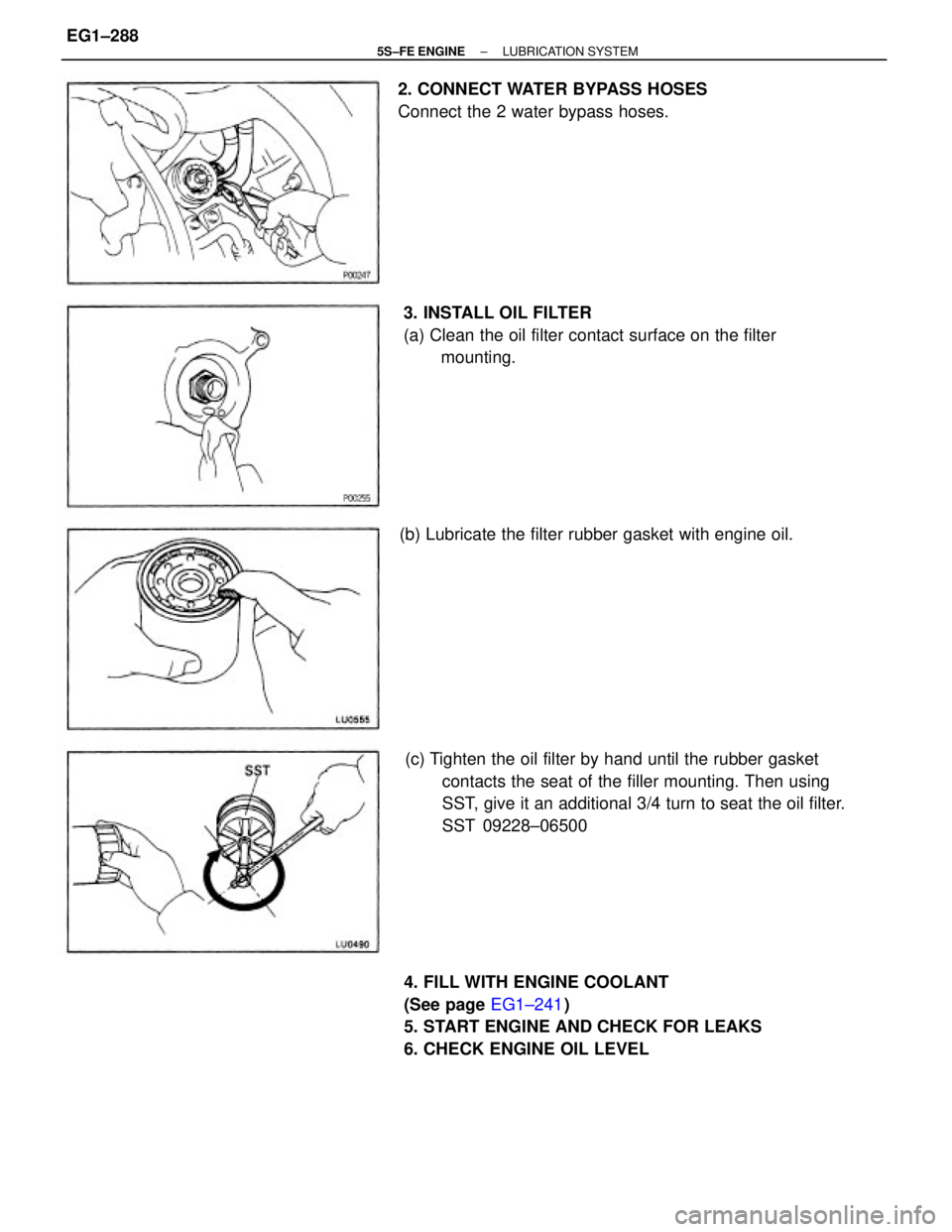
(c) Tighten the oil filter by hand until the rubber gasket
contacts the seat of the filler mounting. Then using
SST, give it an additional 3/4 turn to seat the oil filter.
SST 09228±06500
4. FILL WITH ENGINE COOLANT
(See page EG1±241)
5. START ENGINE AND CHECK FOR LEAKS
6. CHECK ENGINE OIL LEVEL 3. INSTALL OIL FILTER
(a) Clean the oil filter contact surface on the filter
mounting. 2. CONNECT WATER BYPASS HOSES
Connect the 2 water bypass hoses.
(b) Lubricate the filter rubber gasket with engine oil.
± 5S±FE ENGINELUBRICATION SYSTEMEG1±288
Page 342 of 4770

HOW TO PROCEED WITH TROUBLESHOOTING
The Engine Control System broadly consists of the sensors, Engine Control Module (ECM) and actuators.
The ECM receives signals from various sensors, judges the operating conditions and determines the
optimum injection duration, timing, ignition timing and idle speed.
In general, the Engine Control System is considered to be a very intricate system to troubleshoot. But, the
fact is that if you proceed to inspect the circuit one by one following the procedures directed in this manu-
al, troubleshooting of this system is not complex.
This section explains the most ideal method of troubleshooting and tells how to carry out the necessary
repairs.
1. CUSTOMER PROBLEM ANALYSIS
Using the customer problem analysis check sheet for reference, ask the customer in as much details
as possible about the problem.
2. CHECK AND CLEAR DIAGNOSTIC TROUBLE CODE (PRECHECK)
Before confirming the problem symptom, first check the diagnostic trouble code and make a note of
any malfunction code which is output, then clear the code.
HINT: Output of the malfunction code indicates that there is a malfunction in the circuit indicated.
However, it does not indicate whether the malfunction is still occurring or occurred in the past and
returned to normal. In order to determine this, the problem sym toms should be confirmed in step 4
first and the diagnostic trouble code be rechecked in step [6].
Accordingly, if troubleshooting is begun based on the malfunction code only in diagnostic trouble
code check in step [2], it could result in a misdiagnosis, leading to troubleshooting of circuits which
are normal and making it more difficult to locate the cause of the problem.
3. SETTING THE TEST MODE DIAGNOSIS, [4] PROBLEM SYMPTOM CONFIRMATION,
[5] SYMPTOM SIMULATION
In order to find out the trouble more quickly, set the diagnosis check in test mode and with higher
sensing ability of the ECM, confirm the problem symptoms. If the trouble does not reappear, use the
symptom simulation method to make sure the trouble is reproduced.
6. DIAGNOSTIC TROUBLE CODE CHECK IN TEST MODE
Check the diagnostic trouble code in test mode. If the malfunction code is output, proceed to step. If the
normal code is output, proceed to step [7].
7. BASIC INSPECTION
Carry out basic inspection such as the spark check and fuel pressure check, etc.
8. DIAGNOSTIC TROUBLE CODE CHART
If the malfunction code is displayed, proceed to inspect the circuit indicated by the chart for each
code.
9. MATRIX CHART OF PROBLEM SYMPTOMS
If the normal code is displayed in the diagnosis in test mode, perform troubleshooting according to
the inspection order in the Matrix Chart of Problem Symptoms.
10. PARTS INSPECTION
When the Matrix Chart of Problem Symptoms instructs to check the parts, proceed to parts inspection
section included in this manual.
11. CIRCUIT INSPECTION
Determine if the malfunction is the sensor, actuator, wire harness, connector or the ECM.
± 5S±FE ENGINEHOW TO PROCEED WITH TROUBLESHOOTINGEG1±292
Page 343 of 4770
CHECK FOR MOMENTARY INTERRUPTION
By performing the check for momentary interruption, the place where momentary interruptions or
momentary shorts are occurring due to poor contacts can be isolated.
ADJUSTMENT, REPAIR
After the cause of the problem is located, perform adjustment or repairs by following the inspection
and replacement procedures in this manual.
CONFIRMATION TEST
After completing adjustment or repairs, confirm not only that the malfunction is eliminated, but also
conduct a test drive, etc., to make sure the entire Engine Control System is operating normally.
± 5S±FE ENGINEHOW TO PROCEED WITH TROUBLESHOOTINGEG1±293