sensor TOYOTA CAMRY 2000 Service Owner's Guide
[x] Cancel search | Manufacturer: TOYOTA, Model Year: 2000, Model line: CAMRY, Model: TOYOTA CAMRY 2000Pages: 4770, PDF Size: 86.41 MB
Page 137 of 4770
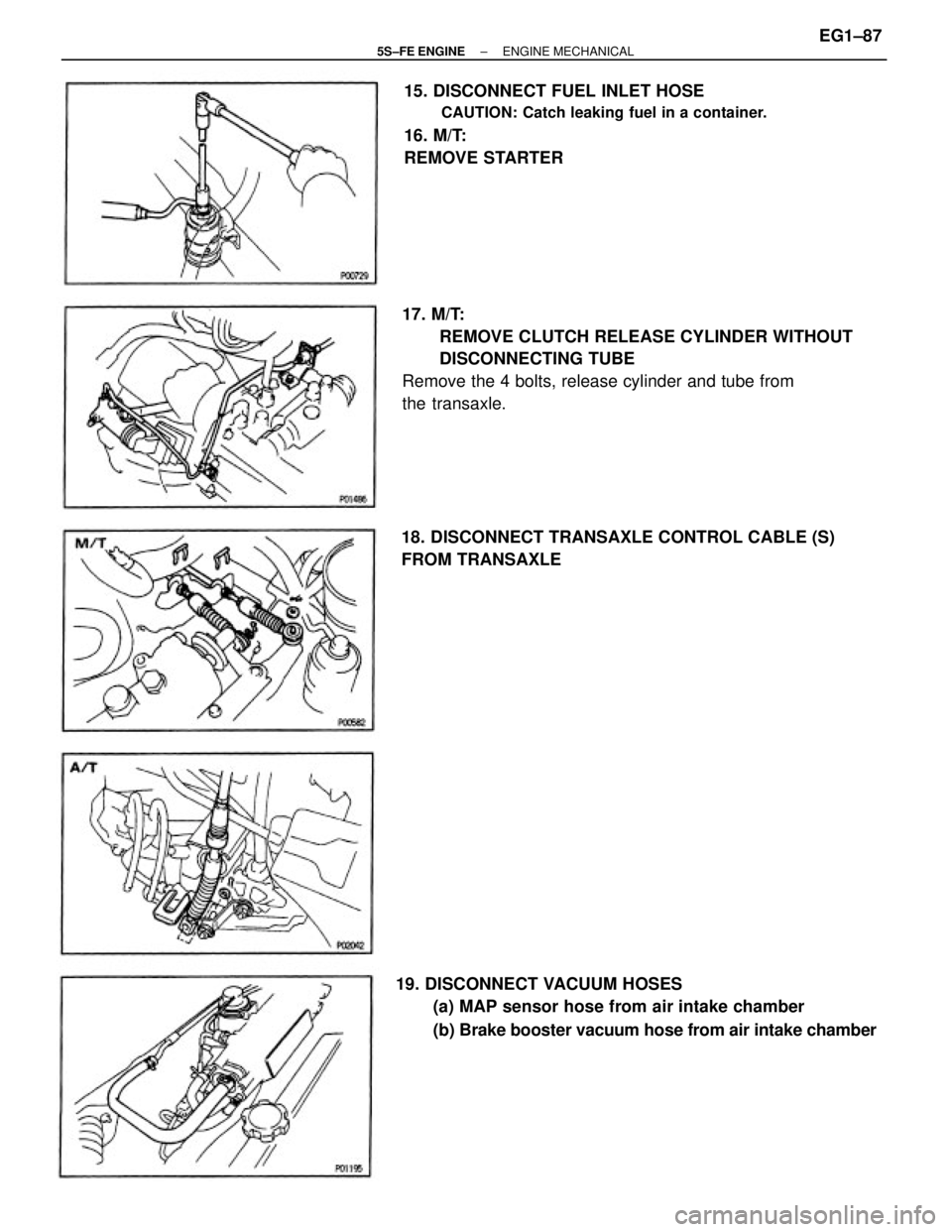
17. M/T:
REMOVE CLUTCH RELEASE CYLINDER WITHOUT
DISCONNECTING TUBE
Remove the 4 bolts, release cylinder and tube from
the transaxle.15. DISCONNECT FUEL INLET HOSE
CAUTION: Catch leaking fuel in a container.
16. M/T:
REMOVE STARTER
19. DISCONNECT VACUUM HOSES
(a) MAP sensor hose from air intake chamber
(b) Brake booster vacuum hose from air intake chamber 18. DISCONNECT TRANSAXLE CONTROL CABLE (S)
FROM TRANSAXLE
± 5S±FE ENGINEENGINE MECHANICALEG1±87
Page 143 of 4770
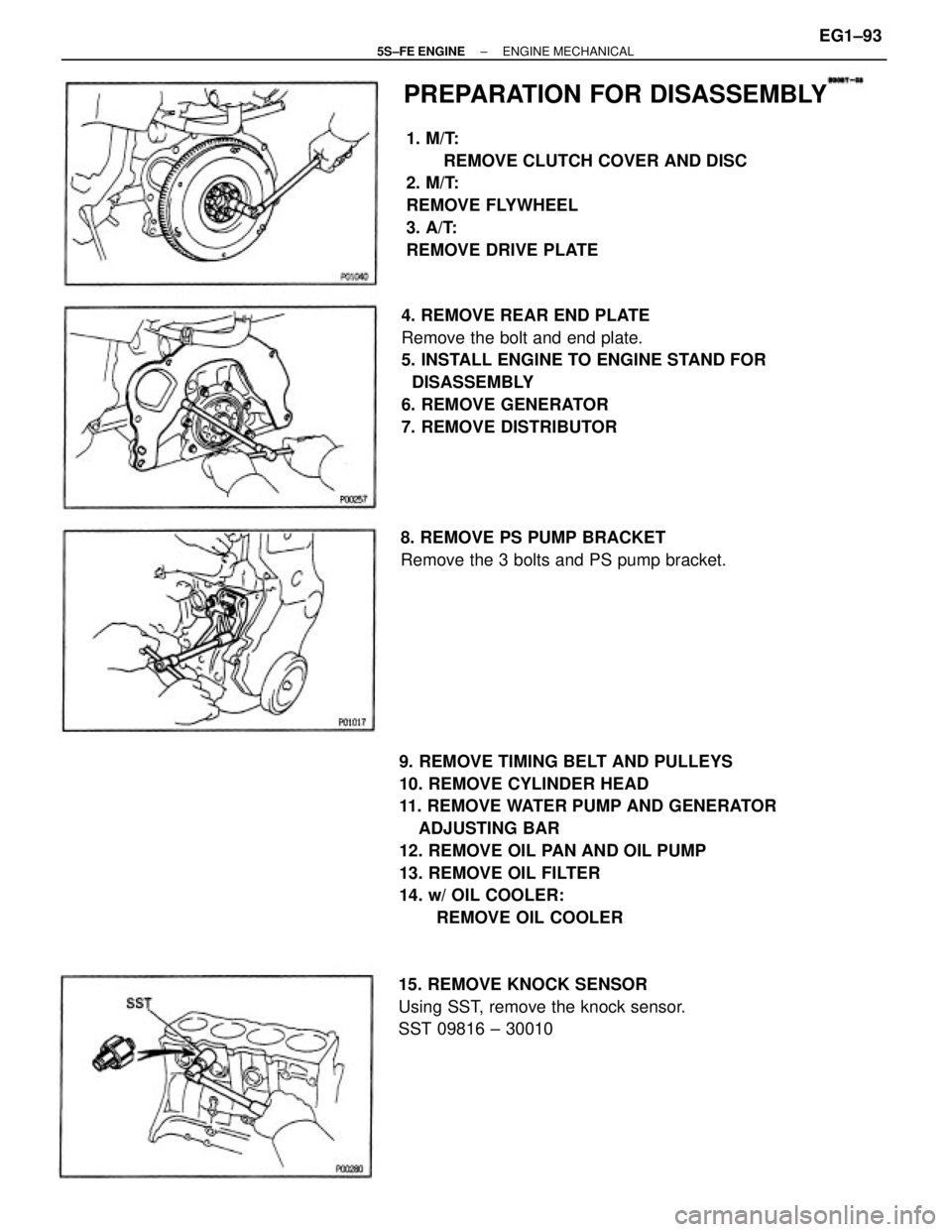
9. REMOVE TIMING BELT AND PULLEYS
10. REMOVE CYLINDER HEAD
11. REMOVE WATER PUMP AND GENERATOR
ADJUSTING BAR
12. REMOVE OIL PAN AND OIL PUMP
13. REMOVE OIL FILTER
14. w/ OIL COOLER:
REMOVE OIL COOLER 4. REMOVE REAR END PLATE
Remove the bolt and end plate.
5. INSTALL ENGINE TO ENGINE STAND FOR
DISASSEMBLY
6. REMOVE GENERATOR
7. REMOVE DISTRIBUTOR1. M/T:
REMOVE CLUTCH COVER AND DISC
2. M/T:
REMOVE FLYWHEEL
3. A/T:
REMOVE DRIVE PLATE
15. REMOVE KNOCK SENSOR
Using SST, remove the knock sensor.
SST 09816 ± 300108. REMOVE PS PUMP BRACKET
Remove the 3 bolts and PS pump bracket.
PREPARATION FOR DISASSEMBLY
± 5S±FE ENGINEENGINE MECHANICALEG1±93
Page 175 of 4770
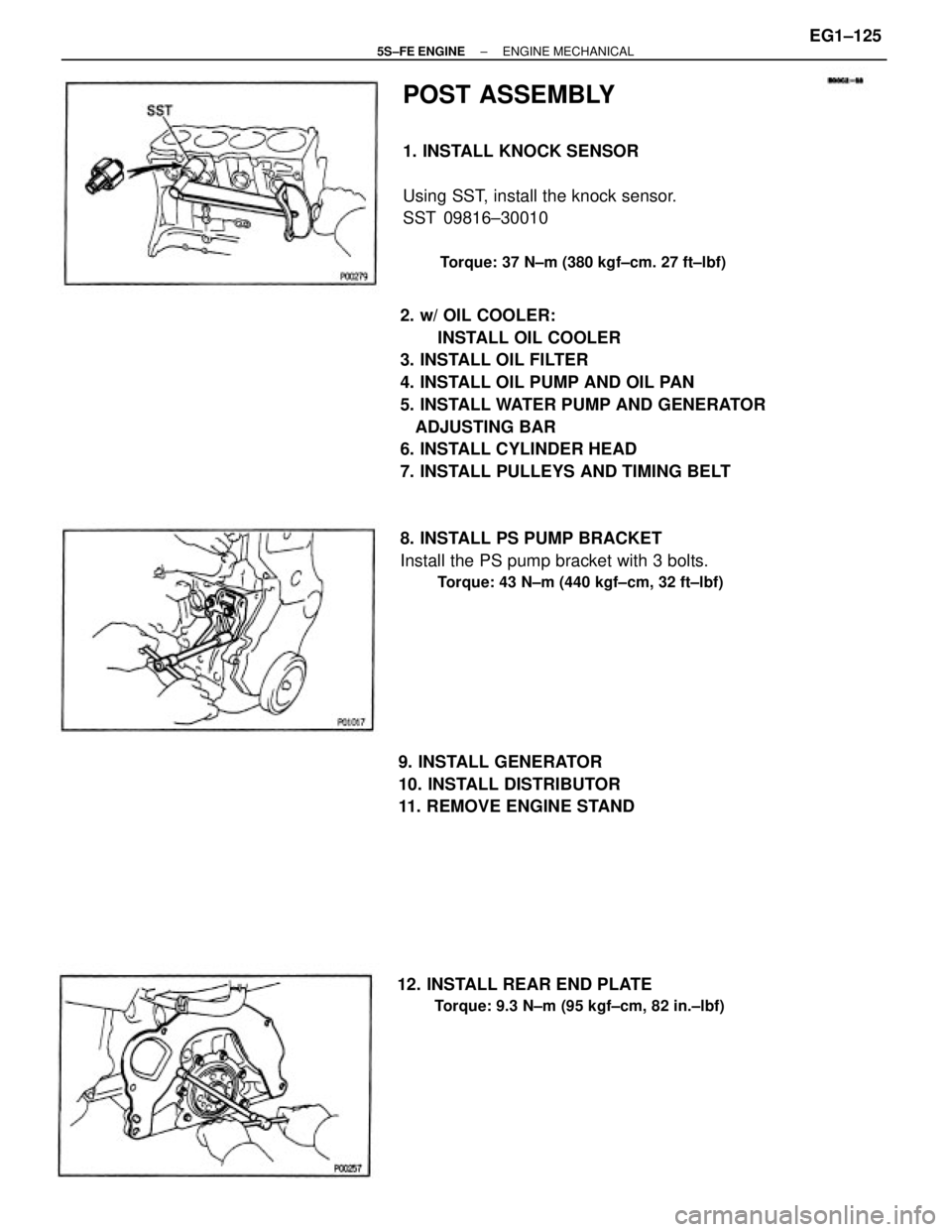
2. w/ OIL COOLER:
INSTALL OIL COOLER
3. INSTALL OIL FILTER
4. INSTALL OIL PUMP AND OIL PAN
5. INSTALL WATER PUMP AND GENERATOR
ADJUSTING BAR
6. INSTALL CYLINDER HEAD
7. INSTALL PULLEYS AND TIMING BELT
POST ASSEMBLY
1. INSTALL KNOCK SENSOR
Using SST, install the knock sensor.
SST 09816±30010
Torque: 37 N±m (380 kgf±cm. 27 ft±lbf)
8. INSTALL PS PUMP BRACKET
Install the PS pump bracket with 3 bolts.
Torque: 43 N±m (440 kgf±cm, 32 ft±lbf)
9. INSTALL GENERATOR
10. INSTALL DISTRIBUTOR
11. REMOVE ENGINE STAND
12. INSTALL REAR END PLATE
Torque: 9.3 N±m (95 kgf±cm, 82 in.±lbf)
± 5S±FE ENGINEENGINE MECHANICALEG1±125
Page 181 of 4770
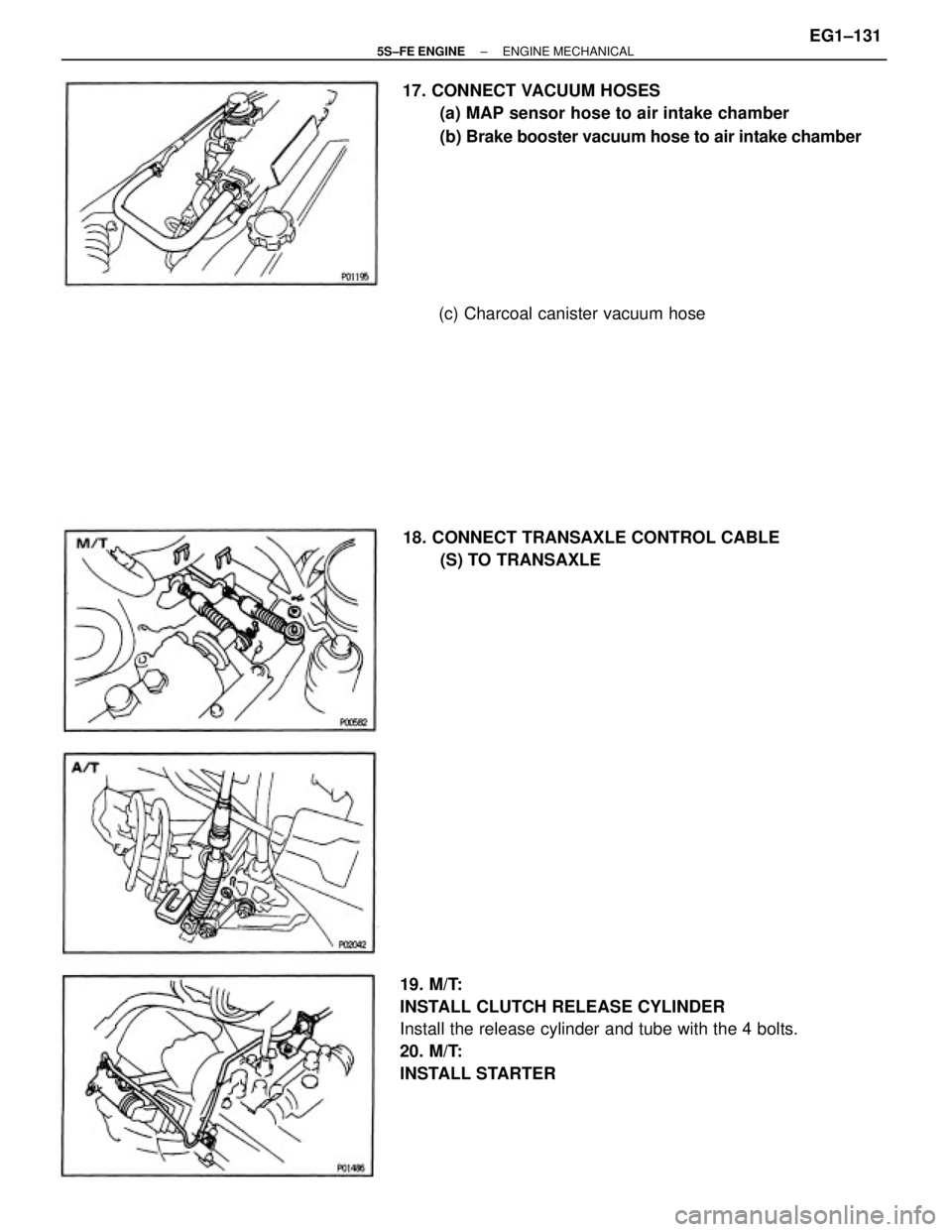
19. M/T:
INSTALL CLUTCH RELEASE CYLINDER
Install the release cylinder and tube with the 4 bolts.
20. M/T:
INSTALL STARTER17. CONNECT VACUUM HOSES
(a) MAP sensor hose to air intake chamber
(b) Brake booster vacuum hose to air intake chamber
18. CONNECT TRANSAXLE CONTROL CABLE
(S) TO TRANSAXLE (c) Charcoal canister vacuum hose
± 5S±FE ENGINEENGINE MECHANICALEG1±131
Page 183 of 4770
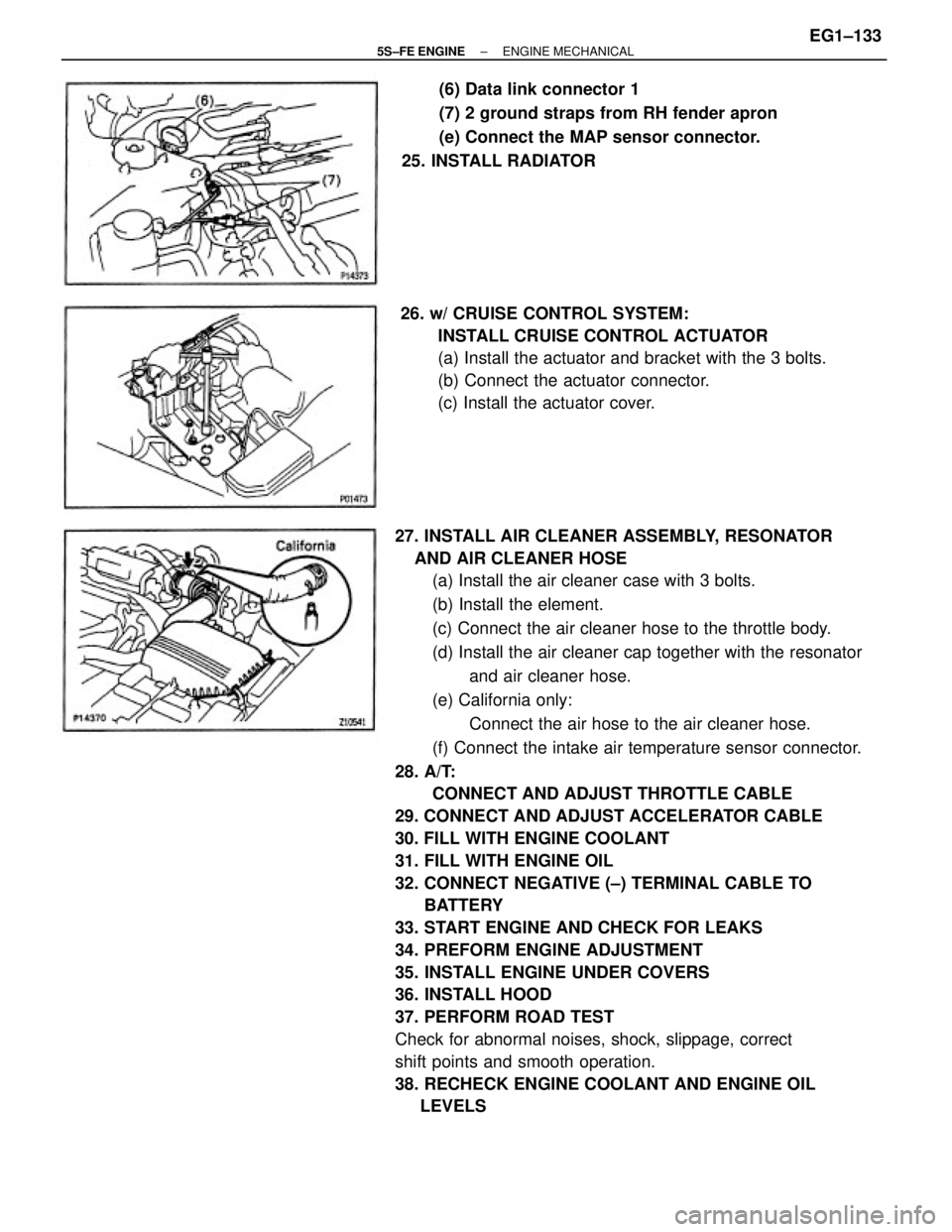
27. INSTALL AIR CLEANER ASSEMBLY, RESONATOR
AND AIR CLEANER HOSE
(a) Install the air cleaner case with 3 bolts.
(b) Install the element.
(c) Connect the air cleaner hose to the throttle body.
(d) Install the air cleaner cap together with the resonator
and air cleaner hose.
(e) California only:
Connect the air hose to the air cleaner hose.
(f) Connect the intake air temperature sensor connector.
28. A/T:
CONNECT AND ADJUST THROTTLE CABLE
29. CONNECT AND ADJUST ACCELERATOR CABLE
30. FILL WITH ENGINE COOLANT
31. FILL WITH ENGINE OIL
32. CONNECT NEGATIVE (±) TERMINAL CABLE TO
BATTERY
33. START ENGINE AND CHECK FOR LEAKS
34. PREFORM ENGINE ADJUSTMENT
35. INSTALL ENGINE UNDER COVERS
36. INSTALL HOOD
37. PERFORM ROAD TEST
Check for abnormal noises, shock, slippage, correct
shift points and smooth operation.
38. RECHECK ENGINE COOLANT AND ENGINE OIL
LEVELS26. w/ CRUISE CONTROL SYSTEM:
INSTALL CRUISE CONTROL ACTUATOR
(a) Install the actuator and bracket with the 3 bolts.
(b) Connect the actuator connector.
(c) Install the actuator cover.(6) Data link connector 1
(7) 2 ground straps from RH fender apron
(e) Connect the MAP sensor connector.
25. INSTALL RADIATOR
± 5S±FE ENGINEENGINE MECHANICALEG1±133
Page 194 of 4770
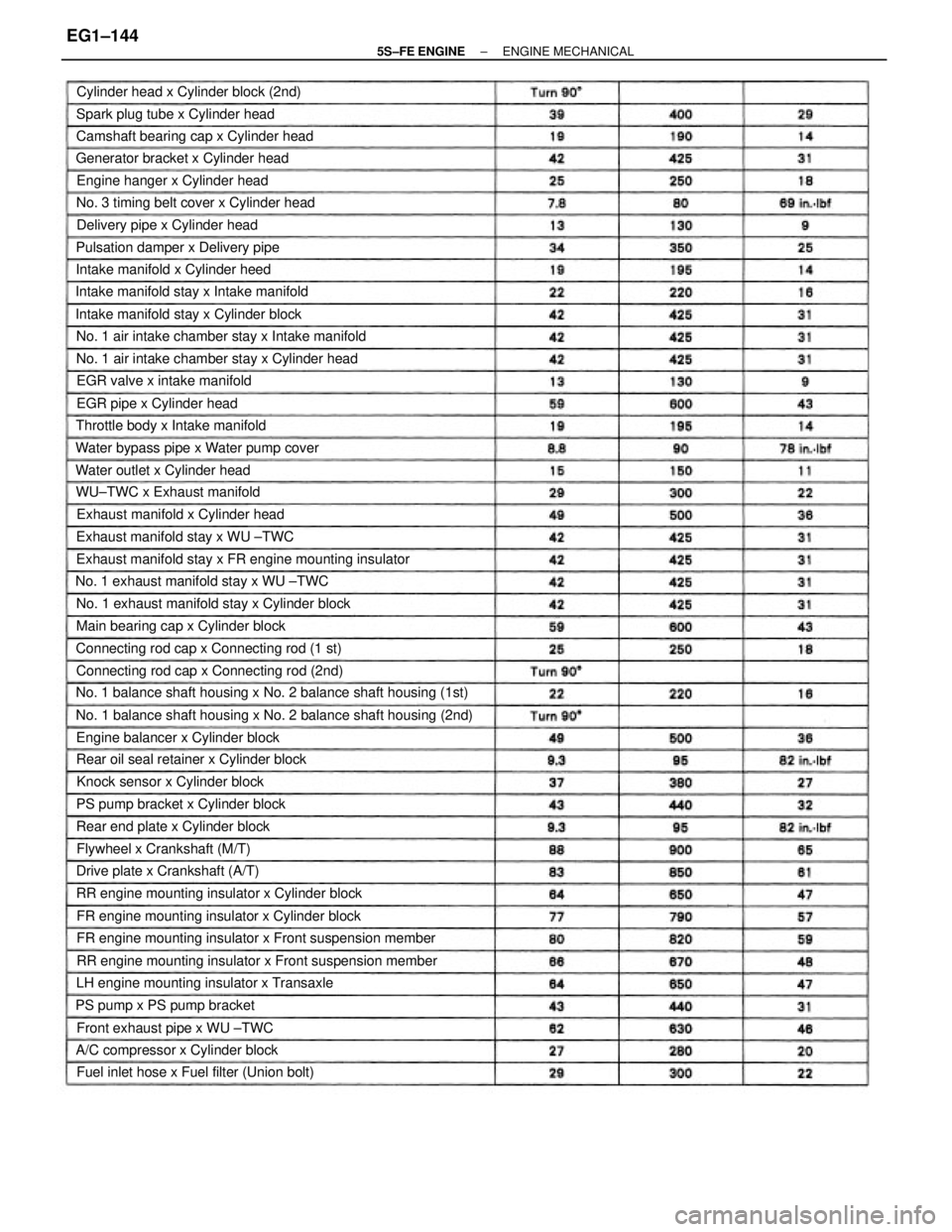
No. 1 balance shaft housing x No. 2 balance shaft housing (1st)
No. 1 balance shaft housing x No. 2 balance shaft housing (2nd)
FR engine mounting insulator x Front suspension member
RR engine mounting insulator x Front suspension member Exhaust manifold stay x FR engine mounting insulator No. 1 air intake chamber stay x Intake manifold
RR engine mounting insulator x Cylinder block
FR engine mounting insulator x Cylinder block No. 1 air intake chamber stay x Cylinder head
No. 1 exhaust manifold stay x Cylinder block
Connecting rod cap x Connecting rod (2nd) Connecting rod cap x Connecting rod (1 st)
LH engine mounting insulator x Transaxle No. 1 exhaust manifold stay x WU ±TWC Water bypass pipe x Water pump cover
Fuel inlet hose x Fuel filter (Union bolt) No. 3 timing belt cover x Cylinder head
Intake manifold stay x Intake manifoldCamshaft bearing cap x Cylinder head
Intake manifold stay x Cylinder blockCylinder head x Cylinder block (2nd)
Rear oil seal retainer x Cylinder block Exhaust manifold stay x WU ±TWC
PS pump bracket x Cylinder block Main bearing cap x Cylinder block Generator bracket x Cylinder head
A/C compressor x Cylinder block Pulsation damper x Delivery pipe
Exhaust manifold x Cylinder head
Engine balancer x Cylinder block
Front exhaust pipe x WU ±TWC Spark plug tube x Cylinder head
Rear end plate x Cylinder block Throttle body x Intake manifold Intake manifold x Cylinder heedEngine hanger x Cylinder head
Drive plate x Crankshaft (A/T)Knock sensor x Cylinder block Delivery pipe x Cylinder head
PS pump x PS pump bracketWU±TWC x Exhaust manifold
Flywheel x Crankshaft (M/T) Water outlet x Cylinder headEGR valve x intake manifold
EGR pipe x Cylinder head
± 5S±FE ENGINEENGINE MECHANICALEG1±144
Page 209 of 4770
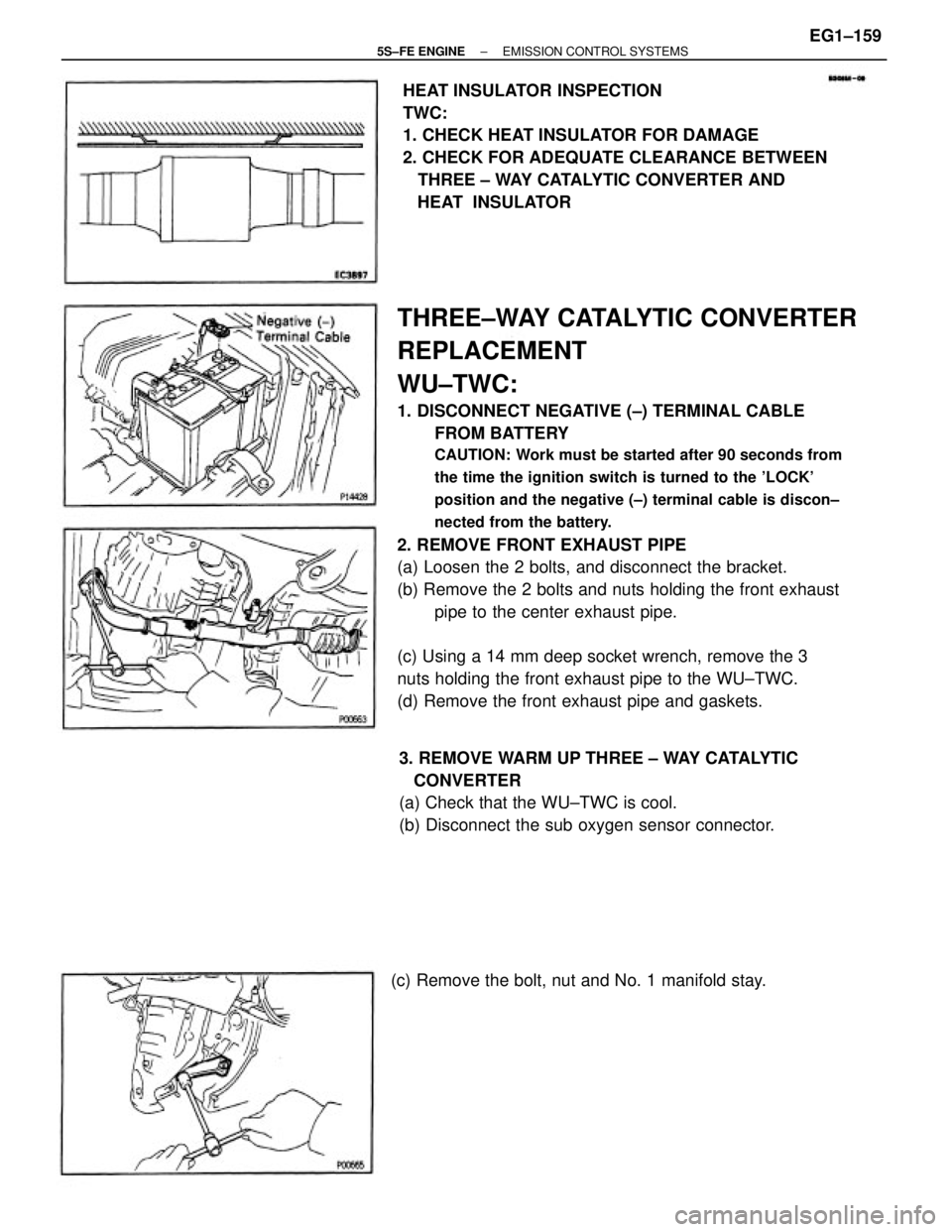
THREE±WAY CATALYTIC CONVERTER
REPLACEMENT
WU±TWC:
1. DISCONNECT NEGATIVE (±) TERMINAL CABLE
FROM BATTERY
CAUTION: Work must be started after 90 seconds from
the time the ignition switch is turned to the 'LOCK'
position and the negative (±) terminal cable is discon±
nected from the battery.
2. REMOVE FRONT EXHAUST PIPE
(a) Loosen the 2 bolts, and disconnect the bracket.
(b) Remove the 2 bolts and nuts holding the front exhaust
pipe to the center exhaust pipe.
(c) Using a 14 mm deep socket wrench, remove the 3
nuts holding the front exhaust pipe to the WU±TWC.
(d) Remove the front exhaust pipe and gaskets.HEAT INSULATOR INSPECTION
TWC:
1. CHECK HEAT INSULATOR FOR DAMAGE
2. CHECK FOR ADEQUATE CLEARANCE BETWEEN
THREE ± WAY CATALYTIC CONVERTER AND
HEAT INSULATOR
3. REMOVE WARM UP THREE ± WAY CATALYTIC
CONVERTER
(a) Check that the WU±TWC is cool.
(b) Disconnect the sub oxygen sensor connector.
(c) Remove the bolt, nut and No. 1 manifold stay.
± 5S±FE ENGINEEMISSION CONTROL SYSTEMSEG1±159
Page 211 of 4770
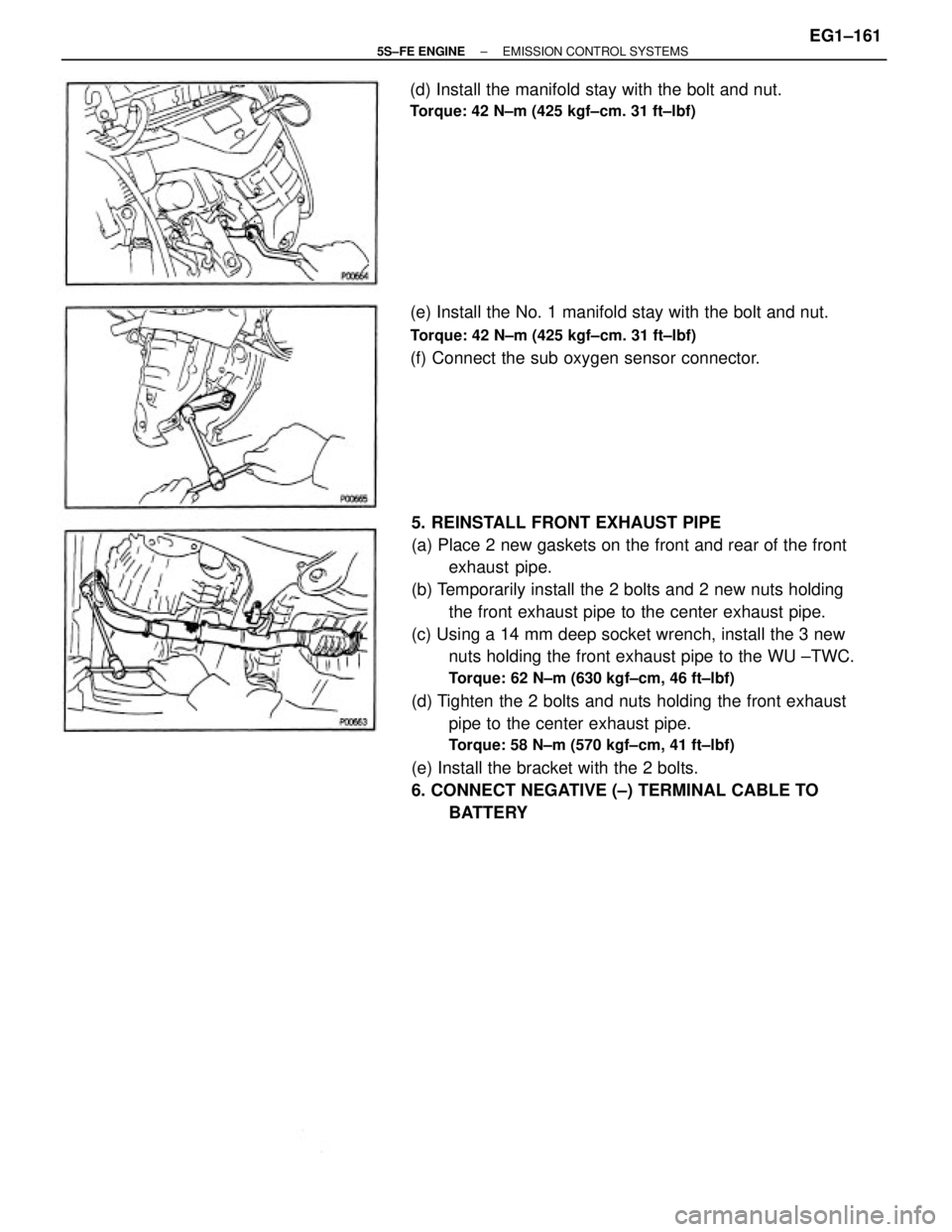
5. REINSTALL FRONT EXHAUST PIPE
(a) Place 2 new gaskets on the front and rear of the front
exhaust pipe.
(b) Temporarily install the 2 bolts and 2 new nuts holding
the front exhaust pipe to the center exhaust pipe.
(c) Using a 14 mm deep socket wrench, install the 3 new
nuts holding the front exhaust pipe to the WU ±TWC.
Torque: 62 N±m (630 kgf±cm, 46 ft±lbf)
(d) Tighten the 2 bolts and nuts holding the front exhaust
pipe to the center exhaust pipe.
Torque: 58 N±m (570 kgf±cm, 41 ft±lbf)
(e) Install the bracket with the 2 bolts.
6. CONNECT NEGATIVE (±) TERMINAL CABLE TO
BATTERY (e) Install the No. 1 manifold stay with the bolt and nut.
Torque: 42 N±m (425 kgf±cm. 31 ft±lbf)
(f) Connect the sub oxygen sensor connector. (d) Install the manifold stay with the bolt and nut.
Torque: 42 N±m (425 kgf±cm. 31 ft±lbf)
± 5S±FE ENGINEEMISSION CONTROL SYSTEMSEG1±161
Page 216 of 4770
ELECTRONIC CONTROL SYSTEM
The CAMRY 5S±FE engine is equipped with a TOYOTA Computer Controlled System (TCCS)
which centrally controls the MFI/SFI, ESA, IAC diagnosis systems etc. by means of an Engine
Control Module (ECM±formerly MFI/SFI computer) employing a microcomputer.
The ECM controls the following functions:
1. Multiport Fuel Injection (MFI)/Sequential Multiport Fuel Injection (SFI)
The ECM receives signals from various sensors indicating changing engine operation conditions
such as:
Intake manifold pressure
Intake air temperature
Engine coolant temperature
Engine speed
Throttle valve opening angle
Exhaust oxygen content etc.
The signals are utilized by the ECM to determine the injection duration necessary for an optimum
air±fuel ratio.
2. Electronic Spark Advance (ESA)
The ECM is programmed with data for optimum ignition timing under all operating conditions.
Using data provided by sensors which monitor various engine functions (RPM, engine coolant
temperature, etc.), the microcomputer (ECM) triggers the spark at precisely the right instant.
3. Idle Air Control (IAC)
The ECM is programmed with target idling speed values to respond to different engine conditions
(engine coolant temperature, air conditioning ON/OFF, etc.). Sensors transmit signals to the ECM
which controls the flow of air through the bypass of the throttle valve and adjusts idle speed to
the target value.
4. Diagnosis
The ECM detects any malfunctions and abnormalities in the sensor network and lights a
malfunction indicator lamp in the combination meter. At the same time, trouble is identified and
a diagnostic trouble code is recorded by the EC
5. The diagnostic trouble code can be read by the
number of blinks of the malfunction indicator lamp when terminals TE1 and E1 are connected.
The diagnostic trouble codes are referred to in later page. (See page EG1±300)
Fail±Safe Function
In the event of the sensor malfunction, a back±up circuit will take over to provide minimal
driveability, and the malfunction indicator lamp will illuminate. The MFI (Multiport Fuel Injection)/SFI (Sequential Multiport Fuel Injection) system is composed
of 3 basic sub±systems: Fuel, Air Induction and Electronic Control Systems.
FUEL SYSTEM
Fuel is supplied under constant pressure to the MFI/SFI injectors by an electric fuel pump. The
injectors inject a metered quantity of fuel into the intake port in accordance with signals from the
ECM (Engine Control Module).
AIR INDUCTION SYSTEM
The air induction system provides sufficient air for engine operation.
± 5S±FE ENGINEMFI/SFI SYSTEMEG1±166
Page 219 of 4770
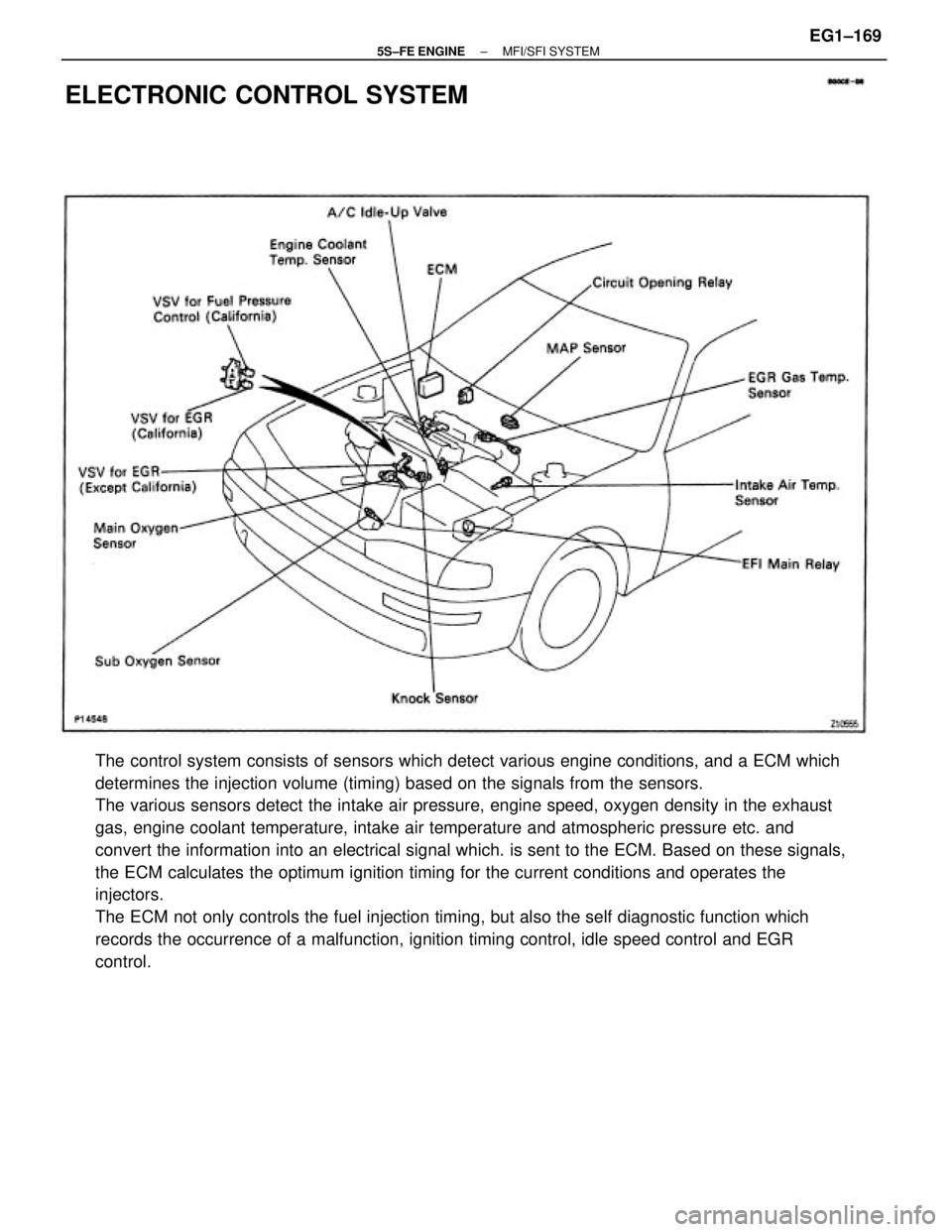
The control system consists of sensors which detect various engine conditions, and a ECM which
determines the injection volume (timing) based on the signals from the sensors.
The various sensors detect the intake air pressure, engine speed, oxygen density in the exhaust
gas, engine coolant temperature, intake air temperature and atmospheric pressure etc. and
convert the information into an electrical signal which. is sent to the ECM. Based on these signals,
the ECM calculates the optimum ignition timing for the current conditions and operates the
injectors.
The ECM not only controls the fuel injection timing, but also the self diagnostic function which
records the occurrence of a malfunction, ignition timing control, idle speed control and EGR
control.
ELECTRONIC CONTROL SYSTEM
± 5S±FE ENGINEMFI/SFI SYSTEMEG1±169