fuel TOYOTA CAMRY 2013 XV50 / 9.G Service Manual
[x] Cancel search | Manufacturer: TOYOTA, Model Year: 2013, Model line: CAMRY, Model: TOYOTA CAMRY 2013 XV50 / 9.GPages: 540, PDF Size: 7 MB
Page 404 of 540
404 4-3. Do-it-yourself maintenance
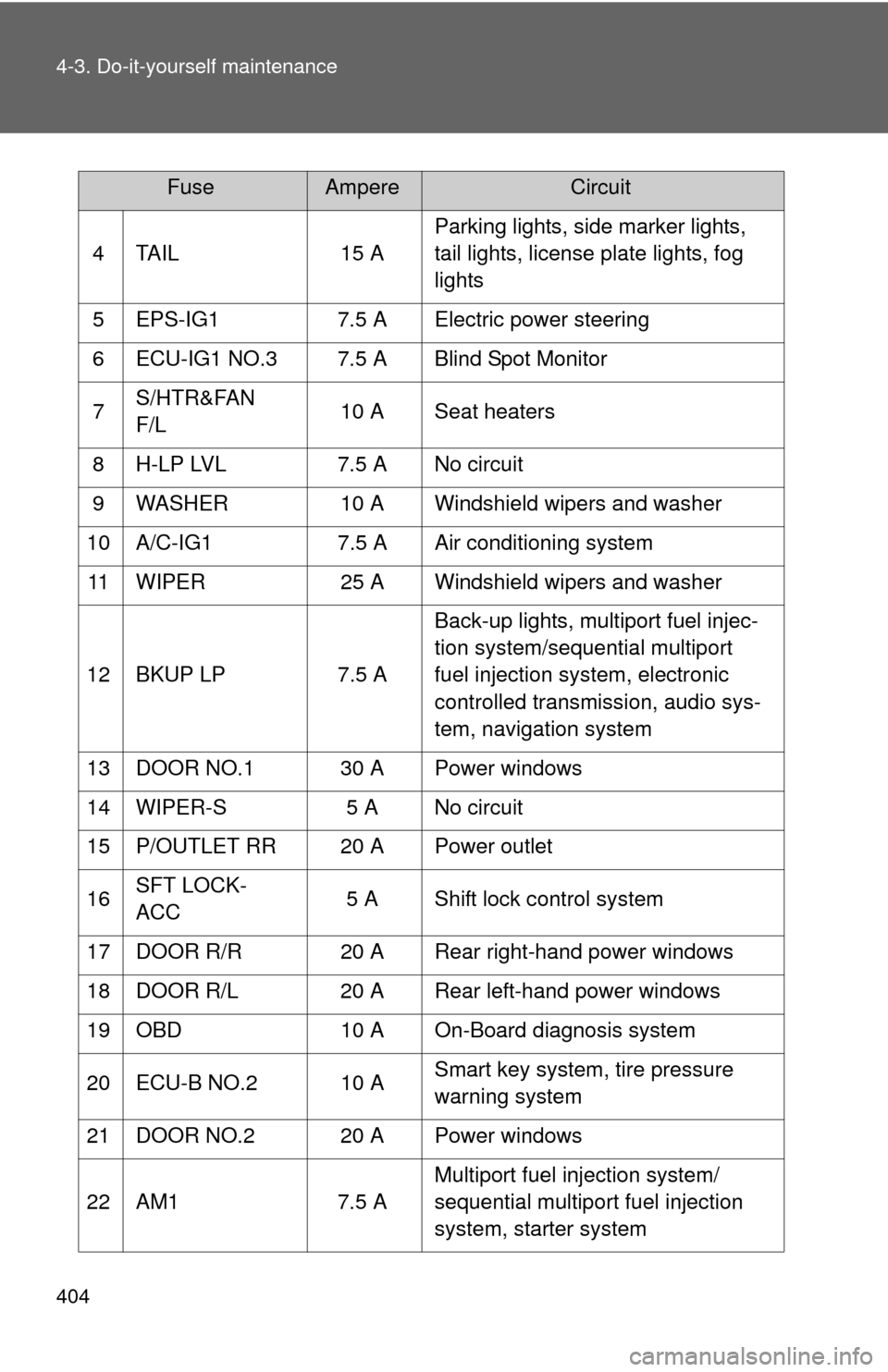
4 TAIL15 AParking lights, side marker lights,
tail lights, license plate lights, fog
lights
5 EPS-IG1 7.5 A Electric power steering
6 ECU-IG1 NO.3 7.5 A Blind Spot Monitor
7 S/HTR&FAN
F/L 10 A Seat heaters
8 H-LP LVL 7.5 A No circuit
9 WASHER 10 A Windshield wipers and washer
10 A/C-IG1 7.5 A Air conditioning system
11 WIPER 25 A Windshield wipers and washer
12 BKUP LP 7.5 ABack-up lights, multiport fuel injec-
tion system/sequential multiport
fuel injection system, electronic
controlled transmission, audio sys-
tem, navigation system
13 DOOR NO.1 30 A Power windows
14 WIPER-S 5 A No circuit
15 P/OUTLET RR 20 A Power outlet
16 SFT LOCK-
ACC 5 A Shift lock control system
17 DOOR R/R 20 A Rear right-hand power windows
18 DOOR R/L 20 A Rear left-hand power windows
19 OBD 10 A On-Board diagnosis system
20 ECU-B NO.2 10 A Smart key system, tire pressure
warning system
21 DOOR NO.2 20 A Power windows
22 AM1 7.5 AMultiport fuel injection system/
sequential multiport fuel injection
system, starter system
FuseAmpereCircuit
Page 405 of 540
405
4-3. Do-it-yourself maintenance
4
Maintenance and care
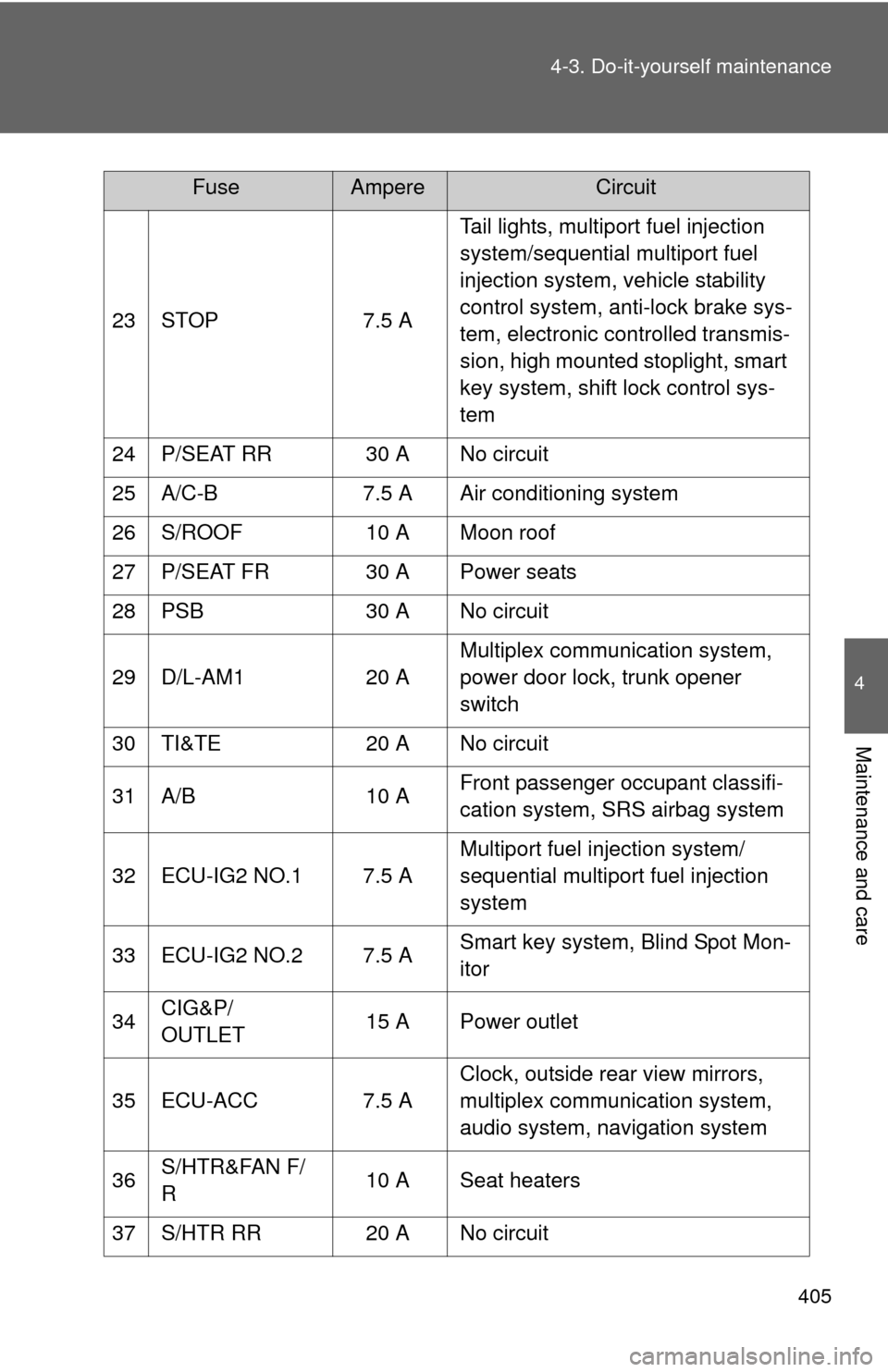
23 STOP
7.5 ATail lights, multiport fuel injection
system/sequential multiport fuel
injection system, vehicle stability
control system, anti-lock brake sys-
tem, electronic controlled transmis-
sion, high mounted stoplight, smart
key system, shift lock control sys-
tem
24 P/SEAT RR 30 A No circuit
25 A/C-B 7.5 A Air conditioning system
26 S/ROOF 10 A Moon roof
27 P/SEAT FR 30 A Power seats
28 PSB 30 A No circuit
29 D/L-AM1 20 AMultiplex communication system,
power door lock, trunk opener
switch
30 TI&TE 20 A No circuit
31 A/B 10 AFront passenger occupant classifi-
cation system, SRS airbag system
32 ECU-IG2 NO.1 7.5 A Multiport fuel injection system/
sequential multiport fuel injection
system
33 ECU-IG2 NO.2 7.5 A Smart key system, Blind Spot Mon-
itor
34 CIG&P/
OUTLET 15 A Power outlet
35 ECU-ACC 7.5 A Clock, outside rear view mirrors,
multiplex communication system,
audio system, navigation system
36 S/HTR&FAN F/
R 10 A Seat heaters
37 S/HTR RR 20 A No circuit
FuseAmpereCircuit
Page 419 of 540
When trouble arises5
419
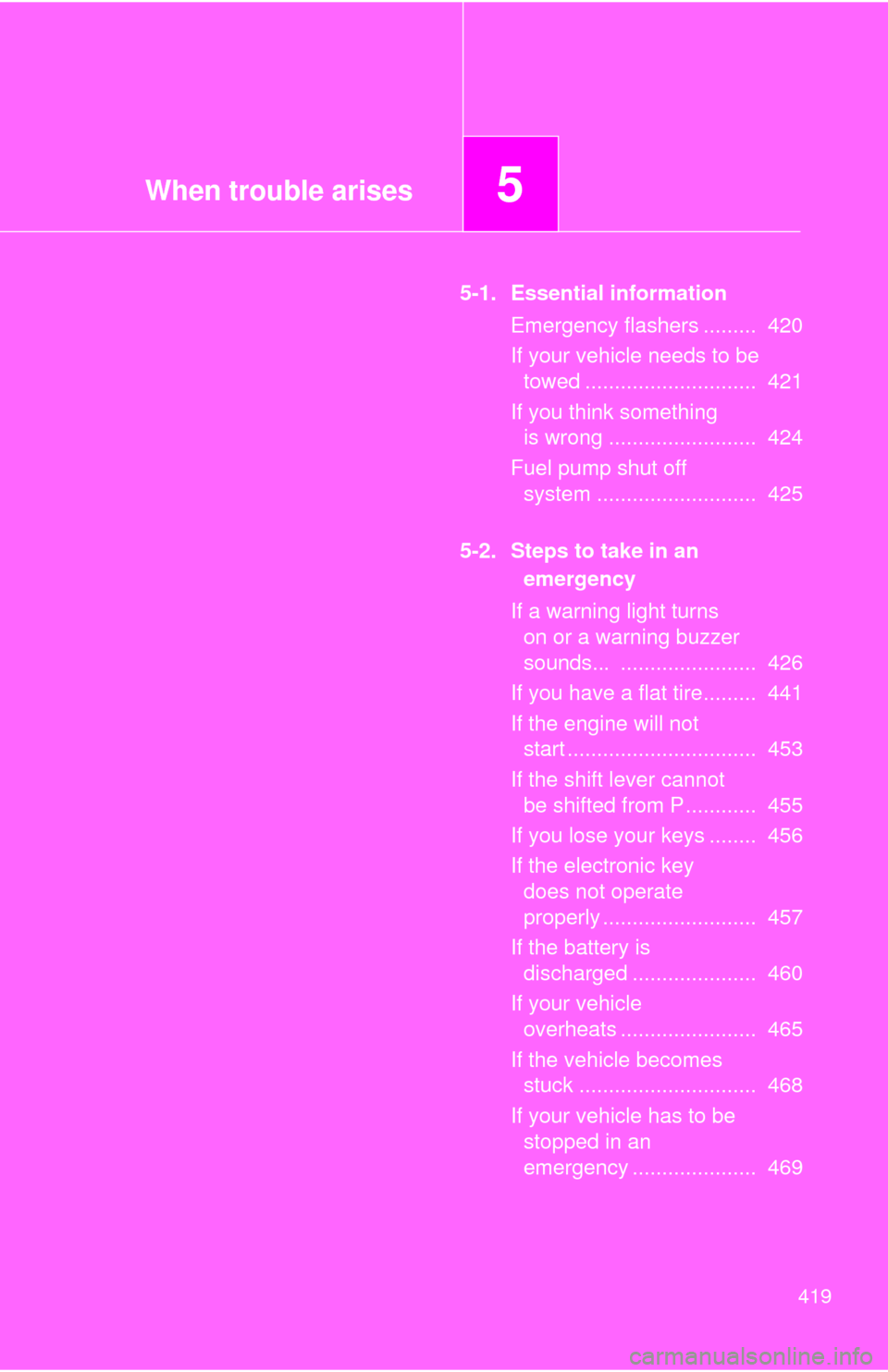
5-1. Essential informationEmergency flashers ......... 420
If your vehicle needs to be towed ............................. 421
If you think something is wrong ......................... 424
Fuel pump shut off system ........................... 425
5-2. Steps to take in an emergency
If a warning light turns on or a warning buzzer
sounds... ....................... 426
If you have a flat tire......... 441
If the engine will not start ................................ 453
If the shift lever cannot be shifted from P............ 455
If you lose your keys ........ 456
If the electronic key does not operate
properly .......................... 457
If the battery is discharged ..................... 460
If your vehicle overheats ....................... 465
If the vehicle becomes stuck .............................. 468
If your vehicle has to be stopped in an
emergency ..................... 469
Page 425 of 540
5
When trouble arises
425
5-1. Essential information
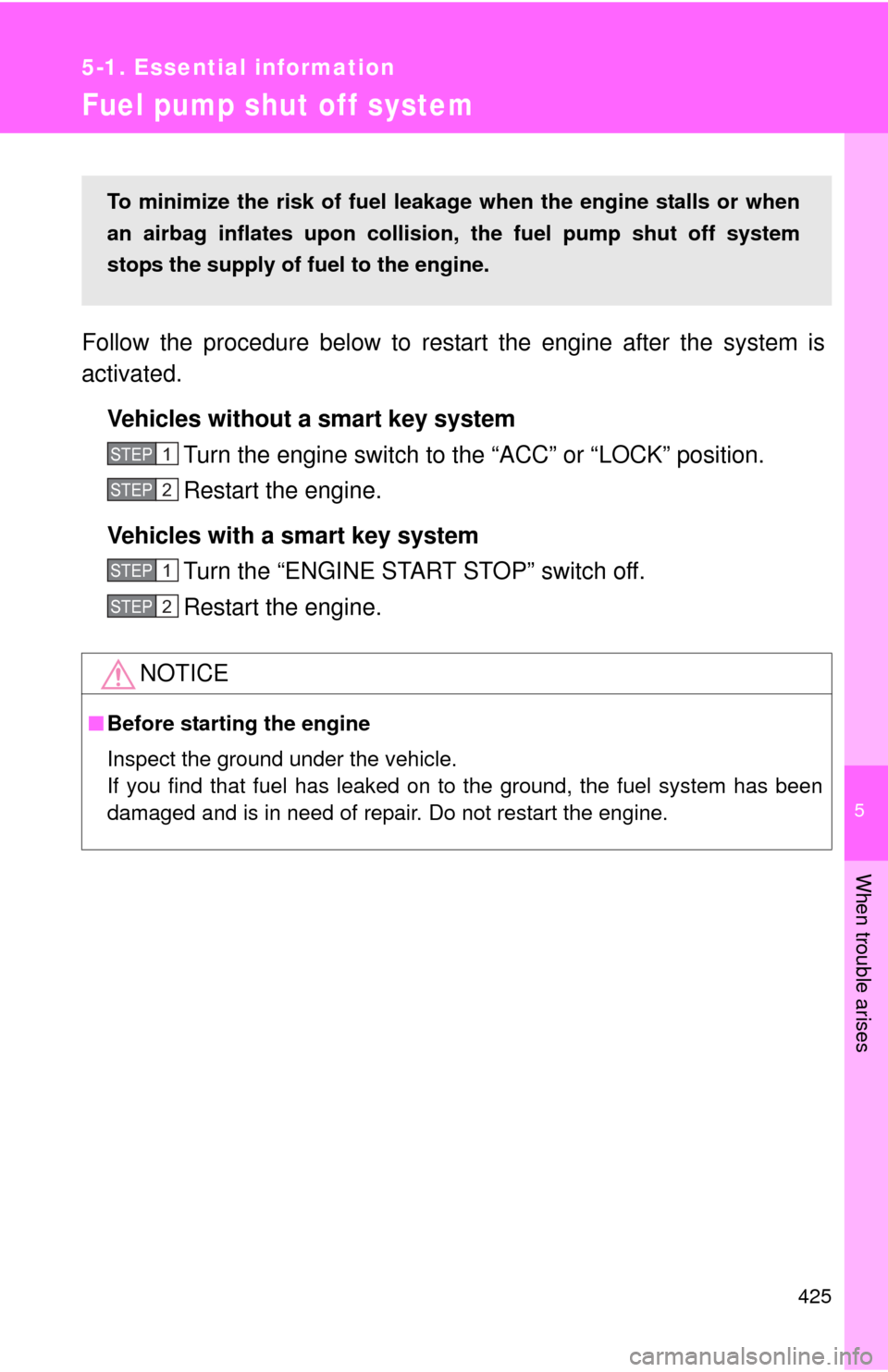
Fuel pump shut off system
Follow the procedure below to restart the engine after the system is
activated.Vehicles without a smart key system Turn the engine switch to the “ACC” or “LOCK” position.
Restart the engine.
Vehicles with a smart key system Turn the “ENGINE START STOP” switch off.
Restart the engine.
NOTICE
■Before starting the engine
Inspect the ground under the vehicle.
If you find that fuel has leaked on to the ground, the fuel system has been
damaged and is in need of repair. Do not restart the engine.
To minimize the risk of fuel leakage when the engine stalls or when
an airbag inflates upon collision , the fuel pump shut off system
stops the supply of fuel to the engine.
STEP1
STEP2
STEP1
STEP2
Page 429 of 540
5
When trouble arises
429
5-2. Steps to take in an emergency
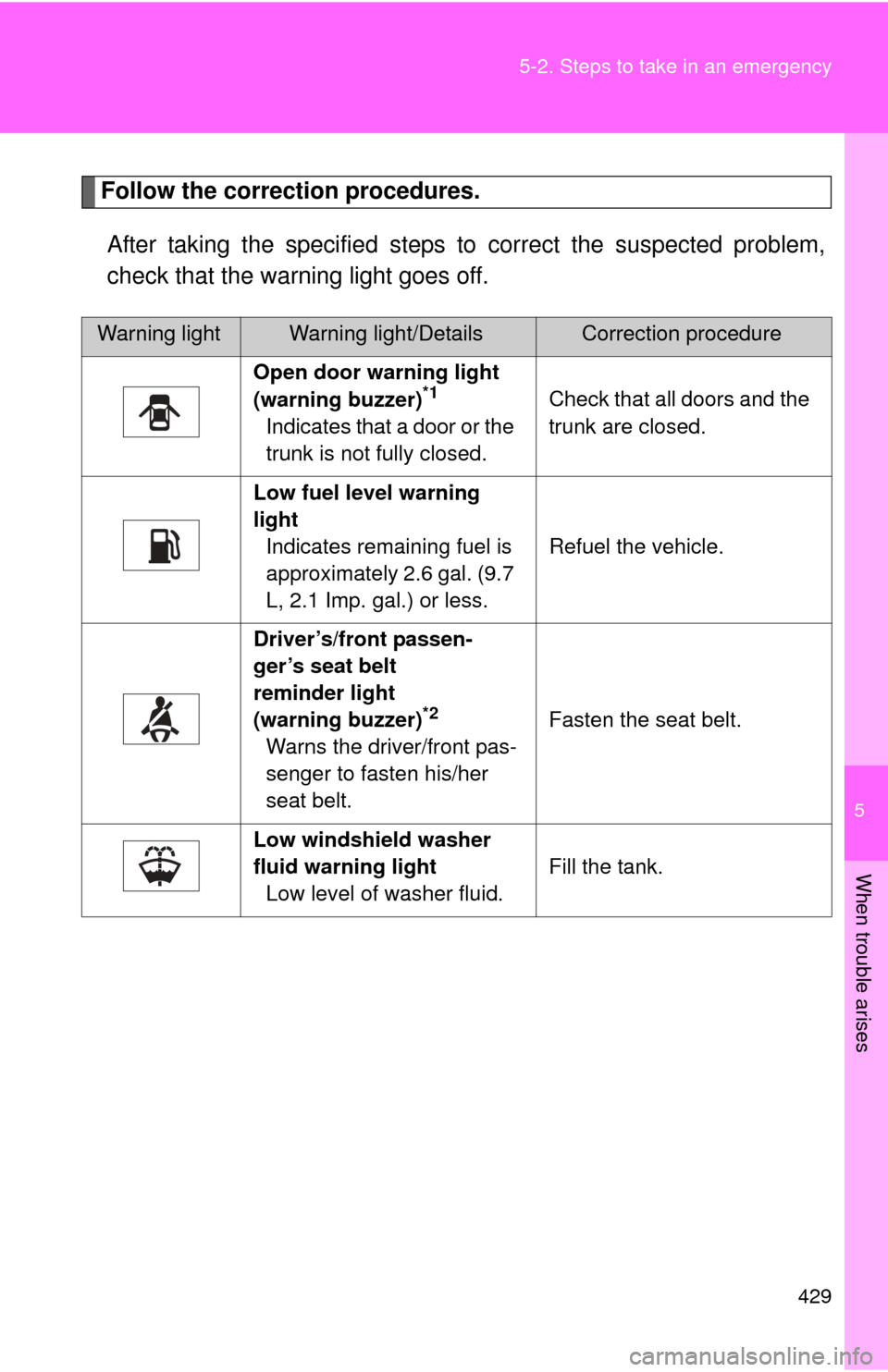
Follow the correction procedures.
After taking the specified steps to correct the suspected problem,
check that the warning light goes off.
Warning lightWarning light/DetailsCorrection procedure
Open door warning light
(warning buzzer)
*1
Indicates that a door or the
trunk is not fully closed. Check that all doors and the
trunk are closed.
Low fuel level warning
light Indicates remaining fuel is
approximately 2.6 gal. (9.7
L, 2.1 Imp. gal.) or less. Refuel the vehicle.
Driver’s/front passen-
ger’s seat belt
reminder light
(warning buzzer)
*2
Warns the driver/front pas-
senger to fasten his/her
seat belt. Fasten the seat belt.
Low windshield washer
fluid warning light Low level of washer fluid. Fill the tank.
Page 436 of 540
436 5-2. Steps to take in an emergency
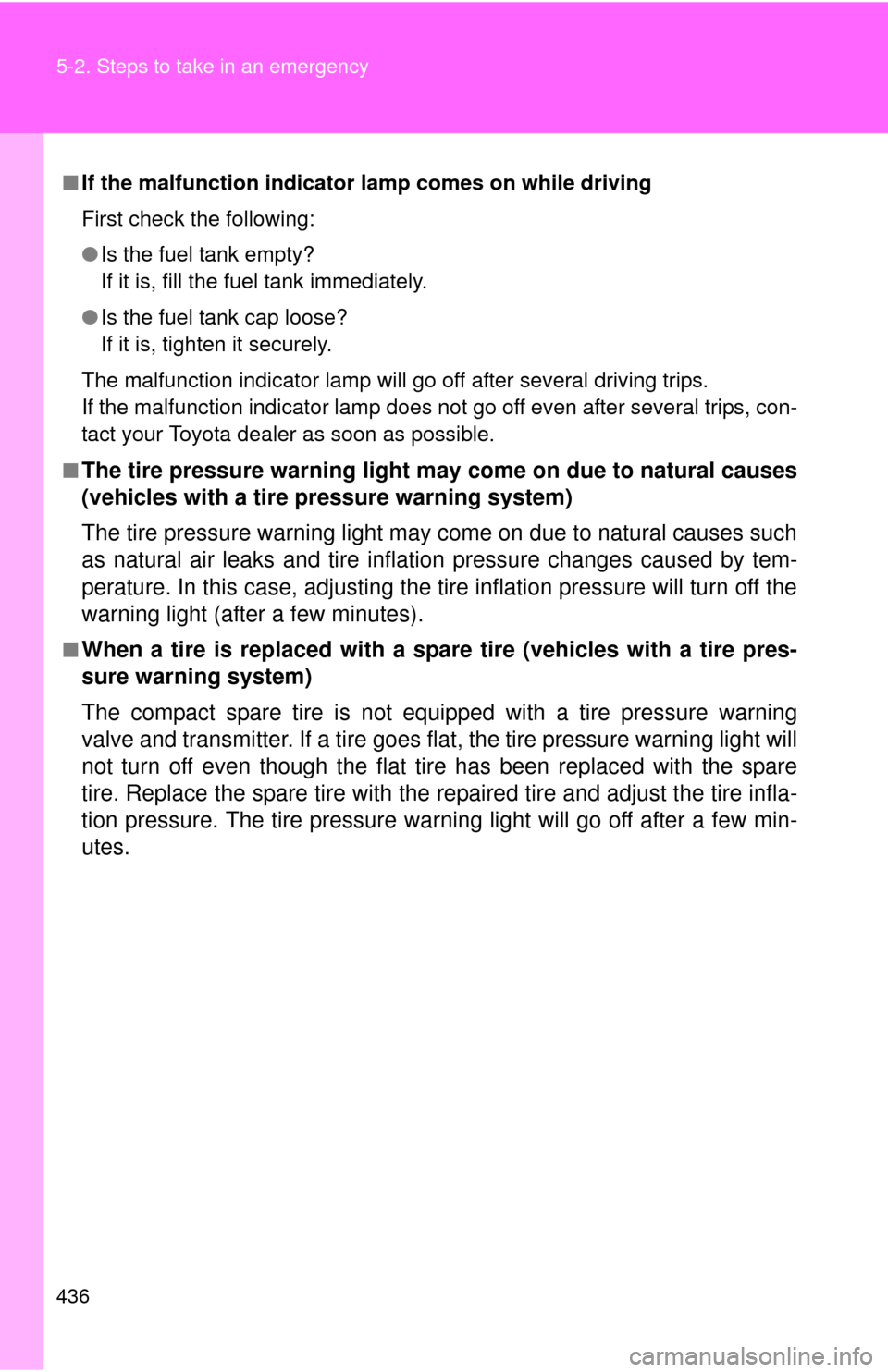
■If the malfunction indicator lamp comes on while driving
First check the following:
● Is the fuel tank empty?
If it is, fill the fuel tank immediately.
● Is the fuel tank cap loose?
If it is, tighten it securely.
The malfunction indicator lamp will go off after several driving trips.
If the malfunction indicator lamp does not go off even after several trips, con-
tact your Toyota dealer as soon as possible.
■
The tire pressure warning light may come on due to natural causes
(vehicles with a tire pressure warning system)
The tire pressure warning light may come on due to natural causes such
as natural air leaks and tire inflat ion pressure changes caused by tem-
perature. In this case, adjusting the tire inflation pressure will turn off the
warning light (after a few minutes).
■When a tire is replaced with a spare tire (vehicles with a tire pres-
sure warning system)
The compact spare tire is not equipped with a tire pressure warning
valve and transmitter. If a tire goes flat, the tire pressure warning light will
not turn off even though the flat tire has been replaced with the spare
tire. Replace the spare tire with the re paired tire and adjust the tire infla-
tion pressure. The tire pressure wa rning light will go off after a few min-
utes.
Page 439 of 540
5
When trouble arises
439
5-2. Steps to take in an emergency
CAUTION
■Maintenance of the tires (vehicles with a tire pressure warning sys-
tem)
Each tire, including the spare (if provided), should be checked monthly
when cold and inflated to the inflation pressure recommended by the
vehicle manufacturer on the vehicle
placard or tire inflation pressure
label (tire and load information label). (If your vehicle has tires of a differ-
ent size than the size indicated on the vehicle placard or tire inflation
pressure label [tire and load information label], you should determine the
proper tire inflation pr essure for those tires.)
As an added safety feature, your vehicle has been equipped with a tire
pressure monitoring system (TPMS-ti re pressure warning system) that
illuminates a low tire pressure telltal e (tire pressure warning light) when
one or more of your tires is significantly under-inflated. Accordingly,
when the low tire pressure telltale (tire pre ssure warning light) illumi-
nates, you should stop and check your tires as soon as possible, and
inflate them to the proper pressure. Driving on a significantly under-
inflated tire causes the tire to overheat and can lead to tire failure.
Under-inflation also reduces fuel effi ciency and tire tread life, and may
affect the vehicle's hand ling and stopping ability.
Please note that the TPMS (tire pressure warning system) is not a sub-
stitute for proper ti re maintenance, an d it is the driver's responsibility to
maintain correct tire pressure, even if under-inflation has not reached the
level to trigger illu mination of the TPMS low ti re pressure telltale (tire
pressure warning light).
Page 453 of 540
5
When trouble arises
453
5-2. Steps to take in an emergency
If the engine will not star t
If the engine will not start even though correct starting procedures
are being followed (
P. 145, 148), consider each of the following
points:
■ The engine will not start even though the starter motor
operates normally.
One of the following may be the cause of the problem:
●There may not be sufficient fuel in the vehicle’s tank.
Refuel the vehicle.
Flex-fuel vehicles: The type of fuel may be different. When
refueling, add the same type of fuel, if available.
After adding a different type of fuel, the engine may run
roughly and driving performance may be reduced for a while
when the engine is first started. In this case, wait until the
engine runs normally.
● The engine may be flooded.
Try to restart the engine again following correct starting proce-
dures. ( P. 145, 148)
● There may be a malfunction in the engine immobilizer system.
( P. 9 3 )
■ The starter motor turns over slowly, the interior lights and
headlights are dim, or the horn does not sound or sounds at
a low volume.
One of the following may be the cause of the problem:
●The battery may be discharged. ( P. 460)
● The battery terminal connec tions may be loose or corroded.
Page 471 of 540
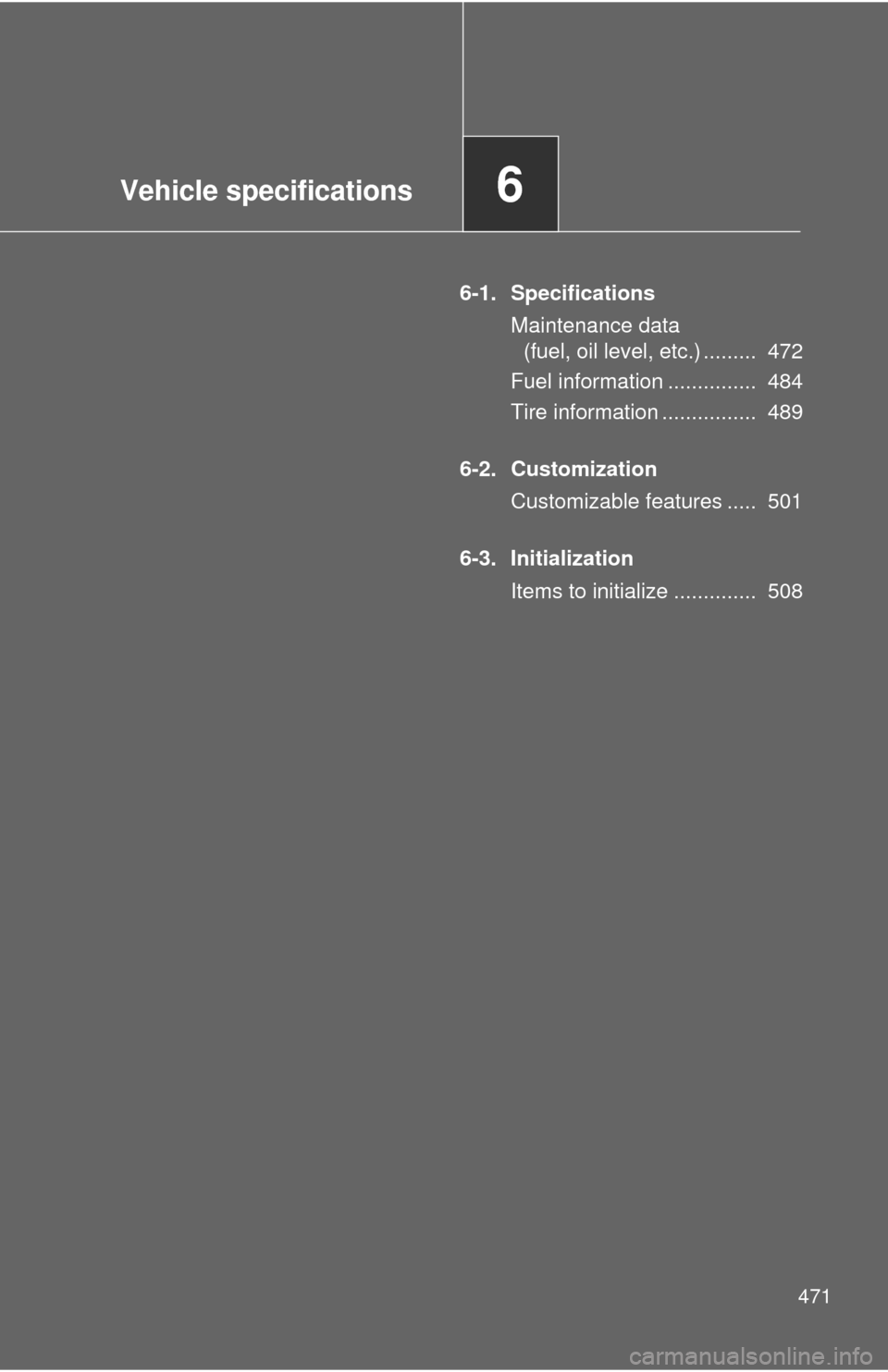
Vehicle specifications6
471
6-1. SpecificationsMaintenance data (fuel, oil level, etc.) ......... 472
Fuel information ............... 484
Tire information ................ 489
6-2. Customization Customizable features ..... 501
6-3. Initialization Items to initialize .............. 508
Page 472 of 540
472
6-1. Specifications
Maintenance data (fuel, oil level, etc.)
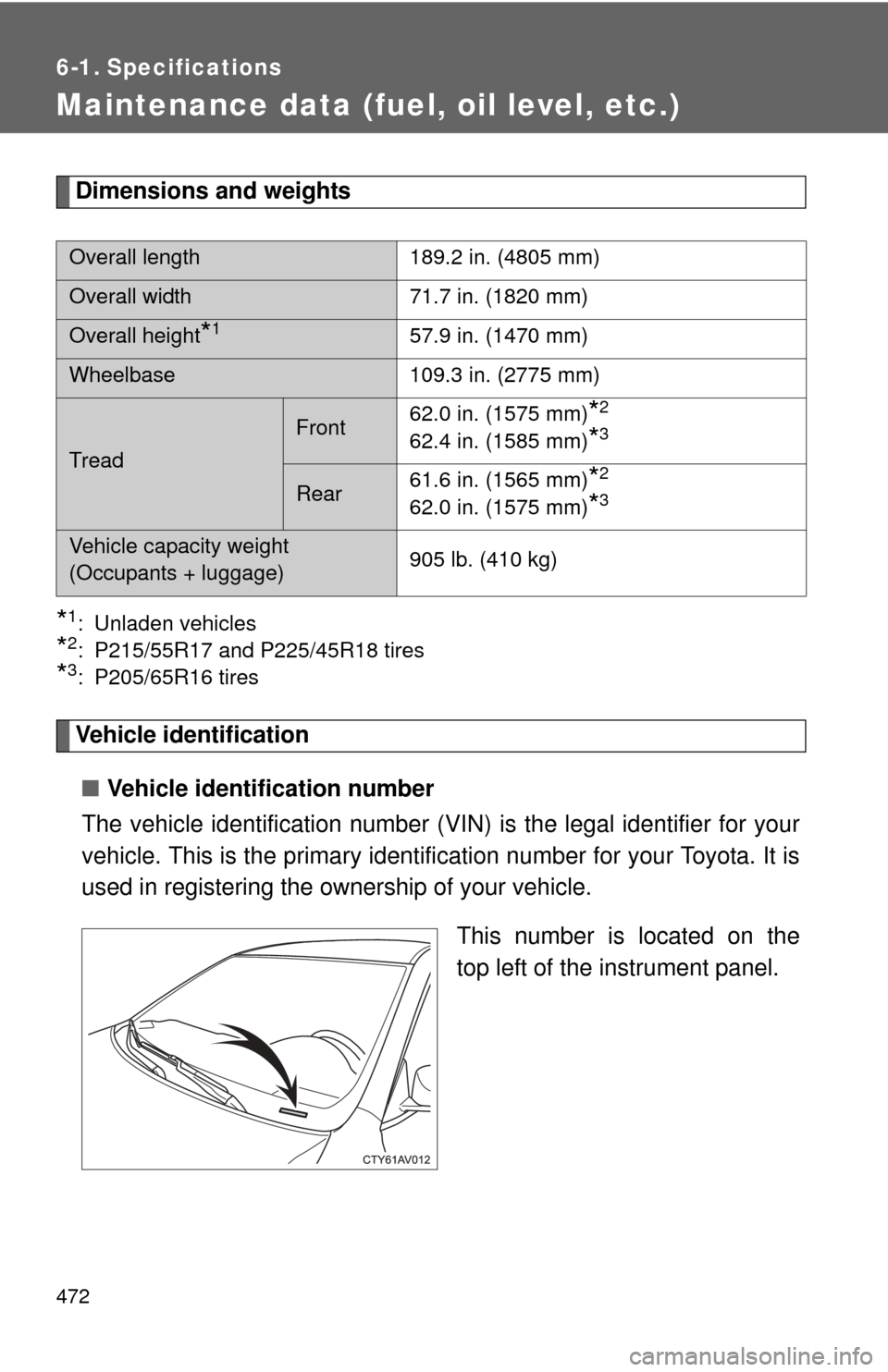
Dimensions and weights
*1: Unladen vehicles
*2: P215/55R17 and P225/45R18 tires
*3: P205/65R16 tires
Vehicle identification■ Vehicle identification number
The vehicle identificati on number (VIN) is the legal identifier for your
vehicle. This is the primary identification number for your Toyota. It is
used in registering the ownership of your vehicle.
This number is located on the
top left of the instrument panel.
Overall length 189.2 in. (4805 mm)
Overall width71.7 in. (1820 mm)
Overall height*157.9 in. (1470 mm)
Wheelbase109.3 in. (2775 mm)
Tread
Front62.0 in. (1575 mm)*2
62.4 in. (1585 mm)*3
Rear61.6 in. (1565 mm)*2
62.0 in. (1575 mm)*3
Vehicle capacity weight
(Occupants + luggage) 905 lb. (410 kg)