steering wheel TOYOTA CAMRY 2018 (in English) Service Manual
[x] Cancel search | Manufacturer: TOYOTA, Model Year: 2018, Model line: CAMRY, Model: TOYOTA CAMRY 2018Pages: 612, PDF Size: 13.73 MB
Page 475 of 612
4756-3. Do-it-yourself maintenance
CAMRY_U (01999-06122)
6
Maintenance and care
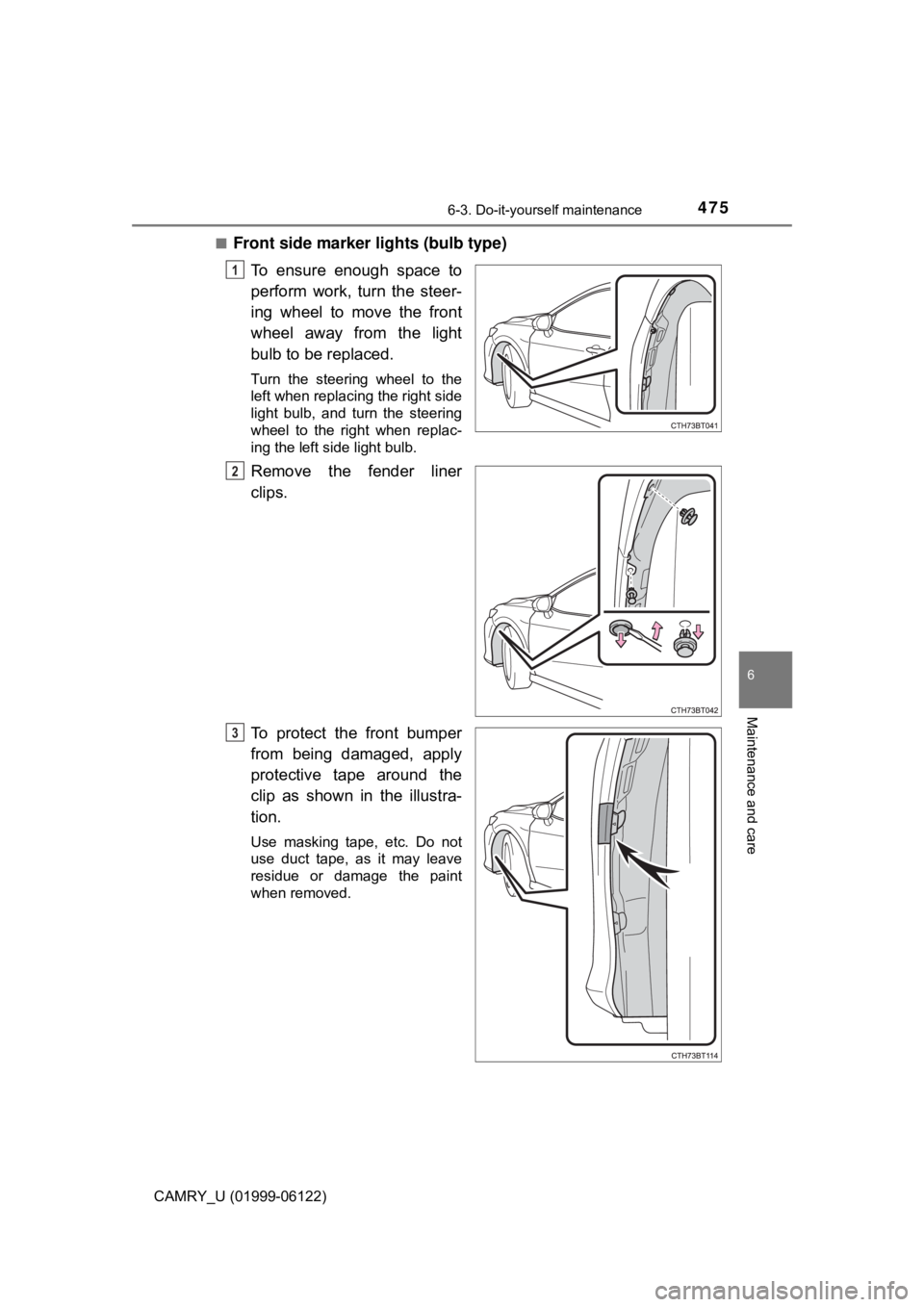
■Front side marker lights (bulb type)
To ensure enough space to
perform work, turn the steer-
ing wheel to move the front
wheel away from the light
bulb to be replaced.
Turn the steering wheel to the
left when replacing the right side
light bulb, and turn the steering
wheel to the right when replac-
ing the left side light bulb.
Remove the fender liner
clips.
To protect the front bumper
from being damaged, apply
protective tape around the
clip as shown in the illustra-
tion.
Use masking tape, etc. Do not
use duct tape, as it may leave
residue or damage the paint
when removed.
1
2
3
Page 488 of 612

4887-1. Essential information
CAMRY_U (01999-06122)
WARNING
■If the engine has to be turned off while driving
●Power assist for the brakes and steering wheel will be lost, making the
brake pedal harder to depress and the steering wheel heavier to turn.
Decelerate as much as possible before turning off the engine.
●Vehicles without a smart key system: Never attempt to remove the key, as
doing so will lock the steering wheel.
Page 490 of 612
4907-2. Steps to take in an emergency
CAMRY_U (01999-06122)
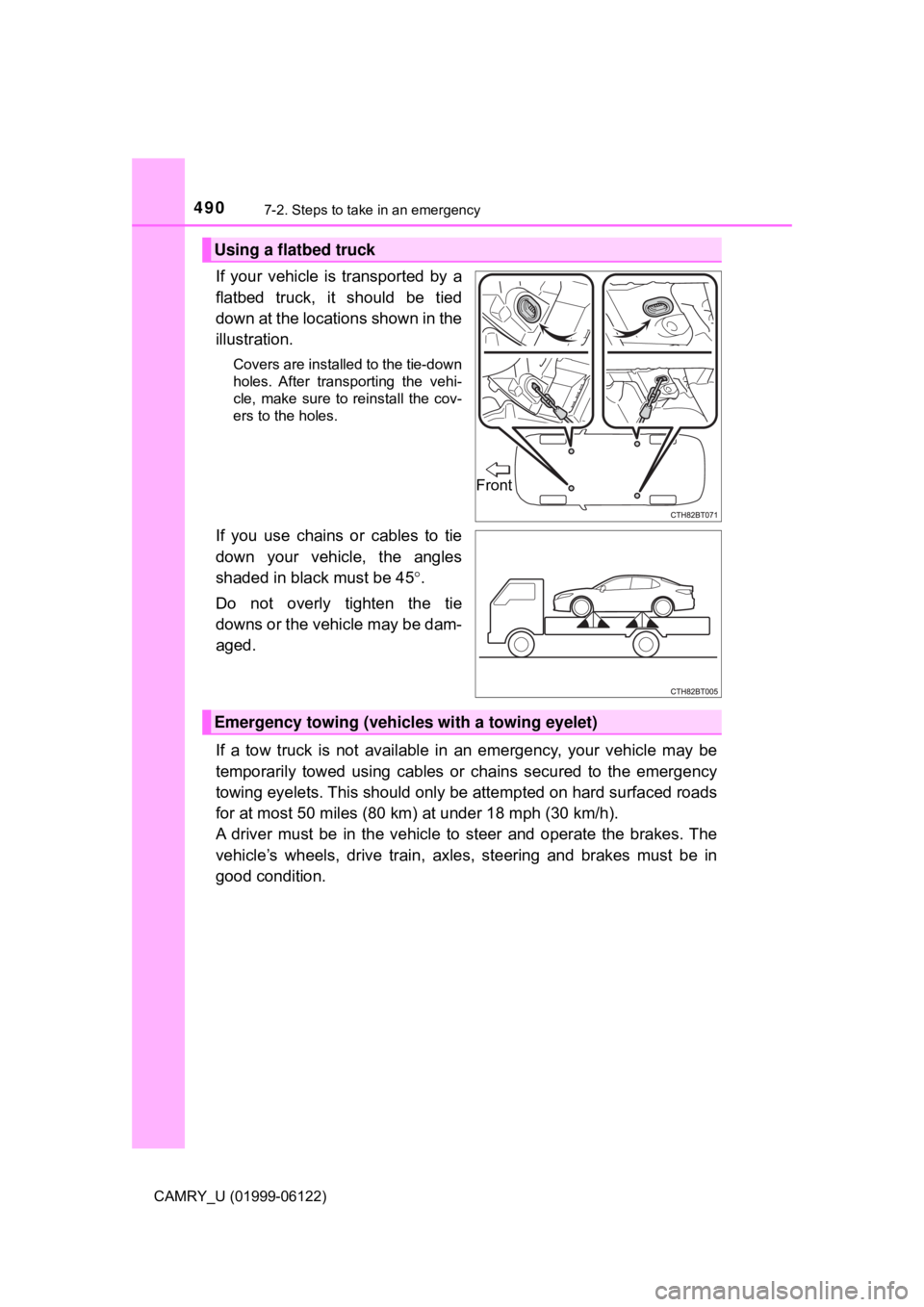
If your vehicle is transported by a
flatbed truck, it should be tied
down at the locations shown in the
illustration.
Covers are installed to the tie-down
holes. After transporting the vehi-
cle, make sure to reinstall the cov-
ers to the holes.
If you use chains or cables to tie
down your vehicle, the angles
shaded in black must be 45°.
Do not overly tighten the tie
downs or the vehicle may be dam-
aged.
If a tow truck is not available in an emergency, your vehicle may be
temporarily towed using cables or chains secured to the emergency
towing eyelets. This should only be attempted on hard surfaced roads
for at most 50 miles (80 km) at under 18 mph (30 km/h).
A driver must be in the vehicle to steer and operate the brakes. The
vehicle’s wheels, drive train, axles, steering and brakes must be in
good condition.
Using a flatbed truck
Front
Emergency towing (vehicles with a towing eyelet)
Page 492 of 612

4927-2. Steps to take in an emergency
CAMRY_U (01999-06122)
Vehicles without a smart key system: Enter the vehicle being towed
and start the engine.
If the engine does not start, turn the engine switch to the “ON” position.
Vehicles with a smart key system: Enter the vehicle being towed
and start the engine.
If the engine does not start, turn the engine switch to IGNITION ON mode.
Shift the shift lever to N and release the parking brake.
When the shift lever cannot be shifted: →P. 2 0 9
■While towing (vehicles with a towing eyelet)
If the engine is not running, the power assist for the brakes and steering will
not function, making steering and braking more difficult.
■Wheel nut wrench (vehicles with a towing eyelet)
Wheel nut wrench is installed in the trunk. (→P. 513)
6
7
Page 493 of 612

4937-2. Steps to take in an emergency
CAMRY_U (01999-06122)
7
When trouble arises
WARNING
Observe the following precautions.
Failure to do so may result in death or serious injury.
■When towing the vehicle
■While towing (vehicles with a towing eyelet)
●When towing using cables or chains, avoid sudden starts, etc. which place
excessive stress on the towing eyelet, cables or chains. The towing eyelet,
cables or chains may become damaged, broken debris may hit people,
and cause serious damage.
●Vehicles without a smart key system: Do not turn the engine switch to the
“LOCK” position.
There is a possibility that the steering wheel is locked and cannot be oper-
ated.
●Vehicles with a smart key system: Do not turn the engine switch off.
There is a possibility that the steering wheel is locked and cannot be oper-
ated.
■Installing towing eyelet to the vehicle (vehicles with a towing eyelet)
Make sure that towing eyelet is installed securely.
If not securely installed, towing eyelet may come loose during towing.
Be sure to transport the vehicle with the
front wheels raised or with all four wheels
raised off the ground. If the vehicle is
towed with the front wheels contacting
the ground, the drivetrain and related
parts may be damaged.
Page 494 of 612

4947-2. Steps to take in an emergency
CAMRY_U (01999-06122)
NOTICE
■To prevent damage to the vehicle when towing using a wheel-lift type
truck
●Vehicles without a smart key system: Do not tow the vehicle from the rear
when the engine switch is in the “LOCK” position or the key is removed.
The steering lock mechanism is not strong enough to hold the front wheels
straight.
●Vehicles with a smart key system: Do not tow the vehicle from the rear
when the engine switch is off. The steering lock mechanism is not strong
enough to hold the front wheels straight.
●When raising the vehicle, ensure adequate ground clearance for towing at
the opposite end of the raised vehicle. Without adequate clearance, the
vehicle could be damaged while being towed.
■To prevent damage to the vehicle when towing with a sling-type truck
Do not tow with a sling-type truck, either from the front or rear.
■To prevent damage to the vehicle during emergency towing (vehicles
with a towing eyelet)
Do not secure cables or chains to the suspension components.
Page 504 of 612

5047-2. Steps to take in an emergency
CAMRY_U (01999-06122)
WARNING
■If both the ABS and the brake system warning lights remain on
Stop your vehicle in a safe place immediately and contact your Toyota
dealer. The vehicle will become extremely unstable during braking, and the
ABS system may fail, which could cause an accident resulting in death or
serious injury.
■When the electric power steering system warning light comes on
When the light comes on yellow, the assist to the power steering is
restricted. When the light comes on red, the assist to the power steering is
lost and handling operations of the steering wheel become extremely
heavy. When steering wheel operations are heavier than usual, grip the
steering wheel firmly and operate it using more force than usual.
■
If the tire pressure warning light comes on
Be sure to observe the following precautions. Failure to do so could
cause a loss of vehicle control and result in death or serious injury.
●Stop your vehicle in a safe place as soon as possible. Adjust the tire
inflation pressure immediately.
●If the tire pressure warning light comes on even after tire inflation pres-
sure adjustment, it is probable that you have a flat tire. Check the tires.
If a tire is flat, change it with the spare tire and have the flat tire
repaired by the nearest Toyota dealer.
●Avoid abrupt maneuvering and braking. If the vehicle tires deteriorate,
you could lose control of the steering wheel or the brakes.
■If a blowout or sudden air leakage should occur
The tire pressure warning system may not activate immediately.
Page 547 of 612
5478-1. Specifications
8
Vehicle specifications
CAMRY_U (01999-06122)
*1: Minimum pedal clearance when depressed with a force of 67 lbf (300 N, 31
kgf) while the engine is running.
*2: Parking brake pedal travel when depressed with a force of 67 lbf (300 N,
31 kgf).
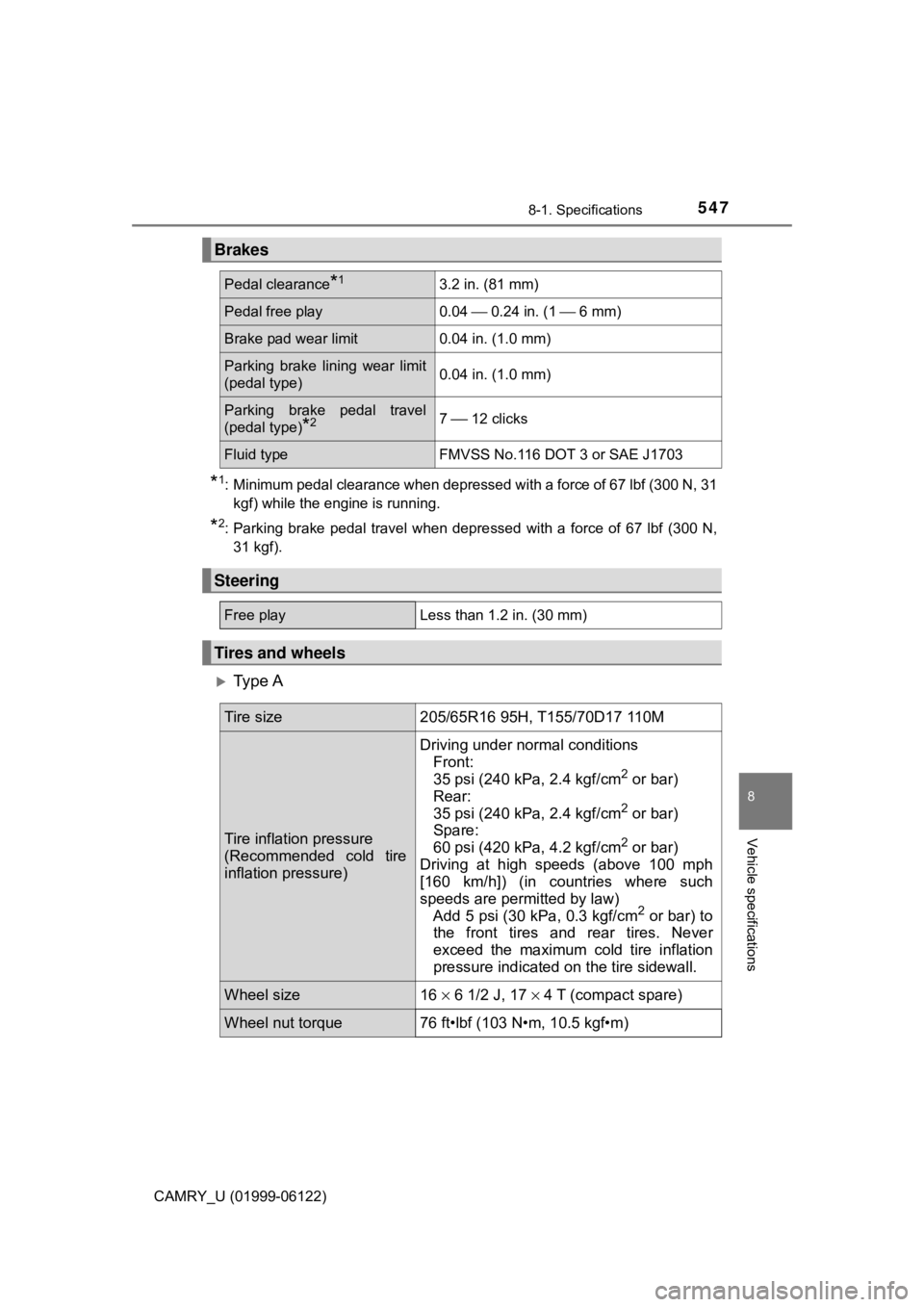
Ty p e A
Brakes
Pedal clearance*13.2 in. (81 mm)
Pedal free play 0.04 ⎯ 0.24 in. (1 ⎯ 6 mm)
Brake pad wear limit0.04 in. (1.0 mm)
Parking brake lining wear limit
(pedal type)0.04 in. (1.0 mm)
Parking brake pedal travel
(pedal type)
*27 ⎯ 12 clicks
Fluid type FMVSS No.116 DOT 3 or SAE J1703
Steering
Free play Less than 1.2 in. (30 mm)
Tires and wheels
Tire size 205/65R16 95H, T155/70D17 110M
Tire inflation pressure
(Recommended cold tire
inflation pressure)Driving under normal conditions
Front:
35 psi (240 kPa, 2.4 kgf/cm
2 or bar)
Rear:
35 psi (240 kPa, 2.4 kgf/cm
2 or bar)
Spare:
60 psi (420 kPa, 4.2 kgf/cm
2 or bar)
Driving at high speeds (above 100 mph
[160 km/h]) (in countries where such
speeds are permitted by law)
Add 5 psi (30 kPa, 0.3 kgf/cm
2 or bar) to
the front tires and rear tires. Never
exceed the maximum cold tire inflation
pressure indicated on the tire sidewall.
Wheel size 16 × 6 1/2 J, 17 × 4 T (compact spare)
Wheel nut torque76 ft•lbf (103 N•m, 10.5 kgf•m)
Page 593 of 612
593What to do if... (Troubleshooting)
CAMRY_U (01999-06122)
●Is the shift lever in P? (→P. 198)
●Is the steering wheel unlocked? (→P. 198)
●Is the battery discharged? (→P. 529)
●Did you press the engine switch while firmly depressing the brake pedal?
(→P. 200)
●Is the shift lever in P? (→P. 202)
●Is the electronic key anywhere detectable inside the vehicle? (→P. 150)
●Is the steering wheel unlocked? (→P. 202)
●Is the electronic key battery weak or depleted?
In this case, the engine can be started in a temporary way. (→P. 527)
●Is the battery discharged? (→P. 529)
●Vehicles without a smart key system:
Is the engine switch in the “ON” position?
If you cannot release the shift lever by depressing the brake pedal with the
engine switch in the “ON” position. (→P. 209)
Vehicles with a smart key system:
Is the engine switch in IGNITION ON mode?
If you cannot release the shift lever by depressing the brake pedal with the
engine switch in IGNITION ON mode. (→P. 209)
If you think something is wrong
The engine does not start
(vehicles without a smart key system)
The engine does not start
(vehicles with a smart key system)
The shift lever cannot be shifted from P even if you depress
the brake pedal
Page 594 of 612

594What to do if... (Troubleshooting)
CAMRY_U (01999-06122)
●Vehicles without a smart key system:
It is locked to prevent theft of the vehicle if the key is pulled from the engine
switch. (→P. 199)
Vehicles with a smart key system:
It is locked automatically to prevent theft of the vehicle. (→P. 202)
●Is the window lock switch pressed?
The power window except for the one at the driver’s seat cannot be oper-
ated if the window lock switch is pressed. (→P. 170)
●The auto power off function will be operated if the vehicle is left in ACCES-
SORY or IGNITION ON mode (the engine is not running) for a period of
time. (→P. 202)
●The seat belt reminder light is flashing
Are the driver and the passenger wearing the seat belts? (→P. 500)
●The parking brake indicator is on
Is the parking brake released? (→P. 212, 213)
Depending on the situation, other types of warning buzzer may also sound.
(→P. 497, 507)
The steering wheel cannot be turned after the engine is
stopped
The windows do not open or close by operating the power
window switches
The engine switch is turned off automatically
(vehicles with a smart key system)
A warning buzzer sounds during driving