cargo and luggage TOYOTA CAMRY 2018 Owners Manual (in English)
[x] Cancel search | Manufacturer: TOYOTA, Model Year: 2018, Model line: CAMRY, Model: TOYOTA CAMRY 2018Pages: 612, PDF Size: 13.73 MB
Page 2 of 612

TABLE OF CONTENTS2
CAMRY_U (01999-06122)For your information....................... 6
Reading this manual .................... 10
How to search .............................. 11
Pictorial index .............................. 12
1-1. For safe use
Before driving ...................... 22
For safe driving ................... 24
Seat belts ............................ 26
SRS airbags ........................ 32
Front passenger occupant
classification system ......... 45
Exhaust gas precautions ..... 50
1-2. Child safety
Riding with children ............. 51
Child restraint systems ........ 52
1-3. Theft deterrent system
Engine immobilizer
system............................... 71
Alarm ................................... 74
2. Instrument cluster
Warning lights and
indicators........................... 78
Gauges and meters............. 84
Multi-information display
(4.2-inch display)............... 87
Multi-information display
(7-inch display).................. 99
Head-up display ................ 113
Fuel consumption
information ...................... 1203-1. Key information
Keys................................... 126
3-2. Opening, closing and
locking the doors
Doors ................................. 135
Trunk ................................. 144
Smart key system .............. 149
3-3. Adjusting the seats
Front seats......................... 158
Rear seats ......................... 160
Head restraints .................. 162
3-4. Adjusting the steering
wheel and mirrors
Steering wheel ................... 164
Inside rear view mirror ....... 166
Outside rear view
mirrors ............................. 168
3-5. Opening and closing
the windows
Power windows.................. 170
Moon roof .......................... 174
Panoramic moon roof ........ 178
4-1. Before driving
Driving the vehicle ............. 184
Cargo and luggage ............ 192
Vehicle load limits .............. 195
Trailer towing ..................... 196
Dinghy towing .................... 197
1For safety and security
2Instrument cluster
3Operation of each
component
4Driving
Page 183 of 612
183
4Driving
CAMRY_U (01999-06122)4-1. Before driving
Driving the vehicle ............. 184
Cargo and luggage ........... 192
Vehicle load limits ............. 195
Trailer towing..................... 196
Dinghy towing ................... 197
4-2. Driving procedures
Engine (ignition) switch
(vehicles without a
smart key system) ........... 198
Engine (ignition) switch
(vehicles with a smart
key system) ..................... 200
Automatic
transmission .................... 205
Turn signal lever................ 211
Parking brake .................... 212
Electric parking brake........ 213
Brake Hold ........................ 217
4-3. Operating the lights and
wipers
Headlight switch ................ 219
Automatic High Beam ....... 223
Windshield wipers and
washer ............................ 2274-4. Refueling
Opening the fuel tank
cap .................................. 231
4-5. Using the driving
support systems
Toyota Safety Sense P ..... 235
PCS (Pre-Collision
System)........................... 242
LDA (Lane Departure
Alert with steering
control) ............................ 253
Dynamic radar cruise
control with full-speed
range............................... 263
Dynamic radar cruise
control ............................. 276
Cruise control .................... 289
Driving assist systems ...... 294
BSM
(Blind Spot Monitor) ........ 300
• BSM function ................ 304
• RCTA function .............. 306
Rear Camera Detection
Function .......................... 310
Intuitive parking assist....... 314
Intelligent Clearance
Sonar (ICS) ..................... 322
Driving mode select
switches .......................... 343
4-6. Driving tips
Winter driving tips ............. 345
Page 192 of 612
1924-1. Before driving
CAMRY_U (01999-06122)
Cargo capacity depends on the total weight of the occupants.
(Cargo capacity) = (Total load capacity) — (Total weight of occupants)
Steps for Determining Correct Load Limit —
(1) Locate the statement “The combined weight of occupants and
cargo should never exceed XXX kg or XXX lbs.” on your vehicle’s
placard.
(2) Determine the combined weight of the driver and passengers that
will be riding in your vehicle.
(3) Subtract the combined weight of the driver and passengers from
XXX kg or XXX lbs.
(4) The resulting figure equals the available amount of cargo and lug-
gage load capacity.
For example, if the “XXX” amount equals 1400 lbs. and there will be
five 150 lb passengers in your vehicle, the amount of available
cargo and luggage load capacity is 650 lbs. (1400 − 750 (5 × 150) =
650 lbs.)
(5) Determine the combined weight of luggage and cargo being loaded
on the vehicle. That weight may not safely exceed the available
cargo and luggage load capacity calculated in Step 4.
(6) If your vehicle will be towing a trailer, load from your trailer will be
transferred to your vehicle. Consult this manual to determine how
this reduces the available cargo and luggage load capacity of your
vehicle.
(→P. 195)
Toyota does not recommend towing a trailer with your vehicle. Your
vehicle is not designed for trailer towing.
Cargo and luggage
Take notice of the following information about storage precau-
tions, cargo capacity and load:
Capacity and distribution
Page 193 of 612
1934-1. Before driving
4
Driving
CAMRY_U (01999-06122)
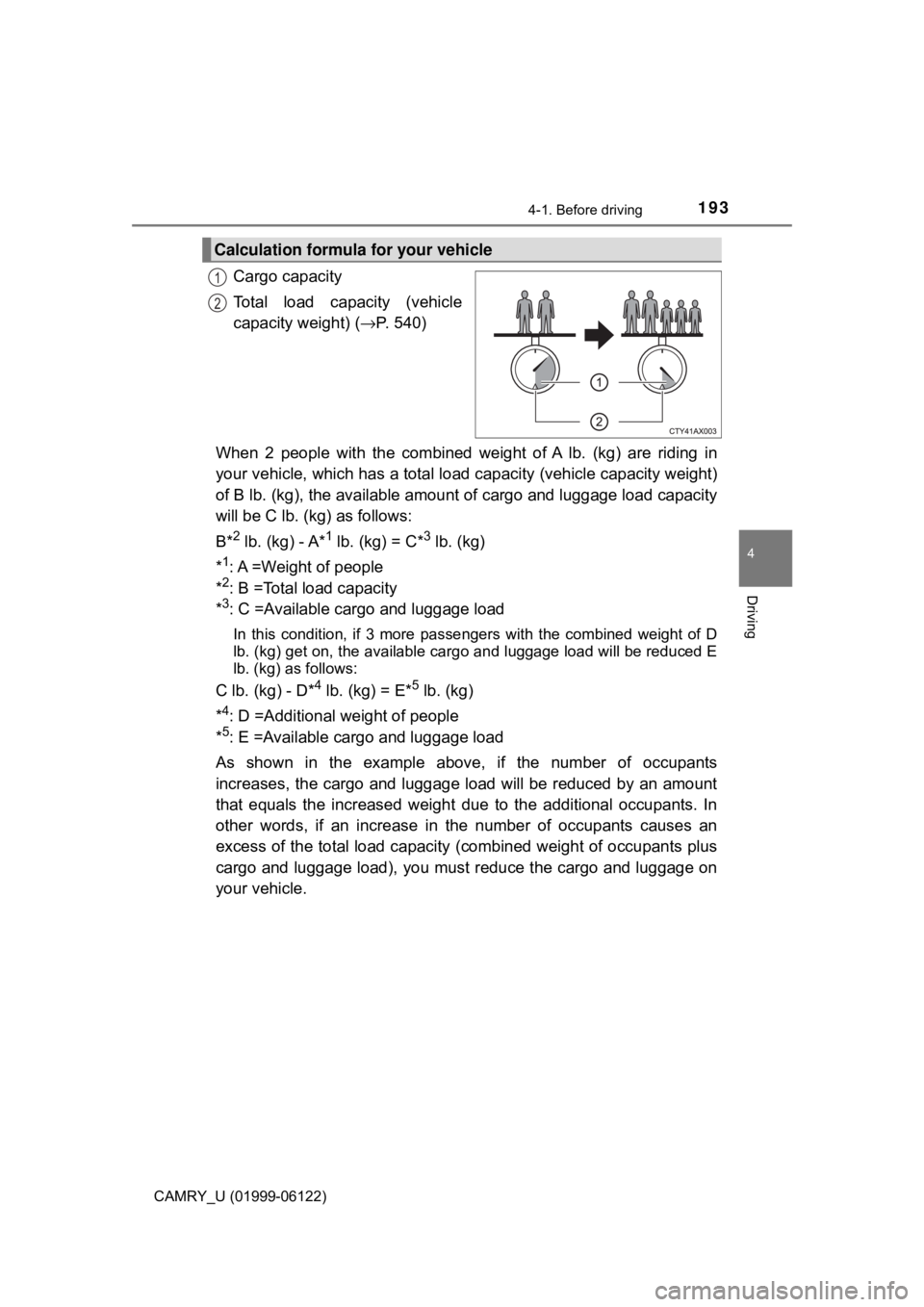
Cargo capacity
Total load capacity (vehicle
capacity weight) (→P. 540)
When 2 people with the combined weight of A lb. (kg) are riding in
your vehicle, which has a total load capacity (vehicle capacity weight)
of B lb. (kg), the available amount of cargo and luggage load capacity
will be C lb. (kg) as follows:
B*
2 lb. (kg) - A*1 lb. (kg) = C*3 lb. (kg)
*
1: A =Weight of people
*2: B =Total load capacity
*3: C =Available cargo and luggage load
In this condition, if 3 more passengers with the combined weight of D
lb. (kg) get on, the available cargo and luggage load will be reduced E
lb. (kg) as follows:
C lb. (kg) - D*4 lb. (kg) = E*5 lb. (kg)
*
4: D =Additional weight of people
*5: E =Available cargo and luggage load
As shown in the example above, if the number of occupants
increases, the cargo and luggage load will be reduced by an amount
that equals the increased weight due to the additional occupants. In
other words, if an increase in the number of occupants causes an
excess of the total load capacity (combined weight of occupants plus
cargo and luggage load), you must reduce the cargo and luggage on
your vehicle.
Calculation formula for your vehicle
1
2
Page 194 of 612

1944-1. Before driving
CAMRY_U (01999-06122)
WARNING
■Things that must not be carried in the trunk
The following things may cause a fire if loaded in the trunk:
●Receptacles containing gasoline
●Aerosol cans
■Storage precautions
Observe the following precautions.
Failure to do so may prevent the pedals from being depressed properly,
may block the driver’s vision, or may result in items hitting the driver or
passengers, possibly causing an accident.
●Stow cargo and luggage in the trunk whenever possible.
●To prevent cargo and luggage from sliding forward during braking, do
not stack anything in the enlarged trunk. Keep cargo and luggage low,
as close to the floor as possible.
●Do not place cargo or luggage in or on the following locations.
• At the feet of the driver
• On the front passenger or rear seats (when stacking items)
• On the package tray
• On the instrument panel
• On the dashboard
• Tray that has no lid
●Secure all items in the occupant compartment.
●Fold-down type rear seat: When you fold down the rear seats, long
items should not be placed directly behind the front seats.
●Fold-down type rear seat: Never allow anyone to ride in the enlarged
trunk. It is not designed for passengers. They should ride in their seats
with their seat belts properly fastened.
■Capacity and distribution
●Do not exceed the maximum axle weight rating or the total vehicle
weight rating.
●Even if the total load of occupant’s weight and the cargo load is less
than the total load capacity, do not apply the load unevenly. Improper
loading may cause deterioration of steering or braking control which
may cause death or serious injury.
Page 195 of 612
1954-1. Before driving
4
Driving
CAMRY_U (01999-06122)
◆Total load capacity (vehicle capacity weight): (→P. 540)
Total load capacity means the combined weight of occupants, cargo
and luggage.
◆Seating capacity: 5 occupants (Front 2, Rear 3)
Seating capacity means the maximum number of occupants whose
estimated average weight is 150 lb. (68 kg) per person.
◆Towing capacity
Toyota does not recommend towing a trailer with your vehicle.
◆Cargo capacity
Cargo capacity may increase or decrease depending on the weight
and the number of occupants.
■Total load capacity and seating capacity
These details are also described on the tire and loading information label.
(→P. 459)
Vehicle load limits
Vehicle load limits include total load capacity, seating capacity,
towing capacity and cargo capacity.
WARNING
■Overloading the vehicle
Do not overload the vehicle.
It may not only cause damage to the tires, but also degrade steering
and braking ability, resulting in an accident.
Page 562 of 612
5628-1. Specifications
CAMRY_U (01999-06122)
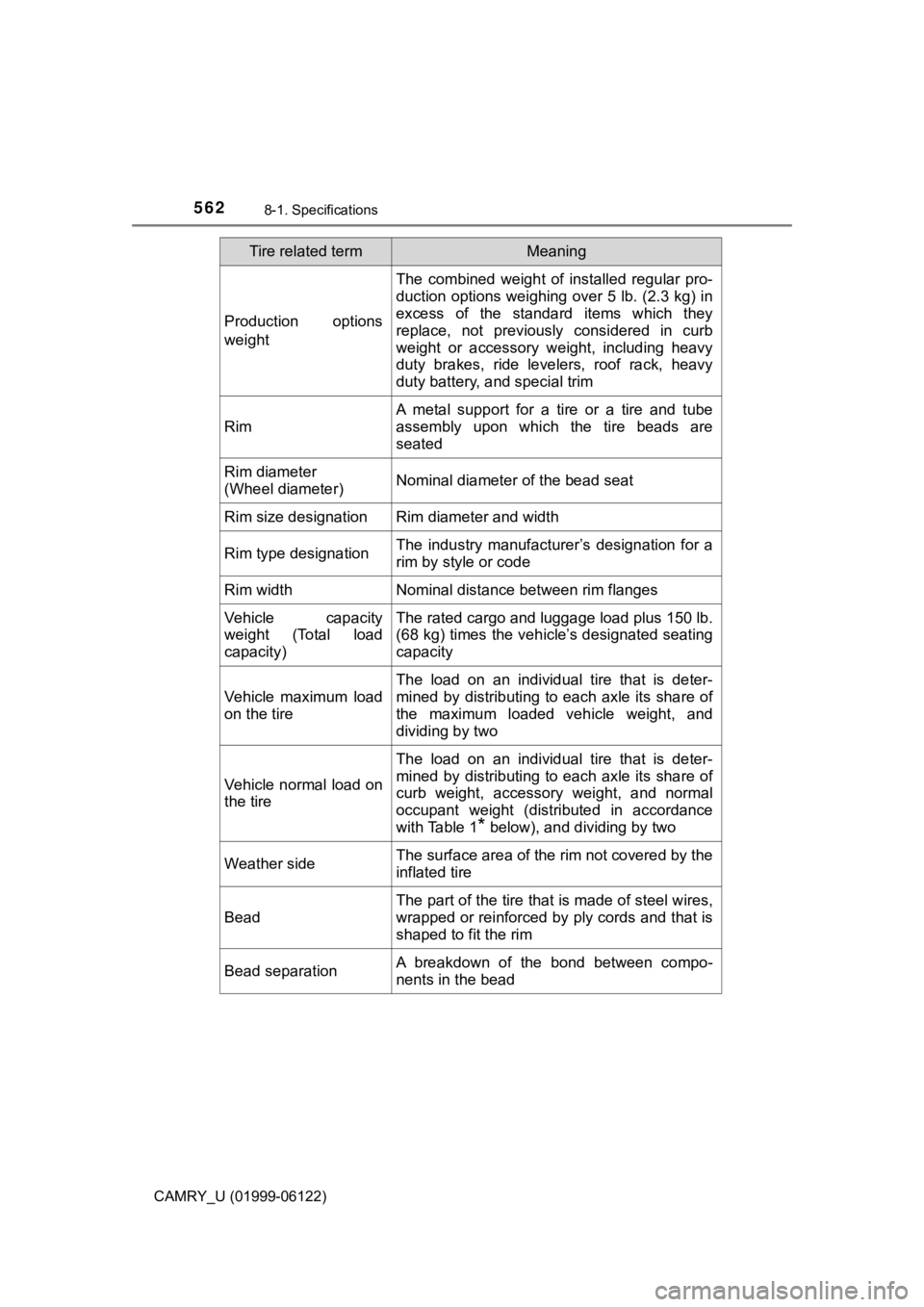
Production options
weight
The combined weight of installed regular pro-
duction options weighing over 5 lb. (2.3 kg) in
excess of the standard items which they
replace, not previously considered in curb
weight or accessory weight, including heavy
duty brakes, ride levelers, roof rack, heavy
duty battery, and special trim
Rim
A metal support for a tire or a tire and tube
assembly upon which the tire beads are
seated
Rim diameter
(Wheel diameter)Nominal diameter of the bead seat
Rim size designationRim diameter and width
Rim type designationThe industry manufacturer’s designation for a
rim by style or code
Rim widthNominal distance between rim flanges
Vehicle capacity
weight (Total load
capacity)The rated cargo and luggage load plus 150 lb.
(68 kg) times the vehicle’s designated seating
capacity
Vehicle maximum load
on the tire
The load on an individual tire that is deter-
mined by distributing to each axle its share of
the maximum loaded vehicle weight, and
dividing by two
Vehicle normal load on
the tire
The load on an individual tire that is deter-
mined by distributing to each axle its share of
curb weight, accessory weight, and normal
occupant weight (distributed in accordance
with Table 1
* below), and dividing by two
Weather sideThe surface area of the rim not covered by the
inflated tire
Bead
The part of the tire that is made of steel wires,
wrapped or reinforced by ply cords and that is
shaped to fit the rim
Bead separationA breakdown of the bond between compo-
nents in the bead
Tire related termMeaning