warning TOYOTA CAMRY HV 2012 User Guide
[x] Cancel search | Manufacturer: TOYOTA, Model Year: 2012, Model line: CAMRY HV, Model: TOYOTA CAMRY HV 2012Pages: 536, PDF Size: 6.29 MB
Page 89 of 536
89
1-4. Adjustable components (s
eats, mirrors, steering wheel)
1
Before driving
CAUTION
Observe the following precautions to reduce the risk of injury in the event of
sudden braking, sudden swerving or an accident.
Failure to do so may cause death or serious injury.
■Wearing a seat belt
●Ensure that all passengers wear a seat belt.
● Always wear a seat belt properly.
● Each seat belt should be used by one person only. Do not use a seat belt
for more than one person at once, including children.
● Toyota recommends that children be seated in the rear seat and always
use a seat belt and/or an appropriate child restraint system.
● To achieve a proper seating position, do not recline the seat more than
necessary. The seat belt is most effective when the occupants are sitting
up straight and well back in the seats.
● Do not wear the shoulder belt under your arm.
● Always wear your seat belt low and snug across your hips.
■ When children are in the vehicle
Do not allow children to play with the seat belt. If the seat belt becomes
twisted around a child’s neck, it may lead to choking or other serious injuries
that could result in death.
If this occurs and the buckle cannot be unfastened, scissors should be used
to cut the belt.
■ Seat belt pretensioners
●Do not place anything, such as a cushion, on the front passenger's seat.
Doing so will disperse the passenger's weight, which prevents the sensor
from detecting the passenger's weight properly. As a result, the seat belt
pretensioner for the front passenger's seat may not activate in the event of
a collision.
● If the pretensioner has activated, the SRS warning light will come on. In
that case, the seat belt cannot be used again and must be replaced at
your Toyota dealer.
Page 116 of 536
116 1-8. Safety information
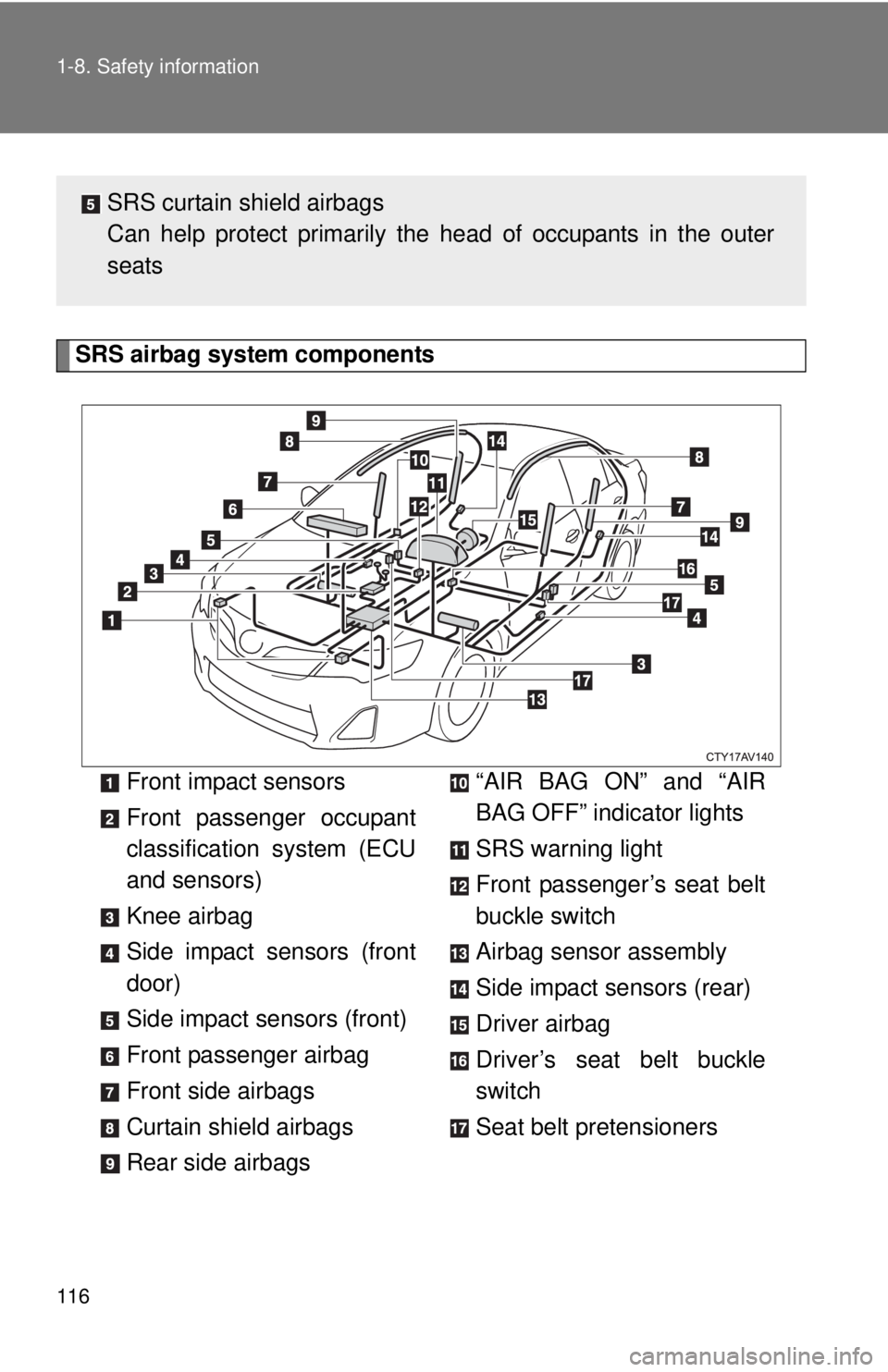
SRS airbag system components
Front impact sensors
Front passenger occupant
classification system (ECU
and sensors)
Knee airbag
Side impact sensors (front
door)
Side impact sensors (front)
Front passenger airbag
Front side airbags
Curtain shield airbags
Rear side airbags“AIR BAG ON” and “AIR
BAG OFF” indicator lights
SRS warning light
Front passenger’s seat belt
buckle switch
Airbag sensor assembly
Side impact sensors (rear)
Driver airbag
Driver’s seat belt buckle
switch
Seat belt pretensioners
SRS curtain shield airbags
Can help protect primarily the
head of occupants in the outer
seats
Page 128 of 536
128
1-8. Safety information
Front passenger occupant classification system
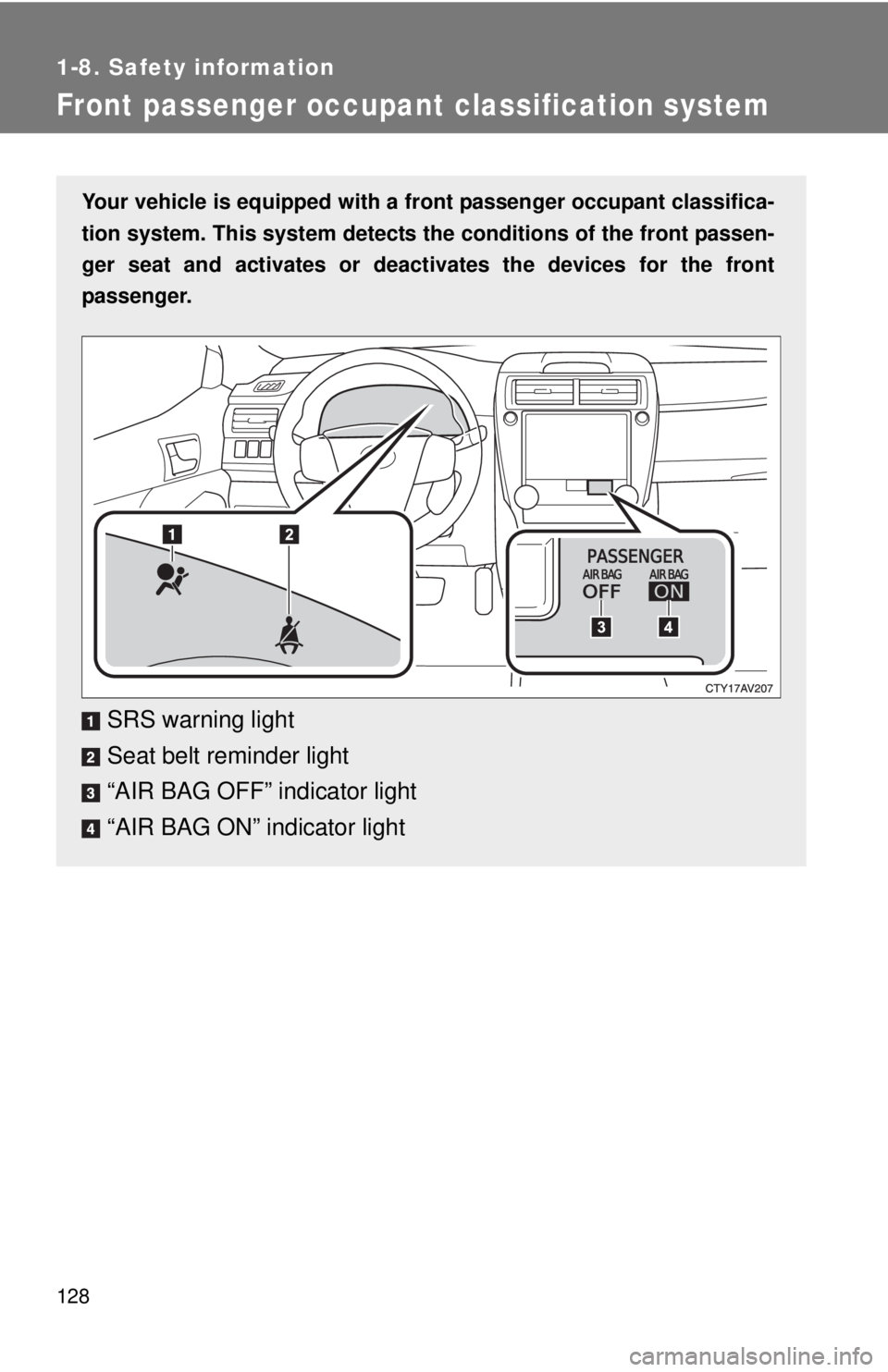
Your vehicle is equipped with a front passenger occupant classifica-
tion system. This system detects the conditions of the front passen-
ger seat and activates or deactiv ates the devices for the front
passenger.
SRS warning light
Seat belt reminder light
“AIR BAG OFF” indicator light
“AIR BAG ON” indicator light
Page 129 of 536

129
1-8. Safety information
1
Before driving
Condition and operation in the front passenger occupant classification system
■
Adult*1
■Child*3 or child restraint system*4
Indicator/
warning light “AIR BAG ON” and “AIR BAG OFF”
indicator lights “AIR BAG
ON”
SRS warning light Off
Seat belt reminder light Flashing
*2
DevicesFront passenger airbag
Activated
Side airbag on the front
passenger seat
Curtain shield airbag in the front passenger side
Front passenger knee airbag
Front passenger’s seat belt pretensioner
Indicator/
warning light “AIR BAG ON” and “AIR BAG OFF”
indicator lights “AIR BAG
OFF”
*5
SRS warning light Off
Seat belt reminder light Flashing
*2
DevicesFront passenger airbag Deactivated
Side airbag on the front passenger seat Activated
Curtain shield airbag in the front
passenger side
Front passenger knee airbag Deactivated
Front passenger’s seat belt pretensioner Activated
Page 130 of 536

130 1-8. Safety information
■Unoccupied
■ There is a malfunction in the system
*1: The system judges a person of adult size as an adult. When a
smaller adult sits in the front passenger seat, the system may rec-
ognize him/her as a child depending on his/her physique and pos-
ture.
*2: In the event the front passenger does not wear a seat belt.
*3: When a larger child who has outgrown a child restraint systemsits in the front passenger seat, the system may recognize him/
her as an adult depending on hi s/her physique or posture.
Indicator/
warning light “AIR BAG ON” and “AIR BAG OFF”
indicator lights “AIR BAG
OFF”
SRS warning light Off
Seat belt reminder light
Devices Front passenger airbag Deactivated
Side airbag on the front passenger seat Activated
Curtain shield airbag in the front
passenger side
Front passenger knee airbag Deactivated
Front passenger’s seat belt pretensioner Activated
Indicator/
warning light “AIR BAG ON” and “AIR BAG OFF”
indicator lights “AIR BAG
OFF”
SRS warning light On
Seat belt reminder light On
Devices Front passenger airbag
Deactivated
Side airbag on the front passenger seats Activated
Curtain shield airbag in the front
passenger side
Front passenger knee airbag Deactivated
Front passenger’s seat belt pretensioner Activated
Page 132 of 536

132 1-8. Safety information
CAUTION
■Front passenger occupant cl assification system precautions
● Do not recline the front passenger seatback so far that it touches a rear
seat. This may cause the “AIR BAG OFF” indicator light to be illuminated,
which indicates that the passenger’s airbags will not deploy in the event of
a severe accident. If the seatback touches the rear seat, return the seat-
back to a position where it does not touch the rear seat. Keep the front\
passenger seatback as upright as possible when the vehicle is moving.
Reclining the seatback excessively may lessen the effectiveness of the
seat belt system.
● If an adult sits in the front passenger seat, the “AIR BAG ON” indicator
light is illuminated. If the “AIR BAG OFF” indicator is illuminated, ask the
passenger to sit up straight, well back in the seat, feet on the floor, and
with the seat belt worn correctly. If the “AIR BAG OFF” indicator still
remains illuminated, either ask the passenger to move to the rear seat, or
if that is not possible, move the front passenger seat fully rearward.
● When it is unavoidable to install a forward-facing child restraint system on
the front passenger seat, install the child restraint system on the front pas-
senger seat in the proper order. ( P. 137)
● Do not modify or remove the front seats.
● Do not kick the front passenger seat or subject it to severe impact. Other-
wise, the SRS warning light may come on to indicate a malfunction of the
detection system. In this case, contact your Toyota dealer immediately.
● Child restraint systems installed on the rear seat should not contact the
front seatbacks.
● Do not use a seat accessory, such as a cushion and seat cover, that cov-
ers the seat cushion surface.
● Do not modify or replace the upholstery of the front seat.
Page 147 of 536
When driving2
147
2-1. Driving proceduresDriving the vehicle............ 148
Power (ignition) switch ..... 159
EV drive mode ................. 166
Hybrid transmission ......... 169
Turn signal lever .............. 171
Parking brake ................... 172
Horn ................................. 173
2-2. Instrument cluster Gauges and meters ......... 174
Indicators and warning lights .............................. 180
Multi-information display............................ 185
2-3. Operating the lights and wipers
Headlight switch ............... 192
Fog light switch ................ 198
Windshield wipers and washer ........................... 200 2-4. Using other driving
systems
Cruise control ................... 204
Driving assist systems ..... 207
Hill-start assist control ...... 213
BSM (Blind Spot Monitor) ....... 215
2-5. Driving information Cargo and luggage .......... 220
Vehicle load limits ............ 224
Winter driving tips ............ 225
Trailer towing ................... 229
Dinghy towing .................. 230
Page 157 of 536
157
2-1. Driving procedures
2
When driving
CAUTION
■
When braking
●When the brakes are wet, drive more cautiously.
Braking distance increases when the brakes are wet, and this may cause
one side of the vehicle to brake differently than the other side. Also the
parking brake may not securely hold the vehicle.
● If the electronically controlled brake system does not operate, do not fol-
low other vehicles closely and avoid hills or sharp turns that require brak-
ing.
In this case, braking is still possible, but the brake pedal should be
depressed more firmly than usual. Also, the braking distance will increase.
● The brake system consists of 2 individual hydraulic systems; if one of the
systems fails, the others will still operate. In this case, the brake pedal
should be depressed more firmly than usual and the braking distance will
increase. If this happens, do not continue to drive the vehicle. If the brake
system warning light (red indicator) comes on together with the buzzer
sound while driving, immediately stop the vehicle in a safe place and con-
tact your Toyota dealer.
NOTICE
■When driving the vehicle
●Do not depress the accelerator and brake pedals at the same time during
driving, as this may restrain driving torque.
● Do not use the accelerator pedal or depress the accelerator and brake
pedals at the same time to hold the vehicle on a hill.
■ When parking the vehicle
Always shift the shift lever to P. Failure to do so may cause the vehicle to
move or the vehicle may accelerate suddenly if the accelerator pedal is acci-
dentally depressed.
Page 180 of 536
180
2-2. Instrument cluster
Indicators and warning lights
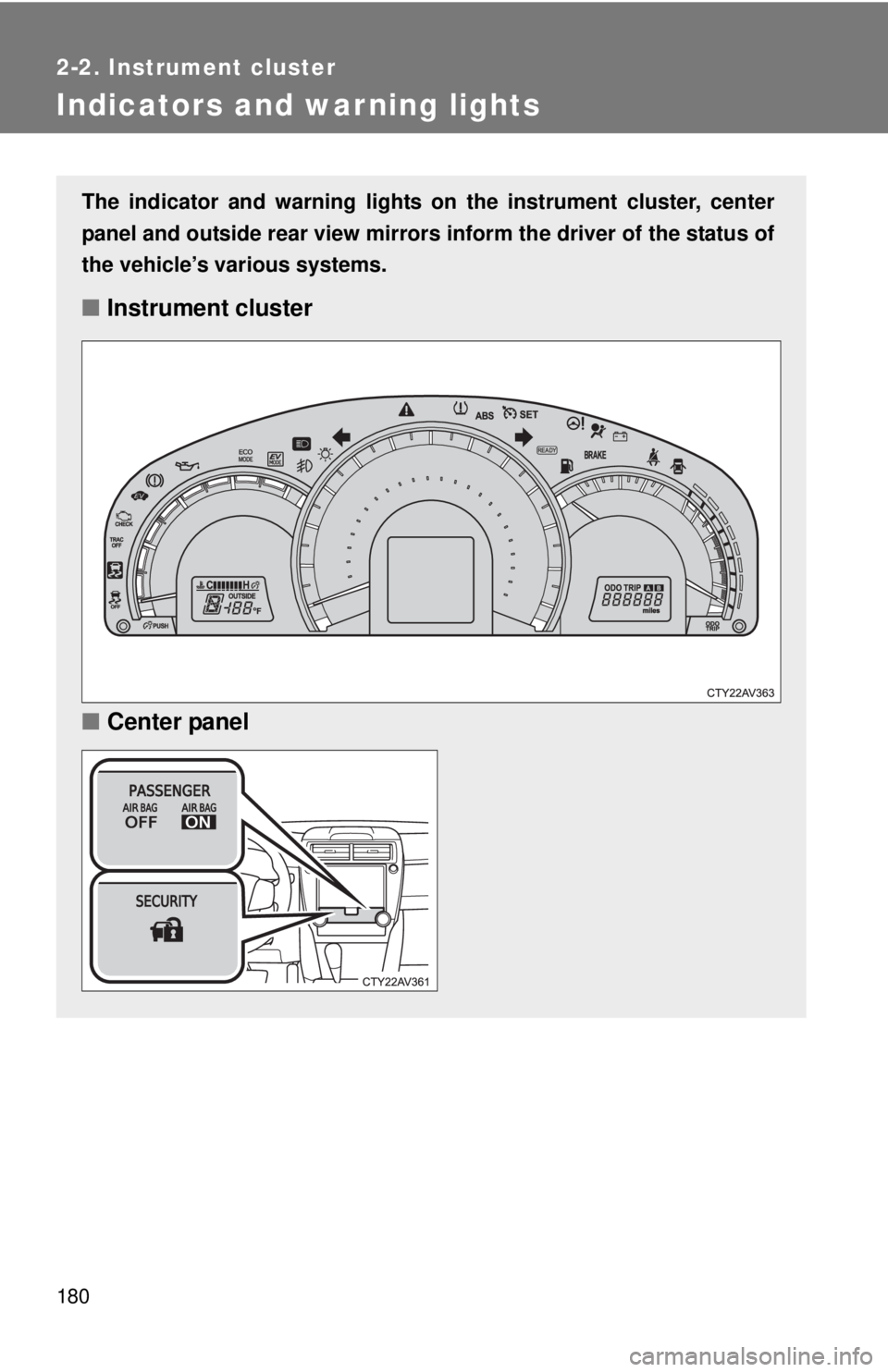
The indicator and warning lights on the instrument cluster, center
panel and outside rear view mirrors inform the driver of the status of
the vehicle’s various systems.
■ Instrument cluster
■ Center panel
Page 184 of 536
184 2-2. Instrument cluster
CAUTION
■If a safety system warning light does not come on
Should a safety system light such as the ABS and SRS warning light not
come on when you start the hybrid system, this could mean that these sys-
tems are not available to help protect you in an accident, which could result
in death or serious injury. Have the vehicle inspected by your Toyota dealer
immediately if this occurs.
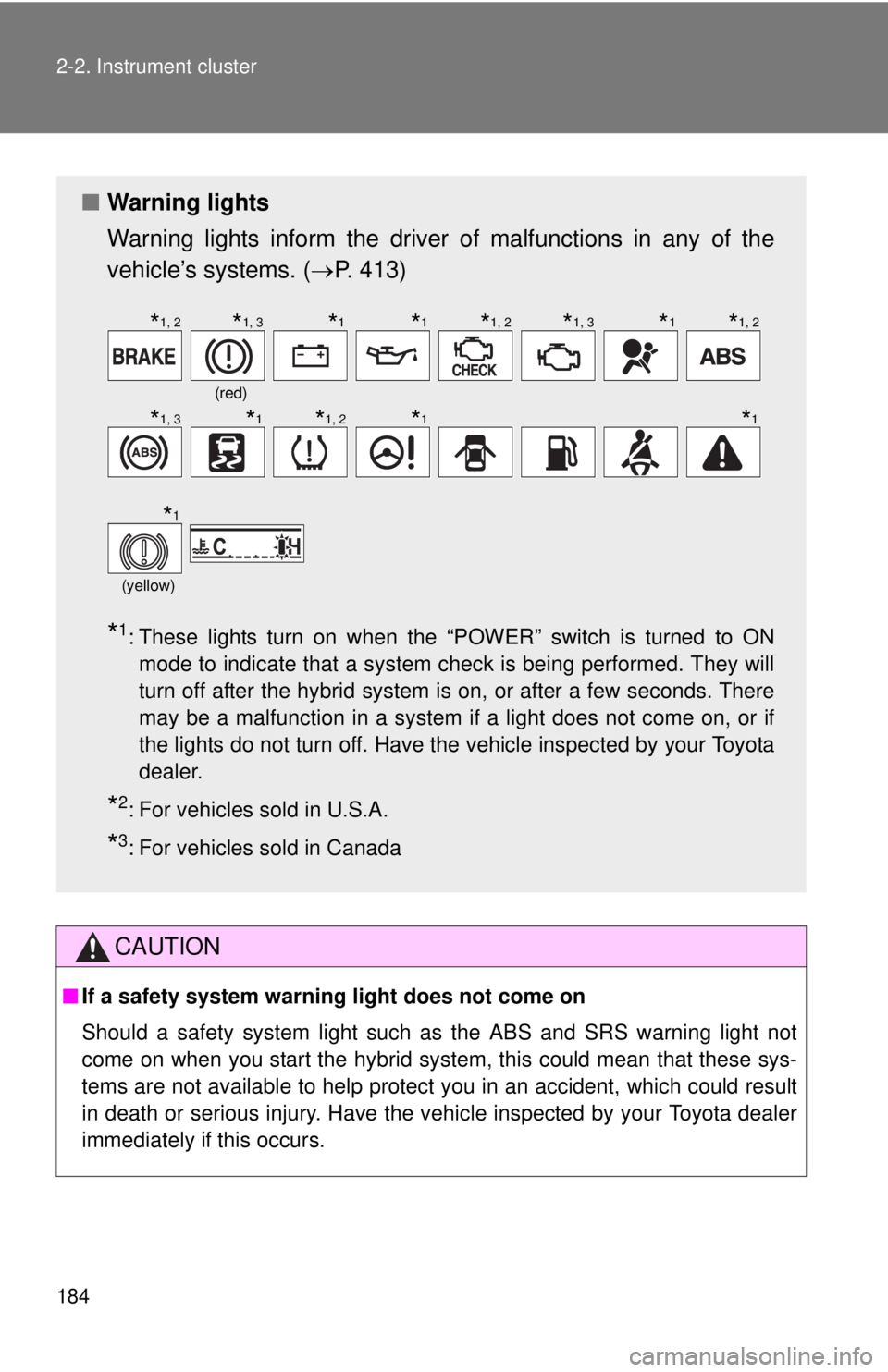
■ Warning lights
Warning lights inform the driver of malfunctions in any of the
vehicle’s systems. ( P. 413)
*1: These lights turn on when the “POWER” switch is turned to ON
mode to indicate that a system check is being performed. They will
turn off after the hybrid system is on, or after a few seconds. There
may be a malfunction in a system if a light does not come on, or if
the lights do not turn off. Have the vehicle inspected by your Toyota
dealer.
*2: For vehicles sold in U.S.A.
*3: For vehicles sold in Canada
(red)
(yellow)
*1, 2*1, 3*1*1*1, 2*1, 3*1*1, 2
*1, 3*1*1, 2*1*1
*1