inflation pressure TOYOTA CAMRY HYBRID 2012 XV50 / 9.G Owners Manual
[x] Cancel search | Manufacturer: TOYOTA, Model Year: 2012, Model line: CAMRY HYBRID, Model: TOYOTA CAMRY HYBRID 2012 XV50 / 9.GPages: 536, PDF Size: 6.29 MB
Page 4 of 536

TABLE OF CONTENTSIndex
4
3-5. Other interior featuresSun visors .......................... 298
Vanity mirrors ..................... 299
Clock .................................. 300
Outside temperature display .............................. 301
Ashtray ............................... 302
Power outlets ..................... 303
Seat heaters ....................... 305
Armrest............................... 307
Coat hooks ......................... 308
Floor mat ............................ 309
Trunk features .................... 311
Garage door opener ........... 313
Compass ............................ 320
Safety Connect................... 324 4-1. Maintenance and care
Cleaning and protecting the vehicle exterior ........... 332
Cleaning and protecting the vehicle interior ............ 335
4-2. Maintenance Maintenance requirements .................... 338
General maintenance ......... 340
Emission inspection and maintenance (I/M)
programs .......................... 344
4-3. Do-it-yourself maintenance Do-it-yourself service precautions ....................... 345
Hood ................................... 348
Positioning a floor jack........ 349
Engine compartment .......... 351
12-volt battery ..................... 361
Tires.................................... 365
Tire inflation pressure ......... 373
Wheels................................ 377
Air conditioning filter ........... 380
Electronic key battery ......... 382
Checking and replacing fuses ................................. 384
Light bulbs .......................... 395
4Maintenance and care
Page 9 of 536
9
: If equipped
*1: For vehicles with a navigation system, refer to “Navigation System Owner’s Manual”.
*2: For vehicles with a Display Audio system, re fer to “Display Audio System Owner’s Manual”.
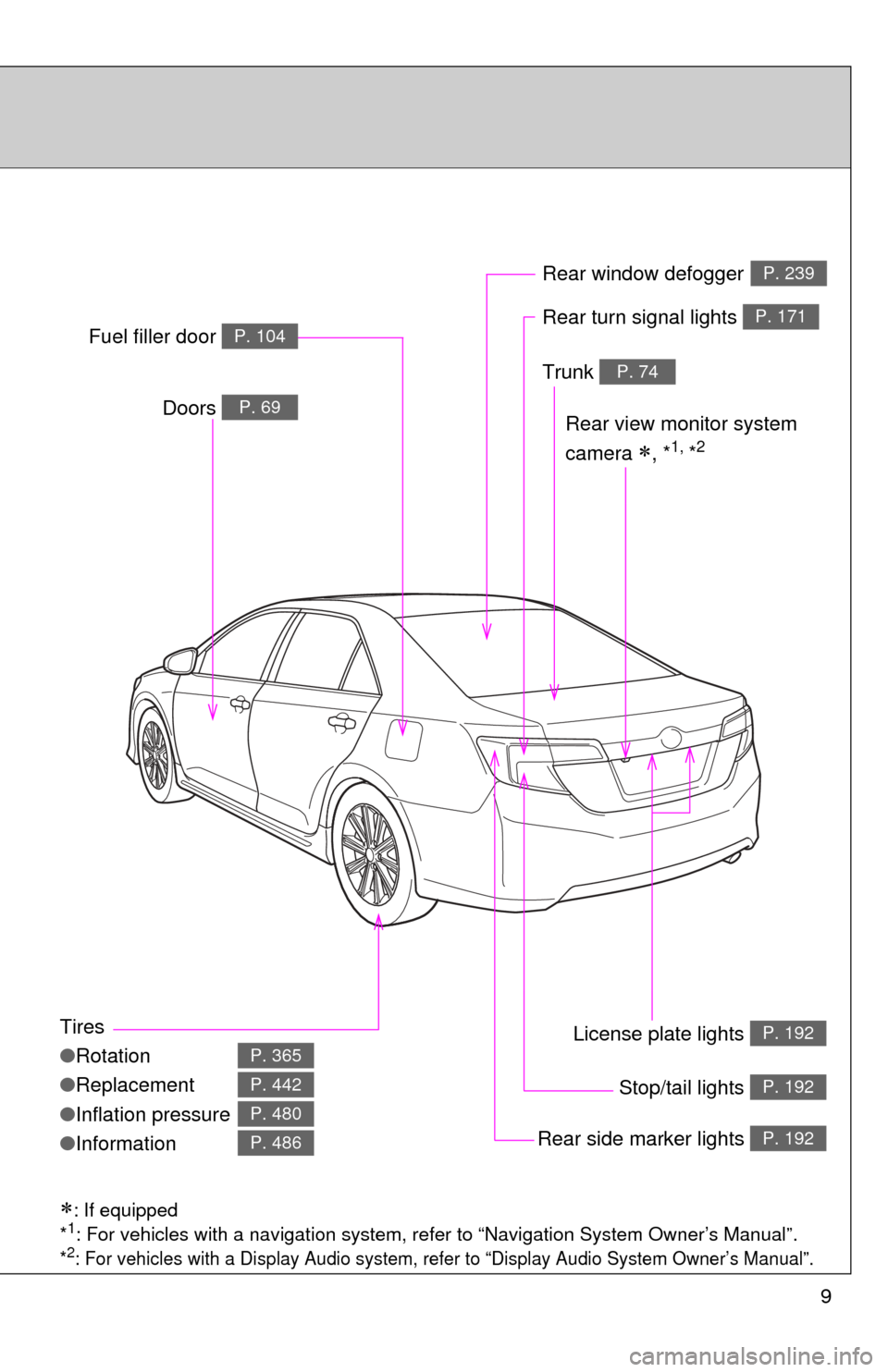
Tires
●Rotation
● Replacement
● Inflation pressure
● Information
P. 365
P. 442
P. 480
P. 486
Trunk P. 74
Doors P. 69
Fuel filler door P. 104Rear turn signal lights P. 171
Rear window defoggerP. 239
Stop/tail lights P. 192
Rear side marker lights P. 192
Rear view monitor system
camera
, *1, *2
License plate lights P. 192
Page 49 of 536
49
1-1. Hybrid system
1
Before driving
■
Checking tire inflation pressure
Make sure to check the tire inflation pressure frequently. Improper tire
inflation pressure can cause poor fuel consumption.
Also, as snow tires can cause large amounts of friction, their use on dry
roads can lead to poor fuel consumption. Use a tire that is appropriate
for the season.
■Luggage
Carrying heavy luggage can lead to poor fuel consumption. Avoid car-
rying unnecessary luggage. Installing a large roof rack can also cause
poor fuel consumption.
■Warming up before driving
Since the gasoline engine starts up and cuts out automatically when
cold, warming up the engine is unnecessary. Moreover, frequently driv-
ing short distances will cause the engine to repeatedly warm up, which
can lead to poor fuel consumption.
Page 212 of 536

212 2-4. Using other driving systems
CAUTION
■When the VSC is activated
The slip indicator light flashes. Always drive carefully. Reckless driving may
cause an accident. Exercise particular care when the indicator light flashes.
■ When the TRAC/VSC syst ems are turned off
Be especially careful and drive at a speed appropriate to the road condi-
tions. As these are the systems to ensure vehicle stability and driving force,
do not turn the TRAC/VSC systems off unless necessary.
■ Replacing tires
Make sure that all tires are of the specified size, brand, tread pattern and
total load capacity. In addition, make sure that the tires are inflated to the
recommended tire inflation pressure level.
The ABS, TRAC and VSC systems will not function correctly if different tires
are installed on the vehicle.
Contact your Toyota dealer for further information when replacing tires or
wheels.
■ Handling of tires and suspension
Using tires with any kind of problem or modifying the suspension will affect
the driving assist systems, and may cause a system to malfunction.
Page 331 of 536
Maintenance and care4
331
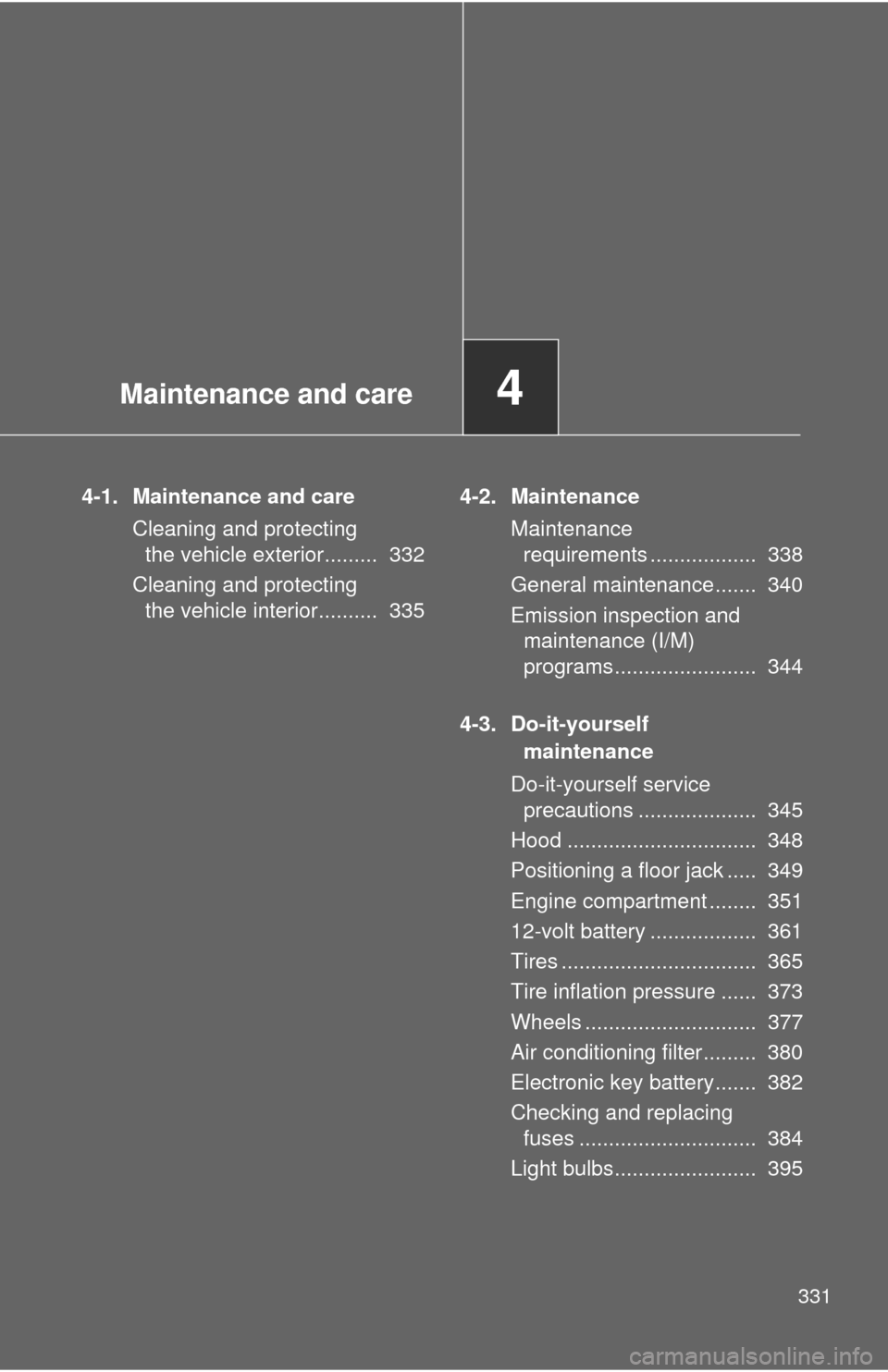
4-1. Maintenance and careCleaning and protecting the vehicle exterior......... 332
Cleaning and protecting the vehicle interior.......... 335 4-2. Maintenance
Maintenance requirements .................. 338
General maintenance....... 340
Emission inspection and maintenance (I/M)
programs........................ 344
4-3. Do-it-yourself maintenance
Do-it-yourself service precautions .................... 345
Hood ................................ 348
Positioning a floor jack ..... 349
Engine compartment ........ 351
12-volt battery .................. 361
Tires ................................. 365
Tire inflation pressure ...... 373
Wheels ............................. 377
Air conditioning filter......... 380
Electronic key battery....... 382
Checking and replacing fuses .............................. 384
Light bulbs........................ 395
Page 343 of 536

343
4-2. Maintenance
4
Maintenance and care
Vehicle exterior
ItemsCheck points
Doors/trunk • Do the doors and trunk operate
smoothly?
Engine hood • Does the engine hood lock sys-
tem work properly?
Fluid leaks • There should not be any signs of
fluid leakage after the vehicle has
been parked.
Tires • Is the tire inflation pressure cor-
rect?
• The tires should not be dam- aged or excessively worn.
• Have the tires been rotated according to the maintenance
schedule?
• The wheel nuts should not be loose.
CAUTION
■ If the hybrid system is operating
Turn the hybrid system off and ensure that there is adequate ventilation
before performing maintenance checks.
Page 346 of 536
346 4-3. Do-it-yourself maintenance
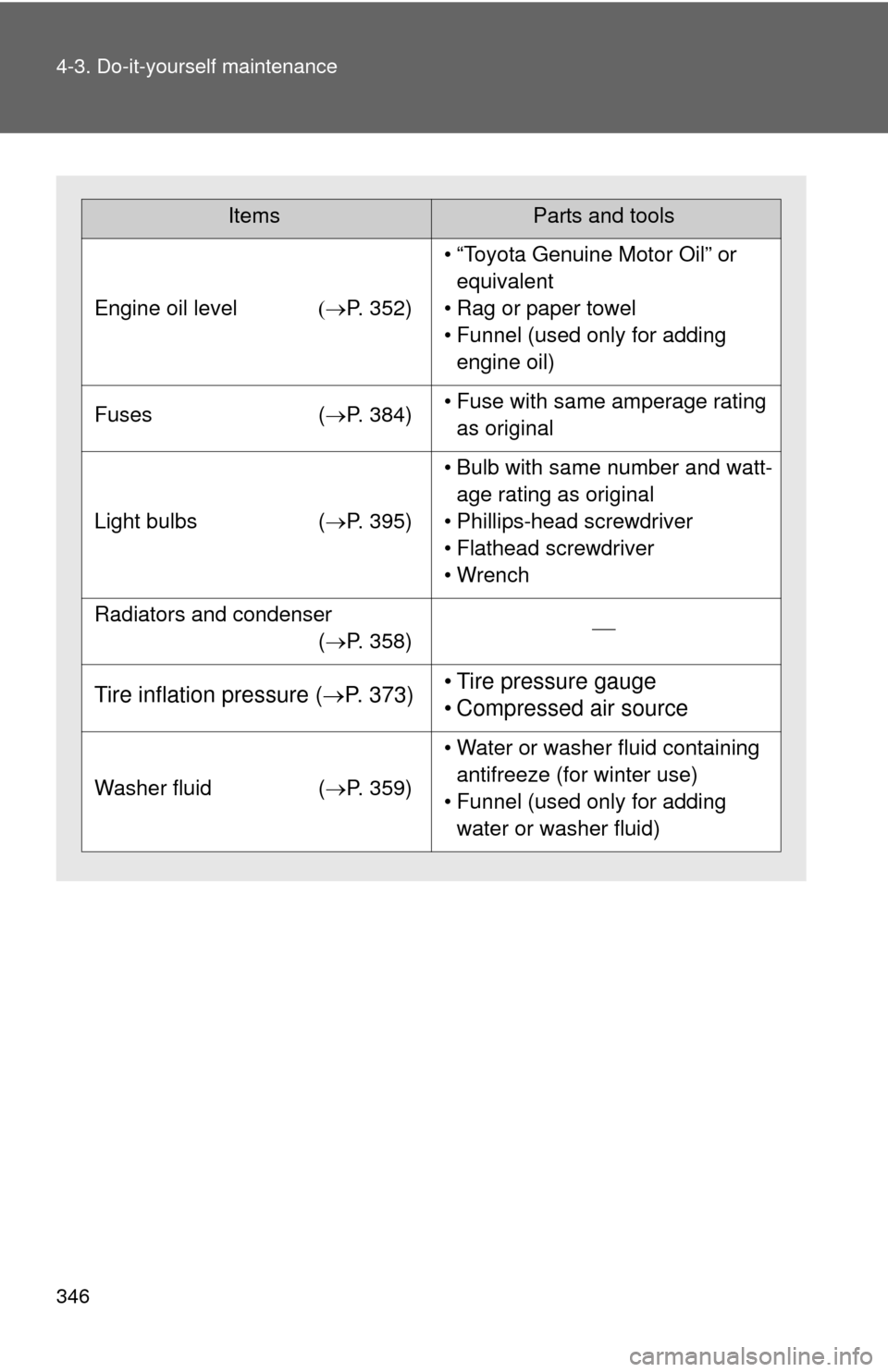
ItemsParts and tools
Engine oil levelP. 352)
• “Toyota Genuine Motor Oil” or
equivalent
• Rag or paper towel
• Funnel (used only for adding engine oil)
Fuses (P. 384)• Fuse with same amperage rating
as original
Light bulbs (P. 395)
• Bulb with same number and watt-
age rating as original
• Phillips-head screwdriver
• Flathead screwdriver
• Wrench
Radiators and condenser
(P. 358)
Tire inflation pressure ( P. 373)• Tire pressure gauge
• Compressed air source
Washer fluid (P. 359)
• Water or washer fluid containing
antifreeze (for winter use)
• Funnel (used only for adding water or washer fluid)
Page 365 of 536
365
4-3. Do-it-yourself maintenance
4
Maintenance and care
Tires
Replace or rotate tires in accordance with maintenance sched-
ules and treadwear.
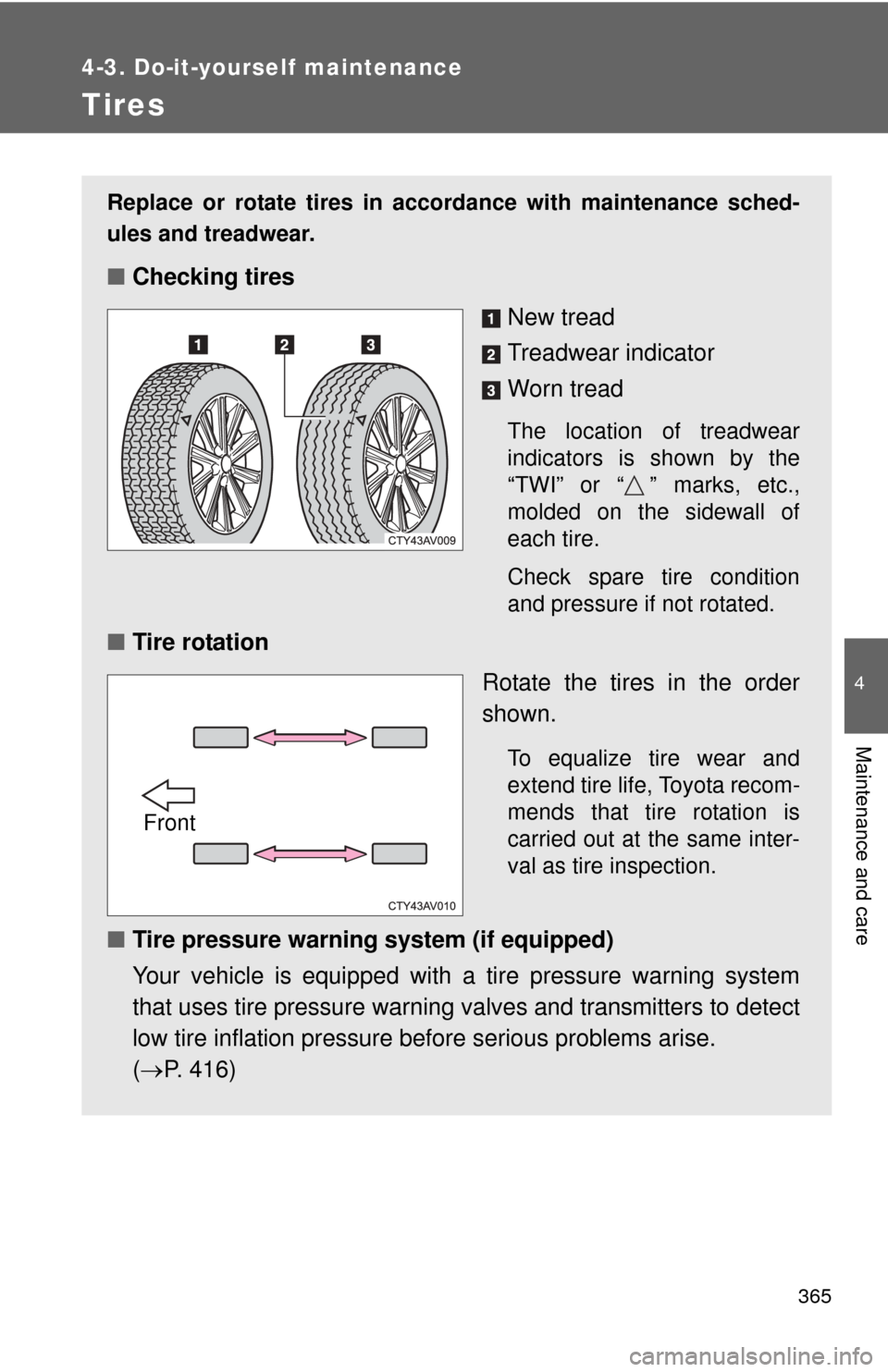
■Checking tires
New tread
Treadwear indicator
Worn tread
The location of treadwear
indicators is shown by the
“TWI” or “ ” marks, etc.,
molded on the sidewall of
each tire.
Check spare tire condition
and pressure if not rotated.
■Tire rotation
Rotate the tires in the order
shown.
To equalize tire wear and
extend tire life, Toyota recom-
mends that tire rotation is
carried out at the same inter-
val as tire inspection.
■Tire pressure warning system (if equipped)
Your vehicle is equipped with a tire pressure warning system
that uses tire pressure warning valves and transmitters to detect
low tire inflation pressure before serious problems arise.
( P. 416)
Front
Page 366 of 536

366 4-3. Do-it-yourself maintenance
Installing tire pressure warning valves and transmittersWhen replacing tires or wheels, tire pressure warning valves and
transmitters must also be installed.
When new tire pressure warning valves and transmitters are
installed, new ID codes must be regi stered in the tire pressure warn-
ing computer and the tire pressure warning system must be initial-
ized. Have tire pressure warning valve and transmitter ID codes
registered by your Toyota dealer. ( P. 367)
■ The tire pressure warning system must be initialized in the fol-
lowing circumstances:
●When the tire inflation pres sure is changed such as when
changing travelling speed or load weight
● When changing the tire size
When the tire pressure warning syst em is initialized, the current tire
inflation pressure is set as the benchmark pressure.
■ How to initialize the tire pressure warning system
Park the vehicle in a safe pl ace and turn the “POWER” switch
off.
Initialization cannot be performed while the vehicle is moving.
Adjust the tire inflation pressure to the specified cold tire infla-
tion pressure level. ( P. 480)
Make sure to adjust the tire pressure to the specified cold tire
inflation pressure level. The ti re pressure warning system will
operate based on this pressure level.
Turn the “POWER” switch to ON mode.
STEP1
STEP2
STEP3
Page 368 of 536
368 4-3. Do-it-yourself maintenance
■When to replace your vehicle’s tires
Tires should be replaced if:
●You have tire damage such as cuts, splits, cracks deep enough to
expose the fabric, and bulges indicating internal damage
●A tire goes flat repeatedly or cannot be properly repaired due to the
size or location of a cut or other damage
If you are not sure, consult with your Toyota dealer.
■Replacing tires and wheels
If the ID code of the tire pressure warning valve and transmitter is not
registered, the tire pre ssure warning system will not work properly. After
driving for about 20 minutes, the tire pressure warning light blinks for 1
minute and stays on to indicate a system malfunction.
■Tire life
Any tire over 6 years old must be checked by a qualified technician even
if it has seldom or never been used or damage is not obvious.
■Routine tire inflation pressure checks
The tire pressure warning system doe s not replace routine tire inflation
pressure checks. Make sure to check tire inflation pressure as part of
your routine of daily vehicle checks.
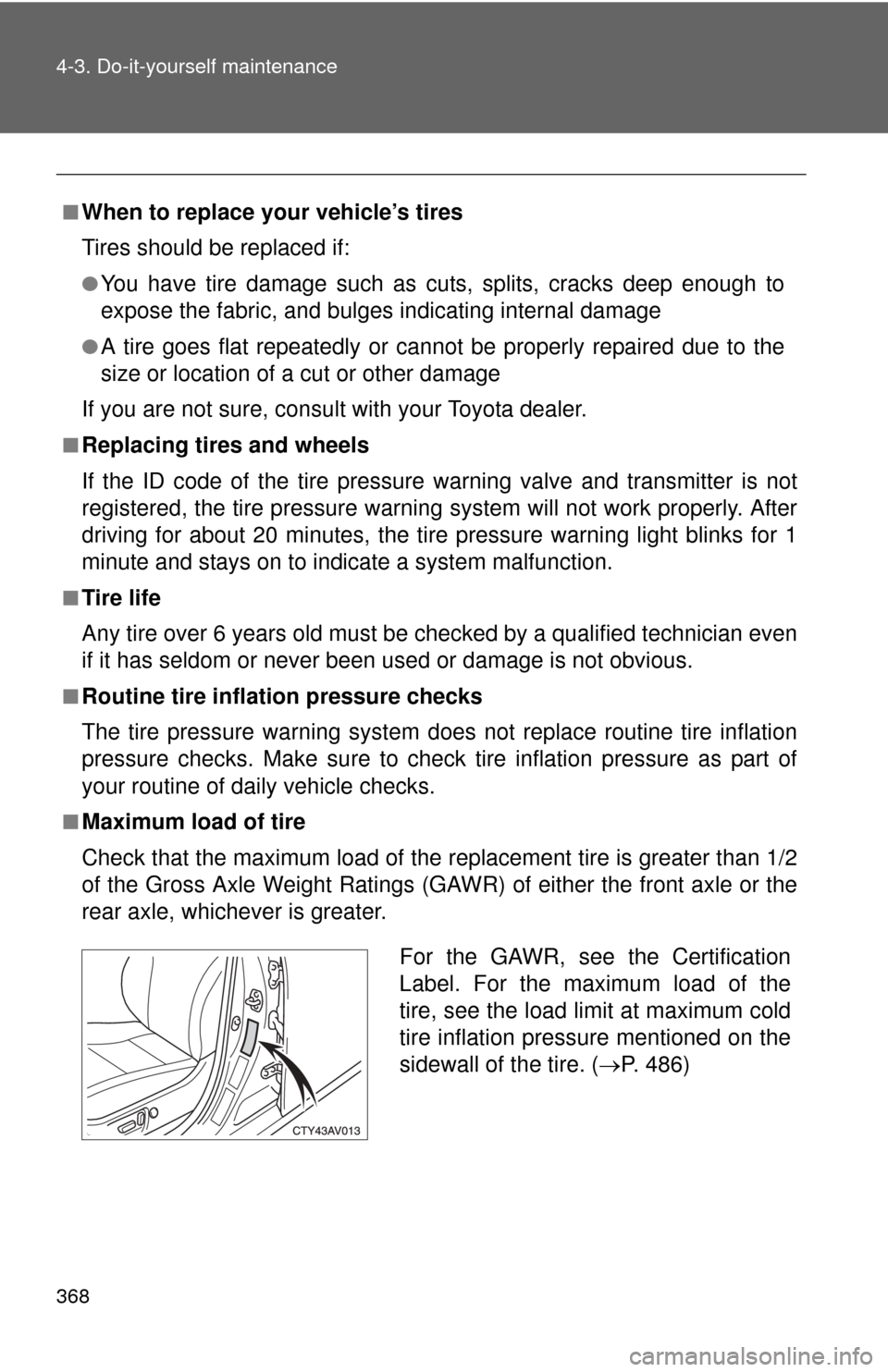
■Maximum load of tire
Check that the maximum load of the replacement tire is greater than 1/2
of the Gross Axle Weight Ratings (GAW R) of either the front axle or the
rear axle, whichever is greater.
For the GAWR, see the Certification
Label. For the maximum load of the
tire, see the load limit at maximum cold
tire inflation pressure mentioned on the
sidewall of the tire. ( P. 486)