warning light TOYOTA CAMRY HYBRID 2016 XV50 / 9.G Owner's Guide
[x] Cancel search | Manufacturer: TOYOTA, Model Year: 2016, Model line: CAMRY HYBRID, Model: TOYOTA CAMRY HYBRID 2016 XV50 / 9.GPages: 572, PDF Size: 7.25 MB
Page 151 of 572

1514-1. Before driving
4
Driving
CAMRY_HV_U (OM33C35U)
WARNING
Observe the following precautions.
Failure to do so may result in death or serious injury.
nWhen driving the vehicle
lDo not drive in excess of the speed limit. Even if the legal speed limit per-
mits it, do not drive over 85 mph ( 140 km/h) unless your vehicle has high-
speed capability tires. Driving over 85 mph (140 km/h) may result in tire
failure, loss of control and possible injury. Be sure to consult a tire dealer
to determine whether the tires on y our vehicle are high-speed capability
tires or not before driving at such speeds.
n When driving on slippery road surfaces
lSudden braking, acceleration and steering may cause tire slippage and
reduce your ability to control the vehicle.
l Sudden acceleration, engine braking due to shifting, or changes in engine
speed could cause the vehicle to skid.
l After driving through a puddle, lightly depress the brake pedal to make
sure that the brakes are functioning properly. Wet brake pads may prevent
the brakes from functioning properly. If the brakes on only one side are wet
and not functioning properly, steering control may be affected.
n When shifting the shift lever
lDo not let the vehicle roll backward while the shift lever is in a driving posi-
tion, or roll forward while the shift lever is in R.
Doing so may result in an accident or damage to the vehicle.
l Do not shift the shift lever to P while the vehicle is moving.
Doing so can damage the transmission and may result in a loss of vehicle
control.
l Do not shift the shift lever to R while the vehicle is moving forward.
Doing so can damage the transmission and may result in a loss of vehicle
control.
l Do not shift the shift lever to a driving position while the vehicle is moving
backward.
Doing so can damage the transmission and may result in a loss of vehicle
control.
l Shifting the shift lever to N while the vehicle is moving will disengage the
hybrid system. Engine braking is not available when N is selected.
l Be careful not to shift the shift lever with the accelerator pedal depressed.
Shifting the shift lever to any position other than P or N may lead to unex-
pected rapid acceleration of the vehicle that may cause an accident and
result in death or serious injury.
Page 152 of 572

1524-1. Before driving
CAMRY_HV_U (OM33C35U)
WARNING
Observe the following precautions.
Failure to do so may result in death or serious injury.
nIf you hear a squealing or scraping noise (brake pad wear limit indica-
tors)
Have the brake pads checked and replaced by your Toyota dealer as soon
as possible.
Rotor damage may result if the pads are not replaced when needed.
It is dangerous to drive the vehicle when the wear limits of the brake pads
and/or those of the brake discs are exceeded.
n When the vehicle is stopped
lDo not depress the accelerator pedal unnecessarily.
If the shift lever is in any position other than P or N, the vehicle may accel-
erate suddenly and unexpectedly, causing an accident.
l In order to prevent accidents due to the vehicle rolling away, always keep
depressing the brake pedal while stopped with the “READY” indicator is
illuminated, and apply the parking brake as necessary.
l If the vehicle is stopped on an incline, in order to prevent accidents caused
by the vehicle rolling forward or backward, always depress the brake pedal
and securely apply the parking brake as needed.
l Avoid revving or racing the engine.
Running the engine at high speed while the vehicle is stopped may cause
the exhaust system to overheat, which could result in a fire if combusti\
ble
material is nearby.
n When the vehicle is parked
lDo not leave glasses, cigarette lighters, spray cans, or soft drink cans in
the vehicle when it is in the sun.
Doing so may result in the following:
• Gas may leak from a cigarette lighter or spray can, and may lead to a
fire.
• The temperature inside the vehicle may cause the plastic lenses and plastic material of glasses to deform or crack.
• Soft drink cans may fracture, causing the contents to spray over the
interior of the vehicle, and may also cause a short circuit in the vehicle’s
electrical components.
l Do not leave cigarette lighters in the vehicle. If a cigarette lighter is in a
place such as the glove box or on the floor, it may be lit accidentally when
luggage is loaded or the seat is adjusted, causing a fire.
l Do not attach adhesive discs to the windshield or windows. Do not place
containers such as air fresheners on the instrument panel or dashboard.
Adhesive discs or containers may act as lenses, causing a fire in the vehi-
cle.
Page 153 of 572

1534-1. Before driving
4
Driving
CAMRY_HV_U (OM33C35U)
WARNING
Observe the following precautions.
Failure to do so may result in death or serious injury.
nWhen the vehicle is parked
lDo not leave a door or window open if the curved glass is coated with a
metallized film such as a silver-colored one. Reflected sunlight may cause
the glass to act as a lens, causing a fire.
l Always apply the parking brake, shift the shift lever to P, stop the hybrid
system and lock the vehicle.
Do not leave the vehicle unattended while the “READY” indicator is illumi-
nated.
l Do not touch the exhaust pipes while the “READY” indicator is illuminated
or immediately after turning the hybrid system off.
Doing so may cause burns.
n When taking a nap in the vehicle
Always turn the hybrid system off. Otherwise, if you accidentally move the
shift lever or depress the accelerator pedal, this could cause an accident or
fire due to hybrid system overheating. Additionally, if the vehicle is parked in
a poorly ventilated area, exhaust gases may collect and enter the vehicle,
leading to death or a serious health hazard.
n When braking
lWhen the brakes are wet, drive more cautiously.
Braking distance increases when the brakes are wet, and this may cause
one side of the vehicle to brake differently than the other side. Also, the
parking brake may not securely hold the vehicle.
l If the electronically controlled brake system does not operate, do not fol-
low other vehicles closely and avoid hills or sharp turns that require brak-
ing.
In this case, braking is still possible, but the brake pedal should be
depressed more firmly than usual. Also, the braking distance will increase.
Have your brakes fixed immediately.
l The brake system consists of 2 or more individual hydraulic systems; if
one of the systems fails, the other(s) will still operate. In this case, the
brake pedal should be depressed more firmly than usual and the braking
distance will increase. Have your brakes fixed immediately.
Page 165 of 572

1654-2. Driving procedures
4
Driving
CAMRY_HV_U (OM33C35U)
WARNING
nWhen starting the hybrid system
Always start the hybrid system while sitting in the driver’s seat. Do not
depress the accelerator pedal while starting the hybrid system under any
circumstances.
Doing so may cause an accident resulting in death or serious injury.
n Caution while driving
If hybrid system failure occurs while the vehicle is moving, do not lock or
open the doors until the vehicle reaches a safe and complete stop. Activa-
tion of the steering lock in this circumstance may lead to an accident, result-
ing in death or serious injury.
n Stopping the hybrid syst em in an emergency
If you want to stop the hybrid system in an emergency while driving the
vehicle, press and hold the power switch for more than 2 seconds, or press
it briefly 3 times or more in succession. ( P. 441)
However, do not touch the power switch while driving except in an emer-
gency. Turning the hybrid system off while driving will not cause loss of
steering or braking control, however, power assist to the steering will be
lost. This will make it more difficult to steer smoothly, so you should pull over
and stop the vehicle as soon as it is safe to do so.
NOTICE
n To prevent 12-volt battery discharge
lDo not leave the power switch in ACCESSORY or ON mode for long peri-
ods of time without the hybrid system on.
l Do not stop the hybrid system when the shift lever is in a position other
than P. If the hybrid system is stopped in another shift lever position, the
power switch will not be turned off but instead be turned to ACCESSORY
mode. If the vehicle is left in ACCESSORY mode, 12-volt battery dis-
charge may occur.
n When starting the hybrid system
lDo not depress the accelerator pedal unnecessarily.
l If the hybrid system becomes difficult to start, have your vehicle checked
by your Toyota dealer immediately.
n Symptoms indicating a malf unction with the power switch
If the power switch seems to be operating somewhat differently than usual,
such as the switch sticking slightly, there may be a malfunction. Contact
your Toyota dealer immediately.
Page 178 of 572

1784-3. Operating the lights and wipers
CAMRY_HV_U (OM33C35U)l
In the situations below, the system may not be able to correctly detect the
surrounding brightness levels, and may flash or expose nearby pedestrians
to the high beam. Therefore, you should consider turning the high beams on
or off manually rather than relying on the Automatic High Beam system.
• In bad weather (rain, snow, fog, sandstorms etc.)
• The windshield is obscured by fog, mist, ice, dirt etc.
• The windshield is cracked or damaged.
• The camera sensor is deformed or dirty.
• The camera sensor temperature is extremely high.
• Surrounding brightness levels are equal to those of headlights, tail lights
or fog lights.
• Vehicles ahead have headlights that are either switched off, dirty, are changing color, or are not aimed properly.
• When driving through an area of in termittently changing brightness and
darkness.
• When frequently and repeatedly driving ascending/descending roads, or
roads with rough, bumpy or uneven surfaces (such as stone-paved
roads, gravel tracks etc.).
• When frequently and repeatedly taking curves or driving on a winding
road.
• There is a highly reflective object ahead of the vehicle, such as a sign or a mirror.
• The back of a vehicle ahead is highly reflective, such as a container on a truck.
• The vehicle’s headlights are damaged or dirty.
• The vehicle is listing or tilting, due to a flat tire, a trailer being towed etc.
• The high beam and low beam are repeatedly being switched between in
an abnormal manner.
• The driver believes that the high beam may be causing problems or dis- tress to other drivers or pedestrians nearby.
n Temporarily lowering sensor sensitivity
The sensitivity of the sensor can be temporarily lowered.
Turn the power switch off while the following conditions are met.
• The headlight switch is in .
• The headlight switch lever is in high beam position. Turn the power switch to ON mode.
Within 5 seconds after , repeat pulling the headlight switch lever to the
original position then pushing it to the high beam position quickly 9 times,
then leave the lever in high beam position.
Automatic High Beam (headlights) may turn on even the vehicle is stopped.
n If a warning message for the Automatic High Beam is shown on the
multi-information display
It may indicate a malfunction in the system. Contact your Toyota dealer.
n Customization
The Automatic High Beam can be deactivated.
(Customizable features: P. 535)
1
2
32
Page 179 of 572
1794-3. Operating the lights and wipers
4
Driving
CAMRY_HV_U (OM33C35U)
WARNING
nLimitations of the Automatic High Beam
Do not rely on the Automatic High Beam. Always drive safely, taking care to
observe your surroundings and turning high beam on or off manually if nec-
essary.
NOTICE
nNotes when using the Au tomatic High Beam system
Observe the following to ensure that the Automatic High Beam functions
correctly.
l Do not place items on the dashboard. There is a possibility that the cam-
era sensor will mistake items reflected in the windshield for streetlights,
the headlights of other vehicles, etc.
l Do not install a parking tag or any other accessories near or around the
camera sensor.
l Do not overload the vehicle.
l Do not modify the vehicle.
l If the windshield needs to be replaced, contact your Toyota dealer.
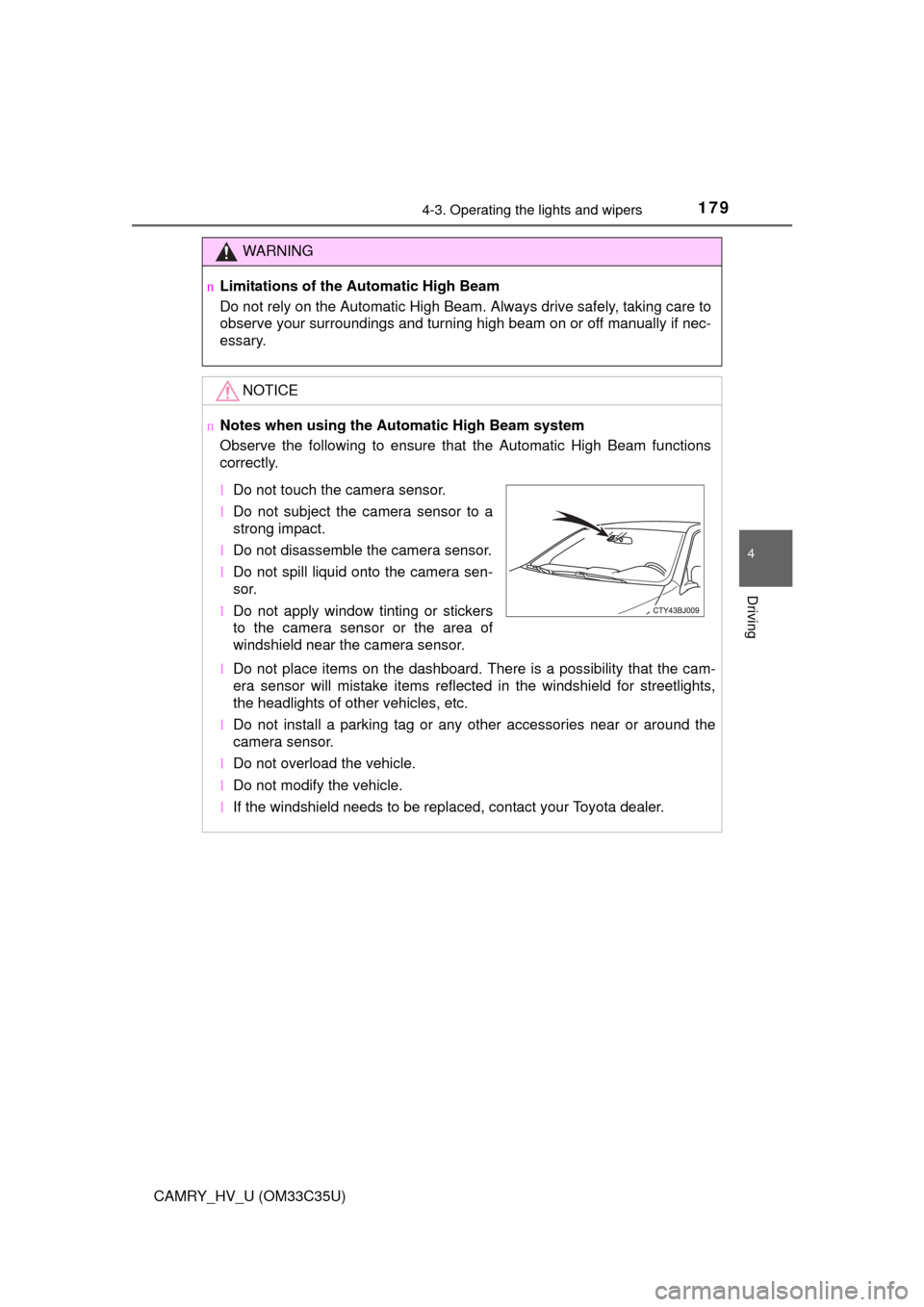
lDo not touch the camera sensor.
l Do not subject the camera sensor to a
strong impact.
l Do not disassemble the camera sensor.
l Do not spill liquid onto the camera sen-
sor.
l Do not apply window tinting or stickers
to the camera sensor or the area of
windshield near the camera sensor.
Page 181 of 572
1814-3. Operating the lights and wipers
4
Driving
CAMRY_HV_U (OM33C35U)
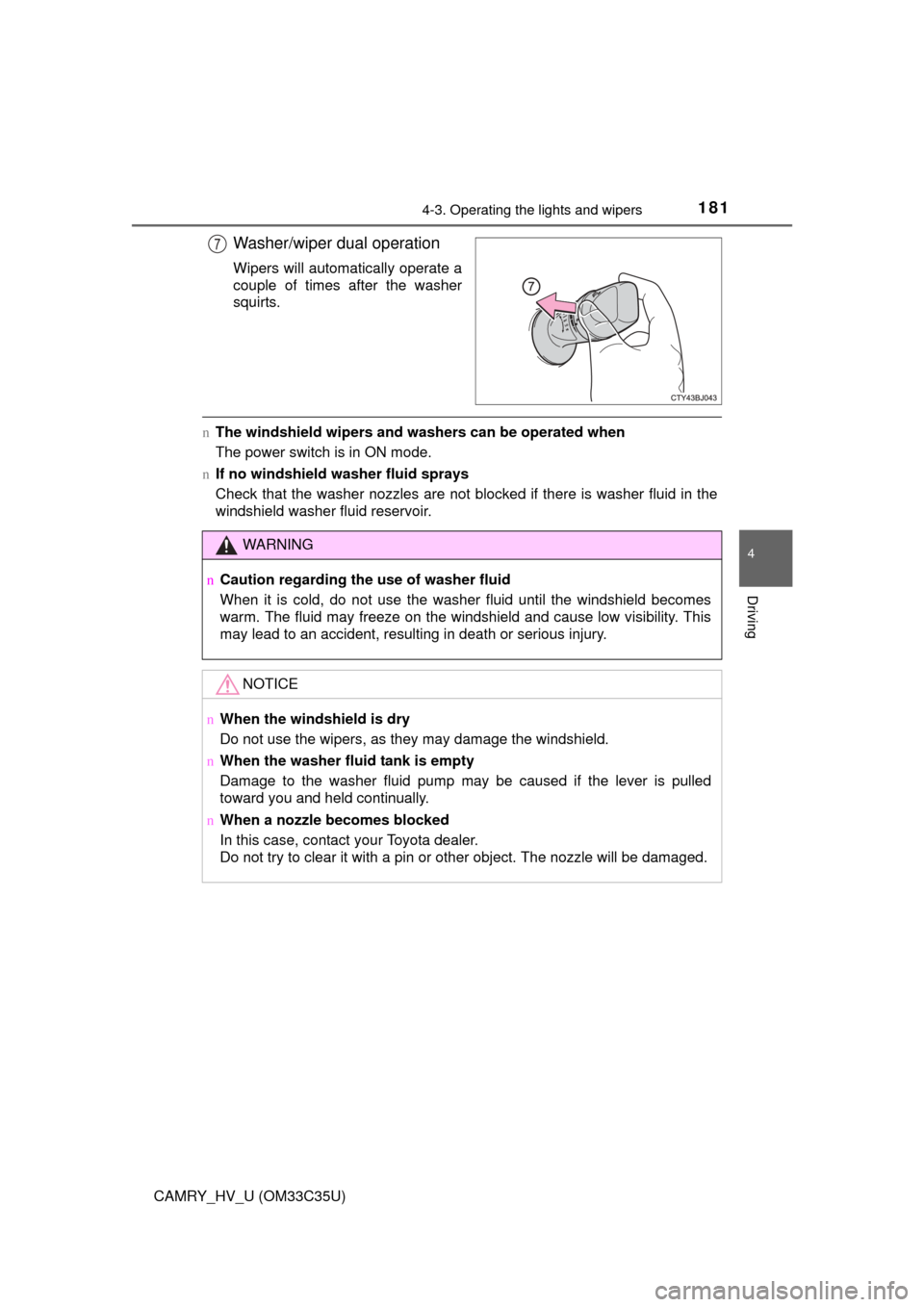
Washer/wiper dual operation
Wipers will automatically operate a
couple of times after the washer
squirts.
nThe windshield wipers and washers can be operated when
The power switch is in ON mode.
n If no windshield washer fluid sprays
Check that the washer nozzles are not blocked if there is washer fluid in the
windshield washer fluid reservoir.
7
WARNING
nCaution regarding the use of washer fluid
When it is cold, do not use the washer fluid until the windshield becomes
warm. The fluid may freeze on the windshield and cause low visibility. This
may lead to an accident, resulting in death or serious injury.
NOTICE
nWhen the windshield is dry
Do not use the wipers, as they may damage the windshield.
n When the washer fluid tank is empty
Damage to the washer fluid pump may be caused if the lever is pulled
toward you and held continually.
n When a nozzle becomes blocked
In this case, contact your Toyota dealer.
Do not try to clear it with a pin or other object. The nozzle will be damaged\
.
Page 184 of 572
1844-4. Refueling
CAMRY_HV_U (OM33C35U)
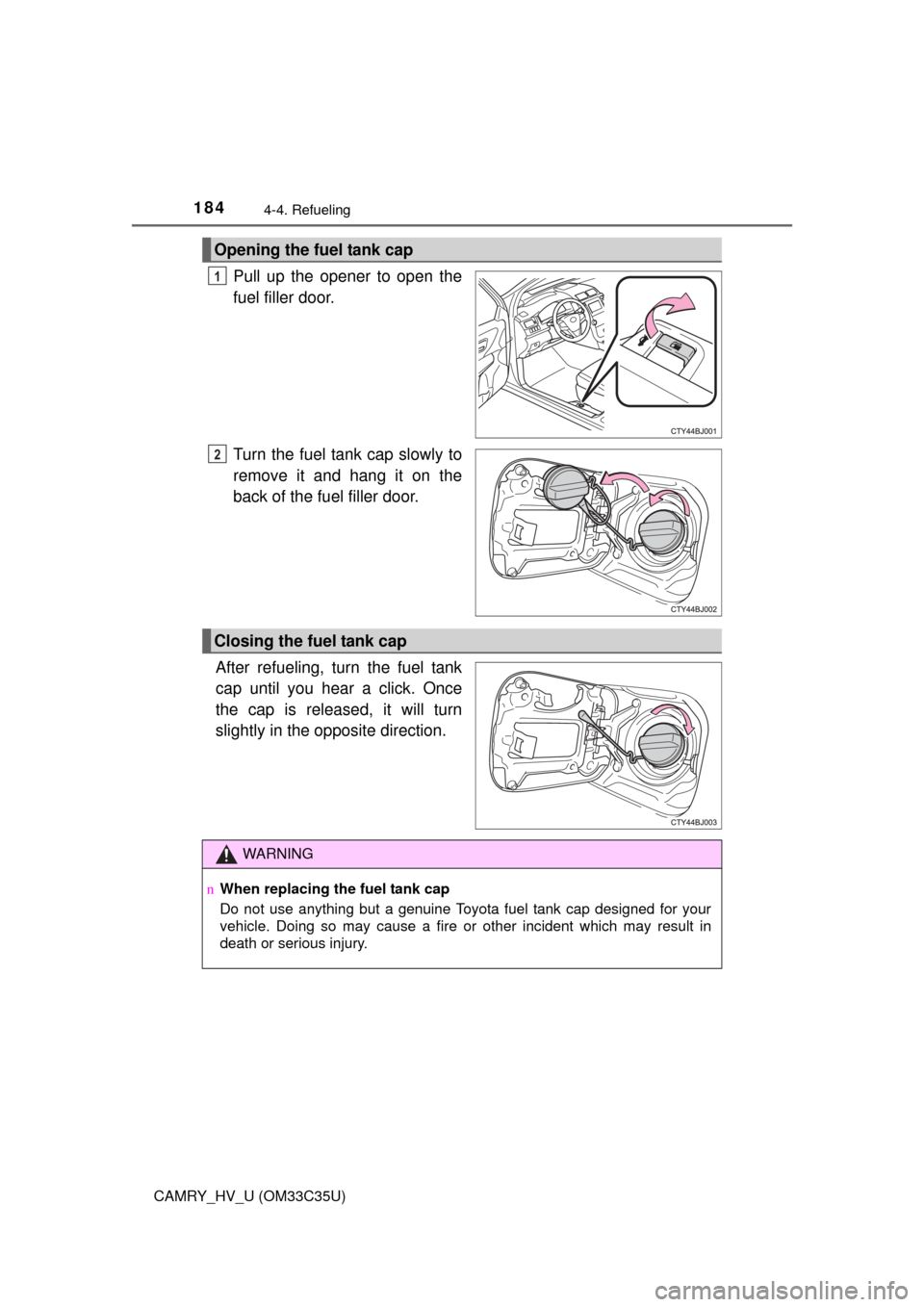
Pull up the opener to open the
fuel filler door.
Turn the fuel tank cap slowly to
remove it and hang it on the
back of the fuel filler door.
After refueling, turn the fuel tank
cap until you hear a click. Once
the cap is released, it will turn
slightly in the opposite direction.
Opening the fuel tank cap
1
2
Closing the fuel tank cap
WARNING
n When replacing the fuel tank cap
Do not use anything but a genuine Toyota fuel tank cap designed for your
vehicle. Doing so may cause a fire or other incident which may result in
death or serious injury.
Page 201 of 572

2014-5. Using the driving support systems
4
Driving
CAMRY_HV_U (OM33C35U)
WARNING
nHandling the radar sensor
Observe the following to ensure the dynamic radar cruise control system
can function effectively.
Otherwise, the radar sensor may not detect correctly and could result in an
accident.
lKeep the sensor and grille cover clean at all times.
Clean the sensor and grille cover with a soft cloth so you do not mark or
damage them.
l Do not subject the sensor or surrounding area to a strong impact.
If the sensor moves even slightly off position, the system may not work
normally or malfunction. If the sensor or surrounding area is subject to a
strong impact, always have the area inspected and adjusted by your
Toyota dealer.
l Do not disassemble the sensor.
l Do not attach accessories or stickers to the sensor, grille cover or sur-
rounding area.
l Do not modify or paint the sensor and grille cover.
l If the radar sensor needs to be replaced, contact your Toyota dealer.
Page 205 of 572

2054-5. Using the driving support systems
4
Driving
CAMRY_HV_U (OM33C35U)n
Conditions in which the function may not operate correctly
In the following situations, the camera sensor may be unable to recognize
lane markers causing the lane departure warning function to operate incor-
rectly. However, this does not indicate a malfunction.
lWhen driving through an area with no lane markers, such as a tollbooth, a
crossing or before a ticket checkpoint
l When driving on a sharp curve
l When lane markers are extremely narrow or extremely wide
l When the vehicle leans to one side an unusual amount due to a heavy load
or improper tire inflation pressure
l When the following distance between your vehicle and the vehicle ahead is
extremely short
l When the lane markers are yellow (These may be more difficult for the sys-
tem to recognize compared to white markers.)
l When the lane markers are broken, Botts’ dots (raised pavement markers)
or stones
l When the lane markers are on a curb etc.
l When lane markers are obscured or partially obscured by sand, dirt, etc.
l When there are shadows on the road running parallel with lane markers, or
if a shadow covers the lane markers
l When driving on a particularly bright road surface, such as concrete
l When driving on a road surface that is bright due to reflected light
l When driving in a location where the light level changes rapidly, such as the
entrance to or exit from a tunnel
l When sunlight or the headlights of oncoming vehicles are shining directly
into the camera lens
l When driving on roads that are branching or merging
l When driving on a road surface that is wet due to rain, previous rainfall,
standing water, etc.
l When the vehicle experiences strong up-and-down motion such as when
driving on an extremely rough road or on a seam in the pavement
l When headlight brightness at nighttime is reduced due to dirt on the lenses,
or when the headlights are misaligned
l When driving on winding roads or roads that are uneven
l When driving on rough or unpaved roads
n When changing the tires
Depending on the tires used, sufficient performance may not be maintainable.
n Warning messages for the LDA system
Warning messages are used to indicate a system malfunction or to inform t\
he
driver of the need for caution while driving. ( P. 459)