spark plugs TOYOTA CAMRY V20 1986 Service Information
[x] Cancel search | Manufacturer: TOYOTA, Model Year: 1986, Model line: CAMRY V20, Model: TOYOTA CAMRY V20 1986Pages: 2389, PDF Size: 84.44 MB
Page 1024 of 2389
TROUBLESHOOTING
TROUBLESHOOTING HINTS
1. Engine troubles is usually not caused by the EFI system.
When troubleshooting, always first check the condition of
the other systems.
(a) Electronic source
wBattery
wFusible links
wFuses
(b) Body ground
(e) Fuel supply
wFuel leakage
wFuel filter
wFuel pump
(d) Ignition system
wSpark plugs
wHigh±tension cords
wDistributor
wIgnition coil
wIgniter
(e) Air induction system
wVacuum leaks
(f) Emission control system
wPCV system
wEGR system
(g) Others
wIgnition timing (ESA system)
wdle speed (ISC system)
wetc.
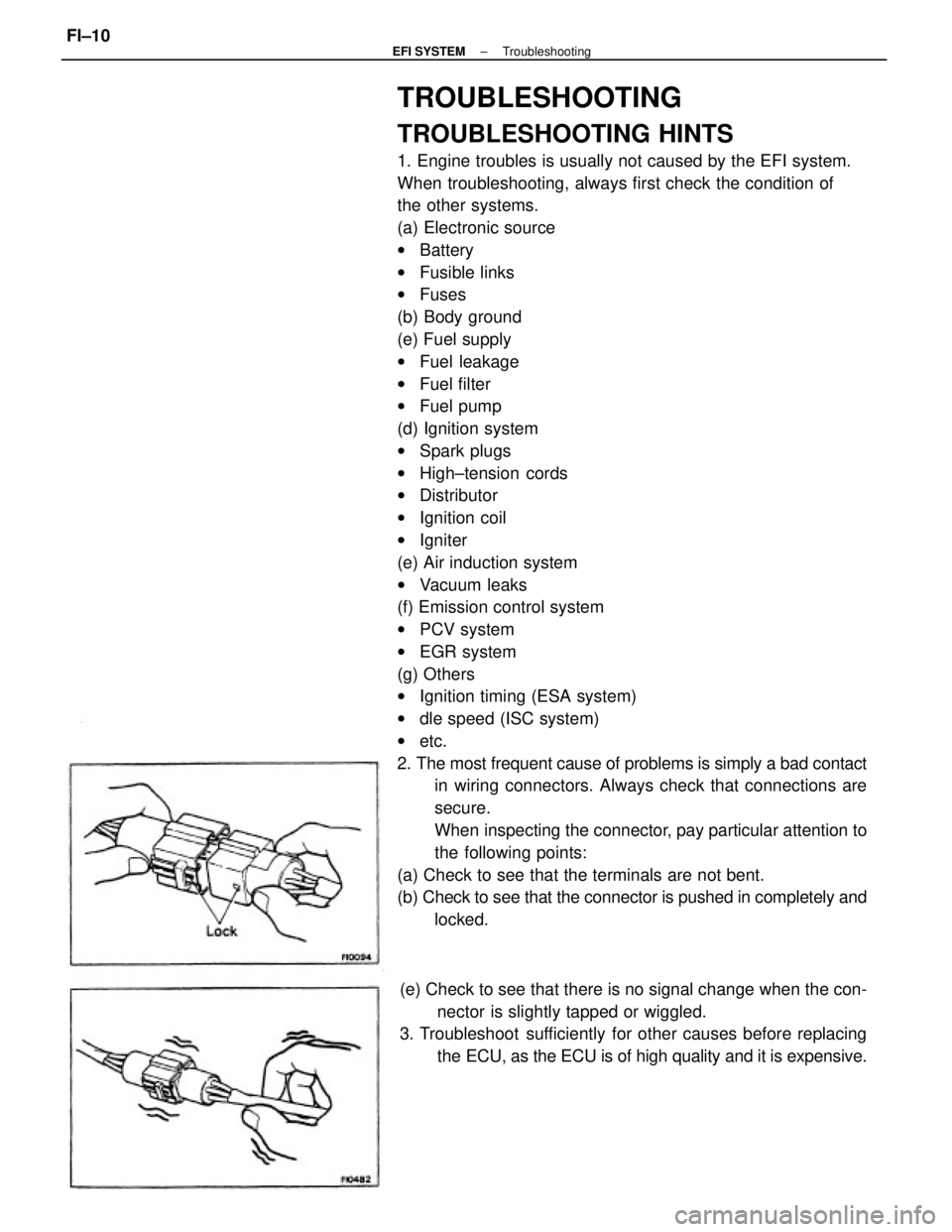
2. The most frequent cause of problems is simply a bad contact
in wiring connectors. Always check that connections are
secure.
When inspecting the connector, pay particular attention to
the following points:
(a) Check to see that the terminals are not bent.
(b) Check to see that the connector is pushed in completely and
locked.
(e) Check to see that there is no signal change when the con-
nector is slightly tapped or wiggled.
3. Troubleshoot sufficiently for other causes before replacing
the ECU, as the ECU is of high quality and it is expensive.
± EFI SYSTEMTroubleshootingFI±10
Page 1026 of 2389
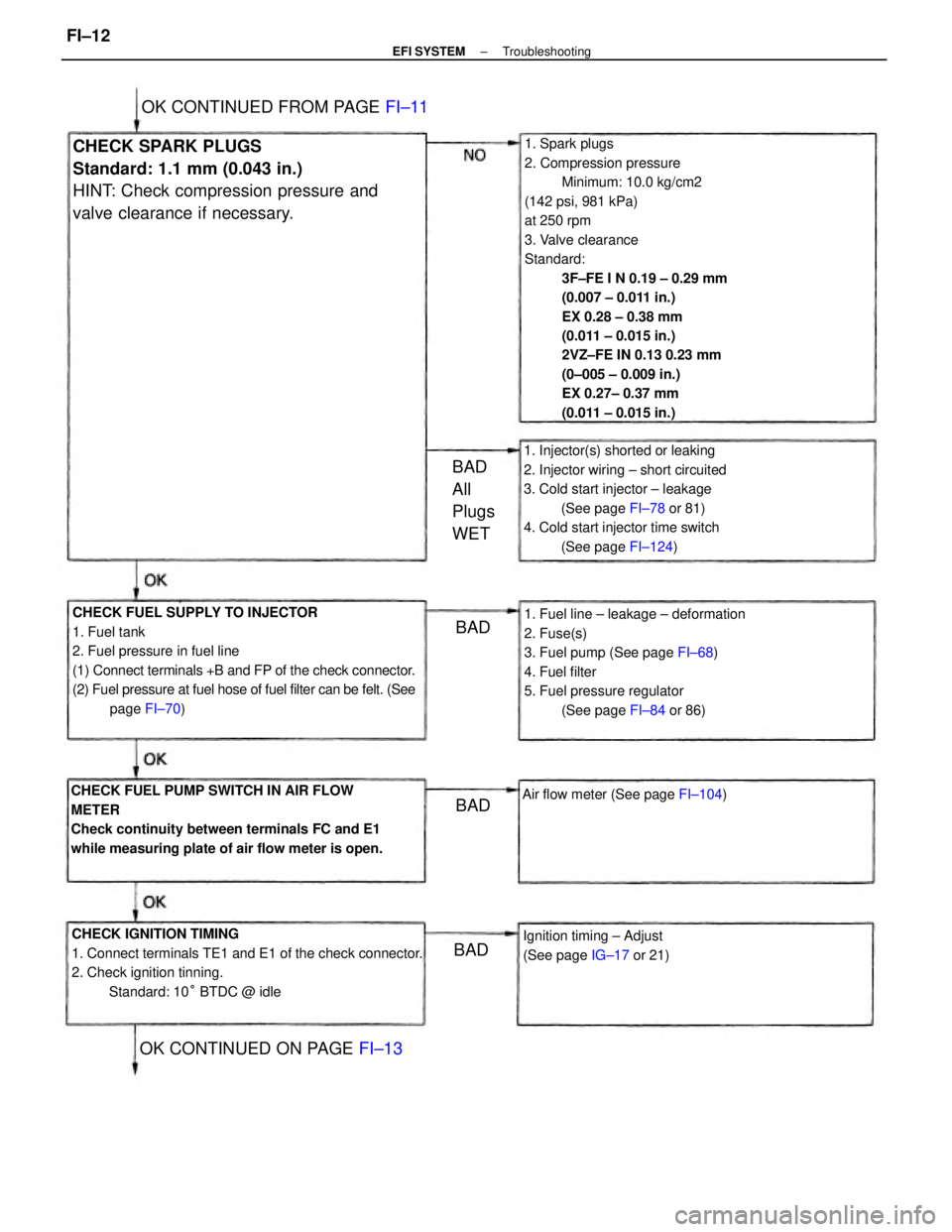
1. Spark plugs
2. Compression pressure
Minimum: 10.0 kg/cm2
(142 psi, 981 kPa)
at 250 rpm
3. Valve clearance
Standard:
3F±FE I N 0.19 ± 0.29 mm
(0.007 ± 0.011 in.)
EX 0.28 ± 0.38 mm
(0.011 ± 0.015 in.)
2VZ±FE IN 0.13 0.23 mm
(0±005 ± 0.009 in.)
EX 0.27± 0.37 mm
(0.011 ± 0.015 in.)
CHECK FUEL SUPPLY TO INJECTOR
1. Fuel tank
2. Fuel pressure in fuel line
(1) Connect terminals +B and FP of the check connector.
(2) Fuel pressure at fuel hose of fuel filter can be felt. (See
page FI±70)
CHECK IGNITION TIMING
1. Connect terminals TE1 and E1 of the check connector.
2. Check ignition tinning.
Standard: 10° BTDC @ idle CHECK FUEL PUMP SWITCH IN AIR FLOW
METER
Check continuity between terminals FC and E1
while measuring plate of air flow meter is open.1. Fuel line ± leakage ± deformation
2. Fuse(s)
3. Fuel pump (See page FI±68)
4. Fuel filter
5. Fuel pressure regulator
(See page FI±84 or 86) 1. Injector(s) shorted or leaking
2. Injector wiring ± short circuited
3. Cold start injector ± leakage
(See page FI±78 or 81)
4. Cold start injector time switch
(See page FI±124)CHECK SPARK PLUGS
Standard: 1.1 mm (0.043 in.)
HINT: Check compression pressure and
valve clearance if necessary.
Ignition timing ± Adjust
(See page IG±17 or 21)
OK CONTINUED FROM PAGE FI±11
OK CONTINUED ON PAGE FI±13
Air flow meter (See page FI±104)
BAD
All
Plugs
WET
BAD
BADBAD
± EFI SYSTEMTroubleshootingFI±12
Page 1028 of 2389
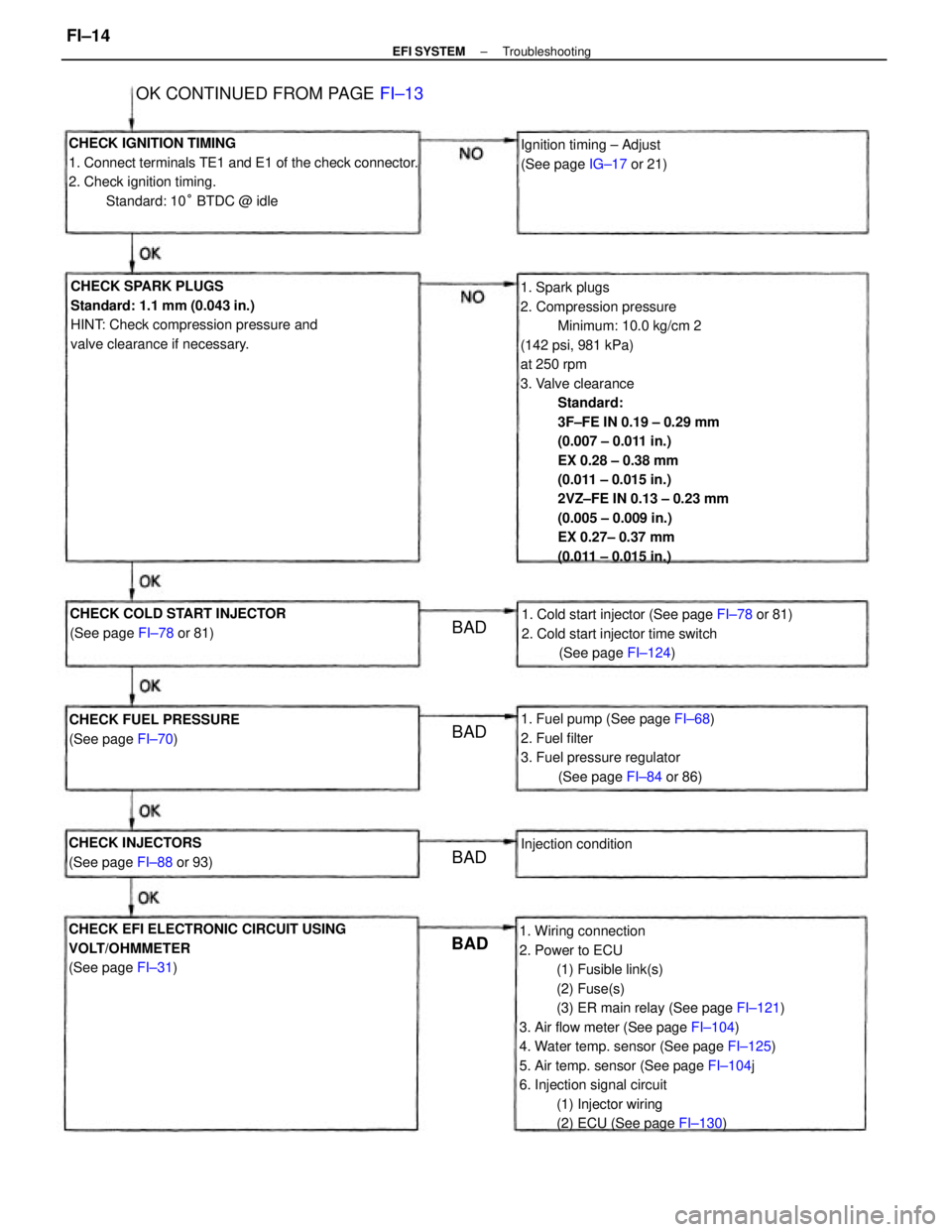
1. Spark plugs
2. Compression pressure
Minimum: 10.0 kg/cm 2
(142 psi, 981 kPa)
at 250 rpm
3. Valve clearance
Standard:
3F±FE IN 0.19 ± 0.29 mm
(0.007 ± 0.011 in.)
EX 0.28 ± 0.38 mm
(0.011 ± 0.015 in.)
2VZ±FE IN 0.13 ± 0.23 mm
(0.005 ± 0.009 in.)
EX 0.27± 0.37 mm
(0.011 ± 0.015 in.)
1. Wiring connection
2. Power to ECU
(1) Fusible link(s)
(2) Fuse(s)
(3) ER main relay (See page FI±121)
3. Air flow meter (See page FI±104)
4. Water temp. sensor (See page FI±125)
5. Air temp. sensor (See page FI±104j
6. Injection signal circuit
(1) Injector wiring
(2) ECU (See page FI±130) CHECK IGNITION TIMING
1. Connect terminals TE1 and E1 of the check connector.
2. Check ignition timing.
Standard: 10° BTDC @ idle
CHECK SPARK PLUGS
Standard: 1.1 mm (0.043 in.)
HINT: Check compression pressure and
valve clearance if necessary.
CHECK EFI ELECTRONIC CIRCUIT USING
VOLT/OHMMETER
(See page FI±31)1. Cold start injector (See page FI±78 or 81)
2. Cold start injector time switch
(See page FI±124)
1. Fuel pump (See page FI±68)
2. Fuel filter
3. Fuel pressure regulator
(See page FI±84 or 86) CHECK COLD START INJECTOR
(See page FI±78 or 81)
OK CONTINUED FROM PAGE FI±13
CHECK FUEL PRESSURE
(See page FI±70)Ignition timing ± Adjust
(See page IG±17 or 21)
CHECK INJECTORS
(See page FI±88 or 93)Injection condition
BADBAD
BAD BAD
± EFI SYSTEMTroubleshootingFI±14
Page 1030 of 2389
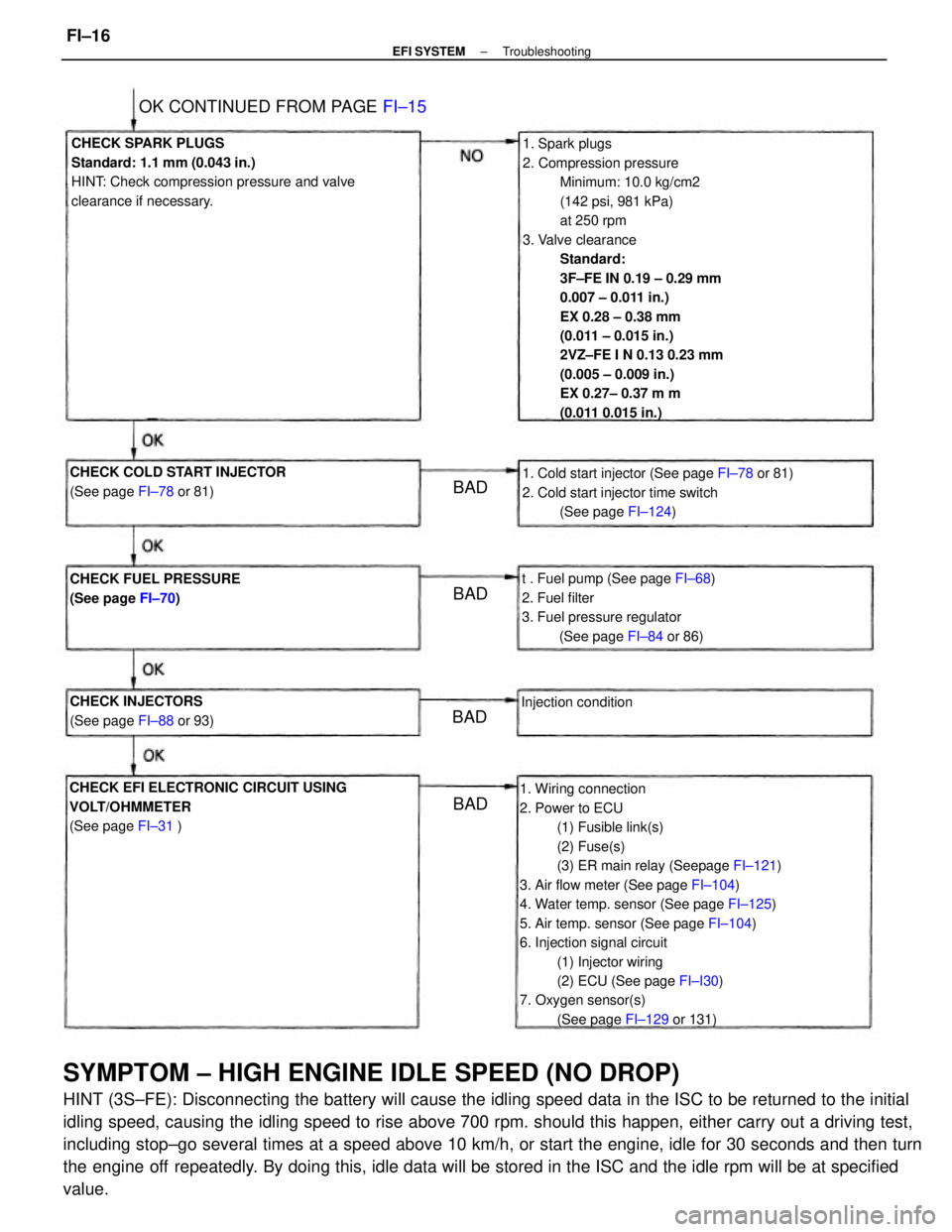
SYMPTOM ± HIGH ENGINE IDLE SPEED (NO DROP)
HINT (3S±FE): Disconnecting the battery will cause the idling speed data in the ISC to be returned to the initial
idling speed, causing the idling speed to rise above 700 rpm. should this happen, either carry out a driving test,
including stop±go several times at a speed above 10 km/h, or start the engine, idle for 30 seconds and then turn
the engine off repeatedly. By doing this, idle data will be stored in the ISC and the idle rpm will be at specified
value.
1. Spark plugs
2. Compression pressure
Minimum: 10.0 kg/cm2
(142 psi, 981 kPa)
at 250 rpm
3. Valve clearance
Standard:
3F±FE IN 0.19 ± 0.29 mm
0.007 ± 0.011 in.)
EX 0.28 ± 0.38 mm
(0.011 ± 0.015 in.)
2VZ±FE I N 0.13 0.23 mm
(0.005 ± 0.009 in.)
EX 0.27± 0.37 m m
(0.011 0.015 in.)
1. Wiring connection
2. Power to ECU
(1) Fusible link(s)
(2) Fuse(s)
(3) ER main relay (Seepage FI±121)
3. Air flow meter (See page FI±104)
4. Water temp. sensor (See page FI±125)
5. Air temp. sensor (See page FI±104)
6. Injection signal circuit
(1) Injector wiring
(2) ECU (See page FI±I30)
7. Oxygen sensor(s)
(See page FI±129 or 131) CHECK SPARK PLUGS
Standard: 1.1 mm (0.043 in.)
HINT: Check compression pressure and valve
clearance if necessary.
CHECK EFI ELECTRONIC CIRCUIT USING
VOLT/OHMMETER
(See page FI±31 )1. Cold start injector (See page FI±78 or 81)
2. Cold start injector time switch
(See page FI±124)
t . Fuel pump (See page FI±68)
2. Fuel filter
3. Fuel pressure regulator
(See page FI±84 or 86) CHECK COLD START INJECTOR
(See page FI±78 or 81)
CHECK FUEL PRESSURE
(See page FI±70)
OK CONTINUED FROM PAGE FI±15
CHECK INJECTORS
(See page FI±88 or 93)Injection condition
BADBAD
BAD
BAD
± EFI SYSTEMTroubleshootingFI±16
Page 1033 of 2389
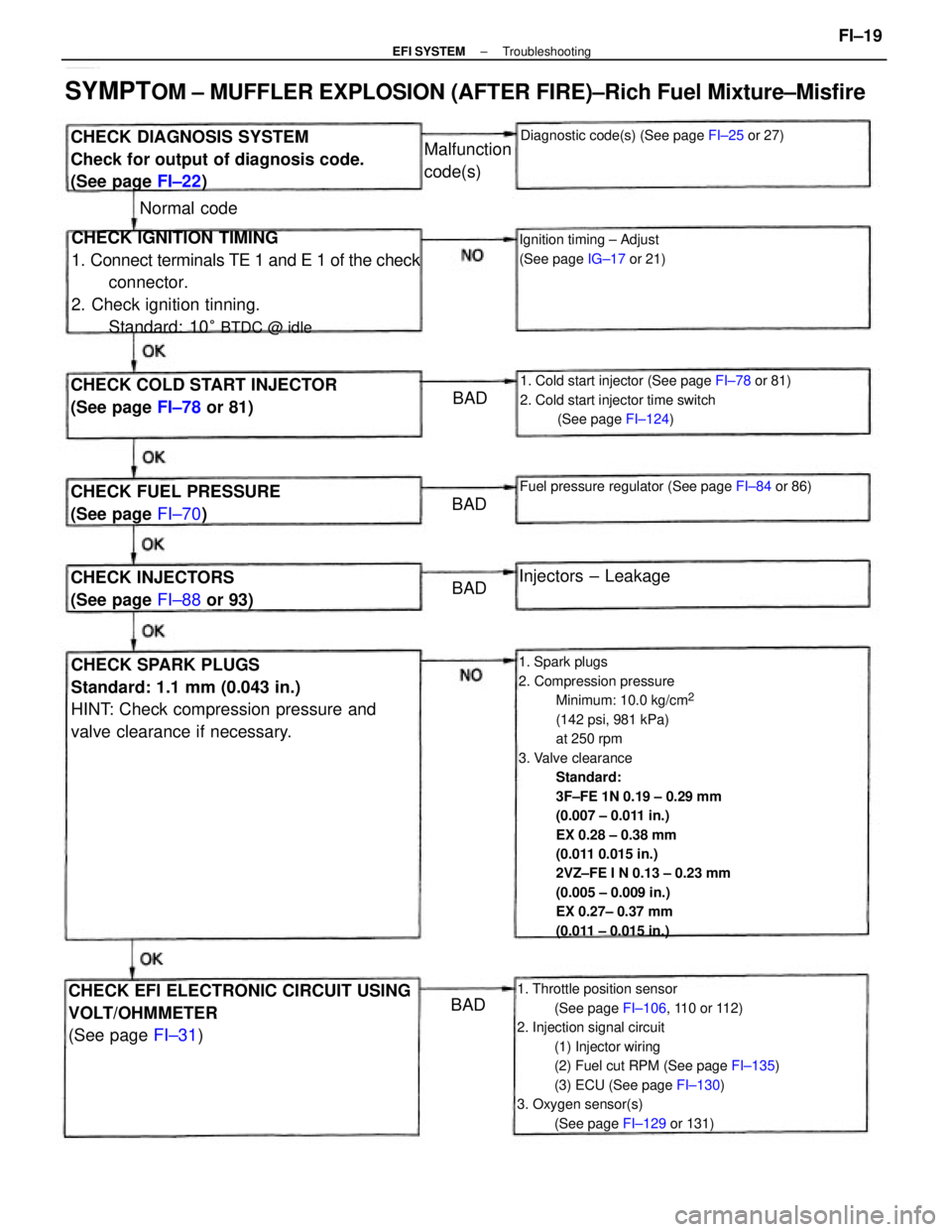
1. Spark plugs
2. Compression pressure
Minimum: 10.0 kg/cm
2
(142 psi, 981 kPa)
at 250 rpm
3. Valve clearance
Standard:
3F±FE 1N 0.19 ± 0.29 mm
(0.007 ± 0.011 in.)
EX 0.28 ± 0.38 mm
(0.011 0.015 in.)
2VZ±FE I N 0.13 ± 0.23 mm
(0.005 ± 0.009 in.)
EX 0.27± 0.37 mm
(0.011 ± 0.015 in.)
1. Throttle position sensor
(See page FI±106, 110 or 112)
2. Injection signal circuit
(1) Injector wiring
(2) Fuel cut RPM (See page FI±135)
(3) ECU (See page FI±130)
3. Oxygen sensor(s)
(See page FI±129 or 131)
CHECK IGNITION TIMING
1. Connect terminals TE 1 and E 1 of the check
connector.
2. Check ignition tinning.
Standard: 10
° BTDC @ idle
CHECK SPARK PLUGS
Standard: 1.1 mm (0.043 in.)
HINT: Check compression pressure and
valve clearance if necessary.
SYMPTOM ± MUFFLER EXPLOSION (AFTER FIRE)±Rich Fuel Mixture±Misfire
CHECK EFI ELECTRONIC CIRCUIT USING
VOLT/OHMMETER
(See page FI±31)
1. Cold start injector (See page FI±78 or 81)
2. Cold start injector time switch
(See page FI±124)
CHECK DIAGNOSIS SYSTEM
Check for output of diagnosis code.
(See page FI±22)
CHECK COLD START INJECTOR
(See page FI±78 or 81)
Fuel pressure regulator (See page FI±84 or 86)CHECK FUEL PRESSURE
(See page FI±70)
Diagnostic code(s) (See page FI±25 or 27)
Ignition timing ± Adjust
(See page IG±17 or 21)
CHECK INJECTORS
(See page FI±88 or 93)Injectors ± Leakage Malfunction
code(s)
Normal code
BAD
BAD
BADBAD
± EFI SYSTEMTroubleshootingFI±19
Page 1035 of 2389
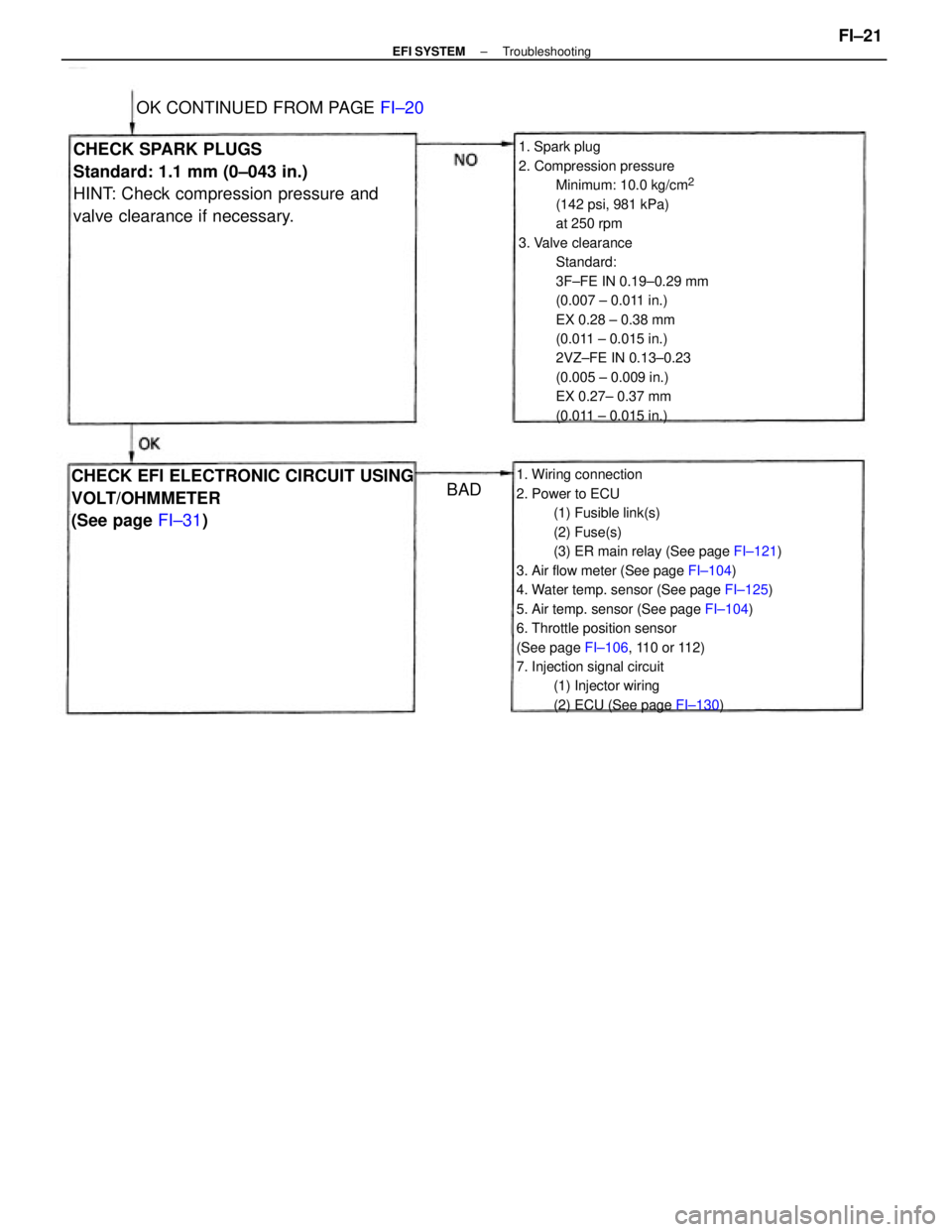
1. Spark plug
2. Compression pressure
Minimum: 10.0 kg/cm
2
(142 psi, 981 kPa)
at 250 rpm
3. Valve clearance
Standard:
3F±FE IN 0.19±0.29 mm
(0.007 ± 0.011 in.)
EX 0.28 ± 0.38 mm
(0.011 ± 0.015 in.)
2VZ±FE IN 0.13±0.23
(0.005 ± 0.009 in.)
EX 0.27± 0.37 mm
(0.011 ± 0.015 in.)
1. Wiring connection
2. Power to ECU
(1) Fusible link(s)
(2) Fuse(s)
(3) ER main relay (See page FI±121)
3. Air flow meter (See page FI±104)
4. Water temp. sensor (See page FI±125)
5. Air temp. sensor (See page FI±104)
6. Throttle position sensor
(See page FI±106, 110 or 112)
7. Injection signal circuit
(1) Injector wiring
(2) ECU (See page FI±130)
CHECK SPARK PLUGS
Standard: 1.1 mm (0±043 in.)
HINT: Check compression pressure and
valve clearance if necessary.
CHECK EFI ELECTRONIC CIRCUIT USING
VOLT/OHMMETER
(See page FI±31) OK CONTINUED FROM PAGE FI±20
BAD
± EFI SYSTEMTroubleshootingFI±21
Page 1072 of 2389
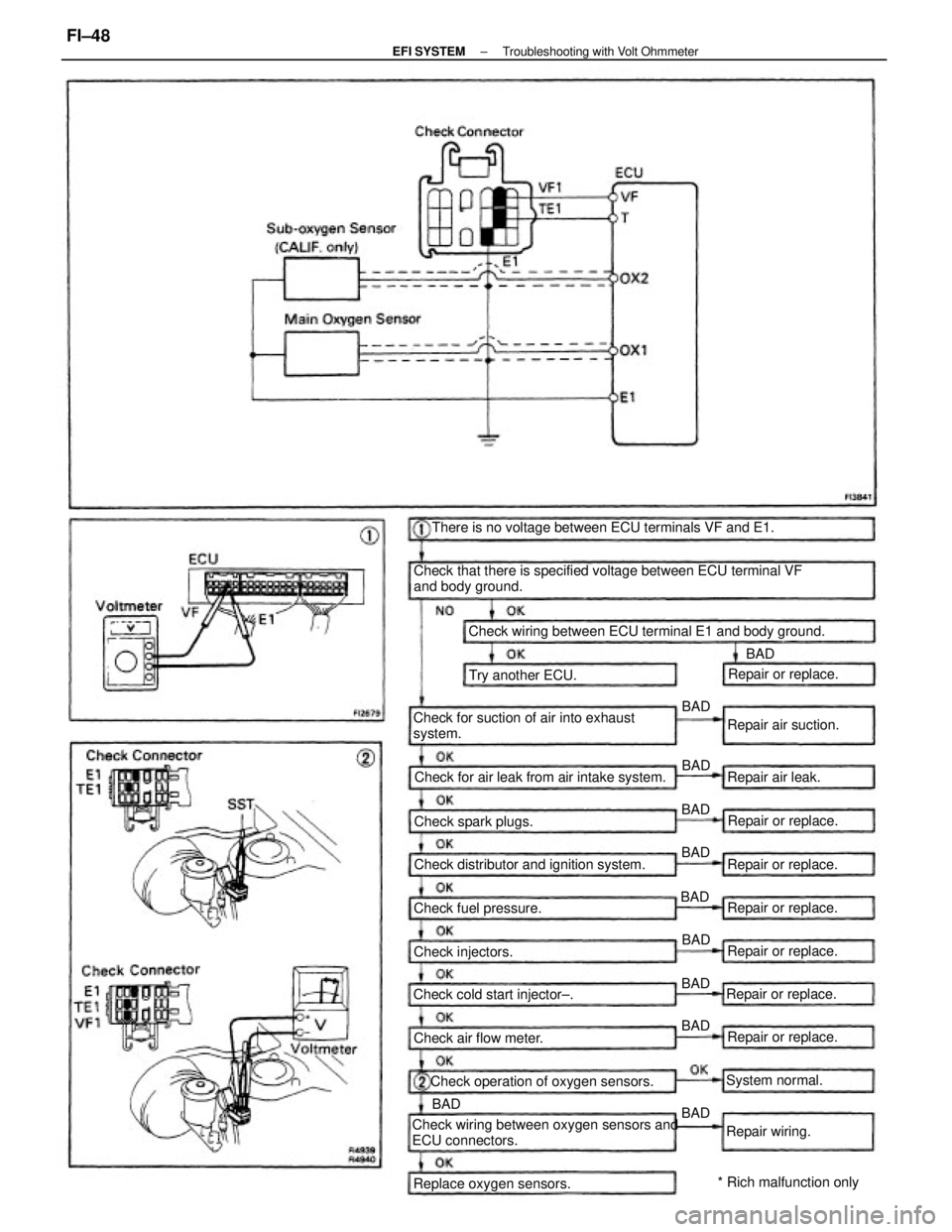
Check that there is specified voltage between ECU terminal VF
and body ground.
Check for suction of air into exhaust
system.Check wiring between ECU terminal E1 and body ground.
Check wiring between oxygen sensors and
ECU connectors.There is no voltage between ECU terminals VF and E1.
Check for air leak from air intake system.
Check distributor and ignition system.
Check operation of oxygen sensors. Check cold start injector±.
Replace oxygen sensors.* Rich malfunction only Check fuel pressure.
Check air flow meter.Check spark plugs.Repair or replace.
Repair air suction.
Repair or replace.
Repair or replace. Repair or replace.
Repair or replace.
Repair or replace. Repair or replace. Try another ECU.
Check injectors.
System normal.Repair air leak.
Repair wiring. BAD
BADBADBADBAD
BADBAD
BAD BADBAD
BAD
± EFI SYSTEMTroubleshooting with Volt OhmmeterFI±48
Page 1090 of 2389
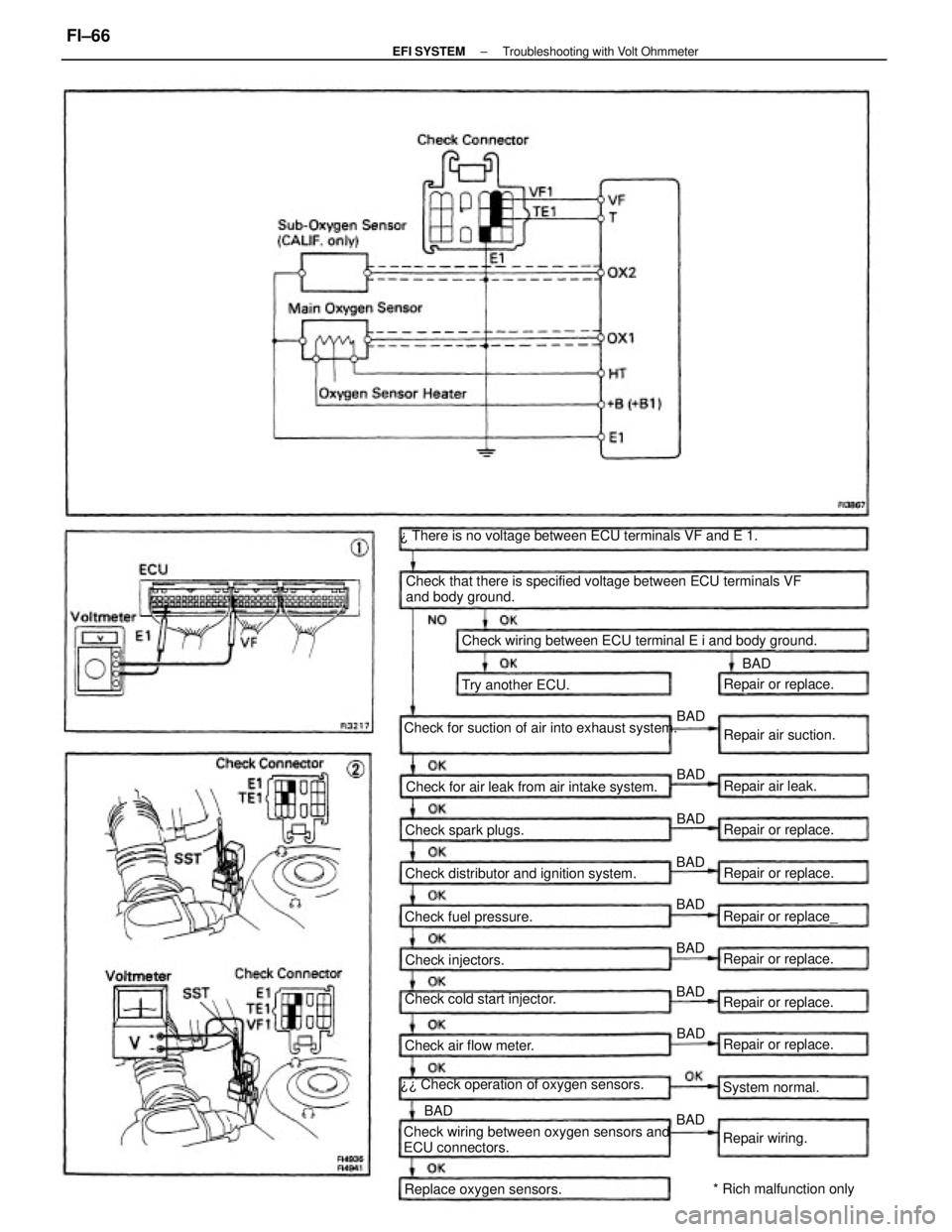
Check that there is specified voltage between ECU terminals VF
and body ground. ¿ There is no voltage between ECU terminals VF and E 1.
Check wiring between ECU terminal E i and body ground.
Check for suction of air into exhaust system.
Check wiring between oxygen sensors and
ECU connectors. ¿¿ Check operation of oxygen sensors.Check for air leak from air intake system.
Check cold start injector.Check distributor and ignition system.
Replace oxygen sensors.* Rich malfunction only Check fuel pressure.
Check air flow meter.Check spark plugs.Repair air suction.
Repair or replace. Repair or replace_Repair or replace.
Repair or replace.
Repair or replace.Repair or replace.
Repair or replace. Try another ECU.
Check injectors.
System normal.Repair air leak.
Repair wiring. BAD
BAD
BADBADBAD BAD
BAD
BAD
BAD BADBAD
± EFI SYSTEMTroubleshooting with Volt OhmmeterFI±66
Page 1180 of 2389
The 3S±FE engine is an in±line 4±cylinder engine with the cylinders numbered 1 ± 2 ± 3 ± 4 from the
front.
The crankshaft is supported by 5 bearing inside the crankcase. These bearing are made of aluminum
alloy.
The crankshaft is integrated with 8 weights for balance. Oil holes are placed in the center of the crank-
shaft to supply oil to the connecting rods, bearing, pistons and other components.
This engine's ignition order is 1 ± 3 ± 4 ± 2. The cylinder head is made of aluminum alloy, with a cross
flow type intake and exhaust layout and with pent±roof type combustion chambers. The spark plugs are
located in the center of the combustion chamber.
The intake manifold has 8 independent long ports and utilizes the inertial supercharging effect to im-
prove engine torque at low and medium speeds.
Exhaust and intake valves are equipped with irregular pitch springs made of special valve spring carbon
steel which are capable of functioning no matter what the engine speed.
The intake side camshaft is driven by a timing belt, and a gear on the intake side camshaft engages with
a gear on the exhaust side camshaft to drive it. The cam journal is supported at 5 places between the
valve lifters of each cylinder and on the front end of the cylinder head. Lubrication of the cam journal and
gear is accomplished by oil being supplied through the oiler port in the center of the camshaft.
Adjustment of the valve clearance is done by means of outer shim type system, in which valve adjusting
shims are located above the valve lifters. This permits replacement of the shims without removal of the
camshafts.
The resin timing belt cover is made of 2 pieces. A service hole is provided in the No. 1 belt cover for ad-
justing the timing belt tension.
Piston are made of high temperature±resistant aluminum alloy, and a depression is built into the piston
head to prevent interference with the valves.
Piston pins are the semi±floating type, with the pins fastened to the connecting rods by pressure fitting,
allowing the pistons and pins to float.
The No. 1 compression ring is made of steel and the No. 2 compression ring is made of cast iron. The oil
ring is made of a combination of steel and stainless steel. The outer diameter of each piston ring is
slightly larger than the diameter of the piston and the flexibility of the rings allows them to hug the cylin-
der walls when they are mounted on the piston rings No. 1 and No. 2 work to prevent gas leakage from
the cylinder and oil ring works to clear oil off the cylinder walls to prevent it from entering the combustion
chambers.
The cylinder block is made of cast iron. It has 4 cylinders which are approximately 2 times the length of
the piston stroke. The top of the cylinders is closed off by the cylinder head and the lower end of the cyl-
inders becomes the crankcase, in which the crankshaft is installed. In .addition, the cylinder block con-
tains a water jacket, through which coolant is pumped to cool the cylinders.
The oil pan is bolted onto the bottom of the cylinder block. The oil pan is an oil reservoir made of
pressed steel shoot. A dividing plate is included inside the oil pan to keep sufficient oil in the bottom of
the pan even when the vehicle is tilted. This dividing plate also prevents the oil from making waves when
the vehicle is topped suddenly and thus shifting the oil away from the oil pump suction pipe.
± ENGINE MECHANICALDescription (3S±FE)EM±3
Page 1182 of 2389
The 2VZ±FE engine has 6 cylinder in a V arrangement at bank of 60°. From the front of the RH bank cylin-
ders are numbered 1 ± 3 ± 5, and from the front of the LH bank cylinders are numbered 2 ± 4 ±r 6. The crankshaft is
supported by 4 bearings inside the crankcase. These bearing are made of copper and lead alloy.
The crankshaft is integrated with 5 weights for balance. Oil holes are placed in the center of the crankshaft for sup-
plying oil to the connecting rods, pistons and other components.
This engine's ignition order is 1 ± 2 ± 3 ± 4 ± 5 ± 6. The cylinder head is made of aluminum alloy, with a cross flow
type intake and exhaust layout and with pent±roof type combustion chambers. The spark plugs are located in the
center of the combustion chambers.
At,the front and rear of the intake port of the intake manifold, a water passage has been provided which connects
the RH and LH cylinder heads.
Exhaust and intake valves are equipped with irregular pitch springs made of special valve spring carbon steel which
are capable of functioning no matter what the engine speed.
The RH and LH intake camshaft are driven by a single timing belt, and a gear on the intake side camshaft engages
with a gear on the exhaust side camshaft to drive it. The cam journal is supported at 5 (intake) or 4
(exhaust) places between the valve liters of each cylinder and on the front end of the cylinder head. Lubrication of
the cam journals and gears is accomplished by oil being supplied through the oiler port in the center of the camshaft.
Adjustment of the valve clearance is done by means of outer shim type system, in which valve adjusting shims are
located above the valve lifters. The permits replacement of the shims without removal of the camshafts.
The timing belt cover is composed of resin type No. 2 and No. 1 above and below the RH mounting bracket.
Piston are made high temperature±resistant aluminum alloy, and a depression is built into the piston head to prevent
interference with the valves.
Piston pins are the semi±floating type, with the pins fastened to the connecting rods by pressure fitting, allowing the
pistons and pins to float.
The No. 1 compression ring is made of steel and the No. 2 compression ring is made±of cast iron. The oil ring is
made of a combination of steel and stainless steel. The outer diameter of each piston ring is slightly larger than the
diameter of the piston and the flexibility of the rings allows them to hug the cylinder walls when they are mounted on
the piston. Compression rings No. 1 and No. 2 work to prevent gas leakage from the cylinder and oil ring works to
clear oil off the cylinder walls to prevent it from entering the combustion chambers.
The cylinder block is made of cast iron with a bank angle of 60°. It has 6 cylinders which are approximately 2
times the length of the piston stroke. The top of the cylinders is closed off by the cylinder heads and the lower end of
the cylinders becomes the crankcase, in which the crankshaft is installed. In addition, the cylinder block contains a
water jacket, through which coolant is pumped to cool the cylinders.
The oil pan is bolted onto the bottom of the cylinder block. The oil pan is an oil reservoir made of pressed steel
sheet. A dividing plate is included inside the oil pan to keep sufficient oil in the bottom of the pan even when the ve-
hicle is tilted. This dividing plate also prevents the oil from making waves when the vehicle is stopped suddenly and
thus shifting the oil away from the oil pump suction pipe.
± ENGINE MECHANICALDescription (2VZ±FE)EM±5