weight TOYOTA CAMRY V20 1986 Service Information
[x] Cancel search | Manufacturer: TOYOTA, Model Year: 1986, Model line: CAMRY V20, Model: TOYOTA CAMRY V20 1986Pages: 2389, PDF Size: 84.44 MB
Page 901 of 2389
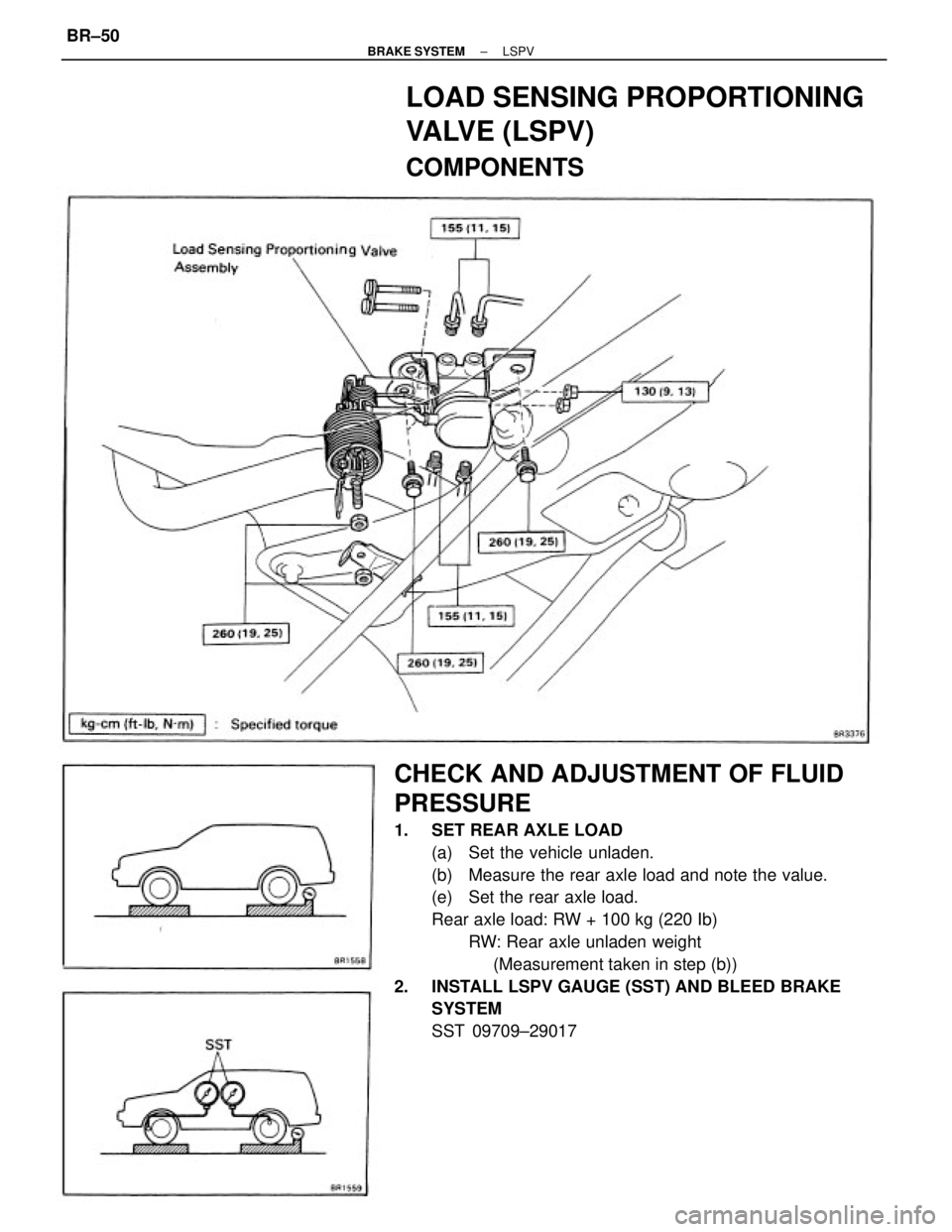
CHECK AND ADJUSTMENT OF FLUID
PRESSURE
1. SET REAR AXLE LOAD
(a) Set the vehicle unladen.
(b) Measure the rear axle load and note the value.
(e) Set the rear axle load.
Rear axle load: RW + 100 kg (220 Ib)
RW: Rear axle unladen weight
(Measurement taken in step (b))
2. INSTALL LSPV GAUGE (SST) AND BLEED BRAKE
SYSTEM
SST 09709±29017
LOAD SENSING PROPORTIONING
VALVE (LSPV)
COMPONENTS
± BRAKE SYSTEMLSPVBR±50
Page 1180 of 2389
The 3S±FE engine is an in±line 4±cylinder engine with the cylinders numbered 1 ± 2 ± 3 ± 4 from the
front.
The crankshaft is supported by 5 bearing inside the crankcase. These bearing are made of aluminum
alloy.
The crankshaft is integrated with 8 weights for balance. Oil holes are placed in the center of the crank-
shaft to supply oil to the connecting rods, bearing, pistons and other components.
This engine's ignition order is 1 ± 3 ± 4 ± 2. The cylinder head is made of aluminum alloy, with a cross
flow type intake and exhaust layout and with pent±roof type combustion chambers. The spark plugs are
located in the center of the combustion chamber.
The intake manifold has 8 independent long ports and utilizes the inertial supercharging effect to im-
prove engine torque at low and medium speeds.
Exhaust and intake valves are equipped with irregular pitch springs made of special valve spring carbon
steel which are capable of functioning no matter what the engine speed.
The intake side camshaft is driven by a timing belt, and a gear on the intake side camshaft engages with
a gear on the exhaust side camshaft to drive it. The cam journal is supported at 5 places between the
valve lifters of each cylinder and on the front end of the cylinder head. Lubrication of the cam journal and
gear is accomplished by oil being supplied through the oiler port in the center of the camshaft.
Adjustment of the valve clearance is done by means of outer shim type system, in which valve adjusting
shims are located above the valve lifters. This permits replacement of the shims without removal of the
camshafts.
The resin timing belt cover is made of 2 pieces. A service hole is provided in the No. 1 belt cover for ad-
justing the timing belt tension.
Piston are made of high temperature±resistant aluminum alloy, and a depression is built into the piston
head to prevent interference with the valves.
Piston pins are the semi±floating type, with the pins fastened to the connecting rods by pressure fitting,
allowing the pistons and pins to float.
The No. 1 compression ring is made of steel and the No. 2 compression ring is made of cast iron. The oil
ring is made of a combination of steel and stainless steel. The outer diameter of each piston ring is
slightly larger than the diameter of the piston and the flexibility of the rings allows them to hug the cylin-
der walls when they are mounted on the piston rings No. 1 and No. 2 work to prevent gas leakage from
the cylinder and oil ring works to clear oil off the cylinder walls to prevent it from entering the combustion
chambers.
The cylinder block is made of cast iron. It has 4 cylinders which are approximately 2 times the length of
the piston stroke. The top of the cylinders is closed off by the cylinder head and the lower end of the cyl-
inders becomes the crankcase, in which the crankshaft is installed. In .addition, the cylinder block con-
tains a water jacket, through which coolant is pumped to cool the cylinders.
The oil pan is bolted onto the bottom of the cylinder block. The oil pan is an oil reservoir made of
pressed steel shoot. A dividing plate is included inside the oil pan to keep sufficient oil in the bottom of
the pan even when the vehicle is tilted. This dividing plate also prevents the oil from making waves when
the vehicle is topped suddenly and thus shifting the oil away from the oil pump suction pipe.
± ENGINE MECHANICALDescription (3S±FE)EM±3
Page 1182 of 2389
The 2VZ±FE engine has 6 cylinder in a V arrangement at bank of 60°. From the front of the RH bank cylin-
ders are numbered 1 ± 3 ± 5, and from the front of the LH bank cylinders are numbered 2 ± 4 ±r 6. The crankshaft is
supported by 4 bearings inside the crankcase. These bearing are made of copper and lead alloy.
The crankshaft is integrated with 5 weights for balance. Oil holes are placed in the center of the crankshaft for sup-
plying oil to the connecting rods, pistons and other components.
This engine's ignition order is 1 ± 2 ± 3 ± 4 ± 5 ± 6. The cylinder head is made of aluminum alloy, with a cross flow
type intake and exhaust layout and with pent±roof type combustion chambers. The spark plugs are located in the
center of the combustion chambers.
At,the front and rear of the intake port of the intake manifold, a water passage has been provided which connects
the RH and LH cylinder heads.
Exhaust and intake valves are equipped with irregular pitch springs made of special valve spring carbon steel which
are capable of functioning no matter what the engine speed.
The RH and LH intake camshaft are driven by a single timing belt, and a gear on the intake side camshaft engages
with a gear on the exhaust side camshaft to drive it. The cam journal is supported at 5 (intake) or 4
(exhaust) places between the valve liters of each cylinder and on the front end of the cylinder head. Lubrication of
the cam journals and gears is accomplished by oil being supplied through the oiler port in the center of the camshaft.
Adjustment of the valve clearance is done by means of outer shim type system, in which valve adjusting shims are
located above the valve lifters. The permits replacement of the shims without removal of the camshafts.
The timing belt cover is composed of resin type No. 2 and No. 1 above and below the RH mounting bracket.
Piston are made high temperature±resistant aluminum alloy, and a depression is built into the piston head to prevent
interference with the valves.
Piston pins are the semi±floating type, with the pins fastened to the connecting rods by pressure fitting, allowing the
pistons and pins to float.
The No. 1 compression ring is made of steel and the No. 2 compression ring is made±of cast iron. The oil ring is
made of a combination of steel and stainless steel. The outer diameter of each piston ring is slightly larger than the
diameter of the piston and the flexibility of the rings allows them to hug the cylinder walls when they are mounted on
the piston. Compression rings No. 1 and No. 2 work to prevent gas leakage from the cylinder and oil ring works to
clear oil off the cylinder walls to prevent it from entering the combustion chambers.
The cylinder block is made of cast iron with a bank angle of 60°. It has 6 cylinders which are approximately 2
times the length of the piston stroke. The top of the cylinders is closed off by the cylinder heads and the lower end of
the cylinders becomes the crankcase, in which the crankshaft is installed. In addition, the cylinder block contains a
water jacket, through which coolant is pumped to cool the cylinders.
The oil pan is bolted onto the bottom of the cylinder block. The oil pan is an oil reservoir made of pressed steel
sheet. A dividing plate is included inside the oil pan to keep sufficient oil in the bottom of the pan even when the ve-
hicle is tilted. This dividing plate also prevents the oil from making waves when the vehicle is stopped suddenly and
thus shifting the oil away from the oil pump suction pipe.
± ENGINE MECHANICALDescription (2VZ±FE)EM±5
Page 1201 of 2389
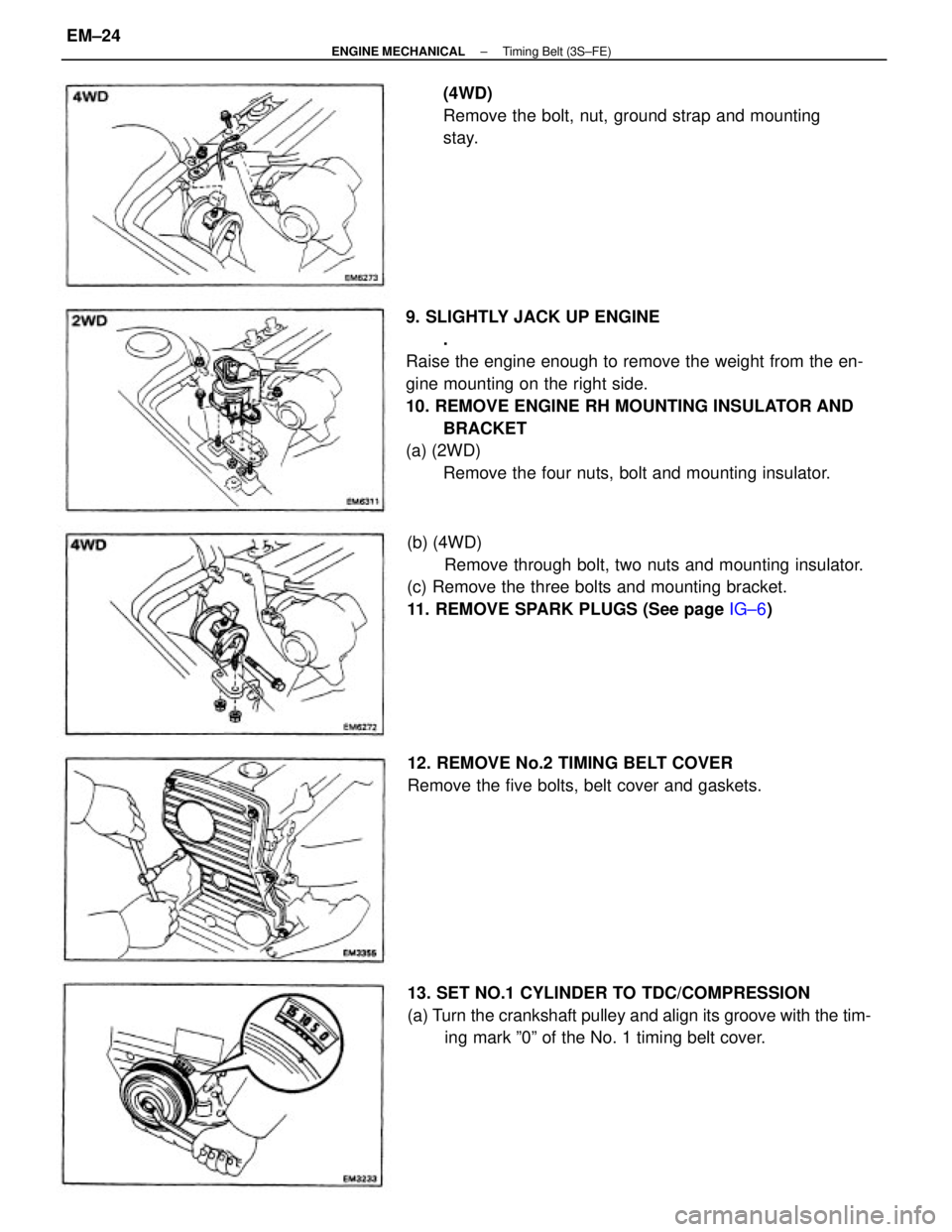
9. SLIGHTLY JACK UP ENGINE
.
Raise the engine enough to remove the weight from the en-
gine mounting on the right side.
10. REMOVE ENGINE RH MOUNTING INSULATOR AND
BRACKET
(a) (2WD)
Remove the four nuts, bolt and mounting insulator.
(b) (4WD)
Remove through bolt, two nuts and mounting insulator.
(c) Remove the three bolts and mounting bracket.
11. REMOVE SPARK PLUGS (See page IG±6)
13. SET NO.1 CYLINDER TO TDC/COMPRESSION
(a) Turn the crankshaft pulley and align its groove with the tim-
ing mark º0º of the No. 1 timing belt cover. (4WD)
Remove the bolt, nut, ground strap and mounting
stay.
12. REMOVE No.2 TIMING BELT COVER
Remove the five bolts, belt cover and gaskets.
± ENGINE MECHANICALTiming Belt (3S±FE)EM±24
Page 1212 of 2389
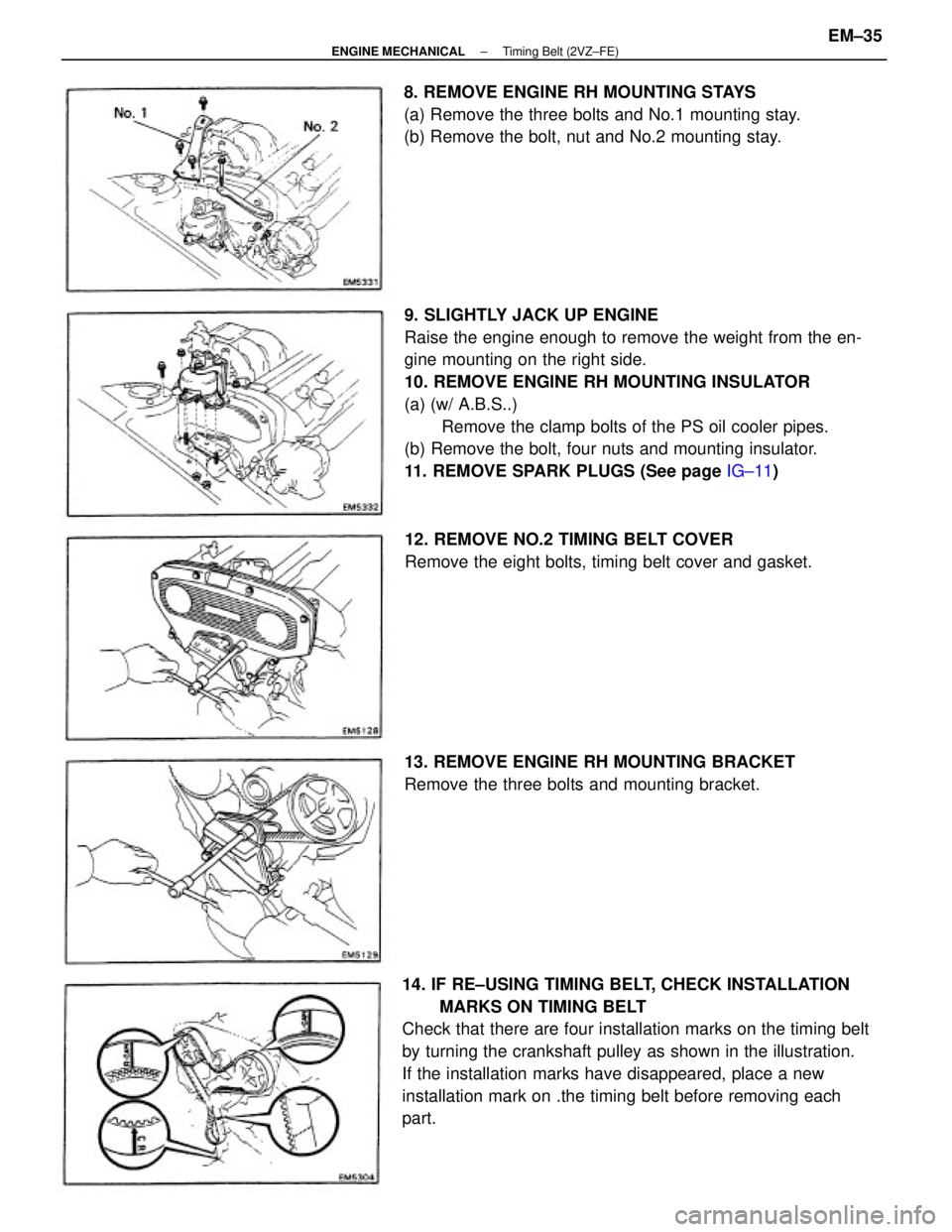
9. SLIGHTLY JACK UP ENGINE
Raise the engine enough to remove the weight from the en-
gine mounting on the right side.
10. REMOVE ENGINE RH MOUNTING INSULATOR
(a) (w/ A.B.S..)
Remove the clamp bolts of the PS oil cooler pipes.
(b) Remove the bolt, four nuts and mounting insulator.
11. REMOVE SPARK PLUGS (See page IG±11)
14. IF RE±USING TIMING BELT, CHECK INSTALLATION
MARKS ON TIMING BELT
Check that there are four installation marks on the timing belt
by turning the crankshaft pulley as shown in the illustration.
If the installation marks have disappeared, place a new
installation mark on .the timing belt before removing each
part.8. REMOVE ENGINE RH MOUNTING STAYS
(a) Remove the three bolts and No.1 mounting stay.
(b) Remove the bolt, nut and No.2 mounting stay.
12. REMOVE NO.2 TIMING BELT COVER
Remove the eight bolts, timing belt cover and gasket.
13. REMOVE ENGINE RH MOUNTING BRACKET
Remove the three bolts and mounting bracket.
± ENGINE MECHANICALTiming Belt (2VZ±FE)EM±35
Page 1373 of 2389
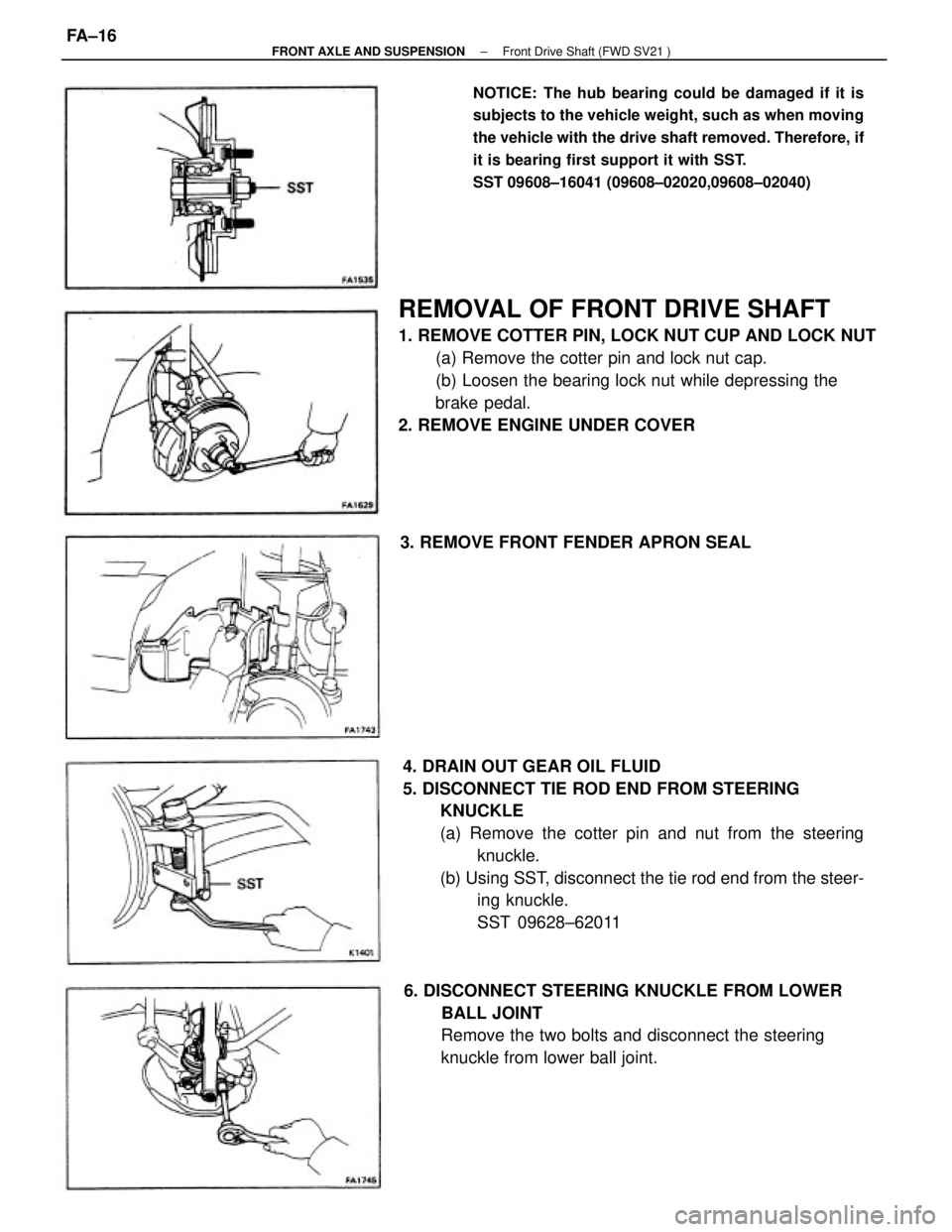
REMOVAL OF FRONT DRIVE SHAFT
1. REMOVE COTTER PIN, LOCK NUT CUP AND LOCK NUT
(a) Remove the cotter pin and lock nut cap.
(b) Loosen the bearing lock nut while depressing the
brake pedal.
2. REMOVE ENGINE UNDER COVER
4. DRAIN OUT GEAR OIL FLUID
5. DISCONNECT TIE ROD END FROM STEERING
KNUCKLE
(a) Remove the cotter pin and nut from the steering
knuckle.
(b) Using SST, disconnect the tie rod end from the steer-
ing knuckle.
SST 09628±62011
NOTICE: The hub bearing could be damaged if it is
subjects to the vehicle weight, such as when moving
the vehicle with the drive shaft removed. Therefore, if
it is bearing first support it with SST.
SST 09608±16041 (09608±02020,09608±02040)
6. DISCONNECT STEERING KNUCKLE FROM LOWER
BALL JOINT
Remove the two bolts and disconnect the steering
knuckle from lower ball joint. 3. REMOVE FRONT FENDER APRON SEAL
± FRONT AXLE AND SUSPENSIONFront Drive Shaft (FWD SV21 )FA±16
Page 1386 of 2389
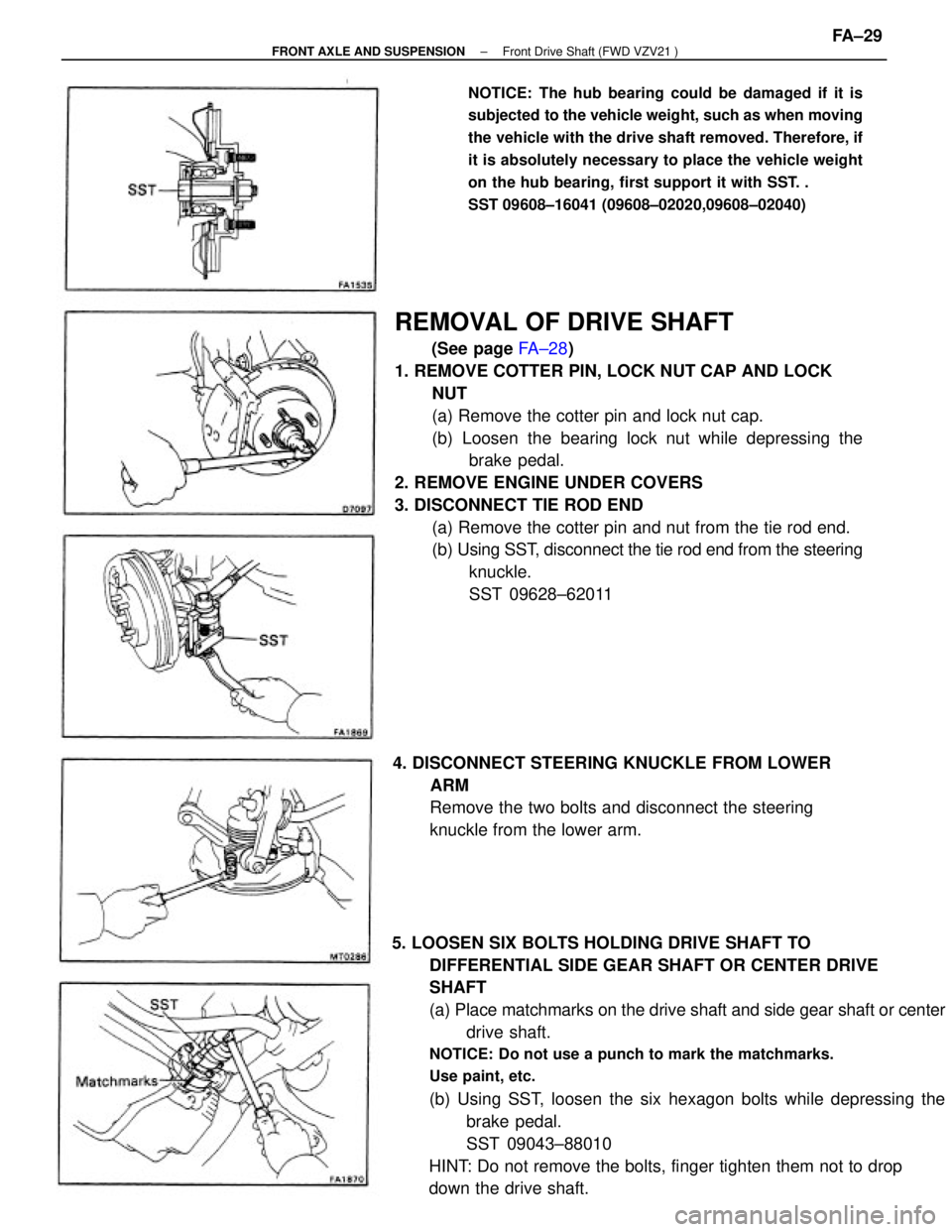
REMOVAL OF DRIVE SHAFT
(See page FA±28)
1. REMOVE COTTER PIN, LOCK NUT CAP AND LOCK
NUT
(a) Remove the cotter pin and lock nut cap.
(b) Loosen the bearing lock nut while depressing the
brake pedal.
2. REMOVE ENGINE UNDER COVERS
3. DISCONNECT TIE ROD END
(a) Remove the cotter pin and nut from the tie rod end.
(b) Using SST, disconnect the tie rod end from the steering
knuckle.
SST 09628±62011
5. LOOSEN SIX BOLTS HOLDING DRIVE SHAFT TO
DIFFERENTIAL SIDE GEAR SHAFT OR CENTER DRIVE
SHAFT
(a) Place matchmarks on the drive shaft and side gear shaft or center
drive shaft.
NOTICE: Do not use a punch to mark the matchmarks.
Use paint, etc.
(b) Using SST, loosen the six hexagon bolts while depressing the
brake pedal.
SST 09043±88010
HINT: Do not remove the bolts, finger tighten them not to drop
down the drive shaft.
NOTICE: The hub bearing could be damaged if it is
subjected to the vehicle weight, such as when moving
the vehicle with the drive shaft removed. Therefore, if
it is absolutely necessary to place the vehicle weight
on the hub bearing, first support it with SST. .
SST 09608±16041 (09608±02020,09608±02040)
4. DISCONNECT STEERING KNUCKLE FROM LOWER
ARM
Remove the two bolts and disconnect the steering
knuckle from the lower arm.
± FRONT AXLE AND SUSPENSIONFront Drive Shaft (FWD VZV21 )FA±29
Page 1399 of 2389
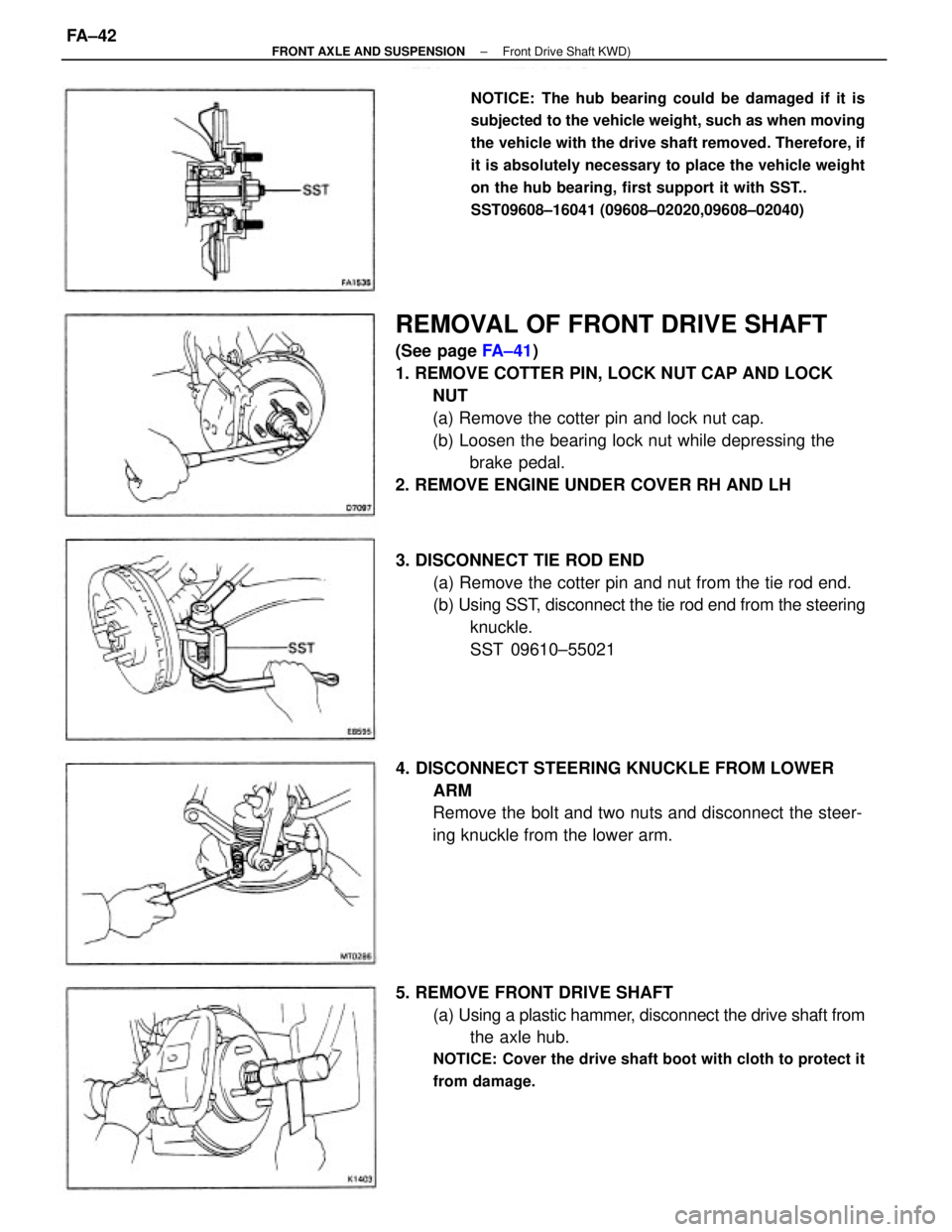
REMOVAL OF FRONT DRIVE SHAFT
(See page FA±41)
1. REMOVE COTTER PIN, LOCK NUT CAP AND LOCK
NUT
(a) Remove the cotter pin and lock nut cap.
(b) Loosen the bearing lock nut while depressing the
brake pedal.
2. REMOVE ENGINE UNDER COVER RH AND LH
3. DISCONNECT TIE ROD END
(a) Remove the cotter pin and nut from the tie rod end.
(b) Using SST, disconnect the tie rod end from the steering
knuckle.
SST 09610±55021
NOTICE: The hub bearing could be damaged if it is
subjected to the vehicle weight, such as when moving
the vehicle with the drive shaft removed. Therefore, if
it is absolutely necessary to place the vehicle weight
on the hub bearing, first support it with SST..
SST09608±16041 (09608±02020,09608±02040)
5. REMOVE FRONT DRIVE SHAFT
(a) Using a plastic hammer, disconnect the drive shaft from
the axle hub.
NOTICE: Cover the drive shaft boot with cloth to protect it
from damage.
4. DISCONNECT STEERING KNUCKLE FROM LOWER
ARM
Remove the bolt and two nuts and disconnect the steer-
ing knuckle from the lower arm.
± FRONT AXLE AND SUSPENSIONFront Drive Shaft KWD)FA±42
Page 1867 of 2389
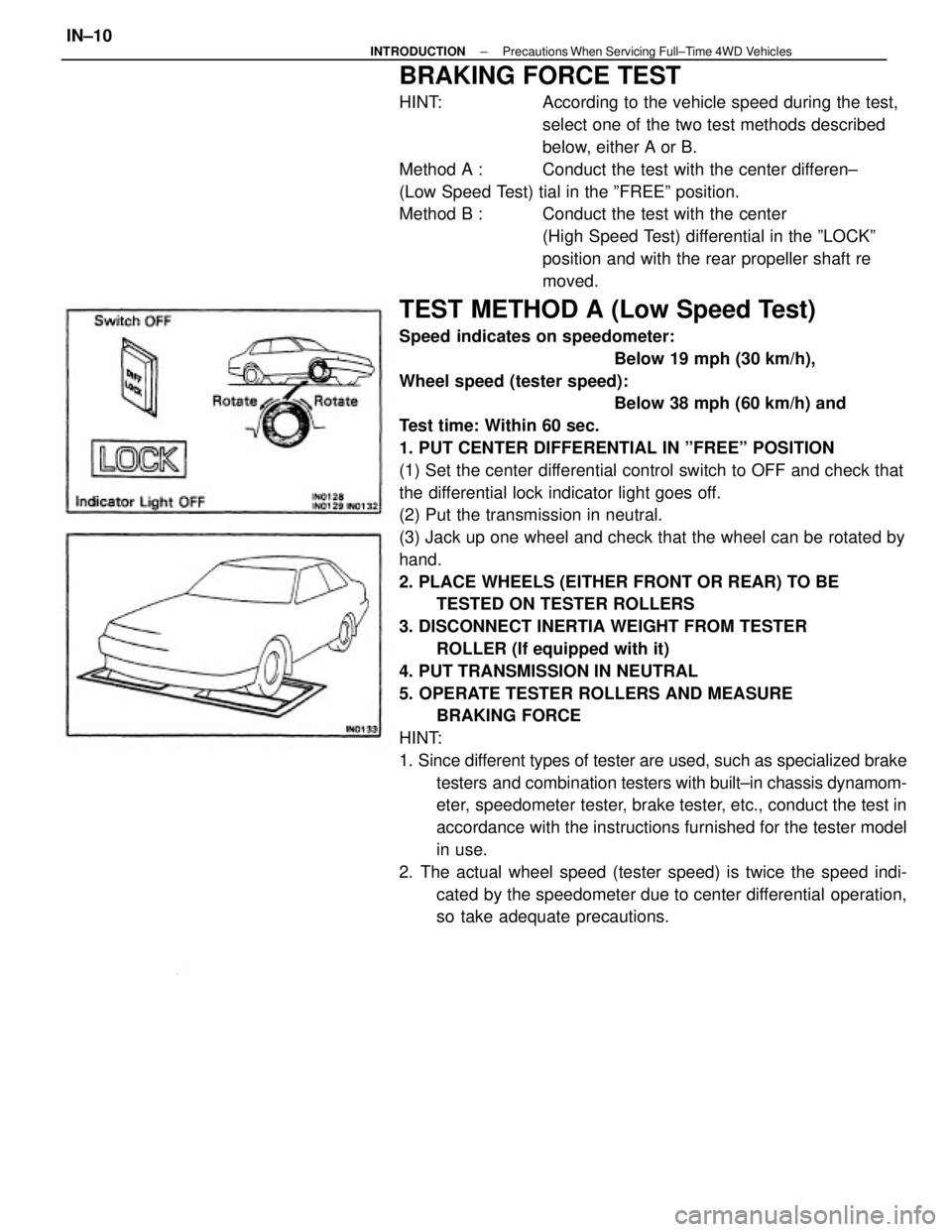
BRAKING FORCE TEST
HINT: According to the vehicle speed during the test,
select one of the two test methods described
below, either A or B.
Method A : Conduct the test with the center differen±
(Low Speed Test) tial in the ºFREEº position.
Method B : Conduct the test with the center
(High Speed Test) differential in the ºLOCKº
position and with the rear propeller shaft re
moved.
TEST METHOD A (Low Speed Test)
Speed indicates on speedometer:
Below 19 mph (30 km/h),
Wheel speed (tester speed):
Below 38 mph (60 km/h) and
Test time: Within 60 sec.
1. PUT CENTER DIFFERENTIAL IN ºFREEº POSITION
(1) Set the center differential control switch to OFF and check that
the differential lock indicator light goes off.
(2) Put the transmission in neutral.
(3) Jack up one wheel and check that the wheel can be rotated by
hand.
2. PLACE WHEELS (EITHER FRONT OR REAR) TO BE
TESTED ON TESTER ROLLERS
3. DISCONNECT INERTIA WEIGHT FROM TESTER
ROLLER (If equipped with it)
4. PUT TRANSMISSION IN NEUTRAL
5. OPERATE TESTER ROLLERS AND MEASURE
BRAKING FORCE
HINT:
1. Since different types of tester are used, such as specialized brake
testers and combination testers with built±in chassis dynamom-
eter, speedometer tester, brake tester, etc., conduct the test in
accordance with the instructions furnished for the tester model
in use.
2. The actual wheel speed (tester speed) is twice the speed indi-
cated by the speedometer due to center differential operation,
so take adequate precautions.
± INTRODUCTIONPrecautions When Servicing Full±Time 4WD VehiclesIN±10
Page 1868 of 2389
![TOYOTA CAMRY V20 1986 Service Information TEST METHOD B (High Speed Test)
[Vehicle speed: Over 38 mph (60 km/h)]
1. PUT CENTER DIFFERENTIAL IN ºLOCKº POSITION
(1) Set the center differential control switch to ON and
check that the different](/img/14/57449/w960_57449-1867.png "TOYOTA CAMRY V20 1986 Service Information TEST METHOD B (High Speed Test)
[Vehicle speed: Over 38 mph (60 km/h)]
1. PUT CENTER DIFFERENTIAL IN ºLOCKº POSITION
(1) Set the center differential control switch to ON and
check that the different")
TEST METHOD B (High Speed Test)
[Vehicle speed: Over 38 mph (60 km/h)]
1. PUT CENTER DIFFERENTIAL IN ºLOCKº POSITION
(1) Set the center differential control switch to ON and
check that the differential lock indicator light goes on.
HINT: If the indicator light does not go on when the
center differential control switch is turned on, move
the vehicle backward or forward slightly.
(2) Put the transmission in neutral.
(3) Jack up one wheel and check that the wheel cannot be
rotated by hand.
2. REMOVE REAR PROPELLER SHAFT
Make matching marks on each end of the rear propeller
shaft, then remove it.
3. PLACE WHEELS (EITHER FRONT OR REAR) TO BE
TESTED ON TESTER ROLLERS
4. DISCONNECT INERTIA WEIGHT FROM TESTER\ROLL-
ER (If equipped with it)
5. PUT TRANSMISSION IN NEUTRAL
6. OPERATE TESTER ROLLERS AND MEASURE
BRAKING FORCE
HINT: Since different types of tester are used, such as spe-
cialized brake testers and combination testers with
built±in chassis dynamometer, speedometer tester, brake
tester, etc., conduct the test in accordance with the instruc-
tions furnished for± the tester model in use.
7. INSTALL REAR PROPELLER SHAFT
Align the matching marks made on the rear propeller shaft
before removal, then install it.
8. SET CENTER DIFFERENTIAL CONTROL SWITCH TO
OFF
NOTE: If the indicator light does not go off when the center
differential control switch is turned off, move the vehicle
backward or forward slightly and check that the indicator light
goes off.
± INTRODUCTIONPrecautions When Servicing Full±Time 4WD VehiclesIN±11