cooling TOYOTA CELICA 1987 Service Repair Manual
[x] Cancel search | Manufacturer: TOYOTA, Model Year: 1987, Model line: CELICA, Model: TOYOTA CELICA 1987Pages: 346, PDF Size: 35.13 MB
Page 22 of 346
. .
co-2 COOLING SYSTEM - Description
,- I . . .
DESCRlqTlON
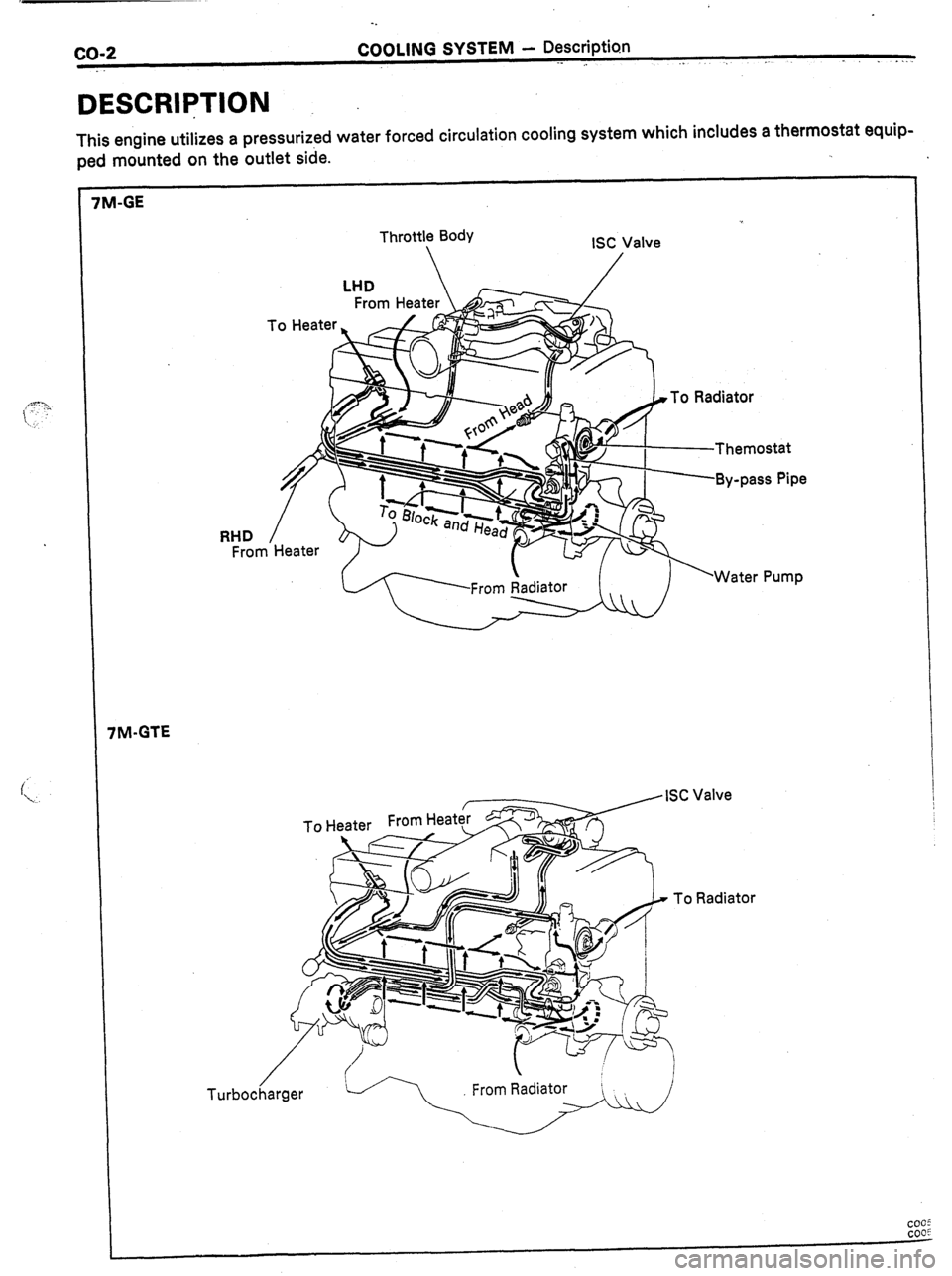
This engine utilizes a pressurized water forced circulation cooling system which includes a thermostat equip-
ped mounted on the outlet side.
5 7M-GE
Throttle Body
ISC Valve
/
To Radiator
RHD
/
From Heater
rM-GTE
/
To Heater From Heat: ISC Valve
To Radiator
COGS
COOF
Page 23 of 346
. COOLING SYSTEM - Description
co;3
RESERVOIR TANK
The reservoir tank is used to catch coolant
which overflows the cooling systein as a result of
volumetric expansion when the coolant is heated.
The coolant in the reservoir tank returns to the
radiator when the coolant temperature drops, thus
keeping the radiator full at all times and avoiding
needless coolant loss. Check the reservoir tank
level to learn if the coolant needs to be rep-
lenished.
WATER PUMP
The water pump is used for forced circulation of
coolant through the cooling system. It is mounted
on the front of the cylinder block and driven by a
V-ribbed belt,
THERMOSTAT I The cooling system is composed of the water
jacket (inside the cylinder block and cylinder head),
radiator, water pump, thermostat, cooling fan,
hoses and other components.
Coolant which is heated in the water
jacket is
pumped to the radiator, through which a cooling
fan blows air to cool the coolant as it passes
through. Coolant which has been cooled is then
sent back to the engine by the water pump, where
it cools the engine.
The water jacket is a network of channels in the
shell of the cylinder block and cylinder head
through which coolant passes. It is designed to
provide adequate cooling of the cylinders are com-
bustion chambers which become the hottest dur-
ing engine operation.
F(/ “ IATOR
The radiator performs the function of cooling
the coolant which has passed through the water
jacket and become hot, and is mounted in the front
of the vehicle. The radiator consists of an upper
tank and ‘lower tank, and a core which connects
the two tanks. The upper tank contains the inlet for
coolant from the water jacket and the filter inlet. It
also has a hose attached through which excess
coolant or steam can flow. The lower tank contains
the outlet for coolant and the drain cock. The core
contains many tubes through which coolant flows
from the upper tank to the lower tank as well as
cooling fins which radiate heat away from the coo-
lant in the tubes. The air sucked through the radia-
tor by cooling fan, as well as the wind generated
by the vehicle’s travel, passes through the radia-
tor, cooling it. Models with automatic transmission
incrl*-le an automatic transmission fluid cooler built
in:.
.le lower tank of the radiator.
RADIATOR CAP
The radiator cap is a pressure type can which
seals the radiator, resulting in pressurization of the
radiator as the coolant expands. The pressuriza-
tion prevents the coolant from boiling even when
the coolant temperature exceeds 100°C. A relief
valve (pressurization valve) and a vacuum valve
(negative pressure valve) are built into the radiator
zap. The relief valve opens and lets steam escape
:hrough the overflow pipe when the pressure
3enerated inside the cooling system exceeds the
imit (coolant temperature:
110 - 1 20°C, (230
- 248”F), pressure; 0.3 - 1 .O kg/cmz, (4.3 - 14.2
)si, 29.4 - 98.1 kPa). The vacuum valve opens to
3ljeviate the vacuum which develops in the coolant
system after the engine is stopped and the coolant
emperature drops. The valve’s opening allows the
)ressure in the cooling system to return to the
Qclant in the reservoir tank. The thermostat has a wax type and is mounted
in the. water outlet housing. The thermostat
includes a type of automatic valve operated by
fluctuations in the coolant temperature. This valve
closes when the coolant temperature drops, pre-
venting the circulation of coolant through the
engine and thus permitting the engine to warm up
rapidly. The valve opens when the coolant tem-
perature has risen, allowing the circulation of coo-
lant. Wax inside the thermostat expands when
heated and contracts when cooled. Heating the
wax thus generates pressure which overpowers
the force of the spring which keeps the valve
closed, thus opening the valve. When the wax
cools, its contraction causes the force of the
spring to take effect once more, closing the valve.
The thermostat in this engine operates at a tem-
perature of 88”C(19O”F).
I
I
Page 25 of 346
COOLING SYSTEM i Check and Replacement of Engine Coolant
co-5
._
CHECK AND REPLACEMENT OF
ENGINE COOLANT
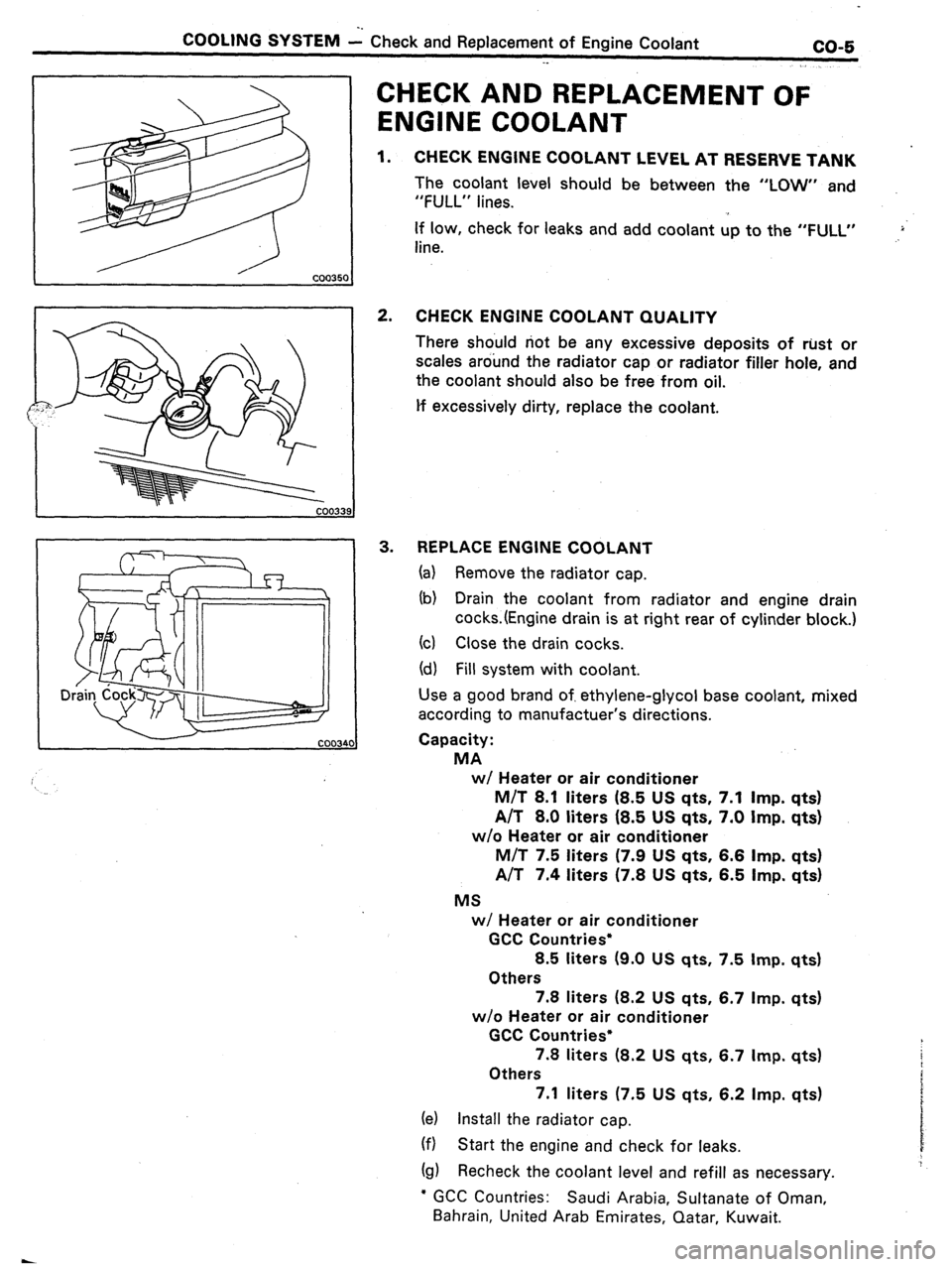
1. CHECK ENGINE COOLANT LEVEL AT RESERVE TANK
The coolant level should be between the “LOW” and
“FULL” lines.
If low, check for leaks and add coolant up to the “FULL”
line. .,>‘
2. CHECK ENGINE COOLANT QUALITY
There should not be any excessive deposits of rust or
scales around the radiator cap or radiator filler hole, and
the coolant should also be free from oil.
lf excessively dirty, replace the coolant.
3. REPLACE ENGINE COOLANT
(a) Remove the radiator cap.
(b) Drain the coolant from radiator and engine drain
cocks.(Engine drain is at right rear of cylinder block.)
(cl Close the drain cocks.
(d) Fill system with coolant.
Use a good brand of. ethylene-glycol base coolant, mixed
according to manufactuer’s directions.
Capacity:
MA
w/ Heater or air conditioner
M/T 8.1 liters (8.5 US qts. 7.1 Imp. qts)
A/T 8.0 liters (8.5 US qts, 7.0 Imp. qts)
w/o Heater or air conditioner
M/T 7.5 liters (7.9 US qts, 6.6
Imp. qts)
A/T 7.4 liters (7.8 US qts, 6.5 Imp. qts)
MS
w/ Heater or air conditioner
GCC Countries*
8.5 liters (9.0 US qts, 7.5 Imp. qts)
Others
7.8 liters (8.2 US qts, 6.7 Imp. qts)
w/o Heater or air conditioner
GCC Countries*
7.8 liters (8.2 US qts, 6.7 Imp. qts)
Others
7.1 liters (7.5 US qts, 6.2 Imp. qts)
(e) Install the radiator cap.
(f) Start the engine and check for leaks.
(g) Recheck the coolant level and refill as necessary.
l GCC Countries: Saudi Arabia, Sultanate of Oman,
Bahrain, United Arab Emirates, Qatar, Kuwait.
Page 28 of 346
CO-8 -. COOLING SYSTEM L Thermostat
._
Valve Lift
i
t-
THERMOSTAT
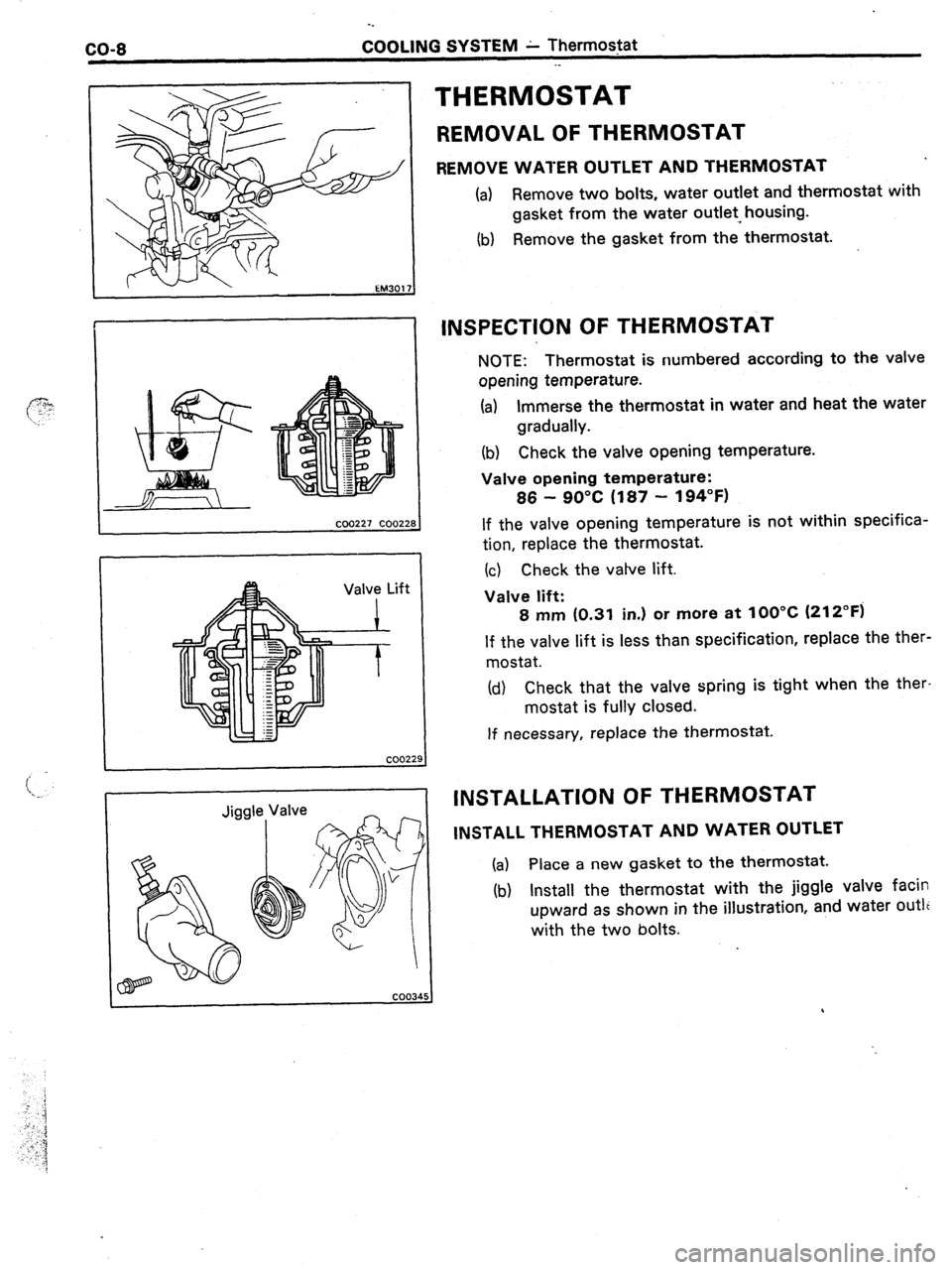
REMOVAL OF THERMOSTAT
REMOVE WATER OUTLET AND THERMOSTAT
(a) Remove two bolts, water outlet and thermostat with
gasket from the water outlet, housing.
(b) Remove the gasket from the thermostat.
INSPECTION OF THERMOSTAT
NOTE: Thermostat is numbered according to the valve
opening temperature.
(a)
Immerse the thermostat in water and heat the water
gradually.
(b)
Check the valve opening temperature.
Valve opening temperature:
86 - 90°C (187
- 194°F)
If the valve opening temperature is not within specifica-
tion, replace the thermostat.
(c) Check the vatve lift.
Valve lift:
8 mm (0.31 in.) or more at
100°C (212°F)
If the valve lift is less than specification, replace the ther-
mostat.
(d) Check that the valve spring is tight when the ther-
mostat is fully closed.
If necessary, replace the thermostat.
INSTALLATION OF THERMOSTAT
INSTALL THERMOSTAT AND WATER OUTLET
(a) Place a new gasket to the thermostat.
(b) Install the thermostat with the jiggle valve facin
upward as shown in the illustration, and water outlc
with the two bolts.
,
Page 29 of 346
COOLING SYSTEM - Radiator
-,... ~‘e:,.,,’ _,
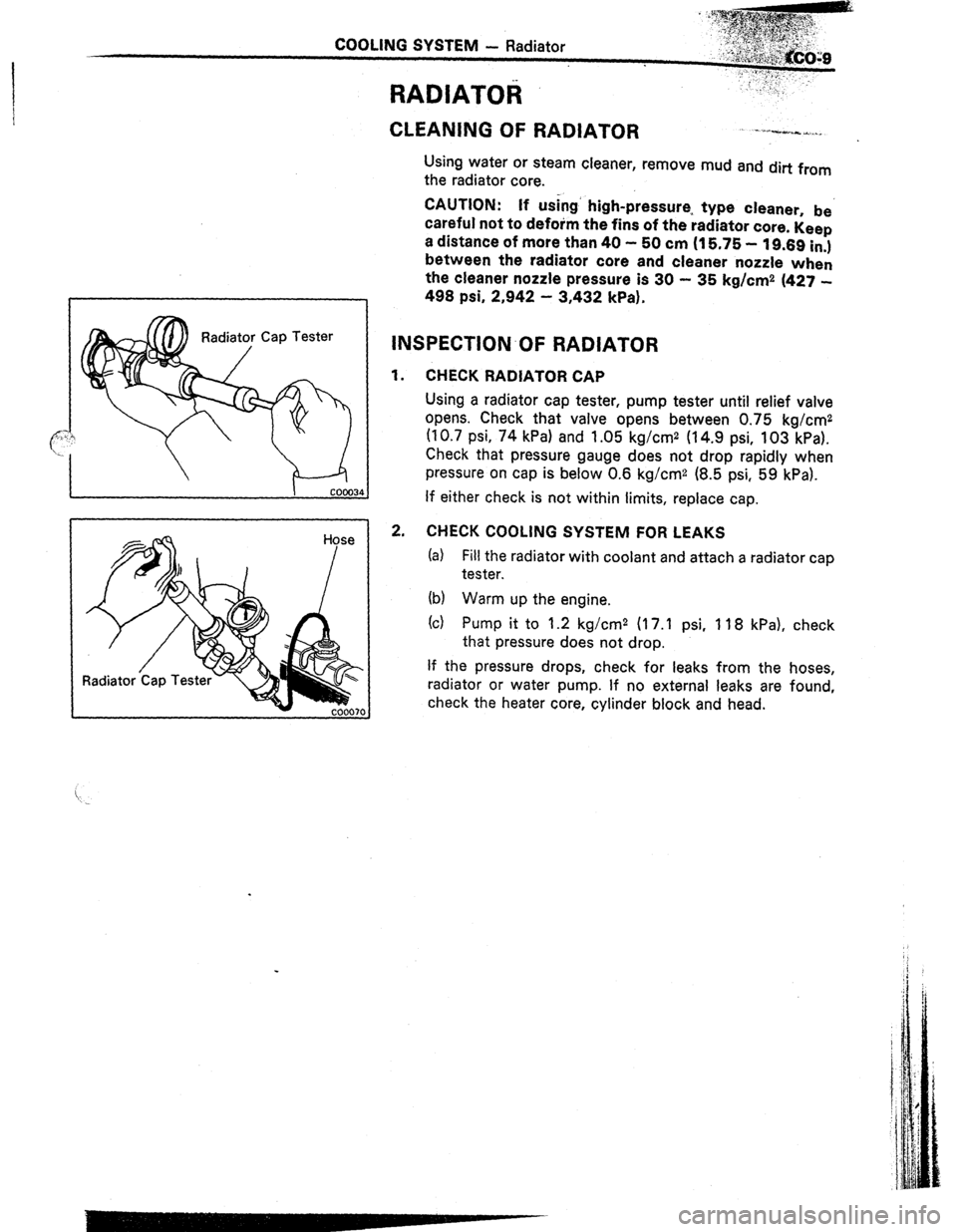
CLEANING OF RADIATOR _ ---w..w- -...,.
Using water or steam cleaner, remove mud and dirt from
the radiator core.
CAUTION: If using’ high-pressure, type cleaner, be
careful not to deform the fins of the radiator core. Keep
a distance of more than 40 - 50 cm (15.75 - 19.69 in.)
between the radiator core and cleaner nozzle when
the cleaner nozzle pressure is 30 - 35 kg/cm2 (427 -
1
498 psi, 2,942 - 3,432 kPa1.
I lNSPECTlON.OF RADIATOR
t 1. CHECK RADIATOR CAP
Using a radiator cap tester, pump tester until relief valve
opens. Check that valve opens between 0.75 kg/cm2
(10.7 psi, 74 kPa) and 1.05 kg/cm2 (14.9 psi, 103 kPa).
Check that pressure gauge does not drop rapidly when
pressure on cap is below 0.6 kg/cm2 (8.5 psi, 59 kPa).
!J If either check is not within limits, replace cap.
1 2. CHECK COOLING SYSTEM FOR LEAKS
(a) Fill the radiator with coolant and attach a radiator cap
tester.
(b) Warm up the engine.
(c) Pump it to 1.2 kg/cm2 117.1 psi, 118 kPa), check
that pressure does not drop.
If the pressure drops, check for leaks from the hoses,
radiator or water pump. If no external
leaks are found,
check the heater core, cylinder block
and head.
Page 30 of 346
CO-IO
-.
COOLING SYSTEM - Radiatpr
. .
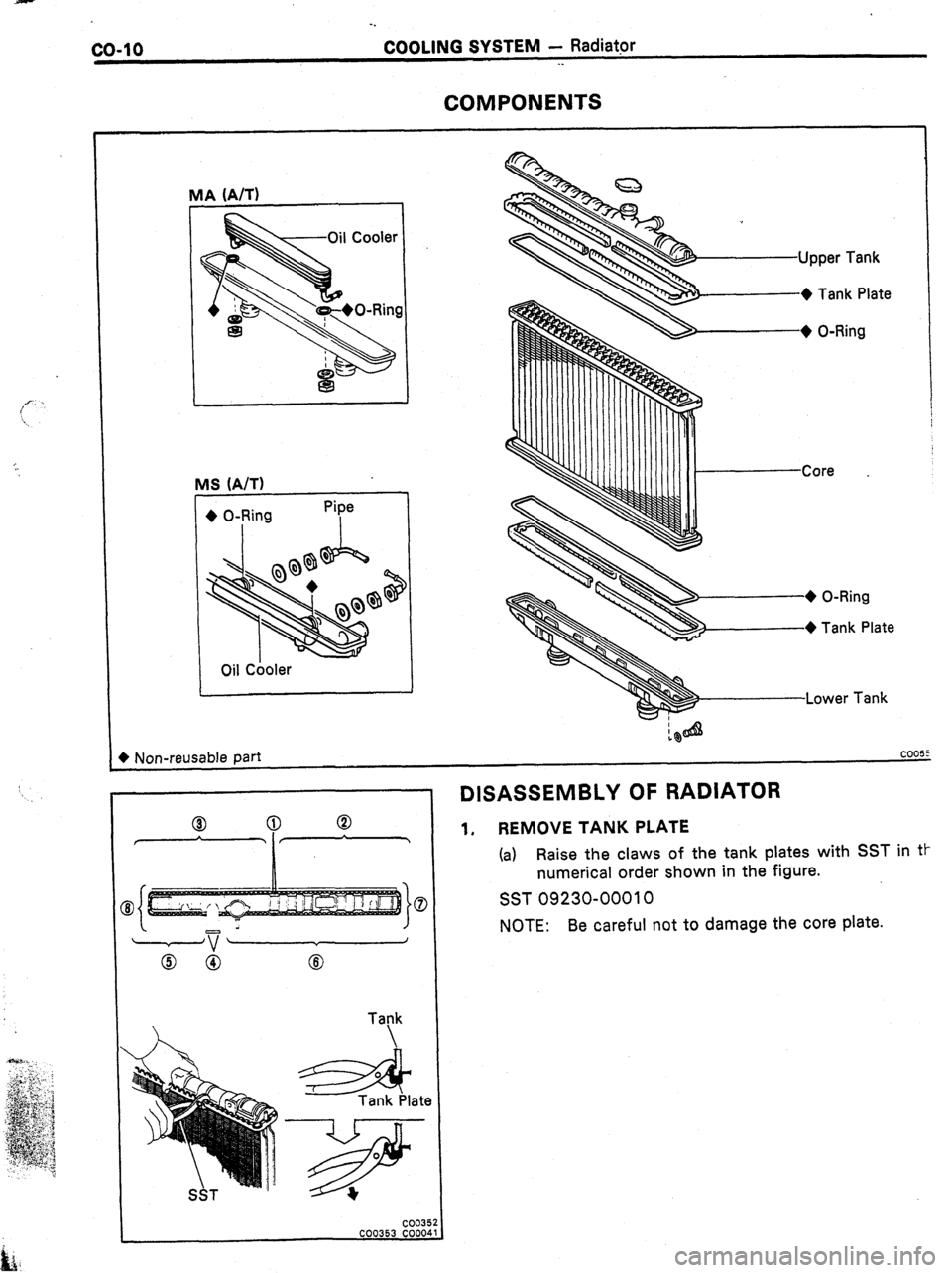
COMPONENTS
IA (A/T)
MS (A/T)
+ O-Ring
I
Oil Cooler Pipe
I
1
Upper Tank
-+ Tank Plate
,+ 0-Rina
I I I I
I I I I I I I I I I I ICore
Lower
Tank
+ Non-reusable part
coo55
SST - I
DISASSEMBLY OF RADIATOR
1. REMOVE TANK PLATE
(a)
Raise the claws of the tank plates with SST in tt-
numerical order shown in the figure.
SST 09230-00010
NOTE:
Be careful not to damage the core plate.
Page 31 of 346
COOLING SYSTEM - Radhtor co-11
Tank
O-Ring
Core
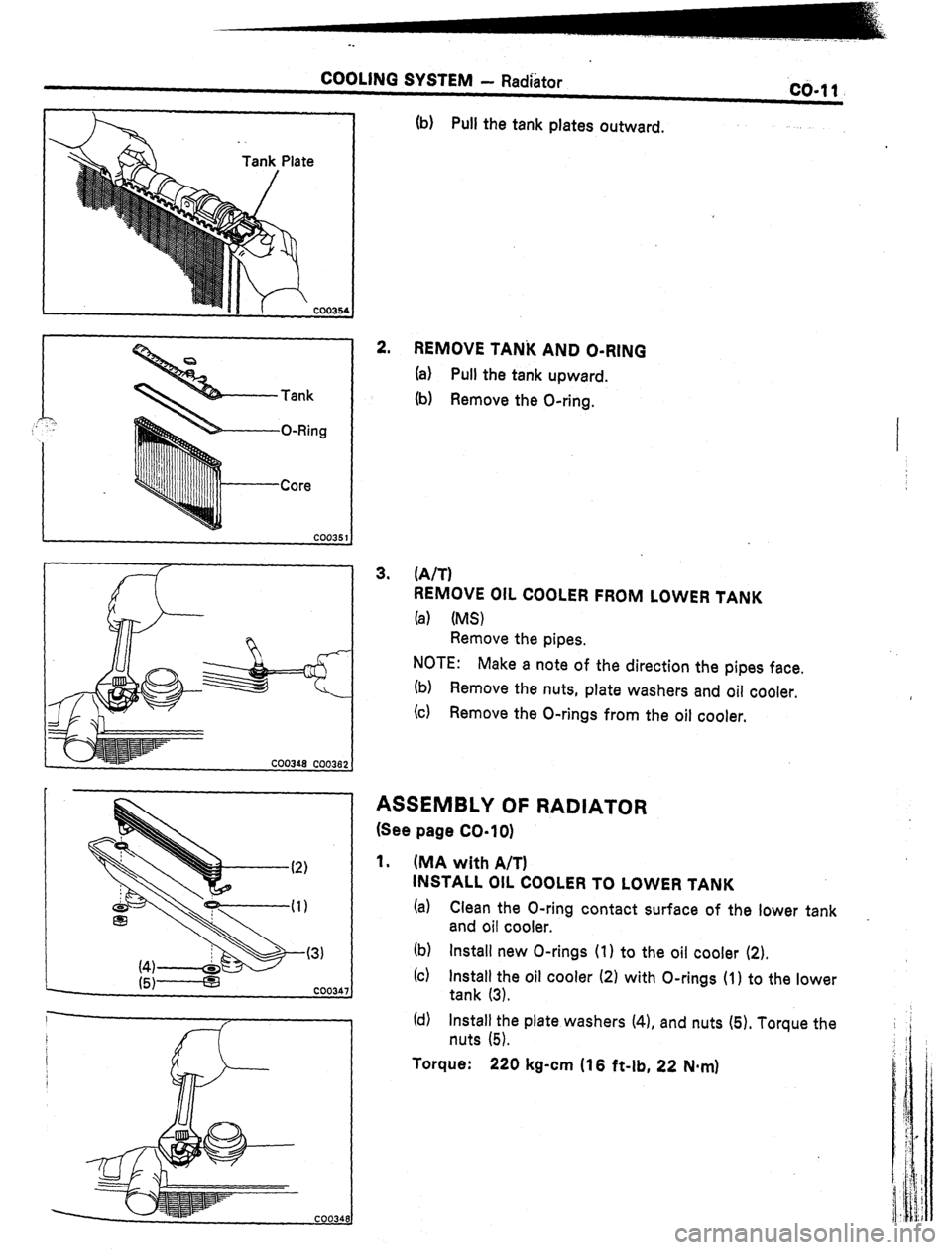
(b) Pull the tank plates outward.
2.
REMOVE TANi( AND O-RING
(a) Pull the tank upward.
(b) Remove the O-ring.
3. (A/T)
REMOVE OIL COOLER FROM LOWER TANK
(a) (MS)
Remove the pipes.
NOTE:
Make a note of the direction the pipes face.
(b) Remove the nuts, plate washers and oil cooler.
(c) Remove the O-rings from the oil cooler.
ASSEMBLY OF RADIATOR
(See page CO-lo)
1. (MA with A/T)
INSTALL OIL COOLER TO LOWER TANK
(a) Clean the O-ring contact surface of the lower tank
and oil cooler. _
(b) Install new O-rings (1) to the oil cooler (2).
(c) Install the oil cooler (2) with O-rings (1) to the lower
tank (3).
(d) Install the plate washers (4). and nuts (5). Torque the
nuts (5).
Torque: 220 kg-cm (16 f&lb, 22 Nqn)
Page 32 of 346
-.
COOLING SYSTEM - Radiator
.
ore
Plate
Core plate
XTwisteq
XTwistedl
- 2755:
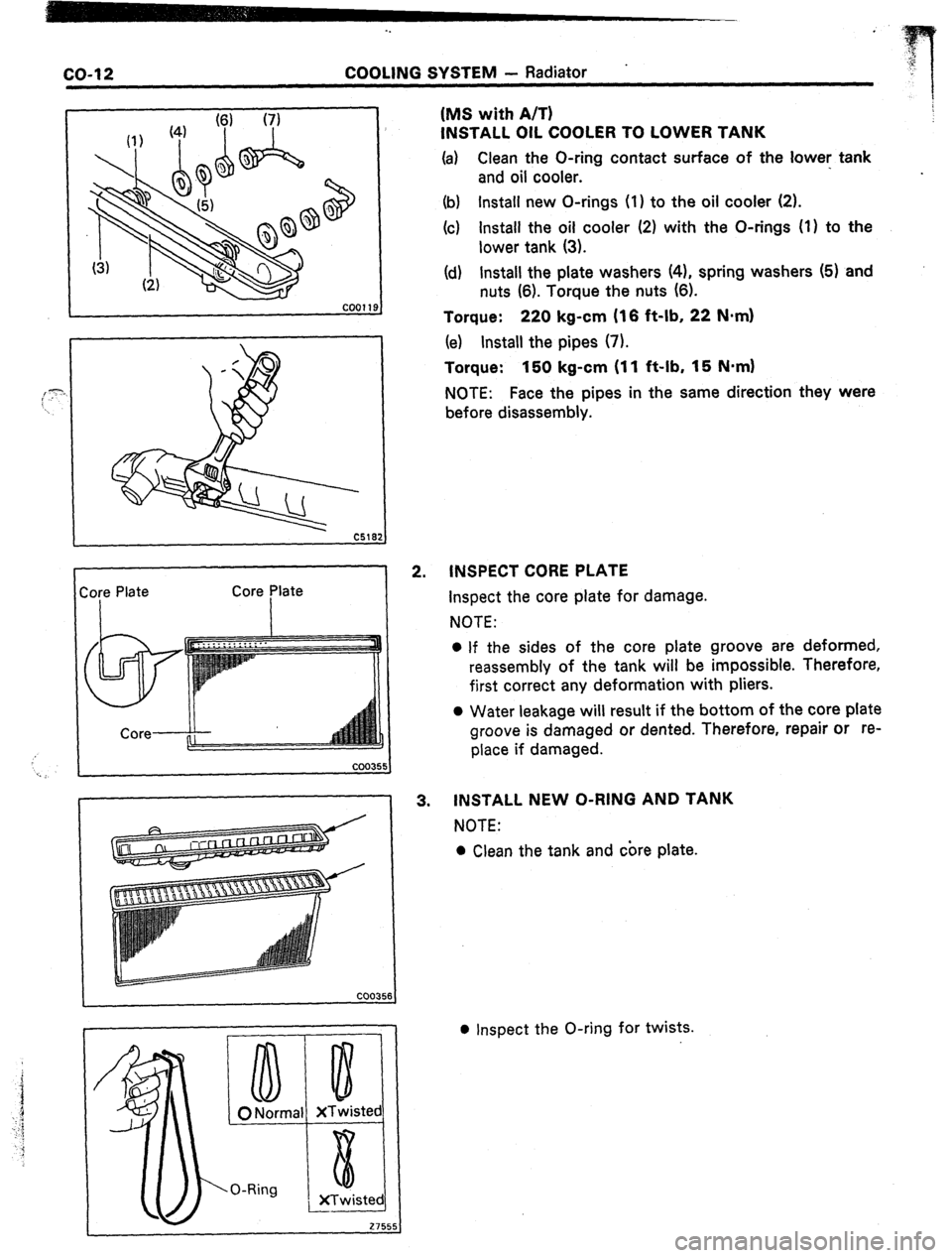
2. (MS with A/T)
INSTALL OIL COOLER TO LOWER TANK
(a)
Clean the O-ring contact surface of the
lower: tank
and oil cooler.
(b) Install new O-rings (1) to the oil cooler (2).
(c) Install the oil cooler (2) with the O-rings (1) to the
lower tank (3).
(d) Install the plate washers (41, spring washers (5) and
nuts (6). Torque the nuts (6).
Torque: 220 kg-cm (16 ft-lb, 22 N*m)
(e) Install the pipes (7).
Torque: 150 kg-cm (11 ft-lb, 15 N.mI
NOTE: Face the pipes in the same direction they were
before disassembly.
INSPECT CORE PLATE
Inspect the core plate for damage.
NOTE:
l If the sides of the core plate groove are deformed,
reassembly of the tank will be impossible. Therefore,
first correct any deformation with pliers.
0 Water leakage will result if the bottom of the core plate
groove is damaged or dented. Therefore, repair or re-
place if damaged.
3. INSTALL NEW O-RING AND TANK
NOTE:
l Clean the tank and core plate.
l Inspect the O-ring for twists.
Page 166 of 346
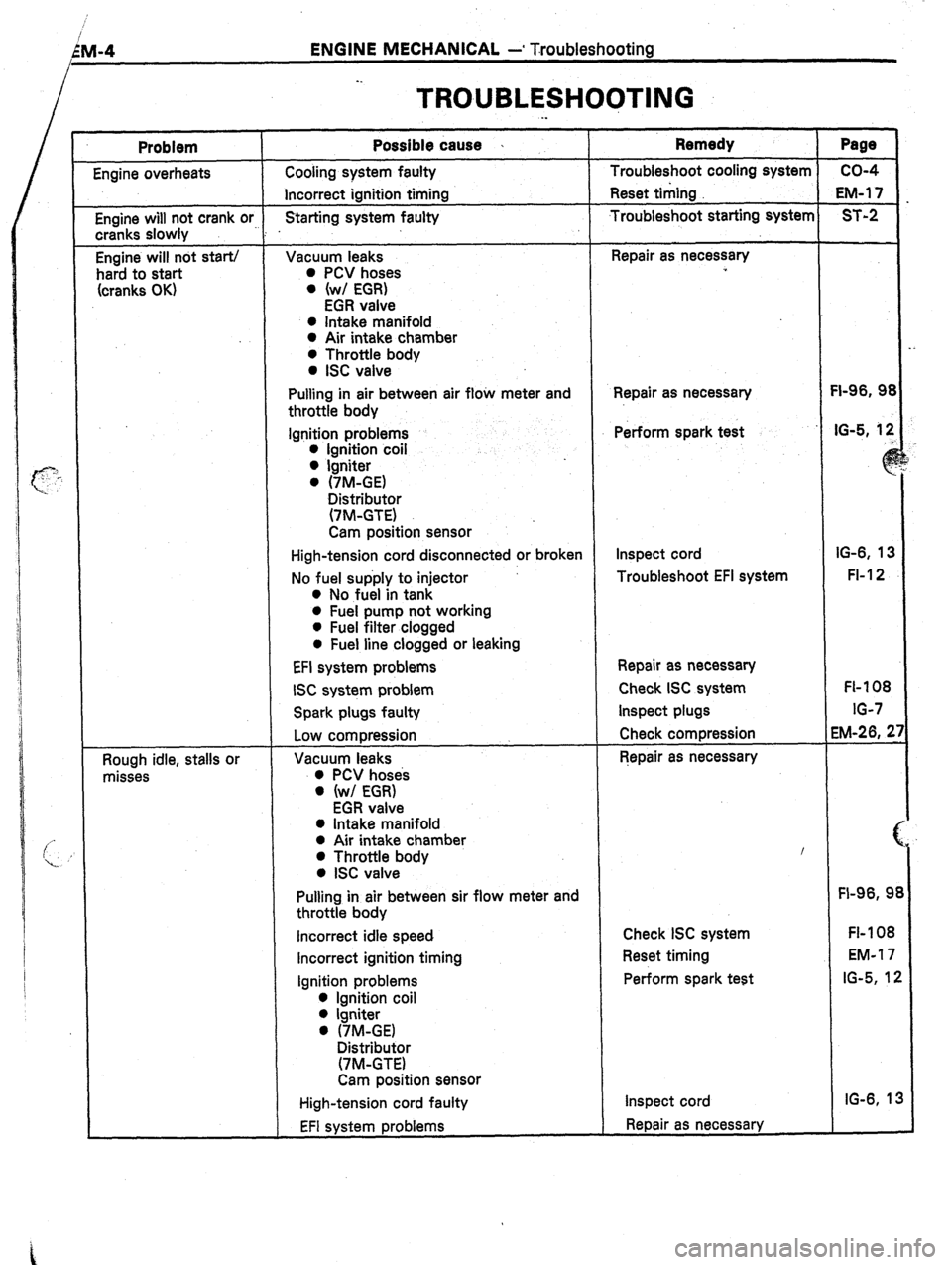
LM-4
I ENGINE MECHANICAL -* Troubleshooting
_.
TROUBLESHOOTING
Problem Possible cause I Remedy Page
Engine overheats Cooling system faulty Troubleshoot cooling system co-4
Incorrect ignition timing Reset timing EM-1 7
Engine will not crank or Starting system faulty Troubleshoot starting system ST-2
cranks slowly : .
Engine will not start/ Vacuum leaks Repair as necessary
hard to start 0 PCV hoses ”
(cranks OK) 0 (w/ EGR)
EGR valve
0 Intake manifold
0 Air intake chamber
0 Throttle body
0 ISC valve
Pulling in air between air flow meter and Repair as necessary FI-96, 93
throttle body
Ignition problems Perform spark test IG-5, 12
0 Ignition coil
0 Igniter
0 (7M-GE)
Distributor
(7M-GTE)
Cam position sensor
High-tension cord disconnected or broken Inspect cord IG-6, 13
No fuel supply to injector Troubleshoot EFI system FI-I 2
l No fuel in tank
0 Fuel pump not working
l Fuel filter clogged
0 Fuel line clogged or leaking
EFI system problems Repair as necessary
ISC system problem Check ISC system FL- 108
Spark plugs faulty Inspect plugs IG-7
Low compression Check compression EM-26, 2
Rough idle, stalls or Vacuum leaks Repair as necessary
misses 0 PCV hoses
0 (w/ EGR)
EGR valve
0 Intake manifold
0 Air intake chamber
0 Throttle body I
0 ISC valve
Pulling in air between sir flow meter and FI-96, 9
throttle body
Incorrect idle speed Check ISC system FI- 108
Incorrect ignition timing Reset timing EM-1 7
Ignition problems Perform spark test IG-5, 12
0 Ignition coil
0 Igniter
0 (-/M-GE)
Distributor
(-/M-GTE)
Cam position sensor
High-tension cord faulty Inspect cord IG-6, 13
EFI system problems Repair as necessary
Page 167 of 346
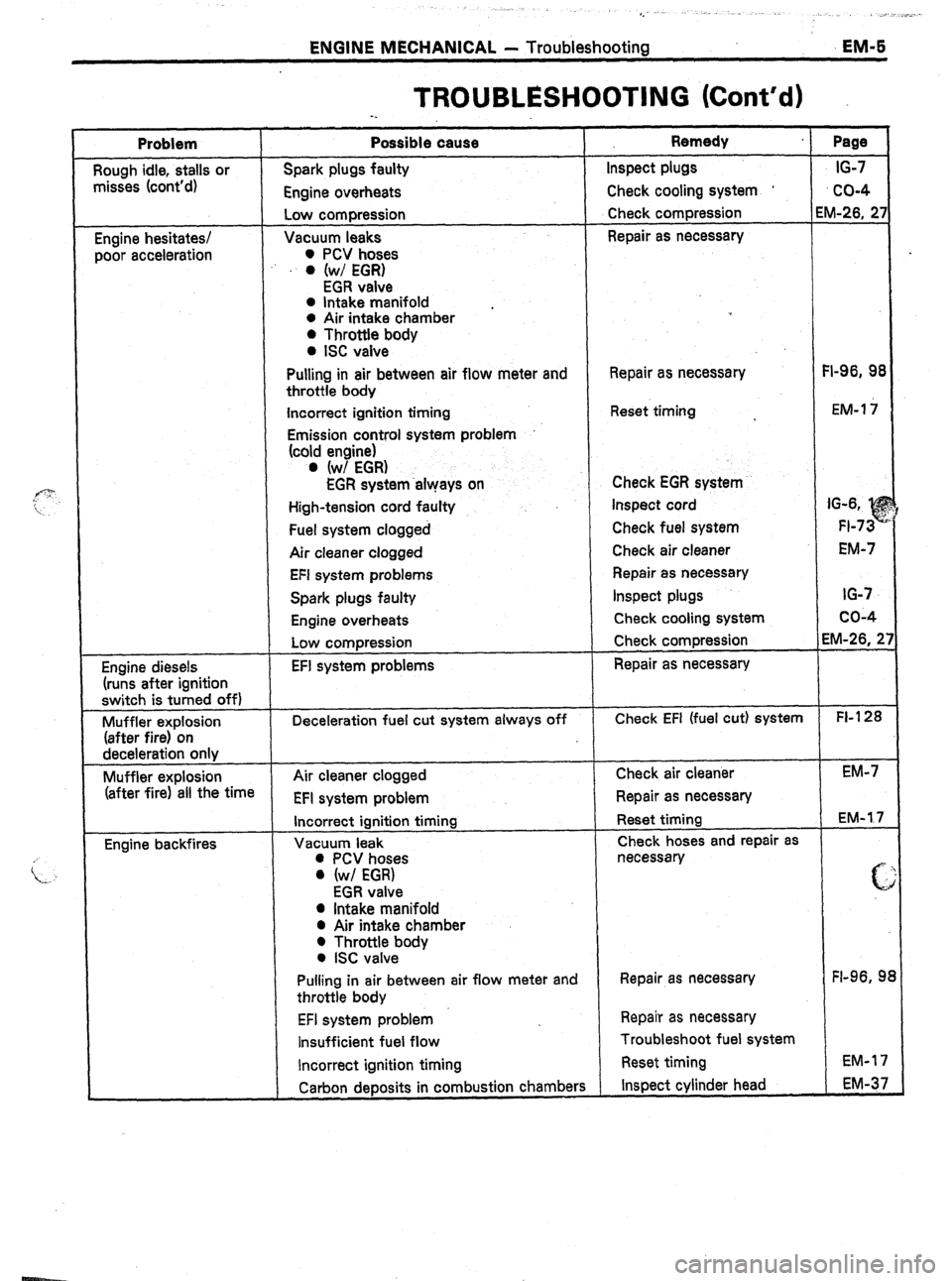
ENGtNE MECHANKAL - Troubleshootinn EM-S
TROUBLESHOOTING (Cont’d)
-.
Problem Possible cause Remedy Page
sough idle, stalls or Spark plugs faulty Inspect plugs IG-7
misses (cont’d)
Engine overheats Check cooling system ’ co-4
Low compression Check compression EM-26, 2;
Engine hesitates/ Vacuum leaks Repair as necessary
poor acceleration 0 PCV hoses
. (w/ EGR)
EGR valve
0 Intake manifold
’ 0 Air intake chamber .c
0 Throttle body
0 ISC valve
Pulling in air between air flow meter and Repair as necessary FI-96, 96
throttle body
Incorrect ignition timing Reset timing _ EM-1 7
Emission control system problem
(cold engine)
0 (w/ EGR)
EGR system always on Check EGR system
High-tension cord faulty Inspect cord 1G-6,
Fuel system clogged Check fuel system FI-7
Air cleaner clogged Check air cleaner EM-7
EFI system problems Repair as necessary
Spark plugs faulty Inspect plugs IG-7
Engine overheats Check cooling system co-4
Low compression Check compression EM-26, 2
Engine diesels EFI system problems Repair as necessary
(runs after ignition
switch is turned off)
Muffler explosion Deceleration fuel cut system always off Check EFI (fuel cut) system FI-128
(after fire) on
deceleration only
Muffler explosion Air cleaner clogged Check air cleaner EM-7
(after fire) all the time
EFI system problem Repair as necessary
incorrect ignition timing Reset timing EM-l.7
Engine backfires Vacuum leak Check hoses and repair as
l PCV hoses necessary
. (w/ EGR)
EGR valve c
0 Intake manifold
0 Air intake chamber
l Throttle body
0 ISC valve
Pulling in air between air flow meter and Repair as necessary Fl-96, 91
throttle body
EFI system problem Repair as necessary
Insufficient fuel flow Troubleshoot fuel system
Incorrect ignition timing Reset timing EM-l 7
Carbon deposits in combustion chambers Inspect cylinder head EM-97