spark plugs replace TOYOTA CELICA 1987 Service Repair Manual
[x] Cancel search | Manufacturer: TOYOTA, Model Year: 1987, Model line: CELICA, Model: TOYOTA CELICA 1987Pages: 346, PDF Size: 35.13 MB
Page 50 of 346
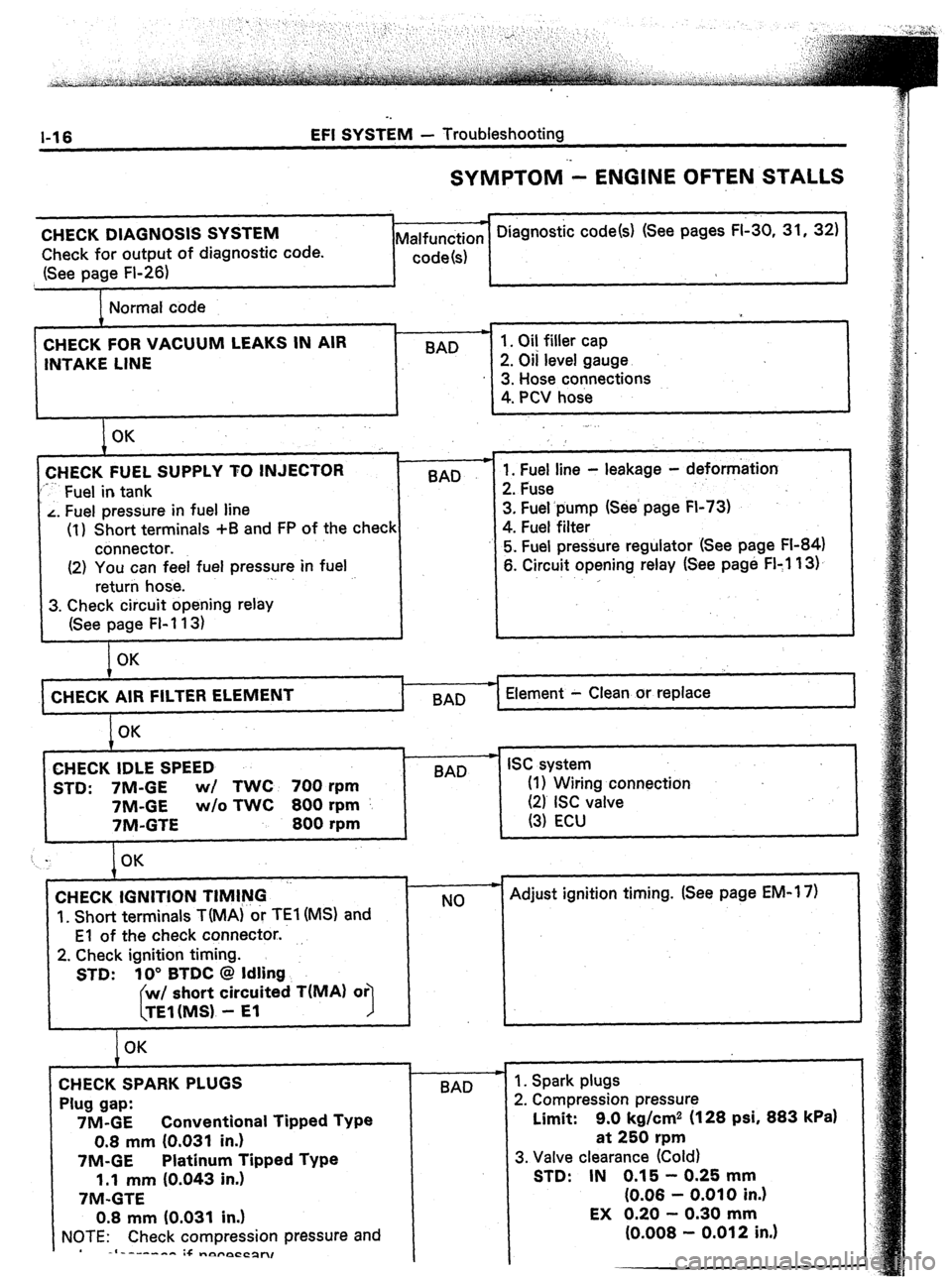
l-16 EFI SYSTEM - Troubleshooting
SYMPTOM - ENGINE OFTEN STALLS
CHECK DIAGNOSIS SYSTEM
Check for output of diagnostic code.
(See page Fl-26) * Diagnostic code(s) (See pages FI-30, 31, 32)
Malfunction
code(s)
Normal code
CHECK FOR VACUUM LEAKS IN AIR
INTAKE LINE BAD 1. Oil filler cap
2. Oil level gauge
3. Hose connections
4. PCV hose
I OK
CHECK FUEL SUPPLY TO INJECTOR
‘*-- Fuel in tank BAD
L. Fuel pressure in fuel line
(1) Short terminals +B and FP of the check
connector.
(2) You can feel fuel pressure in fuel
return hose. .
3. Check circuit opening relay
(See page FI-113) .
1. Fuel line - leakage - deformation
2. Fuse
3. Fuel.pump (See’ page FI-73)
4. Fuel filter
5. Fuel pressure regulator (See page FI-84)
6. Circuit opening relay (See page FI:1 13).
,
OK
CHECK AIR FILTER
I BAD Element - Clean or replace
OK
CHECK IDLE SPEED
STD: 7M-GE wl TWC 700 rpm
7M-GE w/o TWC 800 rpm
7M-GTE 800 rpm
t w
BAD ISC system
(I 1 Wiring connection
(21 ISC valve
(3) ECU
CHECK IGNITION TIMING ‘-
‘I. Short terminals TiMA) or TEl (MS) and
El of the check connector..
2. Check ignition timing.
STD: 10” BTDC @ Idling
short circuited T(MA) or
1
OK
CHECK SPARK PLUGS
Plug gap:
7M-GE Conventional Tipped Type
0.8 mm (0.031 in.)
7M-GE Platinum Tipped Type
1.1 mm (0.043 in.)
7M-GTE
0.8 mm (0.031 in.)
NOTE: Check compression pressure and
-I------- :+ -nyrpCCpn, c
NO
-I-
BAD - Adjust ignition timing. (See page EM-1 7)
1. Spark plugs
2. Compression pressure
Limit: 9.0 kg/cm2 (128 psi, 883
kPa)
at 250 rpm
3. Valve clearance (Cold)
STD: IN 0.15 - 0.25 mm
(0.06 - 0.010 in.)
Page 52 of 346
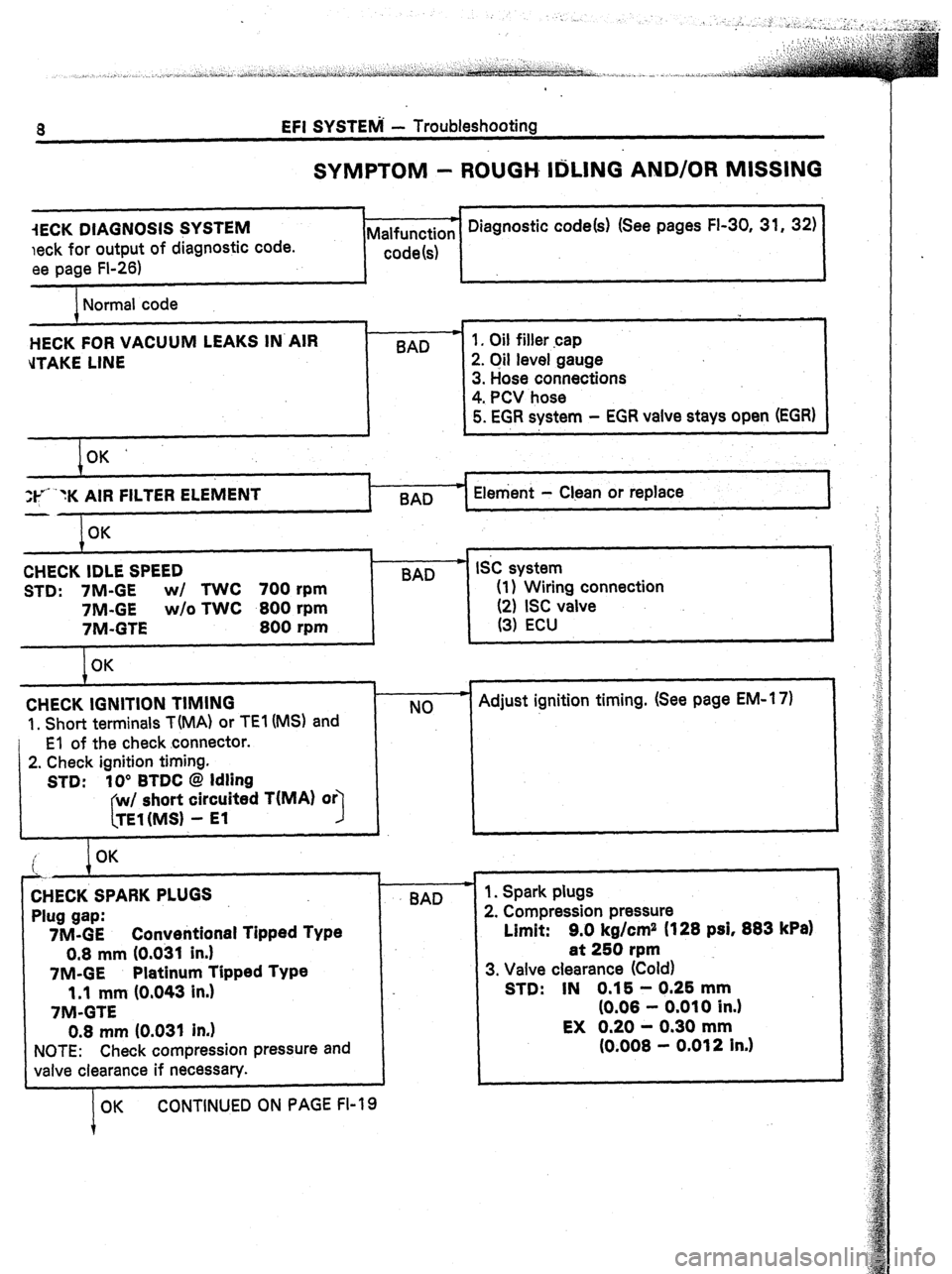
a EFI SYSTEM - Troubleshooting
SYMPTOM - ROUGH IrIiLlNG AND/OR MISSING
iECK DIAGNOSIS SYSTEM
leek for output of diagnostic code.
ee page FI-26)
1 -c Diagnostic code(s) (See pages FI-30, 31, 32)
Malfunction
code(s)
Normal code
HECK FOR VACUUM LEAKS IN’AIR
d-FAKE LINE
I OK’
If* “K AIR FILTER
ELEMENT Element - Clean or replace
I
I 1, Oil filler cap
2. Oil level gauge
3. Hose connections
4. PCV hose
5. EGR system - EGR vaive stays open (EGR)
OK
CHECK IDLE SPEED
STD: 7M-GE w/ TWC 700 rpm
7M-GE w/o TWC 800 rpm
7M-GTE
800 rpm
OK
,
BAD SC system
(1) Wiring connection
(2) ISC valve
(3) ECU
CHECK IGNITION TIMING
1, Short terminals T(MA) or TEI (MS) and
El of the check connector.
2. Check ignition timing.
STD: IO” BTDC @ Idling
w/ short circuited T(MA)
I TEl(MS1 - El NO F Adjust ignition timing. (See page EM-l 7)
i OK
‘.
7
I
CHECK SPARK PLUGS
Plug gap:
7M-GE Converitional Tipped Type
0.8 mm (0.031 in.)
7M-GE Platinum Tipped Type
1.1 mm (0,043 in.)
7M-GTE
0.8 mm (0.031 in.)
NOTE: Check compression pressure and
valve clearance if necessary.
OK CONTINUED ON PAGE FI-19 BAD 1. Spark plugs
2. Compression pressure
Limit: 9.0 kg/cm2 (128 psi, 883
kPa)
at 250 rpm
3. Valve clearance (Cold)
STD: IN 0.15 - 0.25 mm
(0.08 - 0.010 in.)
EX 0.20 - 0.30 mm
(0.008 - 0.012 in.)
Page 165 of 346
ENGINE MECHANICAL -, Description
EM-3
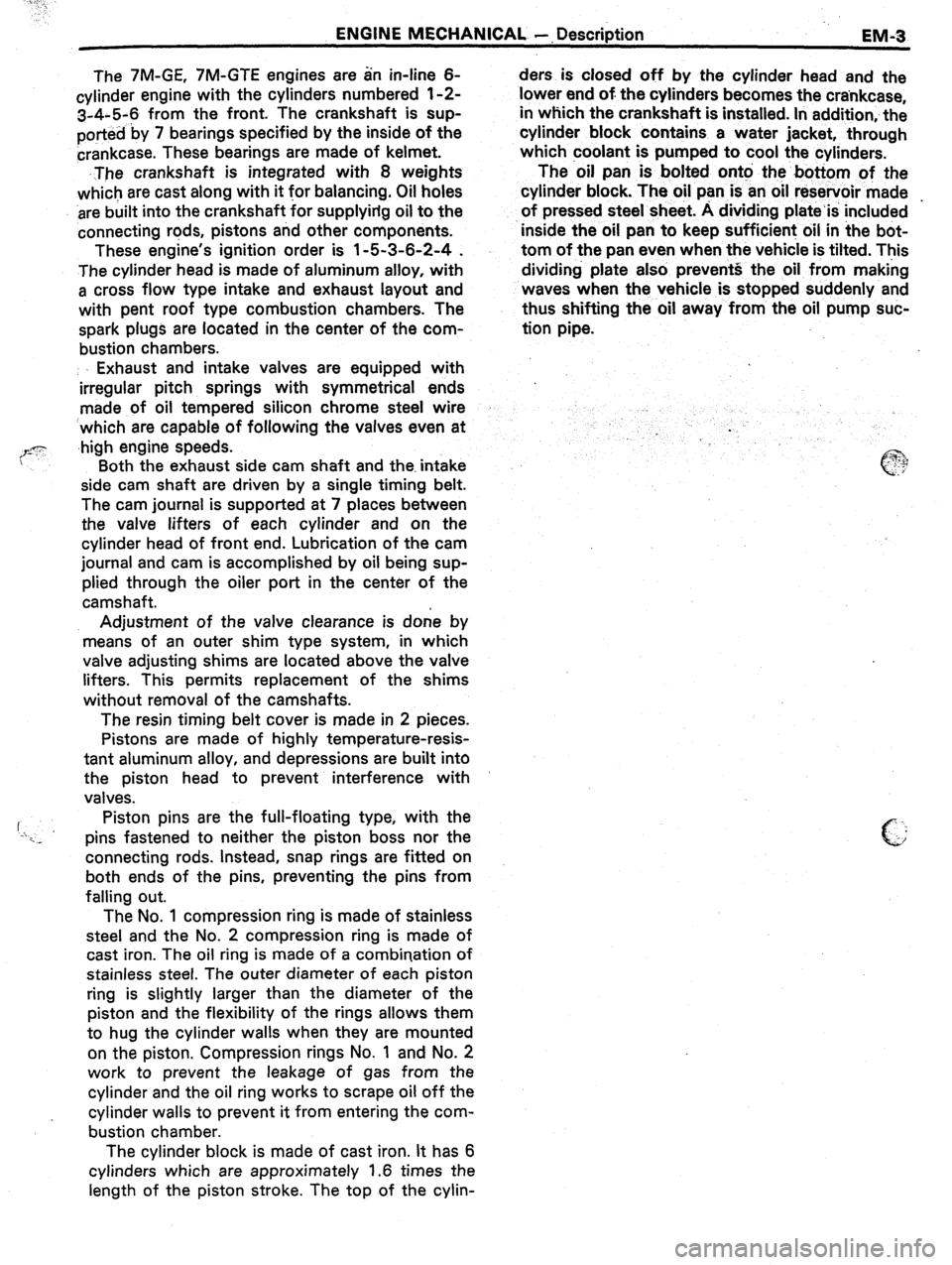
The 7M-GE, 7M-GTE engines are an in-line 6-
cylinder engine with the cylinders numbered l-2-
3-4-5-6 from the front. The crankshaft is sup-
ported by 7 bearings specified by the inside of the
crankcase. These bearings are made of kelmet.
.The crankshaft is integrated with 8 weights
which are cast along with it for balancing. Oil holes
‘are built into the crankshaft for supplying oil to the
connecting rods, pistons and other components.
These engine’s ignition order is l-5-3-6-2-4 .
The cylinder head is made of aluminum alloy, with
a cross flow type intake and exhaust layout and
with pent roof type combustion chambers. The
spark plugs are located in the center of the com-
bustion chambers.
Exhaust and intake valves are equipped with
irregular pitch springs with symmetrical ends
made of oil tempered silicon chrome steel wire
which are capable of following the valves even at
,high engine speeds.
Both the exhaust side cam shaft and the. intake
side cam shaft are driven by a single timing belt.
The cam journal is supported at 7 places between
the valve lifters of each cylinder and on the
cylinder head of front end. Lubrication of the cam
journal and cam is accomplished by oil being sup-
plied through the oiler port in the center of the
camshaft.
Adjustment of the valve clearance is done by
means of an outer shim type system, in which
valve adjusting shims are located above the valve
lifters. This permits replacement of the shims
without removal of the camshafts.
The resin timing belt cover is made in 2 pieces.
Pistons are made of highly temperature-resis-
tant aluminum alloy, and depressions are built into
the piston head to prevent interference with
valves.
Piston pins are the full-floating type, with the
pins fastened to neither the piston boss nor the
connecting rods. Instead, snap rings are fitted on
both ends of the pins, preventing the pins from
falling out.
The No. 1 compression ring is made of stainless
steel and the No. 2 compression ring is made of
cast iron. The oil ring is made of a combination of
stainless steel. The outer diameter of each piston
ring is slightly larger than the diameter of the
piston
and the flexibility of the rings allows them
to hug the cylinder walls when they are mounted
on the piston. Compression rings No. 1 and No. 2
work to prevent the leakage of gas from the
cylinder and the oil ring works to scrape oil off the
cylinder walls to prevent it from entering the com-
bustion chamber.
The cylinder block is made of cast iron. It has 6
cylinders which are approximately 1.6 times the
length of the piston stroke. The top of the cylin- ders is closed off by the cylinder head and the
lower end of the cylinders becomes the crankcase,
in which the crankshaft is installed. In addition,- the
cylinder block contains a water jacket, through
which coolant is pumped to cool the cylinders.
The .oil pan is bolted onto the botiom of the
cylinder block. The oil pan is an oil reservoir made .
of pressed steel sheet. A dividing plate’is included
-inside the oil pan to keep sufficient oil in the bot-
tom of the pan even when the vehicle is tilted. This
dividing plate also prevent5 the oil from making
waves when the vehicle is stopped suddenly and
thus shifting the oil away from the oil pump suc-
tion pipe.
Page 260 of 346
IGNlTliiN SYSTEM - On-Vehicle Inspection (7M-GE)
It059 ‘6
IG059
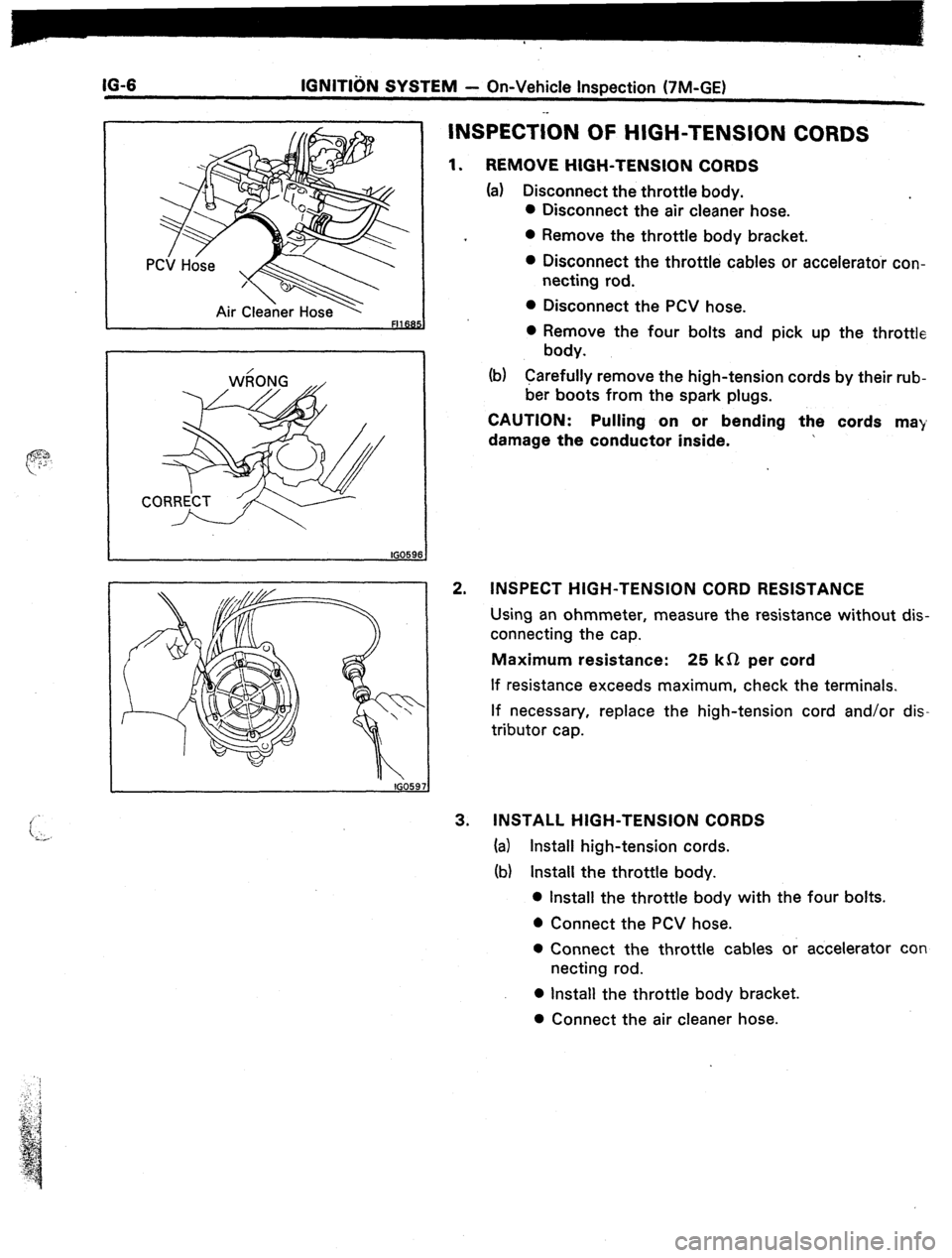
INSPECTiON OF HIGH-TENSION CORDS
1. REMOVE HIGH-TENSION CORDS
(a) Disconnect the throttle body.
l Disconnect the air cleaner hose.
l Remove the throttle body bracket.
0 Disconnect the throttle cables or accelerator con-
necting rod.
l Disconnect the PCV hose.
0 Remove the four bolts and pick up the throttle
body.
(b) Carefully remove the high-tension cords by their rub-
ber boots from the spark plugs.
CAUTION: Pulling on or bending the cords ma)
damage the conductor inside.
2. INSPECT HIGH-TENSION CORD RESISTANCE
Using an ohmmeter, measure the resistance without dis-
connecting the cap.
Maximum resistance: 25 kS2 per cord
If resistance exceeds maximum, check the terminals.
If necessary, replace the high-tension cord and/or dis-
tributor cap.
3. INSTALL HIGH-TENSION CORDS
(a) Install high-tension cords.
(b) Install the throttle body.
l Install the throttle body with the four bolts.
l Connect the PCV hose.
0 Connect the throttle cables or accelerator con
netting rod.
l Install the throttle body bracket.
0 Connect the air cleaner hose.
Page 261 of 346
IGNITION SYSTEM - On-Vehicle Inspection (‘/M-GE)
IG-lf.
~. .
__
1
8 SST I ffio59
IGOt! i2
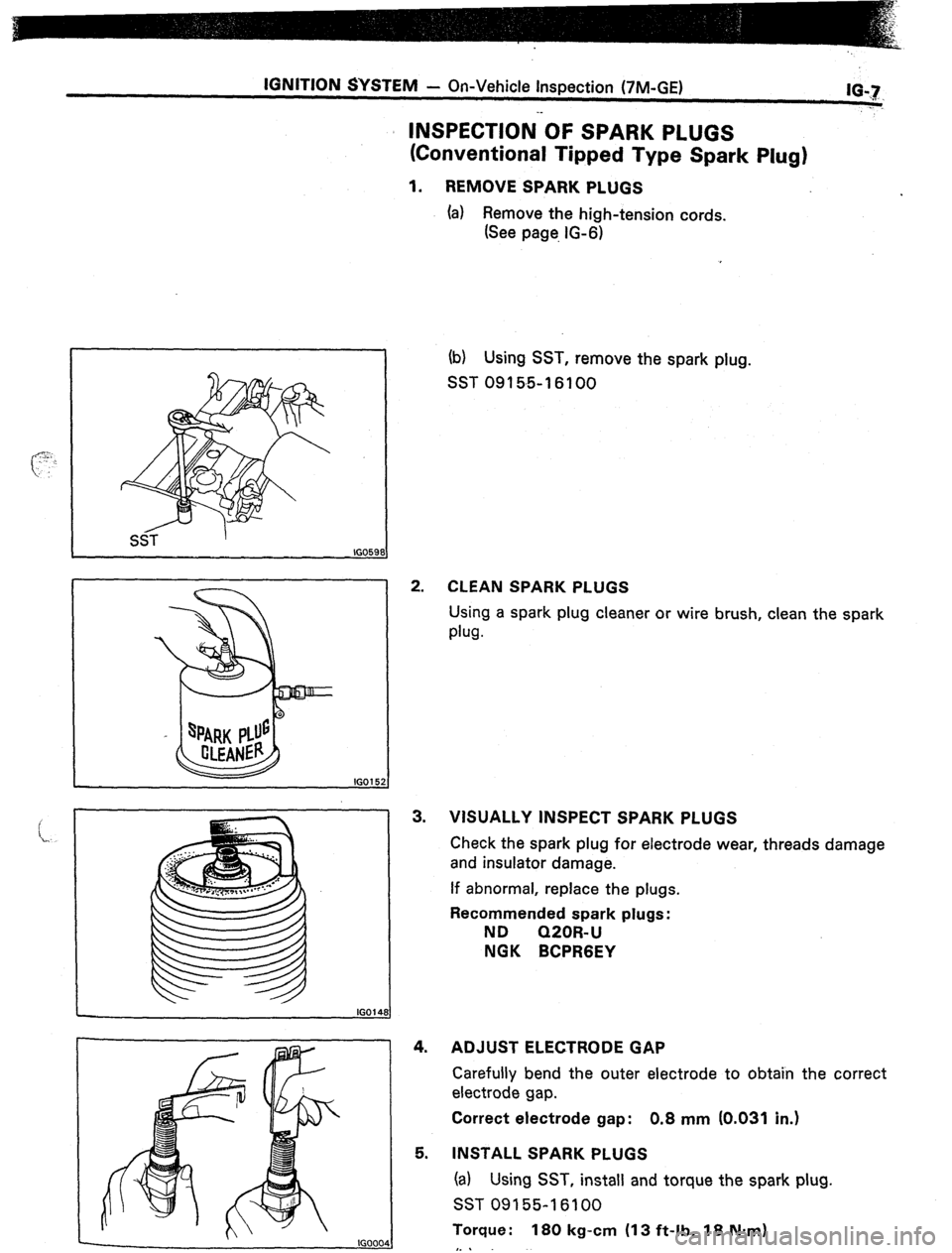
INSPECTION OF SPARK PLUGS
(Conventional Tipped Type Spark Plug)
1. REMOVE SPARK PLUGS
(a) Remove the high-tension cords.
(See page. IG-6)
2.
3.
I
lGOl48
4.
5. (b) Using SST, remove the spark plug.
SST 0915~5-16100
CLEAN SPARK PLUGS
Using a spark plug cleaner or wire brush, clean the spark
plug.
VISUALLY INSPECT SPARK PLUGS
Check the spark plug for electrode wear, threads damage
and insulator damage.
If abnormal, replace the plugs.
Recommended spark plugs:
ND Q20R- U
NGK BCPRGEY
ADJUST ELECTRODE GAP
Carefully bend the outer electrode to obtain the correct
electrode gap.
Correct electrode gap: 0.8 mm (0.031 in.)
INSTALL SPARK PLUGS
(a) Using SST, install and torque the spark plug.
SST 09155-l 6100
Torque : 180 kg-cm (13 ft-lb, 18 Nmrn)
I..
Page 262 of 346
IO-8 IGNITION’SYSTEM - On-Vehicle Inspection (7M-GE)
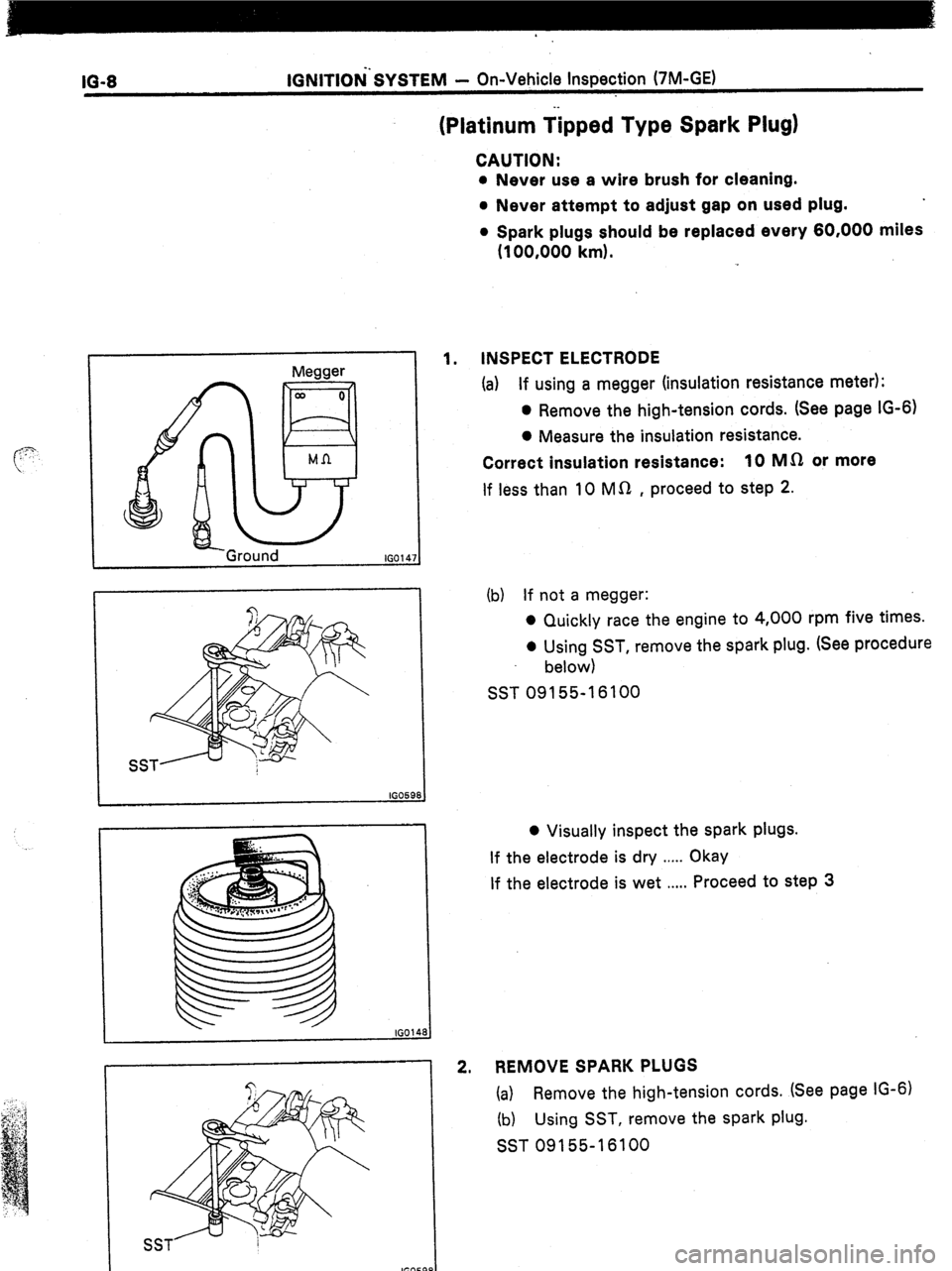
(Platinum tipped Type Spark Plug)
CAUTION:
l Never use a wire brush for cleaning.
l Never attempt to adjust gap on used plug.
l Spark plugs should be replaced every 80,000 miles
(100,000 km).
Megger
IGOlr 17
1. INSPECT ELECTRODE
(a) If using a megger (insulation resistance meter):
0 Remove the high-tension cords. (See page G-6)
0 Measure the insulation resistance.
Correct insulation resistance: 10 MQ or more
If less than 10 MAI , proceed to step 2.
I . IG01481
IG059
0 Visually inspect the spark plugs.
If the electrode is dry ,.... Okay
If the electrode is wet ..,.. Proceed to step 3
2, REMOVE SPARK PLUGS
(a) Remove the high-tension cords. (See page IS-61
Ib) Using SST, remove the spark plug.
SST 09155-l 6100
Page 263 of 346
IGNITION SYSTEM
- On-Vehicle Inspection (7M-GE)
,“lG-9
16031
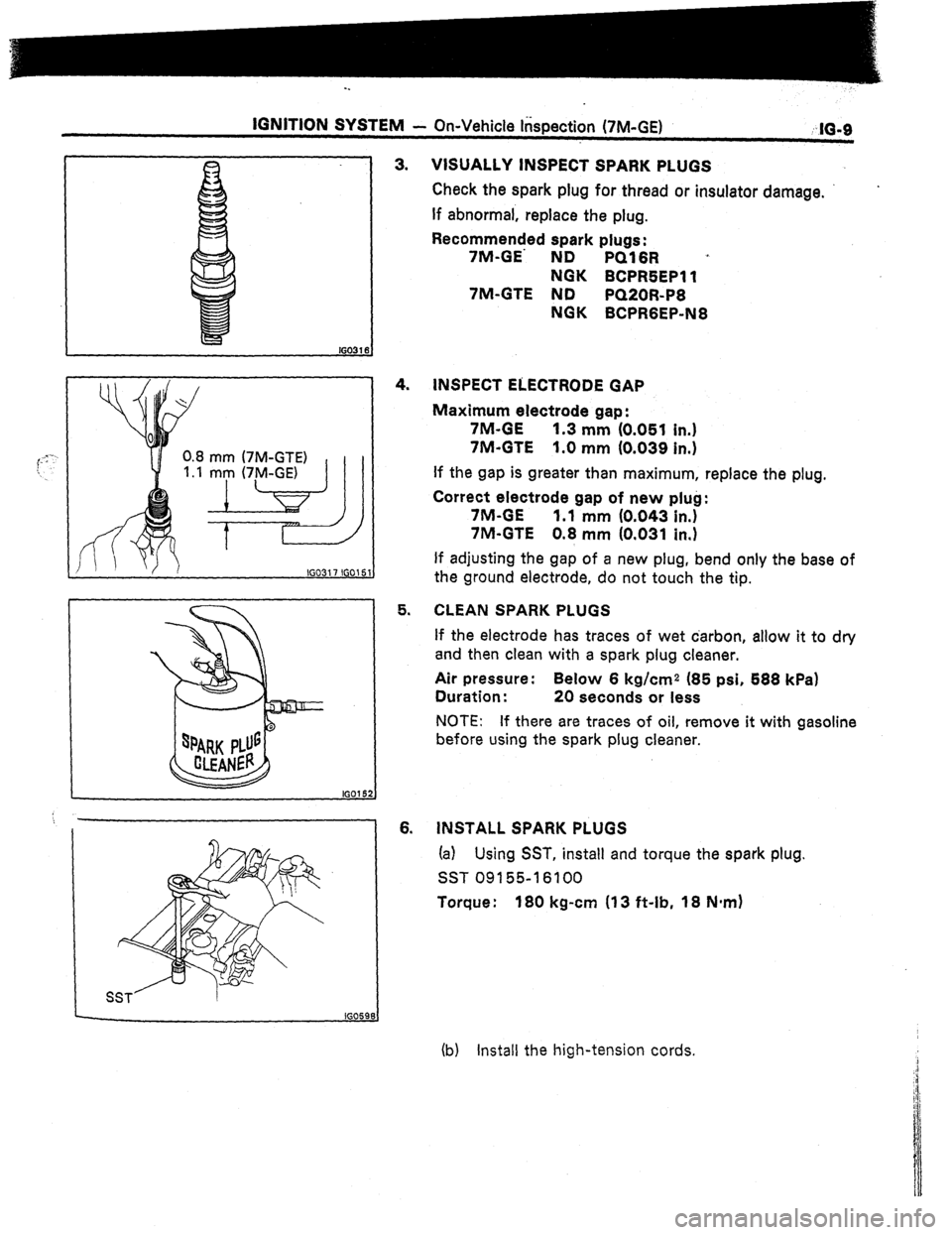
0.8 mm (7M-GTE)
1 .I
mm (7M-GE)
VISUALLY INSPECT SPARK PLUGS
Check the spark plug for thread or insulator damage.
If abnormal, replace the plug.
Recommended spark plugs:
7M-GE’ ND
PQ16R ’
NGK BCPR5EPll
7M-GTE ND
PQ20R-P6
NGK BCPRGEP-N8
INSPECT ELECTRODE GAP
Maximum electrode gap:
7M-GE
1.3 mm (0.051 in.)
7M-GTE 1.0 mm (0.039 in.)
If the gap is greater than maximum, replace the plug.
Correct electrode gap of new plug:
7M-GE
1.1 mm (0.043 in.)
7M-GTE 0.8 mm (0.031 in.)
If adjusting the gap of a new plug, bend only the base of
5. CLEAN SPARK PLUGS
6. the ground electrode, do not touch the tip.
If the electrode has traces of wet carbon, allow it to dry
and then clean with a spark plug cleaner.
Air pressure: Below 6 kg/cm2 (85 psi, 588 kPa)
Duration : 20 seconds or less
NOTE: If there are traces of oil, remove it with gasoline
before using the spark plug cleaner.
INSTALL SPARK PLUGS
(a) Using SST, install and torque the spark plug.
SST 09155-l 6100
Torque : 180 kg-cm (13 ft-lb, 18 N*m)
(b) Install the high-tension cords.
Page 267 of 346
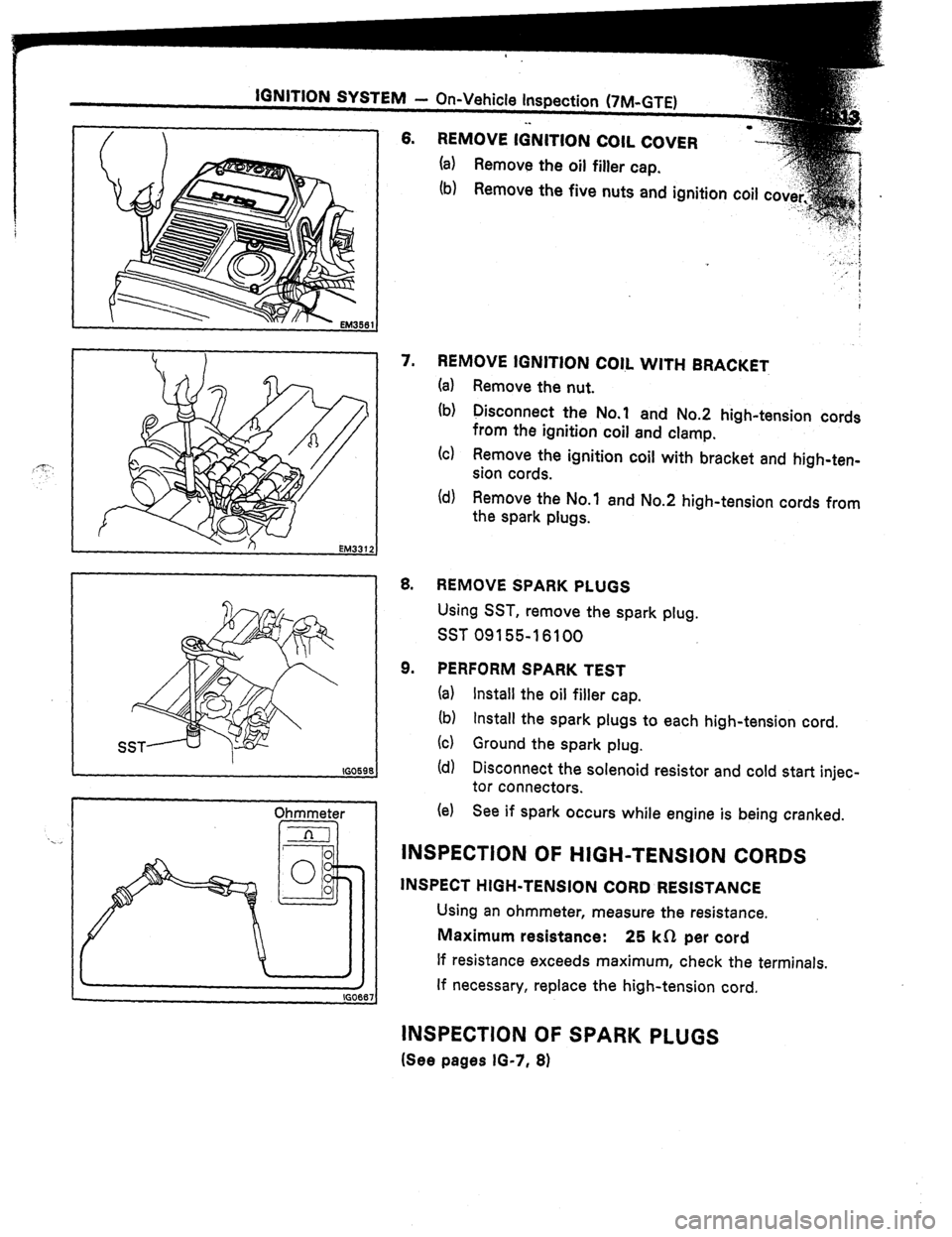
6. REMOVE IGNITION COIL COVER
(a) Remove the oil filler cap.
‘...”
I I
I(30598
Ohmmeter
/
IGO
7. REMOVE IGNITION C0l.L WITH BRACKET
(a) Remove the nut.
(b) Disconnect the No.1 and No.2 high-tension cords
from the ignition coil and clamp.
(cl Remove the ignition coil with bracket and high-ten-
sion cords.
id) Remove the No.1 and No.2 high-tension cords from
the spark plugs.
8.
9. REMOVE SPARK PLUGS
Using SST, remove the spark plug.
SST 09155-16100
PERFORM SPARK TEST
Ia) Install the oil filler cap.
(b) Install the spark plugs to each high-tension cord.
(4 Ground the spark plug.
(d) Disconnect the solenoid resistor and cold start injec-
tor connectors.
(e) See if spark occurs while engine is being cranked.
INSPECTION OF HIGH-TENSION CORDS
INSPECT HIGH-TENSION CORD RESISTANCE
Using an ohmmeter, measure the resistance.
Maximum resistance: 25 kfl per cord
If resistance exceeds maximum, check the terminals.
If necessary, replace the high-tension cord.
INSPECTION OF SPARK PLUGS
(See pages IG-7, 8)