transmission oil TOYOTA CELICA 1987 Service Repair Manual
[x] Cancel search | Manufacturer: TOYOTA, Model Year: 1987, Model line: CELICA, Model: TOYOTA CELICA 1987Pages: 346, PDF Size: 35.13 MB
Page 23 of 346
. COOLING SYSTEM - Description
co;3
RESERVOIR TANK
The reservoir tank is used to catch coolant
which overflows the cooling systein as a result of
volumetric expansion when the coolant is heated.
The coolant in the reservoir tank returns to the
radiator when the coolant temperature drops, thus
keeping the radiator full at all times and avoiding
needless coolant loss. Check the reservoir tank
level to learn if the coolant needs to be rep-
lenished.
WATER PUMP
The water pump is used for forced circulation of
coolant through the cooling system. It is mounted
on the front of the cylinder block and driven by a
V-ribbed belt,
THERMOSTAT I The cooling system is composed of the water
jacket (inside the cylinder block and cylinder head),
radiator, water pump, thermostat, cooling fan,
hoses and other components.
Coolant which is heated in the water
jacket is
pumped to the radiator, through which a cooling
fan blows air to cool the coolant as it passes
through. Coolant which has been cooled is then
sent back to the engine by the water pump, where
it cools the engine.
The water jacket is a network of channels in the
shell of the cylinder block and cylinder head
through which coolant passes. It is designed to
provide adequate cooling of the cylinders are com-
bustion chambers which become the hottest dur-
ing engine operation.
F(/ “ IATOR
The radiator performs the function of cooling
the coolant which has passed through the water
jacket and become hot, and is mounted in the front
of the vehicle. The radiator consists of an upper
tank and ‘lower tank, and a core which connects
the two tanks. The upper tank contains the inlet for
coolant from the water jacket and the filter inlet. It
also has a hose attached through which excess
coolant or steam can flow. The lower tank contains
the outlet for coolant and the drain cock. The core
contains many tubes through which coolant flows
from the upper tank to the lower tank as well as
cooling fins which radiate heat away from the coo-
lant in the tubes. The air sucked through the radia-
tor by cooling fan, as well as the wind generated
by the vehicle’s travel, passes through the radia-
tor, cooling it. Models with automatic transmission
incrl*-le an automatic transmission fluid cooler built
in:.
.le lower tank of the radiator.
RADIATOR CAP
The radiator cap is a pressure type can which
seals the radiator, resulting in pressurization of the
radiator as the coolant expands. The pressuriza-
tion prevents the coolant from boiling even when
the coolant temperature exceeds 100°C. A relief
valve (pressurization valve) and a vacuum valve
(negative pressure valve) are built into the radiator
zap. The relief valve opens and lets steam escape
:hrough the overflow pipe when the pressure
3enerated inside the cooling system exceeds the
imit (coolant temperature:
110 - 1 20°C, (230
- 248”F), pressure; 0.3 - 1 .O kg/cmz, (4.3 - 14.2
)si, 29.4 - 98.1 kPa). The vacuum valve opens to
3ljeviate the vacuum which develops in the coolant
system after the engine is stopped and the coolant
emperature drops. The valve’s opening allows the
)ressure in the cooling system to return to the
Qclant in the reservoir tank. The thermostat has a wax type and is mounted
in the. water outlet housing. The thermostat
includes a type of automatic valve operated by
fluctuations in the coolant temperature. This valve
closes when the coolant temperature drops, pre-
venting the circulation of coolant through the
engine and thus permitting the engine to warm up
rapidly. The valve opens when the coolant tem-
perature has risen, allowing the circulation of coo-
lant. Wax inside the thermostat expands when
heated and contracts when cooled. Heating the
wax thus generates pressure which overpowers
the force of the spring which keeps the valve
closed, thus opening the valve. When the wax
cools, its contraction causes the force of the
spring to take effect once more, closing the valve.
The thermostat in this engine operates at a tem-
perature of 88”C(19O”F).
I
I
Page 120 of 346
EFI SYSTEM - Fuel System
-.
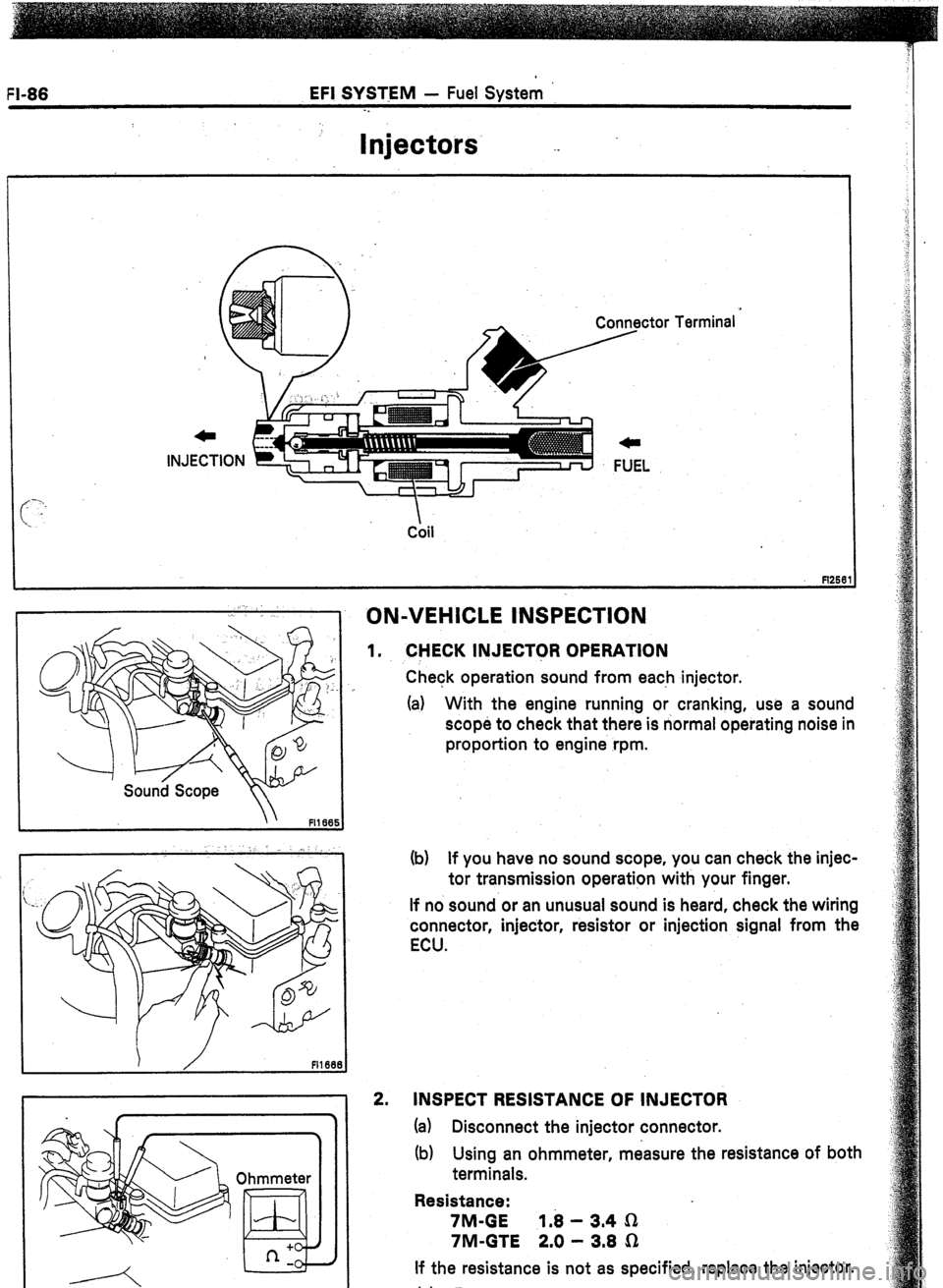
Injectors --
Coil
1 ON-VEHICLE tNSPkTlON
1.
2. CHECK INJECToR OPERATION
Check operation sound from each injector.
(a) With the engine running or cranking, use a sound
scope to check that there is normal operating noise in
proportion to engine rpm.
(b) If you have no sound scope, you can check the injec-
tor transmission operation with your finger.
If no sound or an unusual sound is heard, check the wiring
connector, injector, resistor or injection signal from the
ECU.
INSPECT RESISTANCE OF INJECTOR
(a) Disconnect the injector connector.
(b) Using an ohmmeter, measure the resistance of both
terminals.
Resistance:
7M-GE 1.8 - 3.4 n
7M-GTE 2.0 - 3.8 Q
If the resistance is not as specified, replace the injector.
(c) Reconnect the injector connector.
Page 179 of 346
ENGINE MECHANICAL. - Engine Tune-up
EM-?1 7.
INS’PECTIOlil ‘AhiD ADJUSTMENT O:F .-
IGNITION TIMING
1. VriARiiA. UP ENGINE.
Allow the engine to. reach normal operating temperature.
2.
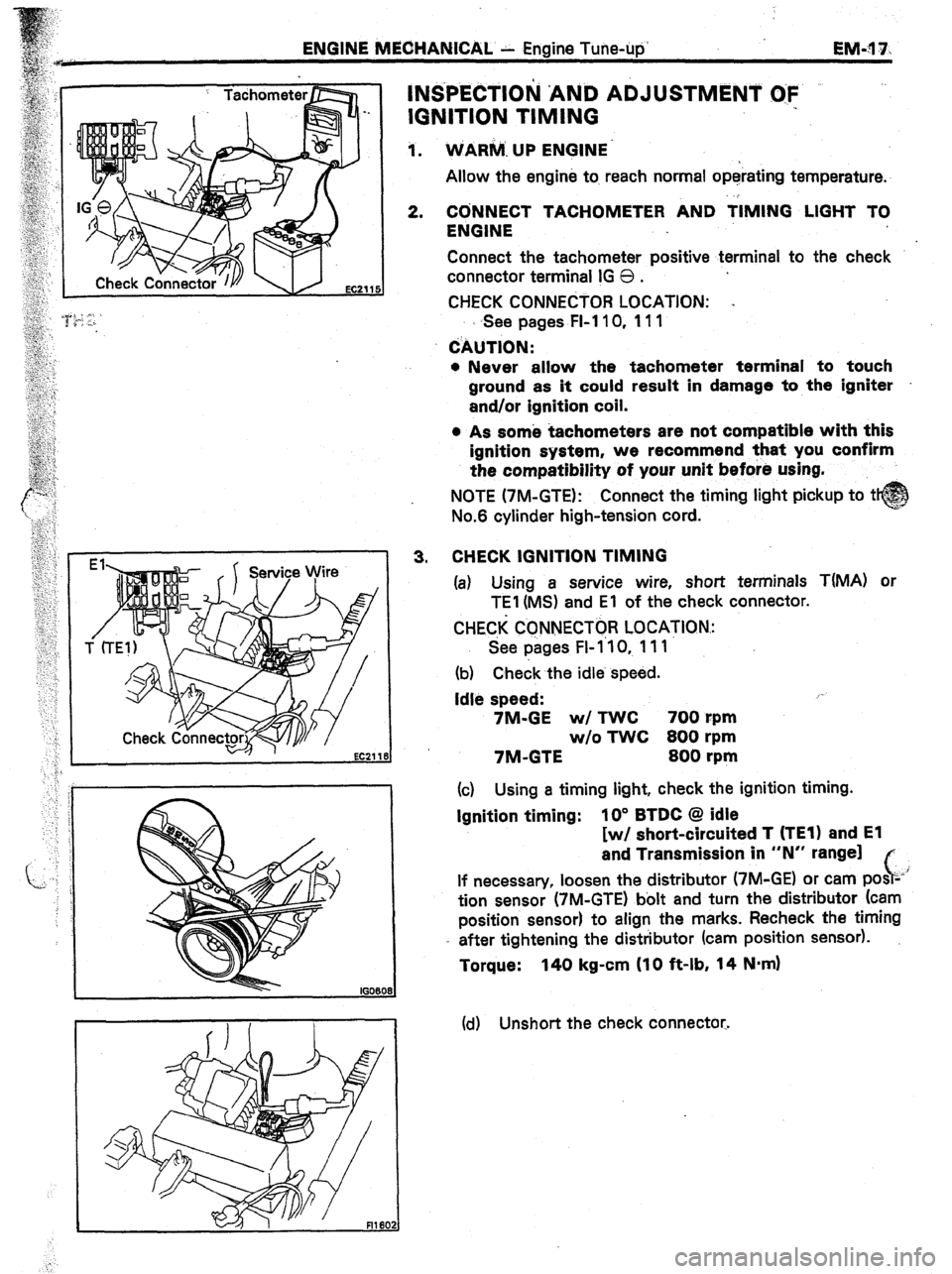
CbNNECT TACHOMETER AND TIMING LIGHT TO
ENGINE
Connect the tachometer positive terminal to the check
connector terminal IG 0 .
CHECK CONNECTOR LOCATION: .,
s See pages FI-110, 111
CAUTION:
l Never allow the tachometer terminal to touch
ground as it could result in damage to the igniter
and/or ignition coil.
, 4% 3.
EC21 18
s As some tachometers are not compatible with this
ignition system, we recommend that you confirm
the compatibility of your unit before using.
NOTE (7M-GTE): Connect the timing light pickup to t
No.6 cylinder high-tension cord.
CHECK IGNITION TIMING
(a) Using a service wire, short terminals T(MA) or
TEI (MS) and El of the check connector.
CHEC,K CCNNECTOR LOCATION.:
See pages FI- 1’10, 111
(b) Check the idle. speed.
Idle speed: /-
7M-GE w/ TWC 700 rpm
w/o TWC 800 rpm
7M-GTE 800 rpm
(c) Using a timing light, check the ignition timing.
Ignition timing: IO” BTDC @ idle
[w/ short-circuited T (TEl) and El
and Transmission in “N” range]
c,
If necessary, loosen the distributor (7M-GE) or cam posz-’
tion sensor (7M-GTE) bolt and turn the distributor (cam
position sensor) to align the marks. Recheck the timing
- after tightening the distributor (cam position sensor).
Torque: 140 kg-cm (10 ft-lb, 14 N-m)
(cl) Unshort the check connector.