throttle TOYOTA CELICA 1987 Service Repair Manual
[x] Cancel search | Manufacturer: TOYOTA, Model Year: 1987, Model line: CELICA, Model: TOYOTA CELICA 1987Pages: 346, PDF Size: 35.13 MB
Page 22 of 346
. .
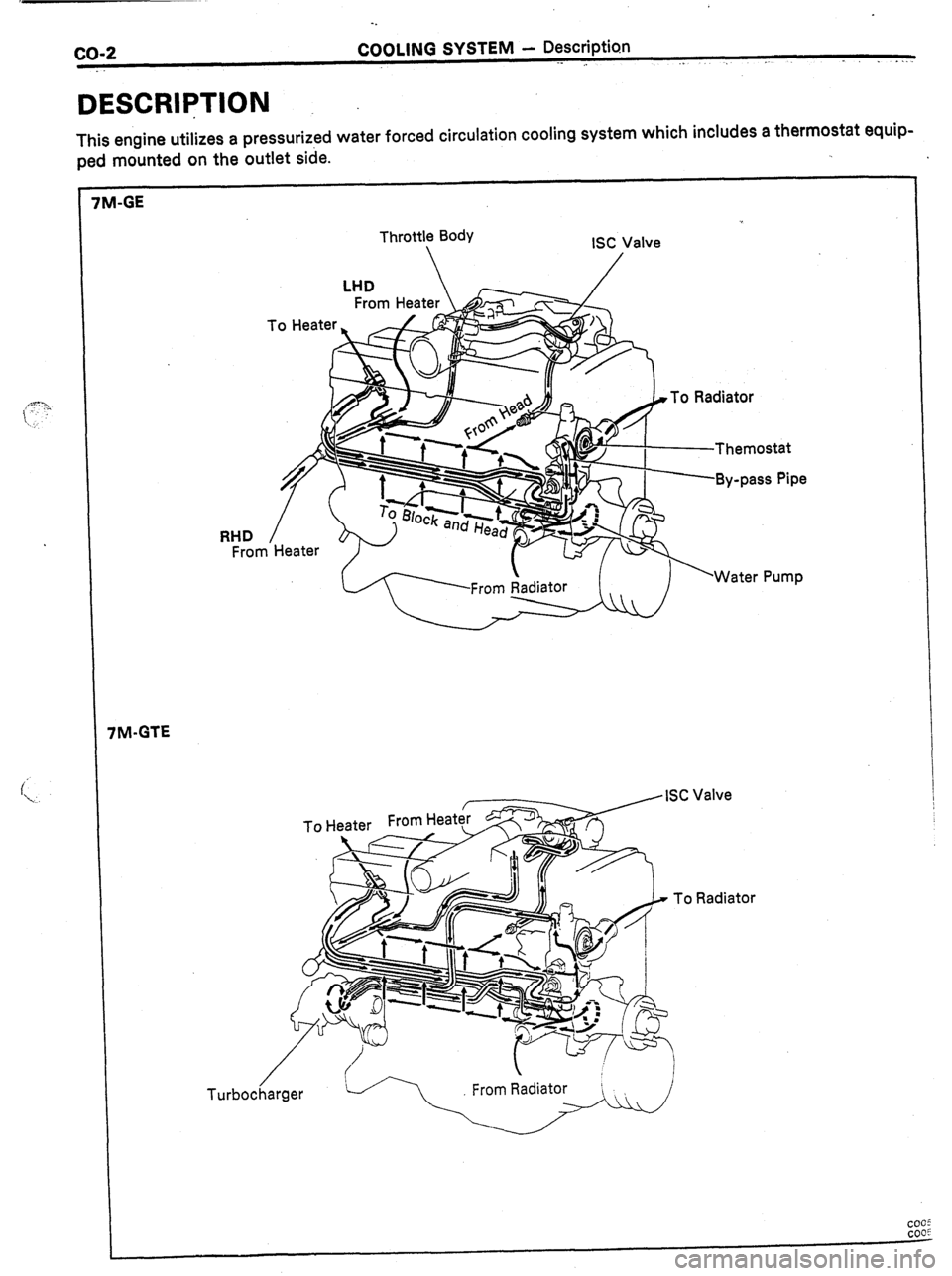
co-2 COOLING SYSTEM - Description
,- I . . .
DESCRlqTlON
This engine utilizes a pressurized water forced circulation cooling system which includes a thermostat equip-
ped mounted on the outlet side.
5 7M-GE
Throttle Body
ISC Valve
/
To Radiator
RHD
/
From Heater
rM-GTE
/
To Heater From Heat: ISC Valve
To Radiator
COGS
COOF
Page 35 of 346
FI-1
i’.. ;
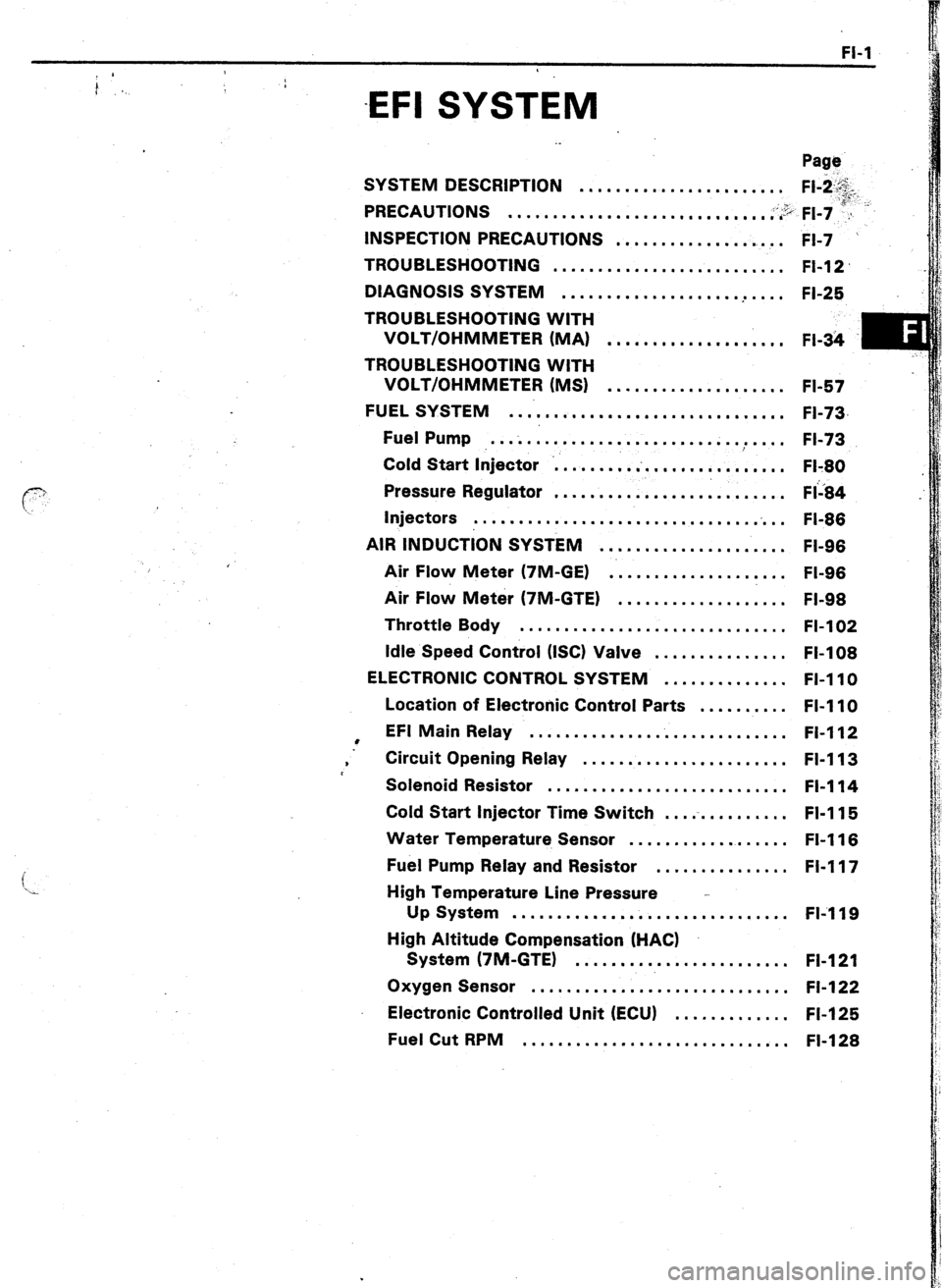
-EFI SYSTEM
i
‘x
. .
Page
SYSTEM DESCRIPTION
....................... Fl-i.&.
PRECAUTIONS
;;:“, F,-, ;a”“- .............................. . ....
INSPECTION PRECAUTIONS
FI-7 . ....................
TROUBLESHOOTING
.......................... FI-12
DIAGNOSIS SYSTEM
.................... .
.... FI-25
TROUBLESHOOTING WITH
VOLT/OHMMETER (MA)
.................... FI-34
m
.:
TROUBLESHOOTING WITH
VOLT/OHMMETER (MS)
.................... FI-57
FUEL SYSTEM
................................ FI-73,
Fuel Pump ..................................
FI-73
Cold Start Injector ...........................
Fl-80
Pressure Regulator
.......................... FI’i84 ..
Injectors
.............................. ..i ..
FI-86
AIR INDUCTION SYSTEM
..................... FI-96
Air Flow Meter (7M-GE)
..................... FI-96
Air Flow Meter (7M-GTE)
................... FI-98
Throttle Body
.............................. FI-102
Idle Speed Control (ISC) Valve
............... FI-108
ELECTRONIC CONTROL SYSTEM .............. FI-110
Location of Electronic Control Parts .......... FI-110
l EFI Main Relay
............................. Fl-112
. Circuit Opening Relay ....................... FI-113
Solenoid Resistor
........................... Fl-114
Cold Start Injector Time Switch ...............
FI-115
Water Temperature Sensor ..................
FI-116
Fuel Pump Relay and Resistor ............... FI-117
High Temperature Line Pressure -
Up System ............................... FIi119
High Altitude Compensation (HACK
System (7M-GTE)
........................ FI-121
Oxygen Sensor .............................
FI-122
Electronic Controlled Unit (ECU) .............
FI-125
Fuel Cut RPM
.............................. FI-128
Page 40 of 346
1-6 EFI SYSTEM - System Description
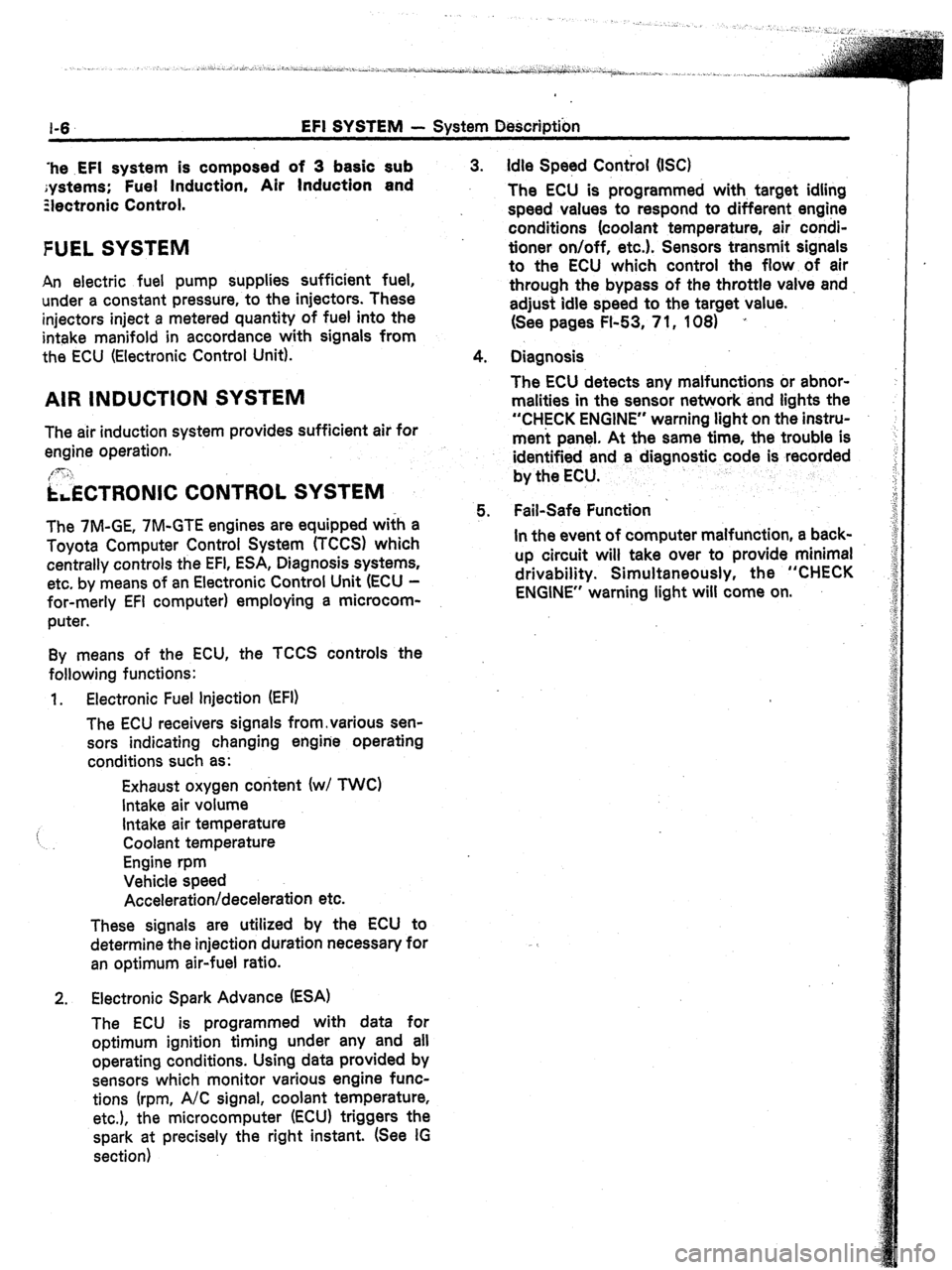
‘he .EFI system is composed of 3 basic sub
;ystems; Fuel Induction, Air Induction and
Ziectronic Control.
FUEL SYSTEM
An electric fuel pump supplies sufficient fuel,
under a constant pressure, to the injectors. These
injectors inject a metered quantity of fuel into the
intake manifold in accordance with signals from
the ECU (Electronic Control Unit).
AIR INDUCTION SYSTEM
The air induction system provides sufficient air for
engine operation.
[3: ‘I
i&TRONIC CONTROL SYSTEM
The 7M-GE, 7M-GTE engines are equipped wifh a
Toyota Computer Control System (TCCS) which
centrally controls the EFI, ESA, Diagnosis systems,
etc. by means of an Electronic Control Unit (ECU -
for-merly EFI computer) employing a microcom-
puter.
By means of the ECU, the TCCS controls the
following functions:
1. Electronic Fuel injection (EFI)
The ECU receivers signals from,various sen-
sors indicating changing engine operating
conditions such as:
Exhaust oxygen content (w/ TWC)
Intake air volume
i Intake air temperature
Coolant temperature
Engine rpm
Vehicle speed
Acceleration/deceleration etc.
These signals are utilized by the ECU to
determine the injection duration necessary for
an optimum air-fuel ratio.
2. Electronic Spark Advance (ESA)
The ECU is programmed with data for
optimum ignition timing under any and all
operating conditions. Using data provided by
sensors which monitor various engine func-
tions (rpm, A/C signal, coolant temperature,
etc.), the microcomputer (ECU) triggers the
spark at precisely the right instant. (See IG
section) 3. Idle Speed Control (IX)
The ECU is programmed with, target idling
speed values to respond to different engine
conditions (coolant temperature, air condi-
tioner on/off, etc.). Sensors transmit signals
to the ECU which control the flow of air
through the bypass of the throttle valve and
adjust idle speed to the target value.
(See pages FI-53, 7 1, 108) ’
4. Diagnosis
The ECU detects any malfunctions or abnor-
malities in the sensor network and tights the
“CHECK ENGINE” warning light on the instru-
ment panel. At the same time, the trouble is
identified and a diagnostic code is recorded
by the ECU.
5. Fail-Safe Function ’
In the event of computer malfunction, a back-
up circuit will take over to provide minimal
drivability. Simultaneously, the “CHECK
ENGINE” warning light will come on.
Page 53 of 346
EFI SYSTEM - Troubleshooting
FI-19
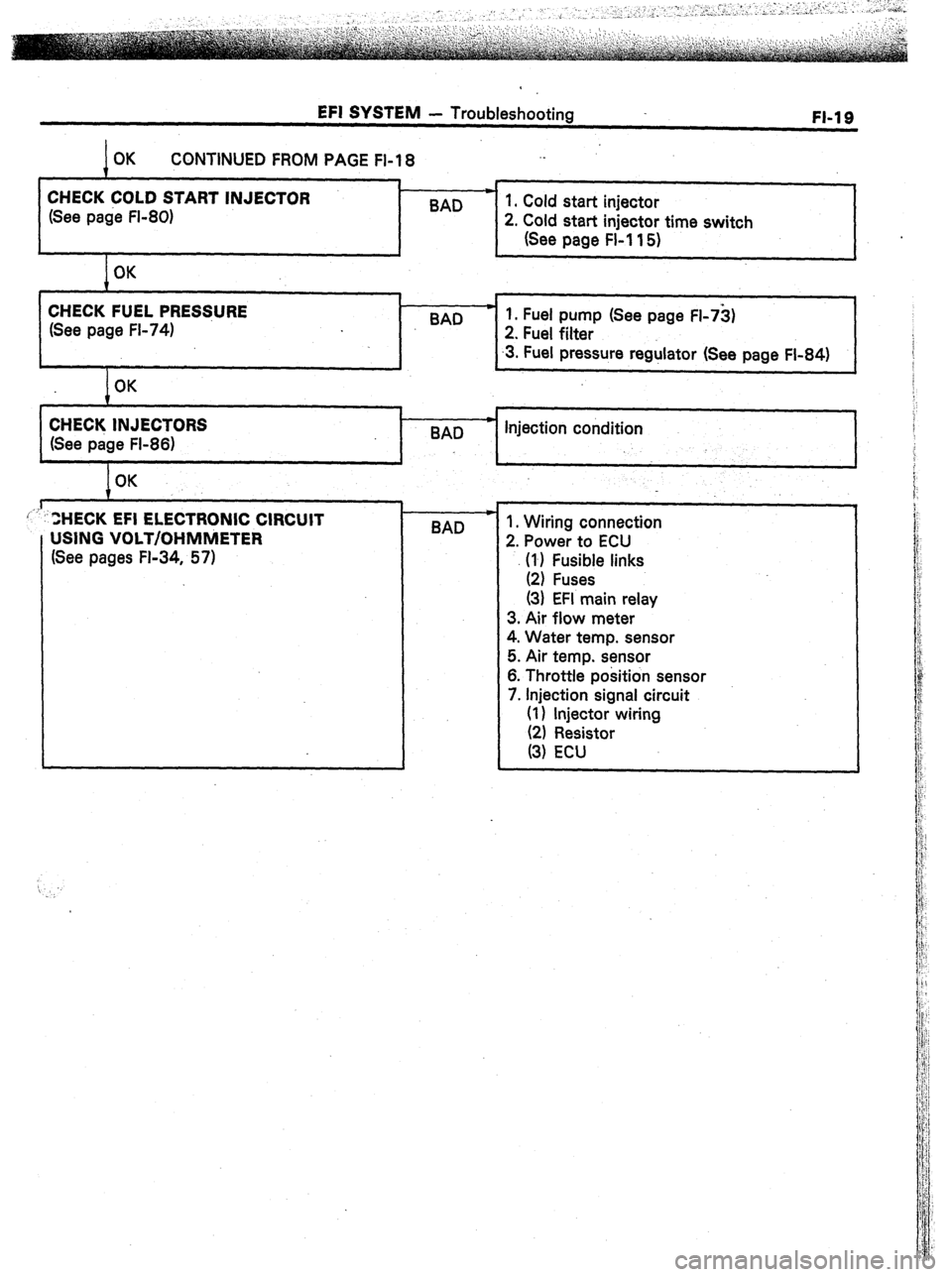
CONTINUED FROM PAGE Fl-18 ._
t
CHECK COLD START INJECTOR *
(See page FI-80) BAD 1. Cold start injector
2. Cold start injector time switch
(See page FL11 5)
CHECK FUEL PRES$URE
(See page FL74) BAD c 1. Fuel pump (See page FI-73)
2. Fuel filter
.3. Fuel pressure regulator (See page FI-84)
I
I 1 c 4
/OK
I
CHECK INJECTORS
(See page FI-86) 8AD * Injection condition
I OK
L 1
ZHECK EFI ELECTRONIC CIRCUIT
USING VOLT/OHMMETER
(See pages FL34, 57) c
BAD 1. Wiring connection
2. Power to ECU
\‘l’, F;t;e links
(3) EFI main relay
3. Air flow meter
4. Water temp. sensor
5. Air temp. sensor
6. Throttle position sensor
7. Injection signal circuit
(1) injector wiring
Page 54 of 346
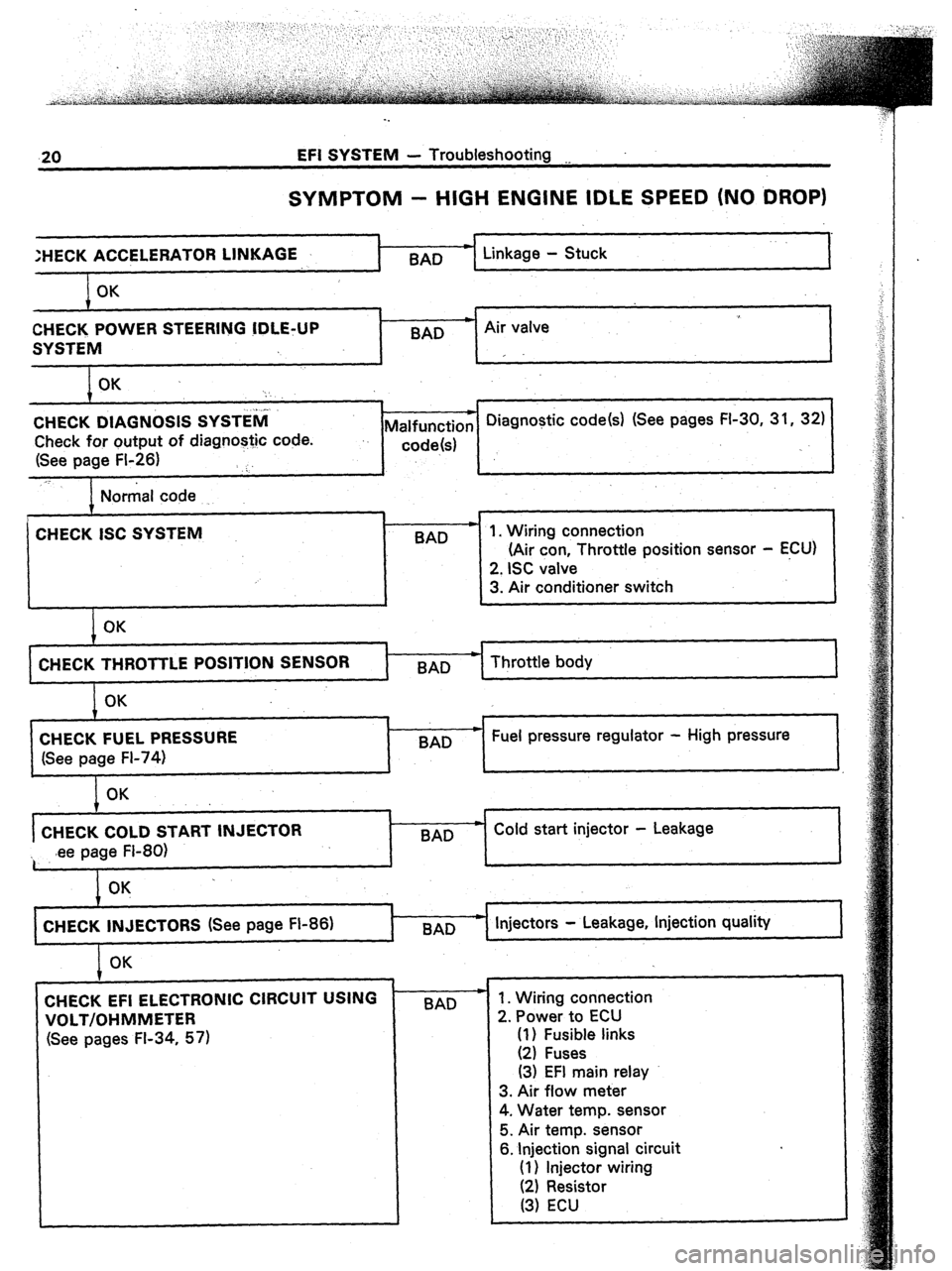
.20 EFI SYSTEM - Troubleshooting __
SYMPTOM - HIGH ENGINE IDLE SPEED (NO DROP)
:HECK ACCELERA
OK
CHECK POWER STEERING !DLE+JP
SYSTEM
OK .
‘:
j..l.
CHECK DIAGNOSIS SYSTEM
Check for output of diagnostic code.
(See page FI-26) ‘:.
_T I Linkage - Stuck
I
9
BAD * Air valve
I
r
* Diagnostic code(s) (See pages FI-30, 31, 32)
Malfunction
..
code!s)
Normal code
.
CHECK ISC SYSTEM
BAD
I
OK
71
(Air con Throttle posrtron sensor - ECU)
1 CHECK THROTTLE POSITION SENSOR
t-x- Throttle body
OK
CHECK FUEL PRESSURE
(See page FI-74) 7
BAD w Fuel pressure regulator - High pressure
OK
CHECK COLD START INJECTOR
~ .ee page FI-80) BAD w Cold start injector - Leakage
CHECK INJECTORS (See page FI-86)
I Injectors - Leakage, Injection quality
I OK
CHECK EFI ELECTRONIC CIRCUIT USING
VOLT/OHMMETER
(See pages FI-34, 57) BAD - 1. Wiring connection
2. Power to ECU
(1) Fusible links
(2) Fuses
(3) EFI main relay
3. Air flow meter
4. Water temp. sensor
5. Air temp. sensor
6. Injection signal circuit
(1) Injector wiring
(2) Resistor
(3) ECU
Page 55 of 346
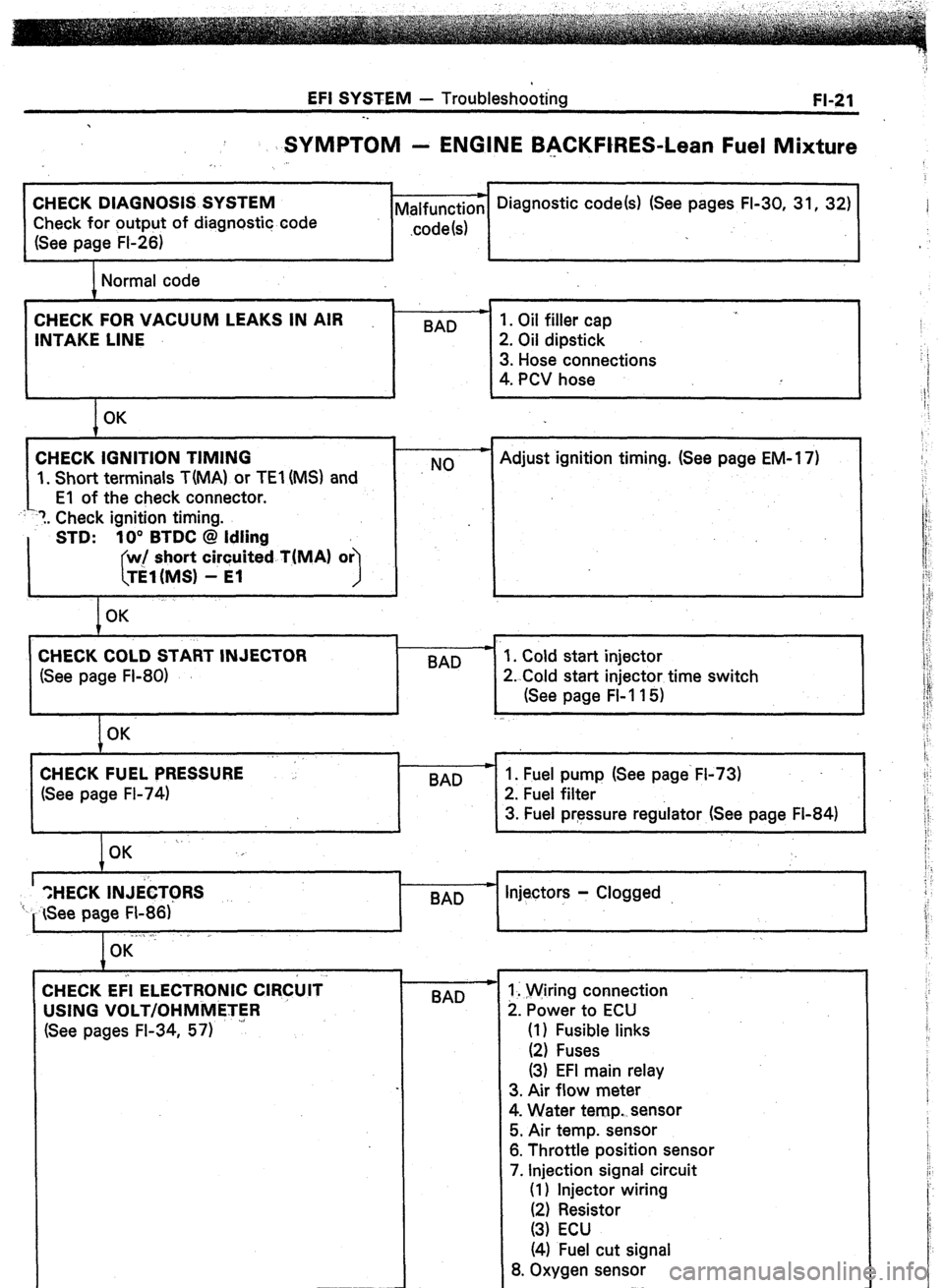
EFI SYSTEM - Troubleshooting
FI-21
-.
SYMPTOM - ENGINE BACKFtRES-Lean Fuel Mixture
CHECK DIAGNOSIS SYSTEM
Check for output of diagnostic code
(See page FI-26) Malfunction --) Diagnostic code(s) (See pages FI-30, 31, 32)
.code 1s) j
,
Normal code
CHECK FOR VACUUM LEAKS IN AIR
INTAKE LINE
1. Short terminals T(MA) or TEl (MS) and BAD -
NO 1. Oil filler cap
2. Oil dipstick
3. Hose connections
4. PCV hose
Adjust ignition timing. (See page EM-1 7)
1. Cold start injector
2. Cold start injector time switch
(See page FI-115)
CHECK FUEL PRESSURE
(See page FI-74)
I
I
BAD 1. Fuel pump (See page‘ FI-73)
2. Fuel filter
3. Fuel pressure regulator (See page Fl-84)
I
’ “,HECK INJib
‘I- See page FI-86)’ - Injectors - Clogged
BAD
. ., .l
I OK
CHECK Eii ELECTRONIC ClR&lT
USING VOLT/OHMMETER
(See pages FI-34, 57)
4
BAD 1. Wiring connection
2. Power to ECU
(1) Fusible links
(2) Fuses
(3) EFI main relay
3. Air flow meter
4. Water temp. sensor
5. Air temp. sensor
6. Throttle position sensor
7. Injection signal circuit
(1) Injector wiring
Ii, zesstor
(4) Fuel cut signal
8. Oxygen sensor
Page 56 of 346
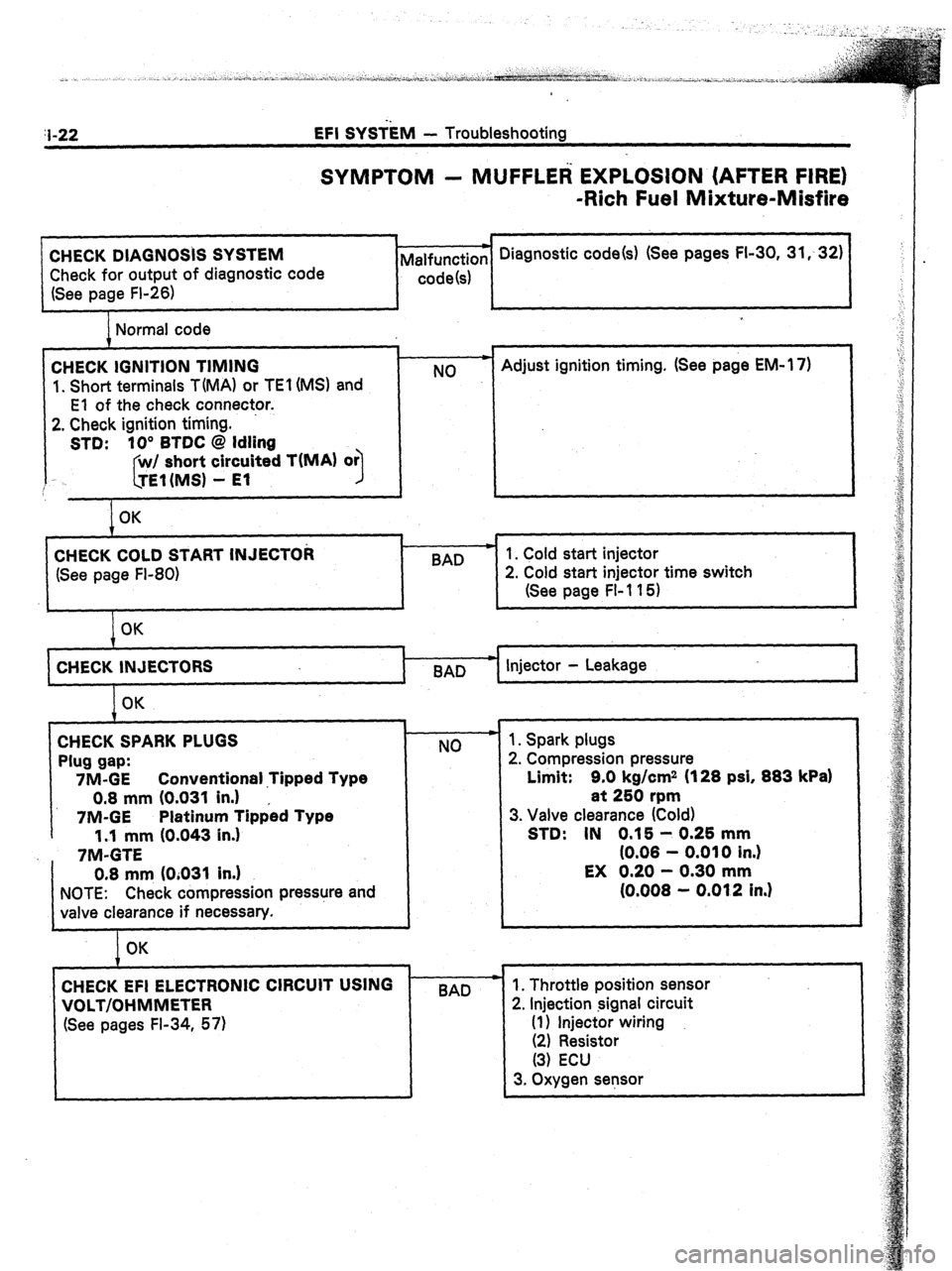
Ii-22 EFI SYSiiM - Troubleshooting
SYMPTOM - MUFFLER EXPLOSION (AFTER FIRE)
-Rich Fuel Mixture-Misfire
CHECK DIAGNOSIS SYSTEM
Check for output of diagnostic code
(See page FI-26) pm Diagnostic code(s) (See pages Fl-30, 31, 32)
Malfunction
code(s)
4
c
Normal code
CHECK IGNITION TIMING
1. Short terminals TiMA) or TEl (MS) and
El of the check connector.
2. Check ignition timing.
STD: IO” BTDC @ Idling
w/ short circuited TfMA) or
C TEl(MS) - El I
OK NO
BAD
I-
Adjust ignition timing. (See page EM- 17)
I
1. Cold start injector
2. Cold start injector time switch
(See page FI- 115)
1
CHECK INJECTORS
BAD injector - Leakage
I
I OK
CHECK SPARK PLUGS
Plug gap:
7M-GE Conventional .Tipped Type
0.8 mm (0.031 in.)
7M-GE Platinum Tipped Type
1.1 mm (0.043 in.)
7M-GTE
0.8 mm (OiO31 in.)
NOTE: Check compression pressure and
valve clearance if necessary.
OK
CHECK EFI ELECTRONIC CIRCUIT USING
VOLT/OHMMETER
(See pages Fl-34, 57) NO
BAD - 1. Spark plugs
2. Compression pressure
Limit: 9.0 kg/cm2 (128 psi, 883
kPa)
at 250 rpm
3. Valve clearance (Cold)
STD: IN 0.15 - 0.25 mm
(0.06 - 0.010 in.)
EX 0.20 - 0.30 mm
(0.006 - 0.012 in.)
i
1. Throttle position sensor
2. Injection signal circuit
(I) Injector wiring
(2) Resistor
(3) ECU
3. Oxygen sensor
Page 58 of 346
. .
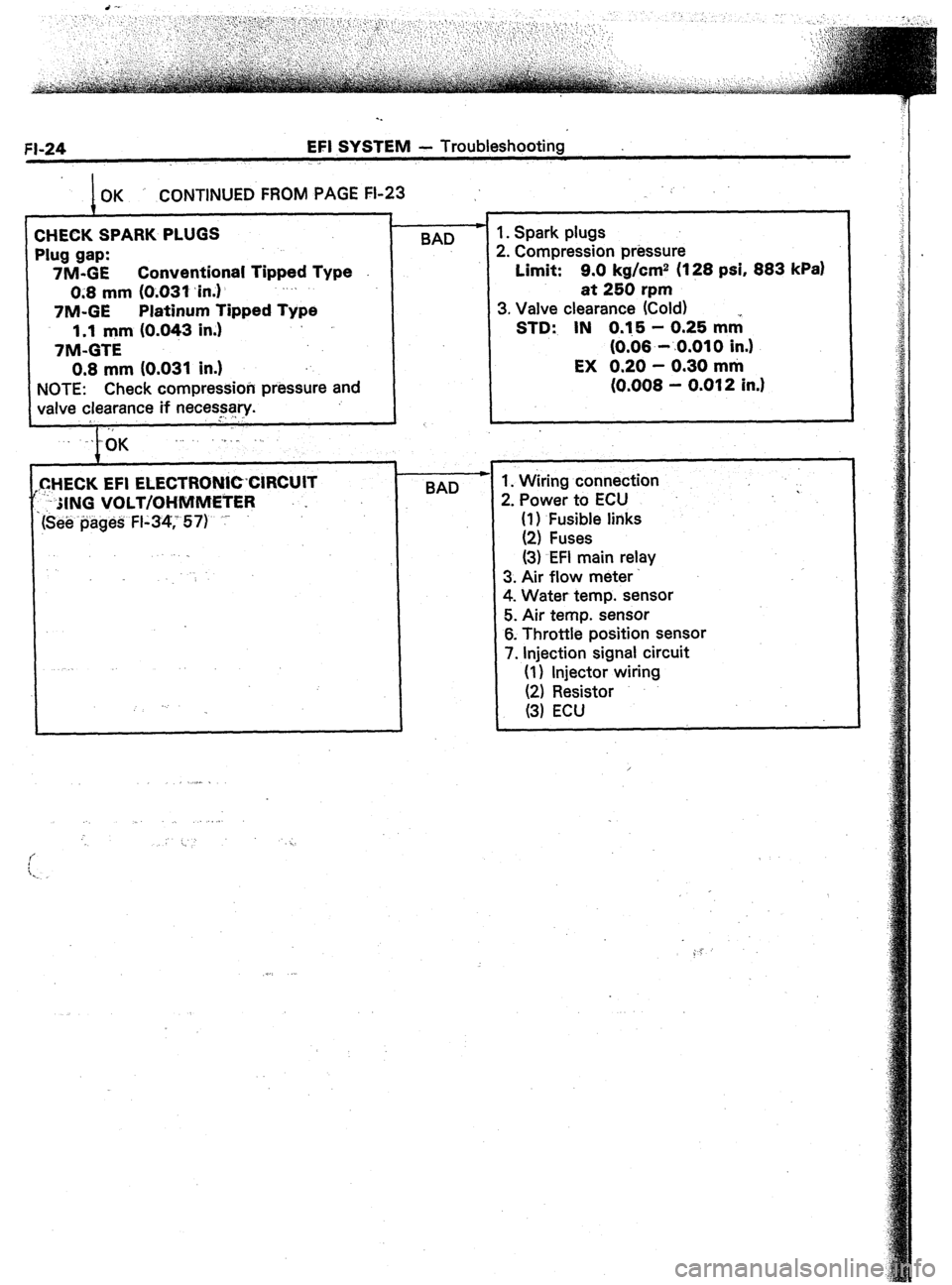
FI-24 EFI SYSTEM - Troubleshooting
,)
OK CONTINUED FROM PAGE FL23
1
CHECK SPARK PLUGS
Plug gap:
7M-GE Conventional Tipped Type
03 mm (0.031 ,in.) .~
7M-GE Platinum Tipped Type
1.1 mm (0.043 in.)
7M-GTE
0.8 mm (0.031 in.)
NOTE: Check compression prossure and
valve clearance if necessary.
.
. r L
BAD
1
;HECK EFI ELECTRONIC’CIRCUIT
-;-;ilNG VOLT/OHMMETER
_
(See-pages FI-34;‘57) Y
.
1. Spark plugs
2. Compression pressure
Limit: 9.0 kg/cm2 (128 psi, 883
kPa)
at 250 rpm
3. Valve clearance (Cold)
STD: IN 0.15 - 0.25 m&
(0.06 -‘.O.OlO in.)
EX 0.20 - 0.30 mti
(0.008 - 0.012 in.1
c
BAD 1. Wiring connection
2. Power to ECU
(I) Fusible links
(2) Fuses
(3) EFI main relay
3. Air flow meter.
4. Water temp. sensor
5. Air temp. sensor
6. Throttle position sensor
7. Injection signal circuit
(I) Injector wiring
(2) Resistor
(3) ECU ’
Page 60 of 346
FI-26 EFI SYSTEM - Diagnosis System
-.
i
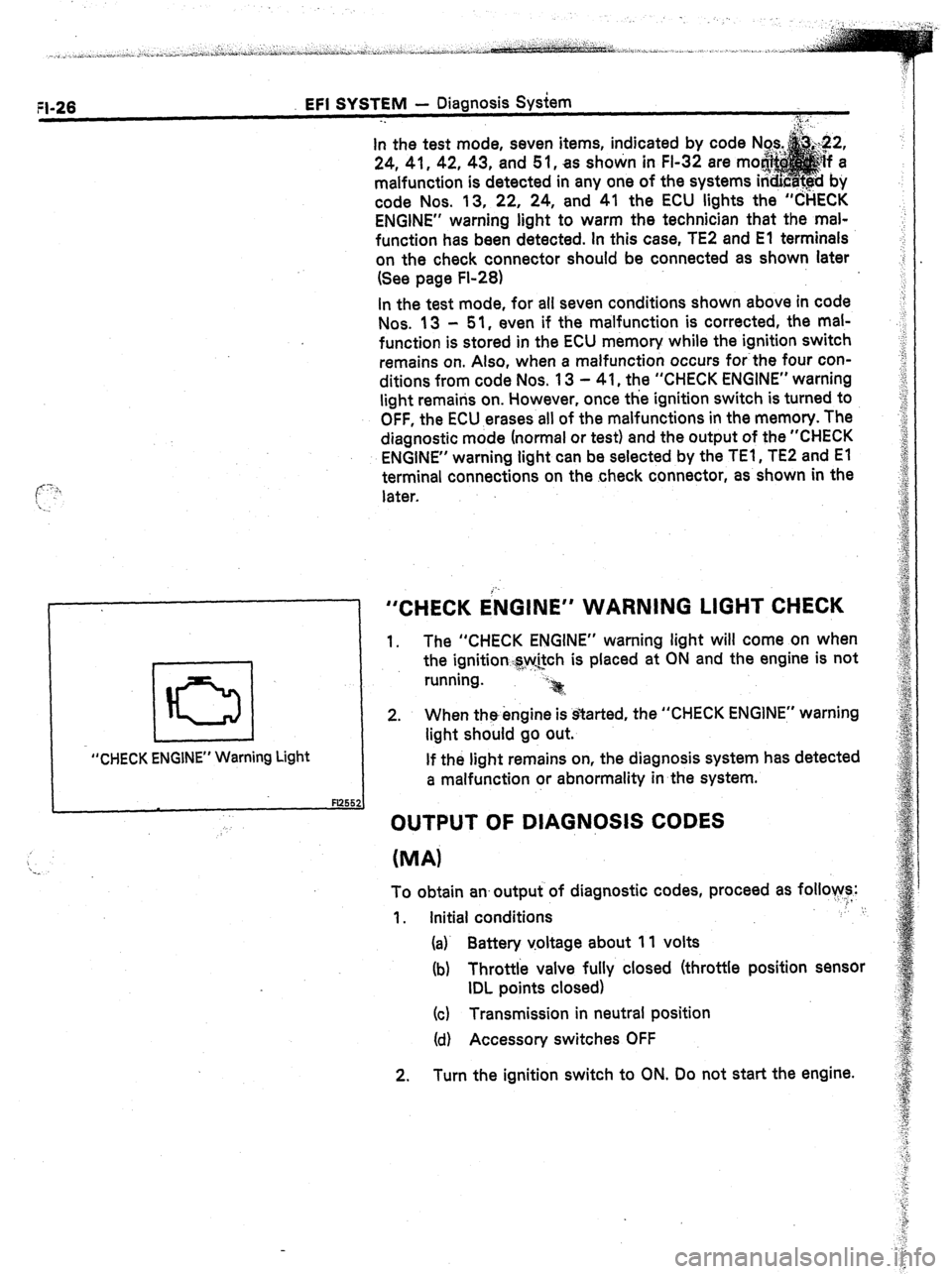
“CHECK ENGINE” Warning Light In the test mode, seven items, indicated by code
24, 41, 42, 43, and 5 1, as shown in FI-32 are m
malfunction is detected in any one of the systems
code Nos. 13, 22, 24, and 41 the ECU lights the “CHECK
ENGINE” warning light to warm the technician that the mal-
function has been detected. In this case, TE2 and El terminals
on the check connector should be connected as shown later
(See page FI-28)
In the test mode, for all seven conditions shown above in code
Nos. 13 - 51, even if the malfunction is corrected, the mal-
function is stored in the ECU memory while the ignition switch
remains on. Also, when a malfunction occurs for-the four con-
ditions from code Nos. 13 - 41, the “CHECK ENGINE” warning
light remains on. However, once the ignition switch is turned to
OFF, the ECU erases all of the malfunctions in the memory. The
diagnostic mode (normal or test) and the output of the “CHECK
ENGINE” warning light can be selected by the TEl , TE2 and El
terminal connections on the check connector, as shown in the
later.
“CHECK ENGINE” WARNING LIGHT CHECK
1. The “CHECK ENGINE” warning light will come on when
the ignitiorqw:@ch is placed at ON and the engine is not
running. -y.
2. When the engine is started, the “CHECK ENGINE” warning
light should go out.
If the light remains on, the diagnosis system has detected
a malfunction or abnormality in the system.
OUTPUT OF DIAGNOSIS CODES
(MA)
To obtain an output of diagnostic codes, proceed as follows:
1. Initial conditions ,’
(a)’ Battery voltage about 11 volts
(b) Throttle valve fully closed (throttle position sensor
IDL points closed)
(cl Transmission in neutral position
(d) Accessory switches OFF
2. Turn the ignition switch to ON. Do not start the engine.
Page 62 of 346
EFI SYSTEM; Diagnosis System
S)
------) -.
I Fl281
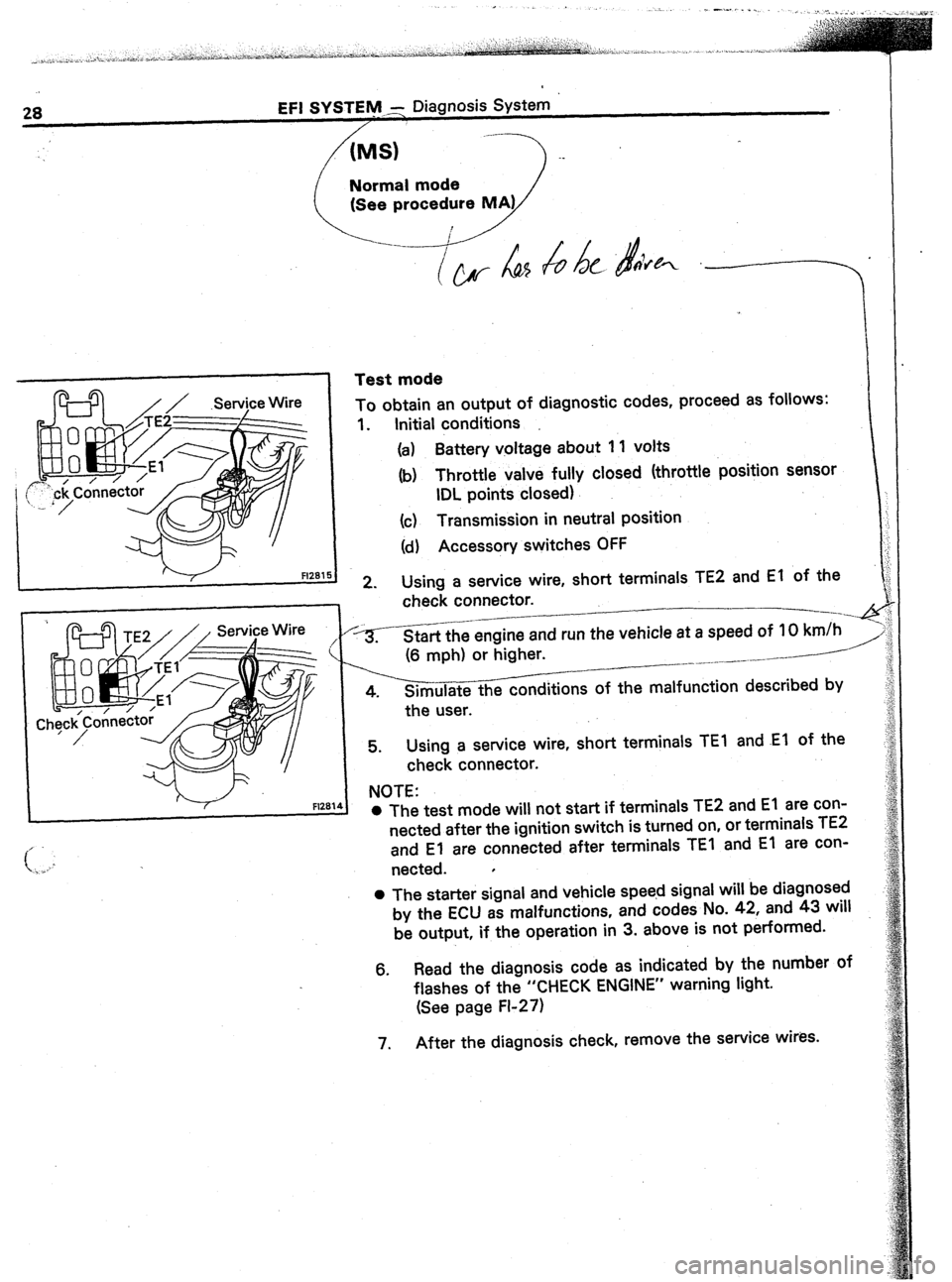
Test mode
i
To obtain an output of diagnostic codes, proceed as follows:
1. Initial conditions
(a) Battery voltage about 1 1 volts
(b) Throttle valve fully closed (throttle position sensor
IDL points closed)
(c) Transmission in neutral position
(d) Accessory switches OFF
2. Using a service wire, short terminals TE2 and El of the j
check connector.
-----.-q
*-heengine and run the vehicle at a speed of IO km/h I
(6 mph) or higher. __-- /---’
_ ___ _.--.--.
4. Simulate the conditions of the malfunction described by
the user.
5. Using a service wire, short terminals TEl and .El of the
check connector.
NOTE:
l The test mode will not start if terminals TE2 and El are con-
nected after the ignition switch is turned on, or terminals TE2
and El are connected after terminals TEI and El are con-
nected.
l
0 The starter signal and vehicle speed signal will be diagnosed
by the ECU as malfunctions, and codes No. 42, and 43 will
be output, if the operation in 3. above is not performed.
6. Read the diagnosis code as indicated by the number of
flashes of the “CHECK ENGINE” warning light.
(See page FI-27)
7. After the diagnosis check, remove the service wires.