brakes TOYOTA CELICA 2000 User Guide
[x] Cancel search | Manufacturer: TOYOTA, Model Year: 2000, Model line: CELICA, Model: TOYOTA CELICA 2000Pages: 256, PDF Size: 3.98 MB
Page 176 of 256
Celica_U
1752000 CELICA (OM20735U)
5. Start your engine in the normal way.After starting, run it at about 2000 rpm
for several minutes with the accelerator
pedal lightly depressed.
6. Carefully disconnect the cables in the exact reverse order: the negative cable
and then the positive cable.
7. Carefully dispose of the battery cover cloths—they may now contain sulfuric
acid.
8. If removed, replace all the battery vent plugs.
If the cause of your battery discharging is
not apparent (for example, lights left on),
you should have it checked. If your engine stalls while driving...
1. Reduce your speed gradually, keeping a straight line. Move cautiously off the
road to a safe place.
2. Turn on your emergency flashers.
3. Turn the ignition key to “ACC” or “LOCK”, and try starting the engine
again.
If the engine will not start, see “If your
vehicle will not start—” in this section.
CAUTION
If the engine is not running, the pow-
er assist for the brakes and steering
will not work so steering and braking
will be much harder than usual.
If your vehicle overheats
If your engine coolant temperature
gauge indicates overheating, if you ex-
perience a loss of power, or if you hear
a loud knocking or pinging noise, the
engine has probably overheated. You
should follow this procedure... 1. Pull safely off the road, stop the ve- hicle and turn on your emergency
flashers. Put the transmission in “P”
(automatic) or neutral (manual) and ap-
ply the parking brake. Turn off the air
conditioning if it is being used.
2. If coolant or steam is boiling out of the radiator or reservoir, stop the engine.
Wait until the steam subsides before
opening the hood. If there is no coolant
boiling over or steam, leave the engine
running and make sure the electric
cooling fan is operating. If it is not,
turn the ignition off.
CAUTION
To help avoid personal injury, keep
the hood closed until there is no
steam. Escaping steam or coolant is
a sign of very high pressure.
If your engine stalls while
driving
ProCarManuals.com
Page 188 of 256
Celica_U
1872000 CELICA (OM20735U)
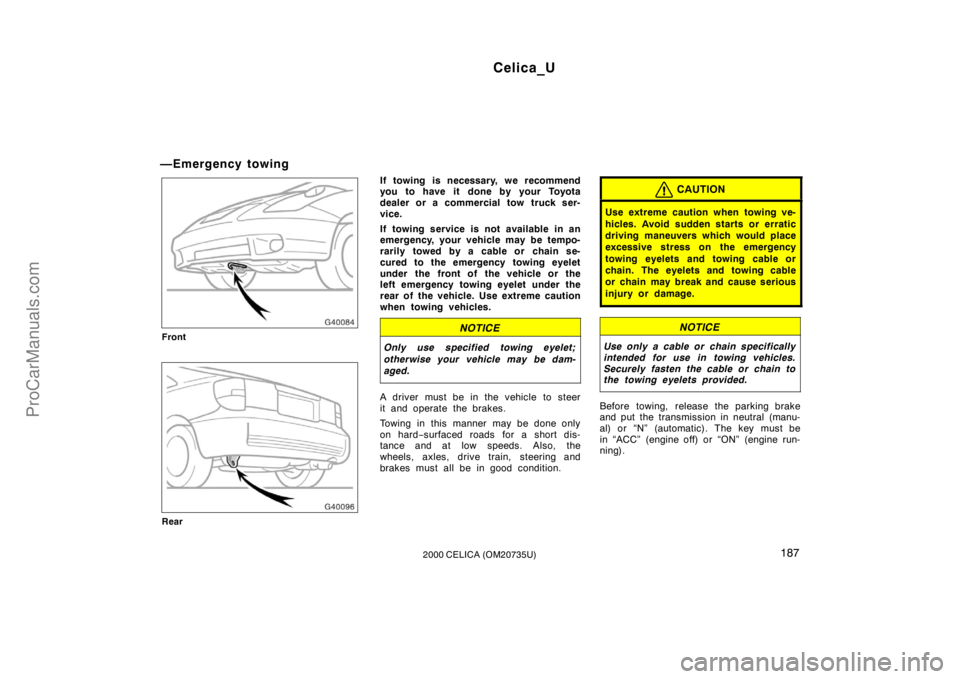
—Emergency towing
Front
Rear
If towing is necessary, we recommend
you to have it done by your Toyota
dealer or a commercial tow truck ser-
vice.
If towing service is not available in an
emergency, your vehicle may be tempo-
rarily towed by a cable or chain se-
cured to the emergency towing eyelet
under the front of the vehicle or the
left emergency towing eyelet under the
rear of the vehicle. Use extreme caution
when towing vehicles.
NOTICE
Only use specified towing eyelet;
otherwise your vehicle may be dam-
aged.
A driver must be in the vehicle to steer
it and operate the brakes.
Towing in this manner may be done only
on hard−surfaced roads for a short dis-
tance and at low speeds. Also, the
wheels, axles, drive train, steering and
brakes must all be in good condition.
CAUTION
Use extreme caution when towing ve-
hicles. Avoid sudden starts or erratic
driving maneuvers which would place
excessive stress on the emergency
towing eyelets and towing cable or
chain. The eyelets and towing cable
or chain may break and cause serious
injury or damage.
NOTICE
Use only a cable or chain specifically
intended for use in towing vehicles.
Securely fasten the cable or chain to
the towing eyelets provided.
Before towing, release the parking brake
and put the transmission in neutral (manu-
al) or “N” (automatic). The key must be
in “ACC” (engine off) or “ON” (engine run-
ning).
ProCarManuals.com
Page 189 of 256
Celica_U
1882000 CELICA (OM20735U)
CAUTION
If the engine is not running, the pow-
er assist for the brakes and steering
will not work so steering and braking
will be much harder than usual.
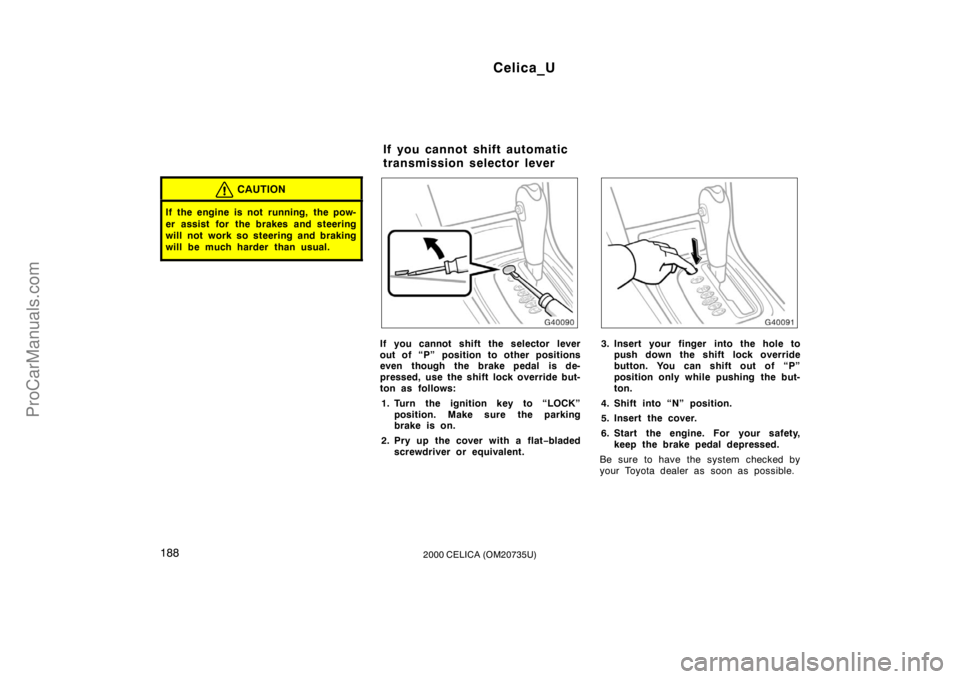
If you cannot shift the selector lever
out of “P” position to other positions
even though the brake pedal is de-
pressed, use the shift lock override but-
ton as follows:1. Turn the ignition key to “LOCK” position. Make sure the parking
brake is on.
2. Pry up the cover with a flat −bladed
screwdriver or equivalent.3. Insert your finger into the hole to push down the shift lock override
button. You can shift out of “P”
position only while pushing the but-
ton.
4. Shift into “N” position.
5. Insert the cover.
6. Start the engine. For your safety, keep the brake pedal depressed.
Be sure to have the system checked by
your Toyota dealer as soon as possible.
If you cannot shift automatic
transmission selector lever
ProCarManuals.com
Page 201 of 256

Celica_U
2002000 CELICA (OM20735U)
INSIDE THE VEHICLE
Items listed below should be checked
regularly, e.g. while performing periodic
services, cleaning the vehicle, etc.
Lights
Make sure the headlights, stop lights, tail
lights, turn signal lights, and other lights
are all working.
Service reminder indicators and warning
buzzers
Check that all service reminder indicators
and warning buzzers function properly.
Steering wheel
Be alert for changes in steering condition,
such as hard steering or strange noise.
Seats
Check that all front seat controls such as
seat adjusters, seatback recliner, etc. op-
erate smoothly and that all latches lock
securely in any position. For folding−down
rear seatbacks, check that the latches
lock securely.
Seat belts
Check that the seat belt system such as
buckles, retractors and anchors operate
properly and smoothly. Make sure the belt
webbing is not cut, frayed, worn or dam-
aged. Accelerator pedal
Check the pedal for smooth operation and
uneven pedal effort or catching.
Clutch pedal
Check the pedal for smooth operation.
Brake pedal
Check the pedal for smooth operation and
that the pedal has the proper clearance.
Check the brake booster function.
Brakes
At a safe place, check that the brakes do
not pull to one side when applied.
Parking brake
Check that the lever has the proper travel
and that, on a safe incline, your vehicle
is held securely with only the parking
brake applied.
Automatic transmission “Park” mecha-
nism
Check the lock release button of the se-
lector lever for proper and smooth opera-
tion. On a safe incline, check that your
vehicle is held securely with the selector
lever in “P” position and all brakes re-
leased.
IN THE ENGINE COMPARTMENT
Items listed below should be checked
from time to time, e.g. each time when
refueling.
Washer fluid
Make sure there is sufficient fluid in the
tank. See Section 7
−3 for additional infor-
mation.
Engine coolant level
Make sure the coolant level is between
the “FULL” and “LOW” lines on the see −
through reservoir when the engine is cold.
See Section 7 −2 for additional information.
Battery electrolyte level
Make sure the electrolyte level of all bat-
tery cells is between upper and lower lev-
el lines on the case. Add only distilled
water when replenishing. See Section 7 −3
for additional information.
Brake fluid level
Make sure the brake fluid level is correct.
See Section 7 −2 for additional information.
Engine oil level
Check the level on the dipstick with the
engine turned off and the vehicle parked
on a level spot. See Section 7 −2 for addi-
tional information.
ProCarManuals.com
Page 248 of 256

Celica_U
2472000 CELICA (OM20735U)
CLUTCH
Pedal free play, mm (in.):5—15 (0.2—0.6)
Fluid type: SAE J1703 or FMVSS No.116 DOT 3
MANUAL TRANSAXLE
Oil capacity, L (qt., Imp. qt.): 1ZZ −FE engine
1.9 (2.0, 1.7)
2ZZ −GE engine
2.3 (2.4 2.0)
Oil type: Gear oil API GL −4 or GL −5
Recommended oil viscosity: SAE 75W −90
AUTOMATIC TRANSAXLE
Fluid capacity (drain and refill),
L (qt., Imp. qt.): 1ZZ −FE engine
Up to 2.1 (2.2, 1.8)
2ZZ −GE engine
Up to 4.0 (4.2, 3.5)
Fluid type: Automatic transmission fluid Type T −IV
Change automatic transmission fluid only
as necessary. Generally, it is necessary to change auto-
matic transmission fluid only if your ve-
hicle is driven under one of the Special
Operating Conditions listed in your
“Scheduled Maintenance Guide” or “Own-
er ’s Manual Supplement”. When changing
the automatic transmission fluid, use only
Toyota Genuine ATF Type T
−IV (ATF
JWS3309) to aid in assuring optimum
transaxle performance.
Notice: Using automatic transmission
fluid other than Toyota Genuine ATF
Ty p e T −IV may cause deterioration in
shift quality, locking up of your trans-
mission accompanied by vibration, and
ultimately damage the automatic trans-
mission of your vehicle. BRAKES
Minimum pedal clearance when depressed
with the pressure of 490 N (50 kgf, 110
lbf) with the engine running, mm (in.):
85 (3.4)
Pedal free play, mm (in.): 1—6 (0.04—0.24)
Pad wear limit, mm (in.): 1.0 (0.04)
Lining wear limit, mm (in.): 1.0 (0.04)
Parking brake adjustment when pulled with
the force of 196 N (20 kgf, 44 lbf): 5—8 clicks
Fluid type: SAE J1703 or FMVSS No.116 DOT 3
STEERING
Wheel free play: Less than 30 mm (1.2 in.)
Power steering fluid type: Automatic transmission fluid DEXRON
®II
or III
ProCarManuals.com