engine coolant TOYOTA COROLLA 2009 10.G User Guide
[x] Cancel search | Manufacturer: TOYOTA, Model Year: 2009, Model line: COROLLA, Model: TOYOTA COROLLA 2009 10.GPages: 468, PDF Size: 9.31 MB
Page 318 of 468
318 4-3. Do-it-yourself maintenance
Radiator and condenserCheck the radiator and condenser and remove any foreign objects.
If any of the above parts are extr emely dirty or you are not sure of
their condition, have your vehicl e checked by your Toyota dealer.
Brake fluid
■ Checking fluid level
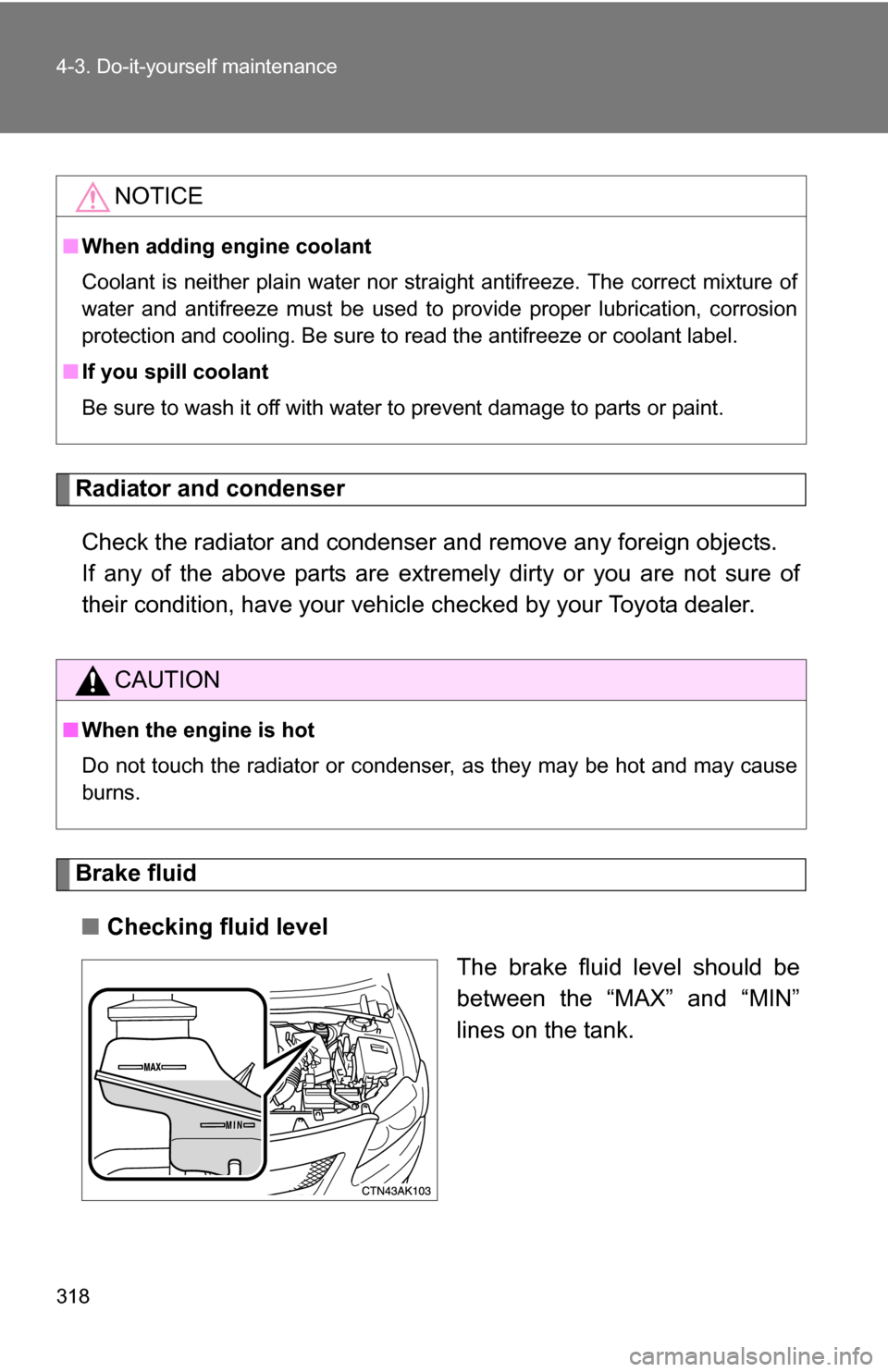
The brake fluid level should be
between the “MAX” and “MIN”
lines on the tank.
NOTICE
■When adding engine coolant
Coolant is neither plain water nor stra ight antifreeze. The correct mixture of
water and antifreeze must be used to provide proper lubrication, corrosion
protection and cooling. Be sure to read the antifreeze or coolant label.
■ If you spill coolant
Be sure to wash it off with water to prevent damage to parts or paint.
CAUTION
■When the engine is hot
Do not touch the radiator or condenser, as they may be hot and may cause
burns.
Page 373 of 468
5
When trouble arises
373
5-1. Essential information
If you think something is wrong
If you notice any of the following symptoms, your vehicle probably
needs adjustment or repair. Contact your Toyota dealer as soon as
possible.
■ Visible symptoms
●Fluid leaks under the vehicle
(Water dripping from the air cond itioning after use is normal.)
● Flat-looking tires or uneven tire wear
● Engine coolant temperature g auge needle continually points
higher than normal
■ Audible symptoms
●Changes in exhaust sound
● Excessive tire squeal when cornering
● Strange noises related to the suspension system
● Pinging or other noises related to the engine
■ Operational symptoms
●Engine missing, stumbling or running rough
● Appreciable loss of power
● Vehicle pulls heavily to one side when braking
● Vehicle pulls heavily to one side when driving on a level road
● Loss of brake effectiveness, s pongy feeling, pedal almost
touches the floor
Page 411 of 468
5
When trouble arises
411
5-2. Steps to take in an emergency
If your vehicle overheats
If your engine overheats:
Stop the vehicle in a safe place and turn off the air condi-
tioning system.
Check to see if steam is coming out from under the hood.
If you see steam: Stop the engine. Wait until the steam subsides, and then
carefully lift the hood.
If you do not see steam: Leave the engine running and carefully lift the hood.
Check to see if the cooling fans are operating.
If the fans are operating: Wait until the temperature of the engine (shown on the
instrument cluster) begins to fall and then stop the
engine.
If the fans are not operating: Stop the engine and call your Toyota dealer.
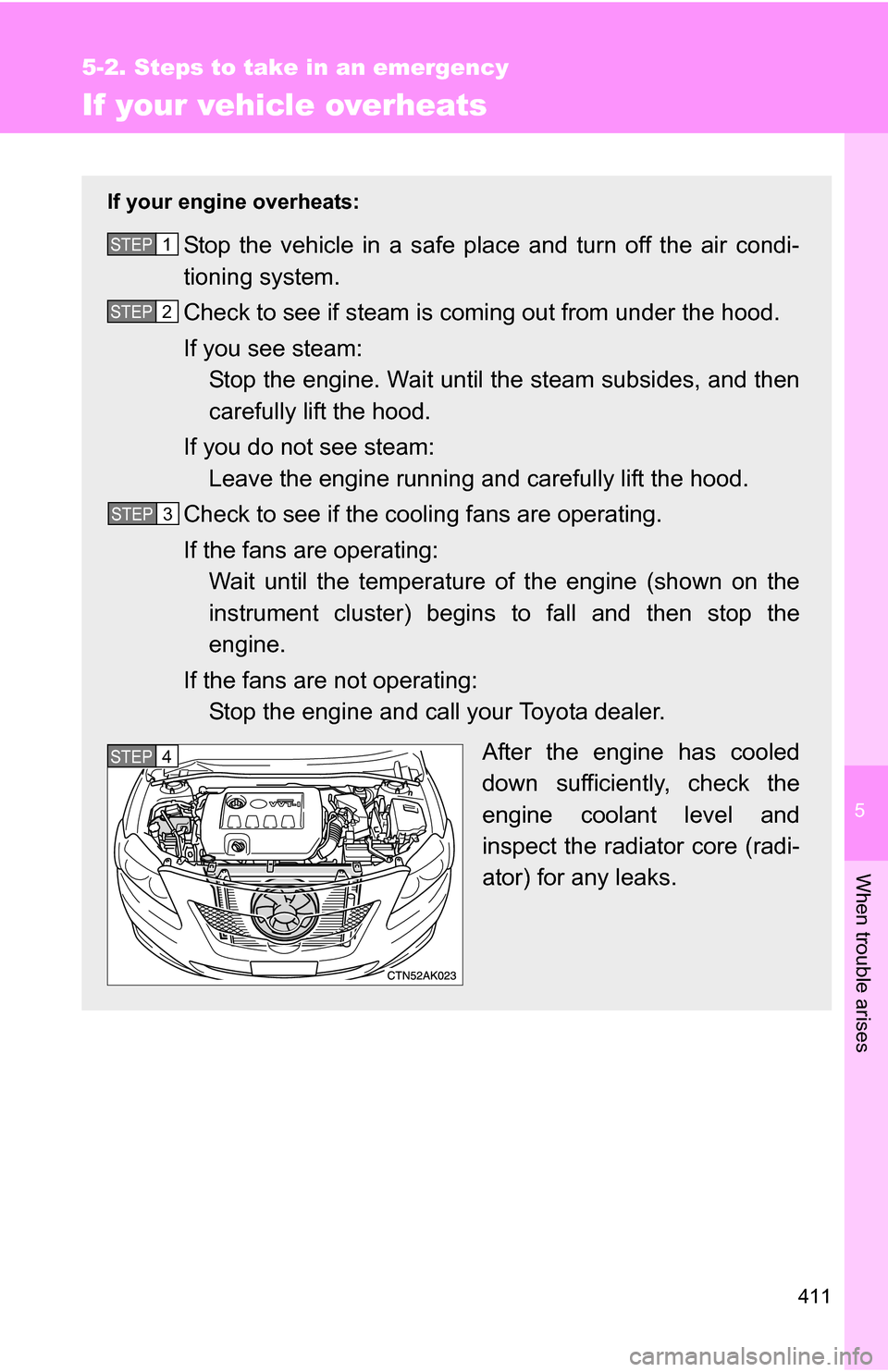
After the engine has cooled
down sufficiently, check the
engine coolant level and
inspect the radiator core (radi-
ator) for any leaks.STEP1
STEP2
STEP3
STEP5STEP4
Page 412 of 468
412 5-2. Steps to take in an emergency
■Overheating
If you observe the following, your vehicle may be overheating.
●The engine coolant temperature gauge enters the red zone or a loss of
power is experienced.
● Steam is coming from under the hood.
CAUTION
■To prevent an accident or injury when inspecting under the hood of
your vehicle
● Keep hands and clothing away from the fan and other belts while the
engine is running.
● Do not loosen the coolant reservoir cap while the engine and radiator are
hot.
Serious injury, such as burns, may result from hot coolant and steam
released under pressure.
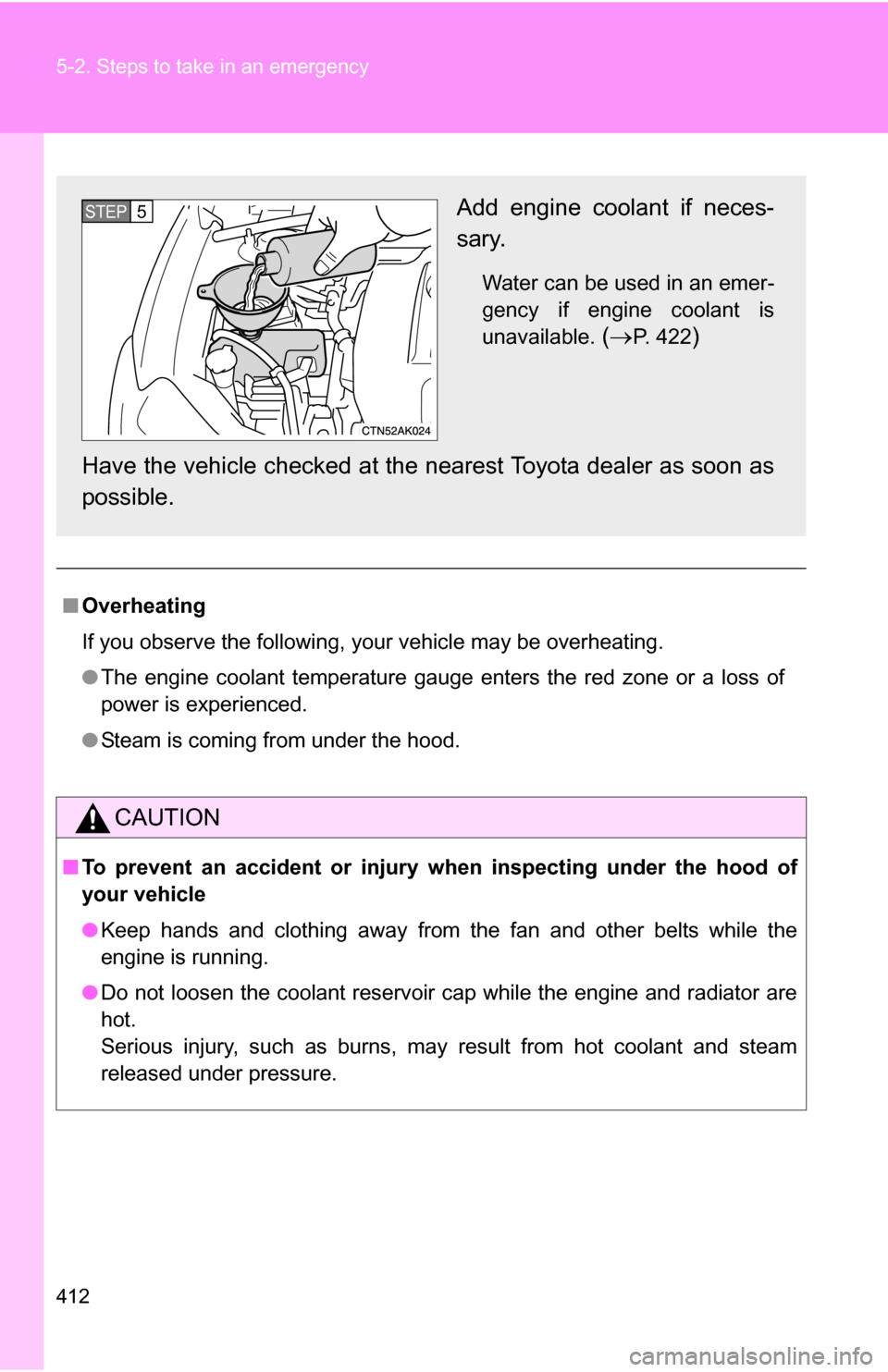
Add engine coolant if neces-
sary.
Water can be used in an emer-
gency if engine coolant is
unavailable.
(P. 422)
Have the vehicle chec ked at the nearest Toyota dealer as soon as
possible.
STEP5
Page 413 of 468
5
When trouble arises
413
5-2. Steps to take in an emergency
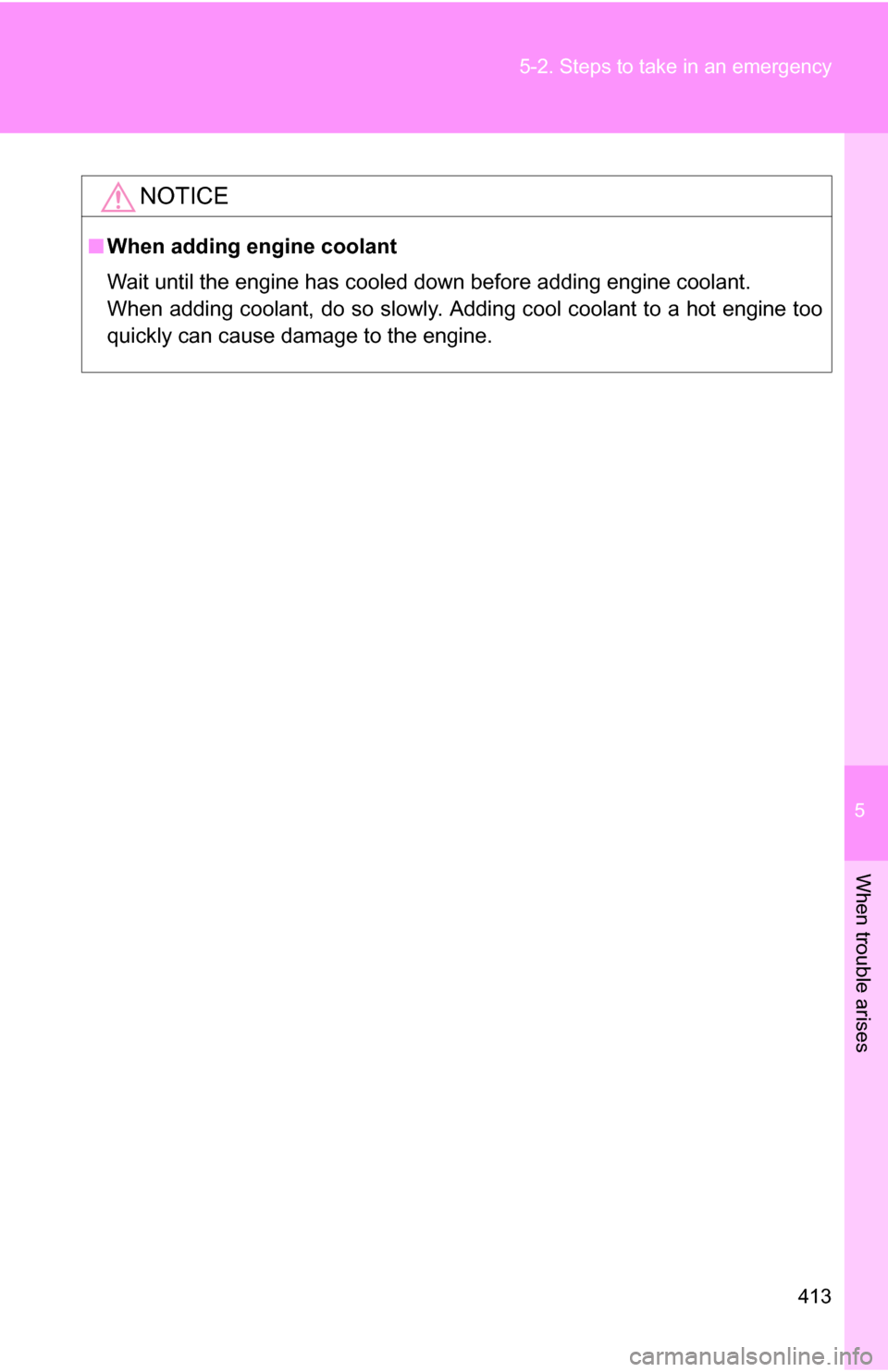
NOTICE
■
When adding engine coolant
Wait until the engine has cooled down before adding engine coolant.
When adding coolant, do so slowly. Adding cool coolant to a hot engine too
quickly can cause damage to the engine.
Page 422 of 468
422 6-1. Specifications
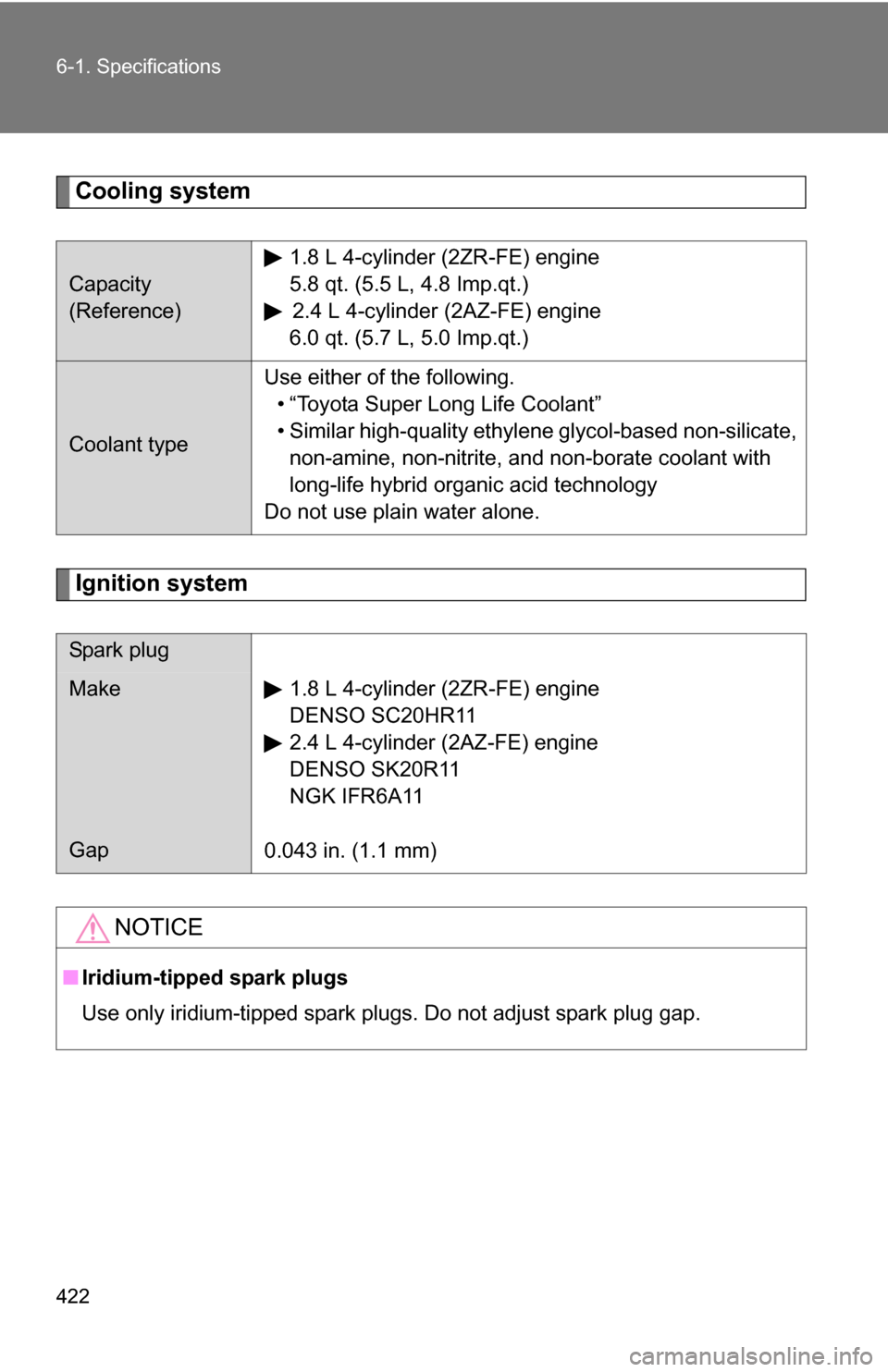
Cooling system
Ignition system
Capacity
(Reference)1.8 L 4-cylinder (2ZR-FE) engine
5.8 qt. (5.5 L, 4.8 Imp.qt.)
2.4 L 4-cylinder (2AZ-FE) engine
6.0 qt. (5.7 L, 5.0 Imp.qt.)
Coolant type Use either of the following.
• “Toyota Super Long Life Coolant”
• Similar high-quality ethylene glycol-based non-silicate, non-amine, non-nitrite, and non-borate coolant with
long-life hybrid organic acid technology
Do not use plain water alone.
Spark plug
Make
Gap 1.8 L 4-cylinder (2ZR-FE) engine
DENSO SC20HR11
2.4 L 4-cylinder (2AZ-FE) engine
DENSO SK20R11
NGK IFR6A11
0.043 in. (1.1 mm)
NOTICE
■ Iridium-tipped spark plugs
Use only iridium-tipped spark plugs. Do not adjust spark plug gap.
Page 437 of 468
437
6-1. Specifications
6
Vehicle specifications
Warning: The temperature grades for this tire are established for a
tire that is properly inflated and not overloaded.
Excessive speed, underinflation, or
excessive loading, either sepa-
rately or in combination, can caus e heat buildup and possible tire fail-
ure.
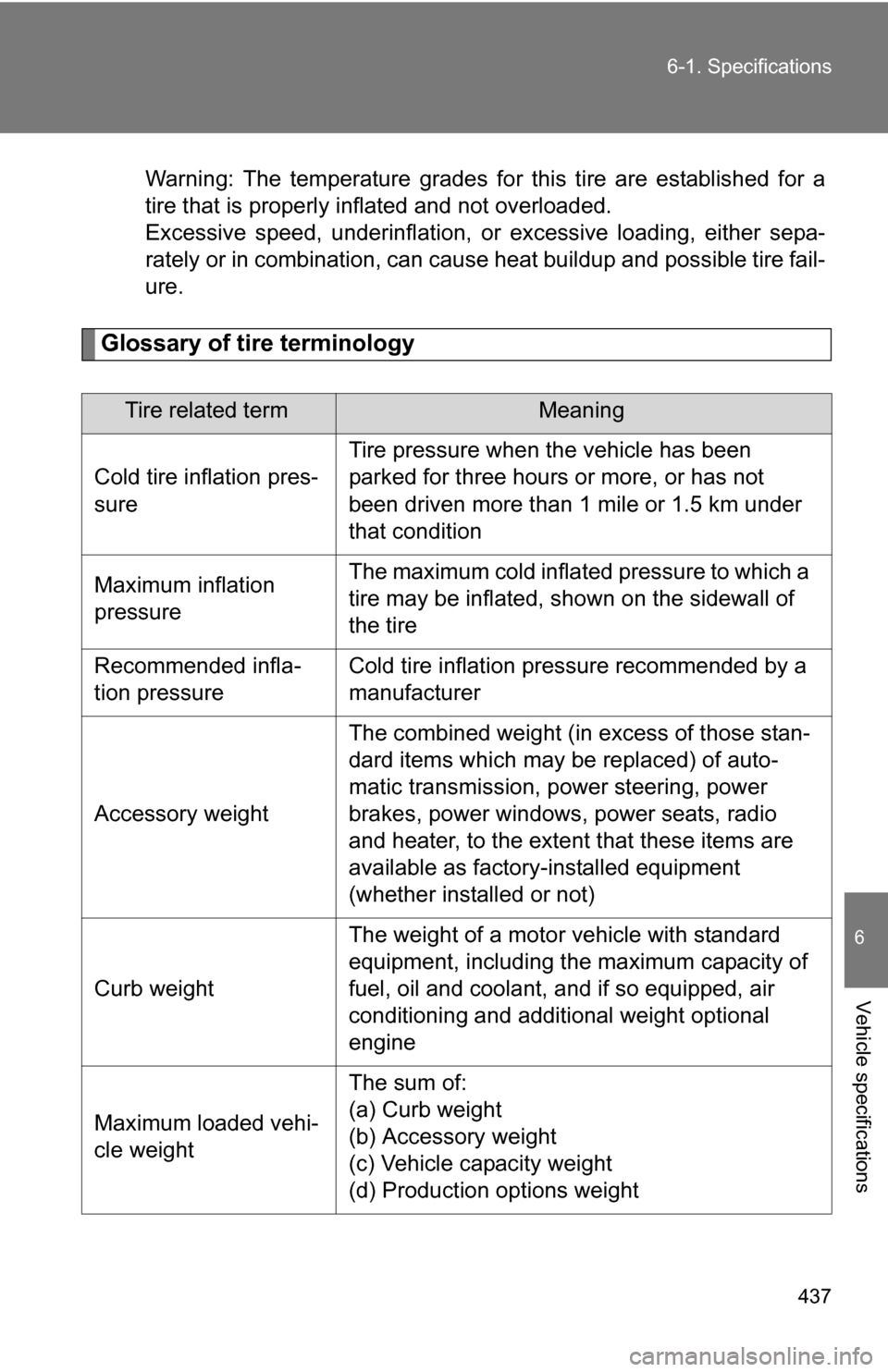
Glossary of tire terminology
Tire related termMeaning
Cold tire inflation pres-
sure Tire pressure when the vehicle has been
parked for three hours or more, or has not
been driven more than 1 mile or 1.5 km under
that condition
Maximum inflation
pressure The maximum cold inflated
pressure to which a
tire may be inflated, s hown on the sidewall of
the tire
Recommended infla-
tion pressure Cold tire inflation pressure recommended by a
manufacturer
Accessory weight The combined weight (in excess of those stan-
dard items which may be replaced) of auto-
matic transmission, power steering, power
brakes, power windows, power seats, radio
and heater, to the extent that these items are
available as factory-installed equipment
(whether installed or not)
Curb weight The weight of a motor vehicle with standard
equipment, including the maximum capacity of
fuel, oil and coolant, and if so equipped, air
conditioning and additional weight optional
engine
Maximum loaded vehi-
cle weight The sum of:
(a) Curb weight
(b) Accessory weight
(c) Vehicle capacity weight
(d) Production options weight
Page 459 of 468
459
Alphabetical index
Daytime running light
system ................................... 151
Defogger Rear window......................... 197
Side mirror ............................ 197
Dimension ................................ 416
Dinghy towing .................. 178,179
Display Trip information .................... 146
Do-it-yourself maintenance .... 301
Doors Door glasses .......................... 66
Door lock .................... 22, 34, 38
Side mirrors ............................ 64
Driver's seat belt reminder light ........................................ 379
Driving
Break-in tips ......................... 114
Correct posture....................... 78
Procedures ........................... 112
Winter driving tips ................. 166
Electric power steering........... 158
Electronic key If your electronic key
battery is discharged .......... 403
Emergency, in case of If a warning light turns on ..... 377
If the electronic key does
not operate properly ........... 403
If the engine will not start...... 399
If the shift lever cannot be
shifted from P ..................... 401
If the vehicle has a
discharged battery ............. 405
If the warning buzzer sounds ............................... 377 If you have a flat tire .............388
If you lose your keys .............402
If you think something is
wrong ..................................373
If your vehicle becomes
stuck ...................................414
If your vehicle needs to be towed ..................................368
If your vehicle overheats .......411
Engine Compartment ........................310
Engine switch ................122, 126
Hood......................................305
How to start the
engine .........................122, 126
Identification number .............416
If the engine will not start ......399
Ignition switch................122, 126
Overheating...........................411
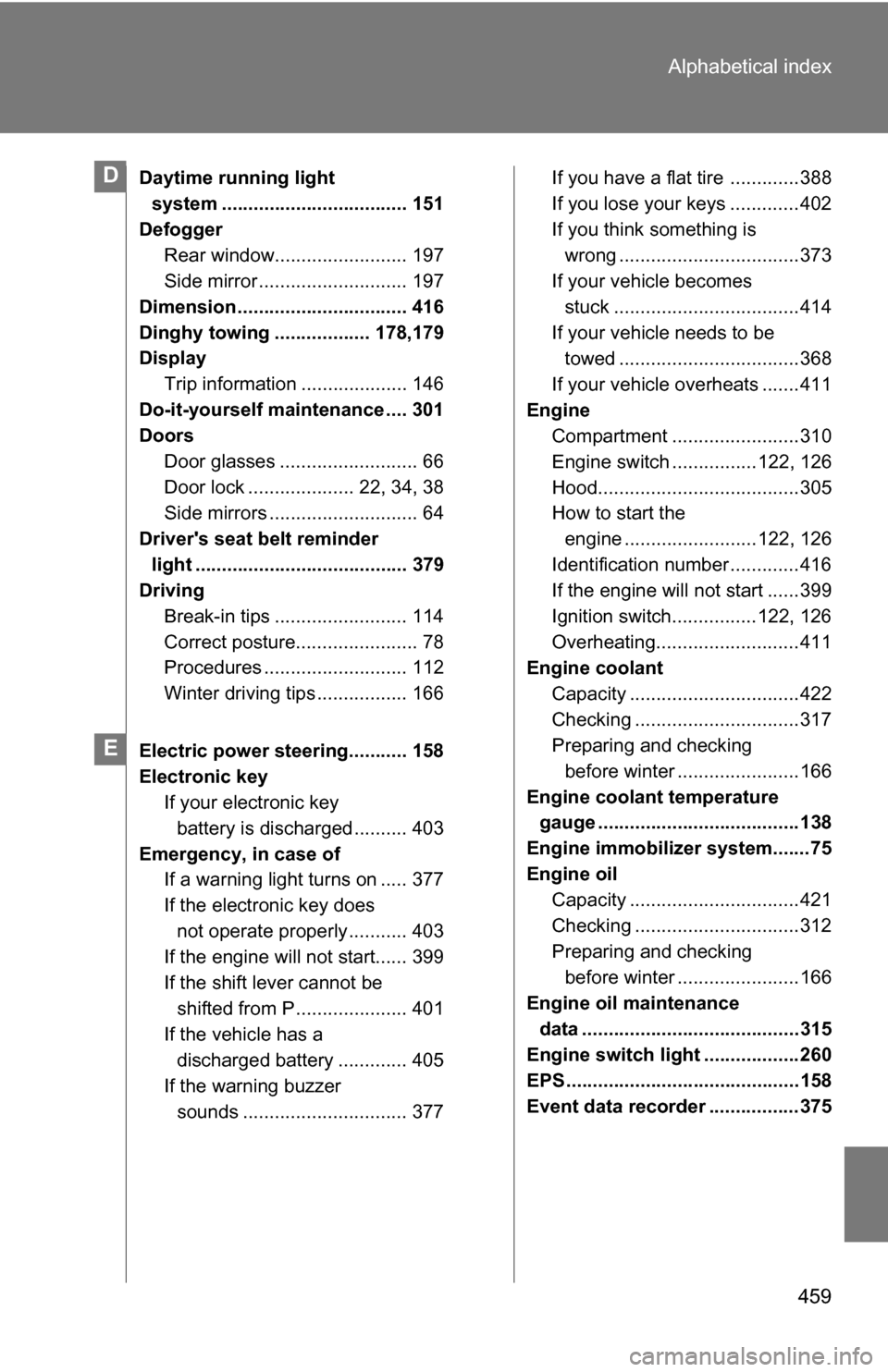
Engine coolant
Capacity ................................422
Checking ...............................317
Preparing and checking before winter .......................166
Engine coolan t temperature
gauge ......................................138
Engine immobilizer system.......75
Engine oil Capacity ................................421
Checking ...............................312
Preparing and checking before winter .......................166
Engine oil maintenance data .........................................315
Engine switch light ..................260
EPS ............................................158
Event data recorder .................375D
E
Page 465 of 468
465
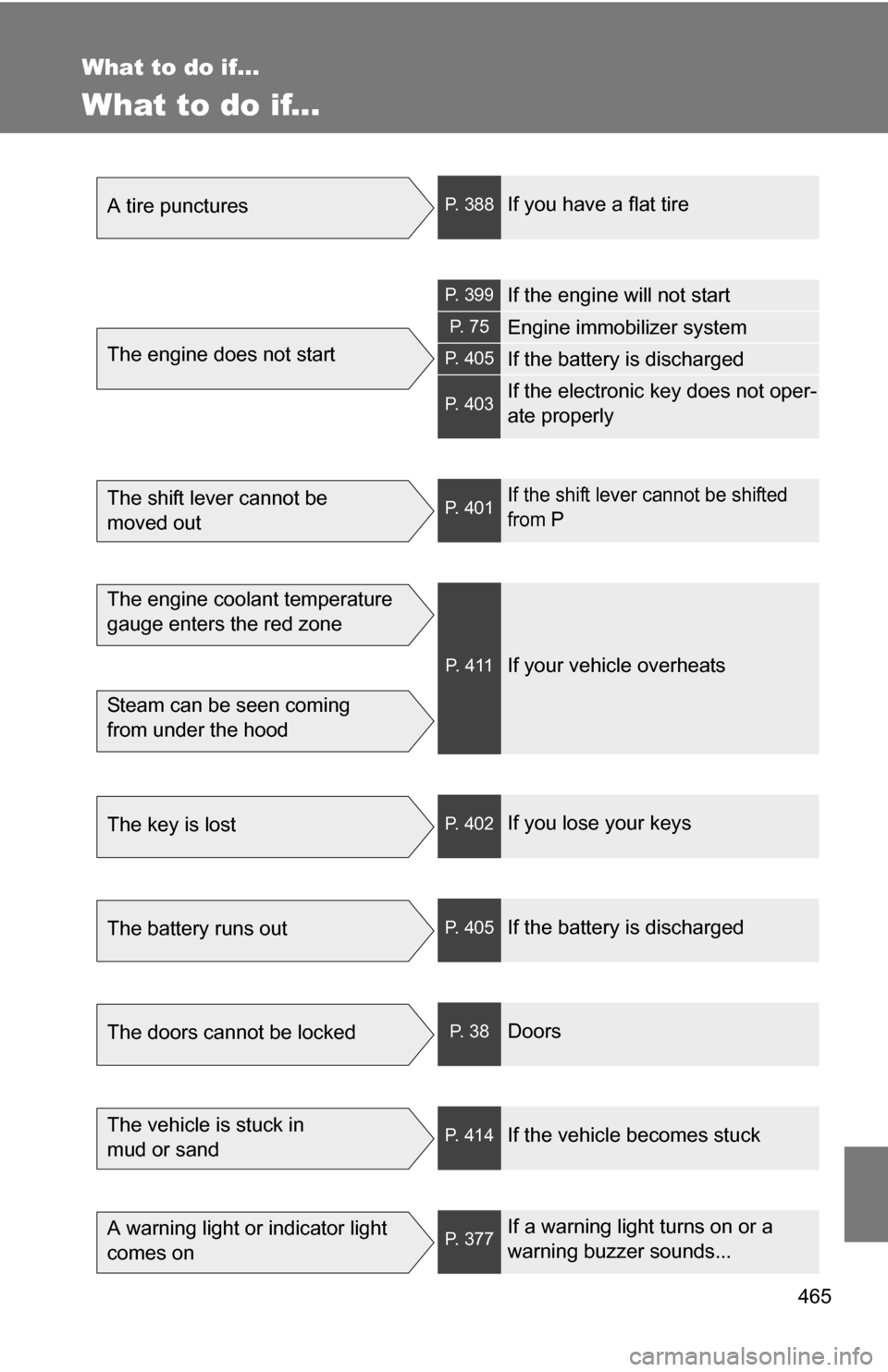
What to do if...
What to do if...
A tire puncturesP. 388If you have a flat tire
The engine does not start
P. 399If the engine will not start
P. 7 5Engine immobilizer system
P. 405If the battery is discharged
P. 403If the electronic key does not oper-
ate properly
The shift lever cannot be
moved outP. 401If the shift lever cannot be shifted
from P
The engine coolant temperature
gauge enters the red zone
Steam can be seen coming
from under the hood
P. 4 1 1If your vehicle overheats
The key is lostP. 402If you lose your keys
The battery runs outP. 405If the battery is discharged
The doors cannot be lockedP. 3 8Doors
The vehicle is stuck in
mud or sandP. 414If the vehicle becomes stuck
A warning light or indicator light
comes onP. 377If a warning light turns on or a
warning buzzer sounds...