tires TOYOTA COROLLA 2016 11.G User Guide
[x] Cancel search | Manufacturer: TOYOTA, Model Year: 2016, Model line: COROLLA, Model: TOYOTA COROLLA 2016 11.GPages: 620, PDF Size: 9.12 MB
Page 223 of 620

2234-6. Driving tips
4
Driving
COROLLA_TMMMS_TMMC_U (OM12J84U)
nTire chain installation
Observe the following precautions when installing and removing chains:
lInstall and remove tire chains in a safe location.
l Install tire chains on the front tires. Do not install tire chains on the rear tires.
l Install tire chains on front tires as tightly as possible. Retighten chains after
driving 1/4 1/2 mile (0.5 1.0 km).
l Install tire chains following the instructions provided with the tire chains.
CAUTION
n Driving with snow tires
Observe the following precautions to reduce the risk of accidents.
Failure to do so may result in a loss of vehicle control and cause death or
serious injury.
lUse tires of the size specified.
l Maintain the recommended level of air pressure.
l Do not drive in excess of 75 mph (120 km/h), regardless of the type of
snow tires being used.
l Use snow tires on all, not just some wheels.
n Driving with tire chains
Observe the following precautions to reduce the risk of accidents.
Failure to do so may result in the vehicle being unable to be driven safely,
and may cause death or serious injury.
lDo not drive in excess of the speed limit specified for the tire chains being
used, or 30 mph (50 km/h), whichever is lower.
l Avoid driving on bumpy road surfaces or over potholes.
l Avoid sudden acceleration, abrupt steering, sudden braking and shifting
operations that cause sudden engine braking.
l Slow down sufficiently before entering a curve to ensure that vehicle con-
trol is maintained.
NOTICE
nRepairing or replacing snow tires (vehicles with a tire pressure warn-
ing system)
Request repairs or replacement of snow tires from Toyota dealers or legiti-
mate tire retailers.
This is because the removal and attachment of snow tires affects the opera-
tion of the tire pressure warning valves and transmitters.
n Fitting tire chains (vehicles with a tire pressure warning system)
The tire pressure warning valves and transmitters may not function correctly
when tire chains are fitted.
Page 419 of 620

419
7Maintenance and care
COROLLA_TMMMS_TMMC_U (OM12J84U)7-1. Maintenance and care
Cleaning and protecting the vehicle exterior .......... 420
Cleaning and protecting the vehicle interior ........... 423
7-2. Maintenance Maintenance requirements ................... 426
General maintenance........ 429
Emission inspection and maintenance (I/M)
programs ......................... 433
7-3. Do-it-yourself maintenance
Do-it-yourself service precautions ..................... 434
Hood ................................. 437
Positioning a floor jack ...... 439
Engine compartment ......... 441
Tires .................................. 454
Tire inflation pressure ....... 462
Wheels .............................. 465
Air conditioning filter.......... 467
Wireless remote control/ electronic key battery ...... 469
Checking and replacing fuses ............................... 472
Light bulbs......................... 475
Page 432 of 620

4327-2. Maintenance
COROLLA_TMMMS_TMMC_U (OM12J84U)
Vehicle exterior
ItemsCheck points
Doors/trunk• Do the doors/trunk operatesmoothly?
Engine hood• Does the engine hood lock systemwork properly?
Fluid leaks
• There should not be any signs offluid leakage after the vehicle has
been parked.
Tires
• Is the tire inflation pressure cor-rect?
• The tires should not be dam- aged or excessively worn.
• Have the tires been rotated
according to the maintenance
schedule?
• The wheel nuts should not be
loose.
Windshield wipers
• The wiper blades should not show
any signs of cracking, splitting,
wear, contamination or deforma-
tion.
• The wiper blades should clear the windshield without streaking or
skipping.
CAUTION
nIf the engine is running
Turn the engine off and ensure that there is adequate ventilation before per-
forming maintenance checks.
Page 454 of 620

4547-3. Do-it-yourself maintenance
COROLLA_TMMMS_TMMC_U (OM12J84U)
Check if the treadwear indicators are showing on the tires. Also check
the tires for uneven wear, such as excessive wear on one side of the
tread.
Check the spare tire condition and pressure if not rotated.
New tread
Worn tread
Treadwear indicator
The location of treadwear indicators is shown by a “TWI” or “ ” mark,
etc., molded into the sidewall of each tire.
Replace the tires if the treadwear indicators are showing on a tire.
Rotate the tires in the order
shown.
To equalize tire wear and extend
tire life, Toyota recommends that
tire rotation is carried out at the
same interval as tire inspection.
Tires
Replace or rotate tires in acco rdance with maintenance sched-
ules and treadwear.
Checking tires
Tire rotation
1
2
3
Front
Page 455 of 620
4557-3. Do-it-yourself maintenance
7
Maintenance and care
COROLLA_TMMMS_TMMC_U (OM12J84U)
Your vehicle is equipped with a tire pressure warning system that uses
tire pressure warning valves and tr ansmitters to detect low tire infla-
tion pressure before serious problems arise. ( P. 498)
uInstalling tire pressure warning valves and transmitters
When replacing tires or wheels, tire pressure warning valves and
transmitters must also be installed.
When new tire pressure warning valves and transmitters are
installed, new ID codes must be registered in the tire pressure
warning computer and the tire pr essure warning system must be
initialized. Have tire pressure warning valves and transmitter ID
codes registered by your Toyota dealer. ( P. 457)
uInitializing the tire pressure warning system
nThe tire pressure warning system must be initialized in the fol-
lowing circumstances:
l When changing the tire size.
l When the tire inflation pressure is changed such as when chang-
ing traveling speed or load weight.
When the tire pressure warning system is initialized, the current tire
inflation pressure is set as the benchmark pressure.
Tire pressure warning system (if equipped)
Page 457 of 620
4577-3. Do-it-yourself maintenance
7
Maintenance and care
COROLLA_TMMMS_TMMC_U (OM12J84U)
uRegistering ID codes
The tire pressure warning valve and transmitter is equipped with a
unique ID code. When replacing a tire pressure warning valve and
transmitter, it is necessary to register the ID code. Have the ID code
registered by your Toyota dealer.
nWhen to replace your vehicle’s tires
Tires should be replaced if:
lThe treadwear indicators are showing on a tire.
lYou have tire damage such as cuts, splits, cracks deep enough to
expose the fabric, and bulges indicating internal damage
lA tire goes flat repeatedly or cannot be properly repaired due to the size
or location of a cut or other damage
If you are not sure, consult with your Toyota dealer.
nReplacing tires and wheels (vehicles with a tire pressure warning
system)
If the ID code of the tire pressure warning valve and transmitter is not reg-
istered, the tire pressure warning system will not work properly. After driv-
ing for about 20 minutes, the tire pressure warning light blinks for 1
minute and stays on to indicate a system malfunction.
nTire life
Any tire over 6 years old must be checked by a qualified technician even
if it has seldom or never been used or damage is not obvious.
nRoutine tire inflation pressure checks (vehicles with a tire pressure
warning system)
The tire pressure warning system does not replace routine tire inflation
pressure checks. Make sure to check tire inflation pressure as part of
your routine of daily vehicle checks.
nLow profile tires (17-inch tires)
Generally, low profile tires will wear mo re rapidly and tire grip perfor-
mance will be reduced on snowy and /or icy roads when compared to
standard tires. Be sure to use snow tires or tire chains on snowy and/or
icy roads and drive carefully at a speed appropriate for road and weather
conditions.
Page 458 of 620
4587-3. Do-it-yourself maintenance
COROLLA_TMMMS_TMMC_U (OM12J84U)n
Maximum load of tire
Check that the maximum load of the re
placement tire is greater than 1/2
of the Gross Axle Weight Ratings (GAWR) of either the front axle or the
rear axle, whichever is greater.
nTire types
lSummer tires
Summer tires are high-speed performance tires best suited to highway
driving under dry conditions. Since summer tires do not have the same
traction performance as snow tires, summer tires are inadequate for
driving on snow-covered or icy ro ads. For driving on snow-covered
roads or icy roads, the use of snow tires is recommended. When install-
ing snow tires, be sure to replace all four tires.
lAll season tires
All season tires are designed to provide better traction in snow and to
be adequate for driving in most winter conditions as well as for use
year-round. All season tires, however, do not have adequate traction
performance compared with snow tires in heavy or loose snow. Also, all
season tires fall short in acceleration and handling performance com-
pared with summer tires in highway driving.
lSnow tires
For driving on snow-covered roads or icy roads, we recommend using
snow tires. If you need snow tires, select tires of the same size, con-
struction and load capacity as the or iginally installed tires. Since your
vehicle has radial tires as original equipment, make sure your snow
tires also have radial construction. Do not install studded tires without
first checking local regulations fo r possible restrictions. Snow tires
should be installed on all wheels. ( P. 221)
nInitializing the tire pressure warn ing system (vehicles with a tire
pressure warning system)
Initialize the system with the tire infl ation pressure adjusted to the speci-
fied level.
nIf the tread on snow tires wears down below 0.16 in. (4 mm)
The effectiveness of the tire s as snow tires is lost.
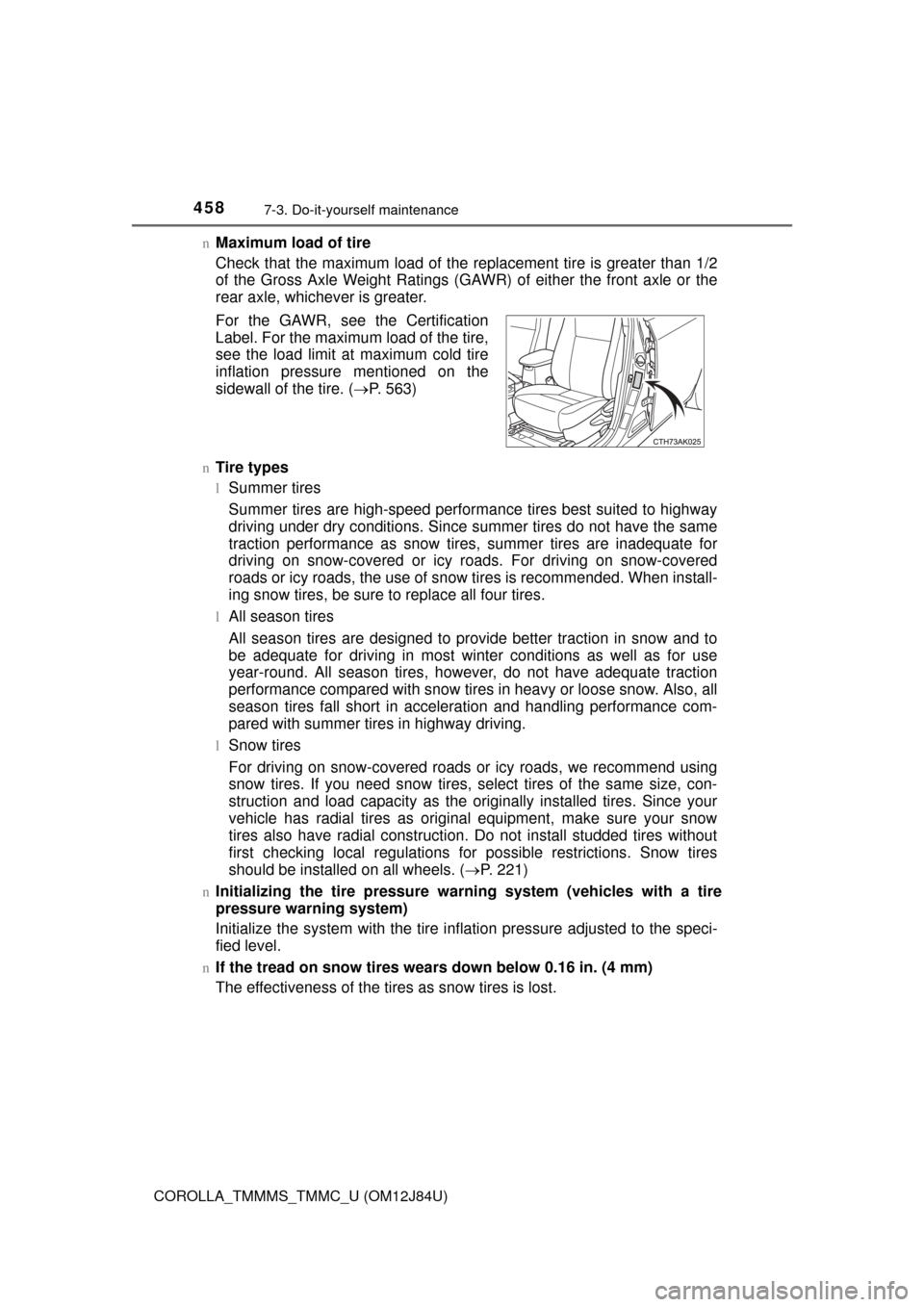
For the GAWR, see the Certification
Label. For the maximum load of the tire,
see the load limit at maximum cold tire
inflation pressure mentioned on the
sidewall of the tire. (
P. 563)
Page 460 of 620

4607-3. Do-it-yourself maintenance
COROLLA_TMMMS_TMMC_U (OM12J84U)
CAUTION
nWhen inspecting or replacing tires
Observe the following precautions to prevent accidents.
Failure to do so may cause damage to parts of the drive train as well as
dangerous handling characteristics, which may lead to an accident
resulting in death or serious injury.
lDo not mix tires of different makes, models or tread patterns.
Also, do not mix tires of remarkably different treadwear.
lDo not use tire sizes other than those recommended by Toyota.
lDo not mix differently constructed ti res (radial, bias-belted or bias-ply
tires).
lDo not mix summer, all season and snow tires.
lDo not use tires that have been used on another vehicle.
Do not use tires if you do not know how they were used previously.
nWhen initializing the tire pressure warning system (vehicles with a
tire pressure warning system)
Do not operate the tire pressure warning reset switch without first
adjusting the tire inflation pressure to the specified level. Otherwise, the
tire pressure warning light may not come on even if the tire inflation
pressure is low, or it may come on when the tire inflation pressure is
actually normal.
Page 461 of 620

4617-3. Do-it-yourself maintenance
7
Maintenance and care
COROLLA_TMMMS_TMMC_U (OM12J84U)
NOTICE
nRepairing or replacing tires, wheels, tire pressure warning valves,
transmitters and tire valve caps (vehicles with a tire pressure warn-
ing system)
lWhen removing or fitting the wheels, tires or the tire pressure warning
valves and transmitters, contact your Toyota dealer as the tire pres-
sure warning valves and transmitters may be damaged if not handled
correctly.
lWhen replacing tire valve caps, do not use tire valve caps other than
those specified. The cap may become stuck.
nTo avoid damage to the tire pressure warning valves and transmit-
ters (vehicles with a tire pressure warning system)
When a tire is repaired with liquid sealants, the tire pressure warning
valve and transmitter may not operate properly. If a liquid sealant is
used, contact your Toyota dealer or other qualified service shop as soon
as possible. Make sure to replace the tire pressure warning valve and
transmitter when replacing the tire. ( P. 455)
nDriving on rough roads
Take particular care when driving on roads with loose surfaces or pot-
holes.
These conditions may cause losses in tire inflation pressure, reducing
the cushioning ability of the tires. In addition, driving on rough roads
may cause damage to the tires themselves, as well as the vehicle’s
wheels and body.
nLow profile tires (17-inch tires)
Low profile tires may cause greater damage than usual to the tire wheel
when sustaining impact from the road surface. Therefore, pay attention
to the following:
lBe sure to use proper tire inflation pressure. If tires are under-inflated,
they may be damaged more severely.
lAvoid potholes, uneven pavement, curbs and other road hazards. Fail-
ure to do so may lead to severe tire and wheel damage.
nIf tire inflation pressure of e ach tire becomes low while driving
Do not continue driving, or your tires and/or wheels may be ruined.
Page 464 of 620

4647-3. Do-it-yourself maintenance
COROLLA_TMMMS_TMMC_U (OM12J84U)n
Instructions for checking tire inflation pressure
When checking tire inflation pressure, observe the following:
lCheck only when the tires are cold.
If your vehicle has been parked for at least 3 hours or has not been
driven for more than 1 mile or 1.5 km, you will get an accurate cold tire
inflation pressure reading.
lAlways use a tire pressure gauge.
It is difficult to judge if a tire is properly inflated based only on its appear-
ance.
lIt is normal for the tire inflation pressure to be higher after driving as
heat is generated in the tire. Do not
reduce tire inflation pressure after
driving.
lNever exceed the vehicle capacity weight.
Passengers and luggage weight should be placed so that the vehicle is
balanced.
CAUTION
nProper inflation is critical to save tire performance
Keep your tires properly inflated.
If the tires are not properly inflated, the following conditions may occur
which could lead to an accident resulting in death or serious injury:
lExcessive wear
lUneven wear
lPoor handling
lPossibility of blowouts result ing from overheated tires
lAir leaking from between tire and wheel
lWheel deformation and/or tire damage
lGreater possibility of tire damage while driving (due to road hazards,
expansion joints, sharp edges in the road, etc.)
NOTICE
nWhen inspecting and adjusting tire inflation pressure
Be sure to put the tire valve caps back on.
If a valve cap is not installed, dirt or moisture may get into the valve and
cause an air leak, resulting in decreased tire inflation pressure.