Vent TOYOTA COROLLA 2016 11.G Owners Manual
[x] Cancel search | Manufacturer: TOYOTA, Model Year: 2016, Model line: COROLLA, Model: TOYOTA COROLLA 2016 11.GPages: 620, PDF Size: 9.12 MB
Page 10 of 620

10
COROLLA_TMMMS_TMMC_U (OM12J84U)This vehicle is equipped with an event data recorder (EDR). The main pur-
pose of an EDR is to record, in certain crash or near crash-like situations,
such as an air bag deployment or hitting a road obstacle, data that will assist
in understanding how a vehicle’s systems performed. The EDR is designed to
record data related to vehicle dynamics and safety systems for a short period
of time, typically 30 seconds or less.
The EDR in this vehicle is designed to record such data as:
• How various systems in your vehicle were operating;
• Whether or not the driver and passenger safety belts were buckled/fas- tened;
• How far (if at all) the driver was depressing the accelerator and/or brake pedal; and,
• How fast the vehicle was traveling.
These data can help provide a better understanding of the circumstances in
which crashes and injuries occur.
NOTE: EDR data are recorded by your vehicle only if a non-trivial crash situ-
ation occurs; no data are recorded by the EDR under normal driving condi-
tions and no personal data (e.g., name, gender, age, and crash location) are
recorded. However, other parties, such as law enforcement, could combine
the EDR data with the type of personally identifying data routinely acquired
during a crash investigation.
To read data recorded by an EDR, special equipment is required, and access
to the vehicle or the EDR is needed. In addition to the vehicle manufacturer,
other parties, such as law enforcement, that have the special equipment, can
read the information if they have access to the vehicle or the EDR.
lDisclosure of the EDR data
Toyota will not disclose the data recorded in an EDR to a third party except
when:
• An agreement from the vehicle’s owner (or the lessee for a leased vehi- cle) is obtained
• In response to an official request by the police, a court of law or a govern-
ment agency
• For use by Toyota in a law suit
However, if necessary, Toyota may:
• Use the data for research on vehicle safety performance
• Disclose the data to a third party for research purposes without disclosing information about the specific vehicle or vehicle owner
Event data recorder
Page 27 of 620
271-1. For safe use
1
For safety and security
COROLLA_TMMMS_TMMC_U (OM12J84U)
Make sure that you can see backward clearly by adjusting the inside
and outside rear view mirrors properly. ( P. 133, 135)
Adjusting the mirrors
CAUTION
Observe the following precautions.
Failure to do so may result in death or serious injury.
lDo not adjust the position of the driver’s seat while driving.
Doing so could cause the driver to lose control of the vehicle.
l Do not place a cushion between the driver or passenger and the seatback.
A cushion may prevent correct posture from being achieved, and reduce
the effectiveness of the seat belt and head restraint.
l Do not place anything under the front seats.
Objects placed under the front seats may become jammed in the seat
tracks and stop the seat from locking in place. This may lead to an acci-
dent and the adjustment mechanism may also be damaged.
l When driving over long distances, take regular breaks before you start to
feel tired.
Also, if you feel tired or sleepy while driving, do not force yourself to con-
tinue driving and take a break immediately.
Page 29 of 620
291-1. For safe use
1
For safety and security
COROLLA_TMMMS_TMMC_U (OM12J84U)
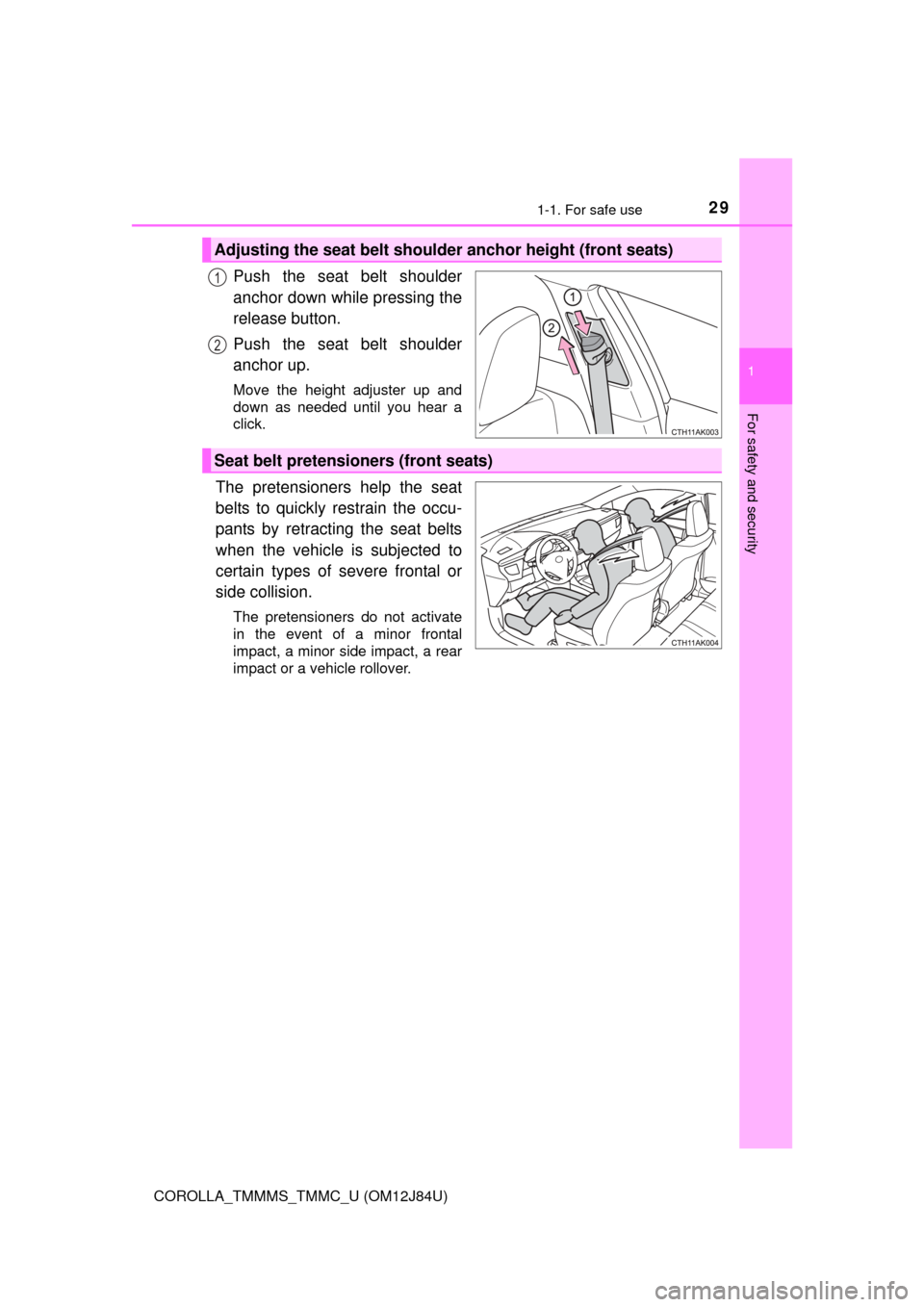
Push the seat belt shoulder
anchor down while pressing the
release button.
Push the seat belt shoulder
anchor up.
Move the height adjuster up and
down as needed until you hear a
click.
The pretensioners help the seat
belts to quickly restrain the occu-
pants by retracting the seat belts
when the vehicle is subjected to
certain types of severe frontal or
side collision.
The pretensioners do not activate
in the event of a minor frontal
impact, a minor side impact, a rear
impact or a vehicle rollover.
Adjusting the seat belt shoulder anchor height (front seats)
1
2
Seat belt pretensioners (front seats)
Page 31 of 620
311-1. For safe use
1
For safety and security
COROLLA_TMMMS_TMMC_U (OM12J84U)
CAUTION
Observe the following precautions to reduce the risk of injury in the event of
sudden braking, sudden swerving or an accident.
Failure to do so may cause death or serious injury.
nWearing a seat belt
lEnsure that all passengers wear a seat belt.
l Always wear a seat belt properly.
l Each seat belt should be used by one person only. Do not use a seat belt
for more than one person at once, including children.
l Toyota recommends that children be seated in the rear seat and always
use a seat belt and/or an appropriate child restraint system.
l To achieve a proper seating position, do not recline the seat more than
necessary. The seat belt is most effective when the occupants are sitting
up straight and well back in the seats.
l Do not wear the shoulder belt under your arm.
l Always wear your seat belt low and snug across your hips.
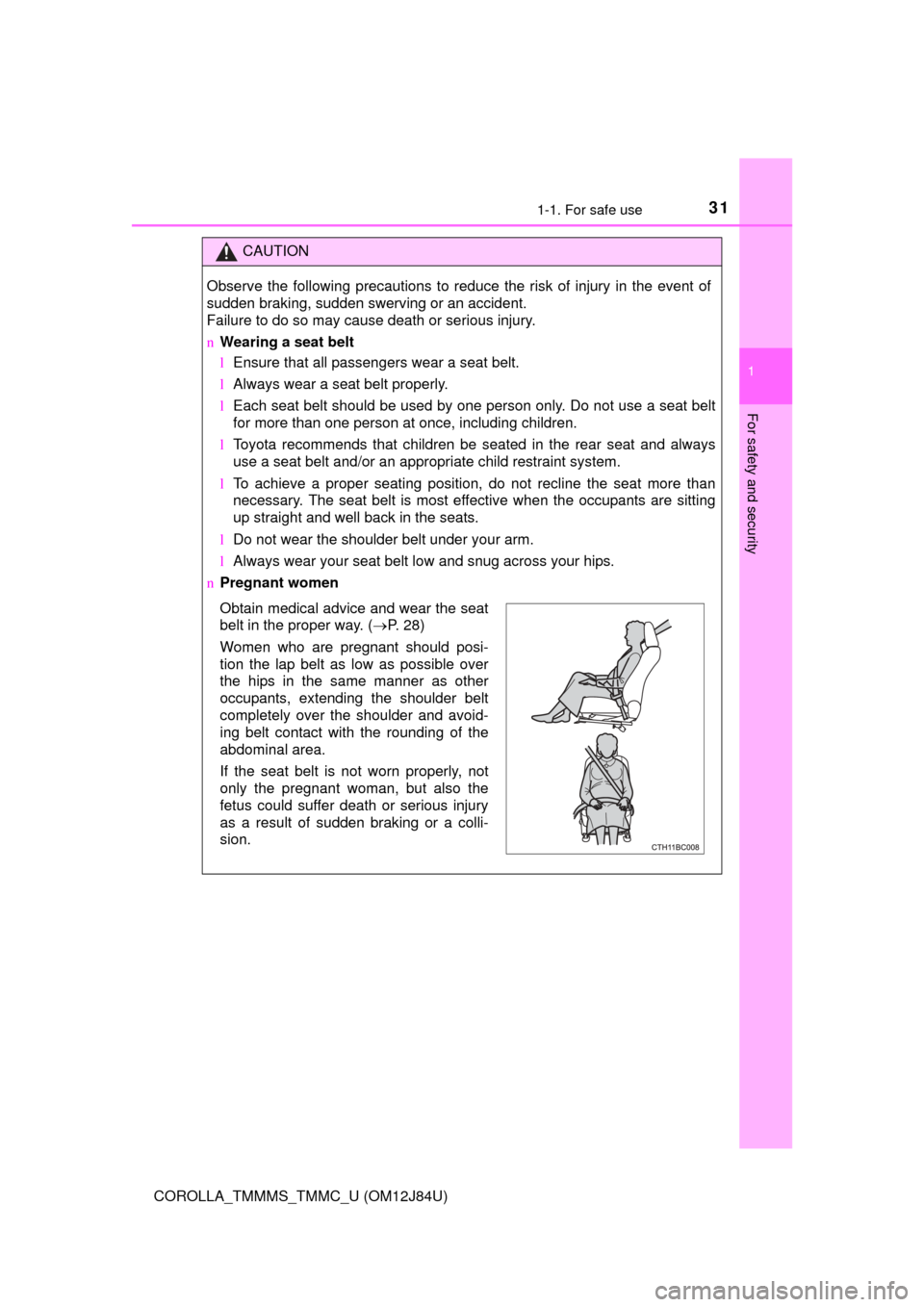
n Pregnant women
Obtain medical advice and wear the seat
belt in the proper way. ( P. 28)
Women who are pregnant should posi-
tion the lap belt as low as possible over
the hips in the same manner as other
occupants, extending the shoulder belt
completely over the shoulder and avoid-
ing belt contact with the rounding of the
abdominal area.
If the seat belt is not worn properly, not
only the pregnant woman, but also the
fetus could suffer death or serious injury
as a result of sudden braking or a colli-
sion.
Page 32 of 620
321-1. For safe use
COROLLA_TMMMS_TMMC_U (OM12J84U)
CAUTION
nPeople suffering illness
Obtain medical advice and wear the seat belt in the proper way. ( P. 28)
n When children are in the vehicle
Do not allow children to play with the seat belt. If the seat belt becomes
twisted around a child’s neck, it may lead to choking or other serious injuries
that could result in death.
If this occurs and the buckle cannot be unfastened, scissors should be used
to cut the belt.
n Seat belt pretensioners (front seats)
lDo not place anything, such as a cushion, on the front passenger's seat.
Doing so will disperse the passenger's weight, which prevents the sensor
from detecting the passenger's weight properly. As a result, the seat belt
pretensioner for the front passenger's seat may not activate in the event of
a collision.
l If the pretensioner has activated, the SRS warning light will come on. In
that case, the seat belt cannot be used again and must be replaced at
your Toyota dealer.
n Adjustable shoulder anchor (front seats)
Always make sure the shoulder belt is positioned across the center of your
shoulder. The belt should be kept away from your neck, but not falling off
your shoulder. Failure to do so could reduce the amount of protection in an
accident and cause death or serious injuries in the event of a sudden stop,
sudden swerve or accident. ( P. 29)
n Seat belt damage and wear
lDo not damage the seat belts by allowing the belt, plate, or buckle to be
jammed in the door.
l Inspect the seat belt system periodically. Check for cuts, fraying, and loose
parts. Do not use a damaged seat belt until it is replaced. Damaged seat
belts cannot protect an occupant from death or serious injury.
l Ensure that the belt and plate are locked and the belt is not twisted.
If the seat belt does not function correctly, immediately contact your Toyota
dealer.
l Replace the seat assembly, including the belts, if your vehicle has been
involved in a serious accident, even if there is no obvious damage.
l Do not attempt to install, remove, modify, disassemble or dispose of the
seat belts. Have any necessary repairs carried out by your Toyota dealer.
Inappropriate handling may lead to incorrect operation.
Page 33 of 620

CAUTION
nUsing a seat belt extender
lDo not wear the seat belt extender if you can fasten the seat belt witho\
ut
the exte")
331-1. For safe use
1
For safety and security
COROLLA_TMMMS_TMMC_U (OM12J84U)
CAUTION
nUsing a seat belt extender
lDo not wear the seat belt extender if you can fasten the seat belt witho\
ut
the extender.
l Do not use the seat belt extender when installing a child restraint system
because the belt will not securely hold the child restraint system, increas-
ing the risk of death or serious injury in the event of an accident.
l The personalized extender may not be safe on another vehicle, when
used by another person, or at a different seating position other than the
one originally intended.
NOTICE
nWhen using a seat belt extender
When releasing the seat belt, press on the buckle release button on the
extender, not on the seat belt.
This helps prevent damage to the vehicle interior and the extender itself.
Page 37 of 620
371-1. For safe use
1
For safety and security
COROLLA_TMMMS_TMMC_U (OM12J84U)
CAUTION
nSRS airbag precautions
lThe SRS front passenger airbag also deploys with considerable force, and
can cause death or serious injury especially if the front passenger is very
close to the airbag. The front passenger seat should be as far from the air-
bag as possible with the seatback adjusted, so the front passenger sits
upright.
l Improperly seated and/or restrained infants and children can be killed or
seriously injured by a deploying airbag. An infant or child who is too small
to use a seat belt should be properly secured using a child restraint sys-
tem. Toyota strongly recommends that all infants and children be placed in
the rear seats of the vehicle and proper ly restrained. The rear seats are
safer for infants and children than the front passenger seat. ( P. 53)
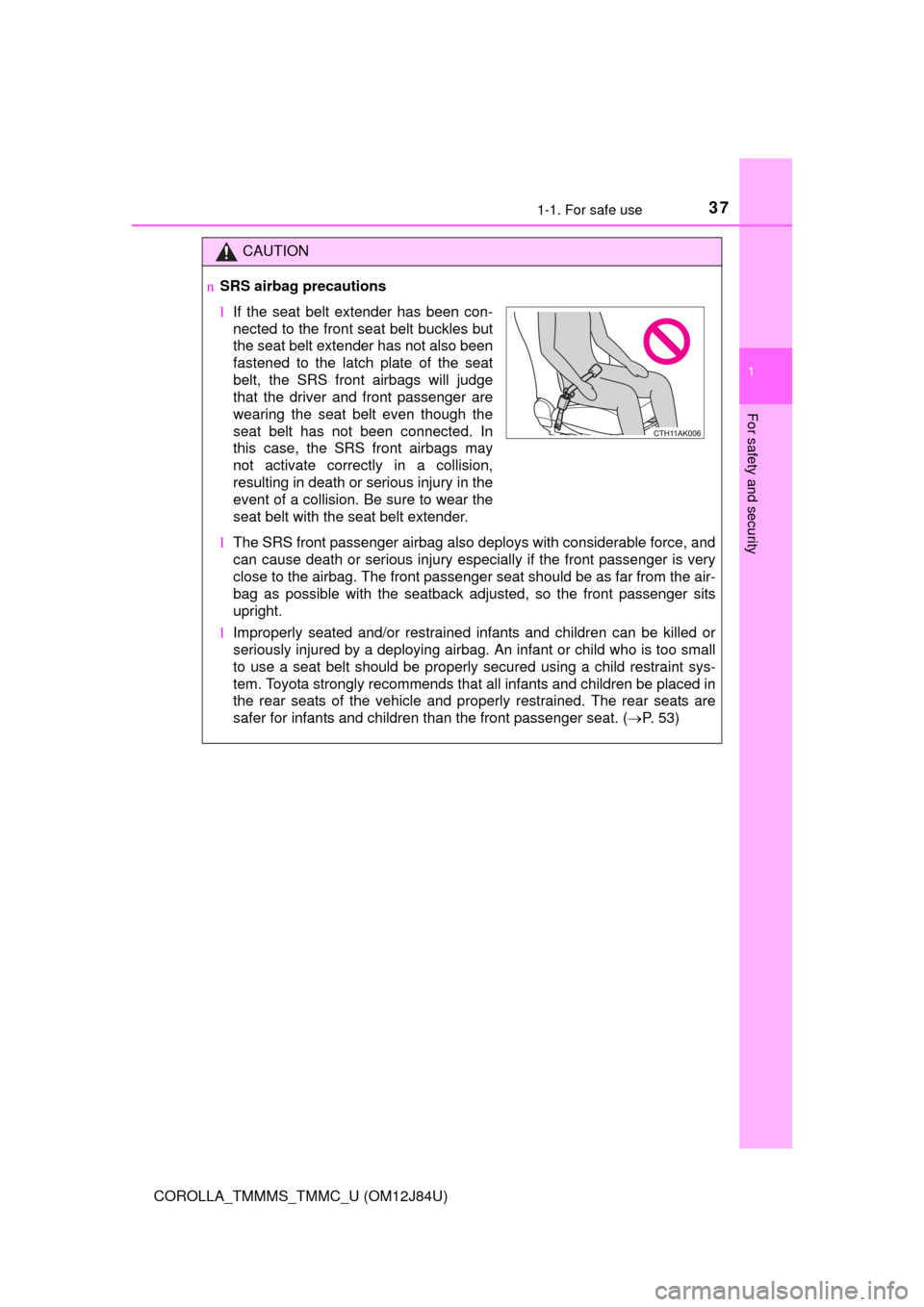
lIf the seat belt extender has been con-
nected to the front seat belt buckles but
the seat belt extender has not also been
fastened to the latch plate of the seat
belt, the SRS front airbags will judge
that the driver and front passenger are
wearing the seat belt even though the
seat belt has not been connected. In
this case, the SRS front airbags may
not activate correctly in a collision,
resulting in death or serious injury in the
event of a collision. Be sure to wear the
seat belt with the seat belt extender.
Page 40 of 620
401-1. For safe use
COROLLA_TMMMS_TMMC_U (OM12J84U)
CAUTION
nSRS airbag precautions
lIf a vinyl cover is put on the area where the SRS driver’s knee airbag will
deploy, be sure to remove it.
l Do not use seat accessories which cover the parts where the SRS side
airbags and SRS seat cushion airbag inflate as they may interfere with
inflation of the SRS airbags. Such accessories may prevent the side air-
bags and seat cushion airbag from activating correctly, disable the system
or cause the side airbags and seat cushion airbag to inflate accidentally,
resulting in death or serious injury.
l Do not strike or apply significant levels of force to the area of the SRS air-
bag components.
Doing so can cause the SRS airbags to malfunction.
l Do not touch any of the component parts immediately after the SRS air-
bags have deployed (inflated) as they may be hot.
l If breathing becomes difficult after the SRS airbags have deployed, open a
door or window to allow fresh air in, or leave the vehicle if it is safe to do
so. Wash off any residue as soon as possible to prevent skin irritation.
l If the areas where the SRS airbags are stored, such as the steering wheel
pad and front and rear pillars garnishes, are damaged or cracked, have
them replaced by your Toyota dealer.
l Do not place anything, such as a cushion, on the front passenger's seat.
Doing so will disperse the passenger's weight, which prevents the sensor
from detecting the passenger's weight properly. As a result, the SRS front
airbags for the front passenger may not deploy in the event of a collision.
n Modification and disposal of SRS airbag system components
Do not dispose of your vehicle or per form any of the following modifications
without consulting your Toyota dealer. The SRS airbags may malfunction or
deploy (inflate) accidentally, causing death or serious injury.
l Installation, removal, disassembly and repair of the SRS airbags
l Repairs, modifications, removal or replacement of the steering wheel,
instrument panel, dashboard, seats or seat upholstery, front, side and rear
pillars or roof side rails
l Repairs or modifications of the front fender, front bumper, or side of the
occupant compartment
l Installation of a grille guard (bull bars, kangaroo bar, etc.), snow plows,
winches
l Modifications to the vehicle’s suspension system
l Installation of electronic devices such as mobile two-way radios and CD
players
l Modifications to your vehicle for a person with a physical disability
Page 41 of 620
411-1. For safe use
1
For safety and security
COROLLA_TMMMS_TMMC_U (OM12J84U)
nIf the SRS airbags deploy (inflate)
lBruising and slight abrasions may result from contact with a deploying
(inflating) SRS airbag.
l A loud noise and white powder will be emitted.
l Parts of the airbag module (steering wheel hub, airbag cover and inflator) as
well as the front seats, parts of the front and rear pillars, and roof side rails,
may be hot for several minutes. The airbag itself may also be hot.
l The windshield may crack.
n SRS airbag deployment conditions (SRS front airbags)
lThe SRS front airbags will deploy in the event of an impact that exceeds the
set threshold level (the level of force corresponding to an approximately 12 -
18 mph [20 - 30 km/h] frontal collision wi th a fixed wall that does not move or
deform).
However, this threshold velocity will be considerably higher in the following
situations:
• If the vehicle strikes an object, such as a parked vehicle or sign pole, which can move or deform on impact
• If the vehicle is involved in an underride collision, such as a collision in
which the front of the vehicle “underrides”, or goes under, the bed of a
truck
l Depending on the type of collision, it is possible that only the seat belt pre-
tensioners will activate.
l The SRS front airbags for the front pass enger will not activate if there is no
passenger sitting in the front passenger seat. However, the SRS front air-
bags for the front passenger may deploy if luggage is put in the seat, even if
the seat is unoccupied.
l The SRS seat cushion airbag on the front seats will not operate if the occu-
pant is not wearing a seat belt.
n SRS airbag deployment conditions (SRS side and curtain shield airbags)
l The SRS side and curtain shield airbags will deploy in the event of an
impact that exceeds the set threshold level (the level of force corresponding
to the impact force produced by an approximately 3300 lb. [1500 kg] vehicle
colliding with the vehicle cabin from a direction perpendicular to the vehicle
orientation at an approximate speed of 12 - 18 mph [20 - 30 km/h]).
l The SRS side and curtain shield airbags may also deploy in the event of a
severe frontal collision.
Page 49 of 620
491-1. For safe use
1
For safety and security
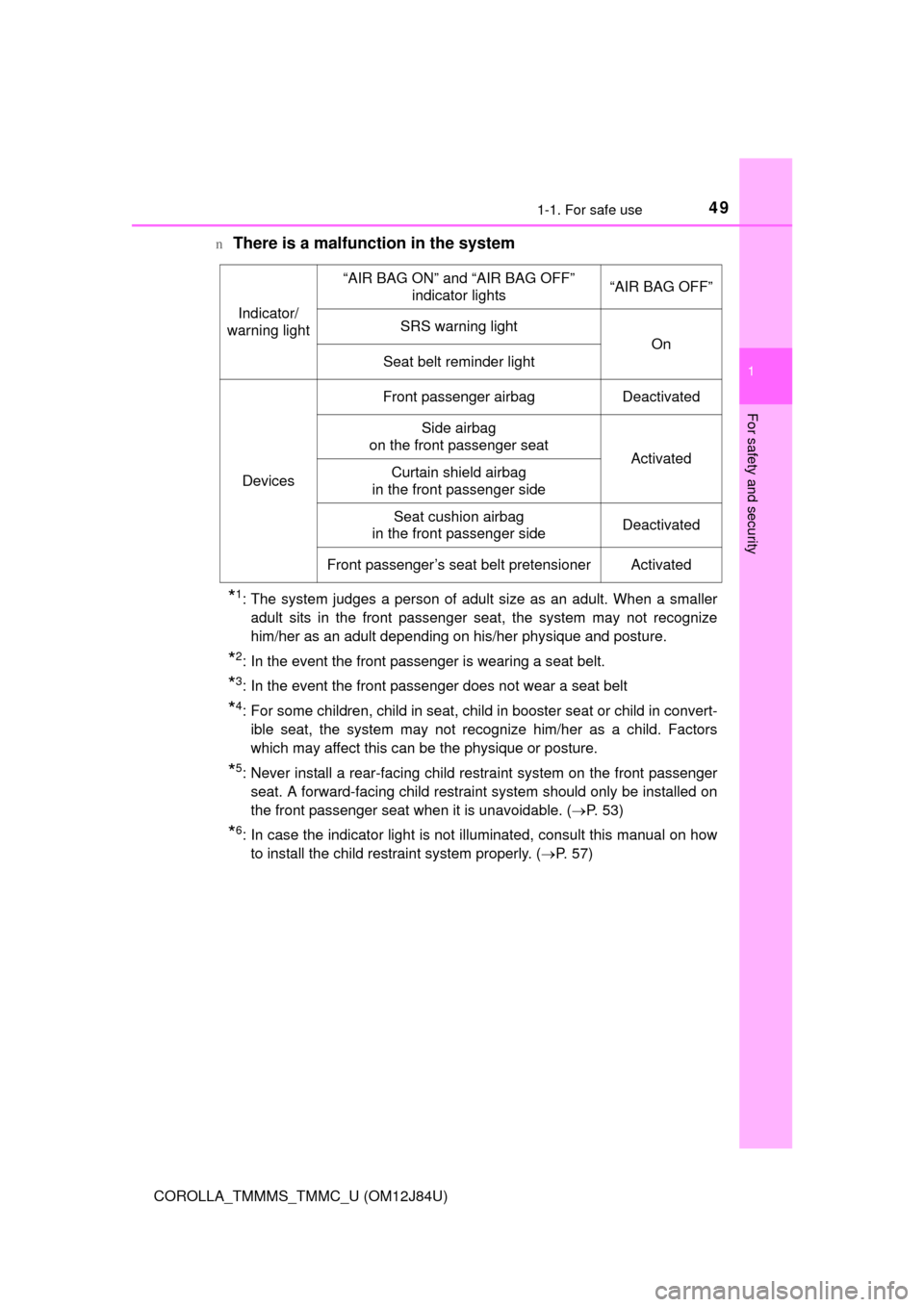
COROLLA_TMMMS_TMMC_U (OM12J84U)n
There is a malfunction in the system
*1: The system judges a person of adult size as an adult. When a smaller
adult sits in the front passenger seat, the system may not recognize
him/her as an adult depending on his/her physique and posture.
*2: In the event the front passenger is wearing a seat belt.
*3: In the event the front passenger does not wear a seat belt
*4: For some children, child in seat, child in booster seat or child in convert-ible seat, the system may not recognize him/her as a child. Factors
which may affect this can be the physique or posture.
*5: Never install a rear-facing child restraint system on the front passengerseat. A forward-facing child restraint system should only be installed on
the front passenger seat when it is unavoidable. ( P. 53)
*6: In case the indicator light is not illuminated, consult this manual on how
to install the child restraint system properly. ( P. 57)
Indicator/
warning light
“AIR BAG ON” and “AIR BAG OFF” indicator lights“AIR BAG OFF”
SRS warning light
On
Seat belt reminder light
Devices
Front passenger airbagDeactivated
Side airbag
on the front passenger seat
ActivatedCurtain shield airbag
in the front passenger side
Seat cushion airbag
in the front passenger sideDeactivated
Front passenger’s seat belt pretensionerActivated