instrument panel TOYOTA COROLLA 2019 Owners Manual (in English)
[x] Cancel search | Manufacturer: TOYOTA, Model Year: 2019, Model line: COROLLA, Model: TOYOTA COROLLA 2019Pages: 608, PDF Size: 10.15 MB
Page 16 of 608
16Pictorial index
COROLLA_TMMMS_TMMC_U
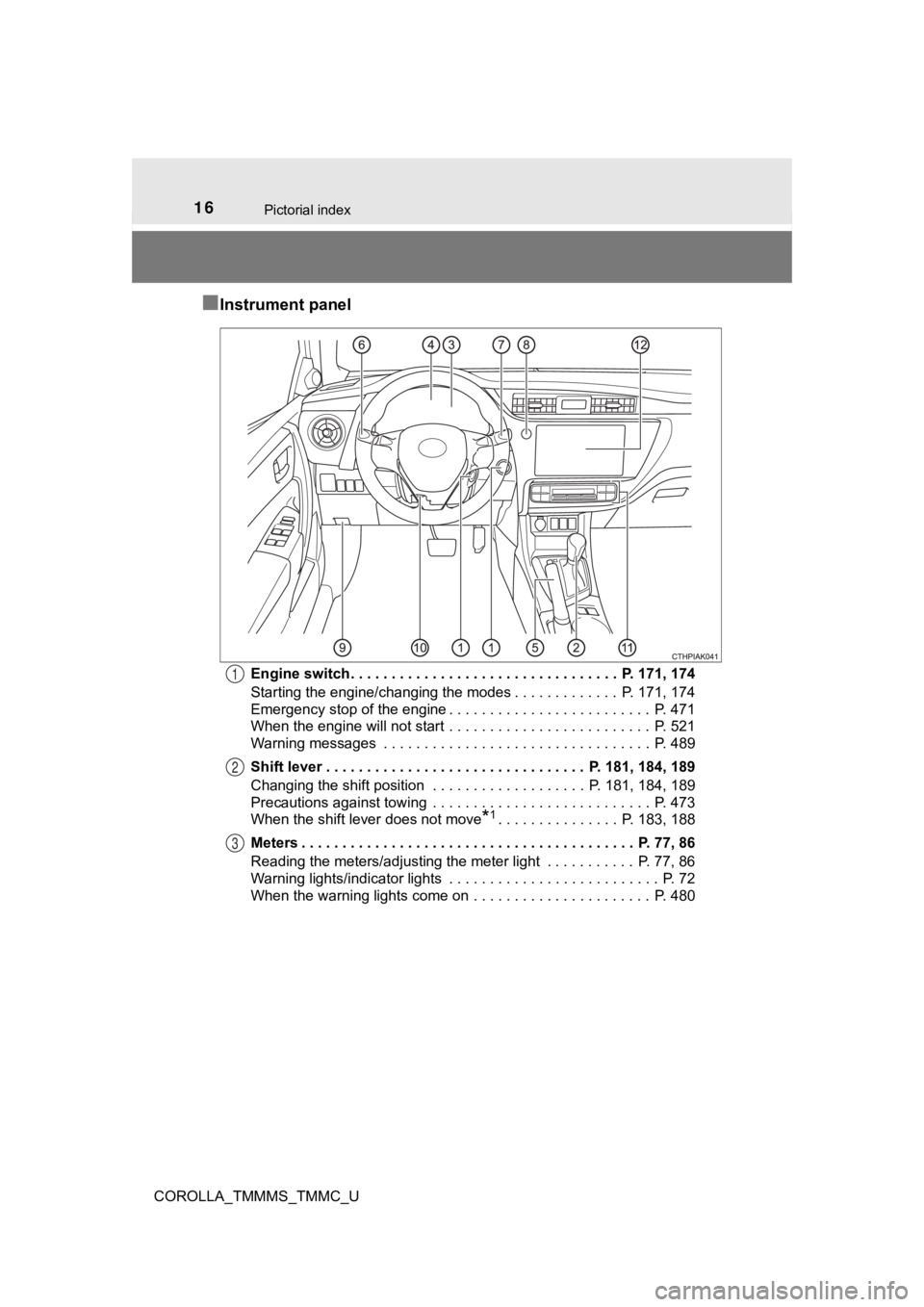
■Instrument panel
Engine switch . . . . . . . . . . . . . . . . . . . . . . . . . . . . . . . . . P. 171, 174
Starting the engine/changing the modes . . . . . . . . . . . . . P. 171, 174
Emergency stop of the engine . . . . . . . . . . . . . . . . . . . . . . . . . P. 471
When the engine will not start . . . . . . . . . . . . . . . . . . . . . . . . . P. 521
Warning messages . . . . . . . . . . . . . . . . . . . . . . . . . . . . . . . . . P. 489
Shift lever . . . . . . . . . . . . . . . . . . . . . . . . . . . . . . . . P. 181, 184, 189
Changing the shift position . . . . . . . . . . . . . . . . . . . P. 181, 184, 189
Precautions against towing . . . . . . . . . . . . . . . . . . . . . . . . . . . P. 473
When the shift lever does not move
*1. . . . . . . . . . . . . . . P. 183, 188
Meters . . . . . . . . . . . . . . . . . . . . . . . . . . . . . . . . . . . . . . . . . P. 77, 86
Reading the meters/adjusting the meter light . . . . . . . . . . . P. 77, 86
Warning lights/indicator lights . . . . . . . . . . . . . . . . . . . . . . . . . . P. 72
When the warning lights come on . . . . . . . . . . . . . . . . . . . . . . P. 480
1
2
3
Page 18 of 608
18Pictorial index
COROLLA_TMMMS_TMMC_U
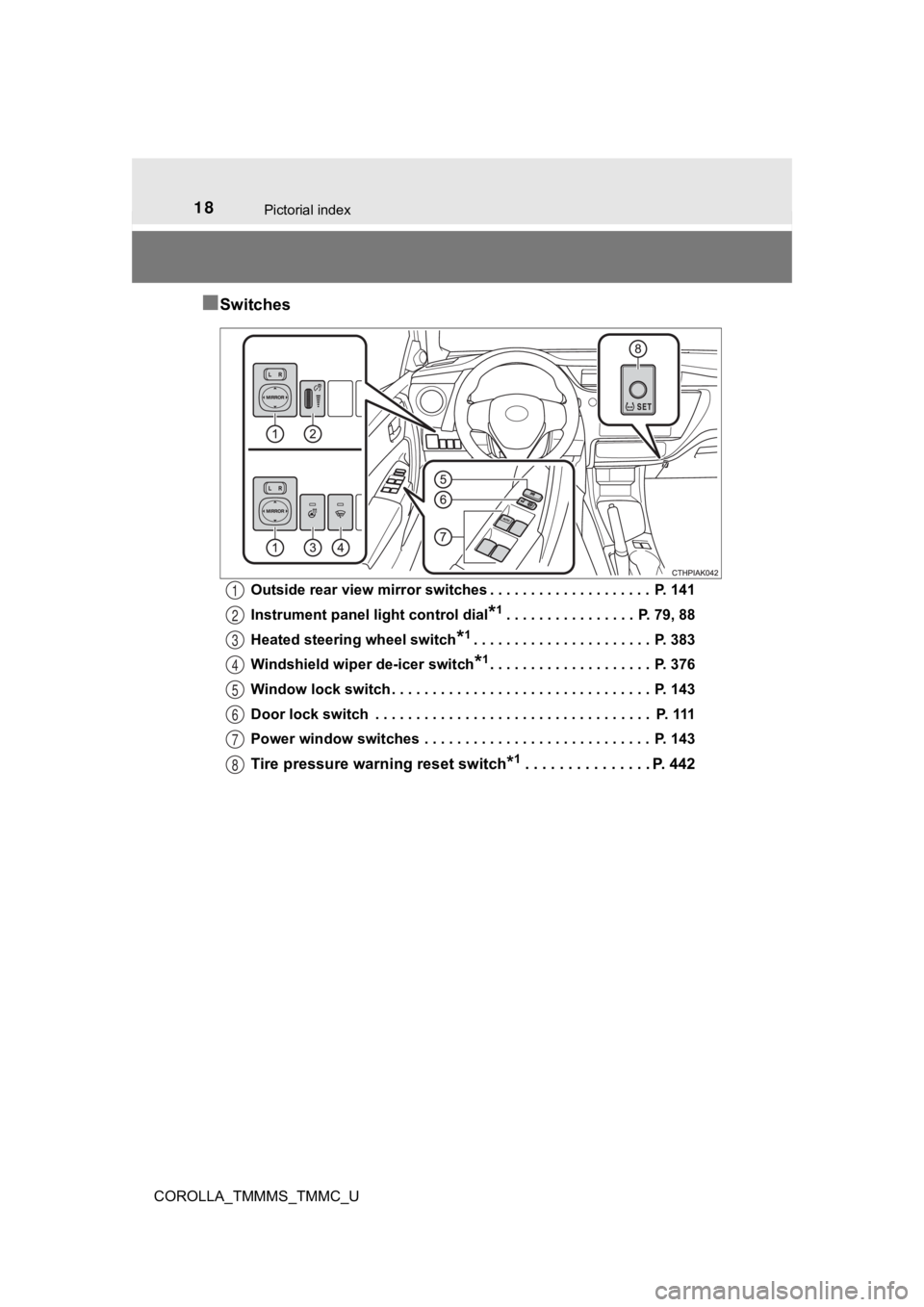
■Switches
Outside rear view mirror switches . . . . . . . . . . . . . . . . . . . . P. 141
Instrument panel light control dial
*1. . . . . . . . . . . . . . . . P. 79, 88
Heated steering wheel switch
*1. . . . . . . . . . . . . . . . . . . . . . P. 383
Windshield wiper de-icer switch
*1. . . . . . . . . . . . . . . . . . . . P. 376
Window lock switch . . . . . . . . . . . . . . . . . . . . . . . . . . . . . . . . P. 143
Door lock switch . . . . . . . . . . . . . . . . . . . . . . . . . . . . . . . . . . P. 111
Power window switches . . . . . . . . . . . . . . . . . . . . . . . . . . . . P. 143
Tire pressure warn ing reset switch*1. . . . . . . . . . . . . . . P. 442
1
2
3
4
5
6
7
8
Page 37 of 608

371-1. For safe use
1
For safety and security
COROLLA_TMMMS_TMMC_U
Your vehicle is equipped with ADVANCED AIRBAGS designed based
on the US motor vehicle safety standards (FMVSS208). The airbag
sensor assembly (ECU) controls airbag deployment based on infor-
mation obtained from the sensors etc. shown in the system compo -
nents diagram above. This informat ion includes crash severity and
occupant information. As the airbags deploy, a chemical reactio n in
the inflators quickly fills the airbags with non-toxic gas to h elp restrain
the motion of t he occupants.
WARNING
■SRS airbag precautions
Observe the following precautions regarding the SRS airbags.
Failure to do so may cause death or serious injury.
● The driver and all passengers in the vehicle must wear their se at belts
properly.
The SRS airbags are supplemental devices to be used with the se at belts.
● The SRS driver airbag deploys with considerable force, and can cause
death or serious injury especially if the driver is very close to the airbag.
The National Highway Traffic Safety Administration (NHTSA) advi ses:
Since the risk zone for the driver’s airbag is the first 2 - 3 in. (50 - 75 mm)
of inflation, placing yourself 10 in. (250 mm) from your driver airbag pro-
vides you with a clear margin of safety. This distance is measured from
the center of the steering wheel to your breastbone. If you sit less than 10
in. (250 mm) away now, you can change your driving position in several
ways:
• Move your seat to the rear as far as you can while still reach ing the ped-
als comfortably.
• Slightly recline the back of the seat.
Although vehicle designs vary, many drivers can achieve the 10 in. (250
mm) distance, even with the driver seat all the way forward, si mply by
reclining the back of the seat somewhat. If reclining the back of your
seat makes it hard to see the road, raise yourself by using a f irm, non-
slippery cushion, or raise the seat if your vehicle has that feature.
• If your steering wheel is adjustable, tilt it downward. This points the air-
bag toward your chest instead of your head and neck.
The seat should be adjusted as recommended by NHTSA above, whil e
still maintaining control of the foot pedals, steering wheel, and your view
of the instrument panel controls.
Page 40 of 608
401-1. For safe use
COROLLA_TMMMS_TMMC_U
WARNING
■SRS airbag precautions
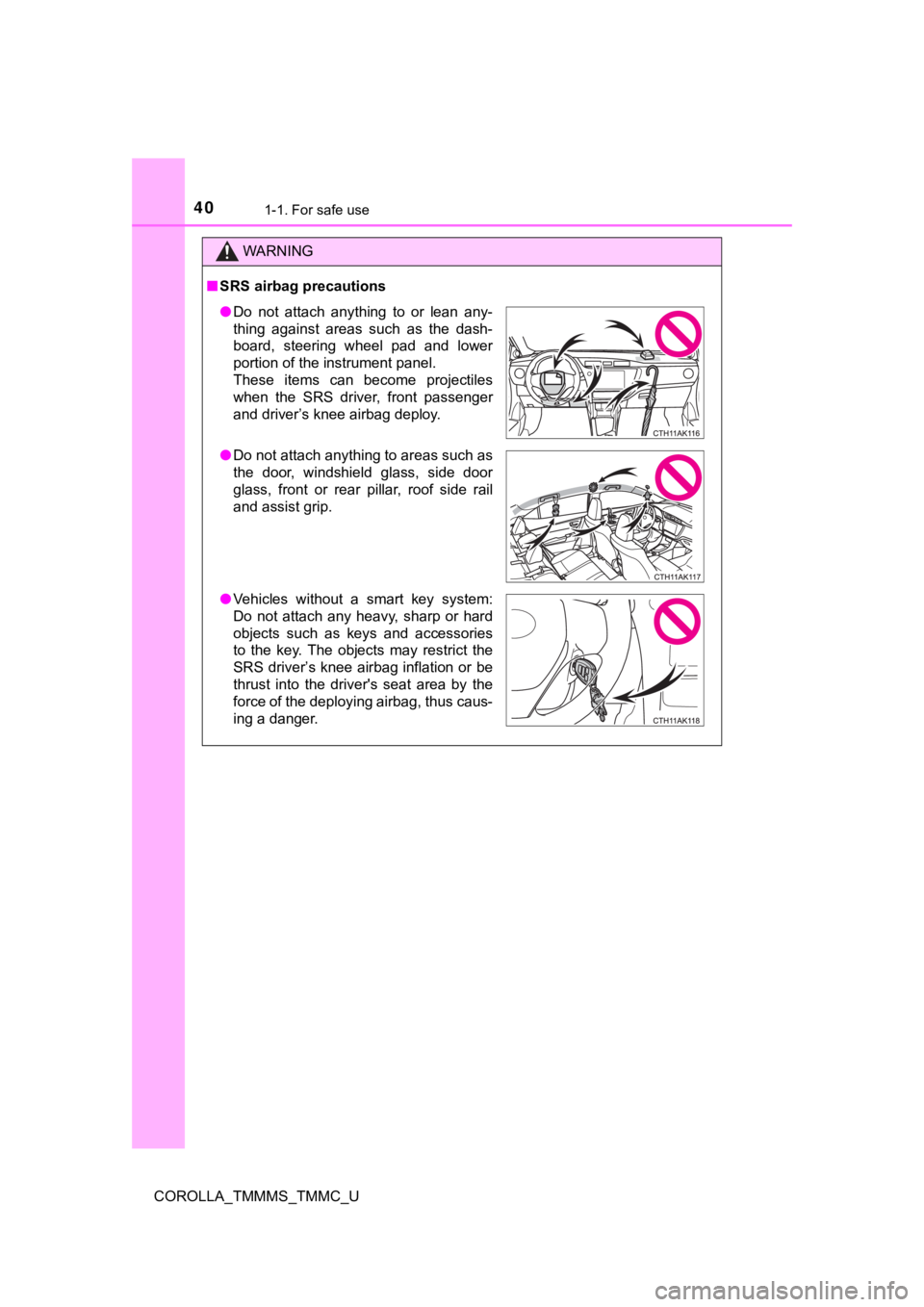
● Do not attach anything to or lean any-
thing against areas such as the dash-
board, steering wheel pad and lower
portion of the instrument panel.
These items can become projectiles
when the SRS driver, front passenger
and driver’s knee airbag deploy.
● Do not attach anything to areas such as
the door, windshield glass, side door
glass, front or rear pillar, roof side rail
and assist grip.
● Vehicles without a smart key system:
Do not attach any heavy, sharp or hard
objects such as keys and accessories
to the key. The objects may restrict the
SRS driver’s knee airbag inflation or be
thrust into the driver's seat area by the
force of the deploying airbag, thus caus-
ing a danger.
Page 41 of 608

411-1. For safe use
1
For safety and security
COROLLA_TMMMS_TMMC_U
WARNING
■SRS airbag precautions
● If a vinyl cover is put on the area where the SRS driver’s knee airbag will
deploy, be sure to remove it.
● Do not use seat accessories which cover the parts where the SRS side
airbags and SRS seat cushion airbag inflate as they may interfe re with
inflation of the SRS airbags. Such accessories may prevent the side air-
bags and seat cushion airbag from activating correctly, disable the system
or cause the side airbags and seat cushion airbag to inflate accidentally,
resulting in death or serious injury.
● Do not strike or apply significant levels of force to the area of the SRS air-
bag components.
Doing so can cause the SRS airbags to malfunction.
● Do not touch any of the component parts immediately after the S RS air-
bags have deployed (inflated) as they may be hot.
● If breathing becomes difficult after the SRS airbags have deplo yed, open a
door or window to allow fresh air in, or leave the vehicle if i t is safe to do
so. Wash off any residue as soon as possible to prevent skin ir ritation.
● If the areas where the SRS airbags are stored, such as the steering wheel
pad and front and rear pillars garnishes, are damaged or cracke d, have
them replaced by your Toyota dealer.
● Do not place anything, such as a cushion, on the front passenge r's seat.
Doing so will disperse the passenger's weight, which prevents t he sensor
from detecting the passenger's weight properly. As a result, th e SRS front
airbags for the front passenger may not deploy in the event of a collision.
■ Modification and disposal of SRS airbag system components
Do not dispose of your vehicle or perform any of the following modifications
without consulting your Toyota dealer. The SRS airbags may malfunction or
deploy (inflate) accidentally, causing death or serious injury.
● Installation, removal, disassembly and repair of the SRS airbag s
● Repairs, modifications, removal or replacement of the steering wheel,
instrument panel, dashboard, seats or seat upholstery, front, s ide and rear
pillars or roof side rails
● Repairs or modifications of the front fender, front bumper, or side of the
occupant compartment
● Installation of a grille guard (bull bars, kangaroo bar, etc.), snow plows,
winches or roof luggage carrier
● Modifications to the vehicle’s suspension system
● Installation of electronic devices such as mobile two-way radio s and CD
players
● Modifications to your vehicle for a person with a physical disa bility
Page 45 of 608
451-1. For safe use
1
For safety and security
COROLLA_TMMMS_TMMC_U■
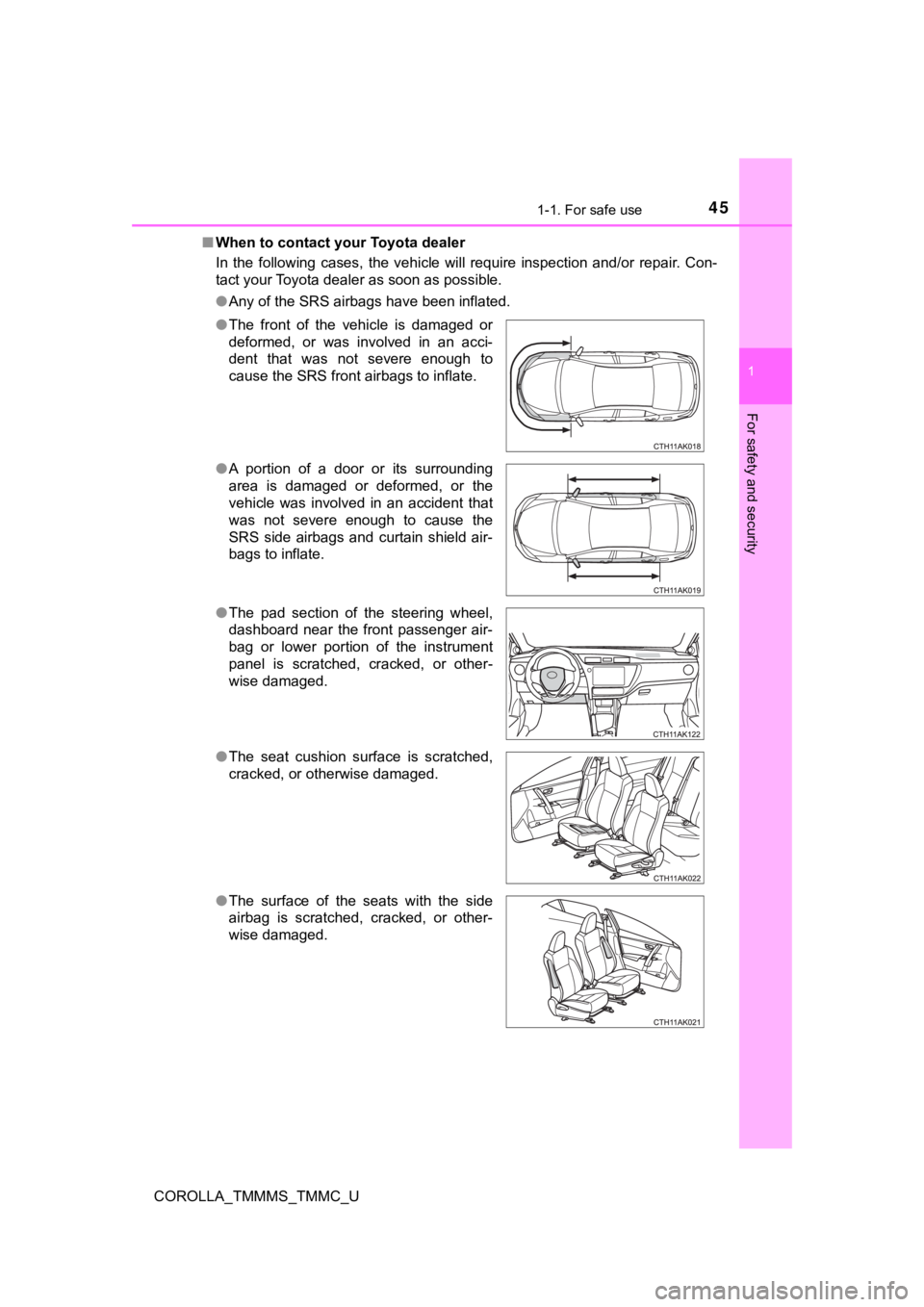
When to contact your Toyota dealer
In the following cases, the vehicle will require inspection and/or repair. Con-
tact your Toyota dealer as soon as possible.
●Any of the SRS airbags have been inflated.
● The front of the vehicle is damaged or
deformed, or was involved in an acci-
dent that was not severe enough to
cause the SRS front airbags to inflate.
● A portion of a door or its surrounding
area is damaged or deformed, or the
vehicle was involved in an accident that
was not severe enough to cause the
SRS side airbags and curtain shield air-
bags to inflate.
● The pad section of the steering wheel,
dashboard near the front passenger air-
bag or lower portion of the instrument
panel is scratched, cracked, or other-
wise damaged.
● The seat cushion surface is scratched,
cracked, or otherwise damaged.
● The surface of the seats with the side
airbag is scratched, cracked, or other-
wise damaged.
Page 72 of 608
72
COROLLA_TMMMS_TMMC_U
2. Instrument cluster
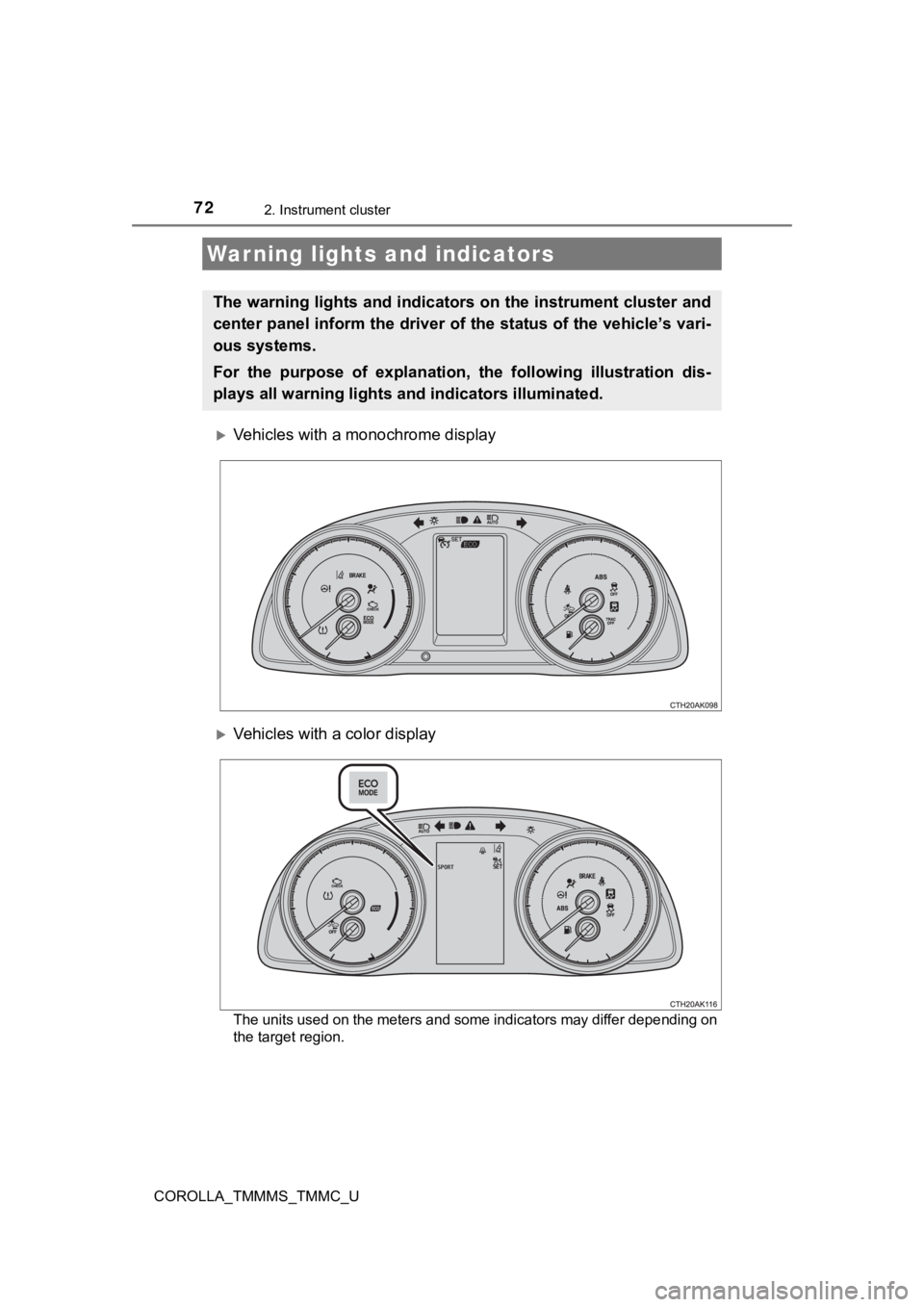
Vehicles with a monochrome display
Vehicles with a color display
The units used on the meters and some indicators may differ depending on
the target region.
Warning lights and indicators
The warning lights and indicators on the instrument cluster and
center panel inform the driver of the status of the vehicle’s vari-
ous systems.
For the purpose of explanation, t he following illustration dis-
plays all warning lights a nd indicators illuminated.
Page 74 of 608

742. Instrument cluster
COROLLA_TMMMS_TMMC_U
*1: These lights turn on when the engine switch is turned to the “ON” position
(vehicles without a smart key system) or the engine switch is turned to
IGNITION ON mode (vehicles with a smart key system), to indicat e that a
system check is being performed. They will turn off after the engine is
started, or after a few seconds. There may be a malfunction in a system if
a light does not come on, or turn off. Have the vehicle inspect ed by your
Toyota dealer.
*2: If equipped
*3: This light illuminates on the center panel.
*4: The light flashes to indicate a malfunction.
Page 76 of 608

762. Instrument cluster
COROLLA_TMMMS_TMMC_U
*1: These lights, except those shown on the multi-information display, turn on
when the engine switch is turned to the “ON” position (vehicles without a
smart key system) or the engine switch is turned to IGNITION ON mode
(vehicles with a smart key system) to indicate that a system ch eck is being
performed. They will turn off after the engine is started, or a fter a few sec-
onds. There may be a malfunction in a system if a light does not come on,
or turn off. Have the vehicle inspected by your Toyota dealer.
*2: If equipped
*3: The light flashes to indicate that the system is operating.
*4: The light does not turn on when the system is disabled.
*5: This light illuminates on the center panel.
*6: The light turns on when the system is off.
*7: When the outside temperature is approximately 37°F (3°C) or lo wer, the
indicator will flash 10 times, then stay on.
*5
Security indicator
( P. 67, 69)*2, 7
Low outside tempera-
ture indicator ( P. 86)
WARNING
■If a safety system warning light does not come on
Should a safety system light such as the ABS and SRS warning lights not
come on when you start the engine, this could mean that these s ystems are
not available to help protect you in an accident, which could r esult in death
or serious injury. Have the vehicle inspected by your Toyota de aler immedi-
ately if this occurs.
Page 77 of 608
772. Instrument cluster
2
Instrument cluster
COROLLA_TMMMS_TMMC_U
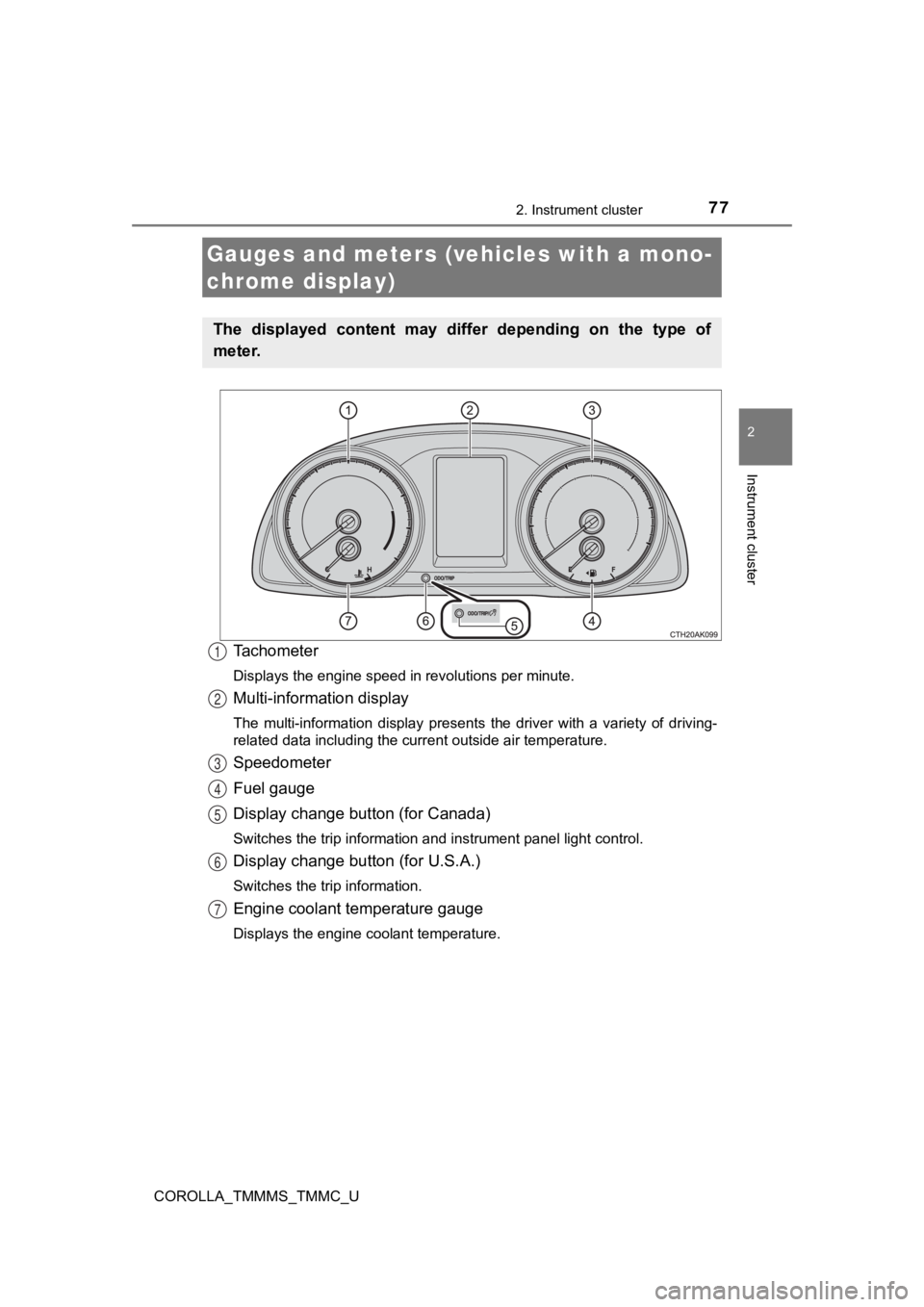
Tachometer
Displays the engine speed in revolutions per minute.
Multi-information display
The multi-information display presents the driver with a variety of driving-
related data including the current outside air temperature.
Speedometer
Fuel gauge
Display change button (for Canada)
Switches the trip information and instrument panel light contro l.
Display change button (for U.S.A.)
Switches the trip information.
Engine coolant temperature gauge
Displays the engine coolant temperature.
Gauges and meters (vehicles with a mono-
chrome display)
The displayed content may differ depending on the type of
meter.
1
2
3
4
5
6
7